

What do you think?

Osprey Warrior #153
Bronze Age Greek Warrior 1600–1100 BC
Osprey's survey of Greek warriors of the period of the Bronze Age from 1600 to 1100 BC. More than a century has passed past since German archeologist Heinrich Schliemann discovered the treasures of Bronze Age Mycenae. The richly decorated artifacts of the entombed warriors, whose bodies still lay in their graves, confirmed that Homer's epic The Iliad was based upon true events, and that the Achaeans described in his poems probably did exist.
Through a combined study of the mythical tradition, archeological findings, and written sources, this fascinating addition to the Warrior series explores the evolution of warfare in the Bronze Age Greek world. Covering weaponry, clothing, helmets, and body armor, it provides a richly illustrated guide to the warriors who have shone from the pages of Homer's poem for almost three millennia.
Through a combined study of the mythical tradition, archeological findings, and written sources, this fascinating addition to the Warrior series explores the evolution of warfare in the Bronze Age Greek world. Covering weaponry, clothing, helmets, and body armor, it provides a richly illustrated guide to the warriors who have shone from the pages of Homer's poem for almost three millennia.
64 pages, Paperback
First published March 22, 2011
Ratings & Reviews
Friends & Following
Create a free account to discover what your friends think of this book!
Community Reviews
Displaying 1 - 4 of 4 reviews
August 5, 2026
Authentic Iliad & Odyssey Era Armour
A review of the Osprey Publishing paperback (March 22, 2011).
This is a complete sidetrack from my usual book reviews, but I was curious to learn something about what supposed authentic Bronze Age Greek armour would have looked like. This was prompted by the cries of inauthenticity by various critics about the dialogue, the casting and the costuming in the recent film The Odyssey (2026) by director Christopher Nolan.
Most film adaptations of The Iliad and The Odyssey set the clothing and armour in the recognizable Archaic Greek era when they are estimated to have been composed c. 800 - 480 BC. The events in those epics themselves are imagined as being from the Bronze Age Mycenaean Greek era c. 1750 to 1050 BC.
Nolan's adaptation does take further liberties on the costuming, but I think mostly only with the Darth Vader-esque shiny black armour of his Agamemnon and the steel-like plated armour of his Laestrygonians.
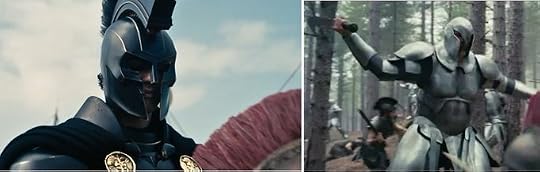
Screenshots from the Christopher Nolan film "The Odyssey." Image sourced from my own collage created at X.
In any case, using authentic Bronze Age Mycenaean armour in any modern day adaptation would have made it quite unrecognizable to audiences. Everything from the unwieldy looking skirted armour to the boar's tusk helmets would have seemed very unfamiliar. It was interesting to note in the Wikipedia article linked from the boar's tusk helmet image below that it is actually mentioned in Book 10 of The Iliad that Odysseus wore such a helmet at one point. D'Amato notes in this book that it would have required the tusks of 20 to 40 boars to make this type of helmet.
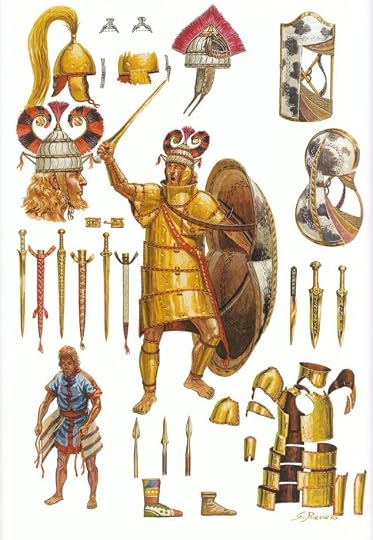
Achaean Warrior 1500 BC, illustration by Giuseppe Rava. Original image from page 29 in this book, sourced from Pinterest.
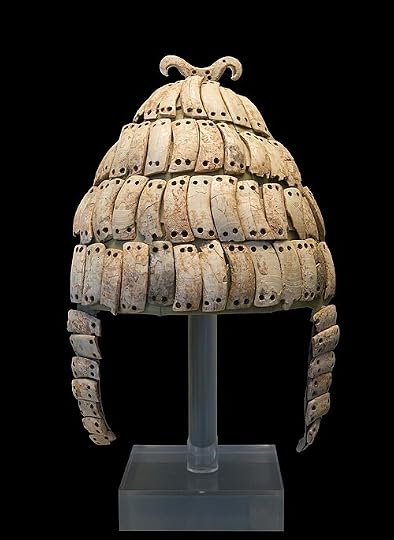
14th Century BC Mycenaean Greek boar tusk helmet . Image sourced from Wikipedia.
Trivia and Links
Osprey Publishing produces various ongoing series related to historical warfare and warriors. The number of volumes are considerable e.g. the Osprey Warrior series currently numbers 178 volumes listed on Goodreads.
I've previously reviewed a few Osprey Publishing volumes that had an Estonian connection i.e. Armies of the Baltic Independence Wars 1918-1920 (Osprey Elite #227 - 2019) and Finnish Soldier vs Soviet Soldier: Winter War 1939-1940 (Osprey Combat #21 -2016). I read one unreviewed from my pre-GR days in Crusader Castles of the Teutonic Knights (2): The Stone Castles of Latvia and Estonia, 1185-1560 (Osprey Fortress #19 - 2004).
A review of the Osprey Publishing paperback (March 22, 2011).
This is a complete sidetrack from my usual book reviews, but I was curious to learn something about what supposed authentic Bronze Age Greek armour would have looked like. This was prompted by the cries of inauthenticity by various critics about the dialogue, the casting and the costuming in the recent film The Odyssey (2026) by director Christopher Nolan.
Most film adaptations of The Iliad and The Odyssey set the clothing and armour in the recognizable Archaic Greek era when they are estimated to have been composed c. 800 - 480 BC. The events in those epics themselves are imagined as being from the Bronze Age Mycenaean Greek era c. 1750 to 1050 BC.
Nolan's adaptation does take further liberties on the costuming, but I think mostly only with the Darth Vader-esque shiny black armour of his Agamemnon and the steel-like plated armour of his Laestrygonians.
Screenshots from the Christopher Nolan film "The Odyssey." Image sourced from my own collage created at X.
In any case, using authentic Bronze Age Mycenaean armour in any modern day adaptation would have made it quite unrecognizable to audiences. Everything from the unwieldy looking skirted armour to the boar's tusk helmets would have seemed very unfamiliar. It was interesting to note in the Wikipedia article linked from the boar's tusk helmet image below that it is actually mentioned in Book 10 of The Iliad that Odysseus wore such a helmet at one point. D'Amato notes in this book that it would have required the tusks of 20 to 40 boars to make this type of helmet.
Achaean Warrior 1500 BC, illustration by Giuseppe Rava. Original image from page 29 in this book, sourced from Pinterest.
14th Century BC Mycenaean Greek boar tusk helmet . Image sourced from Wikipedia.
Trivia and Links
Osprey Publishing produces various ongoing series related to historical warfare and warriors. The number of volumes are considerable e.g. the Osprey Warrior series currently numbers 178 volumes listed on Goodreads.
I've previously reviewed a few Osprey Publishing volumes that had an Estonian connection i.e. Armies of the Baltic Independence Wars 1918-1920 (Osprey Elite #227 - 2019) and Finnish Soldier vs Soviet Soldier: Winter War 1939-1940 (Osprey Combat #21 -2016). I read one unreviewed from my pre-GR days in Crusader Castles of the Teutonic Knights (2): The Stone Castles of Latvia and Estonia, 1185-1560 (Osprey Fortress #19 - 2004).

July 26, 2024
Very detailed information and artwork. The way they reconstruct the warriors in various scenes is superbly creative and very well researched. I was sketching the whole time while reading. This book format is perfect for doing project research, because it cuts straight to the point and only includes what I’m looking for - the subject is so specific.
すごく細かい情報とアート。読む途中よくスケッチしてた。プロジェクトするのためこの本完璧ね。長すぎじゃない、欲しいな情報入ってるしかない
すごく細かい情報とアート。読む途中よくスケッチしてた。プロジェクトするのためこの本完璧ね。長すぎじゃない、欲しいな情報入ってるしかない
July 27, 2018
Poor history background compared to other Osprey books, involves many mistakes in my opinion.

April 3, 2011
The chronology on pages 6-7 lays out the coverage of this slender Osprey volume, as part of the "Warrior" series. It is during this era that the Trojan War would have been fought.
The volume covers military organbization of the time, clothing, werapons and armor, use of chariots, siege warfare, naval warfare, and the life of a warrior. The book concludes by examining the warrior in battle and war campaigns. The latter includes discussion of Greek warriors from Thebes and elsewhere in Troy and Anatolia.
A nice introduction to this long gone era.
The volume covers military organbization of the time, clothing, werapons and armor, use of chariots, siege warfare, naval warfare, and the life of a warrior. The book concludes by examining the warrior in battle and war campaigns. The latter includes discussion of Greek warriors from Thebes and elsewhere in Troy and Anatolia.
A nice introduction to this long gone era.
Displaying 1 - 4 of 4 reviews