Praised for its straightforward and accessible style, this text provides a general introduction to the chief elements in Middle Eastern history, allowing readers to proceed into more specialized topics and themes with a solid understanding of the most current scholarship in the field.
In The Middle East: A History, Ochsenwald and Fisher produced a book that successfully tackles the vast and complex subject of Middle Eastern History. Both the format and style are geared for the busy college student, making it a relatively easy read. The authors did not sacrifice knowledge, however, and after reading the book, a comprehensive understanding of the Middle East, its problems, triumphs and remaining obstacles will be gained. The region has experienced some of the greatest fluctuations in fortune known to man. Parts I & II cover the rise of Islam with particular focus on the great Ottoman and Safavid Empires. Once upon a time Crusaders stood in awe of the dazzling intellectual and material advances of the culture they encountered in the region. By the 19th century, however, the Middle East found itself inferior to Europe in many areas; technology, military power, economic and political development and more. This widening gap between Europe and the Middle East is described in detail in Part III. The desperate attempt to cope with European encroachment is dealt with. These efforts are described as largely unsuccessful as the Ottoman Empire gradually shrank in size and power, Egypt succumbed to British domination and Iran melted away like a “lump of sugar in a glass of water.” The emergence of a Middle East free from foreign control after two world wars is the next topic. Finally, in part IV developments over the last century are treated. The authors maintain a very factual, balanced and objective treatment of events and personalities. For example, in the evaluation of Reza Shah the authors go back and forth five times between the negative and positive aspects of his rule until the reader is able to view his achievements with a balanced, fair and discerning eye. In another instance, European attempts to profit and take advantage of conditions are remarked on, while at the same time encouraging and positive changes initiated or influenced by Europeans are described. For example, on page 289 Ismail’s thorough ‘Europeanization” resulted in a determined effort to end the slave trade in the Sudan. Reformers faced a daunting series of obstacles. Constant diplomatic and military crises and pressures from European imperial ambitions often made reform difficult for the Ottomans (294). Strong-willed reformers such as Mahmud II possessed the best of intentions but often their reforms never went beyond a declaration. For example he declared compulsory education but never found the means to carry out this goal (276). As the authors note on page 308, “Decreeing reforms in Istanbul was one thing, but executing the changes throughout the enormous empire was another.” A lack of trained personnel is an additional factor; “To make the reforms work, both in the central government and in the provinces, required the commitment of more people that were available” (301). Constant opposition to reform by the ulama was another element in slowing or derailing reform efforts (276). Conservative power centers such as the janissaries and ulama often had to be broken before progress could go further. Other important themes in the book are is the emergence of nationalism and the clash between secularism and religion/tradition. In a region as intensely religious as the Middle East this is an inescapable fact. Kemal Ataturk's secularizing regime and the 1979 Revolution are but two instances. The issue of the status of women arose as a vigorously-debated topic in late Nineteenth Century Egypt. The technical and political superiority of Europe was, some argued, in some measure due to the widespread education of women. Progress was slow, however, and the first government-run primary school was only opened in 1917. These issues are still being worked out in the Middle East. The problem of how to cover such a broad topic without skipping vital details is a difficult task. Because European involvement is discusses in terms of a peripheral force intruding upon the central focus of the Middle East, it is to be expected that Europeans will not receive the same thorough treatment. For all that, it is important to avoid at least leaving the reader with unbalanced notions of European interventionism. On page 378, for example, the events leading up to the Balfour Declaration are discussed. The vital Jewish contribution to the British war effort, such as Chaim Weizman’s development of acetone production for the Royal Navy, deserved at least a mention as an important, if indirect cause moving Britain towards the declaration. Only brief paragraphs are given to the actual explanation of Zionism. Given the underpinning role of Zionism in the on-going Middle East crisis, this brevity is inexplicable. Another example is on page 343 in which the Anglo-Egyptian reconquest of the Sudan in 1898 is discussed. The action is treated solely as a move on the chess board of imperial ambitions e.g. the Italian conquest of Eritrea and the French penetration of the upper Nile trigging Ten Downing Street into a response. They do not mention the pressure brought by the British public’s outrage over the slaying of Charles George Gordon and lurid accounts of Mahdist brutality that appeared in written form. Although such brevity is unavoidable in such an overview, it is a pity that the reader is left with a view bereft of the moral dimensions that underlay much European enterprises which had come to play a role by the Victorian era. As to the Middle East itself the reviewer was unclear about the reasons behind the 1960 military coup in Turkey. Going only by the information in the text, the following reasons for the Turkish military takeover and subsequent execution of Prime Minister Adnan Menderes are given; 1. An economic downturn, 2. ‘Vocal’ opposition to the Democrat government among the urban class and 3. Mendere’s indifferent attitude towards this opposition. These facts seem hardly serious enough to take over a government and hang a Prime Minister. On further research this reviewer discovered that the crimes Menderes and others were accused of included high treason and that the tension in Turkish society was viewed as threatening to lead to civil war. The text does not give the impression of such an extreme crisis. Despite what are probably unavoidable gaps, this fine work is highly recommended by anyone needing or wishing to gain a solid grasp of the essential events and developments of Middle Eastern history.
"Muslims have been 'fundamentalists' throughout their history, with a continuing strong emphasis on the Quran and the earliest period of Islamic experience in the seventh century." - William Ochsenwald
Best History of Islam I have been exposed to yet. I read the first half and hope to finnish it some day. But for now I would like to still give it a high reveiw and put it aside.
This is a long and trying read, much like reading a classroom textbook from cover to cover, but the journey is well worth the effort. This book presents a well-organized and digestible overview of Middle Eastern history and should realistically be read by everyone with a desire for understanding contemporary interactions among the world’s contentious people groups. This book is complete with many wonderful maps that assist the reader in geographical orientation in both the modern and ancient world.
Modern social conflicts in the Mid-East can never be resolved without a knowledge of the past, as is conveyed in this comprehensive work. This book has left me with serious concern for the extent to which the news media in the U.S. fails to present mid-eastern news events within a proper historical context, never alluding to the catalysts of western exploitation, of which the majority of U.S. citizens are entirely ignorant.
Clearly, western exploitation has fueled radical Islamization as a way of revolt and protest. Without such domination, mid-eastern countries would certainly have evolved more peaceful cultures. Historically, we can see huge prosperity during the few times that Western and Eastern cultures cooperated, such as in early Ottoman times or during the fusion of the cultures in Spain. Today, the evil of past political exploitation lingers like an inextinguishable virus, awaiting an opportunity to explode in infectious violence, discord, and exacerbations of discontent.
This book is so massive that an in-depth summary is impractical. I shall, however, attempt to review pertinent historical highlights that are useful to remember and end with some lasting impressions.
Geography
Historically, the Middle East includes Egypt, Sudan, Lebanon, Syria, Israel, Jordan, Iraq, Saudi Arabia, Kuwait, Bahrain, Qatar, the United Arab Emirates, Oman, Yemen, Turkey, Iran, Afghanistan, Pakistan, the Balkans, Cyprus, Libya, Tunisia, Algeria, Morocco, and even Spain.
Two river systems are integral to the history of the area: the Nile (the world’s longest river) and the Tigris/Euphrates. The Nile flows from central Africa and Ethiopia, passing through an enormous swamp in Sudan, to carry tons of sediment into Egypt. The Tigris-Euphrates begins in the highlands of Turkey and empties onto the plains of Syria and Kurdistan, before converging upon Baghdad.
Three straits also play major roles in Middle eastern history: the Bab al-Manedeb (the entrance to the Red Sea), the Strait of Hormuz (the entrance to the Persian Gulf), and the Bosphorus (the entrance to the Black Sea). The latter is often called the Hellespont where one of the greatest historical cities, Istanbul (Constantinople), is located.
As the Middle East is the location of the rise of the initial human population, deforestation has denuded most of the land over the past 5000 years. This, in turn, has compromised much of the topsoil. Pollution and diminishing water sources are now major problems.
Antiquity (from the rise of civilization to the coming of Islam)
Civilization began in the Nile valley and along the Tigris and Euphrates (modern day Iraq). The more ancient evidence of civilization is found at Jericho (9000 BCE), Mesopotamia (8900 BCE) and Anatolia (7000 BCE).
Around 3500 BCE the Sumerians established city-states in the Tigris-Euphrates valley and the pharaonic dynasties appeared along the Nile. Around 1750 BCE all of Mesopotamia was unified by Hammurabi of Babylon.
Around 1000 BCE King David made Jerusalem the capital of an expanding Jewish state, perpetuating the establishment of monotheistic faith. In the 6th century BCE, the Persian empire (Zoroastrian Iranians) gained prominence, being checked only by the Greeks in 490 BCE.
In 334 BCE, Alexander the Great conquered all of Anatolia, Syria, Palestine, Egypt, Mesopotamia, Persia and much of India. After his death, his generals divided his empire, with the Ptolemy’s gaining Egypt (who named themselves pharaohs). The Hellenistic age persisted for two centuries until the Nile valley became a Roman province and the Mediterranean became a vast Roman lake.
The Byzantine empire was a continuation of the Roman Empire after the last western emperor in 476 and it lasted 1100 years until it was destroyed by the Ottomans in 1453. However, Byzantine differed from Rome in that it was Christian (orthodox) not pagan and Greek (Hellenistic) not Latin. The Orthodox church strongly opposed Islam.
Byzantine history begins with the era of Constantine and his dedication of the new city of Constantinople in 330. The Byzantine’s initially objected to icons, images and pictures in church services. Large free-standing statues are almost non-existent in the Eastern Orthodox Church. This is partly because cult images of the Greek gods were a focus of the ancient Greek paganism and its Roman equivalent. The debate with western Catholicism over iconoclasm and the jurisdiction of the Pope led the Pope in 1054 to declare the eastern church schismatic. This created a lasting division between western Catholic Europe and the eastern Orthodox Church; and in 1204 Constantinople was sacked by the fourth crusade.
Classical Islamic Period (From Muhammad to the 10th Century)
Muhammad
Muhammad was born in 570. He married a rich widow, 15 years his senior, named Khadijah, but she died in 619, and he inherited her wealth. After her death, Muhammad married several times, having up to nine wives at a time.
Muhammad was driven from Mecca by disbelievers and took up residence with his followers in Medina, where he became a political and social leader. This migration to Medina is called the hijrah. In 630, Muhammad took Mecca and the rapid spread of Islam began. Religion then came to supersede tribal identify as the cohesiveness of the Arab people.
According to Muslim belief, Muhammad underwent a mystical experience wherein he was transported to Jerusalem and from there visited heaven, which made Jerusalem one of the holy places for Muslims. In worship, Muslims pray facing the Kaba (a sanctuary and shrine) in Mecca, make a pilgrimage to Mecca (the hajj), and observe a period of fasting (the month of Ramadan).
The First Caliphs
Muhammad died in 632 leaving no living sons and without clear provision for a successor. The Quran was assembled soon after his death. The Christians of Europe immediately branded Islam as a Christian heresy, a castigation that led to the abhorrence of Muslims. The leadership, or caliphate went in turn to Abu Bakr (Muhammad’s closest friend), Umar, Uthman, and then Ali, in the thirty years following Muhammad’s death.
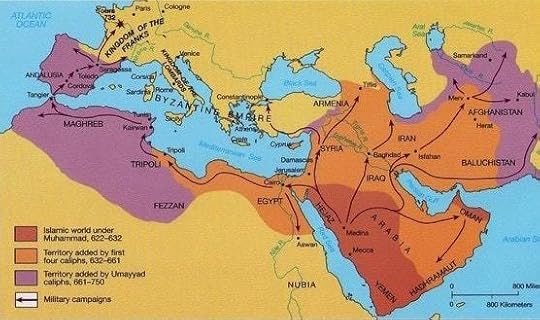
Abu Bakr established Islam throughout Arabia, including Bahrain, Oman and Yemen. In 634, Byzantine armies were defeated near the dead sea, Gaza, and Jerusalem, the year in which Umar ascended to the caliphate. Muslims consider Umar the second founder of Islam. In 636-647, the Byzantine emperor Heraclius lost Syria, Palestine, and Jerusalem to the Muslims. Egypt and Libya fell into Muslim possession in 642. Under Umar’s caliphate, Muslim armies had an unbelievable sweep, conquering what is now Iraq, western Iran, Syria, Palestine and Egypt. Many Hellenistic people left with the defeated Byzantine armies. The Arabs suddenly enjoyed great wealth.
Umar was assassinated in 644 and buried beside Muhammad and Abu Bakr. Uthman followed as caliph from 644 to 657. Under Uthman, a Muslim fleet was developed that repulsed a Byzantine armada in 652 and Muslim armies extended into Khurasan, Armenia, central Asia and Afghanistan.
Political Factions
Three political factions emerged: (1) The party of Muhammad led by less important families in Mecca, of which Abu Bakr and Umar had been members. (2) The Umayyad family that had attacked Muhammad and led campaigns against Muslims in Medina and (3) The Arab soldiers who outnumbered the other two groups but were unorganized. Uthman was murdered and Ali, Muhammad’s cousin and son-in-law became caliphate; however, Muawiyah, the Umayyad governor of Syria, refused to resign or accept Ali as caliph. Ali was assassinated in 661 and Muawiyah became caliph; therefore, the center of the state shifted to Damascus and the Umayyad family.
When the word of the Quran did not appear to give answers, the pious looked to normal practice and custom (sunnah). Believers put together collections of these statements and of deeds of Muhammad, which Sunnis accepted and Shiis often rejected. Medina became a center of these compilations which were called hadith. Important court opinions called fatwa, came to be preserved.
Shiis are partisans of the sect of Ali who rejected the legitimacy of the first 3 caliphs and criticized the Umayyads for the murder of Ali’s son, whose martyrdom became their most fervently celebrated event. The Shiis were usually ruled by the Sunnis. However, today the majority of Muslims in Iran and Iraq are Shiis.
Mysticism entered Islam in the 8th century. A mystical holy man was called a Sufi. By the 12th century, groups of Sufis had formed brotherhoods and by the 14th thousands of Sufism lodges existed. Sufis could be either Sunnis or Shiis, although most were Sunnis
The Umayyads
Muawiyal established a hereditary dynasty which lasted 90 years, until 750. History has depicted the Umayyads as wine-bibbing, luxury-loving, worldly minded usurpers of the caliphate. They were realists who did not always follow the principles of government formulated by the theologians in Medina.
Muawiyah had already driven Byzantine armies from northern Syria and after he became caliph his forces roamed far and wide over Anatolia, but attacks upon Constantinople were unsuccessful. Construction of the Dome of the Rock was initiated in 685 to enshrine the spot from where Muhammad made his nocturnal journey to heaven. Muslim forces raided Libya and the city of Tunis was founded. In 711, Muslim forces crossed the Strait of Gibraltar and defeated the Visigothic Christian forces in Spain. The Arabs called Spain al-Andalusia (“Land of the Vandals”) and maintained a presence there for eight centuries, leaving their indelible mark in the form of Moorish culture. The Arab advance into Europe was turned back by the bloody resistance of the Frankish leader Charles Martel in 732.
The Umayyads also extended eastward to the Indus River, the frontiers of China, Central Asia, Pakistan and Afghanistan. Buddhist temples and monasteries were destroyed. Steady conversion of Buddhists in the northwestern corner of India made the area of Pakistan a part of the Muslim world. However, the Muslims faced strong opposition from the Hindu Indian state and the power of China.
Extent of the Umayyad Empire (661-750)
At this time, ninety percent of the population of the Umayyad Empire was non-Muslim. Muslims considered themselves the leaders of society and marriage with non-Arabs was discouraged. The Muslim minority was enrolled in the imperial registry, not taxed, and received payments from the state treasury. Non-Muslims (Christians, Zoroastrians, Jews, pagan Berbers) were recognized legally as second-class subjects, paid taxes, and could not bear weapons. Arabic became the dominant language of the masses and Islam spread. Slave trading was a legal business. Slaves were acquired as booty in raiding expeditions and were of every race and description.
Eventually, political opposition to the Umayyad’s began to ferment. One source of opposition came from the two grandsons of the Prophet, the children of Ali and Fatimah, Hasan and Husain. Upon the death of Hasan, his brother Husain became the head of the house of Ali, remaining at peace with the Umayyads until Muawiyah’s death, then refusing to recognize his successor, rebelling openly, and being murdered in 680. Both deaths were observed by the Shii sect as martyrs for the faith. The lesser families and clans of Mecca still resented the power that the Umayyad clan possessed, particularly because the Umayyads had opposed Muhammad almost to the very end and Muawiyah’s own father had driven Muhammad from Mecca.
The pomp of the Umayyad court was also a scandal, with its flowing wine, luxurious palaces, singing girls, and practices far removed from the teachings of Muhammad. The Shiis rejected the Umayyad family’s claims to hereditary rule and held the view that power belonged to the family of Muhammad and Ali. In 747, the Abbasids raised the standard of revolt and Abu al-Abbas was recognized as caliph.
The Abbasids (747-944)
The Abbasids were Arabs whose relationship to Muhammad provided their chief claim to legitimacy. The rule of the Abbasid dynasty lasted until the middle of the tenth century. Ruling from Iraq, the dynasty profited from extensive trade with India, China and Central Asia. Trade with Europe was trivial because Europe had little to offer other than furs in exchange for the expensive goods of the Middle East (linen, cotton, silk, wool, paper, glass, ceramics, porcelains, metalwork, dyes, perfume, jewelry, leather, enamelwork, soap,etc.). At that time, Muslim civilization was regarded in Europe as the marvel of the ages. Only slowly would movement of Middle Eastern know-how cross the Mediterranean and Pyrenees.
Situated on the west bank of the Tigris, near a canal connecting with the Euphrates, Baghdad became the hub of the Middle East. The wealth and magnificence of Baghdad became renowned through the tales of the Arabian Nights. In 797 Charlemagne sent a mission to the Abbasids to secure greater safety for Frankish pilgrims to Palestine. The tales and gifts brought back from this mission magnified Baghdad culture as romantic, incredible and fabulous. The learning of the Greco-Romans, the Iranians, and the Hindus was translated into Arabic. Iranians, Berbers, Syrian Christians, Egyptian Copts, Jews, and others began to speak Arabic in their daily lives. Iranian dress, manners and culture spread throughout the empire.
The Abbasids attacked Constantinople twice, but failed to take the city; however, they controlled Egypt. Under the Abbasids, the office of Vizier arose as the alter ego of the caliph. As chief minister, the Vizier’s power was almost unlimited, and the office was frequently filled hereditarily. The Shii followers of Ali were never completely mollified by the Abbasids.
The Umayyads continued to hold sway in Spain and North Africa and maintained a court at Cordoba that rivaled the Abbasids in Baghdad. At its zenith in the 10th century, Cordoba had more than 100,000 inhabitants, 700 mosques and a royal palace containing 400 rooms. The Umayyad governor of Algeria and Tunisia sent fleets to ravage the coasts of Italy and France, seizing Malta, Sicily and Sardina by 835. The great mosque of Qairawan (Kairouan, Qeirwan, al-Qayrawan) in Tunisia became significant as next in importance to Mecca, Medina and Jerusalem.
Shiis steadily attempted to overthrow Abbasid power. An Independent Persian dynasty (Samanid) emerged and was acknowledged by the 10th century. The Persian language began to emerge amidst the Arabic. The authority of the Abbasid caliph began to diminish.
Greek logic was studied during the Umayyad era; however, it was not until the early 9th century that the bulk of Hellenistic thought and science was translated into Arabic. It was upon this base that Muslim philosophy was erected. Muslim scholars, writing in Arabic, had a profound influence on Christian philosophers of medieval Europe. Many Nestorians (believers that Christ has two distinct natures: human & divine; the antithesis of monophysitism) had relocated to the Sasanian Empire of Iran. Widespread adoption of Arabic numerals occurred, including the use of zero, decimals, and square/cube roots. The idea was proposed that the earth rotates on its axis to explain the movement of the stars, as well as its circling about the sun. Algebra, geometry and trigonometry arose. These ideas passed to the western world through Spain and Sicily and eastward to India and China.
Medieval Middle East (from 10th century to 16th Century)
The 11th century saw the rule of Sardinia, Sicily and Malta fall to Christians. The last Muslim ruler in Spain capitulated in 1492. Sunni Islam began to gain over Shiis via incursions of Turkish-speaking nomadic groups. However, Shii Persians controlled the caliphs in Bagdad. The Persian-speaking peoples dominated in the east and the Turks dominated in the west. The Turks adopted the term “sultan” as their chief official title.
Western Crusaders inspired by Pope Urban II began to disrupt the sultan rulers. The Crusaders stormed Jerusalem in 1099 and barred Muslims and Jews from living in the City. The coastal cities of Palestine and Lebanon fell to merchant fleets from Pisa, Venice and Genoa, all allies of the Crusaders. However, they were a minority amidst a Muslim majority and clung close to the coast, never gaining possession of interior cities like Aleppo or Damascus. Crusaders’ castles dotted the landscape. Muslims retook Jerusalem in 1187.
In the 13th century, Mongols from central Asia conquered most of the eastern regions and destroyed the Abbasid caliphate in Baghdad. About the same time, Mamluk slave soldiers established a long-lasting regime in Egypt. The power of the Ottoman state continued in Anatolia. Thus, three major regions dominated the Middle East: a fragmented Iran (Persia), a reduced Ottoman state (Turkish) and a wealthy Mamluk state in Egypt.
The Mongols – In 1219, Genghis Khan, with his shamanistic Mongol nomad horsemen, moved westward into Iran, conquering everything in his path. Inhabitants were slain by the hundreds of thousands. Iraq, Syria, and other areas to the west were spared by Genghis’s death in 1227. However, the Turks in Anatolia paid tribute to the Mongols and Bagdad was ruled by them. The Mongols were halted by the Mamluks in Egypt in 1260. The Mongols didn’t understand or appreciate culture or civilization. As a result of Mongol pillaging, millions of people perished, cities vanished, lands became deserted, civilizations foundered, and life returned to bare essentials. Initially the Mongol rulers remained non-Muslims; however, in 1295 the dynasty became Muslim and sympathetic to Sufism. In 1368, the founder of the Ming dynasty in China conquered the Mongols and closed the overland Silk Road trade routes, diverting commerce through Egypt.
The Mamluks – Because it wasn’t conquered by the Mongol’s, Egypt became the great stronghold of Muslim civilization. The Mamluks originated as a slave bodyguard of foreign origin, which evolved into a Turkish speaking military oligarchy. The Mamluks remained aloof from the native Egyptians whom they despised. The Mamluks supervised the pilgrimage to Mecca. The Mamluk sultans were frequently illiterate, but capable organizers and outstanding generals. Their successes included turning back the Mongols in Palestine and cracking the strength of the Crusaders in Syria.