What do you think?
Rate this book


1192 pages, Paperback
First published January 1, 1987


“Each of us when separated, having one side only, like a flat fish, is but the indenture of a man, and he is always looking for his other half. Men who are a section of that double nature which was once called Androgynous are lovers of women; adulterers are generally of this breed, and also adulterous women who lust after men: the women who are a section of the woman do not care for men, but have female attachments; the female companions are of this sort. But they who are a section of the male follow the male, and while they are young, being slices of the original man, they hang about men and embrace them, and they are themselves the best of boys and youths, because they have the most manly nature.” Plato The Symposium
Women and men each other’s axles, she felt on good days; each other’s future and frontier – Words, words, words…
She arched and farted like Mona Lisa if you really looked at her and moistly for good fruitarian measure.
And she wasn’t getting any younger as the world turns, so your launch window gets smaller by the second until it’s maybe ten minutes wide if you want to launch to gain your desired orbit, because everything else is also moving in its directions and you won’t need a computer to process that stuff because women know. But whichever She it is that we relations raise into this window as a trial sacrifice, it was not consciousness alone we raised and targeted-for-Being, but the body she was becoming. Evolution of angel into human seemed illusion it seemed so slow at times.
Elimination of dead matter in the brain both concentrated energies already present and opened gaps that let that energy jump and grow; the void left where internal body parts had been, set off kinetic potential uniting upper with lower.
"It was as if suddenly, looking into the revealed distance, we could think."Women and Men: Reading Notes
"People, it came to Grace, disappeared into people."
If the reader of Women and Men understands McElroy’s models and purposes, which I have discussed, this sensibility will be experienced as generous and can have the ravishing effect —intellectually, emotionally, morally.
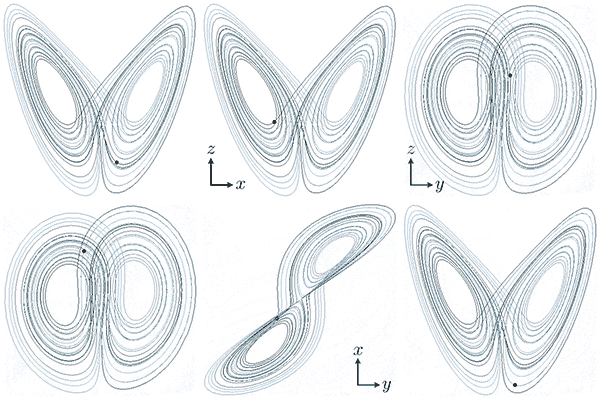
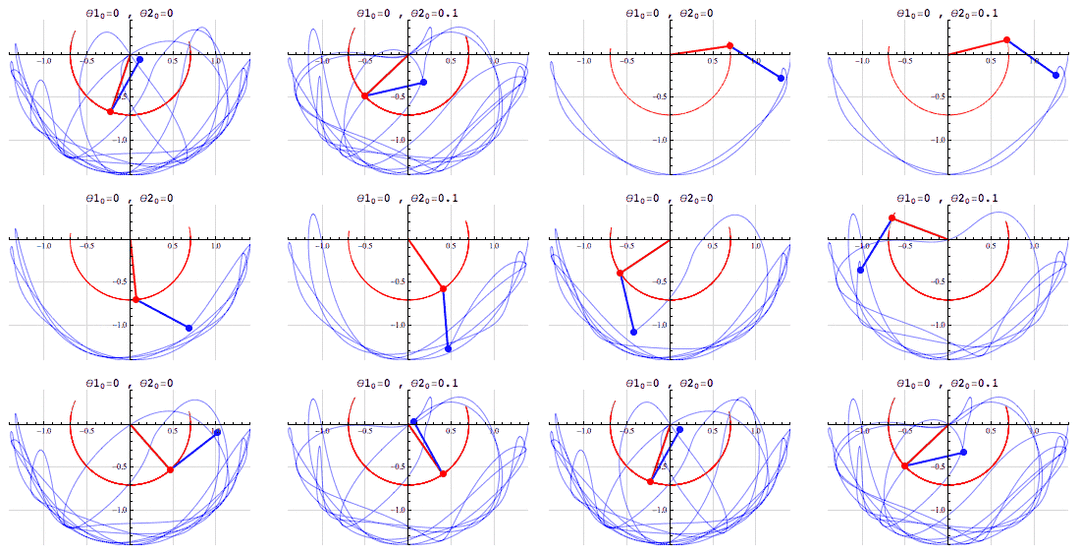
Chaos theory is a branch of mathematics focusing on the behavior of dynamical systems that are highly sensitive to initial conditions. 'Chaos' is an interdisciplinary theory stating that within the apparent randomness of chaotic complex systems, there are underlying patterns, constant feedback loops, repetition, self-similarity, fractals, self-organization, and reliance on programming at the initial point known as sensitive dependence on initial conditions. The butterfly effect describes how a small change in one state of a deterministic nonlinear system can result in large differences in a later state, e.g. a butterfly flapping its wings in Brazil can cause a hurricane in Texas.
...until the meaning of her day approached, and she almost had itTen years ago I studied the weather. Nowadays I tutor English. In the repetitions of the Odyssey, unobserved until explanation necessitated, I found the tidal aid of memory. In the water margin of Women and Men, coastal operative over a denser complexity than formula could ever hope to approximate, I reconciled my seventh grade failure to calculate the low pressure curve to my appreciation of what goes in to the wind, the sun, the snow.
Flick said anyone could have predicted the bomb: it was just bigger.We could put forth the planetary motion of people as safeguard, obliging ourselves with acknowledgement of temporary status yet not really believing we'll ever find anything better. I could track down ever reference to anything ever within the bindings of this particular tome, but that is not a natural commitment of anything else I have ever read. My closure breeds in different ways, and until the void I let it lie.
...for if life is an education it must be to find out what you are already doing because can't avoid in some way Doing.If you dream in sci-fi, are you innovative or simply giving the finger to Freud in the manner of one of many dreaded "genre" style constructions? No tech or politics in fiction for literature's sake, but that electricity wasn't made on the backs of philosophers, nor that forty hour work day. Whatever your comfortable level of luddism or adherence to Thoreau (two years on Walden two miles from home in brought back his laundry every weekend for his mother to do), you are a set of the system. Contemplate the creeded words of Hegel and co., but understanding's a nominal thing if existence is only respected in parts. Pretend as you may, you're not dead yet.
...In my keeper's multiple dwelling there are many Mansons.Not so appealing now, is it.
...call nationalism just another brand of competition which is death next to cooperation...Does that get your goat?
...to a neutral economist who says in the long run "it" evens out, and to Lord Keynes who said In the long run we are dead...You should know my stance on free market capitalism versus a living wage by now.
...and now he works steadily against the death penalty ("against death as a penalty")...I was not leading you astray with my hopeful view of We in the beginning. Only my definition may differ, for a lack of a considered life after the croak has made me all the more keen on the hearing of now. All for one, one for all, and heaven help those sputtering 'but'.
...people are the obstacles we choose and by a system that is always double we are inclined toward these obstacles in order by some last-second correction like multiple-reentry missiles to veer away around them at risk yet with awful chance, too, if we can find the way in to the risk of our lives...If I can do it, so can you.
All of this speaks. In many bodies or, as our leaders have said, on an individual basis. Speaks also, we understand, in this "we" that we have heard. What is it? some community? Ours. Operating less than capacity then suddenly also beyond itself. So that in the zone between we have this voice of relations—is that it?—of possible relations too.There is no we in I on a linguistic case level. So come, tell me the familiar anew; on a level of life, we'll find it yet.

“Women and men maybe weren’t meant to get along”I was talking to a co-worker about this book when I was about halfway through, simultaneously praising it and cautioning my co-worker about its difficulty level. The co-worker asks me, “what’s it about?” and I laugh a bit, and trail off, “well, that’s a bit tough to answer…”
It is partly about the close and even microscopic interrelations between women and men, which are always there. Also, the book sees that there are strange similarities between women and men—however, I cannot say that without acknowledging that this fundamental relationship happened during a time when second generation feminism was so important in New York, and there was a war going on that opened up all of the United States.There’s something expansive to be said about the fact that in a book “partly about the close and even microscopic interrelations between women and men” that the main male and female characters never meet - McElroy’s statement is spot on; within that context Women and Men explores in minute detail just how interrelated are the lives of its two main characters - it “microscopically”, patiently, weaves a jumbled, convoluted skein of characters – and families, and histories, and observers; stretched without regard to chronological time – that tie James/Jim Mayn and Grace Kimball close together, even when they are only passingly aware of the other.
-Joseph McElroy, on Women and Men
Trey Strecker: Your novels are remarkably spatial--the reader experiences first-hand connective networks, cognitive processes, neural neighborhoods, as you call them in the title of one of your early essays.Strecker and McElroy’s description of the reader’s interaction with Women and Men is incisive – especially McElroy’s reinforcement of the “first-hand” aspect of it; this book completely and entirely subsumes the reader into its narrative; the book, in its own way, becomes easier as it progresses.
Joseph McElroy: I'm glad you say "first-hand." And spatial, I guess so: sounds good. If you mean displacing time sequence with a theme unfolding, that's common in novels. Displacing time with space, though--is it me? is it the city? is it congenital attention shifts turning into a rhythm that layers time?--several things at once, the all-at-once, so extension in space comes across more than time passage. What good it is, I have no idea. It seems accurate.
But at the end when the elbows and hands and bottom and knees came free, slip, blip, grind no bump-and she only much later thought of the gunk draining out then, and nothing seemed to matter except the glistening baby that was younger than last month and was a baby beyond boy or girl, beyond not before, and then without strangeness nothing at all for quite a long moment seemed to matter-or be between them-not even the baby that was O.K., she’d looked at her husband behind the young doctor’s hands and she found tears on her husband’s seedy unshaven cheeks, tears from the wonderful vagueness in his eyes and on his forehead too, as if he had wept upward into his thick, bristly hair. But later she remembered what she could remember, as if she might have receded into her own breathing and part of her was never to be seen again, and knew he told the truth when he said it hurt him to see her in pain, and then she recalled those tears upon his forehead and saw that of course they were sweat. And she knew that while he did not look at her while he waited down there between her legs with the doctor, the tears that he could not keep from running out onto his face were not only for his daughter, because they did not-she was sure, she was sure-fill up his eyes and drop onto his skin until suddenly he had looked up past the appearing baby to look her in the eye-us, us--as he had not been able to down there at that end of the delivery table before now.The opening five pages of the novel are utterly perfect – I’ve never came across a better depiction of birth anywhere in literature – and also they are utterly deceptive. See, the chapters which are titled entirely in lowercase – the opening chapter being one of them – are quite straightforward and accessible, functioning almost as short stories breaking up the rest of the book. The language in these sections is still dense, bulky, and at times opaque – so when reading the opening chapter I thought I understood why the book was considered difficult (I mean, I was expecting 1200 pages of this type of density). And then the next 100 pages or so just sort of punches the reader between the eyes. No one but McElroy writes like this – and I mean that both as praise and as recommendation.
And yet we need that child or children. (There’s one or two of them right in the next room.) We said to our child in the next room, to our babe, our love, our hope for ourself, our sweet honest force, “How much light is there, then?" for the all-purpose child is doing its four terms of science dwarfed into one- and-a-half class-weeks (pill-assisted memory-wise, but we didn’t dare ask) and it should (our child) come up with a few of the answers and should know a thing or two about light; and it answers, “Plenty to go around,” it was us, not the kid, the kid knows a dumb question when it hears it (How much light is there?); yet then, inspired by pity, the child with angelic directness is heard to say, “Light is inside people so long as ...” and we add (because maybe that’s as far as our child is up to in class and because the light inside us feels deflected or busted, that sort of thing, though rebounding), “… so long as they turn,” because we have found upon turning that there’s light that likes that, inside us, it makes sounds during eye contact and in turn finds others nearby who have just turned as well, though not necessarily to us – “as long as they,” now continues the child formula from the next room, “turn it on!” This plus the cheer that accompanies the everyday discovery of the light that is cast by ice cream in the refrigerator.Almost every page contains some standout paragraph or sentence (or entire page). More than that, the book is almost entirely self-referential; the narrative seems to spiral in on itself throughout the book, revisiting scenes and times and expanding slowly on them, revealing more and more of the narrative as the book progresses. It is intricate at a stupefying level, and breathtaking throughout the entire read.