

What do you think?
The Forever War #1+2
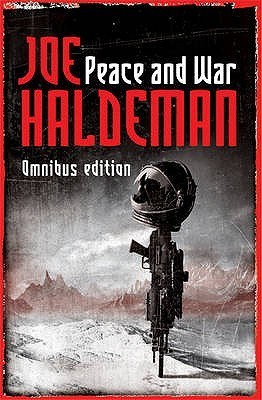
Peace and War
Together in one volume for the first time ever; his classic novel of epic future conflict, The Forever War, its sequel Forever Free, and the companion novel, Forever Peace.
WAR
William Mandella is a reluctant hero, drafted to fight in a distant interstellar war against unknowable and unconquerable aliens. But his greatest test will come when he returns to Earth. Relativity means that everey time he returns home after a few months' tour of duty, centuries have passed on Earth, making him and his fellows ever more isolated from the world for whose future they are fighting.
FREE
When Mandella returns for the last time he finds humanity has evolved into a group mind called Man. Living a dull life in an autocratic and intrusive society, missing the certainties of combat and feeling increasingly alienated, the veterans plan an escape. But when their ship starts to fail, their journey becomes a search for the unknown.
PEACE
2043. The Ngumi War rages, fought by 'soldierboys', indestructible machines operated remotely by soldiers hundreds of miles away. Julian Class is one of those soldiers, and for him war is truly hell. But he and his companion, Dr Amelia Harding, have discovered something that could literally take the universe back to square one. For Julian, the discovery isn't so much terrifying as tempting...
WAR
William Mandella is a reluctant hero, drafted to fight in a distant interstellar war against unknowable and unconquerable aliens. But his greatest test will come when he returns to Earth. Relativity means that everey time he returns home after a few months' tour of duty, centuries have passed on Earth, making him and his fellows ever more isolated from the world for whose future they are fighting.
FREE
When Mandella returns for the last time he finds humanity has evolved into a group mind called Man. Living a dull life in an autocratic and intrusive society, missing the certainties of combat and feeling increasingly alienated, the veterans plan an escape. But when their ship starts to fail, their journey becomes a search for the unknown.
PEACE
2043. The Ngumi War rages, fought by 'soldierboys', indestructible machines operated remotely by soldiers hundreds of miles away. Julian Class is one of those soldiers, and for him war is truly hell. But he and his companion, Dr Amelia Harding, have discovered something that could literally take the universe back to square one. For Julian, the discovery isn't so much terrifying as tempting...
697 pages, Paperback
First published November 1, 2006
About the author
Joe Haldeman
440 books2,273 followersBrother of Jack C. Haldeman II
Haldeman is the author of 20 novels and five collections. The Forever War won the Nebula, Hugo and Ditmar Awards for best science fiction novel in 1975. Other notable titles include Camouflage, The Accidental Time Machine and Marsbound as well as the short works "Graves," "Tricentennial" and "The Hemingway Hoax." Starbound is scheduled for a January release. SFWA president Russell Davis called Haldeman "an extraordinarily talented writer, a respected teacher and mentor in our community, and a good friend."
Haldeman officially received the Damon Knight Memorial Grand Master for 2010 by the Science Fiction and Fantasy Writers of America at the Nebula Awards Weekend in May, 2010 in Hollywood, Fla.
Haldeman is the author of 20 novels and five collections. The Forever War won the Nebula, Hugo and Ditmar Awards for best science fiction novel in 1975. Other notable titles include Camouflage, The Accidental Time Machine and Marsbound as well as the short works "Graves," "Tricentennial" and "The Hemingway Hoax." Starbound is scheduled for a January release. SFWA president Russell Davis called Haldeman "an extraordinarily talented writer, a respected teacher and mentor in our community, and a good friend."
Haldeman officially received the Damon Knight Memorial Grand Master for 2010 by the Science Fiction and Fantasy Writers of America at the Nebula Awards Weekend in May, 2010 in Hollywood, Fla.
Ratings & Reviews
Friends & Following
Create a free account to discover what your friends think of this book!
Community Reviews
Displaying 1 - 30 of 116 reviews

June 27, 2012
This is an omnibus - the first book 'Forever War' was written in 1973 after lots of rejections - but I enjoyed this the most. The sequel written in the late 90's was OK but the 'companion' book written a couple of years after the sequel was disappointing.
The first book was ingenious and relatively compelling and the sequel had some good ideas especially when the main characters return to Earth - Disney gets everywhere! However, the last book lacks substance and the narrative is limited, concentrating a lot on how those who can 'jack' into sync with others can't really be understood by those that can't jack and this has been 'done' much better by other writers.
Overall, don't buy it but if you borrow a copy it's worth a read for the first 2 books.
The first book was ingenious and relatively compelling and the sequel had some good ideas especially when the main characters return to Earth - Disney gets everywhere! However, the last book lacks substance and the narrative is limited, concentrating a lot on how those who can 'jack' into sync with others can't really be understood by those that can't jack and this has been 'done' much better by other writers.
Overall, don't buy it but if you borrow a copy it's worth a read for the first 2 books.

October 2, 2019
First, about the format:
Another audio book I listened, too. And I am confused. Apparently, I listened to the audio book version of the omnibus for all three books in this trilogy, however, I don’t think I actually listened to all three books.
When reading the synopses of the three individual novels, they seemed familiar. Except for the synopsis of book 2 Forever Peace. I don’t remember any main character being called Julian Class…
Then again I do remember things that were mentioned in the synopsis for book 3 - Forever free. Like, I do remember Mandela and the others finally returning to earth to discover an evolved human race.
So did I read (listen to) the omnibus version now or not? Also my version was 9 hours long which I think is a bit short for a (in the German version) 800 page long book?!
Apart from the confusion, there was one other thing I did not like in the audio version - there were no chapters. How can there be no chapters? Does the printed version have chapters? I’d think so…
Now, enough with the format; I think it is fairy clear that I do not recommend listening to this story on audio.
About the story itself:
The forever war is a high science fiction story, first written in 1973. There is a lot of technical language and terminology. The main character is a physicist and throws around with all these clever words. This kind of terminology is not familiar to me. Therefore, I felt a bit lost in these moments and didn’t internalize these parts.
Also, I didn’t really catch the meaning behind this huge war. Yes, there was this alien race and they were enemies and they fought, but way exactly? How did this start? What sense was behind this? I do understand, that this novel is an anti-war story. So maybe that was the whole point? Showing this futility of war. Showing that it is only a waste of resources and human lives and time. Showing that it is all nonsense.
What I did like about this story was the time aspect and how earth, modern civilization and the human race changed over time. Especially for a novel that old this was great! Seeing the different stages of evolution on earth and especially the administrative and political system after Mandela first came back to earth was fascinating.
The characters I didn’t really grow to love. I was quite indifferent about them all. Maybe, because they seemed like machines, created for an shaped by war. Generally, I did like the relationship between Mandela and Marygay though.
Overall, this was an interesting read. But one you really have to take the time to internalize. You have to think about these issues and ideas that are addressed in "the forever war“. And its probably better to read it. I think I would’ve enjoyed the story a lot more, if it weren’t for the confusion the audio book created in my case.
Another audio book I listened, too. And I am confused. Apparently, I listened to the audio book version of the omnibus for all three books in this trilogy, however, I don’t think I actually listened to all three books.
When reading the synopses of the three individual novels, they seemed familiar. Except for the synopsis of book 2 Forever Peace. I don’t remember any main character being called Julian Class…
Then again I do remember things that were mentioned in the synopsis for book 3 - Forever free. Like, I do remember Mandela and the others finally returning to earth to discover an evolved human race.
So did I read (listen to) the omnibus version now or not? Also my version was 9 hours long which I think is a bit short for a (in the German version) 800 page long book?!
Apart from the confusion, there was one other thing I did not like in the audio version - there were no chapters. How can there be no chapters? Does the printed version have chapters? I’d think so…
Now, enough with the format; I think it is fairy clear that I do not recommend listening to this story on audio.
About the story itself:
The forever war is a high science fiction story, first written in 1973. There is a lot of technical language and terminology. The main character is a physicist and throws around with all these clever words. This kind of terminology is not familiar to me. Therefore, I felt a bit lost in these moments and didn’t internalize these parts.
Also, I didn’t really catch the meaning behind this huge war. Yes, there was this alien race and they were enemies and they fought, but way exactly? How did this start? What sense was behind this? I do understand, that this novel is an anti-war story. So maybe that was the whole point? Showing this futility of war. Showing that it is only a waste of resources and human lives and time. Showing that it is all nonsense.
What I did like about this story was the time aspect and how earth, modern civilization and the human race changed over time. Especially for a novel that old this was great! Seeing the different stages of evolution on earth and especially the administrative and political system after Mandela first came back to earth was fascinating.
The characters I didn’t really grow to love. I was quite indifferent about them all. Maybe, because they seemed like machines, created for an shaped by war. Generally, I did like the relationship between Mandela and Marygay though.
Overall, this was an interesting read. But one you really have to take the time to internalize. You have to think about these issues and ideas that are addressed in "the forever war“. And its probably better to read it. I think I would’ve enjoyed the story a lot more, if it weren’t for the confusion the audio book created in my case.

June 25, 2018
Açıkçası şu kitabı bitirmek, uzun bir kabustan uyanmak gibi.
Joe Haldeman'ın Forever War romanını önemli bir yapıt olarak görürüm. Yıllar önce okumuş, ama devam kitabını okumamıştım. Geçtiğimiz haftalarda tüm seriyi okumaya karar verdim. Kitaplığımda üç kitaplık bu "Omnibus Edition" yıllardır okunmayı bekliyordu.
İlk kitap olan Forever War eskiden olduğu gibi kolayca okundu. Işık hızına yakın hızlarda yolculuk etmenin zamana etkisi çevresinde geliştirilmiş, güzel bir anlatı. İkinci kitap olan Forever Free ile hayal kırıklığı başladı. İlk kitapta yaşanan binlerce yıllık savaşın bir "yanlış anlama" sonucu olduğunu söyleyerek zaten okuyucuyu sersemleten bu kitap gayet sıradan, hiçbir önemli olay anlatmayan bomboş bir roman. Kitabın sonlarına doğru yazar ilgi çekecek, hatta belki harika bir öykü olabilecek bir iki fikir geliştirmeye başlıyor, ancak geliştirdiği bu gizemleri kitabın son iki sayfasında, "deus ex machina" tadında anlık çözümlere bağlayarak işin içinden çıkıyor.
Beni asıl öfkelendirense elimdeki cildi oluşturan üçüncü kitap olan Forever Peace oldu. Cildin sağında solunda "companion novel" ya da "spiritual successor" gibi ifadeler kullanılsa da, hayır bu roman Forever War / Forever Free serisiyle kesinlikle alakalı değil. Tahmin ediyorum ki "üçleme olursa güzel oluyor" denerek diğer iki kitabın ardına eklenmiş, askeri temaları dışında alakasız bir roman. Haldeman bu romanda da bazı fikirleri geliştiriyor ancak geliştirdiği fikirleri daha önce yaptığı gibi yine hiçbir yere bağlamadan, son sayfada tepeden inme çözümlere bağlayıp, romanı bitiriyor.
Benim gözümde gerçekten kötü bir roman olan Forever Peace'in Hugo vs. ödüller kazanmış olması, bu ödüllerin asla dikkate alınmaması gereken işler olduğunun bir diğer ispatı sanki.
Kitapları yarım bırakmayı hiç sevmiyorum, çünkü o noktaya kadar harcadığım zamana acıyorum. Haftalardır elime yapışan, tüm okuma planlarımı altüst eden bu kitabı bitirip kurtulduğum için mutluyum. Sanıyorum bir daha Joe Haldeman okumam.
Joe Haldeman'ın Forever War romanını önemli bir yapıt olarak görürüm. Yıllar önce okumuş, ama devam kitabını okumamıştım. Geçtiğimiz haftalarda tüm seriyi okumaya karar verdim. Kitaplığımda üç kitaplık bu "Omnibus Edition" yıllardır okunmayı bekliyordu.
İlk kitap olan Forever War eskiden olduğu gibi kolayca okundu. Işık hızına yakın hızlarda yolculuk etmenin zamana etkisi çevresinde geliştirilmiş, güzel bir anlatı. İkinci kitap olan Forever Free ile hayal kırıklığı başladı. İlk kitapta yaşanan binlerce yıllık savaşın bir "yanlış anlama" sonucu olduğunu söyleyerek zaten okuyucuyu sersemleten bu kitap gayet sıradan, hiçbir önemli olay anlatmayan bomboş bir roman. Kitabın sonlarına doğru yazar ilgi çekecek, hatta belki harika bir öykü olabilecek bir iki fikir geliştirmeye başlıyor, ancak geliştirdiği bu gizemleri kitabın son iki sayfasında, "deus ex machina" tadında anlık çözümlere bağlayarak işin içinden çıkıyor.
Beni asıl öfkelendirense elimdeki cildi oluşturan üçüncü kitap olan Forever Peace oldu. Cildin sağında solunda "companion novel" ya da "spiritual successor" gibi ifadeler kullanılsa da, hayır bu roman Forever War / Forever Free serisiyle kesinlikle alakalı değil. Tahmin ediyorum ki "üçleme olursa güzel oluyor" denerek diğer iki kitabın ardına eklenmiş, askeri temaları dışında alakasız bir roman. Haldeman bu romanda da bazı fikirleri geliştiriyor ancak geliştirdiği fikirleri daha önce yaptığı gibi yine hiçbir yere bağlamadan, son sayfada tepeden inme çözümlere bağlayıp, romanı bitiriyor.
Benim gözümde gerçekten kötü bir roman olan Forever Peace'in Hugo vs. ödüller kazanmış olması, bu ödüllerin asla dikkate alınmaması gereken işler olduğunun bir diğer ispatı sanki.
Kitapları yarım bırakmayı hiç sevmiyorum, çünkü o noktaya kadar harcadığım zamana acıyorum. Haftalardır elime yapışan, tüm okuma planlarımı altüst eden bu kitabı bitirip kurtulduğum için mutluyum. Sanıyorum bir daha Joe Haldeman okumam.

January 23, 2010
I am rereading this book

December 25, 2018
Forever War - 5*, Forever Free - KIV'ed, Forever Peace - 3*
So yeah. Read the two Hugo-Nebula Award winners and the other one I will leave for some other time. Both Forever War and Forever Peace leave you with Thoughts [tm]... which is why I read SF in the first place.
Something occurred to me the other day.... being an SFF reader when I say that something "reads like a science fiction/fantasy story" -- it means something totally different than when someone average joe/jill says something "reads like a science fiction/fantasy story". On the surface level the actual perception of sff to most people I know translates to "fanciful stuff that is shiny and/or colorful and/or grim/dark but ultimately just fanciful" -- having that realisation thrown in my face made me want to try to explain what I actually mean when I say "wow it's like a sf/f story"... but I can't because if you didn't read sff or approach or have takeaways from it like I do -- then we'd just have a pointless conversation that would end up with more muddied waters than not. It honestly just frustrates me sometimes.
Stuff like Forever War & Forever Peace aren't "just science fiction stories".
But they are.
And you know what.
I'll take it.
That's a-okay with me, compadre.
So yeah. Read the two Hugo-Nebula Award winners and the other one I will leave for some other time. Both Forever War and Forever Peace leave you with Thoughts [tm]... which is why I read SF in the first place.
Something occurred to me the other day.... being an SFF reader when I say that something "reads like a science fiction/fantasy story" -- it means something totally different than when someone average joe/jill says something "reads like a science fiction/fantasy story". On the surface level the actual perception of sff to most people I know translates to "fanciful stuff that is shiny and/or colorful and/or grim/dark but ultimately just fanciful" -- having that realisation thrown in my face made me want to try to explain what I actually mean when I say "wow it's like a sf/f story"... but I can't because if you didn't read sff or approach or have takeaways from it like I do -- then we'd just have a pointless conversation that would end up with more muddied waters than not. It honestly just frustrates me sometimes.
Stuff like Forever War & Forever Peace aren't "just science fiction stories".
But they are.
And you know what.
I'll take it.
That's a-okay with me, compadre.

January 29, 2025
Forever war; decent beginning, confusing/dragged out middle, alright (but very quick) end. Like boom, it's over. Epilouge tells of a happy ending between William Mandella and Marygay Potter
Forever free; they are gonna "timetravel". Again. A fun story; more focused on exploration and human needs. But it Becomes a bit repetetive. Same thing all over again until the end; what in the f was that? Uhm...what???
Forever peace; excuse me what? Hard to keep up with in the beginning, and no chapters. I get how this is a part of the story from early on and from a different POV but I can't help but feel it wasn't needed.
Overall; I felt like all three books suffered from them same problem for me; being very repetetive. I felt like they could have been half as long and still covered the same story. I also had a hard time connecting with any of the main characters so I really didn't care that much what would happen to them, as long as something would progress the story. Might be a "me problem" tho.
Forever free; they are gonna "timetravel". Again. A fun story; more focused on exploration and human needs. But it Becomes a bit repetetive. Same thing all over again until the end; what in the f was that? Uhm...what???
Forever peace; excuse me what? Hard to keep up with in the beginning, and no chapters. I get how this is a part of the story from early on and from a different POV but I can't help but feel it wasn't needed.
Overall; I felt like all three books suffered from them same problem for me; being very repetetive. I felt like they could have been half as long and still covered the same story. I also had a hard time connecting with any of the main characters so I really didn't care that much what would happen to them, as long as something would progress the story. Might be a "me problem" tho.
This entire review has been hidden because of spoilers.

Did Not Finish
January 14, 2026I had to DNF this book. I got through the first one just fine, the second one was a disaster and I gave the third book a try. Book 3 starts off with the switching of single to third person perspectives to give you the main characters perspective but also give you worldbuilding the maincharacter is unaware off. I did not even realise at the start that the third person perspective was talking about our main character. The same priviliged hetrosexual male perspective from book 2 coats this book. There are so many things left unexplained that I just was not able to grasp. When the love interest has done an optional surgery to have a metal stick impemented in her brain with a 10% dead rate to be able to connect with others on a no privacy level. She turned into a vegtable, they have contact and the second thing she asks is to have sex like that. I had to give up at this point.

December 25, 2022
Forever War 5/5
Forever Free 3.5/5
Forever Peace 3/5
Forever Free 3.5/5
Forever Peace 3/5

February 15, 2020
I already wrote some comments for each independent book. I loved this.
Forever War was a great book. Forever Free was, interesting but not that good, and Forever Peace was beautiful.
Also, loved the cover art (?)
Forever War was a great book. Forever Free was, interesting but not that good, and Forever Peace was beautiful.
Also, loved the cover art (?)

February 9, 2017
The Peace and War Omnibus is a science fiction series that contains three books, The Forever War (1974), Forever Peace (1997) and Forever Free (1999) by Joe Haldeman. The Forever War and Forever Peace are basically sequels and Forever Free is described as 'a kind of sequel, though, examining some of The Forever War's problems from an angle that didn't exist twenty years ago (when The Forever War came out)."
The first two books follow the same main character, William Mandela, a space soldier who spends the first book, training in space and then fighting an unknown alien race, the Taurons. Throughout this book, he travels back to Earth, arriving hundreds of years in the future and discovering the great changes that took place while he was gone. He goes back to war a few times, regularly with the woman who will become his wife, trying to deal with life as a soldier and with a changing earth's values and lives. It's an interesting story, interesting concepts on living and fighting in space. (It's kind of a Battle Cry or Vietnam War, but set in space. (3.5 stars)
The second book, Forever Free, finds Mandela and his wife. Marygay, and children, now living on the planet Middlefinger, peopled with many other veterans, people of the new human species, 'Man' (basically a combined mind) and Taurons. They chose to live on Middlefinger (MF) because life on Earth was now too strange. However they now feel a desire to leave MF, by traveling in space, out 20 years (their time, but many years more in MF time) and returning to see what changes the future has wrought. Problems happen, forcing them to return to MF, and discovering a fantastic disaster has occurred. They then head to Earth. The story becomes an interesting discussion about whether there is a God, and if so, trying to answer the question, why is he treating us in such a shitty manner. (3.5 stars)
Forever Peace is set on Earth. The Alliance (the US and 'allies') are at war with enemies in Central, South America and Africa. They fight with 'soldier boys' an interesting concept, basically machine robots controlled by soldiers who 'jack' into the machines and fight while remaining in cells back at home base. Julian, a 'soldier boy mechanic' also teaches physics at university in Dallas. A series of events turn his life and those of his friends head over heels. They work on the Jupiter Project, an attempt to create a super collider on Jupiter's moons so they can test their theories on the Big Bang Theory. As they discover the dangers that might result from this test, they must begin a race against time, both to stop the wars on Earth and also the Jupiter Project itself, while being chased and threatened by enemies on Earth, a fanatic religious organization, The Hand of God. (4 stars)
All three stories are quite interesting. The concepts explored make you think. While the stories move slowly at times, as you get into them, they draw you in and hold your interest. Definitely worth the effort to keep with the books. I think that Forever Peace was my favorite, especially the last half (tense and action-filled) and it could safely be read on its own. The other stories should be read together; the second, Forever Peace is the best of the two but the first provides great background leading into it. Glad I tried them. (4 stars)
The first two books follow the same main character, William Mandela, a space soldier who spends the first book, training in space and then fighting an unknown alien race, the Taurons. Throughout this book, he travels back to Earth, arriving hundreds of years in the future and discovering the great changes that took place while he was gone. He goes back to war a few times, regularly with the woman who will become his wife, trying to deal with life as a soldier and with a changing earth's values and lives. It's an interesting story, interesting concepts on living and fighting in space. (It's kind of a Battle Cry or Vietnam War, but set in space. (3.5 stars)
The second book, Forever Free, finds Mandela and his wife. Marygay, and children, now living on the planet Middlefinger, peopled with many other veterans, people of the new human species, 'Man' (basically a combined mind) and Taurons. They chose to live on Middlefinger (MF) because life on Earth was now too strange. However they now feel a desire to leave MF, by traveling in space, out 20 years (their time, but many years more in MF time) and returning to see what changes the future has wrought. Problems happen, forcing them to return to MF, and discovering a fantastic disaster has occurred. They then head to Earth. The story becomes an interesting discussion about whether there is a God, and if so, trying to answer the question, why is he treating us in such a shitty manner. (3.5 stars)
Forever Peace is set on Earth. The Alliance (the US and 'allies') are at war with enemies in Central, South America and Africa. They fight with 'soldier boys' an interesting concept, basically machine robots controlled by soldiers who 'jack' into the machines and fight while remaining in cells back at home base. Julian, a 'soldier boy mechanic' also teaches physics at university in Dallas. A series of events turn his life and those of his friends head over heels. They work on the Jupiter Project, an attempt to create a super collider on Jupiter's moons so they can test their theories on the Big Bang Theory. As they discover the dangers that might result from this test, they must begin a race against time, both to stop the wars on Earth and also the Jupiter Project itself, while being chased and threatened by enemies on Earth, a fanatic religious organization, The Hand of God. (4 stars)
All three stories are quite interesting. The concepts explored make you think. While the stories move slowly at times, as you get into them, they draw you in and hold your interest. Definitely worth the effort to keep with the books. I think that Forever Peace was my favorite, especially the last half (tense and action-filled) and it could safely be read on its own. The other stories should be read together; the second, Forever Peace is the best of the two but the first provides great background leading into it. Glad I tried them. (4 stars)

December 27, 2012
This is very much a book of three thirds. The first, written at the time of the Vietnam War, is a hard sci-fi tale of soldiers fighting a pointless war. Without faster-than-light travel, their alienation is accentuated by the effects of relativistic time dilation. The novel has strong character development and good dialogue, and explores several possible futures over a span of hundreds of years. It's influence on later authors seems clear, particularly Alan Moore's The Ballad of Halo Jones and elements of Alastair Reynolds' Revelation Space series (though it has to be said the portrayal of homosexuality is a bit stereotyped).
The second Book, Forever Free is the weakest of the three. It is set after the Forever War has ended, and although the plot is clichéd (the discontent of "real" humans filled with pioneer spirit, in a peaceful posthuman society) it starts well. However, the second half feels like it belongs to a completely different story with a sudden Deus ex Machina ending.
The third novel, Forever Peace, doesn't really belong with the other two - it was written twenty years later, and isn't a sequel or even set in the same universe. Its background is the 80s and 90s U.S. "interventions" in Africa and Central and South America. However, I felt that it was the best of the three. Not so hard sci-fi, but echoes of Frederik Pohl and C.M. Kornbluth and a more subtle perspective on social and economic issues.
The second Book, Forever Free is the weakest of the three. It is set after the Forever War has ended, and although the plot is clichéd (the discontent of "real" humans filled with pioneer spirit, in a peaceful posthuman society) it starts well. However, the second half feels like it belongs to a completely different story with a sudden Deus ex Machina ending.
The third novel, Forever Peace, doesn't really belong with the other two - it was written twenty years later, and isn't a sequel or even set in the same universe. Its background is the 80s and 90s U.S. "interventions" in Africa and Central and South America. However, I felt that it was the best of the three. Not so hard sci-fi, but echoes of Frederik Pohl and C.M. Kornbluth and a more subtle perspective on social and economic issues.

May 31, 2009
Picked this up because I heard there was a movie due.
The first of the three books - Forever War - is the meat of the story and is by far the best of the three, putting the issues of fighting a relativistic war front and centre, and the effect this has on the soldiers involved. Obviously it has dated a little in places (or alternatively has become a 'classic') but it still reads well and hasn't aged badly at all being comparatively well written (not like re-reading Asimov for example).
The second book, starts well, looking to shape up into a Vinge type epic. However, I really feel it was let down with what seemed to be a tacked on ending which was a different book from the one promised in the first half, and rapidly descended into the fantastical to wrap up with a clichéd ending.
The final book doesn't follow from the others, but is a companion story which reads much more easily as a modern tale of nano-tech and brain interfacing. An enjoyable story in its own right, only weakly linked to Forever War.
The first of the three books - Forever War - is the meat of the story and is by far the best of the three, putting the issues of fighting a relativistic war front and centre, and the effect this has on the soldiers involved. Obviously it has dated a little in places (or alternatively has become a 'classic') but it still reads well and hasn't aged badly at all being comparatively well written (not like re-reading Asimov for example).
The second book, starts well, looking to shape up into a Vinge type epic. However, I really feel it was let down with what seemed to be a tacked on ending which was a different book from the one promised in the first half, and rapidly descended into the fantastical to wrap up with a clichéd ending.
The final book doesn't follow from the others, but is a companion story which reads much more easily as a modern tale of nano-tech and brain interfacing. An enjoyable story in its own right, only weakly linked to Forever War.

September 18, 2011
I read this book years ago, and loved it. Having bought it as a gift for someone I just finished re-reading it, and was reminded of why I enjoyed it so very much.
This book, this series, is enjoyable as a far-reaching sci-fi adventure, and also as a military adventure, and further as a philosophical look at the human race in general, with our politics, economies, social constructs. I won't summarise the plot here, it has been done in a hundred other reviews. But this book serves an important place in sci-fi, and is probably in my top ten for the genre. Mandella as a character is interesting, sometimes infuriating, but always well drawn. The situations, the surrounding cast, and the props he is provided with are fantastic, exploring a large swathe of human history (and future). Definitely a must read for sci-fi lovers.
This book, this series, is enjoyable as a far-reaching sci-fi adventure, and also as a military adventure, and further as a philosophical look at the human race in general, with our politics, economies, social constructs. I won't summarise the plot here, it has been done in a hundred other reviews. But this book serves an important place in sci-fi, and is probably in my top ten for the genre. Mandella as a character is interesting, sometimes infuriating, but always well drawn. The situations, the surrounding cast, and the props he is provided with are fantastic, exploring a large swathe of human history (and future). Definitely a must read for sci-fi lovers.

January 6, 2017
Since this is the Omnibus Edition of the 3 books it's a bit of a challenge to rate as one. But the first book in the omnibus The Forever War was really good, the second was good with some interesting ideas. BUT...
The third book I just couldn't get into at all, it really didn't work for me in any way and I eventually just gave up on it.
So book 3 is a Dnf, which is annoying since the first two books were really good and interesting AND I think that's my first ever Dnf, I can usually persevere and get to the end but not this time.
So I'd definitely recommend you check this out and if you can get into book 3 and enjoy it then more power to you.
The third book I just couldn't get into at all, it really didn't work for me in any way and I eventually just gave up on it.
So book 3 is a Dnf, which is annoying since the first two books were really good and interesting AND I think that's my first ever Dnf, I can usually persevere and get to the end but not this time.
So I'd definitely recommend you check this out and if you can get into book 3 and enjoy it then more power to you.
August 21, 2021
The Forever War: 3/5 stars
I didn't like the first 70 pages of this book. It started off like Heinlein's Starship Troopers, which I didn't like. It was just a story about a soldier going through training and his first couple of missions. Then, however, it got interesting when our protagonist, William Mandella, returned home. I really enjoyed his attempt to get back into society after so much time had passed. The rest of the book was all right, from there on it was just more missions and more attempts to get back into society.
I didn't like the first 70 pages of this book. It started off like Heinlein's Starship Troopers, which I didn't like. It was just a story about a soldier going through training and his first couple of missions. Then, however, it got interesting when our protagonist, William Mandella, returned home. I really enjoyed his attempt to get back into society after so much time had passed. The rest of the book was all right, from there on it was just more missions and more attempts to get back into society.
Other than me not liking the first 70 pages, the things holding this book back from a 4-star rating are some minor annoyances. For example, the reason for fighting the war in the first place: the whole time I was just asking myself why they didn't just talk to the aliens and started a war immediately. From the beginning, the whole thing just seemed like a misunderstanding to me. Lo and behold, I was right. At the end, we learn that none of the two parties wanted a war, the whole millennium-long war was fought because some military guys on Earth started shooting before they started talking.
Forever Free: 1/5 stars
What did I just read. This is a book where a bunch of boomers persuade 150 people to commit a terrorist attack and go on a de facto suicide mission, where all of their fuel disappears for no reason, so they come back only to find out that all humans and Taurans disappeared as well, which is explained to them by three aliens to be the doing of the de facto gods of our universe, who treat it as an experiment. Right, let's delve into more detail, shall we?
The book picks up 20 years after the end of its predecessor, The Forever War. William is now living with Marygay. Both of them for some reason decide that they want to go on another trip into the future, so they persuade 150 people to go 20,000 lightyears out of the galactic plain and back, which will take them 40,000 earth years into the future while only aging them 10 earth years (because of time dilation caused by relativity). When their request for the trip is denied by Earth, they do the sensible thing and continue their lives as normal. Just kidding, they steal a military power suit, use it to take a ship into orbit, and threaten to blow up half of the planet with tonnes of antimatter (which is used as fuel for ships) if their trip is not approved. This is just terrorism - threatening to harm a civilian population if their demands aren't met. At this point I was wondering if the protagonists were truly supposed to be the good guys here, or if they were supposed to be antiheroes. I mean, if their trip at least had a noble purpose, I could forgive that they are literal terrorists, but they just want to go into the future because they don't like how humanity currently looks, I guess?
So, by the time their trip is prepared, and they finally leave, almost half of the book is already over without anything interesting happening. Then we got a couple of pages describing the life on the ship. After that, the book finally got interesting to me for the first (and last) time. Weird stuff starts happening on the ship, e.g., the inside of a locker keeps being emptied of air, creating a vacuum inside. I got excited at this point, because I though from this point on it would be like an Andy Weir book - stuff would keep going wrong and the protagonists would have to fix it with their knowledge of science. However, within the next 10 pages I realised I could not have been more wrong if I tried. The antimatter that fuels the drive of the ship disappears within 30 minutes, so the crew enter the emergency shuttles and evacuate back to the planet where they came from. The shuttles are much slower that the original ship, so this takes 24 years. They spend this time in suspended animation, which wasn't a thing in the previous book. It's almost like they got this technology just so the author could write his way out of the corners he wrote himself into. Huh.
Anyway, when they get back, they find out that everybody disappeared, and after a trip to Earth they confirm that the same has happened on Earth. Gee, with 30 pages left till the end of this book, I wonder how the author is going to wrap this story up. Apparently, he didn't know either, seeing as what followed. It turns out that the bus that carried our protagonists around Earth was actually an alien whose species has lived on Earth for 150,000 years, they've just been hidden ever since we started using language. And would you know it, this alien species knows and tells us what happened: there are these other aliens that actually control our entire universe and its laws, and all of this is just one of their experiments. Then one of these other aliens shows himself and returns all of the people that disappeared and reveals that he did this because our protagonists tried to escape the area of the experiment (our galaxy). Damn, it's almost as if this alien is a god. And it's almost as if he fixed the entire story that the author didn't know how to end. I swear there was a term for these kinds of things... Ah yes, deus ex machina.
So, to summarise this book: boring, no interesting new ideas, average characters, a plot so bad that it has to be saved by the most obvious use of deus ex machina I've ever seen. It takes the crown for the worst sci-fi book I've ever read. The only thing that's keeping it from being the overall worst book I've ever read is that unlike other bad books I've read, it's at least short, so it doesn't waste a lot of your time. Anyway, don't bother with it.
Forever Peace: 3/5 stars
This book feels like two books put together into one - the plot totally changes at the half-way point. The first half tells the story of Julian Class: the missions he goes on for the military, and his civilian life when he is off duty. I didn't enjoy this part, it's just another basic military sci-fi story. The second half is about stopping the end of the universe, and it has barely anything to do with the first one. I quite enjoyed this part.
In my opinion, the first half should have been almost totally cut. I would have enjoyed this book much more if it were cut down to a novella constituting of mainly the second half of this book.
One oddity of this book is the fact that the author keeps switching between first and third person every chapter. I have no idea why this is the case - most of the third person chapters follow Julian anyway. There are some chapters towards the end that follow other characters, so my guess is that it was done so that these other points of view don't stick out. It just seems weird to keep switching like this just for a couple chapters at the end.
This entire review has been hidden because of spoilers.
April 6, 2017
The first two books are worth a read, but I didn't finish the third. The majority of the stars I gave Peace and War come from the first book. The characters are inticing, the plot interesting and the scenarios engaging. The second book, while not as interesting as the first, definatly had some good points- enough to keep a person somewhat engaged.
February 26, 2019
The Forever War was a tour de force.
Forever Free was a somewhat underwhelming novel, but in no way was it bad. Its just that the topic is a very difficult one.
Forever Peace was awesome. THough I thought it might be even better for a moment.
And now I need to go into spoiler territory.
Forever Free was a somewhat underwhelming novel, but in no way was it bad. Its just that the topic is a very difficult one.
Forever Peace was awesome. THough I thought it might be even better for a moment.
And now I need to go into spoiler territory.

May 2, 2024
As a kid I used to spend a lot of time hanging out in the SciFi section of bookshops, browsing, reading, and occasionally even buying books. The Forever War was one I picked up in a shop and read the first 20 or so pages of, then put it back. It didn't grab me back then. Many (maybe 40) years later I came across the whole three books (I didn't even know there were three) in one volume and figured, well it's a classic and even though I gave up on it, aged maybe 8 years old, maybe 58 year old me would grok it.
And look it's not bad, but it doesn't stand up these days. When it was written, back in the 1960/70s, sexual politics was barely a thing. Everyone, even those of a pretty hard left-wing persuasion, was, by today's standards, pretty conservative. There were no gay rights back then and it really shows. It's a huge plot point in the book that the UN forces everyone to be gay in order to control population growth. It's so weirdly specific and ridiculous with hindsight, and alas not in an ironic or comical way. It seems that, back then, people didn't see homosexuality as something someone is, but something someone chooses. The author goes to great pains to reassure his readers of his hero's macho hetro ways, and the angst he suffers as he discovers he's one of the few straight people left in the galaxy. It's actually laugh out loud in some points.
The first book, which kicks off in the far future of 1997, is pretty good fun (above mentioned sexual hangups aside), and works well as an analog of the plight of soldiers returning from Vietnam to discover how much society has changed, how much they don't like it, and thus they return to the battlefield. The Forever War uses relativistic time dilation as a plot device to really drive this point home. This is the real basis for the book's reputation as a classic of sci-fi.
The second book is a direct sequel to the first and, while kind of fun, is mostly silly. Still that said it clearly influenced a lot of other writers, Adrien Tchaikovsky and John Scalzi come to mind specifically. But it's not a patch on the first book alas. Tho it does end, um, interestingly.
The final book was clearly written maybe 20 years later and tells the story of how humans became 'Man' - the hive mind that humanity becomes while our hero is away fighting his wars. It's okay but drags a bit, and, much like the first book and the gays, this one has some curious racial politics that feel very out of place now.
If I was scoring each book individually I'd give FW 3.5 stars, FF 3 stars and FP 2.5 stars. Still fans of science fiction should be conversant with at least the first book as it was massively influential and has some interesting ideas.
And look it's not bad, but it doesn't stand up these days. When it was written, back in the 1960/70s, sexual politics was barely a thing. Everyone, even those of a pretty hard left-wing persuasion, was, by today's standards, pretty conservative. There were no gay rights back then and it really shows. It's a huge plot point in the book that the UN forces everyone to be gay in order to control population growth. It's so weirdly specific and ridiculous with hindsight, and alas not in an ironic or comical way. It seems that, back then, people didn't see homosexuality as something someone is, but something someone chooses. The author goes to great pains to reassure his readers of his hero's macho hetro ways, and the angst he suffers as he discovers he's one of the few straight people left in the galaxy. It's actually laugh out loud in some points.
The first book, which kicks off in the far future of 1997, is pretty good fun (above mentioned sexual hangups aside), and works well as an analog of the plight of soldiers returning from Vietnam to discover how much society has changed, how much they don't like it, and thus they return to the battlefield. The Forever War uses relativistic time dilation as a plot device to really drive this point home. This is the real basis for the book's reputation as a classic of sci-fi.
The second book is a direct sequel to the first and, while kind of fun, is mostly silly. Still that said it clearly influenced a lot of other writers, Adrien Tchaikovsky and John Scalzi come to mind specifically. But it's not a patch on the first book alas. Tho it does end, um, interestingly.
The final book was clearly written maybe 20 years later and tells the story of how humans became 'Man' - the hive mind that humanity becomes while our hero is away fighting his wars. It's okay but drags a bit, and, much like the first book and the gays, this one has some curious racial politics that feel very out of place now.
If I was scoring each book individually I'd give FW 3.5 stars, FF 3 stars and FP 2.5 stars. Still fans of science fiction should be conversant with at least the first book as it was massively influential and has some interesting ideas.
June 6, 2020
This compendium contains two connected books, Foreever War and Forever write as a sort of sequel to tie Free together with a third, Forever Peace which the author says is unconnected but which he had to write to examine some of the problems that didn't exist when the first two were written. Forever War, in fact, dates from 1976 and starts in the then future of 1997. Reading it, it struck me that science fiction can be way out in its pictures of the future in many ways. The book imagines that by 1997 a way via 'collapsars' which enabled interstellar travel, but without violating the rules of relativity which gives the book its main plot device which is that those who travel through the collapsars experience time passing far more slowly than those left behind which enables the plot to move speedily from 1997 to 1000 years hence. However, in envisioning what hasn't happened, the author didn't see was has happened, namely the digital revolution. Even in his early 21st century news is still being disseminated via fax. Even in the last book, set in 2057, the main form of data capture is via what he describes as crystals. However, we have advanced so much that it has been possible to build the equivalent of the Large Hadron Collider around the circumference of Jupiter. I have my doubts as to whether we shall even have been to Mars by then. None of this should be taken in any way as a criticism of the author. Which if us (alive in 1976) could have guessed I'd be writing this on a machine the size of the palm of my hand and that, when I press the tick (check) mark at the top my words could be read by anyone from Alaska to Zanzibar. In the last book, he imagines a global war between the haves and the have nots. The haves are fighting with drones which is already happening and with infantry using remotely guided 'robotic' soldiers which we don't have (so far as I know) but could well have in 30 odd years time. I'm not sure about the nano technology, allowing many things to be constructed virtually for nothing, but we do have 3D printers and who knows how they will develop. Interesting, well written sci fi with concepts, hardware apart, that are thought provoking. Far better than other sci fi I've been moaning about recently! I did find the last book a little harder going than the other two and i was really a bit lost over the mass 'jacking' proposed.

December 19, 2024
Three novels in one here, what the book clubs would call ‘counts as one choice’. The first, The Forever War, published in 1974, is SF as Vietnam aftershock (based on the author’s own Vietnam experience), and rightly hailed as a genre classic (on its own, it's a five-star read). William Mandella is one of Earth’s brightest and best, conscripted to fight the alien Taurans. But constant accelerations to sizeable fractions of light speed means that when his tour is over, relativity ensures that all his friends and family are dead, and even society has changed to the edge of unintelligibility. The only thing he can do is re-enlist. The sequel, Forever Free (1999), follows Mandella and the veterans as they try and fail to settle down on the subarctic planet of Middle Finger, chafing against the homogeneous and authoritarian mass that the human race has become. It’s a bit of a plod, and overcompensates in the final ten pages when it goes a bit loopy (two stars). Forever Peace (two stars) is connected with the first two only thematically, in that the protagonists are reluctant soldiers trying to bring an end to warfare. It’s set in the mid-21st century in which the United States uses remotely controlled soldiers or ‘soldier boys’ to wage a seemingly never-ending war on a hydra-like profusion of rebel groups in the failed states of the global south. Mix in a vast particle physics experiment that has the potential to suck the cosmos into a black hole, with a conspiracy of Christian fundamentalists and white supremacists who’ll stop at nothing to see this happen, and parts of the novel, written in 1997, seem horribly prescient. It’s an enjoyable read, though the author tends to get bogged down in unnecessary details of the characters’ daily lives, a phenomenon known to SF writers as ‘Squid-On-The-Mantelpiece‘ in which the prospect of imminent apocalypse renders as tedious any attempt to dramatise the everyday.

June 8, 2025
Joe Haldeman’s Peace and War Omnibus collects The Forever War, Forever Free, and Forever Peace, three novels that tackle war, time, and soldiers' alienation through a science fiction lens.
The Forever War remains the clear standout for me: a poignant, sharply written allegory of the Vietnam War, it captures the emotional toll of conflict and the disconnection between soldiers and the societies they return to. Its use of time dilation as a metaphor is both clever and devastating.
However, the companion novels don't quite match the first novel. Forever Peace, despite winning awards, feels detached and overly theoretical. The characters lack the emotional grounding of Mandella, and its exploration of war via telepresence soldiers often gets bogged down in exposition and idealistic philosophy. It’s less a sequel than a thematic cousin, which disappoints as I expected a continuity of the first book narrative.
Forever Free, attempts to return to Mandella’s story, and starts strong but takes a bizarre, jarring turn into metaphysics and deus ex machina territory. It undermines the grounded realism of the first book, leaving a final impression that feels incoherent and unsatisfying.
Overall, Peace and War offers an important commentary on militarism and the human cost of conflict, but only The Forever War truly delivers. The omnibus is worth reading for that novel alone—just temper expectations for the rest.
The Forever War remains the clear standout for me: a poignant, sharply written allegory of the Vietnam War, it captures the emotional toll of conflict and the disconnection between soldiers and the societies they return to. Its use of time dilation as a metaphor is both clever and devastating.
However, the companion novels don't quite match the first novel. Forever Peace, despite winning awards, feels detached and overly theoretical. The characters lack the emotional grounding of Mandella, and its exploration of war via telepresence soldiers often gets bogged down in exposition and idealistic philosophy. It’s less a sequel than a thematic cousin, which disappoints as I expected a continuity of the first book narrative.
Forever Free, attempts to return to Mandella’s story, and starts strong but takes a bizarre, jarring turn into metaphysics and deus ex machina territory. It undermines the grounded realism of the first book, leaving a final impression that feels incoherent and unsatisfying.
Overall, Peace and War offers an important commentary on militarism and the human cost of conflict, but only The Forever War truly delivers. The omnibus is worth reading for that novel alone—just temper expectations for the rest.
June 25, 2025
1,5 stars
I had a lot of things that I wanted to say but ultimately, I think that I will keep this short.
The Forever War is a great idea but the execution is disappointing. The main character is barely a character, we get almost no explanation of how the world changes and most of the interesting stuff we are told about happens when Mandella is travelling. That includes the end by the way. I must say though that the whole homophobia and rapey vibe didn't endear the book to me.
Forever Free is significantly worse, the whole first half is uninteresting, then everything happens in the last quarter and the resolution is litteraly a Deus ex Machina with God himself coming explaining what happened and then negating basically the while story. Honestly a massive waste of time.
Forever Peace is a bit more interesting, but again I feel like most of the story happened in the last pages. The idea of the hacks isn't something completely novel (to me, I don't know if it was at the time of publication) but I feel like there is wasted opportunity with not exploring how those who lost their ability to jack feel.
Three books, only one that I would consider worth reading: Forever Peace. Do yourself a favour, read a synopsis of forever war and skip Forever Free completely.
I had a lot of things that I wanted to say but ultimately, I think that I will keep this short.
The Forever War is a great idea but the execution is disappointing. The main character is barely a character, we get almost no explanation of how the world changes and most of the interesting stuff we are told about happens when Mandella is travelling. That includes the end by the way. I must say though that the whole homophobia and rapey vibe didn't endear the book to me.
Forever Free is significantly worse, the whole first half is uninteresting, then everything happens in the last quarter and the resolution is litteraly a Deus ex Machina with God himself coming explaining what happened and then negating basically the while story. Honestly a massive waste of time.
Forever Peace is a bit more interesting, but again I feel like most of the story happened in the last pages. The idea of the hacks isn't something completely novel (to me, I don't know if it was at the time of publication) but I feel like there is wasted opportunity with not exploring how those who lost their ability to jack feel.
Three books, only one that I would consider worth reading: Forever Peace. Do yourself a favour, read a synopsis of forever war and skip Forever Free completely.
This entire review has been hidden because of spoilers.
October 23, 2024
Forever War - Had previously read this many years ago and found the concept really interesting. Hypersleep is used extensively in scifi, but the 'jumps' in time are very rarely addressed. Just as good the second time, even knowing what was coming.
Forever Free- It's interesting to read a follow-on sequel for this. Parts of it seemed really bizarre, like the sudden desire to escape 'Man' by skipping ahead even at the expense of your children.. or the revelation of the god-like caretaker looking after the science experiment. I found the piles of clothes really chilling, and was expecting a somberish finale as the survivors tried to rebuild. While the caricature shape-shifting aliens and 'creator' were interesting, I have to admit some disappointment that everyone was returned and largely went back to normal.
Forever Peace - I didn't pick up any links between the three - it had the same tone, voice etc, but I couldn't see any obvious links. It was predominantly a miscellaneous science fiction book. Regardless, whilst quite slow paced, it was interesting to read his take on remote controlled soldiers.
Forever Free- It's interesting to read a follow-on sequel for this. Parts of it seemed really bizarre, like the sudden desire to escape 'Man' by skipping ahead even at the expense of your children.. or the revelation of the god-like caretaker looking after the science experiment. I found the piles of clothes really chilling, and was expecting a somberish finale as the survivors tried to rebuild. While the caricature shape-shifting aliens and 'creator' were interesting, I have to admit some disappointment that everyone was returned and largely went back to normal.
Forever Peace - I didn't pick up any links between the three - it had the same tone, voice etc, but I couldn't see any obvious links. It was predominantly a miscellaneous science fiction book. Regardless, whilst quite slow paced, it was interesting to read his take on remote controlled soldiers.

August 31, 2025
Rated four because the third book deserves more than three.
OK, this is a biiiiiiiggg looonnnng book. It's three books in one binding, so yeah, it took a while to read it.
Book one examines how a single soldier would experience a centuries long interplanetary war if he was being shipped around at interplanetary speeds for relatively short postings. How would he cope with new colleagues born centuries after everyone he knew has died? How would he cope with massive changes in Earth culture and economics? It's a fun concept, and the story covers it well. Book two follows that same conscript after the end of the war, how he copes with a quiet life far from the challenges of the last few years. The ending is, pretty literally, deus ex machina for fun and frolics. Book three backtracks to a version of earth in approx 2040 that is approaching two major scientific pinch points at the same time. Our hero is another smart conscript soldier who finds himself looking for better answers than his country is giving him. 'Forever Peace' was published a couple of decades after 'The Forever War' and is kinder to the female characters.
OK, this is a biiiiiiiggg looonnnng book. It's three books in one binding, so yeah, it took a while to read it.
Book one examines how a single soldier would experience a centuries long interplanetary war if he was being shipped around at interplanetary speeds for relatively short postings. How would he cope with new colleagues born centuries after everyone he knew has died? How would he cope with massive changes in Earth culture and economics? It's a fun concept, and the story covers it well. Book two follows that same conscript after the end of the war, how he copes with a quiet life far from the challenges of the last few years. The ending is, pretty literally, deus ex machina for fun and frolics. Book three backtracks to a version of earth in approx 2040 that is approaching two major scientific pinch points at the same time. Our hero is another smart conscript soldier who finds himself looking for better answers than his country is giving him. 'Forever Peace' was published a couple of decades after 'The Forever War' and is kinder to the female characters.
This entire review has been hidden because of spoilers.

May 22, 2024
Not quite a 5 but definitely a 4.5, if only such things were allowed. This book collects "The Forever War", its sequel "Forever Free" and the unrelated "Forever Peace" (my favourite of the three). Compelling reading. Heavily plot driven with seamless character development and, like all good sci fi, eerily prescient. I always appreciate authors taking the time and effort to develop and explore the tech required to make their world's feasible. I was especially fascinated by the concept of "jacking", which involved plugging your mind into one or more other minds to share experiences, thoughts and emotions, which featured heavily in the third book. Two minor quibbles. Although it was a tremendous story, "Forever Free's" ending was a letdown. It was just a little too pat, taking the easy way out. While I understood the rationale behind the device, I found the frequent switching from first to third person in "Forever Peace" to be somewhat jarring. Those two minor points aside, this omnibus was an excellent, immersive read that took me to worlds that were a joy to play in.

April 12, 2023
Even though I have read the first and third books in this trilogy 7 or 8 years ago I didn’t really remember anything much about them. Rather a damming indictment I’m afraid. Sadly I found it kinda dated this time around, with far too much emphasis on sex and variations on heterosexuality, it’s not that I’m a prude, but in 2023 I’m just bored by that type of stuff. (Probably because I’m 66 and have become blasé and as my partner could attest am definitely past it).
The final book didn’t seem to relate to the first two either. There were some interesting parts though, the exploration of the effects of relativistic speeds and the resulting time displacement of the protagonist was well imagined, especially when used to highlight the incomprehensible aspects and futility of war. The strange events that occurred when the time displaced soldiers were allowed to leave was certainly worth experiencing and imho the highlight of the trilogy.
The final book didn’t seem to relate to the first two either. There were some interesting parts though, the exploration of the effects of relativistic speeds and the resulting time displacement of the protagonist was well imagined, especially when used to highlight the incomprehensible aspects and futility of war. The strange events that occurred when the time displaced soldiers were allowed to leave was certainly worth experiencing and imho the highlight of the trilogy.

July 26, 2017
It's been years since I read this book but I remember it well with the impact it had on me. It was probably one of the first sf books that really pulled me into the genre, with the time dilating space travel and the wonderment every time you returned to Earth and Middle Finger to see what had changed next, and how the war was already fruitless by the time they arrived to fight it.
When I've thought about it later and considered films like 'Contact' and 'Interstellar' it's interesting to compare how different writers / story tellers describe that feeling of pushing to the edge of the known knowns that we can perceive or conceive, and Forever Peace has Joe providing a mind bending suggestion which kept my brain ticking over for months, and has kept me telling fans of sf about it for years. Highly recommended!
When I've thought about it later and considered films like 'Contact' and 'Interstellar' it's interesting to compare how different writers / story tellers describe that feeling of pushing to the edge of the known knowns that we can perceive or conceive, and Forever Peace has Joe providing a mind bending suggestion which kept my brain ticking over for months, and has kept me telling fans of sf about it for years. Highly recommended!
September 11, 2022
First 2 books, Forever War and Forever Free, were my favourite as the role that relativity played was very cool to see as it is barely mentioned in the sci-fi books I've read so far especially as there is FTL travel in these books as well.
Some very interesting ideas as to the evolution of humanity that appear throughout the first book
Third book I found a bit weirder especially as this version had no chapters. This made switching between third-person and first-person perspectives janky. It took me about 1/3 of the third book to realise that Julian was the person that the first-person parts were told from the perspective of.
Overall a good read and I think it lives up to hype about being a solid sci-fi book.
Some very interesting ideas as to the evolution of humanity that appear throughout the first book
Third book I found a bit weirder especially as this version had no chapters. This made switching between third-person and first-person perspectives janky. It took me about 1/3 of the third book to realise that Julian was the person that the first-person parts were told from the perspective of.
Overall a good read and I think it lives up to hype about being a solid sci-fi book.

December 21, 2020
Enjoyed Forever War. Excellent classic sci-fi.
Forever Free kept me reading, but the ending was a slap in the face cop out on plot points built up throughout the book.
Forever Peace was really hard to read. The extensive battle scenes and army jargon dragged the plot down in the first half. There were far too many characters to keep track of. It felt like a cobbled together explanation of the events occuring back on earth during Forever War, and not all plot points made sense. The ending felt glossed over.
What these books all share are an excellent idea, a classic what-if sci-fi scenario that I wanted to explore through the novel. I just wish the excecution of these ideas had been more satisfying.
Forever Free kept me reading, but the ending was a slap in the face cop out on plot points built up throughout the book.
Forever Peace was really hard to read. The extensive battle scenes and army jargon dragged the plot down in the first half. There were far too many characters to keep track of. It felt like a cobbled together explanation of the events occuring back on earth during Forever War, and not all plot points made sense. The ending felt glossed over.
What these books all share are an excellent idea, a classic what-if sci-fi scenario that I wanted to explore through the novel. I just wish the excecution of these ideas had been more satisfying.
May 11, 2024
Book one is great, a classic almost campy sci-fi. Perhaps some outdated views about homosexuality (although it is explored, which is interesting for the time) and 'inner cities'. But the sci-fi is certainly interesting. If you can get it on its own, do it!
The second book is so poorly constructed as a story that it's hard to believe it has same author. The plot derails so hard in the last act, I don't think I've ever read such a poorly written story, particularly considering the thought that went into the first book. I got the impression the author just gave up finishing. No spoilers: but what was considered, well constructed sci-fi in the first book basically becomes cooky wand waving magic in the second.
The second book is so poorly constructed as a story that it's hard to believe it has same author. The plot derails so hard in the last act, I don't think I've ever read such a poorly written story, particularly considering the thought that went into the first book. I got the impression the author just gave up finishing. No spoilers: but what was considered, well constructed sci-fi in the first book basically becomes cooky wand waving magic in the second.
Displaying 1 - 30 of 116 reviews