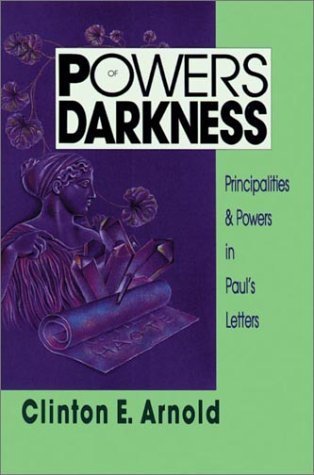
A quickly prepared summary:
Arnold’s book is divided into three parts. The first addresses the supernatural worldview of the first century. Part two is a survey of Paul’s teaching on supernatural principalities and powers. And Part Three interprets Paul’s writings for today.
The stories of the New Testament are set among people who believed that “the supernatural realm exercises control over everyday life and eternal destiny.” (19) For example, the book of Acts records four stories of magic: the story of Simon the Magician who sought to buy the power of the Holy Spirit (Acts 8); Elymas, a Jewish magician who opposed Paul in Cyprus (Acts 13); the slave girl of Philippi who had a spirit of divination (Acts 16); and the burning of the magical books in Ephesus (Acts 19).
In addition to magic, Greco-Roman and Oriental religions shaped Paul’s teaching on principalities and powers. Astrology was also believed to have great influence over the affairs of humans. It was based on the belief that the universe operated as an integrated whole with each of its parts dependent upon and influenced by one another. Perhaps confronting an astrological worldview was in Paul’s mind when he wrote to the Ephesians about God’s predestination of the world. “Kosmokratores” in Ephesians 6:12 and “stoicheia” in Colossians 2:8, 20 and Galatians 4:3, 9 were words used also by pagans to refer to astral spirits.
The Old Testament provides clues concerning the Jewish belief about spiritual beings. False gods were referred to as idols. There are stories of witches, mediums and spiritists. An evil spirit came between Abimelech and the people of Shechem (Judges 9:23), tormented King Saul (1 Samuel 16:14-23) and inspired 400 prophets who advised King Ahab (1 Kings 22:1-40). And possibly the prophecies against the King of Tyre in Ezekiel and Isaiah ultimately pointed to Satan. Supernatural beings are also identified with nations in the Old Testament, and God can direct these beings in response to the prayers of his people (Daniel 10:12). During the intertestamental period, the belief in spirit beings grew as people viewed God as more distant and transcendent.
Chapter 6 is key in Arnold’s thought. In this chapter he explores whether or not Paul viewed principalities and powers as “projections of the abstract notions of personal, corporate and political evil” or as “spirits having their own independent existence.” (89) Paul used both Jewish and Hellenistic terms for spiritual beings. Paul attributes to Satan the blinding of unbelievers to the truth of the gospel (2 Corinthians 4:4), capturing some to oppose the ministry (2 Timothy 2:26), and enslaving people to live under the powers of the world (Galatians 4:3). Paul was concerned for new believers who were tempted to return to idolatry, which Paul equated with demonic influence.
Christ has overcome the devil and disarmed him of his greatest weapon: death. He did this on the cross. Faith in Christ makes possibly union with Christ, and the result is a new identity and a new kingdom where there is freedom from and victory over the principalities and powers that remain active in the world. Christ’s reign over them is shared with his followers, and his Spirit empowers them to be triumphant over demonic forces of influence. “In Christ” believers are secure, “wrapped in the arms of a loving God, forever protected and forever cherished.” (119)
Though believers are secure in Christ, the Enemy continues to wage his warfare against them. In Ephesians 2:1-3 Paul says that believers are enticed to sin by the world, the devil and the flesh. Possibly “the world” could refer to the systems, cultures and structures in which we live, which draw us away from God. The devil’s temptations are more personal. And the flesh is the inner impulse to do what is wrong.
In his chapter on spiritual warfare, Arnold states, “The best way to determine what spiritual warfare means for us now is to discern what it meant for Paul and his readers back then.” (149) Their view was likely more similar to contemporary non-Western views than to Western ones. Spiritual warfare involves power. It isn’t power simply to resist Satan, but also to love and live according to biblical standards. This power is personal and accessible to everyone who trusts in Christ.
Ephesians 6 is the go-to passage for spiritual warfare. The spiritual armor described includes 5 gifts from God and two responsibilities on our part. The spiritual warfare described “is primarily concerned with Christian conduct and spreading the gospel – not with exorcism or eradicating structural evil. The heart of spiritual warfare could best be summarized as resistance and proclamation.” (154) “The primary aggressive action the Christian is called to take in the world is to spread the gospel – the good news of salvation through the death and resurrection of Christ.” (157) Access to the power for spiritual warfare is prayer. This isn’t merely prayer for one’s self, however. We arm one another by praying for one another (Ephesians 6:18). So we pray to resist areas of personal vulnerability. We pray for the spread of the gospel. And we pray to arm one another for battle.
How are we to understand Paul’s teaching concerning principalities and powers today? Paul clearly believed in demonic principalities and powers who, through direct influence and false religions, were exercising control over the human race. However, today many regard them as mythical creatures symbolizing evil but without objective existence. Some, such as Walter Wink, equate them with evil political, social and economic systems – the “inner essence” of a person or organization. Arnold describes well the predicament in which the common westerner finds himself today: “If we accept at face value the Bible’s affirmation of the reality of evil spirits, we create an unbridgeable gulf between our world view and the prevailing Western world view. The crux of the issue … is the degree to which we should allow our Western scientific world view to determine our conclusions.” (176) So will our Western worldview critique the biblical one, or vice versa?
Arnold believes there is compelling evidence to believe the biblical worldview. First, because spirit beings are immaterial, it is impossible for science to prove or disprove their existence. Second, there are many types of evil for which there are not natural explanations. Third, it is only in the past 300 years that there has been skepticism regarding the existence of principalities and powers. Fourth, the majority of the world’s peoples continue to believe in spirit beings. As Paul Hiebert has asserted, Westerners have a blind spot when it comes to the supernatural – what he called our “excluded middle.” Our buffered existence shelters us from many of the experiences those in the non-Western world encounter. Fifth, even in the West many have encountered evil spirits. Sixth, the West is undergoing an “occult explosion.”
How is one to discern if Satan is exploiting a natural impulse, working through an evil system, or directly influencing a person? Direct demonic possession or attack usually involves bizarre behavior. When working through systems, corporations, governments or cultures, Satan often attacks biblical ethics drawing us away from godly values. When exploiting our flesh, he persuades us to surrender to sinful desires or temptations.
Arnold concludes with some helpful advice for Western Christians. First, re-evaluate your worldview in light of Scripture. Second, reflect on where the powers influence you most. Third, know who you are in Christ. Fourth, receive and appropriate God’s power in the Holy Spirit. Fourth, resist the evil one. Fifth, join with God’s people on mission.