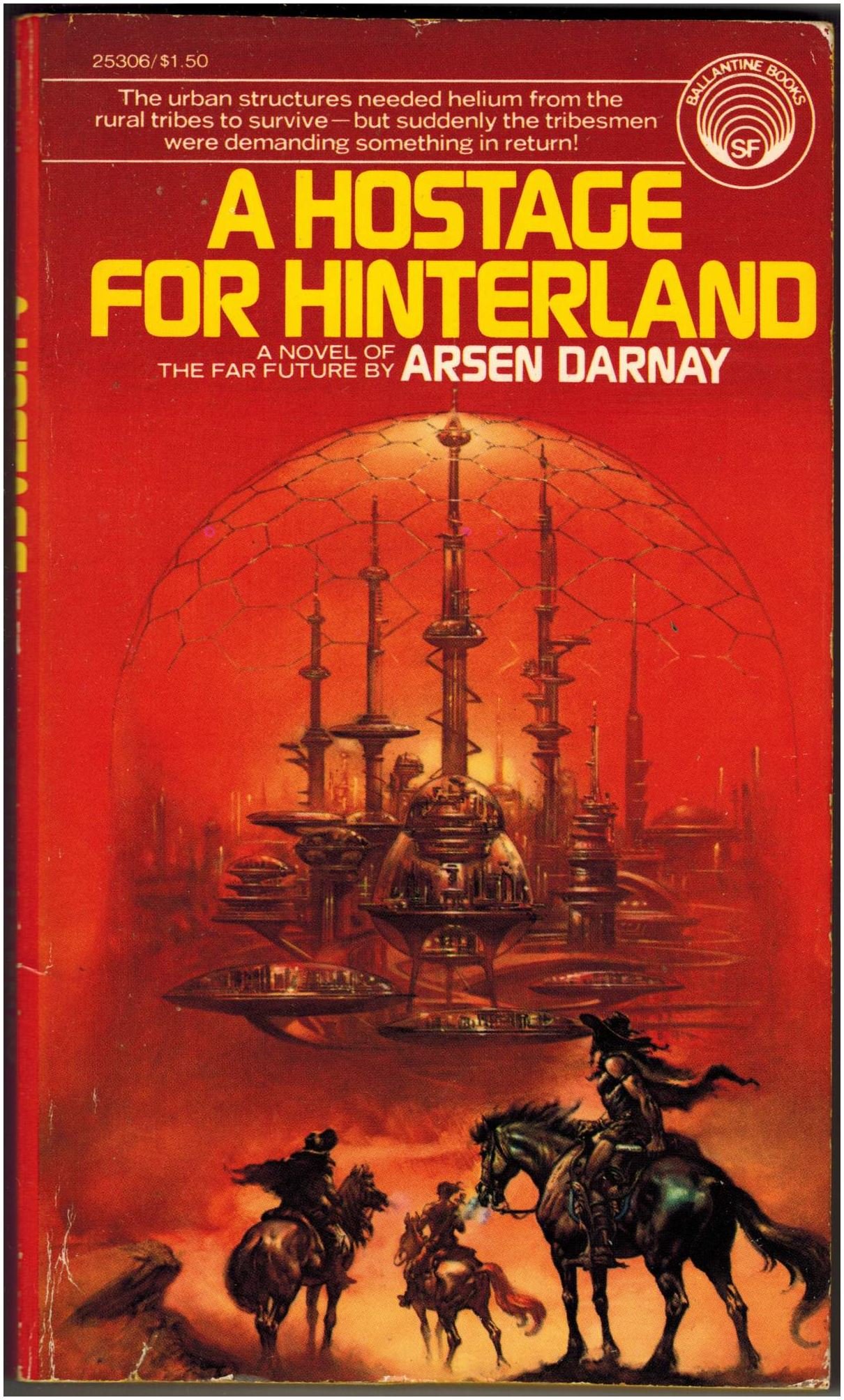
A Hostage For Darnay, A Hostage For Ballantine FIRST First Edition, First Printing. Published by Ballantine Books, 1976. 12mo. Paperback. Book is like new. Seller 508644 Pulp Paperbacks We Buy Books! Collections - Libraries - Estates - Individual Titles. Message us if you have books to sell!
Arsen Julius Darnay. Hungarian-born writer, in the USA from 1953 and a US citizen from 1961. He resides in Michigan with wife Brigitte Theodora nee Schulz, retired reference publisher, also born in Europe. They have 3 children, 5 grandchildren, and 2+ great-grandchildren. http://www.isfdb.org/wiki/index.php/B...
Since age 7, he has considered his "calling to be a writer, even poet". His first sf story, "The Splendid Freedom", appeared in Galaxy in 1974; his first novel, A Hostage for Hinterland, set the pattern for much of his work: in a Post-Holocaust USA, where floating Cities depend upon land-dwelling ecofreak tribesmen for the helium that cools their reactors, crisis erupts into a bleak and somewhat metaphysical confrontation, at the end of which the cities die. A similarly abstract dichotomy, set on a Rimworld, is destabilized in The Siege of Faltara (1978). The Splendid Freedom (collection of linked stories, 1980) carries its protagonists, who are linked through Reincarnation, into a variety of Dystopias. Darnay did not publish fiction 1981-2009.
A Hostage for Hinterland was serialized in three issues of Jim Baen's Galaxy magazine April - July (there was no May issue for some reason) in 1975 with the title Helium. Del Rey released it in mass market format at the end of the following year with this different title, presumably to avoid confusion with Burroughs' John Carter books, and with a striking Boris Vallejo cover. It's a post-apocalyptic political story that's somewhat dated; remember the phrases "peacenik" and "ecofreak"? The characters are fairly well handled, and the positives and negatives of all parties are presented, though it seems to have more than a little of a libertarian flair. It's a little hard to follow at times, but it's not bad. I gave it two-and-a-half and rounded up.
I'm mystified when a book has a Boris Vallejo cover and is not filled with "Boris Vallejo action". The cover scene shows the events of the first few pages and then the book dives into the political conflicts between and among the various power groups of this ill-described, weirdo society. Scene after scene of dialog and rumination between people you don't care about over things you don't understand.
There's merit in an intricate story, methodically constructed from the push and pull of the constituent characters and how they all lock together, and merit in the mystery of dumping the reader into an environment full of unknowns. Doing both? Ambitious and fraught with risk. And Darnay does not pull it off.
Not a very good book, and normally I would have stopped reading it, but I have a book bingo card from the library with a squre for "judged by the cover" and the cover art is what made me interested in this book to begin with.
This is one of those books you can tell was inspired by Dune, but the author didn't just copy it, he tried to go in his own direction. In this book, the Hinterland people live off the land and hate the people of the Structure cities. The structure people aren't allowed to leave, but they control the nukes. The structures are vertical cities maintained with antigravity generators. They need trade with the Hinterland people for fuel, so the Hinterland people fuel the cities and in exchange the city people don't blow them all up with nuclear weapons.
Mostly we see life in the structures, where a delegation sent to negotiate the latest trade deal enters the city. Multiple factions among the Hinterland negotiators and the structure people all have their own grand schemes that crash into one another spectacularly. There are two female characters who exist only to be feminine and mostly useless.