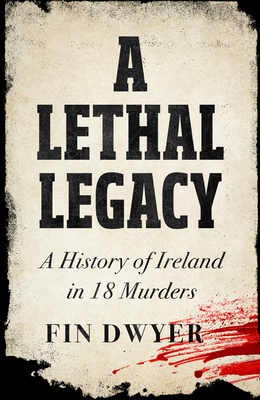
The Instant Top 5 Irish Times BestsellerFrom the creator of The Irish History Podcast comes a fascinating look at Irish history through the lens of murder.
In A Lethal Legacy, Fin Dwyer charts 200 years of Irish history, opening up our past as never before, by observing the grand societal changes of our times through the intimate lens of eighteen murders and the lives and communities they altered forever.
From the creator of the critically acclaimed Irish History Podcast comes a ground-breaking exploration of the past, casting its gaze beyond the chambers of power and carnage of battle, and into the lives of the everyday people that lived through those violent centuries. From the desperate retributions of the Land War of the nineteenth century, through the unprecedented tumult of the revolutionary years, to the causes that helped to shape contemporary Ireland, these previously overlooked cases of human tragedy offer a fresh perspective on a history we think we know.
Astonishing, illuminating and compelling, A Lethal Legacy chronicles Ireland’s turbulent past through one of our most enduring fascinations – the act of killing – and in mapping the causes and aftermath of these cases, Dwyer offers us a fresh new understanding of the fires that forged modern Ireland.
An excellent original concept and very well-researched!
Fans of ‘The Irish History Podcast’ will immediately recognise Dwyer’s remarkable narrative flair and talent for curating the more obscure stories in Irish history you don’t learn about in school, deftly framing these within the wider political and social context of the time. The first half, covering the 19th century, was particularly interesting and informative for me.
I’m definitely going to need to do a re-read to fully absorb the wealth of details crammed into this book, but overall this was a fascinating read that I’d highly recommend.
I half read and half audiobooked this one and I think it holds up better as an audiobook. You can tell the writer is a podcast host, his delivery is great and I found him super entertaining to listen to.
Cool concept of tackling Irish history through the lens of 18 murders - I thought the author handled each story with that care that is absent from most telling of crime stories these days. Found it to be a super accessible way to digest a massive amount of historical information in a way that humanized the people that lived through the events.
A different look into Irish history with more obscure murders framing different periods. Listened on audiobook and it is just like the podcast. While enjoyable, I did find that it felt like a slew of these podcasts rolled into one book. Pro: I learned more on Irish history by having an obscure murder framing it. Enjoyable, would recommend.
Each chapter did largely feel like an episode of his podcast, which I don’t particularly mind. But I’ve never seen a book that needed a Conclusion chapter more and didn’t have one.
This isn't exactly what I was expecting. I did find it a little bit repetitive. A lot of the crimes take place around the potato starvation era. Which reading this, as an Australian, you do not realise how much of an influence not having potatoes had on the Irish people. I personally thought that it was going to be some of the most famous Irish crimes, from the beginning to relatively modern. I judged the book by its cover. However, it is still a fascinating read.
Really enjoyed it. Fin has selected plenty of stories that I think readers will only be learning about for the very first time, all at really interesting junctures in Irish history.
Very good. Shines a light on the social problems of ireland and its advancement from early 1800s to present day .
Shows the issues of emmigration, discrimination , misogyny , poverty and landlordism through the eyes of ordinary people. Wont find the murder of michael collins or veronica guerrin here but of the sort that were a testament to the time and now forgotten.
As a swede, I am very far removed from Ireland and its surprisingly brutal history, but after reading Say Nothing by Keefe last year, I felt compelled to deepen my understanding of this fascinating island and country. I was not entirely prepared for what I learned.
So the book spans quite a large stretch of time, beginning in 1822 and finishing in 1982, roughly 140 years of history. I thought it maybe a bit too ambitious to delve into such a long period through just 18 individual murders, but I was proven wrong.
My knowledge of The Great Hunger was sparse at best, and learning about it through the very real accounts of the suffering and injustice was humbling. From there, we move to sectarian violence, struggles between unionists, Home Rule supporters and the even more radical Sinn Féin, Protestants versus Catholics, extreme poverty, last-ditch emigrations, oppression of the common people, the Black and Tans, the Ulster Unionists and the bloody birth of modern Belfast... I could go on, but I shan't.
In my opinion, Dwyer handles all the cases with a careful hand, never taking a side without elaborating on all sides of a conflict where justified. The final case, that of Declan Flynn, enraged me, and the judge who let the perpetrators get off scot free from what was a murder fueled by bigotry is a disgrace.
Ireland has come a long way, but the fact that gay rights and women's right to abortion are such recent developments is chilling, especially with how the world is leaning currently. I have very little good to say about the Catholic church, and I can only hope that their reign of influence on the nation is a bygone era. This book made me feel a lot of things, sadness, rage, bemusement, and disgust. Though a tough read in many ways, I feel considerably more enlightened after going on this journey with Fin Dwyer as my guide.
An excellent concept expertly executed, in ‘A Lethal Legacy’ the historian and podcaster Fin Dwyer takes 18 murder cases to tell the history of how Irish society has developed over the last 200 years. The homicides described in ‘A Lethal Legacy’ are meticulously researched by Dwyer, the book is structured superbly and – despite much of the subject matter – it rarely resorts to being gratuitously grisly.
The murders selected by Dwyer to illustrate the course of Irish history are often relatively obscure. But Dwyer’s choices are unswervingly reflective of wider trends in Ireland over the last two centuries, from simmering sectarian tensions, the persistent stigmatisation of people with mental health problems, and the effects of the Catholic Church’s sexually repressive morality.
Clever idea for a book. Execution was off though (no pun). The author attempts to pin a particular murder to a time and place that fleshes out a larger theme in Irish history. It's hit or miss. The chapter "Emigration" focuses on the spectacularly scandalous murder of a woman by her Catholic priest lover after she comes the the US and he follows her. This dovetails with the author's overall theme the the Catholic church is the most evil thing in Irish history (a repeated mantra throughout) but it doesn't really have a hell of a lot to do with the history, causes and effects of Irish emigration. Likewise, in other chapters, the details of a murder meant to typify an era is jammed awkwardly for a page or two into an extended essay almost as an afterthought.
I bought this when I was in Ireland last year and just completed it. It's an interesting way to tell the history of a country - by focusing on a number of murders (18 in this case) that have happened through the centuries and using those individual stories to paint the picture of the history of the land. Author Fin Dwyer walks the reader through such dark times as the Great Famine, the Land Wars, the Irish civil war and the Troubles. Along the way we meet some sad figures who were brutally murdered, sometimes in crimes that were never solved. It's a very dark book and at times got bogged down in a bit of minutia but overall I feel a bit more knowledgeable about Ireland and for that I'm grateful.
Excellent, thoroughly enjoyable as a page turning pop history read, and it does what it says on the tin. Obviously the format is good for drawing in the lucrative and popular true crime crowd but by paying diligent attention to the political, economic, social and cultural context to each of the incidents we do get a really good and wide ranging picture of Irish history from the act of union to the near present.
Highly recommended. I read it, after being a listener to the podcast for many years it was easy to just hear it in his voice, but for those uninitiated or users of audiobooks in general it's very much worth getting in that format.
Rating: 3,5/5 rounded up. The concept was great: A selection of murder cases presented in chronological order, which Dwyer links to the wider social, political and economic context in order to create a history of Ireland in 18 crimes. I agree with some of the other reviewers in that there was a little bit of repetition going on and as the book progressed closer to present day, you almost lost sight of what the murder case in focus was, because Dwyer ends up talking about lots of other related crimes. However, overall, I really enjoyed the structure as well as Dwyer's own narration of the audiobook.
Really interesting book. Basically it gives a quick summary of 18 murders that happened in Ireland from the early 1800s to the early 1900s. Each chapter covers one case and are about 20 pages apiece making them really easy to skim through so the book can be read in bite size chunks. More important is that the author does not overly dwell on the details of the murder but puts in context of the history of the time and why the murder was significant. Highly recommended. Also, the hard back edition is gorgeously presented and makes a great gift.
This book has an unusual premise. Illustrating different eras of Irish through the prism of a murder that happened during the course of them but I think it works well in practice. The greater body of the text is dedicated to the historical context of saud murders (in some instances the specific killings feel like a footnote). The writing is accessible without being overly simplistic so the chapters can be ploughed through at a good pace. Would recommend to anyone that’s for a general history of Ireland between 1800 & the 1990s
I usually don't care for true crime stories but this book educated me on various murders in Irish history without glamourising them or making light of them. For anyone interested in learning about Irish society throughout the last few millenia then this is a book you must read. Dwyer's writing style is magnificent. It is academic without being inaccessible or stuffy. I found myself unable to put down the book at points. I feel that, at certain points, he gives too much context. Less would suffice and everything would still be perfectly comprehensible.
This book looks at eighteen of the most culturally and historically significant murders and their effects throughout two hundred years of Irish history. I had not heard of any of these cases, so I was really interested to learn about them. It was also really interesting to see how society reacted to them and how different legalities came to pass as a result of them. I have the Audible version of this book, and loved the narrator as well.
At school, history was a series of dates, names and places. The lesson was these things happened so remember it. Yes, it will be on the test. My teachers never addressed why. It turns out that context is everything. This book is about context and it was enlightening to read.
I enjoyed the book. It’s a pity that the editing wasn’t better, the book has too many typos and grammatical errors which took from the book. Overall I liked it and will recommend it to friends and colleagues
interesting, i appreciated the attention given to women and minorities who are so often overlooked in irish history, as well as the willingness to discuss the crimes of irish people, those involved in the empire and pro-treaty forces.
A very different sort of history book but one that worked on a lot of levels. It could be said that it is a unique look and fits the history of Ireland. Ireland has had a very difficult history with the English and it's very conservative governments.
4.5 stars. Not for those who pass on reading history. This work is dense, sometimes gritty, and may have you clenching your fists when justice is shoved aside by politicians, the wealthy, and the entitled.
I really enjoyed the introduction of minor or ordinary people from irelands history but I found that some of the weaving of the people with wider Irish society and politics to contextualise their deaths was clunky
This is a fantastic social history. Dwyer uses the 18 murders as a frame work to explore the Ireland of their time. This avoids the trap of sensationalising the killings.
I loved this book. Goes through history of Ireland through murders. Fin Dwyer has a great history podcast which I love and the book did not disappoint.