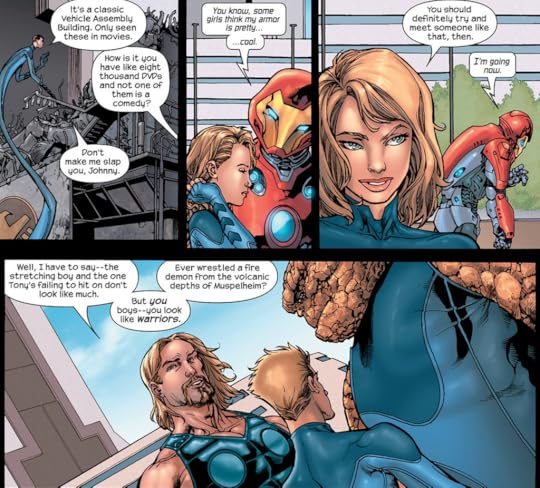
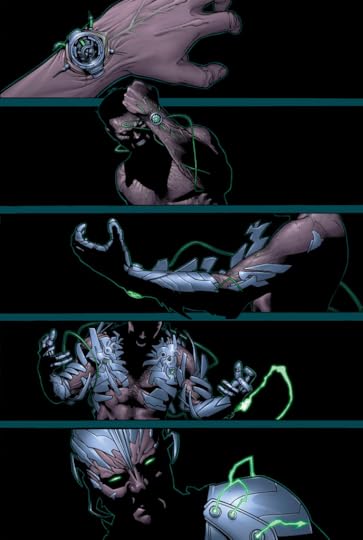
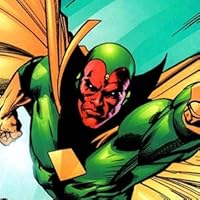
A new propulsion system devised by the U.S. government puts Mars just days away. It creates interplanetary opportunities unprecedented for the human race. But someone - or something - wants Earth's progression into space to stop. What does that mean to the Ultimates and the Ultimate Fantastic Four! And yes, that mysterious white-and-green figure is Ultimate Captain Marvel!Collecting : Ultimate Secret 1-4
Warren Ellis is the award-winning writer of graphic novels like TRANSMETROPOLITAN, FELL, MINISTRY OF SPACE and PLANETARY, and the author of the NYT-bestselling GUN MACHINE and the “underground classic” novel CROOKED LITTLE VEIN, as well as the digital short-story single DEAD PIG COLLECTOR. His newest book is the novella NORMAL, from FSG Originals, listed as one of Amazon’s Best 100 Books Of 2016.
The movie RED is based on his graphic novel of the same name, its sequel having been released in summer 2013. IRON MAN 3 is based on his Marvel Comics graphic novel IRON MAN: EXTREMIS. He is currently developing his graphic novel sequence with Jason Howard, TREES, for television, in concert with HardySonBaker and NBCU, and continues to work as a screenwriter and producer in film and television, represented by Angela Cheng Caplan and Cheng Caplan Company. He is the creator, writer and co-producer of the Netflix series CASTLEVANIA, recently renewed for its third season, and of the recently-announced Netflix series HEAVEN’S FOREST.
He’s written extensively for VICE, WIRED UK and Reuters on technological and cultural matters, and given keynote speeches and lectures at events like dConstruct, ThingsCon, Improving Reality, SxSW, How The Light Gets In, Haunted Machines and Cognitive Cities.
Warren Ellis has recently developed and curated the revival of the Wildstorm creative library for DC Entertainment with the series THE WILD STORM, and is currently working on the serialising of new graphic novel works TREES: THREE FATES and INJECTION at Image Comics, and the serialised graphic novel THE BATMAN’S GRAVE for DC Comics, while working as a Consulting Producer on another television series.
A documentary about his work, CAPTURED GHOSTS, was released in 2012.
Recognitions include the NUIG Literary and Debating Society’s President’s Medal for service to freedom of speech, the EAGLE AWARDS Roll Of Honour for lifetime achievement in the field of comics & graphic novels, the Grand Prix de l’Imaginaire 2010, the Sidewise Award for Alternate History and the International Horror Guild Award for illustrated narrative. He is a Patron of Humanists UK. He holds an honorary doctorate from the University of Essex.
Warren Ellis lives outside London, on the south-east coast of England, in case he needs to make a quick getaway.
This volume wasn't as good as what I thought it would be. Vol 2 of the Galactus arc revolves around Captain Marh Vehl (a Kree infiltrator in the Ultimates Universe) and his interaction with Carol Danvers at the SHIELD aerospace facility.
SHIELD realizing that Capt Marh Vehl is an alien detains him, at which point he decides to defect to the Human side. He offers to tell SHIELD all about Gah Lak Tus (which it turns out is a Kree term for the Anti-god). Fury invites in the Fantastic Four and Stark and Thor. It seems the Kree don't like humanity and want us stuck on Earth and directly in Galactus's path. The second volume really was about getting the FF into the story arc and introducing Capt Marh Vehl and his "insider" knowledge about the massive threat that Galactus poses.
The artwork was uniformly good and I'm not saying this was a bad volume, it's just I expected more. Really the big secret is revealed at the start of the stroy- the SHIELD Doc is Capt Marh Vehl and then the rest of the story is of why the Kree are trying to trap us in Galactus' path with no hope for survival (here's a hint-they hate us).
This is still a well written story and the accompanying art is quite good. I am curious to see how the Ultimates treat the whole Galactus thing. Their Fantastic Four is very young looking, but it works. This is more a background story than an action one.
This is the middle chapter of a trilogy and it really feels like it. There's no way you'd know what the heck was going on if you hadn't already read Ultimate Nightmare.
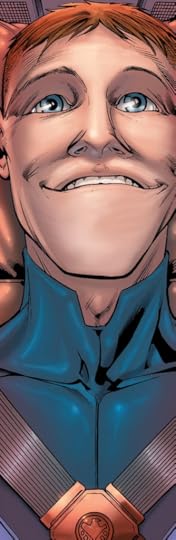
It's a pretty standard connecting chapter with some fighting thrown in, to be honest. The highlight of the book is the introduction of Ultimate Captain Marvel, who is remarkably faithful to the original 616-universe Captain Marvel, despite the surgery required to make him look human instead of his native Kree. (In the original Marvel universe, the Kree look just like humans apart from the fact that they have an ethnic group with blue skin. In the Ultimate universe, the Kree look like cadaverous lizardlike creatures. I'm assuming Captain Marvel's surgery was mainly collagen implants and botox.)
At four issues, this chapter is shorter than both the others, which are five issues apiece. I actually felt like this could have benefited from an extra issue; at its actual length it feels a bit cramped.
The best thing about this otherwise pretty mediocre book is Steve McNiven's artwork but, unfortunately, he only draws the first half of this book.
Middle book of a series which felt like nothing much happened. Well, Captain Marh Vehl did get introduced and was faithful to his origins, but other than that this was a lackluster affair.
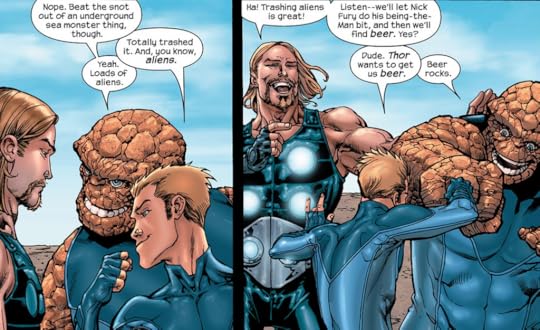
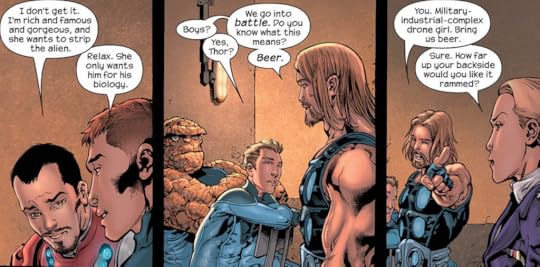
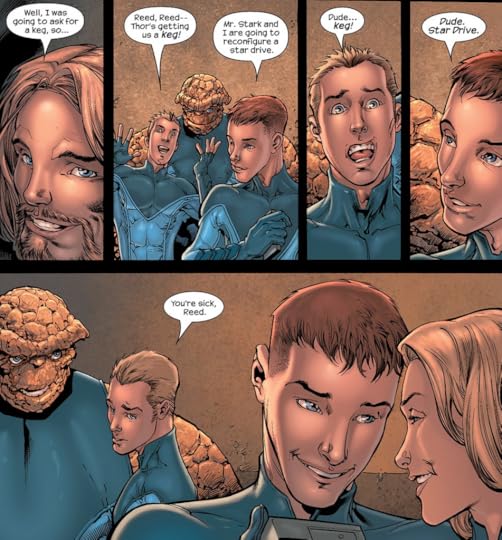
So the Fantastic Four are teenage virgins in the Ultimate universe... Who gets wide-eyed at beer? The story is just as shallow as the Nightmare volume, but it's standalone, so I don't have to worry that my Ultimate universe knowledge is next to nothing.
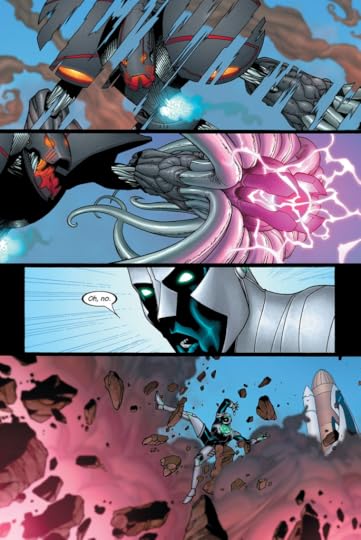
Dr. Philip Lawson has been working on the Asis program to developed technology able to take humanity to the stars. He turns out to be a disavowed Kree who reveals his secret while disabling a killform, a machine sent to destroy the Asis.
Fury invites the Fantastic Four to join the club and briefs them about Lawson, his defection to the human race, Galactus the destroyer of worlds and the Kree who want to keep humanity on Earth and in Galactus's path. They develop a plan to challenge the Kree into sending more troops from the ship where Lawson was a crewmember before defecting. Their end goal is to capture the ship and any information on how to stop Galactus.
This is good, but it’s also action filler. There were few if any revelations in these issues. There was, however, some fulfilling character dynamics at play, as well as overall good writing and kickass art from Steve McNiven and Tom Raney.
Warren Ellis is definitely in his element with the large scale, spacey sci fi. It reminds me a lot of Mass Effect (which actually came later.)
The worst I can say about this is that it's disappointingly short. I could happily read Warren Ellis comics for days. He has a marvelous way of writing about the bleeding edge of technology with breathless abandon. Certainly this series is living up to the "Ultimate" part of its title. One of the best Galactus stories I've ever read and the big G has yet to actually put in an appearance. Still building anticipation. Should be a cracking final volume!
Not quite up to the level of the first volume, but still interesting. Artwork's not quite as good this time. I liked the introduction of Captain Mar Vehl and the Kree, but it seems like there ought to be more going on here. Kind of like the climax of Independence Day, with a diversion on the ground allowing a spaceship to hit the Kree mothership for intel.
Just OK. Moving the Gah Lak Tus storyline forward. I'm just over these macho militaristic stories. The male characters all point guns and act tough and the female characters are all terribly into the men. It all feels so dated. And I don't know why I keep having to write this, but stop using the R word!
Another entirely OK story. This one's best element is probably the more science-fictiony look at Captain Marvel and Kree, and besides that ... it's an adventure story.
This second part of the trilogy, spanning four issues, offers a mixed experience that struggles to live up to the promise of its predecessor, "Ultimate Nightmare."
The story introduces new characters, locations, and threats, but the connection to the previous part remains unclear for much of the run, requiring patience as the plot unfolds. The narrative often feels dragged, with little background or explanation for key developments, such as why Captain Marvel turns against his own people.
Characterization is a major weak point. The portrayal of the Fantastic Four as teenagers and Captain Marvel's armor resembling Iron Man's suit detracts from the story's impact. The characters often behave in a childish, boastful, and nerdy manner, which undermines the tension and seriousness established earlier. Many characters come across as one-dimensional and uninteresting, making it difficult to engage with their struggles.
The pacing suffers from a lack of real danger or tension. The heroes accomplish their goals too easily, with mishaps resolved effortlessly, which diminishes the stakes and suspense.
Artistically, the series is solid but somewhat orthodox and constrained. The art is the highlight of the series, especially in the fourth issue, which is the strongest by a small margin. However, the visuals alone cannot fully compensate for the story's shortcomings.
In summary, while this segment has its moments, it ultimately feels like a disappointment compared to the first part of the trilogy. Fans of "Ultimate Nightmare" may find this continuation irritating, but those willing to persevere might find some enjoyment in the art and occasional action.
The Fermi Paradox has been solved. There aren't many aliens because something comes and eats their planet when they reach a certain state of development. The Kree Empire has ships around the Earth stopping anyone from leaving. We were meant to be warned a century ago, but instead we have very little time to get ready before Gah Lak Tus arrives.
I thought the first volume of this was pretty fun, but this felt like they were stalling. It's alright. But I feel like we could have just skipped to the main event.
Another part of the Galactus Trilogy. Just ok, again. Ellis needed some space to explain things, and he clearly uses this book to do it. Introduces a very interesting Captain Marvel to the ultimate universe, and finally starts to integrate FF to the wider universe, interacting with other characters.
That said, kinda weird that the second part of the trilogy still doesn't really get things in motion. Like, we are 10/15 issues in, and not much happened. Curious for how Ellis wraps it up in the final book.
I like this version of the Captain Marvel, however he's not good enough to carry this forgettable middle part of the Gah Lak Tus trilogy. It serves it's purpose in the grander narrative and, while there are a few neat thing to highlight in this volume (like the aforementioned Marvel or the cute meeting between Richards and Stark), it's just "meh".
This volume is 96 pages and contains the four issue miniseries Ultimate Secret. To be honest this one felt a little clunky. It wasn’t horrible or anything, but it wasn’t great either. I actually would have liked to see it given a little more time for the story to develop. 4 issues felt rushed. Maybe 5 or 6 would have been better.
Captain Marvel enters the Ultimate universe, as do the Kree. This is very much a middle volume and mainly a way to get the Fantastic Four involved. The first couple of issues are completely FF-centric before the Ultimates show up halfway through. Warren Ellis continues to maintain my interest even though Galactus still hasn't been anywhere near Earth yet.
Une histoire un peu bête et pleine d’incohérences (toutes les espèces en état de communiquer avec d’autres planètes sont exterminées avant de le faire, sauf visiblement celle qui est carrément capable de mener un projet scientifique visant à laisser la Terre être exterminée, wtf). Mais il y a plein d’humour, ce qui sauve complètement la situation. Et le dessin est plutôt chouette
Definitely the most solid team-up event thus far, which isn't saying much. There were a few "no way" moments. I appreciated new takes on characters I'm familiar with. I hope the long build of the this supervillain is worth it.
This entire review has been hidden because of spoilers.
Way better than the previous part but still not great. At least the dialogue is fun and there is some world building about alien races... At the very least it maked me a bit more hyped about Gah Lak Tus.
This second edition of this trilogy gave hints what badness this would ultimately be, but in this collection there was also some sweet John Romita Jr. art. So this was not a totally bad. Still, not too good either.
Book Info: This collection contains Ultimate Secret issues #1-4.
ABSOLUTE RATING: {3.5+/5 stars}
STANDARDIZED RATING: <4/5 stars>
In an aerospace development facility in New Mexico, S.H.I.E.L.D. is unveiling a promising experimental spacecraft named Asis. During a conference, project head Phillip Lawson explains how the ship's propulsion drive technology could not only make frequent interplanetary travel far more manageable, but it could open the door for free and limitless energy. Then, a sudden extraterrestrial attack on the compound cuts the event short, and sends the base into lockdown. But when Lawson springs into action trying to protect everyone from this alien threat, he proves to be someone other than who he seemed...
In many ways, Ultimate Secret turned out to be a minor disappointment for me. Compared to Ultimate Nightmare, there was much less action and a significant decrease in thrills. Here, the plot was less ominously mysterious and there were less uncertain variables at play. And while a comparable level of scientific rigor was carried over, it didn't grip me as much – partly since many of the implications were already introduced in Nightmare. I'm also guessing that the one-issue reduction (i.e. from five to four) in this volume provided Ellis with less time to nurture a suspenseful plot, and I didn't find the book benefited very much from his acute focus on casual intrateam bonding; more than anything else, this seemed like he was killing time, and it didn't particularly do much to develop conflict or make me care for the characters as part of a cohesive team.
For me, the first half was the highlight of the volume, and I loved how he worked with McNiven to create such a sleek, futuristic superhero portrayal; there were certain elements about the combat and cutting-edge weaponry that made this book feel five years ahead of its time. One thing that was kind of odd about McNiven was how much his style resembled that of fellow penciller Salvador Larroca. It was perhaps early enough in the artist's career that, if I hadn't known these first issues were drawn by McNiven, I may have guessed it was Larroca, but he seems to have honed his skills somewhat since this. But for issues three and four, Tom Raney takes over illustration, and fortunately (aside from the image of Reed pasted below), the quality of his work isn't so far behind McNiven that the change makes *too* much of a difference. And the chummy dialogue in this half was at least witty and charming enough – with numerous interesting scientific remarks mixed in – that I was kept reasonably entertained until things heated up again.
[Honestly, it's not my intention to scare you away from reading this; consider it just one slip-up in an otherwise decently-drawn two issues.]
While not a bad volume overall, I hope this book primarily serves as a segue into a more exciting third installment. Combined with the introduction of some additional central characters, I'm glad there was still enough plot material and unanswered questions to make for a spectacular finale. I'm just gonna go ahead and trust that Ellis is up to the task...