A haunting first novel based on the fascinating life of an Arctic explorer whose fearless pursuit of scientific discovery revolutionized our perception of the world. In his lifetime Alfred Wegener was a German meteorologist who was better known for his offbeat scientific adventures than for his now famous theory of continental drift. In this lushly imagined and beautifully written novel, Clare Dudman charts his life from his 1880 birth to his last daring Arctic exploration in 1930. Dudman vividly chronicles the key episodes that punctuated his life, such as his 1906 record-setting long-distance balloon flight; his several expeditions to Greenland; his passionate love for his wife; his investigations into meteorites, lunar craters, and the formation of raindrops; and his horrific experiences in the trenches of World War I. Dudman also tells of his struggle to defend his controversial theories, a struggle that forced him to leave all that he loved to make one final, fateful expedition to Greenland at the age of forty-nine. A passionate tale of obsession, endurance, courage, and love, this novel is a scintillating blend of science and history that is sure to appeal to readers of historical fiction and adventure narratives as well as to fans of Dava Sobel's successful histories.
Clare Dudman was born in North Wales. She has a PhD in Chemistry and has worked as a postdoctoral Research Associate in UMIST, a development scientist in industry, a science teacher, a lecturer and as a creative writing tutor for the WEA and the MA in creative writing at University College Chester. She is a member of the Welsh Academy.
If Khaled Hosseini managed to beguile me into thinking 'The Kite Runner' was fact Dudman did the reverse, I had to often pinch myself to remember that Wegener really lived.
I've hoarded this book for a while and it didn't disappoint. Cold adventures are a favourite of mine and in Dudman's hands they can only be brilliant, and they were.
A beautiful tone throughout - I really heard Wegeners voice. I saw through his eyes. I fell for his passions.
Clearly a thoroughly well researched novel, but the author manages to write a novel that wears that research lightly. I feel like I've been to far-flung places, and different times through this book. I feel like I've met people on the way. Who needs to leave the house when travelling through these pages is so perfect.
I'm surprised that I'm giving this such a low rating, because I really expected to like it a lot!
The main thing that's holding me back from really loving this story is the fact that the characters feel really underdeveloped. I get that it's based on real people and events, but I still feel like the characters could have been explored a lot more.
Else was the worst in this sense imo - even after reading about practically her entire life, I still had no real sense of who she is, or how she even feels about anything.
Wegener was a bit better, but there wasn't really any insight into who he was as a person, or why he made the decisions that he did. In the last half of the book especially, it felt like I was just reading a wikipedia biography or something. In fairness, it would have been about the coolest wiki article I've ever read, but that's not really what I pick up a novel for, you know?
Ultimately this book was very well-researched, and I definitely appreciate that effort, but it felt like there was no real heart in it. It had some really beautiful passages, but the character arcs just seemed really stilted and restrained. I'm glad other people enjoyed it more than I did, though!
3.5 stars, really. This is an elegantly knit homage to the German scientist most remembered for his controversial theory of continental drift. But he was a larger character beyond that single discovery—an Arctic explorer, cross-disciplinary scientist, and survivor of WWI trenches—Wegener also had colorful family members and connections. The amount of research this author had to do to cover the details here is staggering. For all that I admire here on subject and style, I was unsatisfied emotionally—especial at the author’s choices when ending the story of Wegener’s epic life. I thought more critical tones might have helped the overall message and made sense of the character’s choices—like what we get from Miranda’s Hamilton musical on Hamilton’s hubris. Probably the biggest sin of this book as a work of art is also its animating engine: it’s tied to the truth of a real man’s life, and the author doesn’t seem comfortable wandering too far into supposition. I wish she had taken a heavier hand to bring the themes of this book together at the end, but I also like the ambitious dedication to making celebratory note of this notable scientist.
I'm usually not a great fan of US retitlings of UK books (think back to Christopher Priest's novel set in Hardy country, A Dream of Wessex, which in the US became The Perfect Lover), but in this instance I gave a cheer when I discovered on the copyright page that the original UK title had been Wegener's Jigsaw. Hellish emotive, wot?
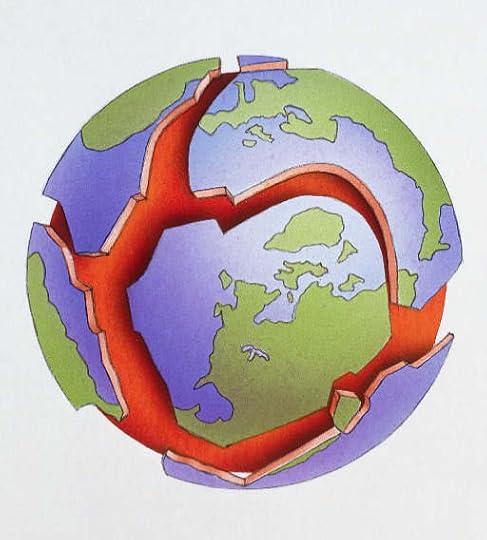
To say this is a biographical novel about Alfred Wegener, the meteorologist/glaciologist who, in the early part of the 20th century, was the first to formulate and champion a coherent theory (or, really, hypothesis) of continental drift, would be accurate but somewhat misleading. Usually one expects a biographical novel to have somewhat the same structure as a biography, but Dudman has eschewed this approach to adopt one that's far more interesting and which gives the book an affect almost of magic realism. The novel starts with Wegener's death on the Greenland ice. What follow are countless smallish, roughly chronological sections narrated by Wegener himself seemingly as a representation of his-whole-life-flashed-before-him as he waits to die. Dudman/Wegener calls these items memory beads, and that seems as good a descriptive term as any. Jigsawed together in one's mind as one reads, they build up a picture of Wegener as a highly appealing, passionate personality; whether they succeed as a biographical account for the reader unfamiliar with the bare bones of Wegener's life is another matter, and one that I confess didn't occur to me -- so enchanted was I by Dudman's telling -- until afterwards.
A major additional joy is that Dudman names some of the now mainly forgotten scientists who, for reasons largely of hideboundedness (even though the complaint that Wegener could produce no plausible mechanism for drift was a fair one), so steadfastly rejected his hypothesis. Despite the historical reality that it wasn't until long after Wegener's death that these numbskulls -- or at least the surviving ones -- got their comeuppance, when the 1960s discovery of the phenomenon of seafloor spreading not only provided a mechanism for drift but (almost) dictated that the continents had to drift, still one feels that the naming of names here offers some kind of justice to the man's memory.
In short, if you want a ripping yarn (Gabriel Hunt and the Secret of the Earth's Plates?), look elsewhere; but, if you want an absorbing and for the most part beautifully written narrative that unveils a bit of science's history that's perhaps too often overlooked, this is the book for you.
I'm finding that I very much enjoy this genre of fiction written about real life people.
I liked a lot about this book. The descriptions of Wegener's early life is well done. Dudman's descriptions of the ice on his explorations of Greenland are evocative.
But I did find myself kind of slogging toward the end. I would have liked a little more psychological insight into the character. And I often found myself wishing Dudman would set a wider field of vision for the descriptions. The close up views of ice caves and blowing snow were fascinating, but I was just dying to pull back and see the broader landscape more often.
You do wonder why-oh-why these explorers do some of the things they do, given that they proved ineffective and/or deadly in their past experience.
I found this book through a reference on Bookslut, which was only commenting on how cool the title was. It took me a week and a half to get into the story—I was always starting to read it late at night and falling asleep and forgetting what I had read. Once I had crossed that hurdle (on a road trip), I found it an engrossing story.
It is a fictionalized account of the life of Alfred Wegener, a German scrientist and explorer. It tracks his entire life, focusing primarily on the time he spent on the glaciers in Greenland, his marriage to the daughter of a professor he knew, and his fight to gain acceptance of his theory of continental drift (which was ridiculed by his contemporaries even though it eventually inspired plate tectonics.)
This was an interesting read in a wikipedia way. It is a fictional biography of Alfred Wegener, who happened to be a meteorologist. I appreciated the fact that the author did her research and that she was able to fabricate dialog, but I wish she had taken a few more creative liberties. It lacked a fictional vibe. The characters/historical figures were very stiff.
The first half was great as I was getting to know who Alfred was. But the last half seemed all wikipedia-ish and it just wasn't staying interesting.
This book is a wonderful example of how fiction can take us somewhere we would never otherwise have had access to: inside the mind of a historical figure, in this case Alfred Wegener. Clare Dudman achieves this so smoothly and movingly, without fireworks or cleverness. This is a powerful account of a man who has not recieved sufficient attention for his achievements, but it is also simply a beautifully-written and gripping story.
This is such a fascinating story of the real life experiences of German scientist (climatologist, glaciologist) Alfred Wegener. I don’t know what I enjoyed more, his voice describing the cold and ice of Greenland, or his home life with his wife and family. It just flows so well, and you can feel Wegener’s love and determination. Wegener was best known for his continental drift hypothesis, which was widely rejected in his time.
Wonderful fictional biography of Alfred Wegener a German scientist whose early proposal of continental shift was met with derision by his peers. His passion for unlocking the secrets of natural science led him to undertake the exploration of Greenland under extremely harrowing conditions. Truly an exciting read.
Chewy and pretty humourless but the science is very interesting. Saying that, if you just want facts there are online resources; one expects a certain finesse in a book.
-------- workaday mp3. Unabridged. A fictionalised biography - fictionalised, yes, but enthralling in terms of scientific discovery.
From Publishers Weekly In British author Dudman's stunning first adult novel, she reveals the poetry of science, interweaving a deep character study of German meteorologist Alfred Wegener (1880–1930) with scenes of pulse-pounding Arctic adventure. Today, Wegener's theory of continental drift, with some refinements, is accepted as scientific truth. During his time, however, Wegener was seen as an eccentric failure. Dudman allows Wegener to tell his own story in first-person present tense. This approach utterly immerses the reader in a sensual, detail-rich world. Dudman's prose is luminous, as in Wegener's reverie over the pages of a rare old book: "I too am adding parts of myself to the pages: oils are leaking from the skin of my hands and molecules of fat are smearing themselves invisibly on its surface." Dudman also displays an astute gift for characterization. Wegener's complex relationship with his brother Kurt and his love for his wife, Else, as measured against his lust for meteorological expeditions, is expertly, often heartbreakingly portrayed. As the story leads inexorably toward Wegener's demise in the frozen tundra of Greenland, Dudman's control over her material becomes even more masterful. The emotional yet understated final scenes are particularly fine. Above all, Dudman shows us one incontrovertible truth about her Wegener: he loved the world, in all of its riotous complexity. Some may say the same of Dudman after reading this wise, beautiful novel.
WASHINGTON: Researchers at Monash University and Scripps Institution of Oceanography have developed a new theory to explain the global motions of tectonic plates on the earth's surface.
The new theory extends the theory of plate tectonics - a kinematic description of plate motion without reference to the forces behind it -with a dynamical theory that provides a physical explanation for both the motions of tectonic plates as well as motion of plate boundaries. The new findings have implications for how scientists understand the geological evolution of Earth, and in particular, the tectonic evolution of western North America, in the past 50 million years.
I have a certain interest in the ridiculous and self-important men who risk their lives (and others’) to pursue an obsession with inhospitable places (see Winterdance, Into the Wild, The White Darkness). There’s always a certain level of indifference to other people’s well-being and desires (children, wives, sled dogs, crew members) but this book added an interesting layer — what if this is your calling?
Unlike those other thrill seekers and survivalists, Alfred Wegener had a scientific mission and a deep passion for his work that often overshadowed his bonds to society and family. At what point does the “hero” owe allegiance to his loved ones over the world?
This same question was asked if not answered in the lovely Good Morning, Midnight, where both father and daughter renounce their family ties to chase scientific dreams but are never sure if the choice was the right one, alone at the end of the world.
This lacked a neat, driving plot, focused entirely on Wegener over his family, jumped around a bit strangely, and was perhaps limited by the truth, but I loved it. Book club did not.
I don't read a great deal of historical fiction (I like both history and fiction, I just generally prefer them separated) but I was eventually drawn into this one and enjoyed the majority of it. Wegener was a fascinating and underappreciated scientist, always searching, striving, and theorizing with a boundless curiosity that sent him wandering into uninhabited lands and unfamiliar fields (often to the irritation of the established experts in those fields). Clare Dudman captures his life, his childhood adventures, his bond with his brother, his harrowing and fascinating Arctic expeditions, the horrors of WWI, his life with his young family in post-war Germany, and his once-highly-derided-but-now-praised theories on continental drift, moon craters, ice flows, and raindrop formation, all told in a voice that at times could almost make you forget it's not actually an autobiography.
"At last, I feel, I am entering the boundary between what is known and what is yet to be discovered. I am becoming a scientist."
A good book, a fictionalized account of Alfed Wegener's life. For the non-geologists, Wegener was the one who first popularized the theory of continental drift, which revolutionized the science. He faced a lot of scorn at the time and didn't really get much recognition until after his death. This story was good, much about his explorations in the arctic, written to make you feel very very cold. While there were some excellent passages, as a whole the author had to stick to Wegener's actual biography, so like most real people's lives, there are long periods of boredom interspersed with the interesting stuff. I'm glad I read it and may come back to it again someday to get more out of it. However, I think much of the detail in this book would be lost on someone who hasn't studied the history of geology or natural science in general.
A novel about German scientist Alfred Wegener's research in the ice to support his theory of continental drift. Based on Wegener's diary and notes, it is written in a first person voice as though an autobiography. There is a stark contrast between the cozy scenes with family and friends in Germany, and the hazards and harsh conditions of his expeditions to Greenland as a meterologist, from the last of which he never returned. My experience of this book may have been heightened by the fact that I read most of in the wee hours while recovering from surgery on the 7th floor of a hospital overlooking downtown Seattle, with sub-freezing weather and a cold draft off the windows. I learned of this one from librarian Nancy Pearl's Fall 2004 reading list.
I seem to be the anomaly here, giving it just two-stars. I thought the book was okay - I did keep reading until the end. I typically read non-fiction, but thought this fictionalized account of Wegener and the development of the theory of continental drift might be an interesting alternative. Some of the parts of his expeditions to Greenland and flying in a hot air balloon were reasonably interesting. But I also thought there was way too much autobiographical stuff with his family and with his wife Elsa - for the most part it was irrelevant to the broader story - and way too little on the actual development of his theory, which I found most interesting.
A beautiful and fascinating book about arctic exploration, this is a fictionalized bio of an actual scientist who was interested in many fields related to weather, the Arctic, plate tectonics, et al. It's also a thoughtful book on the process of science and thinking and experimentation, as well as being a wonderful narrative about adventure as well as family relations.
Beautifully written and wonderfully descriptive story of the life of a somewhat forgotten but, in my opinion, extraordinary man. I felt l was taken on the journey with him, seeing the ice and snow and feeling the excitement and stress with every expedition. A great read to be enjoyed wrapped up ands cozy through winter days.
I rarely quit a book when I am more than half-way through, but enough is enough. I am so bored with this egocentric character. I don't find him the least bit likable, and, frankly, I liked the dog much better. Now, if the author had stuck to the science and his forays into continental drift, I would have stuck with it.
Clare Dudman is an AMAZING writer, but you don't hear much about her. This book made me care about a meteorologist in the Arctic Circle around 1930 (Alfred Wegener, if you're better with science than I am), which is quite an accomplishment. The writing is beautiful, and the character is so real.
This is the fictionalized [auto]biography of an obscure German scientist who lived, studied, and explored remote areas of Greenland in the early 20th century. Certainly it is well-written and well-researched, but I never really connected with the characters or the story.
Seen through the eyes of Alfred Wegener, this book about his life mixed both poetry and science. I liked learning about Wegener's expeditions in Greenland and about his trying to convince the scientific community about continental drift.
Fantastic! First-person fictionalized story of the life of German scientist Alfred Wegener in the early twentieth century. He was a ballooning pioneer, studied glaciers in Greenland, served in World War I, and developed the theory of Continental Drift.
I loved this book! I enjoy this genre of Arctic adventures. It seemed well researched and I felt like I learned a lot about early exploration in Greenland and had a lot of empathy for the characters.
Fantastic book. Happened to pick it up and it was a book that I will always treasure and remember. An incredible historical fiction that inspired me in my real life of research, exploration and academics.