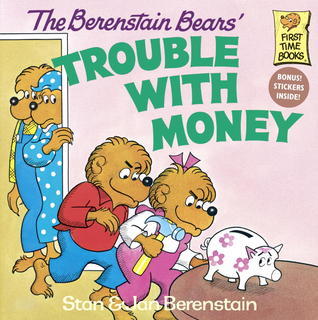
This classic Berenstain Bears story is a perfect way to teach children about the importance of being responsible with money!
Come for a visit in Bear Country with this classic First Time Book® from Stan and Jan Berenstain. Mama and Papa are worried that Brother and Sister seem to think money grows on trees. To make money of their own, the cubs decide to start their very own businesses, from a lemonade stand to a pet-walking service. Includes over 50 bonus stickers!
Stan and Jan Berenstain (often called The Berenstains) were American writers and illustrators best known for creating the children's book series the Berenstain Bears. Their son Mike Berenstain joined them as a creative team in the late 1980s.
Learning about money is something we all have to do. We can save it, spend it, care too much about it or too little about it. This book is as much about how to use money as it is how do parents help their kids find responsibility regarding money.
Brother & Sister bear are pretty good at making money, but if you don’t live next to woods and fields and all those good wild things in nature, it might be more difficult to make.
Still, the nephew and niece know the fun of spending money. My nephew got all the funko pops of Huey, Louis and Dewey. He just bought Toad, the Mario Bros mushroom stuffed animal. He doesn’t save it, he spends every dime when he gets it. The niece saves money more and she spends it on things she really enjoys. The nephew liked this book and he wants a way to get more money, or so he says. He’s pretty carefree and he usually wants it given to him. He wants to try and find things to sell. Good luck in this area. He gave this 4 stars. The niece didn’t think it was an exciting story really. She had it figured out from the start, but she does like Berenstain bears. The story was rather wordy for a Berenstain Bears story. She gave this 3 stars. She felt like she knows a lot about money.
Once again, this is a story where Papa bear looks like a raging, idiotic, hypocrite.
Also, the message is confusing. First, it's bad that the cubs are spending their money. Then it's bad that they are counting it and holding on to it in a piggy bank and sugar bowl. But it's okay to hold onto it in the bank? Why do they look like misers if they are counting their money but not if they have bank account before they are 10 years of age? And in the end, is it bad or good for cubs to earn money, have an allowance and spend money or make money? The message isn't clear.
I don't remember what happens in this story. But I remember reading it as a kid, knowing by the cover art that this book could teach me an important lesson. And I was eager for it to.
As I look back now at all these Berenstain Bears titles I read as a kid, many struck a chord with me. I knew at the time (although I couldn't put it into words) that many of these are moral tales. Or they at least help to make sense of things that might seem strange to children -- and about which children might not ask questions.
Maybe those children are quiet, introverts by nature, like me. Maybe those children don't ask questions about these topics because they don't get answers. Maybe they're ignored. Or maybe the topics aren't really talked about around those children. Maybe, like I did, they have a combination of many of those situations. Maybe money, for example, seems so important to their family unit, so needed and in such short supply, yet its lack could causing other families to see you as beneath them. Then no one in the family can openly discuss this for fear of someone overhearing what a struggle this is.
Who knows if Stan & Jan knew their book was going into homes like that. But regardless, I remember this particular story, out of all the other Berenstain Bears stories, seeming particularly powerful to me. I remember that feeling now by looking at the cover -- probably like I felt when I looked at the cover way-back-when. Like I said, I don't exactly remember specific lessons this book teaches -- but I'm sure it helped shape my perceptions of money. I'm sure it supplied Little Boy Me with some much-needed context for this taboo topic. And I'm grateful for that.
I'm coming away from this book a little confused. The cubs have no idea the value of money - and spend all the time. Then because Papa Bear complains about it, they set about proving just how easy money is to earn - also proving they still don't know the value of money, because it never means anything to them at all. I don't see where they necessarily learned anything in this book. Nor do we learn anything about money in general, or in how to handle it.
Also, it sets up an unreasonable expectation that money is easy to come by - which if you ask any kid with a lemonade stand, that this is not the case at all. Most of these enterprises really aren't all that successful.
Overall, I'm not real happy with this book, which is a shame. So far I've been loving this goal of reading all the Berenstain Bear books with my daughter this spring. I look forward to getting her impressions on this one.
So the trouble with money is that...It doesn't grow on trees, Papa isn't made of it, and you have to save it for a rainy day. The allowance idea is vetoed because they Cubs need to learn to earn money. The Cubs come up with many unique ideas doing what they know to earn money and they save all of it. Except things get slightly out of control when the Cubs start selling family secrets. But all turns out well and the Cubs end up starting a savings account at the bank!
Brother and Sister Bear are at it again! They knew money was fun to have, but more fun to spend. This book is cleverly written to teach children to save their money and not be greedy. We should be sensible with finances is the ultimate goal behind this children's book. Mama and Papa Bear do their best to teach Brother and Sister about saving money at an early age. I grew up with these books and have always enjoyed them, I plan to have them for my children in the future also.
Brother doesn't even have a piggy bank and Mama is worried about their spendthrift ways. Papa gets mad when they waste money on video games and knocks over a chair. Then, parents worry that cubs are getting greedy raising money and selling family honey tree secrets. Papa is humbled when they give him all of the money. Next they visit the bank and start earning an allowance.
This was a good one, as it actually demonstrates a journey of learning a lesson instead of Mama Bear (always Mama Bear!) sensibly going blah blah blah moral and then DONE. Although, the cubs decide to change their spendthrift ways after hearing Papa shout three turn of phrases, which is odd and far-fetched. I appreciated the cubs' entrepreneurial spirit!
This is one of the more classic stories in the Berenstain Bears canon. It does demonstrate that one should not immediately spend what one earns, the value of saving, and the value of working hard to earn money. There isn't anything about budgeting and planning how to spend your money, though.
These books are wonderful because they teach students of all ages how to solve real life issues. Trouble with money teaches students about responsibility. It helps students understand why saving money and managing money properly are important.
Brother and Sister are spending all their money on silly things, causing Mama and Papa Bear to wonder how to better teach them about the value of money and how to save it. Watching Papa Bear explode over the thought of wasting money playing games at the Arcade was amusing!
I don't know why this book is marketed to children; I'm a grown man and this book was way more informative than the boring lectures that my bank gives me. I highly recommend this book to people in college and recent graduates. Total eyeopener.
I am impressed with the content. Are you sure this series are for beginner readers? It sure is a great help for any spendthrift persons of any age. Don’t spend more than your income and learn to save for rainy days. Another figure of speech for the children bears.
I'm slowly finding and rereading a number of odd books I read as a younger reader, and they hit a little differently to an adult reader, I think.
Someone once commented to me that the bumbling husband/dad and the sensible* wife/mother is a common trope, particularly for stories aimed at younger readers, which doesn't help the case where children constantly rely on Mom but Dad is Just This Guy, I think.
I guess it bugs me that Papa is the one who insists on spoiling Brother and Sister, but suddenly IMMEDIATELY goes into Terror Mode when they want money to try a video game at the mall. (Remember malls? Huh.) Like, throwing money at them for snacks and throwaway toys is fine, but I guess video games are a bridge too far? I retroactively REALLY dislike Papa, and I don't know how Mama ever put up with him.
Brother and Sister also seem like they turn 180 degrees in every book where they learn something, exceptions being when they visit the dentist or go to camp, since those are more that they go through experiences than need corrective behaviour. I don't know any kids who would just totally reverse themselves, even spitefully, to sort of "show up" their parents, like, "See? You were wrong about us!" the way Brother and Sister do.
(To be fair, I don't really know any kids, haha.)
That's probably a thing about younger reader books, that they just don't have the space for a more realistically paced change of character. I guess they tried something slower-paced and it didn't work? I don't know. Again, it's a lot different reading as an older reader.
Recommended for young spendthrift readers, haha. I can't vouch for how much it helps, though. (I also don't see how they can manage their "pet minding" business by just leaving the cat in the tree. Cats... don't behave like that.)
*or, for "comedy" stories, henpecked husband and shrewish wife, but that's a different story
This has to be one of my favorite books to read when I was younger. This book is about sister and brother caring so much about the special things their village had they kept it to themselves one thing they didn't care about too much would be about money they would be spoiled at times and spend all their money without a doubt about anything. This brought papa and mama bear to their concerned. They thought about having a talk with their cubs. After a speech the cubs decided to start a business. But forgot about the places that used to be special to them. At the end mama and papa bear had another speech with their cubs and told them the meaning of money. And the cubs ended up giving them a plot twist that surprised the parents. I think this book could help young parents and young children in order to know how to value things.
This is a classic picture book that can be used for any age group about not only learning the value of money but also learning good ways to make money. When Brother and Sister bear start spending their allowance on unnecessary things, Papa and Mama decide it is time to teach them the value of money. Brother and Sister start making money, but they might just take their business too far. This book would be a great tool to use for a cross-lesson between reading and math. Having students determine their own business or even just having them count money will be a great way to integrate other lessons.
As always the kids and I love these brightly illustrated books with a moral. Brother and Sister Bear are learning the value of money and how to make money, but when they start selling family secrets, like the best honey harvesting areas, then Papa starts to get concerned. Of course they find a way to solve the conflict but it's always fun to see what the Bear family is up to.
One of the classics from Stan and Jan Berenstain, The Berenstain Bears' Trouble with Money perfectly encapsulates families' troubles in educating children on money. Money is a complicated theme that needs lots of practice and experience to understand, but I believe that this book can help young children in Pre-K through early Elementary begin to grasp at least a few simple concepts.
Good introduction to spending, earning, and saving money for young children (though admittedly I’m not a fan of Papa bear stealing Mama bear’s idea about an allowance).
So I like the money aspect but mama bear and papa bear don’t fit in with today’s society. My daughter loved this story but my husband couldn’t stand it and I completely understand why.
Aarvik got this book from his bank when he opened his bank account right before his 5th birthday and he loved this book a lot. So five stars for the wonderful book!