राजिन्दर सिंह बेदीको उर्दू भाषामा लिखित उपन्यास ‘एक चादर मैली सी’ (मैलो चादर) अविभक्त पञ्जाबको पृष्ठभूमिमा हुनाले नेपाली पाठकलाई नौलो लाग्नु स्वाभाविक हो। पञ्जाबी बिहामा चादर तान्ने, घोडी गाउने जस्ता रीति-रिवाजहरूको उल्लेख पाइन्छ यस उपन्यासमा। दिनभरि श्रम गर्दा पनि गाँस जुटाउन हम्मे परेका पञ्जाबीहरूको कठिन जीवन-शैली—दैनन्दिन झगडा, गरिबी तथा कठोर सामाजिक रीति-नीतिको चेपुवामा मानवीय मूल्यबोधको अवक्षय भएको कुरालाई दर्शाइएको छ। नारी-जीवनका इच्छा-अनिच्छाहरूको कसरी गला निमोठिएको छ त्यसको पनि मार्मिक चित्रण पाइन्छ प्रस्तुत उपन्यासमा।
Rajinder Singh Bedi was an Urdu writer, playwright (who later became a Hindi film director), screenwriter and dialogue writer. He belonged to Progressive Writers' Movement and is considered one of the leading 20th century progressive writers of Urdu fiction.
Spanning fifty years and 72 short stories, his literary career was marked with versatility and represented one of the finest creative writing in Urdu literature. His stories "Garam Coat" and "Lajvanti" are considered among the masterpieces of Urdu short stories. His later collections of short stories were "Kokh Jali" and "Apne Dukh Mujhe Dedo" and a collection of plays "Saat Khel".
We are used to reading fictions from the Indian subcontinent that seem to swing between the two psycho-social poles of pre and post-marriage lives, with all its unsavoury offshoots - a long, never ending A Suitable Boy. The former is spent under controlling parents who consider it their inviolable right to make every important (and unimportant) decision of your life and the latter wasted under the burdens of connubial anti-bliss from whose poisonous claws the only safe escape is death, natural or brought forward (Throw in a love story to make all this palatable). Both lives are bound together by a shared thread of entrapment and women characters, naturally, lead those stories.
There is no gainsaying a mindset that views children as human properties whose relationship with their parents is given idealised treatment in filial caricatures reminiscent of master-disciple relationships of mystical tales: smiling, submissive, sacrificing, histrionic, conforming - ready to leap into the fire on a subtle hint of the nod. This is supposed to be out of love, respect and duty. And if there's anyone who thinks marriage is not a fixed point of reference in a life-calendar from which the BCs and ACs of one's existential trajectory are measured, then one should pick up this novella and see for herself that a desi life can almost be reduced to a formula: birth, marriage, death. (Who knows, this in part may also account for the extremely fecund wombs of our women. My grandmother were 16 brother and sisters, none of them half)
One reason for the proliferation of these themes is the massive influence Progressive Writers' Movement exercised on writers who led the Indian literary scene from 1930s onwards. They focused, inter alia, on social realities they believed were incompatible with the spirit of the time that valued social justice and battled gender inequality. Underprivileged people, especially women and poor, were made the subject of countless stories. So much was written with so much speed that women found themselves trapped between conflicting and competing ideas of male reformers about the role women should have in society. But on the bright side this literary exercise did much to raise popular consciousness. A debate was set going that couldn't be stopped.
Rajinder Singh Bedi was an integral part of the new movement and a stalwart Urdu writer on social issues. He knew how to draw out emotions without dragging the protagonists through a sentimentalist swamp. Here in this novel he elicits sympathy through careful blending of tribal ethos with Rano's simple desire for familial happiness that has fallen apart when her husband, Tiloka, is murdered. She is no angry intellect soliloquising endlessly in utter disbelief, an easy and once famous way to get a story out of a literary midget, but a sorrowful heart bracing the blows of widowhood with her strength of character; the unique situation she is faced with brings out most prominently the absurdity of her conundrum: in her best interests she is required to marry Mangal, her dead husband's younger brother, who is many years her junior and whom she had raised like a son. Rano's complete silence adds to the sheer confusion of young Mangal whose simmering romance with a village girl he's supposed to marry is common knowledge. Family elders 'ask' Mangal point blank to sacrifice his love to offer male protection to Rano who, of course, could not survive on her own as a widow with young children.
Whether or not they escape this trap is for the reader to find out, but it turns out that men, too, are victims of the same system that puts them above women.
Penurious girl married to philandering husband, a cipher in her own home, forced to marry her husband's younger brother on his death so that she can keep her house and children: the younger brother, much younger to his sister-in-law on whom he has looked on as a surrogate mother all these years - typical Bollywood sob-stuff, don't you think?
Well, that's what I thought too when I started this slim novel. But boy, was I wrong!
Rajinder Singh Bedi's watershed novel is not short on sentiment - but the emotions are raw and bloody, like the people who inhabit her pre-partition Punjab. Ranno is married to Tiloka, who has of late taken to drinking and supplying girls to the zamindars in the village (and most probably getting a slice of the cake). His sins find him out one day when the teen brother of an abused girl bites through his jugular. The boy and the landlords are jailed, but Ranno finds herself a misfit in her husband's house - her mother-in-law hates her, her aged and sick father-in-law cannot help and her brother-in-law Mangal is a good-for-nothing loafer.
Tiloka's mother wants to marry off Waddi, her pretty granddaughter, to a suitable groom for a price - but Ranno will have none of it. The old lady realises that the only way she can exercise control over her son's children is to make Ranno a daughter-in-law again: by marrying her to Mangal, through the Sikh ceremony of "chadar dalna" wherein the brother of a dead man marries his widow by throwing a chadar (wrap) over the woman's head (this gives the novel its original title, Ek Chadar Maili Si - "a wrap, somewhat spoiled" - which is a much more evocative title but which loses something in translation). Mangal is rebellious and he is literally beaten to a pulp and made to go through the marriage. They start living in the house as man and wife in name only.
But this is the Punjab. These are men and women with hot blood and raw emotions. Societal norms and taboos can hold them apart only so long; Mangal and Ranno rediscover themselves as the novel moves towards its totally unexpected climax.
-----------------------------
I loved this story for its bluntness, its sexually loaded language, its lack of moralising and its well-rounded and sympathetic characters. It's full of the real Punjabi exuberance - a bhangra dance on paper.
★★★★☆ This is one book which made me realise (again) that Translation is an art!
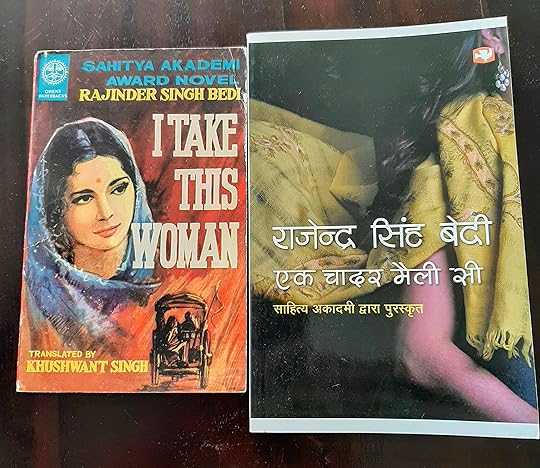
Fascinated by the cover - "Akademi Award" winning title translated in English, procured this 1967 edition from a second hand book seller. On reading the intro, realised that "I Take This Woman" is the English translation of "Ek Chadar Maili Si" (blame it on my ignorance!) Halfway through the book, felt the urge to read the Hindi version instead (thankfully!)
Tadaa!
So I ended up reading them both, learning and appreciating the difficulty of translation.
Difference in Translation: Sharing a sample.
English version (pg10): "We've come on to our rooftop I've a brother tall as a bamboo My brother's wife is tender as the cypress My brother's wife wears gold in her nose."
The same thing in Hindi (pg16): वीर आया खेल के। मैं मन्न पकावां बेल के। (footnote *1) कोठे उत्ते गन्ना, वीर मेरा लम्मां। भाबो मेरी पतली, जीहदे नक्क मछली।
*1- मैं बेलकर बड़ी बड़ी रोटियाँ पकाऊं
Like this, there are 26 such verses in around 100 pages! The Hindi version with the Punjabi verses kept intact, made all the difference in getting the "feel" of the book!
Was the English translation bad? No! Back in 1967, it was done by an expert - Mr Khushwant Singh! But somehow it fails to capture the essence.
What could be better in translation? Combining the translation text along with keeping the original verses intact, would empower the reader to grasp the "feel factor" :) I had a similar experience before, where the English translation totally killed a great book (दोज़ख़नामा : मंटो और ग़ालिब जब हुए रूबरू)
Coming back to the book.
Plot: When elder brother (Triloka) dies, our protagonist Rano (widow from elder brother), and the younger brother (Mangal), are forced to marry each other as per the local custom. In Hindi, this custom is called "चादर डालना" - hence the title. This relationship is tainted as till then, they were having a mother-child relationship. To an extent that while feeding her own kids, Rano offered her breast to Mangal when he was a 5 year old kid! (Cross checked the translation and that sounded pretty weird in both versions!) The rest of the book unfolds by depicting their lives imbibed in the customs around them.
Verdict: Recommended for a decent plot with a lot of local flavors and customs thrown in. If you can read multiple languages, prefer the vernacular Indian one over the English translated one.
I take this woman (Ek Chaddhar Maili si) - Rajinder Singh Bedi Translated from Urdu by Khushwant Singh - Rating 4/5
Translated from Urdu by Khushwant Singh, set in pre-partition India, in Kotla village, this novel is about a Sikh custom/ceremony called "Chadar dalna" (English translates roughly to - 'To Wrap a blanket') - where a brother gets married to his dead sibling's wife. Though a very short read - the emotions depicted are intense. The only factor which erodes the process of - 'sinking of these emotions into the mind of the reader' - is the translation.
Though Khushwant Singh tries very hard to do his magic with translation - but somehow as a reader - I could realize that the depth of emotions conveyed and the intensity of the language used - could have been felt better in the native language.
What is really commendable and well thought about is that - facing the adversities, amidst the flurry of raw emotions brute sexually explicit language stands the rock steady (foundation) character of the novel in Rano. A woman who on one side goes through the pain of losing husband and soon enough is compelled to marry her brother in law whom she considered nothing but a son. Hence the terminology of "Maili" is used which roughly translates to dirty or soiled.
The book gives a glimpse of pre-partition India, brings the reader face to face with everyday life back then. No money, no prospects of a job for lifetime, no savings, everyday meal hard to come by, poverty, this is how many of our ancestors survived in India back in the days. The everyday life also hints at a male dominated society where freedom and decision making for a woman is hard to come by. Yet a slice of happiness is portrayed in the form of an improvised meal at the end of the hard day's work - in the form of soft parathas, with clarified butter, leafy vegetables.
Also depicted is the interconnected lives of neighbours of people in the village, where everyone knows everybody. How they got together during joy and sorrow.
Recommended to be read in native language to understand and feel the depth of vocabulary and emotions many of which are diluted during translation.
قدم بہ قدم جوانی کی سیڑھیاں چڑھتی ایک لڑکی ہے ”بڑی“، جسے شادی کے گدگداتے سپنے آنے لگتے ہیں مگر بجائے اس کا بیاہ کرنے کے، ایک دن اس کی ماں ”رانی“ اپنا بیاہ رچا لیتی ہے۔ ۔ ۔
ایک گبھرو جوان ہے ”منگل“ نام کا، جو رانی کو اپنی ماں برابر سمجھتا ہے کہ اس کے بھائی کی بیوی ہے مگر جسے گاؤں کے لوگ جبراََ عین شباب میں سخت ناپسندیدگی کے باوجود رانی سے بیاہ دیتے ہیں۔ ۔ ۔
اور پھر ”رانی“ ہے، جو پنجاب کی عورت ہے۔ ۔ ۔ بچے پیدا کرتی ہے، پالتی ہے، گھر سنبھالتی ہے، میاں سے پٹتی ہے مگر اپنی ضد بھی منوا کر رہتی ہے اور جسے اپنے ہاتھوں میں پلے ’بیٹے‘ سے ہی، سسرال میں ٹکے رہنے کے لئے اور اپنی اولاد کی خاطر، چادر ڈلوانا پڑتی ہے۔ ۔ ۔
اس بے جوڑ شادی کے بعد تمام ’متاثرین‘ کس طرح وقت کے ساتھ ساتھ نئے حالات سے ایڈجسٹمنٹ کرتے ہیں، اس کے گرد یہ پورا ناولٹ ہے۔ الفاظ دیگر یہ ایک لوو سٹوری ہے مگر کلف لگی یا تکلف سے بھرپور قسم کی نہیں بلکہ خالصتاََ ’پینڈو‘۔ ۔ ۔ دیہی پنجاب کی ٹھیٹھ اوریجنل بولی میں لکھی گئی۔ ۔ ۔ گالم گلوچ، ٹھیٹھ مردانہ انداز کے مکالمے اور خاصی بولڈ قسم کی حرکات۔ مگر اس سب اجڈ پن کے ساتھ ہی ساتھ لوگوں کا سادا پن، صاف دلی اور بے تکلفیاں پڑھ کر غیری ارادی طور پر پڑھنے والا آج کے حالات سے موازنہ کرنے لگتا ہے جب لوگ زیادہ مہذب ہوئے ہیں مگر دلوں سے۔ ۔ ۔
اپنے افسانوں کی طرح اس ناولٹ میں بھی بیدی انسانی جذبات کی عکاسی کو کہانی کے کسی بھی دوسرے پہلو سے دبنے نہیں دیتے اور عورت بالخصوص ایک بیوی کا جذباتی سکیچ بڑے خوبصورت انداز سے کھینچتے ہیں۔ کہانی کا سب سے خوبصورت حصہ وہ لگا جب ایک رات ”منگل“ تیار اپنی معشوقہ سے ملنے کے لئے ہورہا ہے مگر رانی اسے ’چینج آف ہارٹ‘ سمجھتی اور خود پر محمول کرلیتی ہے۔ یہاں سے کہانی پڑھنے سے تعلق رکھتی ہے۔ ۔’بیدی سٹینڈرڈ‘ پر پورا اترتا ایک رواں، مختصر، خوبصورت ناول۔
The more one starts reading books written in the 60s-80s period, the more one is convinced they relished the shock value of relationships. This 1967 award winner translated from Urdu is exhibit A.
Set at Kota, the foothills of Vaishno Devi, the book alludes to the power of the Shakthi while being pretty agnostic about religion. Rano, a mother of 4 and wife of a drunkard carriage driver is at the centre of the tale. When her husband Tiloka is murdered she is forced to marry her brother in law Mangal whom she brought up like a son. In one earlier chapter, she offers the 5 year old Mangal her breast when she is feeding her daughter. Ends shock value and starts the journey (from a man's pov obviously).
Consistent with the values of the period, it liberates women to take charge within the house. Hence the mother in law Jindan gets to impose her wishes, the feisty Jamila who is insulted by Mangal to plot revenge. Even Rano has to "plot" to save her family. If I had not known better, I would have called it a book for the mahila movement (that may make today's feminists froth at their mouth).
I am sure quite a few cultural subtleties are lost in translation. The songs with the English translations sounding bland. The story is steeped in human emotions.
The book may no longer shock you for the content, but sure does shock you with the context.
In a village in undivided Punjab, Rano is wife to a tonga-driver, Tiloka. They live with Tiloka’s blind father and cantankerous old mother; Tiloka’s younger brother Mangal, only about ten years younger than Rano; and Tiloka and Rano’s four children: a nearly-adolescent daughter Badi, two twins, and a baby. Life is hard, unpredictable, but still manageable—until one day, when Tiloka carries in his tonga a teenaged girl who’s come as a devotee to a nearby shrine. The girl, looking for shelter for the night, trusts Tiloka—who takes her to a dharamshala, well aware that the man who runs the establishment is untrustworthy. The girl is raped and dies; and her hot-headed brother, arriving the next day, gets the rapists arrested—and, for good measure, kills Tiloka.
Suddenly, Rano’s world turns topsy-turvy. With a so-far carefree Mangal now forced to take up the driving of the tonga, the family has to make do as best as it can. Badi, too, is growing up, and will need to be married off soon—but where will the money for that come from? And Rano’s mother-in-law, with every passing day, is growing more intolerant, more cruel… Rano is at the end of her tether when a neighbour makes a suggestion: marry Mangal. From that suggestion grows the village’s conviction that yes, this old tradition is best for Rano and Mangal and the family: रानो को मंगल पे चादर डालनी चाहिए. She should, literally, cover him with a sheet, make him hers.
But this chaadar is a filthy one, stained and tainted. For Rano and Mangal have so far shared not a relationship of in-laws, but almost of mother and son: she had even offered a tiny Mangal her breast when she had her first baby, and he had been curious. How can a mother now bed the man she has regarded as a son? And what of Mangal? Besides never thinking of Rano as anything but a bhabhi, he lusts for another woman—the Muslim girl Salamaate.
Rajinder Singh Bedi’s Ek Chaadar Maili Si is an unsettling, disturbing tale. Not terribly dark throughout, but the very premise of it—the tradition of chaadar daalna—is scary. That a community should be so easily and arbitrarily able to govern an individual’s personal life (not to mention sexuality) is frightening. The intrusiveness of the community is supportive at times, but infringing, rabid at others.
What appealed to me the most in this book were Bedi’s insights into human nature, especially into his protagonist, Rano’s. An illiterate woman, orphaned and alone in the world except for the family she’s married into, Rano comes across as strong-willed and independent—and yet, there is the growing fear in her: what will happen of her and her children, especially the adolescent Badi? Will Rano be reduced to selling off her own body? And, when she is forcibly married off to Mangal, the coming to terms with the fact that she is now wife to the man she once called son.
Desperation, despair, anguish, hope, seduction, love. Memories. The pain born out of love. All of these, and more emotions, are what make Ek Chaadar Maili Si so worthy of the Sahitya Akademi award it won. And the description of village life in Punjab is brilliant: not intrusive, but very well woven into the story.
இந்நாவலின் மையக் கதாபாத்திரம் ராணு. ராணுவின் கணவன் திலோகா ஒரு குடிகாரன். அவன் எப்போதும் காலையில் ராணுவை கன்னத்தில் அடிப்பான், இரவிலோ அவள் கால்களை பிடிப்பான்.
காமம் கொள்ளும் போது மட்டும் அவன் காதலனாக உருமாறுவான், காமம் முடிந்த பின்னே அவன் வெறும் ஆண்மகனாக நிலைகொள்வான்.
இப்படிப்பட்ட கணவன் ஒரு நாள் தகாத வேலை செய்துகொண்டிருக்கும் போது கொலை செய்யப்படுகிறான், அதனால் தன்னுடைய கணவனின் தம்பியான மங்களை மணம் செய்யவேண்டிய நிலை ராணுவிற்கு ஏற்படுகிறது.
மங்களோ, அண்ணியை அன்னை என்றே நினைப்பவன். பெற்ற தாயை பெரியம்மா என்றும், அண்ணியை அம்மா என்றும் அழைப்பவன். இவர்களின் வாழ்க்கை என்ன ஆனது என்பதே இந்நாவலின் மீதிக் கதை.
ராணுவின் கதாபாத்திரம் மிகவும் அருமையாக வடிவமைக்கப்பட்டுள்ளது. தன் கணவன் இறந்ததை அறிந்தும் அவளுக்கு கண்ணீர் வரவில்லை, எவ்வளவு முயற்சித்தும் விழிநீர் விழவில்லை. பார்க்கும் ஊர்காரர்கள் என்ன நினைப்பார்கள் என்று அஞ்சி, வெங்காயத்தை கசக்கி கண்ணில் இட்டுக்கொள்ளலாமா என்று எண்ணுகிறாள்.
மற்றொரு இடத்தில், கணவனின் பிணத்தை பார்த்த பின்பு அவளுக்கு புதிய சேலையும், நிறைய நகைகளும் அணிந்துகொள்ள வேண்டும் என்று ஆசை ஏற்படுகிறது. ஆனால் இதையெல்லாம் அறியாத அவள் தோழியர்கள் அவள் கைவளையல்களை சுவற்றில் மோதி உடைக்கின்றனர், மண்கட்டியை எடுத்து அவள் தலையில் போடுகின்றனர்.
ஒரு கட்டத்தில் வறுமையின் நிழல் குடும்பத்தின் மீது படிகிறது. இருப்பதோ கொஞ்சூண்டு சோறு. அதைதான் அவள், மாமனார், மாமியார், பிள்ளைகள் அனைவரும் பங்கிட்டு சாப்பிட வேண்டும். அவளுக்கு இருந்த பெரும் பசியில் உப்பு புளி கூட இல்லாத வெறும் சோற்றை சிறிதும் மிச்சம் வைக்காமல் உண்டுவிடுகிறாள். உண்ட பிறகே எல்லாவற்றையும் சாப்பிட்டுவிட்டோமே என்ற குற்றவுணர்வு அவளுக்கு ஏற்படுகிறது.
மிகவும் கச்சிதமான நாவல் இது. ஒரு சொல் கூட வீணாக்கப்படவில்லை. இந்நூலின் ஆசிரியர் ராஜேந்திர சிங் பேடி சுருங்கச் சொல்வதே செம்மை என்ற நிலைப்பாடு கொண்டவர் போல. சொற்களை எண்ணி எண்ணி எழுதியிருக்கிறார்.
சான்றாக, இந்நாவலில் வரும் சாமியாரை ஆசிரியர் இரும்பு லங்கோடு அணிந்தவர் என்று குறிப்பிடுகிறார். ஒரு கட்டத்தில் அந்த சாமியார் கைது செய்யப்படுகிறார், ஏன் அவர் கைது செய்யப்பட்டார் என்பதை ஒரே வரியில் "அவர் அணிந்திருந்தது இரும்பு லங்கோடு அல்ல, துணியினால் ஆனது" என்கிறார்.
இப்படி சொல்வேண்டிய அனைத்தையும் சுருங்கச் சுருங்கச் சொன்னதால், நாவலே அளவில் மிகவும் சுருங்கிப் போய்விட்டது. மொத்தமே 117 பக்கங்கள் தான்.
இந்நாவல் எனக்கு நல்லதொரு படைப்பை படித்த மனநிறைவை அளித்தது. உங்களுக்கும் பிடிக்கலாம், முயற்சித்து பார்க்கவும்.
உருது மொழியில் எழுதப்பட்ட இந்நாவல், தமிழில் "பொலிவு இழந்த போர்வை" என்ற பெயரில், நாமெல்லாம் பிறப்பதற்கு நெடுங்காலத்திற்கு முன்பு, டைனோசர்கள் வாழ்ந்த காலகட்டத்தில் சாகித்திய அகாதமி பதிப்பகத்தால் வெளியிடப்பட்டுள்ளது. எப்போதும் போல் மறுபதிப்பு ஆகவில்லை. இனியும் ஆகாது. Pdf-யில் கிடைக்கிறது. ஆர்வம் உள்ளவர்கள் பயன்படுத்திக் கொள்ளவும். ஆமென்.
Rajinder Singh Bedi is one of the masters of Urdu shorter fiction and arguably one of the finest short story writers in any language. He was long a resident of Lahore - a city where he grew up and spent several important creative years of his life and which he dearly loved. Amongst his contemporaries - great names like Manto, Ismat Chughtai, Balwant Singh - I find his to be the most literary, accomplished and complex prose. No wonder because he was known to, and at times even teased about, laboring over it and not just narrating his tales as they came to him but to imbue them with reflection, creativity and imagination. Consequently, he is also a deeply psychological writer and excels at exploring the inner thoughts, anxieties and paradoxes of his characters.
Bedi writes mostly and empathetically about vulnerable, weak and hopeless people who fare ill while facing the hard grind of life. He particularly focuses on the plight of women facing patriarchy, social taboos, religious and cultural restrictions and prejudice. Aik Chadar Maili Si is an excellent example of the literary merit of his prose, his prowess for psychological exploration and his deeply sensitive description of characters caught up in an oppressive and exploitative environment. It is the only novel/novelette he wrote. Bedi writes brutally honest stories about a brutal world but these are not mere reportage. He is deeply inquisitive and thoughtful about the meaning of it all and the predicament of human existence. That is what persuades me to rate him above Manto on literary merit.
This novella revolves around the violent death of an abusive man Taloka that leaves his wife Rani and many children vulnerable at the hands of a vicious mother in law, in a poor household and a social context that eventually forces her to marry her younger brother in law Mangal. Both are deeply averse to this mismatch as both have once looked upon their relationship as a maternal one. This causes deep disgust and emotional and psychological turmoil amongst the two and thereby staunch resistance. However, both due to the pressure (and in Mangal's case physical coercion), from the elders and other residents of their village Kotla, and also because Rani (who is a queen only in name as impoverished and without any family she is) has no other place to go to and wants to safeguard her children and settle them, they go through the dismal ritual. It is performed under an old sheet of cloth spread over their heads that gives the story its name - a practice of the time to marry people in their situation. Thereon both prove to be heroic as they try and make the marriage work for the sake of the orphaned children, more than anything.
Against the backdrop of the main story also runs a sinister and grotesque tale of abduction and trafficking of women. Rani's drunkard husband Taloka is involved in this and is murdered by the enraged brother of a young lost girl he had handed over to the local villains involved in the trade. She was subsequently raped and murdered. The sordid business is carried on by certain influential figures in the village and the Hindu priest in the local dharmashala also turns out to be a fraud. This combined with the general economic and social backwardness of the village presents a rather dismal picture of the Punjabi countryside and in particular rural Sikh households. These scoundrels are eventually caught and jailed. Rather melodramatically the person - now released - who is a coveted suitor for Rani's eldest daughter shockingly turns out to be the same young man who had murdered Taloka.
Bedi adroitly sketches multiple other characters in the village milieu that is also a pilgrimage site, explores how different classes and religious communities work in the multi-cultural context of the time, illustrates the camaraderie of women tormented by the ways of their men, analyzes the enigmas of human sexuality, and often cites Punjabi poetry and uses colloquial dialogue that enhances the flavor of the story. While quite rich in more traditional and idiomatic Urdu diction his prose has a distinctive flavor which he explains in the preface of one his story collections where he states that he boldly writes Punjabi Urdu because that is the place he is mostly writing about. This tragic novelette epitomizes one of Bedi's literary preoccupations which is to expose the exploitative practices and demeaning social attitudes of his context and time towards women.
The novelette has some lovely descriptions. Here is one of a furious red sun ferociously driving his chariot horses and disappearing beyond the cotton fields, leaving behind a delicate moon to drain and yellow:
شائید اسی لیے اس دن کا سورج غصے میں لال اپنے رتھ کے گھوڑوں کو ادھر سے چھانٹا، ادھر چابک، ادھر چھانٹا، ادھر چابک لگاتا ہوا سامنے خانقاہ والے کنویں کے پاس، فارم کی کپاس کے پیچھے کہیں گم ہو گیا تھا اور اوپر آسمان پر دوج کے نازک سے چاند کو نچڑنے، پیلا ہونے کے لیے چھوڑ گیا
And here he compares the lusterless moon to a white kite stuck in a kikar tree that then appears to run along the one horse carriage and finally settles down in the vast expanse of the sky.
آج دن کچھ اندر باہر تھا۔ جب منگل قصبے سے لوٹا۔ سورج کی روشنی ابھی آسمان پر ہونے سے اشٹم کا بے نور چاند سفید سی پتنگ کی طرح ایک کیکر میں الجھا ہوا تھا۔ اور اب اِکے کے ساتھ ساتھ بھاگتا ہوا ساھنسیوں کی ٹھٹی کے اوپر، آسمان کے کھلے میدان میں جا کر ساکت ہو گیا
His descriptions capture and augment the mood that he wants to create. In a single line describing the beaten up and coerced Mangal he captures the landscape, crops and plant life of central Punjab.
اس کے بدن، پھٹے ہوے کپڑوں، لمبے لمبے کیسوں اور داڑھی میں دھرکونے کی جھاڑیاں، کپاس کی من چھٹیاں، مکئی کے ٹانڈے، خشک آک میں سے اڑنے والی بڈھی مائیاں اور نہ جانے کیا کیا کچھ گھسٹتا آرہا تھا۔
Poignant references to Punjabi folklore, to Bulleh Shah, Waris Shah and Qadir Yar, to Heer Ranjha and Mirza Sahiban, Sikh and Muslim jokes, lyrics of festive songs as well as insults, combine to make this a memorable depiction of a certain Punjab in a certain era in which he locates a story of universal appeal and relevance.
In a particularly romantic and picturesque passage Bedi describes how in the land that falls before the snow-clad Himalayan and Dhauladhar mountain ranges the pathos of the mountain people emerged - separated as the lovers who dwelt there were always by the peaks that lay between their abodes. From there the pain of their separation travelled down the Ravi, Chenab and Jhelum to the lower valley regions of Neeli Bar and Ganji Bar, through the voices of Waris Shah and Qadir Yar. Punjab remains immortalized in Bedi's celebrated work.
A poignant tale of 20th century rural Punjab and a realistic look into the life of women who have to fight some sort of battles everyday merely for the ability to survive. Also provides a seething narrative around the clutches of patriarchy and how it impacts each member of the society even men in detrimental ways.
I find it a bit odd to review a novel that was written more than fifty years ago. But I feel the effort is worthwhile even if it inspires just one person to read this classic novel by the award-winning Urdu writer Rajinder Singh Bedi.
I Take this Woman (Ek Chadar Malli Si) is a gripping story of rural life in pre-Partition Punjab. In the 122 pages of the excellent English translation by Kushwant Singh, the author has distilled -- like nectar -- the essence of what married life is like for a poor, young married woman caught in the dreadful web of a hostile, extended family in rural India. Some of the characters are clichéic (e.g., the hard-drinking, violent husband; the evil mother-in-law), but this is compensated by the careful portrayal of the main character, Rano, whose life seems to go from bad to worse.
The plot is relatively simple. When Rano's useless husband is murdered after a shameless act that results in the rape and death of an innocent pilgrim girl, Rano is pressured by friends and the village elders to marry the much younger brother of her husband, whom she nursed as a child. Rano is a hard-working woman who loves and tries to protect her four children, despite the bile she endures from her mother-in-law. But for the poor, unloved widow, no good deed goes unpunished.
The violence she endures from her first husband, which is met with bites and other acts of aggression, reminded me of the real-life stories cited in the works of Freudian psychiatrist Sudhir Kakar. And yet, even in this world of extreme hardship, there are moments when a character shows some genuine tenderness, feels remorse, or sings a verse from a Sufi poet. Moreover, there are a few young characters who manage to maintain their innocence, which lightens the heavy mood from time to time. Occasionally, emotional relief comes from nature, as when, "A strong breeze blew from beyond the hills. It brought with it flocks of migratory birds from distant lands -- from the Siberian marshes, the mountains of the Caucauses, the plateux of the Palmirs and the peaks of the Sulaiman range."
Sometimes, the reader is given a taste of prose that is truly poetic. The novel's opening sentence is a good example, foreshadowing death with the lovely image of a blood-red sunset. "The sun was deeper red; the heavens were a darker crimson as if spattered with the blood of innocents: the stream of blood ran from the sky down into Tiloka's [Rano's husband's] courtyard, tinting the green of the bakain with hues of purple."
Bedi's narrator is omniscient, and I found it sometimes jarring when the point of view abruptly switches from one character to another. But this was a small price to pay for a novel that is emotionally gripping, as well as illuminating. Bedi's masterpiece is a raw portrayal of human misery on a truly personal level. But the emotional weight of the story is leavened by an unpretentious style sprinkled with just the right amount of ornamentation to keep even the most demanding reader engaged.
"ایک چادر میلی سی" راجندر سنگھ بیدی کا پہلا ناول ہے۔ یہ کہانی ہے کوٹلہ گاؤں کی رانو کی، جسکا شوہر تلوکا، ایک شرابی بھی ہے اور اس کو مار پیٹ بھی کرتا ہے۔ تلوکا مہربان سنگھ کو دھرم شالے کی آڑ میں معصوم کنواری لڑکیاں سپلائی کرتا ہے اور وقت کا پھیر اسے آ لیتا ہے اور اسکا قتل ہو جاتا ہے۔ اسکے قتل کے بعد رانو کی شادی اسکے بھائی منگل سے کر دی جاتی ہے۔ منگل رانو سے دس سال چھوٹا ہے جسے اس نے تلوکے کے ساتھ بیاہ کے بعد بچوں کی طرح پالا تھا۔ اس شادی کے پیچھے بہت سی مصلحتیں ہیں جنہیں منگل کو سمجھنے میں وقت لگتا ہے اور بہت سی گرہیں ہیں جنہیں کھولنا اب رانو کی زندگی کا مقصد ہے۔
تینتیس، چونتیس سالہ رانو اس کہانی کا مرکزی کردار ہے۔ ایک طرف تو وہ جنسی جذبات سے معمور ، جوان،بھری پوری عورت ہے تو دوسری طرف ممتا سے نچڑی ہوئی ماں۔ جو ان دونوں حیثیتوں میں تقسیم بھی ہے اور انکو بیک وقت خوبی سے نبھا بھی رہی ہے۔ وہ عام عورت ہے اور اسکی عمومیت ہی اسکا حسن ہے۔ پیار کرتی ہے تو تن کر اور گالی دیتی ہے تو ڈنکے کی چوٹ پر۔ تلوکے کی مار،جنداں کی گالیاں اور مائیکے کی عدم موجودگی بھی اسکی spirit کو زیر نہیں کر سکتے۔
بیدی نے تشبیہات اور استعارات کا استعمال بہت مشاقی سے کیا ہے جس سے کہانی کو چار چاند لگ گئے ہیں۔ مثلاً کوٹلہ میں مندر بھی ہے اور دھرم شالہ(جو مہربان سنگھ اور اسکے دوستوں کی عیاشیوں کا اڈہ ہے). مندر خیر کا استعارہ ہے تو دھرم شالہ معاشرے/مرد ذات کی منافقت یا سیدھا سیدھا شر کے لیے استعارہ ہے۔ یہانتک کی بکائن(رانو کے آنگن کا درخت) اور ڈبو(کتا) بھی ہمہ وقت بدلتی زندگی میں ان مستقل چیزوں کے لیے استعارہ ہیں جو کبھی نہیں بدلتیں۔
میلی چادر بظاہر تو مجبوری کی کوکھ سے جنم لیتے منگل اور رانو کے رشتے کے لیے استعارہ ہے مگر اسکے ذریعے بیدی نے پیغام دیا ہے کہ انسان میں دم خم ہو تو محدود میسر وسائل میں بھی اپنی جڑیں مضبوط کر سکتا ہے۔
کردار نگاری بیدی کی superpower معلوم ہوتی ہے۔ مثلاً حضور سنگھ(رانو کا سسر جو تقریباً نابینا ہے)کو ہی لیجیے۔ وہ ویسے تو ایک بے کار سا بڈھا ہے جسکی زندگی کا مقصد صرف جنداں کے کوسنے سننا ہے۔ مگر کہانی کے آخر میں اسکا بر وقت شفقت بھرا لممس رانی کو وہ اعتماد فراہم کر دیتا ہے جسکے ذریعے وہ بڑی(رانو کی بیٹی)کے حق میں درست فیصلہ کرنے کے قابل ہو جاتی ہے۔
کہانی میں جہلم ارین، ودیا،چنوں جیسی عورتیں اس ہجوم کی عکاس ہیں جو انسان کی خوشی اور تکلیف کی پرت در پرت گہرائی سے ناآشنا ہوتی ہیں ،بس مرگ ہو تو بین اور بیاہ ہو تو ناچنے کے لیے تیار۔ یہ بے ضرر تماشا بین تو ہیں مگر اپنی اسی سادگی اور انجانے پن میں ہی رانو کا گھر بسانے،منگل سے اسکا رشتہ استوار کرنے میں کامیاب ہو جاتی ہیں۔
کہانی گو کہ تلخ حقائق کی اون سے بُنی ہوئی ہے مگر جا بجا ناچ گانے،ٹپے،گیت ہلکا پھلکا مذاق اسے بوجھل نہیں ہونے دیتے۔بیدی کے مشاق قلم سے کوٹلہ اور اسکے اطراف کا فطری حسن، آسمان کے بدلتے رنگ،چاند کی تبدیل ہوتی ہییت کا اظہار ناول کو ایک شاعرانہ پہلوعطا کرتا ہے۔
ناول۔مرد و عورت کے فطری رشتے اور اس میں اختلاط کی اہمیت پر social commentary ہے گویا یہ رشتہ بیج ہے اور خوشی، اطمینان یہانتک کہ روزگار تک کے پودے اسی سے پھوٹتے ہیں۔
سوچتی ہوں اگر بیدی کاپہلا ناول اتنا کمال ہے تو باقی کہانیاں کس درجے کی ہوں گی۔ میں نے اس ناول کو ایک دن میں مکمل کر لیا مگر لگتا ہے ذہن پر اسکا اثر تادیر رہے گا کیونکہ "ایک چادر میلی سی" ایسی کہانیوں میں سے ہے جو بھولتی نہیں، انسان کے ساتھ رہتی ہیں۔
It is an interesting book which discovers the fact that when a woman becomes a widow she is not capable of living by herself and thus needs to be put under the domination of a man. Like in this novel, Rano's(the woman) husband dies and she is married to her brother in law who is almost her son's age. Bedi has done a good work and so has Khushwant Singh by translating this work from Urdu to english.
I had heard a lot about Bedi and his realistic fiction but this is a hard story brutally told. Full of violence - verbal, physical and mental. I liked the writing which is as stark as the subject matter but can't say I care for the story.
Written by Rajinder Singh Bedi, translated by Avtar Singh Judge
I wanted to read the book the moment I read the title. I read the English translation, the original work is in Urdu. When I started reading the first few pages, I found it a little difficult to understand Rano and her frustrations. I was in denial when Rano decided to get married to Mangal. It is not easy to relate to Rano’s world, especially in this day and age. If you want to understand Rano, her fears, her decisions, her whims and fancies you have to take yourself to a very different era. It was tough in the beginning but I found my way and once I started reading the book keeping in mind when it was written, the chapters and words took a different meaning.
Rano, the protagonist, was married to the elder son of Hazoor Singh, Tiloka. Tiloka was a sadist, a social misfit and he used to take female pilgrims to the house of Choudhury Meherban Das in return for some money and alcohol. One such pilgrim’s brother murders Tiloka. Even though one does feel Tiloka deserved this treatment but this incident left Rano in a dicey position.
Back then, a woman without a husband was looked at as a burden on their in laws. Under societal pressures, Rano and Mangal, who was the younger brother of Tiloka had to marry each other. Rano had treated Mangal as her son and not her brother-in-law. Mangal, too loved and respected Rano as his mother so much so that he used to call his own mother “aunty”.
There is a tradition in Punjab, as part of which, the younger brother weds his elder brother’s widow upon the latter’s death. This tradition is called ‘chadar daalna’. Compelled by this custom and the brutal physical force of the villagers, Mangal weds his sister-in-law Rano. In the marriage ceremony, Mangal places a slightly soiled, somewhat tattered three-yard “chadar” over Rano, signifying the transfer of shelter and security. Ironically, the chadar, which is supposed to redeem the characters is “maili’ or “soiled”. It speaks volumes of the cleverness the story holds. Initially reluctant, with time both Mangal and Rano get over their dilemma and find not merely consummation but passion also in their union as the villagers had expected.
“When Mangal was made to sit besides Rano he was bleeding profusely and Rano was unconscious. But all the women there was convinced that in the end everything would turn out right“
The beauty of the narration lies in how it shows Rano, the bubbly housewife turn into a vindicated widow and then back to the bubbly housewife. In between, it also shows Rano’s shades of a protective mother who would go to any extent to give her children a happy life and her daughter a loving husband. She would not let her mother-in-law sell off her daughter even if that means she has to agree to get her daughter married off to the same man who killed her first husband, the daughter’s father Tiloka!
The book shook me deep within. The trauma of Rano is heart-piercing and her inner strength to sustain everything and find her way is an example of the “survival of the fittest”. Well then pick up the book and live Rano’s journey but remember to switch on your time machine and go back in time to understand her better!
I Take This Woman is the English rendition of the Urdu novella Ek Chadar Maili Si by Rajinder Singh Bedi, translated by the veteran novelist Khushwant Singh. The novella was written in 1962 and won the Sahitya Akademi Award in 1964. It is replete with anger, frustration, despair and desire, all emerging from acute penury.
The plot revolves around Rano. Her husband, Tiloka, is murdered while ferrying a 13 year old girl for the Chaudhary's sexual rendezvous. If Rano has to still survive, she should marry her young brother in law, Mangal, whom she has brought up as her own son. Shamed, averted, nagged and beaten, Rano's life goes on.
The Urdu title Ek Chadar Maili Si stands for the ceremony of Chadar (symbol of love and protection) daalna (put). Ironically though, this chadar is maili (dirty). The relation is unacceptable to both the partners as they consider each other mother and son.
Meanwhile, Waddi, Rano's daughter, had almost been sold by her grandmother for a few hundred bucks. On the contrary, if she takes no dowry with her, her in laws would break the hell loose as Rano has already been suffering. By God's grace, Rano receives a proposal for Waddi from a well to do and handsome lad. But, on a closer look, she almost dies to find that it is the same boy who murdered Tiloka. With a devastated Rano, the betrothal still takes place. Does a starving family even have an option if it decides not to sell their girl off?
3.8 for the novella which is fast paced, raw in sentiment and scintillating in experience. The book gives a rich sneak peek into the rural beliefs and institutions. Although a translation, Singh has done a brilliant job at maintaing its impact. However, the folk songs do lack lustre. The novella is a must read for a view of human foibles and strengths imbued with the raw rustic life conveyed in a crisp series of quickly unfolding events.
This entire review has been hidden because of spoilers.
Ek Chadar Maili Si (Paperback) by Rajinder Singh Bedi- urdu novel- translated in Hindi. Rajinder Singh Bedi is a celebrated urdu novelist from Lahore and later after partition shifted to Bombay. The novel is about a tonga driver named Triloka his wife Rano, his younger brother Mangal, his mother Zinda, his two children and blind father Hazoor Singh. Triloka runs errands on this tonga for a living but in the evening he regularly drinks and returns home. Zinda taunts her daughter in law everyday about not bringing enough dowry during her marriage. A young girl is left behind at the Railway station. Triloka brings her and leaves her at an inn. Next morning the girl is found raped and she dies. The Inn keeper asks Triloka to take her body to the cremation ground. He obliges but on the way the brother of the girl meets him and doubts that Triloka has killed his sister. During the fight, Triloka is killed. The other man is arrested and but household of Triloka is without bread winner. Village elders suggest that either Rano should leave the house of Triloka with her children or marry Mangal. The rasam is called "Chaddar Udhana" . For the sake of her children, Rano is acccepts Mangal as her husband. At the time of her marriage Mangal was a young boy and she treated him like her son. Mangal loves a gypsy girl named Raji. After the chadar ceremony, Mangal forgets Raji. The story depicts the difficult life of women in ertwhile Punjab. Lack of education, opportunities of earn money , purdah system, dowry system bind her and shrink her flight to progress. The Book has won awards and is classic and good read for all. The novel is classic as it ends with a message of hope amidst difficulties.
An excellent novel. Without any doubt a deserving Winner of a Sahiyta Akadami Award. Cheery on the cake is that this book was translated by Kushwant Singh.
The highs and lows of the story are flawlessly weaved together. Story follows a woman Rano from Kotla. Story of her life, marriage, her children and need to remain under a shelter for the sake of her children gets quickly turned into her own remarriage. Life of families & their friends from an Indian village is also beautifully portrayed in the novel.
Rajinder Singh Bedi has an uncanny earthy grip on the reality of rural Punjab. He showcases the social forces, both instinctive and man-made, in the day-to-day interaction between members of society and families. However, the novel seems to tie up everything rather too well. While Bedi manages to showcase beauty and meaninglessness of human relationships very well, the latter part of the book is too dramatic and seems to buck its well-established realistic tone to produce a happy ending.
جس پبلشر کی میں نے کتاب لی تھی، اس نے کتاب میں بہت زیادہ املا کی غلطیاں کی تھیں، جس کے باعث کتاب کا سارا مزہ کراکرا ہو کر رہ گیا۔ بیدی صاحب نے تشبیہات ، استعارات کا بہت زیادہ استعمال کیا تھا، جو مجھے تو کافی بورنگ لگا، جس کی وجہ میرا کم ناول پڑھنا ہو سکتا ہے۔ بار بار کی منظر نگاری نے بھی میری دلچسپی کو کم کر دیا تھا۔ لیکن کرداروں کی development کافی شاندار رہی؛ اور جس طرح کچھ رشتے آپ کے جذبات کو جانے بنا ، انجان بنے آپ کی زندگی کا حصہ رہتے ہیں۔
It is a classic novel and a short one which is what made me pick it up. The novel begin well and was good until the 3/4th point. It is the final chapters which were a disappointment, could have worked better with a different ending. Overall a decent read.
Very beautifully describes how two people come to terms with a bother and sister in law to husband wife relationship both the softness and toughness of Punjabi village life.
There has been a marriage like this in my family and it is interesting how the author traces the contours of human relationships. When a bhabhi like ma becomes a wife! quite enjoyed it.
I had always heard of the movie but happened to read the novel first. It is a short but nice portrait of rural Punjabi life; it reminded me of Mitro Marjani. Although the lead characters couldn't be more different.
Language is a tad hard to understand for a Hindi speaker; surprisingly not on account of vocabulary but because of the idiomatic usage.
I read the book in Hindi. Loved it. The life in a rural community in Punjab is described so beautifully. It makes you cry, think, abhor the ridiculous traditions and love the adaptability and bravery of the characters. Truly remarkable.