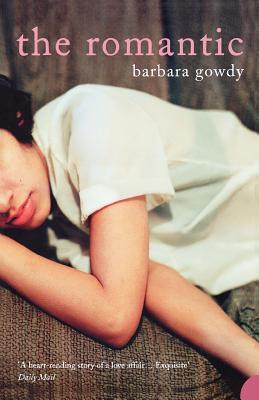
"Louise Kirk learns about love and loss at an early age. When she is nine years old, her former beauty queen mother disappears, leaving a note that reads only - and incorrectly - "Louise knows how to work the washing machine."
Soon after, the Richters and their adopted son, Abel, move in across the street. Louise's immediate devotion to the exotic, motherly Mrs. Richter is quickly transferred to her nature-loving, precociously intelligent son." From this childhood friendship evolves a love that will bind Louise and Abel for the rest of their lives. Though Abel moves away, Louise's attachment becomes ever more fixed as she grows up.
Separations are followed by reunions, but with every turn of their fractured relationship, Louise discovers that she cannot get Abel to love her as fiercely and exclusively as she loves him.
Only when Louise comes face to face with another great loss is she finally forced to confront the costs of abandoning herself to another.
Barbara Gowdy is the author of seven books, including Helpless, The Romantic, The White Bone, Mister Sandman, We So Seldom Look on Love and Falling Angels, all of which have met with widespread international acclaim. A three-time finalist for The Governor General’s Award, two-time finalist for The Scotia Bank Giller Prize, The Rogers Writers’ Trust Fiction Prize and The Commonwealth Writers’ Prize, winner of the Marian Engel Award and The Trillium Book Prize, Gowdy has been longlisted for The Man Booker Prize. She has been called “a miraculous writer” by the Chicago Tribune, and in 2005 Harper’s magazine described her as a “terrific literary realist” who has “refused to subscribe to worn-out techniques and storytelling methods.” Born in Windsor, Ontario, she lives in Toronto.
Two words I would use to describe this book: curious and haunting. “The Romantic” is a book that feels wordy but isn’t, and tells a very drawn out tale of adolescent obsession, heartbreak, and unrequited love. Many times during this book I felt creeped out as we follow the unremarkable character of Louise and her infatuation with the “boy next door” and his odd mother after her own mother abandons her. It is clear where Louise gets her eccentric behavior or compulsive feelings towards Abel and his parents, but the scariest part of this novel is the screaming and unaddressed mental disorder the main character has. I wasn’t a huge fan of this book due to its annoyingly and unflinchingly obsessive prose about Abel and all of the WONDERFUL things he is, but I managed to finish it and feel content I suppose.
I can never decide if I like the word "poignant". The sentiment appeals but it sounds half-swallowed, and upon hearing it all I can think of is my high-school Latin textbook explaining that gn in Latin (eg "magnus") is pronounced as in the English "hangnail". But I would use it to describe this story.
Brief synopsis: Louise is ten, and her mother has left. A new family moves in on their street. Louise first falls in love with the mother, Greta, then a year later, the son, Abel. A dozen years later he is dead. The blurb suggests that this is "the unravelling story of their romance", but I think it's really the story of Louise's experience of romance: As an idea, an emotion, an event.
Gowdy's credible portrayal of children continues to impress me. In this novel her accuracy in depicting the mind of a child is not so startling as in her short stories, particularly the one about the two girls and their foster mother in We So Seldom Look on Love, but good short stories are always compacted, explosive. I like them for the same reason I hate opening bottles of champagne. Here the characters are crafted with the same precision but introduced in threads, weaving back and forth through time, gathering form. There is a softness and space where short stories are sharp, urgent, tight.
For me this started off as a good novel, solid but unspectacular -- interesting yet familiar characters, fitting but unremarkable style, a story peculiar enough to intrigue but well within plausibility. Enjoyable enough to keep me reading until forced to put it down, but in time probably insignificant. Then somehow, without an obvious turn, it touched me. As the adult Louise came to dominate, the narration developed a wry humour that I hadn't seen earlier in the novel. It seemed to give everything this tenderness. Instead of a detached interest in the story's movement, I felt a rush of love for each character in the moment. Everything that had happened was transformed; the same desperation became adorable instead of merely intriguing. Pathos, I guess, but for me it always brings to mind the word "exquisite". I guess because it's a synonym for "beautiful" or "magnificent" that I feel is only properly applied to types of pain, most particularly an ache.
An very personal, physical spiritualism seems to be a recurring theme in Gowdy's work. Louise sees wisps of white light in her peripheral vision, which she calls angels, though she also jokes that it may just be a retinal disorder. Towards the end of this book my emotional responses had physical manifestation. Not in the way people usually use the word "visceral". Not a wrenching pain. I guess a sense of tenderness, and heat, centered on my sternum. Also flashes of recognition accompanied by shivers. I remember deja vu being cited as a common mystical experience in a text I read for my philosophy course, years ago. I'm intrigued by that, by what I consider fairly concrete, corporeal mystical experiences. It doesn't matter if they're true but it matters that they're real.
And then I cried and cried and cried, until long after the last page, long after lights out. I haven't cried over a book in a long time. It wasn't depressing -- sad, often, but not depressing. I cried because of its accuracy. There is something painful about being known.
On my edition there is this excerpt on the back cover. Before reading the book I liked it, but it means much less out of context. I think it helps to at least know at this point Louise is not with Abel. Because it's very much written as a novel, not a string of stories or a fictional essay or a prose poem or anything else that might appear to be a novel, it's impossible to find a representative sample, but this may give you a sense of how the characters feel.
>As I'm speaking, I imagine holding my hand a few inches above a boulder. It's twilight, summer, growing cool. The boulder gives off the heat of the day. My love for Abel is like the heat between the boulder and the falling night. That feeling, or that place.
I feel spoiled, most of the books I've read lately have been great. I must be heading for a fall.
This was my first Gowdy, and won't be my last. I like novels with central child / adolescent characters. And this is a good one. The novel was so much better than the title, cover or blurb suggested.
I liked the way we jumped about in time. Knowing where we were heading well before we got there. I liked the hope and the futility carefully combined. I could relate to each and every character, most clearly the ones I liked the least.
This novel made me think as well as feel. And I got a top piece of advice from one page, which might just change my life, but this is not the place to share that!
The premise of this book intrigued me. A mother walks out of her nine year old daughter's life, and the daughter becomes totally obsessed and enamored of the mother of a neighborhood child. She wants to be adopted, like the adopted son. She falls in love with the Mother first...then the son. The first few pages seemed interesting enough, but as one gets a little further into the story the reader gets whiplash as the author jumps from one thought to another, one decade to another, and one story to another. The premise was simple. It could have been a good story, told simply. As it was, it plodded along like a Clydesdale. This is one I chose not to finish. Life is too short.
Middling, obsessive love story or should I say "stalking". Gowdy tells the tale of 2 damaged young lovers who struggle to maintain a relationship of sorts across miles both literal and figurative. Boy love interest is the doomed love (here Gowdy quotes Rimbaud at one juncture) who is slowly drinking himself to death. Girl love interest is just plain obsessed and cannot come to terms with someone who indeed loves her but loves alcohol more. Problematic to me is that the secondary characters are shallowly portrayed and at times resemble well worn fictional tropes and the alcoholism 0r suicidal tendency which is central to the story seems to be a backstory of sorts. It looms large but it's shadowy at the same time.
Overly long too, I thought. Nominated for Man Booker prize which also makes me scratch my head a little.
Even at her most mediocre (not that she does mediocre) Barbara Gowdy is a star – and this is sheer brilliance. This is a soulful tale of lost and semi-requited love, of passion, of attachment, of a cheatin' heart and a fickle lover, and of the banality that surrounds us and most of us miss. Gowdy's inventiveness, eye for detail, and beautiful style has yet to fail her, while her empathy as a writer for mildly and badly broken people means that even at the lowest points, where ordinarily a reader would feel mournful, sadness, or grief, I felt compassion and wonderment. She's a major writer stuck in a Canadian lack-of-profile. It must be close to my novel of the year – even though it is from 2004.
Wonderful simple but layered prose. Emotionally honest and smart without being self-consciously clever. Did NOT find it depressing as some did. Though it was melancholy it was still alive and kicking.
A fantastic novel that encompasses the human spirit. How Abandonment,loss, grief and unconditional love holds true to all of us. Gowdy captures our strengths, weaknesses and our ability to persevere, reminding us that this is all part of the human condition, to be loved, keep loving and forgive.
I’ll give it 2.5. I started out enjoying this book but the more I read, the less I liked - the writing the main characters and everything they did, the jumping timelines. And then it just kind of ended?
A dysfunctional love story of the unhealthy obsession an abandoned young woman harbours for a lifetime. The object of her affection is dangerously unworthy and it is incredibly frustrating to read about the protagonist’s self-destructive “romance”.
Upon reading the last page in this novel all I felt was a sense of disappointment—disappointment in the story as a whole. In the Romantic, Louise Kirk is abandoned by her mother and left in the care of her passive father. Shortly after her mother leaves Louise becomes obsessed with a boy (Abelard) who has moved in across the street, and he remains the focus of her love well into her adult life. Abelard is just as passive as her father (if not more so) and finds Louise’s love, and the love of his parents, overwhelming. For Abel the only way to escape is to commit suicide; but he is so passive that his suicide takes the form of slowly drinking himself to death.
The reader knows the love between Louise and Abel is doomed because Gowdy begins the story with Abel’s death. The narrative then jumps back and forth through time as Gowdy relates the events of their childhood, and their adult lives. I enjoyed the narrative structure Gowdy uses and her writing style is excellent. My disappointment is with the characters themselves. Ultimately I found Abel unlikable (to me his total passivity was boring) and a little unworthy of the love lavished upon him. And while Louise, fierce in her love and hate, is a compelling character, in the end one looses patience with her.
If you like dysfunctional and doomed relationships then this is the book for you. If you like dysfunctional and doomed relationships with interesting and compelling characters then you might want to look else where.
I read this book for the first time a couple of years ago and I loved it. I had - as always, it seems - expected something different. But that didn't stop me from loving the book. Then, a while ago, I felt the need to re-read it. No reason really. So I did. What is this book about? Love. With a capital 'L'. Re-reading it now, I think I spotted even more love than when I read it the first time. The first time I felt cheated by the unhappy ending between Abel and Louise. This time I did not. This time I noticed the "love" between Louise and her mother. Louise and her father, Mrs. Carver and of course Mrs. Richter. Those seemed much more important to me all of a sudden. Abel was something else, of course. But having re-read it now, I was annoyed by Abel. Moreso than the first time. I know he was sick, at least at the end, but he was also selfish. No matter how Louise saw him, to me he was selfish. Very selfish. In the end, the real sadness (but also happiness) comes from Louise's journey. Her mother leaves her, and just like that she falls in love with abel who will constantly leave and hurt her. Just like her mother. In the end both of them are dead. Louise has survived them both. I could be wrong, but I think she was happy at the end. Free, in a way, of those two influences.
Argh! Barbara Gowdy can write so beautifully but this! This infuriated me. Louise is less a character than a wad of tear-soaked tissues and Abel just a Tortured Artist Type. She tells you the outcome on the first page, so she lacks the element of surprise to overcome the wafer-like characterizations and predictable plotting. There are beautiful passages, but somehow those served only to make me angrier at the rest.
Sure, the love interest, Abel, is annoying in his ultra-sensitive, too-frail-for-life way, but these chapters with him drinking himself to death are short and interspersed into flash-backs of Louise's life, so they were tolerable. The point anyway was Louise, not him. I really liked the writing and the way I was brought into the experiences of the main character Louise.
There were parts of this story that I really enjoyed, but I didn't really like either main character and I found parts of the book very dull. I'm glad it over!
Whiplash for sure! Half the time I didn't know where I was or where they were. One minute he is dead or dying and then all of a sudden all is fine and in bed together..
Every so often (not often enough, however), a novel comes along and it is so engaging it compels you to inhale it all at one sitting. Of course, 372 pages would make for a rather longish sit, so you do what is second best. You carry it with you on the subway, to the doctors’ office waiting room, to Canadian Tire while you await your overdue oil change, to the kitchen while dinner is sizzling (burning?…whatever), to bed, where you read long past your appointed bedtime and then live to regret it in the morning. Barbara Gowdy’s The Romantic is one of those novels. Narrated in first person by the adult Louise Kirk, the story is told, meanderingly, moving from the distant past to the recent and very recent past, and back again, without a strict chronological order, yet with a direction that is nevertheless always coherent. It is Louise’s story. The story of a girl whose mother abandons the family when she is nine years old, shaping her whole angst-ridden life thereafter. Louise’s survival after this trauma hinges upon the relationships she establishes with the neighbours across the street – The Richters, a German immigrant family who are a source of fascination (obsession?) for Louise, but it is with Mrs. Richter the young Louise falls in love. It is Mrs. Richter who she seeks to “adopt” as Mother when she plays with Abel Richter in the neighbourhood ravine. And it is no surprise when her devotion to Mrs. Richter eventually metamorphoses into a deep and obsessive love for the son, Abel Richter. Gowdy’s characters are nothing short of flesh and blood people: Louise, the motherless child, troubled adolescent, angry, directionless young woman; Mr. Kirk, the confused and abandoned husband; Abel Richter, the almost Christ-like figure, who must self-destruct because of “an extreme sensitivity to the physical world”, an inability to cope with the pain that he will inflict, that each of us inflicts even unknowingly as we travel through the course of our lives. If I have a quibble with The Romantic, it stems from my ‘70’s feminist indoctrination. The two mothers in the novel are diametric opposites. The ‘kind, wise and brave” Mrs. Richter is Louise’s epitome of the perfect mother figure, while her own mother Grace Kirk (nee Hahn) is equally as wicked - painted as heartless, vain, critical. Even the adult Louise seems to be completely incapable of coming to terms with her own mother’s flawed existence. And this is where the story falters slightly for me. Mrs. Richter (The Good) and Mrs. Kirk (The Bad) become rather flat caricatures as opposed to relatable characters simply by virtue of their relationship to Louise (motherhood). While Louise’s voice lifts off the page, drawing us into her struggles with her less-than-perfect life, while Abel likewise springs to life in his sordid, drug-induced quest for a death that will provide escape from the imperfection of our pain-filled world, the two mothers remain just that – a good mother. A bad mother. I wanted something more for these women. (Though it’s possible that Louise’s limitations as a character with flaws of her own prevent her from giving us these women more fully – after all, how many of us are truly capable of understanding our mothers as people, outside their role in our lives?). Quibbles aside however, this is one fabulous read! Gowdy has given us characters to care and hope and grieve for, issues to contemplate, and a wonderfully familiar setting in the T.O. of the ‘60’s and ‘70’s. Most important, however, is the story. Barbara Gowdy’s precision with the pen improves with each novel she offers. I look forward to the next one already…Sizzling suppers and sleep? I’m afraid they’ll just have to languish once again on the back burner.
Barbara Gowdy’s The Romantic is a breathtaking exploration of love in its most complex, painful, and destructive forms. From the very first page, Gowdy lays bare the heartbreak at the novel’s core, yet she keeps the reader enthralled through her profound character studies and lyrical prose. This is not a simple story of unrequited love; it’s a portrait of a love that is all-consuming and unhealthy, entwined with grief, abandonment, and addiction in ways that feel both devastating and achingly real.
At the heart of the novel is Louise Kirk, a character whose emotional landscape is shaped by loss from an early age. When Louise’s mother suddenly leaves her and her father, it creates a void that she desperately tries to fill. She finds solace and security in her neighbors, the Richter family, particularly in Mrs. Richter, who becomes a surrogate mother figure. Mrs. Richter represents everything Louise’s mother is not—warm, attentive, and present. This early attachment to Mrs. Richter sets the stage for Louise’s later fixation as she shifts her focus and love on her childhood friend, Abel Richter.
As Louise grows up, her love for Abel evolves from childhood infatuation to a desperate yearning for the stability and safety that she lost with her mother’s departure. Abel, with his own struggles against addiction and emotional turmoil, becomes the epicenter of Louise’s world—a magnetic force that draws her in while simultaneously threatening to consume her. His presence in her life is both a source of profound happiness and a wound that refuses to heal. Gowdy masterfully portrays Abel as a character filled with contradictions; he is charming and elusive, yet deeply troubled, leaving Louise trapped in a cycle of longing and disappointment.
Through Abel’s character, Gowdy delves into the themes of addiction and the destructive nature of love. Their relationship is not merely a case of unrequited love, but a complex interplay of dependency, need, and unresolved trauma. Louise's obsession with Abel mirrors his addiction—both are entangled in their own cycles of pain and self-destruction. As Abel drifts in and out of her life, each encounter deepens Louise’s emotional scars, and readers are left grappling with the uncomfortable truth that what she seeks in him is often unattainable.
What makes The Romantic truly extraordinary is Gowdy's ability to transform the mundane into the profound. She captures the small, everyday moments that define a life—the fleeting glances, shared secrets, and the weight of unspoken words. These seemingly ordinary instances become imbued with meaning as Louise clings to them, trying to piece together a coherent narrative of love from the fragments that Abel leaves behind. The author elevates the quotidian into something heartbreakingly beautiful, demonstrating how love can be both a sanctuary and a source of despair.
The novel's landscapes, from the suburban streets of Toronto and Louise's childhood to the emotionally barren terrain of adulthood, serve as vivid backdrops to the characters' inner worlds. Nature itself echoes Louise's emotional state—beautiful yet foreboding, familiar yet tinged with danger and unpredictability. Gowdy's descriptions of the places Louise and Abel inhabit are more than settings; they reflect the shifting dynamics between the characters, underscoring the isolation and desolation that often accompany their interactions.
At its core, The Romantic is a meditation on memory, loss, and the passage of time. Louise’s memories of Abel are shaped and reshaped, becoming more vivid yet less trustworthy as the years go by. This tension between reality and fantasy deepens the tragedy of her character. Gowdy forces us to confront the uncomfortable truth that sometimes we build our identities around people who can never be more than a dream—and in doing so, we risk losing ourselves.
Ultimately, The Romantic will break your heart, not just because of Louise’s longing, but because it captures the universal experience of loving someone beyond reason. The characters are so utterly, disappointingly, and beautifully human—flawed in their desires, misguided in their choices, but deeply real in their emotions. Even as you watch Louise spiral deeper and lose so much of herself to Abel, you can’t help but empathize with her, hoping she’ll find a way out, even as you know she won’t.
This is a novel that doesn’t promise closure or redemption but offers something more honest: a portrait of love in all its messy, destructive, and transformative power. It’s a story about the lengths we go to for love, the pain we endure, and the hope we cling to, even when it destroys us. You’ll laugh, you’ll cry, and in the end, The Romantic will linger with you, a beautiful, heartbreaking novel that you’ll want to revisit time and time again.
I generally dislike books that begin by giving you a peek at the final page, but it works well here. We are told going in that Abel dies young, which helps to focus us on the story of Louise. Abel is an unlikely character, and anyway he only matters because of his impact on Louise.
The same can be said of her mother, who is even less of a character, while having an enormous impact on how Louise deals with life.
As for Louise, she is an odd duck in her own right, to the point you may be tempted to diagnose her with some emotional disorder. She misunderstands things terribly, and has no trusted peer group to set her straight.
After a pretty big misadventure and perceived betrayal take the wind out of her sails, Louise begins to drift through her early adulthood. This is the real meat of the story -- will the positive and supportive people she meets cause her to escape her destructive youthful obsession? In many books, this sort of struggle would be tiresome and tedious, but here the author really steps up. The entire miserable struggle for Louise is a joy for us to read.
The writing is fabulous all the way through, and the way it all resolves is perfect.
Unexpectedly entertaining and wryly comical, The Romantic overcomes it's unpromising title and explores the hungry-for-love world of a girl whose beauty queen mother is ill-equipped for domesticity leaving the family home without without so much as a by-your-leave when our narrator is a mere lass of ten. Between that and the inevitable school bullies, she is driven to seek love in unpromising places: an unfashionably German matron who dresses like a bonfire in orange and red, and then, by stealth, with her son, a virtuoso piano player and a lover of bats and six-legged life forms. Love hungry women and too-sensitive men do not always do well in the pot-smoking, jazz dive-frequenting, free-love sixties but Gowdy pens some glorious character sketches and, in the grand tradition of noughties Booker-nominated fiction, we romp from one life disaster to another refusing to bow before convention. Gowdy's stunning way with words redeems the trope. We don't really feel her heroine's pain in a realistic way but she riffs of Rimbaud and presents a salutary tale of love and freedom with some kicking prose and a riotous imagination you suspect had been consuming her every waking moment since she herself was a skinny ten-year-old in need of love.
This novel left me feeling sad and elated at the same time. I felt a strong connection with every character in this novel.
It is a beautifully written account of one young women's fears, love and obsession with people as she tries to fit in and follow the norm by simultaneously being different. At times, I was left feeling sorry for Louise, sometimes angry. There were other times in the novel that I felt like I had walked in Louise's shoes and knew exactly how she was feeling. I endured a strong remorse and empathy for Abel who felt the weight of the world on his shoulders, he loved too much and too hard. Depression, alcoholism, young love and the sense of abandonment are among the themes evolving in this novel. The majority of this novel exposes scenes of downtown Toronto- characterizing the lifestyle of young aspiring musicians and a woman who just wants to be loved. I adore the title "The Romantic"- I truly felt that both Louise and Abel were helpless romantics, and that made for a beautiful story. The author portrays pain that each character is filled with, which allows the reader to visualize every situation to its fullest, and grow a relationship with the various personalities. In the end, evil didn't win, and neither did temptation, reality took over, and that made this a wonderful novel. Thank you for writing this.
Still reeling, still processing it. And I am confused by some reviews I've read. Of course Abel didn't earn Louise's love. Of course readers expect Louise to play her heroic part with a page 200 You Go Girl moment that makes us all feel better about the fact that nobody earns love, and that most of us have had our heartstrings snapped by an inexplicable, indecipherable connection to a person we'd warn our friends away from. Those connections populate our messy lives, and what we cringe at in Louise and despise in Abel are not unfamiliar shadows. The sudden, gut-bending reaction to those characters is recognition.
Excellent as it was, The Romantic wasn't my personal favourite of her novels, but even so, line by line Gowdy's just so damn good, so sharp and funny and then, when you're right where she wants you, she pulls back and you feel yourself rush to fill (and feel) where the story is going next. When it comes to writing the absurdities and complexities of what makes and sustains (or destroys) family, Barbara Gowdy nails it every time.
I've felt a strange kinship with Barbara Gowdy and her characters since I first encountered her work when my Grade 12 English teacher gave me a copy of Mister Sandman at graduation. Years later I read Falling Angels in a Comp Lit class, where my professor told me she suspected Gowdy's stories might resonate with me because they're dark and funny.
I love Louise Kirk. I hate Abel Richter. I'm terrible at writing reviews. I struggled to get through the first half of this book because I hated Abel so much. My love for Louise powered me through the rest of the story. Louise spends so much time obsessing over how good Abel is that she forgets to see how good SHE is herself. I take this as a reminder that I am good, too. We have to give ourselves time and space alone to see how we are good and we'll be better for it.
I'll need to reread this later to remind myself of all this.
3.5 stars. Beautifully written but it began to drag halfway through. I was frustrated with Louise and her obsession with Abel’s somewhat unrequited love but, then again, that was what it was all about, wasn’t it. I love books written from a child’s POV and Gowdy manages Louise’s maturing voice magnificently over the years from childhood to adolescent to young adulthood. Two disappointments. I would have liked to have seen her find her “calling” in the end instead of her coasting along. I also would have liked the mystery of her mother’s disappearance resolved more dramatically. It kind of fell flat; we never really find out the why of her leaving.
This entire review has been hidden because of spoilers.
The story of Louise whose mother abandons the family at age 10 and her love/need for neiighbor Abel. an adopted boy who. like Louise is a misfit
Louise's need for required love is understandable and well-drawn by the author. She seeks to be un-abandonable. Abel cannot hurt anyone so he tells them what they want to hear but cannot really give a deep, connecting love. His descent into suicidal alcoholism is hard to read. Overall well done. but needed more of Abel's back story to explain why he could not volunteer love.