

What do you think?

Reign of Iron: The Story of the First Battling Ironclads, the Monitor and the Merrimack – An Epic Naval History of Revolutionary Warfare and American Innovation
At the outbreak of the Civil War, North and South quickly saw the need to develop the latest technology in naval warfare, the ironclad ship. After a year-long scramble to finish first, in a race filled with intrigue and second guessing, blundering and genius, the two ships -- the Monitor and the Merrimack -- after a four-hour battle, ended the three-thousand-year tradition of wooden men-of-war and ushered in "the reign of iron." In the first major work on the subject in thirty-five years, novelist, historian, and tall-ship sailor James L. Nelson, acclaimed author of the Brethren of the Coast trilogy, brilliantly recounts the story of these magnificent ships, the men who built and fought them, and the extraordinary battle that made them legend.
400 pages, Paperback
First published January 1, 2004
About the author
James L. Nelson
46 books375 followersJames L. Nelson (1962-) is an American historical nautical novelist. He was born in Lewiston, Maine. In 1980, Nelson graduated from Lewiston High School. Nelson attended the University of Massachusetts, Amherst for two years, and then transferred to UCLA, with the ambition of becoming a film director. Nelson, his wife, Lisa, and their daughter Betsy lived for two years in Steubenville, Ohio, while Lisa attended Franciscan University. They also have two boys, Nate and Jack. They now live in Harpswell, Maine, where Nelson continues to write full time.
Ratings & Reviews
Friends & Following
Create a free account to discover what your friends think of this book!
Community Reviews
Displaying 1 - 19 of 19 reviews

July 9, 2019
While every history can be condensed to a consise length, the first encounter between armoured warships lends itself admirably to custom levels of detail. Their striking visual appearance & one-day duel fits even into comic format:
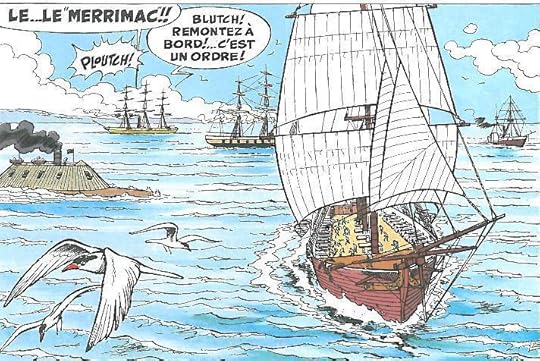
But if you want to include the evolution of the warship from the 1840s onward, pay proper attention to the fuddled shipyard spiking that yielded the Virginia's hull while that eccentric Swede designs his "cheesebox on a raft" [my favorite contemporary description EVER] & also conclude with 20th century underwater archeology, 350 pages is a good fit.
Between the lines, it shows how resource-consuming the construction of ironclads was for the South. Given steelworks were in short supply, this gamble on "assymetrical warfare" was an unwise choice against the industrial power of the North.
But if you want to include the evolution of the warship from the 1840s onward, pay proper attention to the fuddled shipyard spiking that yielded the Virginia's hull while that eccentric Swede designs his "cheesebox on a raft" [my favorite contemporary description EVER] & also conclude with 20th century underwater archeology, 350 pages is a good fit.
Between the lines, it shows how resource-consuming the construction of ironclads was for the South. Given steelworks were in short supply, this gamble on "assymetrical warfare" was an unwise choice against the industrial power of the North.

June 15, 2007
Essential reading for any serious Civil War buff. The author has a competent style and weaves the different narrative threads together much better than the average writer. This book will make you want to find out even more about the revolutionary ironclads...

November 1, 2011
James Nelson does an excellent job of describing the importance of the battle between the first two ironclads in world history. The USS Monitor (Erickson's Battery) against the CSS Virginia (formerly USS Merricmack) was tactically a draw but each side claimed victory and the world naval community was forever changed. The CSS Virginia's easy destruction of the Cumberland and Constitution showed the end of the wooden era and although that as largely the end of its destructive rampage, the psychological damage would be immense for the Union. Shortly after the Virginia destroyed those two ships the Monitor arrived on scene and for four hours the two ships battered each other causing no damage to either. The book goes on to describe how the Virginia would be blown up as McClellan's army invaded the peninsula and took Norfolk. The Monitor would not outlast its foe much longer when it was damaged in a storm about a year later and sunk with several hands lost. Many other ironclads would be built throughout the civil war this battle represented the triumph of the new navy and the future of shipbuilding in the United States.
Each side realized the immense value of an ironclad and raced to build as many as they could. The North's immense industrial advantage gave them the lead in building. One of the things that Nelson does very well is laying out the naval administrative sides for both North and South. He has done a superb job to show how each navy debated which ironclads to use and how they went about building them. It is a great look at an often referenced Civil War story that is explained in a great detail. The only complaint worth maybe a half star off is he jumps from north and south frequently with very little transition and you have to read very closely to notice when he makes his switch. Otherwise a thoroughly enjoyable read and for Civil War fans a must.
Each side realized the immense value of an ironclad and raced to build as many as they could. The North's immense industrial advantage gave them the lead in building. One of the things that Nelson does very well is laying out the naval administrative sides for both North and South. He has done a superb job to show how each navy debated which ironclads to use and how they went about building them. It is a great look at an often referenced Civil War story that is explained in a great detail. The only complaint worth maybe a half star off is he jumps from north and south frequently with very little transition and you have to read very closely to notice when he makes his switch. Otherwise a thoroughly enjoyable read and for Civil War fans a must.
July 25, 2007
It is a great book about the monumental battle between the USS Monitor and the CSS Virginia (formerly USS Merrimack)... the first battle between two iron-clad ships. Follows the development, construction, battle between and the demise of each of the vessels.

April 22, 2025
Overall 3.5 – 4 stars. 'Reign of Iron' begins with the two maiden voyages of America's first ironclad ships before their historic battle in Hampton Roads during the Civil War. The Confederacy's Virginia comes out guns blazing and rams the USS Cumberland, sinking it and then firing mercilessly on the US Congress. In the race down the East Coast to meet her rival, the Yankee's Monitor nearly sinks as it's towed in heavy seas. This 5-star portion of the book is followed by some Civil War background and how the north lost the Gosport Naval Yard in Norfolk, Virginia. Northern troops were fooled into fearing the imminent takeover of the huge ship facility so burned the yard's buildings and ammunition as well scuttling and burning its ships to avoid property falling into the hands of the Southerners in the early days of the Civil War. This 4-star story explains how the USS Merrimack came to fall in the hands of the Confederacy when the Southerners took over the yard and raised the ship whose temperamental engines, boilers and hull would become the CSS Virginia.
There are no drawings or photos of either ship in the book, except the cover. I found Drachinifel's video on youtube about the ships and the battle full of the missing paintings, drawings and few existing photos of the ships to be quite helpful.
A more mundane but well-researched 3-star story then presents the race to develop these revolutionary ironclads: their design, financing, engineering, construction and outfitting challenges. These chapters alternate between the North, under Navy Secretary Gideon Welles, building the USS Monitor battery and the South, under Navy Secretary Steven Mallory, rebuilding the Merrrimac into the ironclad Virginia in their race to launch the first ironclad. During the lengthy description of this process, we learn of the fascinating career of John Ericsson, the inventor of the Monitor and the challenges of iron plating in this time period.
Finally, we get to the battle between the two ships which we have patiently been waiting for and back to a five-star story. The two ships' overwhelming ability to dish out and take punishment is amply described. The aftermath of the first day's battle between the ships is then described and, to avoid any spoilers, the final disposition of both ships. Though both suffer embarrassing ends, their legacy was the end of the construction of wooden warships.
There are no drawings or photos of either ship in the book, except the cover. I found Drachinifel's video on youtube about the ships and the battle full of the missing paintings, drawings and few existing photos of the ships to be quite helpful.
A more mundane but well-researched 3-star story then presents the race to develop these revolutionary ironclads: their design, financing, engineering, construction and outfitting challenges. These chapters alternate between the North, under Navy Secretary Gideon Welles, building the USS Monitor battery and the South, under Navy Secretary Steven Mallory, rebuilding the Merrrimac into the ironclad Virginia in their race to launch the first ironclad. During the lengthy description of this process, we learn of the fascinating career of John Ericsson, the inventor of the Monitor and the challenges of iron plating in this time period.
Finally, we get to the battle between the two ships which we have patiently been waiting for and back to a five-star story. The two ships' overwhelming ability to dish out and take punishment is amply described. The aftermath of the first day's battle between the ships is then described and, to avoid any spoilers, the final disposition of both ships. Though both suffer embarrassing ends, their legacy was the end of the construction of wooden warships.
January 15, 2024
Amazon review on May 17, 2011:Monitor rules..but barely!
Really this effort deserves more than 4 stars but maybe not a 5. Still he does a great job here covering nearly every aspect of what was a major technical and historical development. He covers all the major characters on both sides, it is in fact a very well-balanced account. The book could certainly have used a better map to show the Hampton Roads area and exactly where the events took place, the one in the paperback book is plain inadequate. It was hard to tell from the narrative and maps why exactly the Virginia was trapped by the land actions and could not escape. I have a brand new appreciation for what it took to create these ships, get them to battle (1 day apart!)and how it truly revolutionary they were!
Really this effort deserves more than 4 stars but maybe not a 5. Still he does a great job here covering nearly every aspect of what was a major technical and historical development. He covers all the major characters on both sides, it is in fact a very well-balanced account. The book could certainly have used a better map to show the Hampton Roads area and exactly where the events took place, the one in the paperback book is plain inadequate. It was hard to tell from the narrative and maps why exactly the Virginia was trapped by the land actions and could not escape. I have a brand new appreciation for what it took to create these ships, get them to battle (1 day apart!)and how it truly revolutionary they were!
June 29, 2019
Interesting Reading
If you are interested in learning more about the forces which lead to the construction of the Monitor and the Virginia, details of the construction and the actual battle, this book is for you. There is also a nice section detailing the lives of the men involved in the years following the battle. The main characters come alive in this easy to read book. Seriously lacking in the Kindle edition edition are photographs and maps. Both would have been valuable additions.
If you are interested in learning more about the forces which lead to the construction of the Monitor and the Virginia, details of the construction and the actual battle, this book is for you. There is also a nice section detailing the lives of the men involved in the years following the battle. The main characters come alive in this easy to read book. Seriously lacking in the Kindle edition edition are photographs and maps. Both would have been valuable additions.
July 23, 2026
A Thorough and Readable History
While I’m familiar with the infamous battle of the ironclads in 1862, this book filled in massive amounts of history about both ships and the characters who lived through the experience. While a couple of maps would have been nice to illustrate the region in question it was not a deal breaker. Interested in naval history and/or the Civil War? Then you’ll enjoy this book.
While I’m familiar with the infamous battle of the ironclads in 1862, this book filled in massive amounts of history about both ships and the characters who lived through the experience. While a couple of maps would have been nice to illustrate the region in question it was not a deal breaker. Interested in naval history and/or the Civil War? Then you’ll enjoy this book.

June 11, 2019
One of the better books I've read so far this year. The author does a good job of keeping the reader's attention with a lively and persuasive narrative. He details the events and personalities leading up to the creation of the nation's first ironclads. An excellent history book that also crosses over into the biopic field.

April 16, 2020
Although well written the book includes a lot of detail that frequently slows down the narrative and can get confusing. There were a lot of people involved in the events described and in naming all of them it became hard to remember who was who. However, the main theme of the books does come through and, ultimately, you get the importance of what happened.

February 9, 2023
A narrative focused on the ships, sailors, and policy makers that constructed and manned the USS Monitor and CSS Virginia and the world's first naval battle between ironclads in 1862.
James Nelson is a good storyteller and jumps between the development, construction, and deployment of both ships.
James Nelson is a good storyteller and jumps between the development, construction, and deployment of both ships.

October 14, 2020
Well written & researched, though a little too focused on the confederacy.

January 17, 2026
A book I would pick up and put down constantly. Very interesting to see different narratives from both the North and South. Solid read for anyone interested in Civil War history.

June 11, 2013
This is for true history buffs. Lots of detail here so it won't appeal to the casual reader of history. I started out with gusto and spent the last few chapters in "gorge mode" (flipping pages, skimming, and taking in the gist of the story). You will definitely learn a lot about this epic battle.
Recommended if you are a civil war buff and/or are traveling to the battle site.
Recommended if you are a civil war buff and/or are traveling to the battle site.

June 7, 2010
An excellent new treatment of an incident that has spawned many historical narratives. Nelson brings to bear much new source material and devotes considerable attention to the back stories.

July 1, 2010
Too much fiction, not enough history.
April 29, 2011
Another great book that covers the battle between the Monitor & the Merrimack. Highly recommend.

April 4, 2012
Could have been better proof-read. It was slow, but well worth it in the end.
March 22, 2016
One of the most absorbing histories I have read. It held my interest like a well-constructed novel.
Displaying 1 - 19 of 19 reviews