Benjamin Britten, sailing uncomfortably close to the wind with his new opera, Death in Venice , seeks advice from his former collaborator and friend, W. H. Auden. During this imagined meeting, their first in twenty-five years, they are observed and interrupted by, among others, their future biographer and a young man from the local bus station.
Alan Bennett's new play is as much about the theater as it is about poetry or music. It looks at the unsettling desires of two difficult men, and at the ethics of biography. It reflects on growing old, on creativity and inspiration, and on persisting when all passion's ultimately, on the habit of art.
Librarian Note: There is more than one author in the GoodReads database with this name.
Alan Bennett is an English author and Tony Award-winning playwright. Bennett's first stage play, Forty Years On, was produced in 1968. Many television, stage and radio plays followed, along with screenplays, short stories, novellas, a large body of non-fictional prose and broadcasting, and many appearances as an actor. Bennett's lugubrious yet expressive voice (which still bears a slight Leeds accent) and the sharp humour and evident humanity of his writing have made his readings of his own work (especially his autobiographical writing) very popular. His readings of the Winnie the Pooh stories are also widely enjoyed.
This is a multi-layered story within a story, so a little like Charlie Kaufman's film Synecdoche, New York.
It is set during the rehearsal of a rather weak play about a fictitious meeting between WH Auden and Benjamin Britten near the end of their lives. So the actors play actors playing other people, and they argue with the writer and stage manager about how to perform it, fiddle with props and fluff their lines etc. That makes it sound pretentious and obscure, but it's clever, funny and thought-provoking.
The play they are performing echoes The Tempest and hence a poem that Auden wrote about it. In the period covered, Brittan was writing an opera based on Thomas Mann’s Death in Venice, which, with is pederastic undertones, has uncomfortable parallels with his own life. Because he is struggling with it, he is considering reviving his earlier collaboration with Auden. Humphrey Carpenter (who once interviewed Auden and was eventually biographer of both) is also a character in it.
Because of its structure, its plot has a less obvious trajectory than his other works; in some ways it is a miscellany of musings, loosely held together in concentric contexts. But somehow Bennett makes it work.
My favourite line is ascribed to WH Auden in the play: "Style is the sum of one's imperfections." I think that means I can claim to be stylish, whist remaining modest.
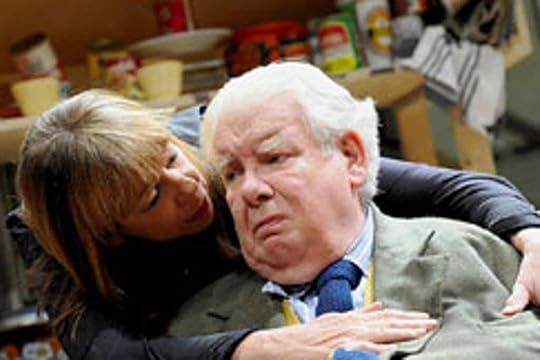
Frances de la Tour and Richard Griffiths in the original London production
I have never seen this particular Alan Bennett play, but I loved reading it. I am a huge fan of his writing, though, so that is no surprise.
It takes the form of a play within a play. A group of old luvvies at the National Theatre (the theatre this play was written for) are being put through their paces by a stage manager (originally played by Frances de la Tour - for whom it seems obvious Bennett wrote the part, as one can practically hear her speaking all of Kay's lines). The play within the play explores a fictitious conversation between poet W. H. Auden and composer Benjamin Britten, in Oxford, in their autumn years. It is partly narrated by Humphrey Carpenter who, in real life, penned biographies of both men.
The play(s) puncture theatrical illusions. Actors are portrayed as insecure and egotistical, writers as uncompromising and crew as long-suffering. Nor do the characters escape censure: Auden lives in squalor, the stench of his underpants the subject of gossip within the first few minutes of the drama; while Britten is frankly described as a paedophile.
Bennett handles his subject deftly, managing to pack punches with his deceptively light touch. This may be the last of Bennett's great plays (People drifted disappointingly and Allelujah! lacked subtlety, particularly in the closing speeches). I should dearly like to see The Habit of Art revived, ideally at the National Theatre. Sadly, I missed a recent UK tour. Honestly, though, I am surprised the play is "commercial" and that ageing middle-class theatregoers continue to see Bennett as cosy, despite his best efforts to disabuse them of this undeserved persona: one of his key characters here is a rent boy... to reveal what Auden wants to do with him would be one spoiler too many!
Alan Bennett. Or, as my sister more forthrightly puts it 'Alan fucking Bennett.'
We drove to another country to see this last night, which I say as an Australian would say that. Let me use a kids' word...it was a cool thing to do.
But I have to admit as time goes on and I age and Alan F. Bennett does too, he no longer does it for me. Maybe he never did. Maybe if people didn't act like he was important I'd like him more. To me he's like David Williamson. Entertaining, deals with safe issues that WERE controversial but aren't now. Polished, slick. But his plays will die with him.
And, yes, I've done the talking heads thing and I still think that. Sorry.
Alan fucking Bennett. I just want you to know that me and my sister (sic) are a bit sick of it. Well, no. My sister, to be perfectly frank 'can't fucking stand it, can't be in the same fucking room as it'.
Okay...those of you who know me will be wanting to ask this? Did I sleep through it? My friend Harry was impressed that I got up to double figures. That's measured in minutes, in case you are wondering. So, I have to confess that this review is based on the impressions of a sleeping person and a slightly grumpy one at that because WH Auden kept shouting all the time. I was right up the front. Why did he have to do that? I kept waking up thinking maybe something was happening, but it wasn't. Did Auden really shout like that? I can't believe a person could talk in a manner so different from his poetry. But don't you have dramatic license, AFB? Could you not have made him quietly spoken even if that weren't the case? Or was it that Benjamin Britten was quiet and therefore Auden had to shout?
Has anybody else seen this? If so, please explain what I missed. Please.
I was lucky enough to see The Habit of Art in its original run at the National Theatre, the first Bennett play I'd seen live.
The setting, as a play being rehearsed in a fictional setting with fictional stage managers and others, is an extremely clever way to get around the problem of disseminating information that the audience needs, but doesn't fit in the mouths of the main protagonists. Indeed Bennett talks about this conceit in his wonderful introduction to the text, which is as much about the craft of writing as it is about The Habit of Art itself.
The play itself is packed full of Bennett's characteristic humour, and reading it here takes me right back to the performance and literally howling with laughter at some of the jokes.
Per ora è il primo libro di Bennett che non posso dire mi sia piaciuto. È un testo teatrale raccontato un po' con una sorta di doppio metateatro. Siamo in un teatro in cui si prova uno spettacolo dedicato a due artisti inglesi molto importanti: un poeta, Auden, e un compositore, Britten. Peccato però che si concentri troppo su loro come persone e non insegni molto. Leggendo l'introduzione si riesce a capire meglio l'intento ma la doppia storia è dispersiva e fa perdere tempo. Gli attori in scena sono troppi e proprio quando lo spettacolo che stanno provando diventa interessante di solito si bloccano e discutono in modo insensato. Sarà anche realistico, ma l'effetto è fastidioso, snervante e fa perdere interesse. Concludo con una battuta che però mi è piaciuta molto di Auden: "Lo stile è una somma di imperfezioni... C'è tutto quello che uno non riesce a fare, oltre a quello che gli riesce..." Probabilmente però potrei apprezzarlo vedendolo a teatro.
Questa volta ho peccato di fiducia. Bennet per me è una garanzia, storie brevi e brillanti con un pizzico di sarcasmo o ironia: ero certa di andare sul sicuro. Forse se avessi fatto più attenzione in libreria mi sarei accorta che, per godermelo appieno, mi mancavano dei pezzi: chi era Auden? E Britten? E Carpenter? Mi sono persa tra attori, personaggi, nomi, voci e penso di non essere riuscita a leggere tutti i piani della storia. Nonostante tutto questo Bennet si conferma geniale nella sua capacità di dipingere personaggi e raccontare storie brevi senza annoiare mai.
An entertaining imaginary meeting between an elderly W.H. Auden and an ailing Benjamin Brittain to explore Auden's collaboration on "A Death in Venice". "He was my father in law you know..."
I forgot to remember that I think Alan Bennett is a bit too self-important before I read this. Oh well. I've taken an interest in Britten and Auden and their relationship, and this was at least interesting from that angle.
a short play that speculates (?) about a late in life meeting between WH Auden and Benjamin Britten. Hilarity not ensuing - but some damn funny moments.
Auden (interrupting) Do you mind not doing that? You should not quote a poet's words back at him. It is a betrayal of trust. A poem is a confidence. Besides which many of my poems embarrass me. They don't seem - Dr Leavis's word - authentic. People tell me off for censoring my poems, rewriting them, or cutting some well-loved lines. I tell them it's because I can no longer endorse those particular sentiments, but it's also because I'm fed up with hearing them quoted. (Ironically) We must love one another or die.' (Shudders.) In the end art is small beer. The really serious things in life are earning one's living and loving one's neighbour.
Britten Do you not work? Auden Every day, but I do nothing. I have the habit of art. I write poems of a cosy domesticity trying to catch the few charred emotions that scuttle across my nullified landscape. Still, writing is apparently therapeutic. That's what they say these days, isn't it? It is therapeutic.
3.5 stars I always enjoy Alan Bennett’s work, whether it’s a play, a memoir or a film. I do think (at least his plays) can be a bit repetitive in terms of the characters that reappear- obvs I don’t meant literal characters but their roles. If you read The History Boys and this play, you can see exactly who translates to who, and as much as I really enjoy and admire Alan Bennett, I’m not sure that’s the mark of an excellent writer? Maybe that’s unfair because it’s natural for writers to have an existential bit between their teeth which they come back to and continue to try to reason with and understand throughout their career. And I did enjoy learning more about Auden, given that all I really knew about him was what I had read in The History Boys (lol). In short I enjoyed reading the play (even if it does require a little bit of concentration to get into, due to the frame of a play within a play), I was just a bit bemused by the fact that I felt like I’d read this play ~somewhere~ before.
This feels as if it started out as a one act play (the second act) and someone came along and said, " Alan, love, we can't charge the punters 60 quid a seat for an imagined conversation between Auden and Britten about Death in Venice, the personal exposure involved in the act of artistic creation and growing old gracefully as a celebrated English homosexual. Could you beef it up?"
And thus the first act arrived. An entertaining rehearsal of a play that imagines a conversation between W.H. Auden and Benjamin Britten about adapting Auden's accidental father-in-law's Death In Venice. This adds a rent-boy, college servants, Auden and Britten's biographer and various parts of furniture in Auden's room, as well as the playwright and a very patient stage manager.
Whether any of that adds to a greater understanding of the second half, I don't know, there is fun to be had, but it rather outstays it's visit.
This isn't necessarily top-drawer Bennett but its wit and humanity did win me over.
National Theater Live subscription 10: I was very intrigued by this interplay between Britten and Auden, and the humor of pre-staging the play with constant egotistical interruptions by the actors landed just right, but thematically I think it falls apart at the end. This may have been intentional; there is some meta ado about how to end a play properly discussed explicitly by the characters, but I'm not convinced that the rent-boy's play-within-a-play speech about how all the lovers of Auden and Britten "contributed" silently to their respective art works is either philosophically truthful or hangs robustly on anything previously presented in the play - it feels panderingly tacked on. This is also an issue with the primary outer-play ending, Kay's speech about actors + fear + the stage going "on and on and on". Also, was she supposed to be the "one character who's always left out", their arc incomplete? I am skeptical.
Page 14 May: But Mr Auden’s been Professor of Poetry. Boyle: He’s been professor of putting his knob in people’s gobs for longer than that.
Page 20 [Auden, Wystan Hugh: City Without Walls] .“without a watch/ he would never know when/ to feel hungry or horny. ”
Page 21 Besides, nothing I ever wrote in the 30s saved one Jew from extinction or shortened the war by five seconds.
Page 23 I was never young, until I was older.
Page 27 Plays, they don’t so much go into production as into intensive care.
Page 49 at 20 I tried to vex my elders. Pass 60, it’s the young I hope to shock.
Page 54 There are some writers who set their sights on the Nobel Prize before they even pick up the pen. Elias Canetti is like that. And I’m afraid Thomas Mann. Never underestimate the role of the will in the artistic life. Some writers are all will. Talent you can dispense with but not woll. Will is paramount. Not joy, not the light, but grim application.
Page 68 I don’t prey on them. They like me only because I… attend to them. I listen. And since many of them are musical we play together… musically. Even the ones I cannot touch I can play with. Maybe one sort of playing is a substitute for another sort of playing, but it means we can do things together and perfectly properly. There is no threat in it a duet or… playing the teacups.
Page 69 Death isn’t the payment. Death is just the checkout.
I remember seeing this on National Theater Live, loving it but knowing that I would had to read it because there was so much to unpack. After reading it, I am similarly amazed at the way Bennett is able to playfully address such heavy subjects as the importance of the personal lives of the people that make art. Bennett’s use of humor is a beautiful way to defuse the stuffy feeling that creeps in whenever Art (with a capital A) is being talked about. It was really a phenomenal play and Bennett’s introduction was just marvelous at pulling back the curtain to its creation. I definitely recommend it.
A theatre production recreates an imagined meeting between Auden and Britten. This play reflects on the creative stoicism that keeps going when inspiration seems gone - the habit of art - , the paradox between art and artist, and the way history selects sone and edits out others.
It’s not as interesting as the History Boys, the wonderful Madness of George III, or some of his shorter plays and novellas, and the wood is occasionally obscured by the layered trees. But there is good stuff here and it is quite moving in places .
I’ve seen this play twice and loved it both times. The thing Bennett does well, is he made me feel smart just by witnessing these two.
But as a play, it’s more historical then having some big overarching point. All the funnies of being an ‘actor’ and ‘director’- which are fun and I enjoyed when I saw it and read it, but it could dig deeper.
And maybe not have a poor woman director suffering fools.
This is a review on the play itself, not the paper edition, so please do keep that in mind.
This play is a play within a play, and focuses on the nature of art, from the perspective of a general audience, and emphasizes the risk in glorifying historical artists over the common man. This final point is also the play's weakest. The first half is mostly the cast attempting to rehearse (while breaking character to commentate on the plot/just getting distracted), and the second half is a pretty straight-forward depiction of Britten and Auden's intellectual conversation.
The actual conversation between Ben and Wystan is extremely interesting. Both men haven't spoken in decades (keep in mind, this is a fictional meeting), and are reconciling the fact that they are about to die. The characterization of Auden and Britten both feel historically accurate, with Wystan's dry wit/hiring a rent boy in the middle of their conversation lol, and Ben's neuroticism contrasted by his guilt about his pedophilia makes for an interesting dynamic!
I cannot say the same of the actor characters in the frame narrative (Bennett's original). Most of them have a singular personality trait (this is even lampshaded by the characters themselves. Several times.), and feel to me like a collective of Bennett's braincells commenting on a play he already wrote. This makes the final "moral" feel completely pointless and confusing? If your point is that we should care about ordinary people, then why did you write your play so that the "great artists" had significantly more depth than everyone else? Why did you write your ordinary people like stock characters to laugh and make fun of? As someone with strong beliefs that the notion of a "great" artist is revolting, this play feels almost offensive to me. I agree! We should not aggrandize horrible men as gods above us "mere mortals"! So why are you doing it?
In short, I would have enjoyed a shorter play just about Wystan and Ben's interactions, and I felt like the play within a play metacommentary was both distracting and detrimental to everything the play stood for. I feel like Bennett's point of humanization instead of idolization would have come through simply through highlighting Ben and Wystan's negative aspects (something he already has done).
This entire review has been hidden because of spoilers.
Good --(rehearsing a) play-within-a-play. Auden and Britten matched. The actors behind them and what they go through, the stage manager. The author - that was quite enjoyable! Lots of words, near the end, last 10 pages.
Divertente. Non so se riuscirò ancora a leggere una poesia di Auden senza pensare a lui che pisciava nel lavandino o se ascolterò un pezzo di Britten dimenticando che adescava i ragazzini.
It’s Bennett. Meta, funny, meditative. Loosely structured but that seems part of the point. Not as stunning as THE HISTORY BOYS or TALKING HEADS, but close—and that’s a high bar to meet.
Reading a play is often more difficult than viewing a play. It is certainly different in many ways. Yesterday I had the opportunity to see the The Habit of Art By Alan Bennett as presented via a rebroadcast of National Theatre (of England) Live’s 2010 broadcast. Alan Bennett’s acclaimed play The Habit of Art, with Richard Griffiths and Alex Jennings, was offered by the Music Box Theater cinema as part of the National Theatre's 50th anniversary celebrations. The story of the play is simple: Benjamin Britten, sailing uncomfortably close to the wind with his new opera, Death in Venice, seeks advice from his former collaborator and friend, W. H. Auden. During this imagined meeting, their first for twenty-five years, they are observed and interrupted by, amongst others, their future biographer and a young man from the local bus station. The actual play as written by Alan Bennett is a bit more complicated. It is actually staged as a play within a play, thus the audience sees the actors and the stage management perform a run-through of the play, late in its preparation for its formal presentation. This was somewhat more complicated in the reading than when viewing the play. In addition to the main story of the Auden/Britten meeting the work of the actors is interrupted from time to time by discussions of changes to the script, questions of appropriate location of certain scenes and other issues that one might naturally encounter while preparing to stage a play. This aspect of the play was rather fascinating as the audience was provided a look inside the world of the theater. It reminded me a bit of the play "Noises Off" by Michael Frayn in this aspect although it was not nearly as anarchic as that wonderful comedy. The poetry of Auden is present in the character and he explains what he does succinctly and simply in the phrase "I have the habit of art." That being said, he has many other very human habits and the play highlights this very human side of Auden, as it does for Britten. The staging is exceptional and the acting superb with Richard Griffiths as Auden, Alex Jennings as Britten, and Frances de la Tour as the Stage Manager. Alan Bennett’s play is as much about the theatre as it is about poetry or music. It looks at the unsettling desires of two difficult men, and at the ethics of biography. It reflects on growing old, on creativity and inspiration, and on persisting when all passion’s spent: ultimately, on the habit of art
This is a play about W. H. Auden and Benjamin Britten (and Humphrey Carpenter, who wrote biographies of both), but it's also a play about actors and writing and plays, with plenty to think about. The title comes from Auden's repeated response to questions about whether he is working on anything now that he has retired to Oxford; if art is mere "habit," there's nothing elevated or mysterious about it. And the man himself is all too worldly, with habits ranging from annoying to disgusting. Through the framing device of actors playing the characters (rehearsing for a play whose author is also onstage), Bennett can show the unpleasant habits while suggesting that there is something more going on, not least the pleasure that playgoers will take in the finished product. The reading can be confusing because each real-life actor assumes so many different roles, but savoring Bennett's humor makes it worthwhile. I'm looking forward to seeing this one in performance.
Maybe I'm high off the rush of having just seen it, but I think this may be Bennett's masterwork. It just felt like all of his themes and stylistic streams came together. At one point Auden tells Britten that you have to write close to the bone (he used a better phrase which I can't remember) for it to be really true and good. And I feel like Bennett followed his own advice here. It felt like his was picking apart his own career, his own neuroses, his own sentimentality, his own persona as much as he was Auden and Britten. Plus, at times, it was just plain ole fucking funny. I probably laughed out loud more at this than any of his other works. For me it just hit all the right notes.
It wasn't as looooong as I thought it would be. I ket putting reading this one off because I thoughg it was going to be boring but it wasn't. I actually enjoyed it, but I'm going to be rereading it 'cause I didn't really understand it although I quite get what it's trying to say. I haven't read a play in years so the dialogue format confused me especially since this is basically a play within a play. I'll need to do some research about some of the characters since I don't know them all, which contributed considerably in the perplexity I felt while reading this.