

What do you think?

Modigliani
The controversial darling and target of the popular Scandalous Amedeo Modigliani To contemporaries, Amedeo Modigliani was the very definition of Parisian Bohemia, the controversial darling and target of the popular press and the model on which many a novel, play and film was based.
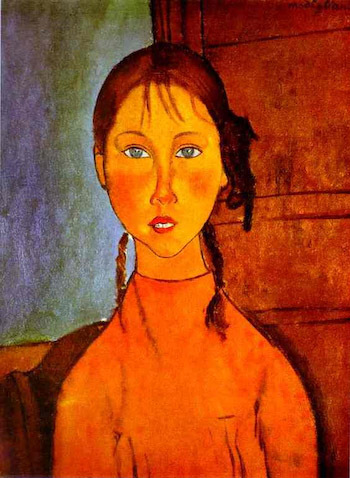
As an artist, the scandalous Modigliani made his name chiefly with his celebrated pictures of women, with almond eyes and long necks and bodies. His style had ancient roots that lay deep in classical antiquity or Africa. But his portraits of intellectual giants of the age, friends such as Pablo Picasso, Jean Cocteau or Diego Rivera, were inimitable also. In Doris Krystof’s study, the scene Modigliani was the hero of comes alive, and his sensitive paintings and sculptures speak in tongues. About the
Each book in TASCHEN’s Basic Art series
As an artist, the scandalous Modigliani made his name chiefly with his celebrated pictures of women, with almond eyes and long necks and bodies. His style had ancient roots that lay deep in classical antiquity or Africa. But his portraits of intellectual giants of the age, friends such as Pablo Picasso, Jean Cocteau or Diego Rivera, were inimitable also. In Doris Krystof’s study, the scene Modigliani was the hero of comes alive, and his sensitive paintings and sculptures speak in tongues. About the
Each book in TASCHEN’s Basic Art series
96 pages, Paperback
First published November 1, 1996
Ratings & Reviews
Friends & Following
Create a free account to discover what your friends think of this book!
Community Reviews
Displaying 1 - 13 of 13 reviews

October 23, 2016

Amedeo Modigliani (1884-1920) – The Poetry of Seeing: Six elegant essays by art historian Doris Krystof along with dozens of full color illustrations of the artist’s works. I so much enjoyed this book published by Taschen. To share a bit of Modigliani rasa, here are several quotes from the book along with my comments:
“Entwined with the name of Modigliani are all manner of ideas about the Bohemian life in Paris, the fateful poverty of the artist and his grand passions. Modigliani is the prototype of the artist who executes his work in the draughty studios of Montmartre and Montparnasse, intoxicated by alcohol, hashish, love and poetry.”
Author Doris Krystof does a good job separating myth from known facts, that is, from the artist’s day to day living and ever evolving approach of his art.
“The “spoiled brat” becomes a dandy and “the last real Bohemian.” The small, sickly boy in Livorno becomes the great, suffering artist in Paris, the painter who spares neither his strength nor his health in the creation of his work.”
This can be a lesson for us all: to never limit ourselves to our life in the present since our identity, our gifts, our capacities are forever changing; we never really know what greatness we might be capable.
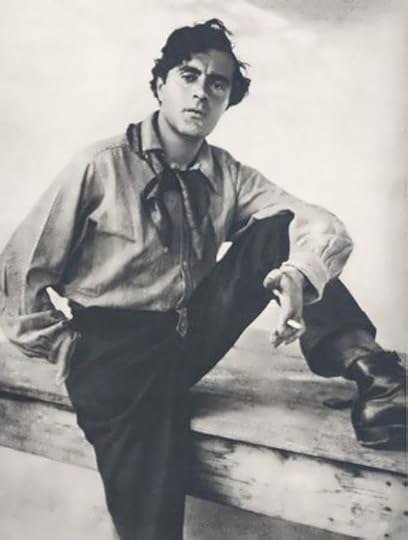
“Mondigliani appears to have spent the time before he moved to Paris more in the intensive study of Italian art history than in any further training as an artist. Nevertheless, his studies in Italy, the visits to original paintings and sculptures and thus the appreciation of an art historical tradition, the discovery of “forms of beauty and harmony,” as he put it in his letter from Rome, where some of the most important foundations for the later development of Modigliani’s art.”
The artist’s acquaintance with the magnificent tradition of Italian art enriched his own experience and deepened his work; or, to put it another way, as in literature, where a writer is empowered by extensive reading, so an artist is empowered by extensive seeing.
The eyes – “mirrors of the soul” – play an unusually important role in the work of the Symbolist painters. Whether closed as in sleep, open or blind, they are always a visionary organ, one which can be directed both outwards and inwards. This is significant for Modigliani’s later development as a painter, insofar as the eyes of his sitters also take on the visionary role they had already played for the Symbolists.”
For me and perhaps for others, like the Cheshire cat in Alice in Wonderland where his grin lingers after his body disappears, so with a Modigliani portrait, the eyes linger even when other features might fad from memory.

“With his talent for the concentrated portrayal of the characteristic traits of his sitters, and with his feeling for elegant forms and colors, Modigliani could easily have become one of the most sought-after portraitists of Parisian high society.”
A telling sign of a visionary artist: he refused to be swayed by the lure of commercial success.
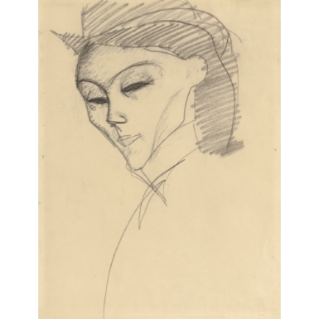
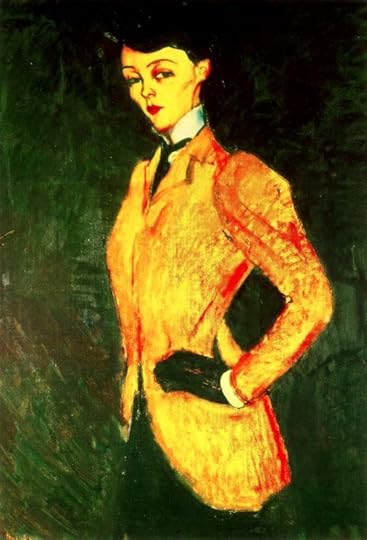
“Preparatory drawings for The Amazon allow one to see how Modigliani slowly encircled his subject, playing through various possibilities of expression before finally arriving at a subtle understanding of the portrayed person.”
These preparatory drawings are such a revealer of the process of how the artist wanted to peel away layer after layer of superficiality and strike at the truth of the sitter’s humanness.
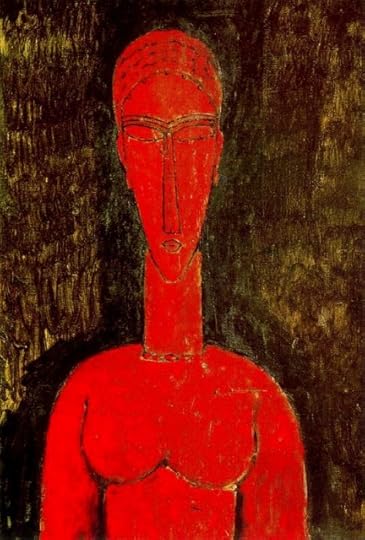
“Modigliani’s work as a sculptor was enormously beneficial to his painting. It was through sculpture that he formally arrived at reduction, linearity and abstraction, the components of his own personal, homogeneous pictorial language.”
Similar to how a playwright can improve their writing having been an actor, so Modigliani is a prime example of how working within one art form can strengthen another.
“Modigliani’s approach to art appears removed from the sphere of aesthetic debate. His sculptures were not really responses to the challenges of the genre; rather, as their lyric description as “columns of tenderness” suggests, they arose out of a comprehensive, poetic understanding of art. It is well known that Modigliani was a great lover of poetry, that he could recite entire passages of Dante and Petrarch from memory and often did so, sometimes even while painting.”
This really shows how being an artist is not a head trip, how painting and poetry are linked much more directly to the passions, feelings and the senses.

“The development of photography, as well as the desire for artistic autonomy, meant that by the beginning of the twentieth century the genre of portraiture had lost much of its original function of depicting the likeness of a person. Modigliani is the only artist of classical Modernism who still concentrated almost exclusively on the actual subject.”
Modigliani’s prime chosen art form was the portrait and he wasn’t about to be dissuaded by any modern technology.
June 3, 2023
I liked the artist himself more than his work
the way he drew faces and necks wasn't really to my liking whether it was influenced by ancient african statues or by one of the symbolist artists that he really liked before moving to paris it just looks disturbing
the way he drew faces and necks wasn't really to my liking whether it was influenced by ancient african statues or by one of the symbolist artists that he really liked before moving to paris it just looks disturbing

November 29, 2020
Paris'in meşhur bohem ressamlarından Modigliani'nin kısacık yaşamı ve yapıtları kitapta derli toplu bir şekilde aktarılmış. Yazarın ilgi çekici iddialarından biri, hiçbir akıma mensup olmayan ve hayatının sonuna dek bireyselliğini koruyan Modigliani'nin resmettiği portrelerin zaman içerisinde modellerinden çok üslubunu yansıtacak şekilde evrilmiş olduğu ve bu bakımdan portrenin ressamla resmedilen kişinin bir bileşimi olduğu yönündeki görüşü somut bir biçimde ortaya koyduğu. Afrika heykellerinin sanatçının üslubunu şekillendiren temel unsurlardan olması da ilgi çekici bir diğer detay.
This entire review has been hidden because of spoilers.

June 7, 2020
Modigliani’s should be read slowly... I did enjoy this book, but I wish there were more anecdotal moments of his life depicted rather than analysis of his artworks and the historic influences they had. Don’t get me wrong, I do enjoy those interpretations but I wish I could read more, think more and feel more like Modigliani thus hear more about his life and what he felt to have created what he had created.


January 6, 2019
I forgot how much I love it ...
February 3, 2019
I like it! Great art pics and narrative.

August 18, 2019
My favorite Artist

February 4, 2024
This is a picture book. I like the pictures. I saw it and continue to see it and I will continue to enjoy.

November 30, 2025
La figure de Modigliani, alcoolique, amateur de femmes, de haschisch et d’éther, longtemps méconnu et mort à 35 ans de la tuberculose, incarne le romantisme maudit du XXᵉ siècle. Outsider, Juif dans une France catholique, Italien récitant Dante à Montmartre, il finit en épave affaiblie tentant encore de vendre ses portraits envoûtants. Comment une vie si tourmentée a-t-elle pu engendrer une œuvre d’une telle beauté et sérénité ? Doris Krystof éclaire admirablement ce paradoxe et analyse avec finesse ses nus allongés et portraits intenses, révélant la profondeur d’un véritable génie.
J’admire Modigliani profondément. Chaque fois que je suis à Londres, je retourne dans l’exquise salle 10 de la Courtauld Gallery pour revoir Female Nude (1916). Si vous y allez, c’est une expérience splendide, calme et inoubliable, l’une des plus belles salles d’art au monde. ❤️
J’admire Modigliani profondément. Chaque fois que je suis à Londres, je retourne dans l’exquise salle 10 de la Courtauld Gallery pour revoir Female Nude (1916). Si vous y allez, c’est une expérience splendide, calme et inoubliable, l’une des plus belles salles d’art au monde. ❤️

August 22, 2025
Short and sweet

November 13, 2025
Debería leer más sobre la vida y obra de los artistas...

March 27, 2026
Clear and graspable as a whole; a good introduction with useful timeline.
Displaying 1 - 13 of 13 reviews