La jeunesse porte en elle une énergie débordante, qui permet d'accomplir de grandes choses, et même de se soulever contre un statu quo inacceptable. Mais c'est aussi une période à laquelle on a plus que jamais besoin de l'approbation du groupe, et c'est dans ce terreau que se développe le fascisme. Entre un graffeur poussé par le désespoir à dénoncer la loi et une classe de lycéens où sévit la délation et l'intégrisme, Fujimoto a de plus en plus de mal à garder ses opinions secrètes.
Siamo a metà della storia! Veramente un manga stupendo, scritto e disegnato benissimo e con il gran potere di portare con ogni storia che racconta un messaggio e ispirare una riflessione nel lettore! Consigliatissimo al momento!
Il voto è salito a 4,5 ⭐️ - spero di chiudere con un 5 pieno!
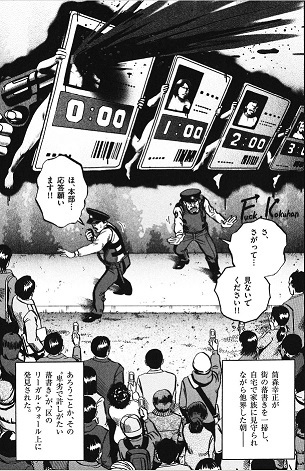
Story #1: A group of graffiti artists discuss their idol, who goes by the tag FK. We find out that FK only took up graffiti because his family runs a normal painting company, and if there is graffiti on the streets then they get more calls to paint over it. He just happened to get good at it. He wanted to be an illustrator but ofc the dad was like noooo u gotta take on the family business etc etc etc. FK is approached to make a legitimate mural because he actually does have talent and the government wants to seem hip for hiring a banksy like figure. FK declines because it wouldn’t be in the spirit of graffiti. The job goes to a kid who idolized him. FK gets served an Ikigami and with his final hours he paints on the wall where the mural was supposed to be. The image is extremely critical of the NWP.
Story # 2: The son of a man who works for the NWP is obsessed with both the program and getting respect from his family. He wants to rat out a social miscreant for the respect he will gain from his father. His older brother is in police training and he feels the familial pressure, but he also seems to believe in the NWP deep in his heart. He genuinely thinks it’s good for the country. When he gets served the Ikigami he cries with gratitude for the honor. However in his final hours he tries to get his whole class deemed social miscreants because they gossipes about him and didn’t like him. He beats up a student and ultimately his dad comes to arrest him because beating someone to a pulp is social miscreant behavior :////
Meanwhile, Fujimoto’s doubts are getting even stronger. At first I thought I was wrong in vol 4 and the Psych was actually going to rat Fujimoto out for being a dissident. I mean it’s still up in the air, she could be plotting. But it seems that she might be a dissenter as well. This volume was very different from the others in that the background plot with Fujimoto’s disillusionment is beginning to get more play. The first story was the first instance where there was public dissent shown rather than just a heartfelt personal story. The second story was unique to see someone who completely bought into the ideology and felt honored to receive an Ikigami. I don’t think I would mind if the whole rest of the series continued to be the short stories about the last 24 hours of different characters, because there is so much you can do with the same concept and this author is incredibly creative and talented. I get completely invested in the character even when it’s following the identical format and I know they will die in 24 hours. It’s still not tiresome. That being said, I am excited to see where the Fujimoto plot goes and the general population’s disillusionment with the system.
En este volumen nos encontramos con artista del graffiti cuyos sueños ha reprimido toda su vida y con el hijo de un funcionario al cual su existencia ha sido encaminada al único propósito de servir al gobierno que ratificó el sistema de muerte controlada volviéndolo un verdadero creyente de la causa. En ambas historias encontramos puntos de cuestionamiento de las acciones del gobierno y como este hace todo lo posible para suprimirlos.
As this series is progressing the overarching plot is shaping up to be a very interesting look at someone torn between a totalitarian government and a growing rebellion. Then the individual stories are fascinating looks at what someone might do if they know they only have 24 hours to live. Good stuff that's becoming better through the telling..
This was the first volume where I liked both stories. I feel like more and more people are starting to have dissident thoughts and (guerilla) fighting against the National Welfare Police, a.k.a. Big Brother.
This was one of the better volumes of the manga. I'm so confused as to what's going on with his woman friend though. Is she part of the resistance? Is she faking to get him in trouble? My theory is the second one, but only time will tell.
Another good read from the Ikigami series. The personal "ikigami" stories themselves were not my favorite thus far, but I love how all of the personal stories reveal another dimension of the National Welfare Program's effect on citizens and society. And in this latest edition, we're starting to stretch beyond just the negative impact on individuals and really get more of a feel for how the populace at large is viewing the program. In contrast, while in previous volumes we see ikigami delivery agent Fujimoto weighing the consequences of the program on a large scale, it's becoming a much more personal issue for him as he suspects he may be dangerously singled out as a "social miscreant" for his non-conformist inclinations...
After 8 standalone stories the Ikigami series starts to utilize the slowly developing story arch more fully. One would think that it's about time by the fifth volume, but the standalone stories have been just so completely excellent that it's actually just the perfect timing to give more attention to the regular characters who haven't been particularly prominent so far.
There are still two separate stories here involving people killed randomly as sacrifice to the state, and those storylines work as well. But yeah, it's nice to see that the imagined totalitarian state the series presents is getting fleshed out.
The two stories in this volume are more related to the premise, the National Welfare Act, and how the secret police use it to silence dissent by letting suspicion and paranoia spread among people. One starts to worry if protagonist Fujimoto should trust his co-workers with his concerns about the act.
The stories are still strong and Fujimoto is a character you can really identify with. He is a good person doing a soul-killing job in a society where anyone can be accused of being a "social miscreant" and taken away by the National Welfare Police for "reeducation". While this story is fictional, there are certainly parallels to totalitarian regimes today (or in the past, like Nazi Germany, or the former Soviet Union). I think teens could find a lot to discuss in this series.
Dans cette suite (toujours aussi intéressante!), on entre de plus en plus dans le doute concernant la loi des morts programmées par l'état. Les différents protagonistes commencent à se poser des questions sur le bien fondé de cette règle.
De plus, on suit également l'histoire d'un lycéen plutôt fanatique, du fait de l'éducation très pro-gouvernement de son père.
It was interesting seeing the thoughts on getting an ikigami from someone who has been raised to respect that law. This volume also started showing me the underlying storyline i've been waiting for. Excited to continue onwards.
My most favourite volume so far? I’m not entirely sure. Nonetheless, it revealed some more about the main characters and pushed the plot a little bit further. It’s interesting to follow along the one-time side characters, also, and how they’re so different to one another.