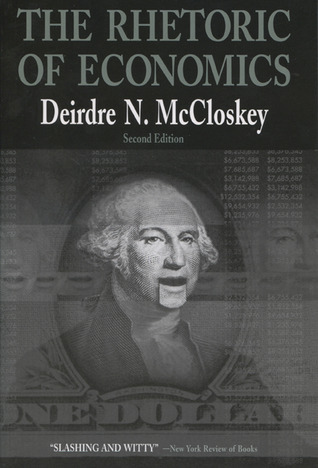
A classic in its field, this pathbreaking book humanized the scientific rhetoric of economics to reveal its literary soul. In this completely revised second edition, Deirdre N. McCloskey demonstrates how economic discourse employs metaphor, authority, symmetry, and other rhetorical means of persuasion. The Rhetoric of Economics shows economists to be human persuaders, poets of the marketplace, even in their most technical and mathematical moods.
Deirdre Nansen McCloskey has been distinguished professor of economics and history and professor of English and communications at the University of Illinois at Chicago. She is the author of numerous books, including Bourgeois Equality: How Ideas, Not Capital or Institutions, Enriched the World.
I once took a Macroeconomics methods course with a tenured faculty member from a top economics department. After one class, I came up to him and asked about whether he was concerned that one of the econometric techniques he taught [think matrix stacking] required a fair number of subjective judgments ex-ante which produced ambiguity when interpreting results. He broke into a somewhat sheepish grin and replied that Economics is after all simply a matter of Economists arguing over priors using tool-kits as a form of mutually understandable rhetoric – like McCloskey might suggest. This glib analysis – spoken by an expert whose pubic-facing published papers project none of this ironic humility on economic knowledge – has stuck with me since.
I think McCloskey’s Critique (as her thoughts here presented have come to be known) is at once more optimistic and more constructively critical than this matrix manipulator’s interpretation in paraphrase. Although she takes aim at overly self-assured social scientists, her picture of economics doesn’t cast it as “mere rhetoric”. Rather, she suggests that the whole project of science – physical, social, or “human” – is carefully supported argumentation rather than the cold “objective” falsification from the logical positivist perspective. In so arguing, McCloskey engages in extensive intellectual arbitrage from post-modernist philosophy and literary criticism. As any economics student knows, arbitrage adds values for consumers who would lack access otherwise – no doubt the case here. McCloskey brings a bevy of thinkers and direct quotations to bear that are far outside of your average economist’s reading list, to enlightening effect.
One suspects that a fair amount is lost in this exchange. As McCloskey herself argues, appeals to authority matter, and McCloskey is hardly an authority on epistemology or the philosophy of science – though I’m in no position myself to point out exactly where and how that shows. This encourages special skepticism in latter parts of the book, where McCloskey diverges from pointing out economic rhetoric in practice towards expounding her dog in the fight between modernism and its discontents with impressive but unconvincing bravado. Nor are the analogies tying economics to linguistics and literature entirely convincing. A straw-woman McCloskey might address these criticisms with a knowing wink – isn’t a rhetor’s job to convince us of their well-grounded perspective more than anything else? Perhaps, but sending signals of self-assured sophistry hardly helps her cause.
Nonetheless, the “Rhetoric of Economics” is a helpful pedagogical tool, for self-teaching or classrooms. If nothing else than for helpfully casting light on foundational philosophical debates for readers who otherwise might go on trucking with simplistic scientism. The inclusion of the chapter on “significance stars” in basic econometrics syllabi, for example, would be salutary (as it was for a time series econometrics course I took). The book would also be a useful read for starry-eyed social scientists from adjacent disciplines, who have been drifting moth-like in recent years towards the light of “rigor” that economics promises. Later chapters should be especially sobering for chest-beating “methodologists” (see: political science) who’ve taken to sneering at the perceived subjectivity of their co-disciplinary fellows.
Aunt Deirdre had an excellent premise - treating economics like a text and doing a literary criticism of it. This is one of those books where you can't go back to seeing things as you did before. She completely destroys the idea of scientific nature of economics and shows how economists also use figurative metaphors and write stories like poets and novelists, or like 'the arts'. However, her aim isn't really to attack economics, as she kept mentioning several times. It is to reform.
Under the guise of pure science, many racist, patriarchal and colonial ideas dominate economics. This was the case with many fields but they could accept criticism and reform - which made them stronger. Anthropology is one such field - It once rested completely upon racist ideas but now has space for a range of diverse ideas. Accommodating multiple ideas and constantly correcting them;Being aware that nothing is free of value,aesthetic, form etc - these things will only enrich the field, not tear it down. Economists should get off the high toy horse and do some real introspection.
Прославленный экономист Дирдра Макклоски, написавшая к настоящему времени шестнадцать книг и более четырех сотен научных работ, возглавлявшая в прошлом американскую ассоциацию экономических историков, в книге "Риторика экономики" подтвердила то, что подозревали многие: экономика не Наука.
Наука, как ее принято понимать среди экономистов, да и обывателей, полагается на логику и факты. Однако экономисты, как и литераторы, пользуются в статьях метафорами и историями. Экономисты рисуются, в смысле сознательно создают у читателя определенный образ себя, а не только предмета.
Макклоски полагает, что все это к лучшему. Не являясь "Наукой", экономика все же является хорошей нормальной наукой. Любые ученые, включая физиков, химиков и биологов, на которых экономистам так хотелось бы походить, пользуются всем богатством средств убеждения, и каждое средство может помочь понять мир. Плохо сводить методы исследования лишь к логике, а логику к modus tollens (из А следует Б, раз не видим Б, то нет и А; если кто-то недавно почистил зубы, щетка будет мокрой, однако щетка сухая, значит зубы не чистили). Хорошие исследователи достигают успеха именно потому что не практикуют то, что принято подавать как методологию экономики.
Книга Макклоски поможет любому участнику разговора про экономику. Осознав, какими приемами убеждения он в реальности пользуется, экономист сможет соотнести их с лучшими образцами в своем роде. Напротив, слушатель, критик, сможет лучше распознать изъяны аргументации. Стоит ли говорить, что говорящий и сам должен быть своим первым критиком?
Like many books, The Rhetoric of Economics would perhaps have been better if it were half the length. I understand the basic premise to be: regardless of whether there is objective truth, we need human persuasion to implement that understanding; the sooner economists recognize that there is a persuasive element in their science, rather than simply hammering out objective truth, the better they will be at persuading, and the better they will be at arriving at their truths. For instance, one especially insightful point is how, by neglecting the rhetorical element of economics, economists often confuse statistical significance with significance as commonly understood. And if they were aware of economics as rhetoric, they would do a better job of actually trying to arrive at commonly-understood significant results rather than merely crunching out numbers that are statistically significant, and assuming that these findings actually are significant.
I think it's mostly good, but maybe it gets a little too preachy at some points, and becomes an anti-modernist screed. But at the same time, McCloskey does warn us that this is an introductory book, and the full philosophical examination is found in other works. As an introductory work, I think it does a pretty good job.
McCloskey, amazingly, manages to take a highly intriguing and multidisciplinary topic - the philosophy and methodology of economics - and ruin it with obtuse writing style and odd manners of expression. To make this topic boring probably requires a Herculean effort.
A new life attitude that I've come to adopt is that since my time is so limited now, I've no time for unclear writing unless you're a Kant or a Hegel or an Aristotle - basically a proven genius who's worth my time spent in deciphering your dense language. If you're not a proven genius who has earth-shattering ideas to offer humanity, then I'm afraid you should work on your clarity.
But McCloskey's core insight is still very useful - that economists are not objective discovers of self-evident truth (mathematicians 'discover' math, but economists don't 'discover' econ), but rather, they use an incredible range of rhetorical techniques to present their arguments. McCloskey shows how the standard tools of economics - event studies, statistical tests, mathematical proofs, even simple verbal analysis - are basically just similar to literary techniques that poets and writers use to evoke emotion in their readers and thus prove their point. For example, the use of 'implied authors' and 'actual authors' etc - McCloskey shows that an abstract in any econ paper invokes this.
And so, McCloskey insists that econ cannot be a science. Ofc, I do agree to a large extent, but on the other hand it's clear that this assessment of econ was made longgg before the modern form of the credibility revolution, where applied micro people today, in particular, run natural experiments all day. We've long since moved from an a priori, deductive art to an a posteriori, inductive science.
Couldn't bear to slog thru this painful writing, and I finally decided to just skim the chapter on Coase and call it a day. McCloskey's various articles, where she gives various econ issues piecemeal treatments, have proven to be more useful.
My younger self would have greatly appreciated McCloskey's key insight. That was a time when I was fooled by the math used by economists into thinking that econ papers are devoid of ideology.
My studies in philosophy made me rethink a lot of preconceived notions I'd had regarding the methodology of economics. Basically, what I realised was how incredibly rare it is for any statement or analysis to present a self-evident truth, and hence the vast majority of statements are just arguments, not truths, like how all of philosophy consist of arguments. So, when reading an econ textbook for example, you are reading the author's argument and attempt to convince you to subscribe to a certain economic theory, not necessarily the author's presentation of the truth. This line of thinking made me wonder if even textbooks in the natural sciences like physics are also just arguments, not truths - but since I don't have a background in the natural sciences I cannot comment.
And this idea is what made me start to think that the philosophy of math is what could possibly solve all the problems of philosophy. Because it attempts to clarify the nature of what we would all agree is absolute truth - math and logic. Why do we see math as the truth? And do mathematicians REALLY 'discover' math, not invent it?
I Read the short-version of this, on the Journal of Economic Literature. This is mandatory reading for students of philosophy of science, economics, social sciences, jurisprudence, statistics and sciences, whether someone agrees or disagrees with the McCloskey's view. The broadness of topics examined and the erudition of the author is rare. One can show this paper to economists and make them overcome the physics envy, or show it to jurisprudence students to help them understand the importance of their work, or to scientists to challenge their worldview. For a bonus, read Steve Weinberg's "Against Philosophy" and find similarities and differences in their thesis. Both of them are not philosophers of science, making their practicality refreshing for readers and illuminating for students that are lost in a large volume of mandatory coursework.
This is a worthwhile introduction to rhetorical analysis in economics. It both demonstrates how this could be done and the benefits of doing so.
This can make the book rather repetitive, there are numerous chapters in the middle portion which, insofar as they are supporting examples of an overarching argument, are driving home the same point (this isn't to say that these aren't examples worth discussing in and of themselves).
The core argument here is that all science inevitably relies on rhetoric of some form or another. However, for me, the far more interesting point that McCloskey makes is that this is not a bad thing! She argues that we should acknowledge and constantly work to improve our rhetoric rather than search in vain for a methodology which pushes it aside.
Became clear early on that this was written by an incredibly conservative economist who thought the discipline was fine but that economists could use a bit of training on rhetoric. Disappointing. When she lauded Gary Becker for his discussion of "criminals" as "small business owners," it was obvious that none of this would actually fundamentally criticize economics for its use of mathematical jargon to construct a conservative worldview, which is at the top of the list of necessities when considering a critique of economic rhetoric.
A fairly tricky book to read due to the heavy technical jargon. I personally preferred Deirdre's journal article titled 'metaphors economists live by.' I think the points made in the book are really good though and I really liked Deirdre's point about the lack of clarity surrounding metrics when economists make blanket statements such as 'the economy is bad' etc. I think this is one of the key things that makes economic discourse and news so esoteric. I don't think I would classify this as the best book in the field of economic discourse but it is most definitely a classic.
Deirdre is at her best in this book. It resolved my internal conflict as a PhD student in social sciences between what I felt was persuasive in seminars and what was portrayed in methodology papers and articles. The point of the book is the following: Everywhere and always, we're telling a story, and there's not a single standard for a good argument, not even falsification, other than being persuasive, no matter what that looks like, and quantitative evidence is but a type of argument that helps support that story.
This entire review has been hidden because of spoilers.
Very well written and funny book about different unscientific ways of presenting economic theories, but because i am not an economist, i cannot say that i understood everything that the author was arguing. For me the most interesting part was the analyses of different scientific strains like positivism, modernism and postmodernism and how all sciences are prone to unsubstantiated biases that can be destructive
This book is very intellectually difficult for me. I wish I had a seminar each week to work through one of the chapters with others reading the book and a professor with a deep understanding of the material. This book uses technical rhetorical analysis to understand technical economics papers and while everything I get out of it is interesting, I feel like I'm not getting it all.