

What do you think?
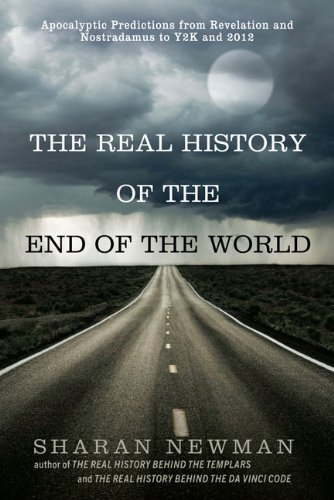
The Real History of the End of the World: Apocalyptic Predictions from Revelation and Nostradamus to Y2K and 2012
From the author of The Real History Behind the Templars --the origins and stories behind end-of-the-world predictions throughout history, from Revelations to 2012.
In entertaining and sharp prose, historian Sharan Newman explores theories of world destruction from ancient times up to the present day- theories which reveal as much about human nature as they do about the predominant historical, scientific, and religious beliefs of the time. Readers will find answers to the following end-of-times
?Did the Mayans really say the world will end in December 2012?
?How have the signs in the New Testament Book of Revelations been interpreted over the years?
?How did ancient Egyptians, Norse, and Chinese think the world would end?
?When did Nostradamus predict that the last days would come?
?Does the I Ching reference 2012?
?Why didn't the world end in Y2K?
?Are meteors, global warming, super-volcanoes, and the threat of nuclear war signs that the end is near?
In entertaining and sharp prose, historian Sharan Newman explores theories of world destruction from ancient times up to the present day- theories which reveal as much about human nature as they do about the predominant historical, scientific, and religious beliefs of the time. Readers will find answers to the following end-of-times
?Did the Mayans really say the world will end in December 2012?
?How have the signs in the New Testament Book of Revelations been interpreted over the years?
?How did ancient Egyptians, Norse, and Chinese think the world would end?
?When did Nostradamus predict that the last days would come?
?Does the I Ching reference 2012?
?Why didn't the world end in Y2K?
?Are meteors, global warming, super-volcanoes, and the threat of nuclear war signs that the end is near?
336 pages, Paperback
First published January 1, 2010
About the author
Sharan Newman
52 books195 followersSharan Newman is a medieval historian and author. She took her Master’s degree in Medieval Literature at Michigan State University and then did her doctoral work at the University of California at Santa Barbara in Medieval Studies, specializing in twelfth-century France. She is a member of the Medieval Academy and the Medieval Association of the Pacific.
Rather than teach, Newman chose to use her education to write novels set in the Middle Ages, including three Arthurian fantasies and ten mysteries set in twelfth-century France, featuring Catherine LeVendeur a one-time student of Heloise at the Paraclete, her husband, Edgar, an Anglo-Scot and Solomon, a Jewish merchant of Paris. The books focus on the life of the bourgeoisie and minor nobility and also the uneasy relations between Christians and Jews at that time. They also incorporate events of the twelfth-century such as the Second Crusade and the rise of the Cathars.
For these books, Newman has done research at the Bibliothèque Nationale in Paris, the Centre National de la Recherche Scientifique France Méridionale et Espagne at the University of Toulouse and the Institute for Jewish History at the University of Trier, as well as many departmental archives.
The Catherine Levendeur mysteries have been nominated for many awards. Sharan won the Macavity Award for best first mystery for Death Comes As Epiphany and the Herodotus Award for best historical mystery of 1998 for Cursed in the Blood. The most recent book in the series The Witch in the Well won the Bruce Alexander award for best Historical mystery of 2004.
Just for a change, her next mystery, The Shanghai Tunnel is set in Portland in 1868.
The Shanghai Tunnel allowed Sharan Newman to explore the history of the city she grew up in. She found that the history she had been taught in school had been seriously whitewashed. Doing research in the city archives as well as the collections at Reed College and the Oregon Historical society was exciting and eye-opening. Many of the “founding fathers” of Portland turn out to have been unscrupulous financiers. Chinese workers were subject to discrimination and there was an active red light district.
On the other hand, Portland in the post-Civil War period also saw some amazingly liberal movements. Women’s rights were an important issue as was religious toleration. Even at that early date, preserving the natural environment was hotly debated.
This is the world in which Emily Stratton, the widow of a Portland merchant and the daughter of missionaries to China, finds herself.
Newman has written a non-fiction book, The Real History Behind the Da Vince Code Berkley 2005. It is in encyclopedia format and gives information on various topics mentioned in Dan Brown’s novel. Following on that she has just completed the Real History Behind the Templars published by Berkley in September of 2007.
She lives on a mountainside in Oregon.
(Text taken from: http://www.sharannewman.com/bio.html )
Rather than teach, Newman chose to use her education to write novels set in the Middle Ages, including three Arthurian fantasies and ten mysteries set in twelfth-century France, featuring Catherine LeVendeur a one-time student of Heloise at the Paraclete, her husband, Edgar, an Anglo-Scot and Solomon, a Jewish merchant of Paris. The books focus on the life of the bourgeoisie and minor nobility and also the uneasy relations between Christians and Jews at that time. They also incorporate events of the twelfth-century such as the Second Crusade and the rise of the Cathars.
For these books, Newman has done research at the Bibliothèque Nationale in Paris, the Centre National de la Recherche Scientifique France Méridionale et Espagne at the University of Toulouse and the Institute for Jewish History at the University of Trier, as well as many departmental archives.
The Catherine Levendeur mysteries have been nominated for many awards. Sharan won the Macavity Award for best first mystery for Death Comes As Epiphany and the Herodotus Award for best historical mystery of 1998 for Cursed in the Blood. The most recent book in the series The Witch in the Well won the Bruce Alexander award for best Historical mystery of 2004.
Just for a change, her next mystery, The Shanghai Tunnel is set in Portland in 1868.
The Shanghai Tunnel allowed Sharan Newman to explore the history of the city she grew up in. She found that the history she had been taught in school had been seriously whitewashed. Doing research in the city archives as well as the collections at Reed College and the Oregon Historical society was exciting and eye-opening. Many of the “founding fathers” of Portland turn out to have been unscrupulous financiers. Chinese workers were subject to discrimination and there was an active red light district.
On the other hand, Portland in the post-Civil War period also saw some amazingly liberal movements. Women’s rights were an important issue as was religious toleration. Even at that early date, preserving the natural environment was hotly debated.
This is the world in which Emily Stratton, the widow of a Portland merchant and the daughter of missionaries to China, finds herself.
Newman has written a non-fiction book, The Real History Behind the Da Vince Code Berkley 2005. It is in encyclopedia format and gives information on various topics mentioned in Dan Brown’s novel. Following on that she has just completed the Real History Behind the Templars published by Berkley in September of 2007.
She lives on a mountainside in Oregon.
(Text taken from: http://www.sharannewman.com/bio.html )
Ratings & Reviews
Friends & Following
Create a free account to discover what your friends think of this book!
Community Reviews
Displaying 1 - 28 of 28 reviews

November 26, 2023
I think it's a competent, entertaining survey of the world's doomsday prophecies. The selection of examples to discuss is a bit random and a bit repetitive, but Newman does her homework and her attitude is refreshing. For example: People can't decide when the Middle Ages ended. Personally, I think we're still in them. After all, if this is the last age, then any quibbles about eras within it are rather pointless.
In discussing Augustine's views on the book of Revelation, she comments, I find it comforting that someone as brilliant and devout as Augustine couldn't understand it either. In examining the predictions of total cataclysm in the Mayan Popol Vu, she notes This is what happens to people who don't respect the hard work their gods went through to create them.
Here's a few more quotes that convey the book's scope and approach:
In researching this book, I read about a lot more prophets, doomsday groups, and theorists than I could possibly include. You may find the ones I've chosen a bit odd. I may have left out your favorite scenario. But the more I researched, the more I realized that the ideas about the end of the world were astonishingly similar.
Also,
I began to realize that no one expects their world to end. People who expect the Apocalypse soon arn't preparing to die but to survive. They'll build an ark or be raptured up or hitch a ride on the mother ship.
In discussing Augustine's views on the book of Revelation, she comments, I find it comforting that someone as brilliant and devout as Augustine couldn't understand it either. In examining the predictions of total cataclysm in the Mayan Popol Vu, she notes This is what happens to people who don't respect the hard work their gods went through to create them.
Here's a few more quotes that convey the book's scope and approach:
In researching this book, I read about a lot more prophets, doomsday groups, and theorists than I could possibly include. You may find the ones I've chosen a bit odd. I may have left out your favorite scenario. But the more I researched, the more I realized that the ideas about the end of the world were astonishingly similar.
Also,
I began to realize that no one expects their world to end. People who expect the Apocalypse soon arn't preparing to die but to survive. They'll build an ark or be raptured up or hitch a ride on the mother ship.
July 26, 2023
This was a rather fun read, actually. The author breaks down various end-of-the-world prophecies that have sprung up through history into short two- to three-page chapters (sometimes longer) in which she gives a quick synopsis of who predicted it, where they claim to have gotten their information, and what impact it had on the world around them, and she ends each chapter with all of the sources that she used to obtain the information. I also enjoyed her writing style as she tastefully interjected her own opinions (especially when the sources were outlandish) which brought some humor, and even a little insight, into the subject matter.
Whilst there were a few chapters on non-Christian sources, the vast majority of those within this book were from Christians, or Christian-adjacent people, by a big margin. It seems Christianity just can’t help being a Death Cult no matter how hard it tries…and it doesn’t really seem to try very hard, at all.
If you’re like me, and eschatology is something you enjoy, I would definitely recommend reading this book. Fun fact: just about every prediction and/or prophesy has already come to pass and not a single one of them bore fruit. It’s almost like it’s a bunch of bullshit certain people use to prey on other people for fun, power, and profit.
Whilst there were a few chapters on non-Christian sources, the vast majority of those within this book were from Christians, or Christian-adjacent people, by a big margin. It seems Christianity just can’t help being a Death Cult no matter how hard it tries…and it doesn’t really seem to try very hard, at all.
If you’re like me, and eschatology is something you enjoy, I would definitely recommend reading this book. Fun fact: just about every prediction and/or prophesy has already come to pass and not a single one of them bore fruit. It’s almost like it’s a bunch of bullshit certain people use to prey on other people for fun, power, and profit.

January 16, 2018
The Real History of the End of the World is a decent, broad introduction to end-times prophecies, cults, and beliefs spread across a global range of cultures from ancient times through 2012, but the book is plagued throughout with errors in spelling and mechanics. Whoever edited this book did a piss-poor job.
I like the fact that Newman included footnotes to direct interested readers to plenty of additional sources. Some of her secondary sources are quite dated, going as far back as the mid-19th century, but maybe that’s just because those remain the best sources available in the field. Given the provocative nature of this particular subject, though, I kind of doubt it.
There were a couple of chapters that didn’t really seem to fit that well with the theme of the book. Chapter 27 especially, “The Cherokee Ghost Dance of 1811 – 1812”, seems kind of wedged in through some inexplicable loophole and is somewhat of a confused muddle.
Still, not a bad book, just hard to rate as more than just ‘okay’. I’ll be looking for better books on this topic. Anybody have any recommendations for me?
I like the fact that Newman included footnotes to direct interested readers to plenty of additional sources. Some of her secondary sources are quite dated, going as far back as the mid-19th century, but maybe that’s just because those remain the best sources available in the field. Given the provocative nature of this particular subject, though, I kind of doubt it.
There were a couple of chapters that didn’t really seem to fit that well with the theme of the book. Chapter 27 especially, “The Cherokee Ghost Dance of 1811 – 1812”, seems kind of wedged in through some inexplicable loophole and is somewhat of a confused muddle.
Still, not a bad book, just hard to rate as more than just ‘okay’. I’ll be looking for better books on this topic. Anybody have any recommendations for me?

January 31, 2023
Newman has an incredibly fun and engaging writing style that makes what could easily have been an overly heavy or tedious study an absolute breeze to read. It's a very light, layman friendly overview so it doesn't dig in too deep, but I personally already had pretty good knowledge of a lot of Christian millennial or apocalyptic movements and the information she gave was always well-sourced and correct as far as I knew it. She also does a good job explaining the beliefs of these groups with minimal editorialising, altho when she does editorialize she does it in an obvious and usually funny way, not pretending to be objective in those moments. Anyway, if you're interested in history and theology, and especially the history OF religion, this is a great, quick introduction to some of the more pressing concerns of Believers throughout history.

March 4, 2025
I like to look at systems or institutions rather than people when looking for causes but when it comes to religious texts, the tendency towards tribalism and a survival instinct creates a dynamic of "othering" We cant blame people for how we evolved but when the tendency is encouraged we look at who gains from it.
Anyhow, disagreements over sectarianism have cause untold suffering in the world. It is boggling to me how bible book clubs decide the fate of so many. Bibles and their instruction of how we ought to live has been one of the worst tragedies of mankind.
I was assigned this book in college and read some chapters for the course on representations of art in the apocalypse and found it quite interesting. Decided to read through the whole thing. The author mentions this but there are so many apocalyptic belief systems and examples that the book could run over a thousand pages. For a survey read over some big ideas, and some underdeveloped or not relevant sections, this book isn't bad. Accessible style. Not a bad read but others recommend better books on the subject.
I had the exact same thoughts as the author in the final chapter. The only reasonable concerns we have over existential threats are ecological disaster and nuclear war. Both are preventable and have only ourselves to blame if we mess it up.
Anyhow, disagreements over sectarianism have cause untold suffering in the world. It is boggling to me how bible book clubs decide the fate of so many. Bibles and their instruction of how we ought to live has been one of the worst tragedies of mankind.
I was assigned this book in college and read some chapters for the course on representations of art in the apocalypse and found it quite interesting. Decided to read through the whole thing. The author mentions this but there are so many apocalyptic belief systems and examples that the book could run over a thousand pages. For a survey read over some big ideas, and some underdeveloped or not relevant sections, this book isn't bad. Accessible style. Not a bad read but others recommend better books on the subject.
I had the exact same thoughts as the author in the final chapter. The only reasonable concerns we have over existential threats are ecological disaster and nuclear war. Both are preventable and have only ourselves to blame if we mess it up.

September 28, 2021
most of these i had already read about it was a repeat of it all, just in another book, nothing new

July 5, 2010
I thought it was going to only be two stars, but it started improving. Part of the issue was that there is a ton of material available, and she did not want to release something that large, so things are treated fairly shallowly. There are a lot of end notes, but they don't really add much. So you just dip along into everything very quickly.
The other issue, and the need for brevity could have been a factor, was that the tone often felt very flippant, and certainly that is easy to do, but there are some sincere beliefs here, and some real though, and there were times when it felt disrespectful.
That was more with the early portions of the book. As we started moving along, either the tone changed or I adjusted to it. There is a lot of interesting information there, but I think something deeper would have been more interesting. If I end up researching any of the topics more, I would probably go with Isaac Newton or possibly the Russian Orthodox Schism.
The other issue, and the need for brevity could have been a factor, was that the tone often felt very flippant, and certainly that is easy to do, but there are some sincere beliefs here, and some real though, and there were times when it felt disrespectful.
That was more with the early portions of the book. As we started moving along, either the tone changed or I adjusted to it. There is a lot of interesting information there, but I think something deeper would have been more interesting. If I end up researching any of the topics more, I would probably go with Isaac Newton or possibly the Russian Orthodox Schism.
May 14, 2010
If there is one constant throughout history, it's the belief we are living in the end times

September 18, 2022
Not just about predictions, but also about movements based on predictions--which is actually the more important aspect (after all, anyone can predict). An apt book for our times, when we feel our world turning upside-down. Having been raised (in the 1960s) hearing dire warnings based on The Book of Revelations, this book seemed oddly poignant to me. In Sunday School, we got a thrill from those predictions--and in small town Arkansas, I wanted some thrills. We realized: the End of Days could happen any moment--the signs all said so. Of course, deep down, we knew the end wasn't near. So, we could get the excitement of imagining, yet still feel secure.

December 30, 2022
This sweeping overview of apocalyptic worldviews takes in a lot of ground so it doesn't go deep into any specific creed, sect or belief. Still, it makes a good overview of Danile, Revelation and Christian views of the end times; Muslim beliefs in the Twelfth Imam and the Mahdi; the Mayan worldview (this 2010 book was partly inspired by the then-popular fixation on the supposed Mayan apocalypse); Nostradamus; Millerites; and modern apocalyptic beliefs including the Branch Davidians (an offshoot of the Seventh Day Adventists), Y2K, the Rapture and more.
Overall, pretty good.
Overall, pretty good.
June 2, 2025
The End of the world
I enjoyed reading the book and learning of all the different types of the end of the world 🌎 that have been predicted and preached over the centuries since man could write before the bible was written
I enjoyed reading the book and learning of all the different types of the end of the world 🌎 that have been predicted and preached over the centuries since man could write before the bible was written

October 19, 2018
Excellent rundown of all the predictions throughout time. A very interesting read.
December 2, 2020
A fairly comprehensive analysis, both chronologically and geographically. We clearly have a species-wide obsession with our own mortality, morality, and the unknown...

May 24, 2011
Obviously inspired by the popular media obsession with the 2012 end of the world conspiracies, as asides mentioning that date crop up frequently, this work is a series of short articles covering different end of the world beliefs throughout history. It hits most of the main ones, though a few famous ones (e.g. Dorothy Martin's Seekers) are somewhat surprising in their omission.
In the end, just not what I was looking for. Like reading a series of blog posts, both in coverage of individual subjects (brief) and author tone — perhaps pithy? I wouldn't use witty or clever, as both imply a degree of humour that I didn't find present though that was obviously the intent. The briefness worked both in its favour, in that it allowed for a large number of such beliefs to be covered, and against, in that a number of authorial conclusions presented lack any basis in the text to help the reader understand why that may be he proper interpretation to take.
I'm probably being rougher on this than it deserves, coming at it from a perspective that it was never meant to fulfil.
So, in the desire for fairness: it's a decent enough quick reference or introduction to the subject matter. But I feel I'd have preferred something containing more in depth coverage of a smaller number of end of the world scenarios and the followers thereof with fewer authorial asides. (e.g. "I never!")
In the end, just not what I was looking for. Like reading a series of blog posts, both in coverage of individual subjects (brief) and author tone — perhaps pithy? I wouldn't use witty or clever, as both imply a degree of humour that I didn't find present though that was obviously the intent. The briefness worked both in its favour, in that it allowed for a large number of such beliefs to be covered, and against, in that a number of authorial conclusions presented lack any basis in the text to help the reader understand why that may be he proper interpretation to take.
I'm probably being rougher on this than it deserves, coming at it from a perspective that it was never meant to fulfil.
So, in the desire for fairness: it's a decent enough quick reference or introduction to the subject matter. But I feel I'd have preferred something containing more in depth coverage of a smaller number of end of the world scenarios and the followers thereof with fewer authorial asides. (e.g. "I never!")
October 24, 2013
Excellent. As Newman points out, "It may seem strange, if not impossible, to write a history of something that hasn't happened yet." But she goes on to do just that. Turns out people have been predicting the end of the world with great glee for a very long time, in what seems like every culture all over the world. A great book to give anyone whose theme song seems to be, "No, really -- this *has* to be it! Game over, man! Stick a fork in the human race -- we're done!" We all know someone like that. And as the old joke has it, if you *don't* know someone like that, you probably *are* someone like that.

June 13, 2010
I'm always looking for good nonfiction books, and this is an easy read that should be for anyone looking for a nice light book.
This book goes through the various "end of the world" scenarios and religous concepts and puts them under the microscope - from the Egyptians who actually never had an actual "end of the world" concept in their religious beliefs to the Ranch Davidians to the Bible Code. And all in short, easy-to-read chapters that doesn't boggle you with footnotes or academia chat that'll have your mind spinning.
An excellent addition to anyone's bookshelf, says I!
:)
This book goes through the various "end of the world" scenarios and religous concepts and puts them under the microscope - from the Egyptians who actually never had an actual "end of the world" concept in their religious beliefs to the Ranch Davidians to the Bible Code. And all in short, easy-to-read chapters that doesn't boggle you with footnotes or academia chat that'll have your mind spinning.
An excellent addition to anyone's bookshelf, says I!
:)

February 4, 2012
I thoroughly enjoyed this book. I wouldn't call it an in-depth study, but Ms. Newman gives a brief overview of many end-times theories, from major religions to minor cults and everything in between. She touches on the current events that influenced these beliefs and puts them into a cultural context rather than trying to explain them from a modern point of view. And she's got a terrific sense of humor. Recommended as a fun & interesting read for eschatology fans.
June 27, 2012
This is a thoroughly-researched overview of several millenial and apocryphal traditions throughout history. It's interesting to see the common themes emerge. I did find myself having to re-read portions to keep track of the names and references. From the perspective of understanding the present by reviewing the past, this is an interesting read.

November 17, 2010
Easy read and great author. Goes through history with about 5 pages for each piece of history starting with Babylonians in 4000bc to Y2K and now 2012. I'm really starting to love history and with this book you get a little of everything.
April 10, 2013
Good read and interesting.
Author and historian, Sharan Newman, provides insightful information about various theories (from ancient times to present) about how the world is/was supposed to end. She provides detailed information, many references, and she writes with humor.
Author and historian, Sharan Newman, provides insightful information about various theories (from ancient times to present) about how the world is/was supposed to end. She provides detailed information, many references, and she writes with humor.

August 5, 2015
Amounts to a brief history of a few dozen millennial and apocalyptic traditions around the world and throughout history, backed by solid research and leavened with dry wit. Recommended for history-lovers especially.
August 19, 2010
This book is about the end of the world and the early people who predict that the destruction of the world is at
december 21 2012
december 21 2012

December 31, 2010
Did not finish reading this book. Liked the idea of it, but couldn't get through it. Not a bad book -- just not quite what I was looking for.

May 25, 2011
Does what it says on the tin. This was an easy read, and it was interesting seeing how so many people throughout history have felt that they were living in the end times.

June 13, 2012
A very interesting and well-written book. With apocalyptic scenarios now commonplace in movies and books, it's good for people to know they are nothing new.
August 11, 2013
interesting read learned a few things I didn't know about the past.

May 25, 2010
Loved it! I'd like to read it again.

April 23, 2017
While this book outlines a number of beliefs relating to the end of the world, it is fairly superficial in its examination of them.
Displaying 1 - 28 of 28 reviews