

What do you think?
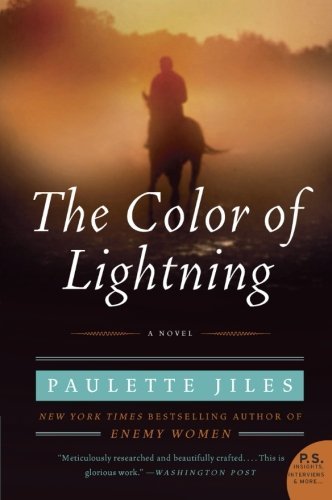
The Color of Lightning
In 1863, as the War Between the States creeps inevitably toward its bloody conclusion, former Kentucky slave Britt Johnson ventures west into unknown territory with his wife, Mary, and their three children, searching for a life and a future. But their dreams are abruptly shattered by a brutal Indian raid upon the Johnsons' settlement while Britt is away establishing a business. Returning to find his friends and neighbors slain or captured, his eldest son dead, his beloved and severely damaged Mary enslaved, and his remaining children absorbed into an alien society that will never relinquish its hold on them, the heartsick freedman vows not to rest until his family is whole again.
A soaring work of the imagination based on oral histories of the post-Civil War years in North Texas, Paulette Jiles's The Color of Lightning is at once an intimate look into the hearts and hopes of tragically flawed human beings and a courageous reexamination of a dark American history.
A soaring work of the imagination based on oral histories of the post-Civil War years in North Texas, Paulette Jiles's The Color of Lightning is at once an intimate look into the hearts and hopes of tragically flawed human beings and a courageous reexamination of a dark American history.
384 pages, Paperback
First published January 1, 2009
About the author
Paulette Jiles
20 books2,365 followersPaulette Kay Jiles was an American poet, memoirist and novelist.
Ratings & Reviews
Friends & Following
Create a free account to discover what your friends think of this book!
Community Reviews
Displaying 1 - 30 of 973 reviews

November 12, 2019
The cover blurb from the Washington Post on my edition says, "Meticulously researched and beautifully crafted...This is glorious work.". That just about covers it.
Yes, a glorious work. Well written historical fiction can teach me more than years in a classroom, because it gives me people with personalities, names, faces, motives; it leads me step by step into dangerous but lovely landscapes, it shows me why certain things happened as they did, and in this book it explains so much about the western expansion and the tragedy of the American Indian. I get overwhelmed just thinking of how to describe this book and all it contains.
Very basically, it is the story of Britt Johnson, who comes to Texas as a free black man just after the Civil War. He has plans to become a freighter, hauling goods by wagon to outposts and forts. The Commanche raid his community, kill his oldest son, and take his wife and two younger children captive. He sets out to find them. It's also the story of Samuel Hammond, a Quaker sent to work with Indian Affairs, who discovers that all the love and Christian charity in the world is sometimes useless. The author also miraculously gets us to understand the native American mind-set, and in so doing shows us the heartbreak and tragedy of a brave people who couldn't fight white man's progress.
A warning to those who don't like violence; this book has a lot of it. Really though, how can you write about the West without it, if you want the whole story of what it took to survive in that time, and the courage needed to try? Paulette Jiles includes the violence, but then gives us the most beautiful prose to make up for it. I seem to be reading her books in backward order, as I started with News of the World, her latest book. I will surely add her two earlier books to my list now, and eagerly wait for whatever she does next.
Yes, a glorious work. Well written historical fiction can teach me more than years in a classroom, because it gives me people with personalities, names, faces, motives; it leads me step by step into dangerous but lovely landscapes, it shows me why certain things happened as they did, and in this book it explains so much about the western expansion and the tragedy of the American Indian. I get overwhelmed just thinking of how to describe this book and all it contains.
Very basically, it is the story of Britt Johnson, who comes to Texas as a free black man just after the Civil War. He has plans to become a freighter, hauling goods by wagon to outposts and forts. The Commanche raid his community, kill his oldest son, and take his wife and two younger children captive. He sets out to find them. It's also the story of Samuel Hammond, a Quaker sent to work with Indian Affairs, who discovers that all the love and Christian charity in the world is sometimes useless. The author also miraculously gets us to understand the native American mind-set, and in so doing shows us the heartbreak and tragedy of a brave people who couldn't fight white man's progress.
A warning to those who don't like violence; this book has a lot of it. Really though, how can you write about the West without it, if you want the whole story of what it took to survive in that time, and the courage needed to try? Paulette Jiles includes the violence, but then gives us the most beautiful prose to make up for it. I seem to be reading her books in backward order, as I started with News of the World, her latest book. I will surely add her two earlier books to my list now, and eagerly wait for whatever she does next.

August 8, 2019
3.5 stars, rounded up
Fair warning, this book starts on a pretty violent note with an Indian raid against a settlement in Texas. And it doesn’t lighten up. It’s dark and depressing.
There are multiple story lines here, all taking place at the same time, the end of the Civil War through 1871. The first belongs to Britt Johnson, a freedman who loses his family to the raid. The second belongs to Samuel Hammond, a Quaker tasked with overseeing the Friend’s Indian Affairs for the Comanche, the Kiowa and the Kiowa-Apache, the same tribes involved in the raid. And then Elizabeth, one of the women captured during the raid and now living with the Comanche and Mary, Britt’s wife, also captured but with the Kiowa.
Jiles does a wonderful job of painting time and place, whether Philadelphia, Texas or the Indian Territories.
As the warden in Cool Hand Luke says, what we have here is a failure to communicate. Neither side can understand the other’s way of life and look down their noses at each other. Each feels that they are in the right. I appreciated that two of her main characters are black and thus outside of both cultures.
I can’t say I enjoyed this book the way I did The News of the World. I appreciated it, though, for the story it told and the points it made. Like with TNotW, my main sympathy was with the children that were captured by Indians but then returned to the settlers.
Britt Johnson and most of the others actually lived and the story is based on their lives, but major liberties are taken due to the minimal facts known.
Fair warning, this book starts on a pretty violent note with an Indian raid against a settlement in Texas. And it doesn’t lighten up. It’s dark and depressing.
There are multiple story lines here, all taking place at the same time, the end of the Civil War through 1871. The first belongs to Britt Johnson, a freedman who loses his family to the raid. The second belongs to Samuel Hammond, a Quaker tasked with overseeing the Friend’s Indian Affairs for the Comanche, the Kiowa and the Kiowa-Apache, the same tribes involved in the raid. And then Elizabeth, one of the women captured during the raid and now living with the Comanche and Mary, Britt’s wife, also captured but with the Kiowa.
Jiles does a wonderful job of painting time and place, whether Philadelphia, Texas or the Indian Territories.
As the warden in Cool Hand Luke says, what we have here is a failure to communicate. Neither side can understand the other’s way of life and look down their noses at each other. Each feels that they are in the right. I appreciated that two of her main characters are black and thus outside of both cultures.
I can’t say I enjoyed this book the way I did The News of the World. I appreciated it, though, for the story it told and the points it made. Like with TNotW, my main sympathy was with the children that were captured by Indians but then returned to the settlers.
Britt Johnson and most of the others actually lived and the story is based on their lives, but major liberties are taken due to the minimal facts known.
July 10, 2017
4➕★
Seven years before the wonderful News of the World was published there was this one. The setting once again is late 1800s Texas and Captain Kidd makes an early appearance reading his newspapers, reporting the passing of the Fifteenth Amendment allowing the vote to all men regardless of race or color. In his audience is former Kentucky slave Britt Johnson. In her ending notes the author says that though this is fiction its “backbone—Britt’s story—is true” and what a great story it is to one like me who loves this subject matter.
Britt returns home to find friends as well his oldest son slaughtered by plains Indians and wife Mary and their two other children taken. He sets out alone on a quest to rescue them.
Samuel Hammond, a peaceable Quaker, has just arrived as new agent for the Office of Indian Affairs which is rife with corruption. He is a decent man and feels called to help the suffering tribes but is disturbed to learn that warriors have been going off reservation raiding, killing, and taking captives.
The narrative of Mary, her friend Elizabeth, and the children’s time in captivity with the Kiowa is very powerful and brutal reading, setting the reader down into the very heart of the clash between two cultures, one of which is passing into history but whose unfettered lifestyle is very enticing to the children despite the horrors they have witnessed. Life on the wide open plains also beckons to Britt, where there is freedom from the white man’s prejudice and a man can live on his own terms.
Once again Paulette Jiles has thoroughly engaged me with her lyrical prose and fascinating characters as she opens up a window into our conflicted and violent history.
Seven years before the wonderful News of the World was published there was this one. The setting once again is late 1800s Texas and Captain Kidd makes an early appearance reading his newspapers, reporting the passing of the Fifteenth Amendment allowing the vote to all men regardless of race or color. In his audience is former Kentucky slave Britt Johnson. In her ending notes the author says that though this is fiction its “backbone—Britt’s story—is true” and what a great story it is to one like me who loves this subject matter.
Britt returns home to find friends as well his oldest son slaughtered by plains Indians and wife Mary and their two other children taken. He sets out alone on a quest to rescue them.
Samuel Hammond, a peaceable Quaker, has just arrived as new agent for the Office of Indian Affairs which is rife with corruption. He is a decent man and feels called to help the suffering tribes but is disturbed to learn that warriors have been going off reservation raiding, killing, and taking captives.
The narrative of Mary, her friend Elizabeth, and the children’s time in captivity with the Kiowa is very powerful and brutal reading, setting the reader down into the very heart of the clash between two cultures, one of which is passing into history but whose unfettered lifestyle is very enticing to the children despite the horrors they have witnessed. Life on the wide open plains also beckons to Britt, where there is freedom from the white man’s prejudice and a man can live on his own terms.
Once again Paulette Jiles has thoroughly engaged me with her lyrical prose and fascinating characters as she opens up a window into our conflicted and violent history.

October 29, 2021
We spend our lives in worlds remote from one another. We imagine we all live together on this round earth but we do not.
Sometimes the things that divide us are of our own making, and sometimes they are insurmountable misunderstandings. Jiles recognizes both, and shows them to us without flinching.
This is the story of Britt Johnson, a free black man from Kentucky, who comes West to settle his family, along with his hopes of owning and operating a freight service. One of the first blood-curdling events we encounter is the taking of his wife and children by the Comanche and Kiowa.
One of the complaints I have heard from others regarding this novel is that it is starkly, brutally violent. Well, the times are starkly and brutally violent and Jiles is no liar, no softener of history; she tells it as it was. Her ability to provide detail that makes us feel we are present among the sights, the textures, and the smells, ranks among her greatest assets as a novelist.
Mary lay half awake all night to watch the flickering light of the fire shifting on the tipi walls and the liner, a hypnotic and incessant dashing of light and shadow, the noise of the tipi cover and liner belling in and out accompanied by the unpredictable stanzas of the wind. The fire smoke shot upward, carried by the chimney of air that rose between the liner and the walls. It blossomed up into the smoke flaps and out. Whirling eddies of snow sifted down between the flaps and flashed in the light of the fire, and vanished. The fire threw shadows of moccasins hung up to dry so that they seemed to walk against the tipi walls, the fire threw shadows of a fishnet and a gourd dipper snaring the evaporating snowflakes.
I’ve never spent a snowy night in a teepee, until now.
This is Britt’s story, but it is more than that, of course. Jiles is an even-handed historian; she takes no sides and gives no quarter. And, in doing so, she makes us understand, in a way we might not have done before, how impossible this situation was for both the settlers and the Indians. This is a clash of cultures. What is murder to outsiders is ritual and courage to the Indians; what seems like an offering of a better way for the Quaker agent is the destruction of freedom and life itself for the Indian. There can be no simple resolution. The more powerful group will win, and in doing so, annihilate the other.
Much of what Jiles tells us about Britt and his family, friends and life, is conjecture. This is, after all, fiction. However, it mattered very much to me that Britt Johnson was a real man and that the larger fabric of this story is based on true events and real courage. In her afterward, Jiles states that Britt’s story “returned to me repeatedly as I read through north Texas histories over the years, and I often wondered why no one had taken it up. And so I did.” I’m so glad she did.
Sometimes the things that divide us are of our own making, and sometimes they are insurmountable misunderstandings. Jiles recognizes both, and shows them to us without flinching.
This is the story of Britt Johnson, a free black man from Kentucky, who comes West to settle his family, along with his hopes of owning and operating a freight service. One of the first blood-curdling events we encounter is the taking of his wife and children by the Comanche and Kiowa.
One of the complaints I have heard from others regarding this novel is that it is starkly, brutally violent. Well, the times are starkly and brutally violent and Jiles is no liar, no softener of history; she tells it as it was. Her ability to provide detail that makes us feel we are present among the sights, the textures, and the smells, ranks among her greatest assets as a novelist.
Mary lay half awake all night to watch the flickering light of the fire shifting on the tipi walls and the liner, a hypnotic and incessant dashing of light and shadow, the noise of the tipi cover and liner belling in and out accompanied by the unpredictable stanzas of the wind. The fire smoke shot upward, carried by the chimney of air that rose between the liner and the walls. It blossomed up into the smoke flaps and out. Whirling eddies of snow sifted down between the flaps and flashed in the light of the fire, and vanished. The fire threw shadows of moccasins hung up to dry so that they seemed to walk against the tipi walls, the fire threw shadows of a fishnet and a gourd dipper snaring the evaporating snowflakes.
I’ve never spent a snowy night in a teepee, until now.
This is Britt’s story, but it is more than that, of course. Jiles is an even-handed historian; she takes no sides and gives no quarter. And, in doing so, she makes us understand, in a way we might not have done before, how impossible this situation was for both the settlers and the Indians. This is a clash of cultures. What is murder to outsiders is ritual and courage to the Indians; what seems like an offering of a better way for the Quaker agent is the destruction of freedom and life itself for the Indian. There can be no simple resolution. The more powerful group will win, and in doing so, annihilate the other.
Much of what Jiles tells us about Britt and his family, friends and life, is conjecture. This is, after all, fiction. However, it mattered very much to me that Britt Johnson was a real man and that the larger fabric of this story is based on true events and real courage. In her afterward, Jiles states that Britt’s story “returned to me repeatedly as I read through north Texas histories over the years, and I often wondered why no one had taken it up. And so I did.” I’m so glad she did.

October 1, 2025
Paulette Jiles was a brilliant writer of historical fiction portraying in this novel , with impeccable research and beautiful prose , the brutal and complex time in Texas after the Civil War . At the start of the novel, the blood curdling scenes of a Comanche and Kiowa attack on a Texas settlement with violent murder, scalpings, rapes, pillage, women and children taken into captivity are so vividly brutal they gave me pause for a bit about whether I could continue. Jiles doesn’t spare the horrific details, but this is what makes it so authentic.
History tells us, though , that the violence was not one sided .
“ Early in the fifties a large force of Texas Rangers attacked a perfectly peaceful reservation and slaughtered women and children sleeping in their beds. Now it will take long time before the Indians of Texas ever trust white man again.”
This novel while fiction, is based on the true story a freed black man, Britt Johnson who flees Kentucky for Texas in hopes of finding a better life for his family. When he returns to the settlement while on a trip to get supplies, he finds that his family and others have been the victims of a violent attack by the Comanche . He sets out to find his wife and children who have been taken captive.
There are multiple points of view here besides Britt’s. There is his wife Mary and Elizabeth Fitzgerald, another woman in the settlement who is also held captive with her grandchildren. The portrayal of their time in captivity as slaves and their relationship with their captors is fascinating illustrating in so many ways the differences in their ways of life. We also get the perspective of Samuel Hammond, a Quaker assigned as an agent for Indian Affairs to work peacefully with the Comanche and Kiowa tribes which proves to be a formidable task.
I loved that there was a glimpse to a future book with the introduction of Captain Kidd from News of the World which was my first Jiles book. I’ve read four other novels by Paulette Giles and loved them all. I’m not sure what took me so long to read this one, other than it got lost on my way too long tbr list . So glad I finally got to it. This is what excellent historical fiction looks like - well researched, taking us to this place and time through characters real and imagined who inform us and move us .
History tells us, though , that the violence was not one sided .
“ Early in the fifties a large force of Texas Rangers attacked a perfectly peaceful reservation and slaughtered women and children sleeping in their beds. Now it will take long time before the Indians of Texas ever trust white man again.”
This novel while fiction, is based on the true story a freed black man, Britt Johnson who flees Kentucky for Texas in hopes of finding a better life for his family. When he returns to the settlement while on a trip to get supplies, he finds that his family and others have been the victims of a violent attack by the Comanche . He sets out to find his wife and children who have been taken captive.
There are multiple points of view here besides Britt’s. There is his wife Mary and Elizabeth Fitzgerald, another woman in the settlement who is also held captive with her grandchildren. The portrayal of their time in captivity as slaves and their relationship with their captors is fascinating illustrating in so many ways the differences in their ways of life. We also get the perspective of Samuel Hammond, a Quaker assigned as an agent for Indian Affairs to work peacefully with the Comanche and Kiowa tribes which proves to be a formidable task.
I loved that there was a glimpse to a future book with the introduction of Captain Kidd from News of the World which was my first Jiles book. I’ve read four other novels by Paulette Giles and loved them all. I’m not sure what took me so long to read this one, other than it got lost on my way too long tbr list . So glad I finally got to it. This is what excellent historical fiction looks like - well researched, taking us to this place and time through characters real and imagined who inform us and move us .

November 28, 2019
Paulette Jiles weaves an intricate tale full of the danger of the Old West and built around characters that are as dynamic as their fluid environment and the circumstances in which they find themselves. Moses Johnson finds scripture in the Bible that he believes is leading him away from Burkett Station in Kentucky. As they are traveling through the free state of Illinois, he sets his slaves, Britt and Britt’s wife, Mary free. Jiles sinks me deep into Britt and Mary’s world as she describes how they settle in the plains of Texas, a land unfamiliar to them. Mary wants to teach in the soon-to-be black school. Britt tries not to show favorites among his children, but his oldest boy, Jim at age eleven constantly draws his father’s attention. Mary and her three children stay with their neighbor, Elizabeth Fitzgerald while Britt is away on business.
Just like Larry McMurtry in Lonesome Dove, Jiles spares nothing when she describes the Indian raid at Elizabeth Fitzgerald’s home. Seven hundred Comanche and Kiowa flood into Young County, Texas, committing murder and mayhem. It is brutal and Jiles evokes all the senses in the telling. As Jack Garrett’s voice narrates Jiles’s chilling words, I feel consumed by horrible visuals. This is the way it really was, I think, and yet, the settlers were very much trespassers on land that had belonged to Native Americans for as long as time had stretched behind them. Throughout the novel, Jiles is able to show this tension between the Indians and the settlers.
Jiles writes, “The men who decided the fate of the Red Indians lived in the east, under roofs of slate and shingle.” In one sentence, she describes the problem with the white men’s way of decision making. They make their decisions at a far remove from what they consider ‘the problem,’ and they have no stake in the fallout. Whatever is decided, whatever occurs as a result of their decision, they and their families will not be harmed. Samuel Hammond, a Quaker, is a character in Jiles’s novel, who epitomizes the moral struggle. He is sent to be an Indian agent, putting forward a Peace Policy. He has no idea of the difficulties that lie ahead.
The lives of the captives, Elizabeth Fitzgerald, Mary, and the children that survive the raid, are described in authentic detail. Listed in Jiles’s bibliography is the book, Captured by the Indians: 15 Firsthand Accounts, 1750-1870, by Frederick Drimmer, as well as others, which show the amount of research she put into creating a credible saga. The Indians would adopt captive children and love them as their own. These children knew freedom that was very unlike the circumstances of their previous lives. With few restrictions and left alone to play, many did not want to return home when the opportunity arose.
At the heart of the story is Britt Johnson’s journey to retrieve his family from the Indians. It is a hero’s journey, with all the complexity that entails. When Britt meets Tissoyo, a young Comanche sitting guard over a herd of horses in front of the remote Wichita Mountains, it is a fortuitous meeting. Tissoyo provides the bridge that Britt needs to negotiate with the Indians for his family’s return. He personalizes the Indians for Britt and for the reader. Through Tissoyo, moral creeks become rivers of uncertainty rushing toward an ocean of dilemma.
I am happy to have read this book because as good books do, it causes me to ask more questions, to want to explore further. The narrator was average, so I’m giving Jack Garrett a three. Audio versus reading is a very personal experience and for me, some books lend themselves to audio better than others. I would have enjoyed this book more if I’d read it. The descriptions are often lush and detailed, and I would lose my train of thinking with the audio, but I was committed to ‘listening’ so I could do other work with my hands. I’m grateful that Jiles brings the oral history of Britt Johnson to life. My own life is enriched by learning of Britt’s great courage as well as by learning more about the plight of the Comanches and Kiowa through the depth of Tissoyo’s character. The Quakers played a large role in the Underground Railroad, so I also found it interesting to see them take a leading role in relationships with the Indians. Highly recommended!
Just like Larry McMurtry in Lonesome Dove, Jiles spares nothing when she describes the Indian raid at Elizabeth Fitzgerald’s home. Seven hundred Comanche and Kiowa flood into Young County, Texas, committing murder and mayhem. It is brutal and Jiles evokes all the senses in the telling. As Jack Garrett’s voice narrates Jiles’s chilling words, I feel consumed by horrible visuals. This is the way it really was, I think, and yet, the settlers were very much trespassers on land that had belonged to Native Americans for as long as time had stretched behind them. Throughout the novel, Jiles is able to show this tension between the Indians and the settlers.
Jiles writes, “The men who decided the fate of the Red Indians lived in the east, under roofs of slate and shingle.” In one sentence, she describes the problem with the white men’s way of decision making. They make their decisions at a far remove from what they consider ‘the problem,’ and they have no stake in the fallout. Whatever is decided, whatever occurs as a result of their decision, they and their families will not be harmed. Samuel Hammond, a Quaker, is a character in Jiles’s novel, who epitomizes the moral struggle. He is sent to be an Indian agent, putting forward a Peace Policy. He has no idea of the difficulties that lie ahead.
The lives of the captives, Elizabeth Fitzgerald, Mary, and the children that survive the raid, are described in authentic detail. Listed in Jiles’s bibliography is the book, Captured by the Indians: 15 Firsthand Accounts, 1750-1870, by Frederick Drimmer, as well as others, which show the amount of research she put into creating a credible saga. The Indians would adopt captive children and love them as their own. These children knew freedom that was very unlike the circumstances of their previous lives. With few restrictions and left alone to play, many did not want to return home when the opportunity arose.
At the heart of the story is Britt Johnson’s journey to retrieve his family from the Indians. It is a hero’s journey, with all the complexity that entails. When Britt meets Tissoyo, a young Comanche sitting guard over a herd of horses in front of the remote Wichita Mountains, it is a fortuitous meeting. Tissoyo provides the bridge that Britt needs to negotiate with the Indians for his family’s return. He personalizes the Indians for Britt and for the reader. Through Tissoyo, moral creeks become rivers of uncertainty rushing toward an ocean of dilemma.
I am happy to have read this book because as good books do, it causes me to ask more questions, to want to explore further. The narrator was average, so I’m giving Jack Garrett a three. Audio versus reading is a very personal experience and for me, some books lend themselves to audio better than others. I would have enjoyed this book more if I’d read it. The descriptions are often lush and detailed, and I would lose my train of thinking with the audio, but I was committed to ‘listening’ so I could do other work with my hands. I’m grateful that Jiles brings the oral history of Britt Johnson to life. My own life is enriched by learning of Britt’s great courage as well as by learning more about the plight of the Comanches and Kiowa through the depth of Tissoyo’s character. The Quakers played a large role in the Underground Railroad, so I also found it interesting to see them take a leading role in relationships with the Indians. Highly recommended!

March 21, 2017
This book is by turns vivid, beautiful, violent, and brutal. It is not a quick read and it’s not for the faint of heart. Just as in News of the World, Paulette Jiles has her very own unique style and while it might not work for everyone, it resounds with me. She doesn’t just paint a picture, she uses words to create a new dimension, an atmosphere, a whole world. I feel like some of her passages could be considered poetry, in some sense.
One early morning there was a heavy fog. They broke camp in a strange isolate stillness as if in a world just formed and not yet emerged into definition. Every limb adorned with lines of tiny drops and the grass wet. They walked on with soaked, dark legs, and they covered many miles in silence, going nowhere in the same spot with the blurring fog all around them.
After the Civil war, American settlers encroaching upon the territory of native tribes resulted in a very bloody period of conflict which lasted for many years before its sad conclusion. Jiles gives thoughtful consideration to both sides of this quarrel in which plains settlers in northern Texas are living in fear of Comanche and Kiowa raids, while the natives are simply trying to maintain their freedom and way of life in the only way they know how.
The period and setting impacts all of the characters, most of whom are based on real people. Children forever altered by tribal captivity. Women enduring atrocities and becoming stronger than many men through sheer will to survive. Peaceful, non-violent men hardened by war, who eventually will relinquish their tightly held ideals.
He felt he was turning into someone else. Or perhaps someone he had always been. He was hardening like pottery fired in a kiln. Hard angry words in his head carrying an abrasive silt. He did not like the sounds of the words in his own head.
I think this book requires patience and attention and if you have that, it will be very worth it to you. I didn’t tear through it, I savored it page by page, and in the end I felt drained but complete.
One early morning there was a heavy fog. They broke camp in a strange isolate stillness as if in a world just formed and not yet emerged into definition. Every limb adorned with lines of tiny drops and the grass wet. They walked on with soaked, dark legs, and they covered many miles in silence, going nowhere in the same spot with the blurring fog all around them.
After the Civil war, American settlers encroaching upon the territory of native tribes resulted in a very bloody period of conflict which lasted for many years before its sad conclusion. Jiles gives thoughtful consideration to both sides of this quarrel in which plains settlers in northern Texas are living in fear of Comanche and Kiowa raids, while the natives are simply trying to maintain their freedom and way of life in the only way they know how.
The period and setting impacts all of the characters, most of whom are based on real people. Children forever altered by tribal captivity. Women enduring atrocities and becoming stronger than many men through sheer will to survive. Peaceful, non-violent men hardened by war, who eventually will relinquish their tightly held ideals.
He felt he was turning into someone else. Or perhaps someone he had always been. He was hardening like pottery fired in a kiln. Hard angry words in his head carrying an abrasive silt. He did not like the sounds of the words in his own head.
I think this book requires patience and attention and if you have that, it will be very worth it to you. I didn’t tear through it, I savored it page by page, and in the end I felt drained but complete.
March 21, 2021
I enjoyed this author’s News of the World so very, very much. This one I did not like quite as much. It is its equal in beautiful, perfectly written prose but somehow it did not pull me in.
There is a huge amount of brutality in The Color Of Lightning but, although I do not enjoy reading about cruelty, it was not that which put me off. I think maybe it was the huge cast of characters and the fact that I was not really invested in any of them. Britt was the closest the book came to a main character whose presence made the reader involved. It was interesting to read afterwards that he was a real person and that many of the events described may have involved him even though the author has used her creativity in the parts he plays in the story.
Texas was a hotbed of racial issues at the time this book is set, and Jiles sets out the problems in a factual way with no bias to any side. If only each party could have understood each other’s needs then so much blood would never have had to be shed, but it is ever so.
This is a beautifully written book which puts forward the plight of the American Indians at that time in a solid and believable way. I am extremely glad I read it.
There is a huge amount of brutality in The Color Of Lightning but, although I do not enjoy reading about cruelty, it was not that which put me off. I think maybe it was the huge cast of characters and the fact that I was not really invested in any of them. Britt was the closest the book came to a main character whose presence made the reader involved. It was interesting to read afterwards that he was a real person and that many of the events described may have involved him even though the author has used her creativity in the parts he plays in the story.
Texas was a hotbed of racial issues at the time this book is set, and Jiles sets out the problems in a factual way with no bias to any side. If only each party could have understood each other’s needs then so much blood would never have had to be shed, but it is ever so.
This is a beautifully written book which puts forward the plight of the American Indians at that time in a solid and believable way. I am extremely glad I read it.

September 21, 2011
I don't often go back and reread a sentence just because it is so beautiful, but I found myself doing just that while reading THE COLOR OF LIGHTNING. The author is a poet as well as a memoirist and novelist, and it shows. Let me set up this sentence for you. It is December of 1870 in North Texas. A man is standing in dense fog, trying to be totally silent, because he knows that a Kiowa or Comanche is nearby, as he heard the voice singing and chanting a song of grief. The man may not be able to see anything because of the fog, but sounds are magnified. And so he stands, motionless, waiting. "He saw a drop of moisture on his hat brim appear and then grow pendant with a condensed seed of light from the pale fog in its center, and then it dropped."
I could read about a garbage truck and love it with writing this beautiful, but when the story is a gripping, suspenseful historical fiction, I'm absolutely hooked.
Thank you, Ms. Jiles, for this book.
I could read about a garbage truck and love it with writing this beautiful, but when the story is a gripping, suspenseful historical fiction, I'm absolutely hooked.
Thank you, Ms. Jiles, for this book.

November 7, 2021
"This was a world unto itself that lay between the Canadian River and the Rio Grande as if it had been designated on the day that God made it as the place where men would come to fight and kill each other. The Texans had brought their women and their children and their slaves right into the middle of the war land and expected to set up houses and fields and herds and live as if they were in Maryland, and were surprised on moonlit nights like this when Comanche arrows sang through the air in the dark." (101)
Paulette Jiles' historical novel features Britt Johnson, a free black man, who travels to Texas with his wife and children as the American Civil War is ending. He's hoping to start a freighting business to transport goods through dangerous territory by wagons. While Britt is away, Comanches and Kiowas attack their community in a violent raid. They take Britt's wife, Mary, and his two younger children as well as their neighbor and her two grandchildren as captives. The captive women hope that Britt will be able to rescue them.
The women are treated as slaves, but many of the child captives adapt quite well to this different way of life with the Native Americans. They enjoy the freedom, the adventure, and the strong bond with nature. The Native Americans follow the streams, the new grass, the buffalo and other food sources in a seasonal circuit.
Samuel Hammond, an idealistic Quaker, is sent to Texas to be the Indian agent. He tries using kindness to convince the Native Americans to farm, live in wood houses, go to school, listen to Bible readings, and release their captives. The Native Americans are uninterested in changing their way of life, and resent being driven away from their traditional hunting grounds by the settlers and soldiers. The tribes had been decimated by white men's diseases and violence.
Jiles gives a balanced account of the conflict where the cultures are so far apart that compromise is almost impossible. There is a lot of violence in this tale since the author is writing about the true dangers of that era which she has carefully researched. The book also has many beautiful poetic passages describing the Western plains that invite the reader to stop and reread the passage. "The Color of Lightning" is the fourth Paulette Jiles book I have read, and I'm always impressed with her writing and her research.
Paulette Jiles' historical novel features Britt Johnson, a free black man, who travels to Texas with his wife and children as the American Civil War is ending. He's hoping to start a freighting business to transport goods through dangerous territory by wagons. While Britt is away, Comanches and Kiowas attack their community in a violent raid. They take Britt's wife, Mary, and his two younger children as well as their neighbor and her two grandchildren as captives. The captive women hope that Britt will be able to rescue them.
The women are treated as slaves, but many of the child captives adapt quite well to this different way of life with the Native Americans. They enjoy the freedom, the adventure, and the strong bond with nature. The Native Americans follow the streams, the new grass, the buffalo and other food sources in a seasonal circuit.
Samuel Hammond, an idealistic Quaker, is sent to Texas to be the Indian agent. He tries using kindness to convince the Native Americans to farm, live in wood houses, go to school, listen to Bible readings, and release their captives. The Native Americans are uninterested in changing their way of life, and resent being driven away from their traditional hunting grounds by the settlers and soldiers. The tribes had been decimated by white men's diseases and violence.
Jiles gives a balanced account of the conflict where the cultures are so far apart that compromise is almost impossible. There is a lot of violence in this tale since the author is writing about the true dangers of that era which she has carefully researched. The book also has many beautiful poetic passages describing the Western plains that invite the reader to stop and reread the passage. "The Color of Lightning" is the fourth Paulette Jiles book I have read, and I'm always impressed with her writing and her research.

November 3, 2021
…the red men have always taken captives. It’s a kind of custom. Sometimes the captives survive and sometimes they don’t. Sometimes the red men themselves survive and sometimes they don’t. Life is hard for everybody out there.
Paulette Jiles has once again written a brilliant historical novel based on real people and incidents in history with what it seems like ease. Her writing is brilliantly fluid, poetic and purposeful. Her research is accurate and thorough which enhances the fiction she creates. The Color of Lightning tells the story of the life of Britt Johnson, a freed man from Kentucky who leaves to start fresh with his wife Mary and their 3 children in north Texas. The Civil War has ended and the opportunities for him are wide however the dangers of settling here are real. Indians raid this part of Texas taking women and children, killing, raping and scalping others and stealing horses and cattle for themselves.
This was a world unto itself that lay between the Canadian River and the Rio Grande as if it had been designated on the day that God made it as the place where men would come to fight and kill one another. The Texans had brought their women and their children and their slaves right into the middle of the war land and expected to set up houses and fields and herds and live as if they were in Maryland, and were surprised on moonlit nights like this when Comanche arrows sang through the air in the dark.
Jiles doesn’t steer clear of the violence. When Britt Johnson’s family is brutally taken by the Kiowas along with a white woman, Elizabeth Fitzgerald and her grandchildren by the Comanches, Jiles does not hold back on describing the horrifying ordeal these women endured. Mary takes a stone to the head and is left with jumbled speech. Her children, especially her son, Jube, are accepted into the tribe and allowed to learn Indian ways. Here there are no barriers to life as there are in their civilized life. Elizabeth’s granddaughter is favored by one of the Comanche women and adopted. When Britt discovers his family has been seized, he takes on a nearly impossible task of finding them and bringing them home. His journey demonstrates his fortitude and fearlessness. He even befriends a young Comanche, Tissoyo, who helps him in his negotiations with the tribes.
The freedom the Indians lived was the only way of life they knew and being herded onto reservations and trying to be persuaded to stop raiding and settle down to farm was a death sentence for them. This divisive merging of divergent cultures in which one wills the taming of the other at the expense of a lost lifestyle is plainly heard. Adapting the Indians to a Western style of living was what Indian Agent Samuel Hammond attempted and pursued when he was sent by the Society of Friends (Quakers) to Oklahoma. He was well-intentioned and very green concerning the magnitude of “civilizing” a people who were prone to violence and had been mishandled and wronged by the US government.
Americans are not comfortable with tragedy. Because of its insolubility. Tragedy is not amenable to reason and we are fixers, aren’t we? We can fix everything.
Jiles is definitely at the top of my favorites list of contemporary authors of historical fiction. She is talented beyond words and does everything right when it comes to choosing her topics. I was pleasantly surprised to see Captain Kidd reading the news here in north Texas just like he did in News of the World. I love how Jiles connects her novels with such unforgettable characters. I will read everything she writes!

November 11, 2021
I admire authors who are able to bring to life a place and a time. Paulette Jiles is such an author.
This book starts in 1863- Britt Johnson, a free Black man, has come to Texas to get away from the still ongoing Civil War. His wife and 3 children are with him. Many white people are coming to Texas to stake their claims and start new lives. Clashes occur between the settlers and the Indians.
This book focuses on Britt , a larger than life hero. While Britt is away, The Indians attack killing his older son and taking his wife and children captive. (Not a spoiler- in the blurb) Britt’s focus becomes the rescuing of his family.
The author does a brilliant job of depicting the horrific attacks and the strain on the settlers. She is fair though- she looks at both sides. How the white man coming and placing their rules on the Indian tribes, ruins their way of life.
Samuel, the Quaker Indian agent, sent there to maintain peace is conflicted.
“They are not toys or dolls that one can arrange their thoughts or minds as you wish, simply give them a change of costume. They are grown men and they are lethal.”
There is so much I learned reading this book. What resonated was how the white captives reacted to their captivity and how hard it was for many of them to return to their previous lives.
If you have an interest on how the West was “won”, this is a book you must read. It is not always a pleasant read, but then again, this is life as it was in the American West from 1863-1870.
Published: 2009
This book starts in 1863- Britt Johnson, a free Black man, has come to Texas to get away from the still ongoing Civil War. His wife and 3 children are with him. Many white people are coming to Texas to stake their claims and start new lives. Clashes occur between the settlers and the Indians.
This book focuses on Britt , a larger than life hero. While Britt is away, The Indians attack killing his older son and taking his wife and children captive. (Not a spoiler- in the blurb) Britt’s focus becomes the rescuing of his family.
The author does a brilliant job of depicting the horrific attacks and the strain on the settlers. She is fair though- she looks at both sides. How the white man coming and placing their rules on the Indian tribes, ruins their way of life.
Samuel, the Quaker Indian agent, sent there to maintain peace is conflicted.
“They are not toys or dolls that one can arrange their thoughts or minds as you wish, simply give them a change of costume. They are grown men and they are lethal.”
There is so much I learned reading this book. What resonated was how the white captives reacted to their captivity and how hard it was for many of them to return to their previous lives.
If you have an interest on how the West was “won”, this is a book you must read. It is not always a pleasant read, but then again, this is life as it was in the American West from 1863-1870.
Published: 2009

November 22, 2017
I read News of the World, also by Paulette Jiles, earlier this year. The historical period and themes are similar, but the focus is more on two characters. This novel is much wider in scope, with more storylines. The violence was quite a bit more explicit, and if this hadn't been for a postal book swap, I may have quit after the first chapter. Phew!
To me, the most interesting story was that of Samuel, the Quaker being sent to the lawless front where the Comanche are killing and kidnapping while the settlers attempt to work land that doesn't really belong to them. What a complex and dangerous situation to send a man into, especially when the expectation is that he was only use his words and not violence to navigate the situation! I appreciate the nuances the author was able to show about his impossible task.
The idea of captives missing their lives in captivity continues to intrigue me, and I love this:
Actual read date: August/September 2017. I'm listing it under November below since that is the date of my review.
To me, the most interesting story was that of Samuel, the Quaker being sent to the lawless front where the Comanche are killing and kidnapping while the settlers attempt to work land that doesn't really belong to them. What a complex and dangerous situation to send a man into, especially when the expectation is that he was only use his words and not violence to navigate the situation! I appreciate the nuances the author was able to show about his impossible task.
The idea of captives missing their lives in captivity continues to intrigue me, and I love this:
"She was afraid of the slow death of confinement. Of being trapped inside immovable houses and stiff clothing. Of the sky shuttered away from her sight, herself hidden from the operatic excitement of the constant wind and the high spirits that came when they struck out like cheerful vagabonds across the wide earth with all of life in front of them and unfolding and perpetually new. And now herself shut in a wooden cave. She could not go out at dawn alone and sing, she would not be seen and known by the rising sun." (pg. 222)This is what I love about book swaps. I never would have read this book otherwise!
Actual read date: August/September 2017. I'm listing it under November below since that is the date of my review.

January 7, 2020
The Color of Lightning is a beautiful historical fiction novel that is a riveting character-driven tale taking place at the close of the Civil War. Former Kentucky slave Britt Johnson and his wife Mary, along with their three children, head west to the new territories being settled with their manumission papers in hand. Setting up a home in the developing Texas territory, the Johnsons are looking forward to their bright future. However, Britt upon returning from a business trip, discovers that the Comanche Kiowa Indians have raided their homesteads, killing many of Britt's friends and neighbors as well as his eldest son as he attempted to protect his family. Mary Johnson and her two remaining children had been taken captive along with neighboring women and children. Britt's world is shattered but he vows to bring them all home. It is on this journey that Britt Johnson befriends a Kiowa-Apache Indian, Tissoyo, who serves a guide, with Spanish being the language they use to communicate with one another. Paulette Jiles writes with beautiful and descriptive prose throughout this wonderful book describing this tumultuous and dangerous but exciting time in the history the development of the western part of the United States.
"At the top they lay down on a shelf of red granite in order not to outline themselves against the sky. They could see a long way. In the remote distance to the west the Sangre de Cristo mountains of New Mexico and the cone of the Capulin volcano. And beyond them were the Mexican settlements, Santa Fe and San Ildefonso."
"At the top they lay down on a shelf of red granite in order not to outline themselves against the sky. They could see a long way. In the remote distance to the west the Sangre de Cristo mountains of New Mexico and the cone of the Capulin volcano. And beyond them were the Mexican settlements, Santa Fe and San Ildefonso."
July 25, 2011
Eloquent, illuminating tale about frontier life in Northern Texas between 1864-1871. Based on a true story, this novel is also graphic and bloody (take note: not for the queasy) in its descriptions of the capture and dispatching of frontierspeople by Kiowa and Comanche. One of the things I loved about the story was its realism. The violence was completely necessary, in my opinion, to fully understanding the story and the relationships of the characters. The author was fully adept in describing the problematic relationship of the Native Americans of the Plains and the settlers. Each committed atrocities, each came from different worlds, clashes were inevitable. All of the characters were interesting: Britt Johnson, ex-slave from Kentucky; his wife Mary; his son, who is coming of age when he is captured; Samuel, sent from the most nonviolent sect (Quaker) to be agent to two of the most violent, nomadic tribes settlers would ever clash with.... An incredible, well-researched story based on truth by a talented author, who sympathizes with & respects her characters.

May 21, 2021
Whoa - this book - it's raw, violent, and graphic. It's not for the faint of heart.
Paulette Jiles sure knows how to write compelling stories that bring history to life. Like her brilliant News of the World, This takes place in the reconstruction period after the civil war. Britt Johnson is a former slave from Kentucky who is freed shortly before it will be compelled by law. He takes his family to Texas with the excitement of freedom and a dream to start his own business as a freighter who will transport goods from town to town by wagon.
Britt's wife Mary was a reluctant participant in his dream and would have preferred to stay in Kentucky where she wasn't treated too badly as a house slave, and knowing that freedom was coming soon for everyone. Just after they are settled in Texas, Britt and Mary have a big fight that serves as a harbinger of things to come. Tragedy comes quickly as their homestead is raided by Indians. The foreshadowing and symbolism in these opening scenes is sublime.
Jiles crafted her heroic protagonist based on the historical Britt Johnson she found from researching through oral histories. The outline of his story is true, but bringing him to life required fictionalization because details were minimal.
I won't go into more of the story or share quotes because it's hard to do without spoilers and it would take too long! Jiles created many dynamic characters and multiple meaningful storylines that examined complex issues through just about every perspective. It's much more complex and multi-layered than "News of the World" and lacks the feel-good magical ending. The feel-good part here is more subtle and reflective but just as powerful. The moving moments and beautiful poetic prose serve as antidotes to the violence and keep you thinking.
Captain Kidd makes a brief appearance to read news of the passage of the 15th Amendment that would keep any state from denying the right to vote based on "race, color, or previous condition of servitude." I'm so thankful that she expanded on this wonderful character in her next book. It's also so cool that the books have overlapping time periods where Britt Johnson appears in News of the World at this same point. I adore both of these characters. Each book foreshadows the other so it doesn't matter which way you read them. I'm going to continue backward and read the latest one last in the event that she has more of these wonderous tricks up her sleeve.
I'm in awe of Paula Jiles's talent. I felt tones of Cormac McCarthy with the brutal violence that was softened with poetic prose. She has her own style for sure and it's more optimistic. Despite all the horrific things that happen, unlikely friendships form, love endures and forgiveness becomes more than an idea. I look forward to reading more from this brilliant writer.
Paulette Jiles sure knows how to write compelling stories that bring history to life. Like her brilliant News of the World, This takes place in the reconstruction period after the civil war. Britt Johnson is a former slave from Kentucky who is freed shortly before it will be compelled by law. He takes his family to Texas with the excitement of freedom and a dream to start his own business as a freighter who will transport goods from town to town by wagon.
Britt's wife Mary was a reluctant participant in his dream and would have preferred to stay in Kentucky where she wasn't treated too badly as a house slave, and knowing that freedom was coming soon for everyone. Just after they are settled in Texas, Britt and Mary have a big fight that serves as a harbinger of things to come. Tragedy comes quickly as their homestead is raided by Indians. The foreshadowing and symbolism in these opening scenes is sublime.
Jiles crafted her heroic protagonist based on the historical Britt Johnson she found from researching through oral histories. The outline of his story is true, but bringing him to life required fictionalization because details were minimal.
I won't go into more of the story or share quotes because it's hard to do without spoilers and it would take too long! Jiles created many dynamic characters and multiple meaningful storylines that examined complex issues through just about every perspective. It's much more complex and multi-layered than "News of the World" and lacks the feel-good magical ending. The feel-good part here is more subtle and reflective but just as powerful. The moving moments and beautiful poetic prose serve as antidotes to the violence and keep you thinking.
Captain Kidd makes a brief appearance to read news of the passage of the 15th Amendment that would keep any state from denying the right to vote based on "race, color, or previous condition of servitude." I'm so thankful that she expanded on this wonderful character in her next book. It's also so cool that the books have overlapping time periods where Britt Johnson appears in News of the World at this same point. I adore both of these characters. Each book foreshadows the other so it doesn't matter which way you read them. I'm going to continue backward and read the latest one last in the event that she has more of these wonderous tricks up her sleeve.
I'm in awe of Paula Jiles's talent. I felt tones of Cormac McCarthy with the brutal violence that was softened with poetic prose. She has her own style for sure and it's more optimistic. Despite all the horrific things that happen, unlikely friendships form, love endures and forgiveness becomes more than an idea. I look forward to reading more from this brilliant writer.

July 4, 2011
I haven't read a historical fiction book that I loved so much in a long time. This one is set in North Texas--right in my back yard. It is the fictionalized version of, Britt Johnson, a freed slave's life immediately following the Civil War. His wife and children were kidnapped by Kiowa Indians and he rescued them single handedly. There are many points of view represented in the novel including a Quaker Indian agent--very loosely based on Laurie Tatum, and the Comanches and Kiowas who were fighting for their fading way of life.
The fact that I taught Texas History for 7 years might be one of the reasons I was so riveted by this book. I recognized so many of the characters and the places. The research that must have gone into the book is mind boggling. Jiles did a fantastic job and should be commended.
Furthermore, this book is a testament to the the power of the library! I was browsing the shelves at my local library and the title caught my eye. It wasn't on the Barnes and Noble best sellers table or dressed up in a fancy cover. It was just sitting there--all on its own! I will tell everyone I know to read it! Fantastic!
The fact that I taught Texas History for 7 years might be one of the reasons I was so riveted by this book. I recognized so many of the characters and the places. The research that must have gone into the book is mind boggling. Jiles did a fantastic job and should be commended.
Furthermore, this book is a testament to the the power of the library! I was browsing the shelves at my local library and the title caught my eye. It wasn't on the Barnes and Noble best sellers table or dressed up in a fancy cover. It was just sitting there--all on its own! I will tell everyone I know to read it! Fantastic!

August 23, 2013
Do you know why the rainbow is infinite in its scope of color? Because all colors are contained within white light -- the stuff the prism of a raindrop separates -- the stuff that lightning is made of -- the stuff this American story is made of. Awesome read! And, I know that my attention was captivated because Jiles stuck to authentic American History... terrifying, bloody, and tribal from every racial point of view. Indian. African. Mexican. Canadian. French. Spanish. English. Asian. German. Irish. Italian. And all the rest. Jiles didn't miss a drop of blood in the creation of the American DNA. The Color of Lightning is the color of the American -- as seen through the prism of a drop of our blood.

December 24, 2016
One of my favorite books of 2016 was News of the World, so good it will perhaps be one of my favorite books of all time. In it we meet Captain Kidd, elderly civil war veteran who roams north Texas in 1870 reading newspapers from far and wide to settlers hungry for news. On one of his trips, he is asked to return a captive girl to her people hundreds of miles away, hired by freighter Britt Johnson.
Real-life Britton Johnson, born a slave in Tennessee, moved with his wife and children and slave-owner Moses Johnson to north Texas toward the end of the Civil War. A larger-than-life character in the settlement of this area and in the wars with the Comanche and Kiowa, he is the focus of this book, written seven years before NotW. The themes of this book are writ large - peace treaties with the Indian Tribes, freedom for slaves, Indian raids, killing and capture of settlers, futile government programs designed to tame the Indians, recapture of people taken captive, etc.
Two distinct story lines make this a thrilling and educational read. First is the killing of Britt's oldest son and the capture of his wife and remaining two children in the Elm Creek Raid in 1864. We follow Britt in his quest to find and bring home his wife and children as well as a neighbor and her granddaughter. The other story line, which did not engage me as much, but was still interesting was that of Indian agent, Quaker Samuel Hammond who has been sent to enforce the peace treaties and negotiate the return of captives. I did not know that the government assigned enforcement of the peace treaties to religious organizations and the peaceable Quakers were unlucky enough to be chosen to work with the Comanches and Kiowa, notoriously violent tribes.
I pretty much thought that NotW was the perfect novel -compact, focused, and beautifully written touching all the right emotions. The Color of Lightning came close, although the sprawling nature of the storylines and the importance of the things Jiles writes about sometimes got in the way. In some passages, Jiles' research dominated the story, especially that of Samuel Hammond. But none of this stopped me from enjoying this book - recommended! I also endorse the audiobook.
Here's a little more information on Britt Johnson from the Texas State Historical Association. https://tshaonline.org/handbook/onlin...
Real-life Britton Johnson, born a slave in Tennessee, moved with his wife and children and slave-owner Moses Johnson to north Texas toward the end of the Civil War. A larger-than-life character in the settlement of this area and in the wars with the Comanche and Kiowa, he is the focus of this book, written seven years before NotW. The themes of this book are writ large - peace treaties with the Indian Tribes, freedom for slaves, Indian raids, killing and capture of settlers, futile government programs designed to tame the Indians, recapture of people taken captive, etc.
Two distinct story lines make this a thrilling and educational read. First is the killing of Britt's oldest son and the capture of his wife and remaining two children in the Elm Creek Raid in 1864. We follow Britt in his quest to find and bring home his wife and children as well as a neighbor and her granddaughter. The other story line, which did not engage me as much, but was still interesting was that of Indian agent, Quaker Samuel Hammond who has been sent to enforce the peace treaties and negotiate the return of captives. I did not know that the government assigned enforcement of the peace treaties to religious organizations and the peaceable Quakers were unlucky enough to be chosen to work with the Comanches and Kiowa, notoriously violent tribes.
I pretty much thought that NotW was the perfect novel -compact, focused, and beautifully written touching all the right emotions. The Color of Lightning came close, although the sprawling nature of the storylines and the importance of the things Jiles writes about sometimes got in the way. In some passages, Jiles' research dominated the story, especially that of Samuel Hammond. But none of this stopped me from enjoying this book - recommended! I also endorse the audiobook.
Here's a little more information on Britt Johnson from the Texas State Historical Association. https://tshaonline.org/handbook/onlin...
February 20, 2014
This is a wonderful historical based in North Texas at the end of the Civil War. It's based on a man named Britt Johnson, a freed slave who brought his family to Texas to make a new life. The author is a poet and her prose is lovely. The story is compelling and Britt is a larger than life character. There was a movie loosely based on his story called The Searchers starring John Wayne. I wish it could be remade with black actors. In the right hands it would make a great film. I really loved this book.

September 16, 2017
I loved News of the World but I haven't been able to get through any of the author's other books. This book had too much detailed violence for me.

January 8, 2024
Historical fiction based on a real person, Britt Johnson, a freed black man, who lived with his family on the frontier in post-Civil War Texas. In the opening few chapters, Britt’s wife, another woman, and their children, are abducted by Kiowa and Comanche raiders. He has no idea where they have been taken and the storyline follows his long process of figuring out how to rescue them. His journey leads him to make several unlikely alliances. The story explores the complex relationships between settlers, indigenous tribes, and African Americans during this period.
One notable aspect of the novel is its portrayal of the harsh realities faced by the characters as they deal with the many challenges of survival on the Texas frontier. Jiles’s writing elegantly captures the physical and emotional toll of this environment. She does not spare descriptions of the brutalities that were part of their lives (sensitive readers be forewarned).
Britt Johnson is a compelling protagonist. He was free prior to the end of slavery, but settlers make assumptions that he had recently been a slave. In his travels, the people he meets react differently to him. Some see only his race, but others view him as an individual who can relate to both the settlers and the tribes. The novel also investigates the cultural clashes between the settlers and tribes, particularly the Comanche and Kiowa.
Another key aspect of the novel is the portrayal Samuel Hammond, the Quaker placed in charge of Indian Affairs, who acted as liaison with the same tribes involved in the raid. It describes his rather naïve assumption that all captives would want to be returned to their original white families. He has no concept that many, especially children, feel part of the tribal community and have no desire to return. When they do return, the results are mostly negative. Jiles skillfully portrays the complexities of these interactions, offering a glimpse into the many cultural misunderstandings and why attempts at coexistence ultimately failed.
Jiles's prose is outstanding – poetic, evocative and rich in historical detail, immersing readers in the vividly depicted landscape and time period. The narrative, while rooted in historical events, incorporates fictional elements that contribute to the novel's depth. In the Afterword, the author clarifies what is fact versus fiction. I found it a powerful story that captures the harsh realities of the era through its diverse cast of characters and their interconnected stories. It also provides a sad commentary on the factors that led to the isolation of the indigenous tribes. I can also recommend Jiles's News of the World.
One notable aspect of the novel is its portrayal of the harsh realities faced by the characters as they deal with the many challenges of survival on the Texas frontier. Jiles’s writing elegantly captures the physical and emotional toll of this environment. She does not spare descriptions of the brutalities that were part of their lives (sensitive readers be forewarned).
Britt Johnson is a compelling protagonist. He was free prior to the end of slavery, but settlers make assumptions that he had recently been a slave. In his travels, the people he meets react differently to him. Some see only his race, but others view him as an individual who can relate to both the settlers and the tribes. The novel also investigates the cultural clashes between the settlers and tribes, particularly the Comanche and Kiowa.
Another key aspect of the novel is the portrayal Samuel Hammond, the Quaker placed in charge of Indian Affairs, who acted as liaison with the same tribes involved in the raid. It describes his rather naïve assumption that all captives would want to be returned to their original white families. He has no concept that many, especially children, feel part of the tribal community and have no desire to return. When they do return, the results are mostly negative. Jiles skillfully portrays the complexities of these interactions, offering a glimpse into the many cultural misunderstandings and why attempts at coexistence ultimately failed.
Jiles's prose is outstanding – poetic, evocative and rich in historical detail, immersing readers in the vividly depicted landscape and time period. The narrative, while rooted in historical events, incorporates fictional elements that contribute to the novel's depth. In the Afterword, the author clarifies what is fact versus fiction. I found it a powerful story that captures the harsh realities of the era through its diverse cast of characters and their interconnected stories. It also provides a sad commentary on the factors that led to the isolation of the indigenous tribes. I can also recommend Jiles's News of the World.

November 11, 2021
The Color of Lightning is a great companion novel for News of the World. If you liked News of the World, in this novel, Paulette Jiles has written another story which illuminates that period of time which followed the Civil War as settlers moved west away from the Old South and into territories formerly inhabited by Native Americans. Although I read them in reverse order, this book actually precedes Mews of the World. Of note, Captain Kidd makes a cameo appearance in this novel, and, although I don’t recall it, Britt Johnson apparently made a cameo appearance in News of the World.
The novel is based on a true story. The hero of the book is Britt Johnson, a free black man who loses his wife and family in a Comanche- Kiowa raid while he is away. His oldest son is killed. His wife and three children are taken as captives along with another mother and her child. Britt’s mission is to recover these people.
The writing is skillful. This is a book that will make you shake your head. It will tell you about the displacement of native Americans from their home lands and, at the same time, about the atrocities committed by them against the invading white settlers. One very fascinating aspect of the story is to learn about the experiences of the captives taken, women and young children, and their adaptations to Native American life. As in News of the World, there are those captives who may have preferred not to be retrieved.
I found Chapter Two difficult to read. I think it is a tribute to Jiles that she can write something so cinematic that I wanted to hide my eyes from the words on the page — something I routinely do in movies that are visually violent. It shouldn’t stop you, though, from reading this story, especially if you have family history related to these areas of Texas, Oklahoma and Kansas.
This was a Buddy Read with a small group of readers from a Goodread group. We have read several historical novels which describe the settling of the American West. It is genre which has become more interesting to me as I have a long standing family history project and I can relate the migrations of several branches as they moved across the United States from the East Coast to the West. I look forward to reading more by Paulette Jiles with this group.
The novel is based on a true story. The hero of the book is Britt Johnson, a free black man who loses his wife and family in a Comanche- Kiowa raid while he is away. His oldest son is killed. His wife and three children are taken as captives along with another mother and her child. Britt’s mission is to recover these people.
The writing is skillful. This is a book that will make you shake your head. It will tell you about the displacement of native Americans from their home lands and, at the same time, about the atrocities committed by them against the invading white settlers. One very fascinating aspect of the story is to learn about the experiences of the captives taken, women and young children, and their adaptations to Native American life. As in News of the World, there are those captives who may have preferred not to be retrieved.
I found Chapter Two difficult to read. I think it is a tribute to Jiles that she can write something so cinematic that I wanted to hide my eyes from the words on the page — something I routinely do in movies that are visually violent. It shouldn’t stop you, though, from reading this story, especially if you have family history related to these areas of Texas, Oklahoma and Kansas.
This was a Buddy Read with a small group of readers from a Goodread group. We have read several historical novels which describe the settling of the American West. It is genre which has become more interesting to me as I have a long standing family history project and I can relate the migrations of several branches as they moved across the United States from the East Coast to the West. I look forward to reading more by Paulette Jiles with this group.

September 26, 2025
***Starting with a Spoiler***
So reads a grave marker in Young, Texas, about ninety miles west of Fort Worth. Flat, brown land it looks to be when I drop a Google Maps marker down and take a look around. It doesn't take much to imagine what it must have looked like 150 years ago .
Paulette Jiles does more than imagine. She breathes pulsing, thriving, insistent life into this northeast Texas landscape that offered many second chances at a critical juncture in American history, but at an astonishingly high cost.
The greatest cost was borne by Comanche and the Kiowa, Plains tribes that were pushed into a constantly contracting territory by American settlers, their populations further annihilated by disease and starvation as the settlers brought smallpox and decimated the buffalo population. The raids these tribes exacted upon tiny communities of homesteaders were breathtaking in their brutality: Be warned that Jiles spares nothing in the novel's opener. And it is from this terrible beginning that we are dropped into the moral dilemmas that haunted the settlement of the American West.
The narrative centers around Britt and Mary Johnson, freed slaves from Kentucky who leave the antebellum South to homestead in Texas' arid northeast. When Mary and the children are caught up in a Kiowa-Comanche raid, Britt sets off alone to rescue his family. In a parallel narrative, Quaker Samuel Hammond arrives in Texas as the newly-appointed administrator of the Indian Affairs Office, charged with civilizing the tribes and turning them into farmers. Jiles also puts the reader deep into tribal life from the perspective of the women and children who are taken captive, some of whom become captivated by their new lives.
I first came to know Jiles' work through the magnificent 2016 novel News of the World. I see now how that novel was inspired by this earlier narrative: the kidnapping of homesteaders in tribal raids and how a rescue doesn't always mean the victims are eager to return. To my delight, The Color of Lightning includes cameo appearances of characters who would later take center stage in News of the World.
This is an extraordinary novel. It continues to resonate, weeks after I turned the final page. Britt Johnson was a real man, as were many of the Kiowa and Comanche depicted here. Paulette Jiles not only excavates historical fact with thrilling detail, she wraps her words around your heart with unforgettable characters. I mourn the loss of Paulette Jiles, one of the greatest writers of American historical fiction. Please give yourself the gift of reading her stunning work.
So reads a grave marker in Young, Texas, about ninety miles west of Fort Worth. Flat, brown land it looks to be when I drop a Google Maps marker down and take a look around. It doesn't take much to imagine what it must have looked like 150 years ago .
Paulette Jiles does more than imagine. She breathes pulsing, thriving, insistent life into this northeast Texas landscape that offered many second chances at a critical juncture in American history, but at an astonishingly high cost.
The greatest cost was borne by Comanche and the Kiowa, Plains tribes that were pushed into a constantly contracting territory by American settlers, their populations further annihilated by disease and starvation as the settlers brought smallpox and decimated the buffalo population. The raids these tribes exacted upon tiny communities of homesteaders were breathtaking in their brutality: Be warned that Jiles spares nothing in the novel's opener. And it is from this terrible beginning that we are dropped into the moral dilemmas that haunted the settlement of the American West.
The narrative centers around Britt and Mary Johnson, freed slaves from Kentucky who leave the antebellum South to homestead in Texas' arid northeast. When Mary and the children are caught up in a Kiowa-Comanche raid, Britt sets off alone to rescue his family. In a parallel narrative, Quaker Samuel Hammond arrives in Texas as the newly-appointed administrator of the Indian Affairs Office, charged with civilizing the tribes and turning them into farmers. Jiles also puts the reader deep into tribal life from the perspective of the women and children who are taken captive, some of whom become captivated by their new lives.
I first came to know Jiles' work through the magnificent 2016 novel News of the World. I see now how that novel was inspired by this earlier narrative: the kidnapping of homesteaders in tribal raids and how a rescue doesn't always mean the victims are eager to return. To my delight, The Color of Lightning includes cameo appearances of characters who would later take center stage in News of the World.
This is an extraordinary novel. It continues to resonate, weeks after I turned the final page. Britt Johnson was a real man, as were many of the Kiowa and Comanche depicted here. Paulette Jiles not only excavates historical fact with thrilling detail, she wraps her words around your heart with unforgettable characters. I mourn the loss of Paulette Jiles, one of the greatest writers of American historical fiction. Please give yourself the gift of reading her stunning work.

August 14, 2017
it took me three months to get through this novel because i had to put it down several times, and i couldn't have done otherwise. paulette jiles is a poet and her writing is poetry but it's also incredible historical fiction and you read it and you wonder how she does it. she uses parataxis a lot too which is why i just wrote the paratactical sentence that precedes this more hypotactical one. you can find out what this book is about in the synopsis. in the epilogue we are told the story is grounded in real-life events and characters whose memory is preserved in the history books -- some -- and in oral history -- some others -- the latter of which has by now been transcribed though it hasn't quite made it into the history books because the history books are about white people and people with melanin in their skins always get left out of them.
the story is not complicated but the entirely unflinching, deep, brave look jiles takes into the dark soul of the "conquest" of america is. there are no easy answers anywhere and she doesn't offer them, but you cannot read this book and not understand why this country is so damn violent. it will take many, many generations for this country to lay down its weapons and start talking sense. we are nowhere near it. we are still fighting for control of the land and its people.
i finished reading this a couple of days after the charlottesville, VA, nazi demo and it, the book, gives me a few nuanced and intelligent keys with which to understand the tragedy that happened in charlottesville. none of this is simple. history is not simple. a friend who is currently in germany posted today on facebook that he went to see a soccer game in which one of the teams was from "east germany." i had no idea that anything was still from "east germany." i asked him about it and he said, "if i understand it right, before the unification this club was the top club for many years in a row in the east german leagues. after reunification, money and all that, and they are languishing in the next division down." i am not sure whether this is a cause for happiness or unhappiness. facebook and social media, with their easy "likes" and "hearts," are making us want to take sides all the time. but maybe sometimes there are no sides to take. history, as i said, is complex and messy.
let me state outright, in case my previous statement is taken to mean otherwise, that white people should never, ever have massacred, ill-treated, or oppressed in any way the people who lived on this land before they arrived here. once they arrived though, they weren't going to go back and maybe they shouldn't have been asked to do so. almost invariably, though, when white people decide to move into lands where other people (non white) live, they take over. white people should stop doing this immediately. if asked to go back, they should, if there is a back to go to (europe is very crowded right now so it might be complicated).
if you read this book you will be surprised that paulette jiles chose to portray the indians as aggressive and murderous (but also smart, deep, loyal, and funny). then you take a second to think and realize that, according to the CDC, on an average day 93 americans are killed with guns.* we have been relentlessly trained to consider white violence less abhorrent, reprehensible, and generalizable than violence perpetrated by people of color. this training is so ingrained that no effort on our part will ever undo it. we must just keep reminding ourselves that our way of looking at violence is irremediably tainted, and correct it every time. if our way of looking at violence weren't morally skewed in favor of white violence, peaceful BLM protesters wouldn't be brutalized and violent white supremacist demonstrators would be curbed.
this book is written as well as any book was ever written and paulette jiles should be one of our most treasured authors. that she is not is, in my opinion, solely result of her gender. do yourself a favor and read this fantastic novel. just be warned that, since it's so hard to put down, you will be tempted to keep going even while your soul is being slashed. all i can say is, take care of yourself.
* i realize that it cannot go unsaid that the indians were at war, and that this war was for their very existence. lots of violence from the other side too, but that of course is okay.
the story is not complicated but the entirely unflinching, deep, brave look jiles takes into the dark soul of the "conquest" of america is. there are no easy answers anywhere and she doesn't offer them, but you cannot read this book and not understand why this country is so damn violent. it will take many, many generations for this country to lay down its weapons and start talking sense. we are nowhere near it. we are still fighting for control of the land and its people.
i finished reading this a couple of days after the charlottesville, VA, nazi demo and it, the book, gives me a few nuanced and intelligent keys with which to understand the tragedy that happened in charlottesville. none of this is simple. history is not simple. a friend who is currently in germany posted today on facebook that he went to see a soccer game in which one of the teams was from "east germany." i had no idea that anything was still from "east germany." i asked him about it and he said, "if i understand it right, before the unification this club was the top club for many years in a row in the east german leagues. after reunification, money and all that, and they are languishing in the next division down." i am not sure whether this is a cause for happiness or unhappiness. facebook and social media, with their easy "likes" and "hearts," are making us want to take sides all the time. but maybe sometimes there are no sides to take. history, as i said, is complex and messy.
let me state outright, in case my previous statement is taken to mean otherwise, that white people should never, ever have massacred, ill-treated, or oppressed in any way the people who lived on this land before they arrived here. once they arrived though, they weren't going to go back and maybe they shouldn't have been asked to do so. almost invariably, though, when white people decide to move into lands where other people (non white) live, they take over. white people should stop doing this immediately. if asked to go back, they should, if there is a back to go to (europe is very crowded right now so it might be complicated).
if you read this book you will be surprised that paulette jiles chose to portray the indians as aggressive and murderous (but also smart, deep, loyal, and funny). then you take a second to think and realize that, according to the CDC, on an average day 93 americans are killed with guns.* we have been relentlessly trained to consider white violence less abhorrent, reprehensible, and generalizable than violence perpetrated by people of color. this training is so ingrained that no effort on our part will ever undo it. we must just keep reminding ourselves that our way of looking at violence is irremediably tainted, and correct it every time. if our way of looking at violence weren't morally skewed in favor of white violence, peaceful BLM protesters wouldn't be brutalized and violent white supremacist demonstrators would be curbed.
this book is written as well as any book was ever written and paulette jiles should be one of our most treasured authors. that she is not is, in my opinion, solely result of her gender. do yourself a favor and read this fantastic novel. just be warned that, since it's so hard to put down, you will be tempted to keep going even while your soul is being slashed. all i can say is, take care of yourself.
* i realize that it cannot go unsaid that the indians were at war, and that this war was for their very existence. lots of violence from the other side too, but that of course is okay.

November 18, 2019
This is a very well done historical fiction. I love this legit author that really puts to paper the details. It’s a fascinating account of our history. The author does a fabulous job personalizing the historical events. Note: the book opens with some very graphic and violent scenes

February 23, 2011
THIS BOOK SHOULD COME WITH A HUGE TRIGGER WARNING. Truth to tell, I didn't make it very far into this book. Much as I adore Ms Jiles' work, I felt shocked and dismayed at how little prepared I was for the sickening violence that began only a few pages into the story. If I had wanted to read an accurate portrayal of the horrors faced by some early settlers, I would have picked up a clearly-marked non-fiction historical narrative. That the story wheels so suddenly from the interpersonal struggles of the characters as they adjust to a new life to a terrifyingly descriptive, jaw-dropping scene that sadly is all too real without warning is just too triggering for a reader with PTSD, or for those who simply do not have the stomach for this kind of violence. It may be exactly what some readers want, but not me, thanks. I was thrown completely out of the story, and that makes me sad, because Ms Jiles' other works are some of my most favorite.
July 27, 2017
When doing research for another book, Jiles came across Britt Johnson, a freed slave who settled with his wife and children in southern Oklahoma in the 1860s. In this book, Jiles imagines a life for this man about whom history has kept little record. Although Johnson inspired this novel, his story is only one of many threads that Jiles tries to follow. This is historical fiction about the clash of cultures between the native peoples of the southern Great Plains and the American settlers who arrived with an abundance of cultural imperialism certain that the indigenous nations would be grateful to exchange the land for the chance to be enculturated into European norms and lifestyles. Needless to say, the result was brutal bloodshed, captivity, impoverishment and hardships for all, especially the natives who lost land, language, autonomy, and most of their culture by the time all was over. I had the impression that Jiles was more interested in teaching history than in unfolding a story. This book had the literary feel of one of those documentaries where a historian’s voice narrates and explains events while footage of that piece of history unspools on the screen. Her descriptions were vivid enough that I could see it all, but her tendency to tell rather than show, left me at a distance from the characters and events. The sense that I was being given a history lesson was compounded by the number of details and scenes that were historically interesting, but did nothing to further the narrative. This is a low 3 stars for me, just above average.

February 19, 2018
I just could not read this entire book -- I'm sure it is historically accurate, and I am well aware that the history of our country is full of violence and hostility between white (and black) settlers and native Americans. But the degree of graphic, explicit, brutal murder and rape is too much for me. I don't care for the writing style, either -- it's turgid and indirect, with a lot of plodding details in small side points like the way the butler turns around, or the glistening mint jelly on the lamb.
I did flip through the rest of the book before I set it aside or wrote this review, to see whether there was "soaring lyricism" (or whatever inspiring moments the book jacket promises), and I couldn't find any redemption or beauty. Maybe it's just too subtle for me, or maybe I just can't take any more negativity in this age of Trump. I'm leaving it behind in the hotel room and buying a happier book at the airport.
I did flip through the rest of the book before I set it aside or wrote this review, to see whether there was "soaring lyricism" (or whatever inspiring moments the book jacket promises), and I couldn't find any redemption or beauty. Maybe it's just too subtle for me, or maybe I just can't take any more negativity in this age of Trump. I'm leaving it behind in the hotel room and buying a happier book at the airport.

May 8, 2024
Paulette Jiles is becoming one of my favorite authors for historical fiction. This is one of her earlier novels, and tells the story of the clash of cultures and ways of life on the northwest Texas prairies after the Civil War. Ms. Jiles covers so many elements of that history, and makes a great effort to show all sides involved, at both their best and worst. She does this through telling of various settlers coming to the area, with the most focus on a black family coming from Kentucky; through the eyes and voice of a Quaker man who is the newly appointed Indian Agent for the area; and through various members of the Comanche, Apache, and Kiowa tribes. And as in her later work, Ms. Jiles takes a special interest in children who are captures by Native tribes, then later returned to their families, and the difficulties they faced. I am looking forward to reading more of this author's historical fiction.
Displaying 1 - 30 of 973 reviews