

What do you think?

Godric
Frederick Buechner's Godric "retells the life of Godric of Finchale, a twelfth-century English holy man whose projects late in life included that of purifying his moral ambition of pride...Sin, spiritual yearning, rebirth, fierce asceticism--these hagiographic staples aren't easy to revitalize but Frederick Buechner goes at the task with intelligent intensity and a fine readiness to invent what history doesn't supply. He contrives a style of speech for his narrator--Godric himself--that's brisk and tough-sinewed...He avoids metaphysical fiddle, embedding his narrative in domestic reality--familiar affection, responsibilities, disasters...All on his own, Mr. Buechner has managed to reinvent projects of self-purification and of faith as piquant matter for contemporary fiction [in a book] notable for literary finish...Frederick Buechner is a very good writer indeed." — Benjamin DeMott, The New York Times Book Review
"From the book's opening sentence...and sensible reader will be caught in Godric's grip...Godric glimmers brightly." — Peter S. Prescott, Newsweek
"Godric is a memorable book...a marvelous gem of a book...destined to become a classic of its kind." — Michael Heskett, Houston Chronicle
"In the extraordinary figure of Godric, both stubborn outsider and true child of God, both worldly and unworldly, Frederick Buechner has found an ideal means of exploring the nature of spirituality. Godric is a living battleground where God fights it out with the world, the Flesh, and the Devil." — London Times Literary Supplement
"With a poet's sensibly and a high reverent fancy, Frederick Buechner paints a memorable portrait." — Edmund Fuller, The Wall Street Journal
"From the book's opening sentence...and sensible reader will be caught in Godric's grip...Godric glimmers brightly." — Peter S. Prescott, Newsweek
"Godric is a memorable book...a marvelous gem of a book...destined to become a classic of its kind." — Michael Heskett, Houston Chronicle
"In the extraordinary figure of Godric, both stubborn outsider and true child of God, both worldly and unworldly, Frederick Buechner has found an ideal means of exploring the nature of spirituality. Godric is a living battleground where God fights it out with the world, the Flesh, and the Devil." — London Times Literary Supplement
"With a poet's sensibly and a high reverent fancy, Frederick Buechner paints a memorable portrait." — Edmund Fuller, The Wall Street Journal
178 pages, Paperback
First published January 1, 1980
About the author
Frederick Buechner
60 books1,272 followersFrederick Buechner is a highly influential writer and theologian who has won awards for his poetry, short stories, novels and theological writings. His work pioneered the genre of spiritual memoir, laying the groundwork for writers such as Anne Lamott, Rob Bell and Lauren Winner.
His first book, A Long Day's Dying, was published to acclaim just two years after he graduated from Princeton. He entered Union Theological Seminary in 1954 where he studied under renowned theologians that included Reinhold Niebuhr, Paul Tillich, and James Muilenberg. In 1955, his short story "The Tiger" which had been published in the New Yorker won the O. Henry Prize.
After seminary he spent nine years at Phillips Exeter Academy, establishing a religion department and teaching courses in both religion and English. Among his students was the future author, John Irving. In 1969 he gave the Noble Lectures at Harvard. He presented a theological autobiography on a day in his life, which was published as The Alphabet of Grace.
In the years that followed he began publishing more novels, including the Pulitzer Prize finalist Godric. At the same time, he was also writing a series of spiritual autobiographies. A central theme in his theological writing is looking for God in the everyday, listening and paying attention, to hear God speak to people through their personal lives.
His first book, A Long Day's Dying, was published to acclaim just two years after he graduated from Princeton. He entered Union Theological Seminary in 1954 where he studied under renowned theologians that included Reinhold Niebuhr, Paul Tillich, and James Muilenberg. In 1955, his short story "The Tiger" which had been published in the New Yorker won the O. Henry Prize.
After seminary he spent nine years at Phillips Exeter Academy, establishing a religion department and teaching courses in both religion and English. Among his students was the future author, John Irving. In 1969 he gave the Noble Lectures at Harvard. He presented a theological autobiography on a day in his life, which was published as The Alphabet of Grace.
In the years that followed he began publishing more novels, including the Pulitzer Prize finalist Godric. At the same time, he was also writing a series of spiritual autobiographies. A central theme in his theological writing is looking for God in the everyday, listening and paying attention, to hear God speak to people through their personal lives.
Ratings & Reviews
Friends & Following
Create a free account to discover what your friends think of this book!
Community Reviews
Displaying 1 - 30 of 348 reviews
![Profile Image for s.penkevich [hiatus-will return-miss you all].](https://i.gr-assets.com/images/S/compressed.photo.goodreads.com/users/1735525095i/6431467._UX200_CR0,11,200,200_.jpg)
December 9, 2021
‘Remember me not for the ill I've done but for the good I've dreamed.’
Can a life filled with destruction, degradation and other dishonorable conduct still be a life that leaves a positive mark upon the world? Frederick Buechner’s Godric —finalist for the 1981 Pulitzer Prize—questions this through a fictional hagiographic account of 12th century Roman Catholic saint Godric of Finchdale. This is the story of a deeply flawed man who, after years of ignoring heavenly visions to sate his lusts and greed, becomes a hermit and reflects upon his own evils while pondering what grace means in a world equally flawed. Insistent to the end that he is not a good man, Buechner uses Godric’s sanitized hagiography as written by an enthusiastic young monk, Reginald of Durham, to criticize Catholic insistence on sanctification and purity. Written in a dense prose he developed to mimic medieval English while remaining accessible to the average reader—much of which is in iambic pentameter—Buechner’s Godric is an impressively poetic and cutting investigation of spirituality that criticizes organized religion to teach that even flawed humans are worthwhile and meaningful.
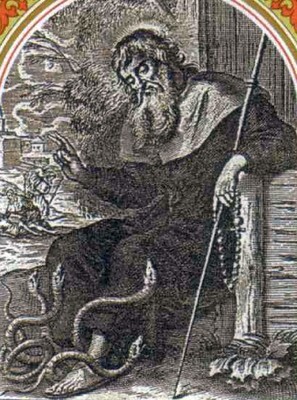
Gordic of Finchdale with his snakes
I recently read this for my book club and it was quite a good novel for discussion, particularly with members coming from a variety of denominations and varying levels of religiosity (myself on the low end, though raised Polish Catholic so Saints were pretty ruthlessly drilled into me). A very wise librarian recently told me how what you take away from this book will likely reflect your relationship to religion, and I find that to be a really exciting aspect of this book because it is quite interpretable and can register on a wide range of topics both intellectually and emotionally. She also pointed out the iambic pentameter, which is an impressive aspect of the prose and reflective of the real Godric’s own poetry. He was one of the first English songwriters, or at least the earliest who’s work survived to be known about. Buechner’s own prose here feels antiquated yet reads very boisterously and likely best heard than silent read, which helps really pull the reader into this 12th century Catholic world. Little is known about the actual Godric, so Buechner fills in much of the story with fiction, and it does feel a bit similar to Lauren Groff’s absolutely breathtaking novel Matrix.
‘What's friendship, when all's done, but the giving and taking of wounds?’
The novel opens with what has certainly joined the ranks of favorite first lines: ‘Five friends I had, and two of them snakes.’ Interpersonal relationships make up a major theme of this novel, particularly for Godric who only counts five, ‘one for each of Jesu’s wounds,’ and two of them it turns out are quite literally snakes (Godric the saint actually is known for his friendship with animals). His scant relationships have a huge sway over his life, particularly Roger Mouse (who, alas, is not a mouse but I did picture him as a vulgar version of Reepicheep from Narnia the whole time) with whom he goes pirating and pillaging, or Elrich who teaches Godric how to become a hermit. But most important for Godric is his (incestuous) relationship with his sister, Burcwen. She figures as a symbol of community, something Godric rejects even when she insists she will kill herself if he leaves. He prefers his life of sin on the run and only engages with community through manipulating them for personal gain. The father, Aedlward, is based on Buechner’s own father who took his own life after feeling he had failed his family by not providing enough for them. Godric’s early resentment for his absent father is an early metaphor of rejection of god, though one he cannot easily cast off and still feels guilt about his lack of good behavior (though not enough to actually change).
Much of the novel concerns Godric’s exploits as a merchant with schemes such as bleeding out a martyr to sell his blood for profit, switching to cat blood when the body runs dry, or his time with Roger Mouse. While they do save a noble at one point, most of their time is spent in depravity, for which Godric feels shame when confronted with visions and thoughts of God's judgement. He makes two pilgrimages, one with his mother to Rome but find Rome detestable, ‘a corpse without a shroud.’ Eventually, late in life, he meditates by a river on sin and life. Godric sees that the mystic version of God is the one that makes the most sense, and dislikes those who run about doing good deeds in the name of an organized religion. Isn’t life strange and mysterious enough without religion, he ponders and finds mysticism to have a far greater depth than the churches he finds to be mostly scams like his own merchant times.
There’s something here that reminds me of Knut Hamsun’s existential ideas expressed in the novel Mysteries. Hamsun argues that there are no purely selfless acts, that all good deeds inevitably call attention upon oneself, that even saintly men have a secret vice all their actions are moving towards. Godric looks down upon those who make themselves outwardly pious and he in his own wilful evils, seems the more authentic person for not hiding behind the pillars of the Church or pretending to be saintly. Which is ultimately Buechner’s point in making Godric such a flawed character to tear down the veil that the saints lead unblemished lives. Godric in a way reminds me of Darth Vader, able to be a total shit his whole life but at the very end squeaks over into the light and gets to appear in the holy trinity of Force ghosts before the credits roll.
There is something very hopeful and empowering in Buechner’s vision that even the most flawed among us can be counted among the saints. It is also a comical ending with Godric utterly enraged that a monk would consider him for such an honor. Godric is a brief book, 178 pages, but feels very robust. Told in a broken up and scattered timeline, told by a 100 year old Godric, it stitches his whole life together to best show cause and effect and that we are a product of our decisions which can affect us even late in life. There is an aspect to it though that I find unfortunate in novels written by men where rape is just glossed over as some jovial depravity without much emotional weight and like, do we really need another book rehabilitating the goodness of rapists? Buechner was using this to point out that religious people are flawed but it still seems a bit glossed over (though in keeping with Biblical stories I suppose). Godric is an interesting read that I suspect will be engaging to many regardless of their religious positioning, those who dislike religion will get a lot out of the satire aspects and those who are more devout will find a lot to ponder and absorb from this tale written by a Protestant pastor. The prose is stunning, the story is moving and quite funny, and it is an important criticism of religion that serves to empower us all.
3.5/5
Can a life filled with destruction, degradation and other dishonorable conduct still be a life that leaves a positive mark upon the world? Frederick Buechner’s Godric —finalist for the 1981 Pulitzer Prize—questions this through a fictional hagiographic account of 12th century Roman Catholic saint Godric of Finchdale. This is the story of a deeply flawed man who, after years of ignoring heavenly visions to sate his lusts and greed, becomes a hermit and reflects upon his own evils while pondering what grace means in a world equally flawed. Insistent to the end that he is not a good man, Buechner uses Godric’s sanitized hagiography as written by an enthusiastic young monk, Reginald of Durham, to criticize Catholic insistence on sanctification and purity. Written in a dense prose he developed to mimic medieval English while remaining accessible to the average reader—much of which is in iambic pentameter—Buechner’s Godric is an impressively poetic and cutting investigation of spirituality that criticizes organized religion to teach that even flawed humans are worthwhile and meaningful.
Gordic of Finchdale with his snakes
I recently read this for my book club and it was quite a good novel for discussion, particularly with members coming from a variety of denominations and varying levels of religiosity (myself on the low end, though raised Polish Catholic so Saints were pretty ruthlessly drilled into me). A very wise librarian recently told me how what you take away from this book will likely reflect your relationship to religion, and I find that to be a really exciting aspect of this book because it is quite interpretable and can register on a wide range of topics both intellectually and emotionally. She also pointed out the iambic pentameter, which is an impressive aspect of the prose and reflective of the real Godric’s own poetry. He was one of the first English songwriters, or at least the earliest who’s work survived to be known about. Buechner’s own prose here feels antiquated yet reads very boisterously and likely best heard than silent read, which helps really pull the reader into this 12th century Catholic world. Little is known about the actual Godric, so Buechner fills in much of the story with fiction, and it does feel a bit similar to Lauren Groff’s absolutely breathtaking novel Matrix.
‘What's friendship, when all's done, but the giving and taking of wounds?’
The novel opens with what has certainly joined the ranks of favorite first lines: ‘Five friends I had, and two of them snakes.’ Interpersonal relationships make up a major theme of this novel, particularly for Godric who only counts five, ‘one for each of Jesu’s wounds,’ and two of them it turns out are quite literally snakes (Godric the saint actually is known for his friendship with animals). His scant relationships have a huge sway over his life, particularly Roger Mouse (who, alas, is not a mouse but I did picture him as a vulgar version of Reepicheep from Narnia the whole time) with whom he goes pirating and pillaging, or Elrich who teaches Godric how to become a hermit. But most important for Godric is his (incestuous) relationship with his sister, Burcwen. She figures as a symbol of community, something Godric rejects even when she insists she will kill herself if he leaves. He prefers his life of sin on the run and only engages with community through manipulating them for personal gain. The father, Aedlward, is based on Buechner’s own father who took his own life after feeling he had failed his family by not providing enough for them. Godric’s early resentment for his absent father is an early metaphor of rejection of god, though one he cannot easily cast off and still feels guilt about his lack of good behavior (though not enough to actually change).
Much of the novel concerns Godric’s exploits as a merchant with schemes such as bleeding out a martyr to sell his blood for profit, switching to cat blood when the body runs dry, or his time with Roger Mouse. While they do save a noble at one point, most of their time is spent in depravity, for which Godric feels shame when confronted with visions and thoughts of God's judgement. He makes two pilgrimages, one with his mother to Rome but find Rome detestable, ‘a corpse without a shroud.’ Eventually, late in life, he meditates by a river on sin and life. Godric sees that the mystic version of God is the one that makes the most sense, and dislikes those who run about doing good deeds in the name of an organized religion. Isn’t life strange and mysterious enough without religion, he ponders and finds mysticism to have a far greater depth than the churches he finds to be mostly scams like his own merchant times.
There’s something here that reminds me of Knut Hamsun’s existential ideas expressed in the novel Mysteries. Hamsun argues that there are no purely selfless acts, that all good deeds inevitably call attention upon oneself, that even saintly men have a secret vice all their actions are moving towards. Godric looks down upon those who make themselves outwardly pious and he in his own wilful evils, seems the more authentic person for not hiding behind the pillars of the Church or pretending to be saintly. Which is ultimately Buechner’s point in making Godric such a flawed character to tear down the veil that the saints lead unblemished lives. Godric in a way reminds me of Darth Vader, able to be a total shit his whole life but at the very end squeaks over into the light and gets to appear in the holy trinity of Force ghosts before the credits roll.
There is something very hopeful and empowering in Buechner’s vision that even the most flawed among us can be counted among the saints. It is also a comical ending with Godric utterly enraged that a monk would consider him for such an honor. Godric is a brief book, 178 pages, but feels very robust. Told in a broken up and scattered timeline, told by a 100 year old Godric, it stitches his whole life together to best show cause and effect and that we are a product of our decisions which can affect us even late in life. There is an aspect to it though that I find unfortunate in novels written by men where rape is just glossed over as some jovial depravity without much emotional weight and like, do we really need another book rehabilitating the goodness of rapists? Buechner was using this to point out that religious people are flawed but it still seems a bit glossed over (though in keeping with Biblical stories I suppose). Godric is an interesting read that I suspect will be engaging to many regardless of their religious positioning, those who dislike religion will get a lot out of the satire aspects and those who are more devout will find a lot to ponder and absorb from this tale written by a Protestant pastor. The prose is stunning, the story is moving and quite funny, and it is an important criticism of religion that serves to empower us all.
3.5/5
February 27, 2011
A beautiful, beautiful book,it opens with a remarkable line: "Five friends I had, and two of them were snakes." Buechner has conceived a unique writing style to tell the story of the medieval Saxon and unofficial saint, Godric. It's the kind of book to nibble at over time, to savor the mostly iambic metered prose that seems to favor words with Anglo-Saxon roots. The artful narrative is adorned with medieval symbols and details and is too densely crafted for a quick read, despite being only 175 pages long.
It is a story of a self-acknowledged fallen man broken by his sins on the one hand, and of those who would elevate him to sainthood on the other, even in the face of his protests and his freely offered evidence of unworthiness. The book is Godric's confession of this unworthiness and the expression of his faith. "He laid his hands on me and blessed my eyes to see God's image deep in every man. He blessed my ears to hear the cry especially of the poor. He blessed my lips to speak no word but Gospel truth." In earthy even vulgar language the account goes on to describe his sins and struggles ranging from thievery to forbidden relations. Starkly honest and salacious, the narrative delves the soul of the saint in his utter humanness. But far from celebrating the sin found there, the tapestry Buechner weaves always points to Godric's guilt and repentance, to his lostness without a Savior. So we too, as we read, are convinced by Godric's own personal testimony of his unholiness, a testimony that draws us through his honesty and humility to see the brightness of the salvation that Christ offers. This is the assurance that Godric needs and finds despite his profound unworthiness.
It is a story of a self-acknowledged fallen man broken by his sins on the one hand, and of those who would elevate him to sainthood on the other, even in the face of his protests and his freely offered evidence of unworthiness. The book is Godric's confession of this unworthiness and the expression of his faith. "He laid his hands on me and blessed my eyes to see God's image deep in every man. He blessed my ears to hear the cry especially of the poor. He blessed my lips to speak no word but Gospel truth." In earthy even vulgar language the account goes on to describe his sins and struggles ranging from thievery to forbidden relations. Starkly honest and salacious, the narrative delves the soul of the saint in his utter humanness. But far from celebrating the sin found there, the tapestry Buechner weaves always points to Godric's guilt and repentance, to his lostness without a Savior. So we too, as we read, are convinced by Godric's own personal testimony of his unholiness, a testimony that draws us through his honesty and humility to see the brightness of the salvation that Christ offers. This is the assurance that Godric needs and finds despite his profound unworthiness.

October 8, 2013
🌳 A beautifully crafted novel of realism set in medieval times, it reminds me of a morality play, dealing as it does with significant archetypal themes. It penetrates to the core.
Buechner had this to say about his novel in his book Now and Then:
Godric is a very old man as he tells his tale, and old age and the approach of death are very much in the back of his mind throughout. In this sense I think it was a book as prophetic, for me, as the Bebb books had been. It was prophetic in the sense that in its pages, more than half without knowing it, I was trying on various ways of growing old and facing death myself. As the years go by, Godric outlives, or is left behind by, virtually everybody he has ever loved-his sister, Burcwen; his shipmate, Roger Mouse; the two snakes, Tune and Fairweather, who for years were his constant companions; and the beautiful maid, Gillian, who appeared to him on the way back from his pilgrimage to Rome. But, although not without anguish, he is able to let them all go finally and to survive their going. His humanity and wit survive. His faith survives.
Now and Then, a memoir of vocation / 106-7
🌿 I met him in Michigan at a writers conference several years ago. He reminded me of a hobbit.
Buechner had this to say about his novel in his book Now and Then:
Godric is a very old man as he tells his tale, and old age and the approach of death are very much in the back of his mind throughout. In this sense I think it was a book as prophetic, for me, as the Bebb books had been. It was prophetic in the sense that in its pages, more than half without knowing it, I was trying on various ways of growing old and facing death myself. As the years go by, Godric outlives, or is left behind by, virtually everybody he has ever loved-his sister, Burcwen; his shipmate, Roger Mouse; the two snakes, Tune and Fairweather, who for years were his constant companions; and the beautiful maid, Gillian, who appeared to him on the way back from his pilgrimage to Rome. But, although not without anguish, he is able to let them all go finally and to survive their going. His humanity and wit survive. His faith survives.
Now and Then, a memoir of vocation / 106-7
🌿 I met him in Michigan at a writers conference several years ago. He reminded me of a hobbit.
This entire review has been hidden because of spoilers.

December 1, 2011
Godric was leant to me by a friend, but it sat on the shelf for almost a year awaiting a breach in my perpetual reading list. Recently I was ready to just give it back without reading because I had held on to it so long, but an endorsement on the back cover caught my eye literally moments before I handed it back: “From the book’s opening sentence…any sensible reader will be caught in Godric’s grip...” (Peter Prescott, Newsweek). Well, that sounded like a challenge. “Five friends I had, and two of them snakes.” Upon reading that first line I was skewered like a live pig, but squealing thenceforward with delight through the rest of book.
Frederick Buechner truly writes with a masterful literary and poetic quality. It was irreverent, but wonderfully so, for it happened to balance out the sense of histrionic piety throughout other parts of the book. It was hilarious, crude, and beautiful at the same time. Some of the lines made me blush in modesty (“…My bullocks shriveled to beansize in their sack and old One-eye scarce a barnacle’s length clear of my belly and crying a-mercy”). Some lines struck me dumb with awe (“‘Hold fast to Christ,’ I said, and she to me, ‘In Hell, you are the only Christ I have.’”). It is raw and witty (“[He prayed to] a God he must have hoped by then ruled elsewhere than the carcasses of mortal men”). His prose sings (“Why did we weep?...more than anything, I think, we wept for us, and so it is ever with tears. Whatever be their outward cause, within the chancel of the heart it’s we ourselves for whom they finally fall”). He writes like he doesn’t have to work hard at it. It flows too naturally to have been under stylistic duress of any kind, and I imagine this sort of writing would have eventually unraveled had its author been overly cognizant of his own gifting. It pays tribute to its medieval theme (a middle ages saint), yet it speaks with a modern poignancy and timeless relevance.
You have to be vigilant reading this book, especially at first. The meaning of a sentence will suddenly leap and twist mid-sentence to double back on itself with another ending than you anticipated. He brilliantly evades clichés and predictable interpretations of his characters. If you place yourself in the shoes of the much-derided Reginald, Godric’s biographer, you’d get a good feel for how Buechner chafes at conventional interpretations of religion. He does only as much as he has to in order to help the reader understand something, but he leaves some experience raw and undefined, out of the reach of a deconstructing desire to digest the universe and God almighty with it. Buechner is content with not knowing some things, even about God. “He learned that it was Jesu saved him from the sea, though saved him why, or saved for what deep end he did not learn, nor has he learned it to this day.”
The foibles of his saint, Godric, comes with its medieval share of disgusting habits, a mystical view of nature and religion, slavish self-flagellation, inflation of God’s wrath, deflation of his mercy, and a devaluation of self as a parasite that God tolerates. In worshipful moments Godric slithers and moans like a man who has not yet learned that if a creature can out-moral his God, then by all appearances at least he has bested his God in the only way that counts. The saint cowers because he has not yet realized that if God need defend his belt against us, then we must be formidable challengers indeed. Thus it is pride and not humility that envisions God as monster, and we the despised worms between his toes over which he glowers in greed for his breath back. I for one want no god who suffers my existence merely to pave his roads and bejewel his throne by my praise and groveling adoration. Such a god would be in greater need of my charity, than I his.
There are some truly tragic moments in this story (spoiler alert!). I hate that Godric left De Granville’s pre-pubescent wife to suffer the shame and torment of De Granville’s cruelty. I hate that his friend Mouse died without knowing how much Godric cared. I hate that Godric’s brother was so desperate for a soul-tether, but drowned while searching in the night for his sister. I hate how Godric and his sister fell in love with each other, but were doomed to never find social acceptance of their relationship. But I hated with the author, because I loved with him his story, and his characters.
Clearly Buechner loves the tragic-heroic story of humanity, as dark as it is in some places. But ‘from the slime all gods have risen’, and the author’s celebration of the triumph of love and truth shines through the blackest shadows of human history. He loves mankind for what he is—sexual, sinful, self-punishing, dirty, smelly, starving for a laugh, drowning in his tears. And he loves mankind for what he can be: “As a man dies many times before he’s dead, so does he wend from birth to birth until, by grace, he comes alive at last.” Make no mistake, Godric may have been written as a period piece, but it is reflective of Buechner’s own beliefs. With all of Godric’s flaws, he is still honest, a character trait quite possibly prized by Buechner above every other value except courage and faith.
I have one question that remains after my first bump into Buechner: have I discovered a living Lewis? Methinks so.
Frederick Buechner truly writes with a masterful literary and poetic quality. It was irreverent, but wonderfully so, for it happened to balance out the sense of histrionic piety throughout other parts of the book. It was hilarious, crude, and beautiful at the same time. Some of the lines made me blush in modesty (“…My bullocks shriveled to beansize in their sack and old One-eye scarce a barnacle’s length clear of my belly and crying a-mercy”). Some lines struck me dumb with awe (“‘Hold fast to Christ,’ I said, and she to me, ‘In Hell, you are the only Christ I have.’”). It is raw and witty (“[He prayed to] a God he must have hoped by then ruled elsewhere than the carcasses of mortal men”). His prose sings (“Why did we weep?...more than anything, I think, we wept for us, and so it is ever with tears. Whatever be their outward cause, within the chancel of the heart it’s we ourselves for whom they finally fall”). He writes like he doesn’t have to work hard at it. It flows too naturally to have been under stylistic duress of any kind, and I imagine this sort of writing would have eventually unraveled had its author been overly cognizant of his own gifting. It pays tribute to its medieval theme (a middle ages saint), yet it speaks with a modern poignancy and timeless relevance.
You have to be vigilant reading this book, especially at first. The meaning of a sentence will suddenly leap and twist mid-sentence to double back on itself with another ending than you anticipated. He brilliantly evades clichés and predictable interpretations of his characters. If you place yourself in the shoes of the much-derided Reginald, Godric’s biographer, you’d get a good feel for how Buechner chafes at conventional interpretations of religion. He does only as much as he has to in order to help the reader understand something, but he leaves some experience raw and undefined, out of the reach of a deconstructing desire to digest the universe and God almighty with it. Buechner is content with not knowing some things, even about God. “He learned that it was Jesu saved him from the sea, though saved him why, or saved for what deep end he did not learn, nor has he learned it to this day.”
The foibles of his saint, Godric, comes with its medieval share of disgusting habits, a mystical view of nature and religion, slavish self-flagellation, inflation of God’s wrath, deflation of his mercy, and a devaluation of self as a parasite that God tolerates. In worshipful moments Godric slithers and moans like a man who has not yet learned that if a creature can out-moral his God, then by all appearances at least he has bested his God in the only way that counts. The saint cowers because he has not yet realized that if God need defend his belt against us, then we must be formidable challengers indeed. Thus it is pride and not humility that envisions God as monster, and we the despised worms between his toes over which he glowers in greed for his breath back. I for one want no god who suffers my existence merely to pave his roads and bejewel his throne by my praise and groveling adoration. Such a god would be in greater need of my charity, than I his.
There are some truly tragic moments in this story (spoiler alert!). I hate that Godric left De Granville’s pre-pubescent wife to suffer the shame and torment of De Granville’s cruelty. I hate that his friend Mouse died without knowing how much Godric cared. I hate that Godric’s brother was so desperate for a soul-tether, but drowned while searching in the night for his sister. I hate how Godric and his sister fell in love with each other, but were doomed to never find social acceptance of their relationship. But I hated with the author, because I loved with him his story, and his characters.
Clearly Buechner loves the tragic-heroic story of humanity, as dark as it is in some places. But ‘from the slime all gods have risen’, and the author’s celebration of the triumph of love and truth shines through the blackest shadows of human history. He loves mankind for what he is—sexual, sinful, self-punishing, dirty, smelly, starving for a laugh, drowning in his tears. And he loves mankind for what he can be: “As a man dies many times before he’s dead, so does he wend from birth to birth until, by grace, he comes alive at last.” Make no mistake, Godric may have been written as a period piece, but it is reflective of Buechner’s own beliefs. With all of Godric’s flaws, he is still honest, a character trait quite possibly prized by Buechner above every other value except courage and faith.
I have one question that remains after my first bump into Buechner: have I discovered a living Lewis? Methinks so.

February 22, 2013
This was the first of Buechner's fiction that I had ever read, and it was such a good book! Through the story of Godric, which became my story, Buechner explores the darkness of the human heart and how amazing and beautiful the agape love of Christ is. This is my favorite quote from the book,
"What's prayer? It's shooting shafts into the dark. What mark they strike, if any, who's to say? It's reaching for a hand you cannot touch. The silence is so fathomless that prayers like plummets vanish in the sea. You beg. You whimper. You load God down with empty praise. You tell him sins that he already knows full well. You seek to change his changeless will. Yet Godric prays the way he breathes, for else his heart would wither in his breast. Prayer is the wind that fills his sail. Else waves would dash him on the rocks, or he would drift with witless tides. And sometimes, by God's grace, a prayer is heard."
"What's prayer? It's shooting shafts into the dark. What mark they strike, if any, who's to say? It's reaching for a hand you cannot touch. The silence is so fathomless that prayers like plummets vanish in the sea. You beg. You whimper. You load God down with empty praise. You tell him sins that he already knows full well. You seek to change his changeless will. Yet Godric prays the way he breathes, for else his heart would wither in his breast. Prayer is the wind that fills his sail. Else waves would dash him on the rocks, or he would drift with witless tides. And sometimes, by God's grace, a prayer is heard."

October 3, 2016
The life of a medieval hermit and saint, Godric, in his own words and memories, and also as written down by Reginald, a monk. This gives you a glimpse into the medieval mind, especially into that of one who is sorrowful for his life and spends fifty years in reparation, praying to God. Before visions [or dreams] of a monk, Cuthbert, and a girl, Gillian, Godric lives the life of a peddler, merchant, pirate, steward to a lord, sexton to a priest, then gives his life to God. This beautiful story flowed like the River Wear. The author has turned it into a sort of rhythmical prose-poem, if I can use that expression. A must-read.

July 18, 2023
This is one of those books that will bloom even more in re-reading. It's a spin on the medieval saint's tale that seems fresh, even after 40+ years. In so many other books the spin is...gasp!...atheism, where with this one, the spin is that Godric believes perhaps a little too hard. It was beautiful in many places, ugly in others, true to the medieval style Beuchner imitates. A fascinating rhythm of storytelling and one ripe for analysis. I would say, not for the fainthearted due to the bawdiness, but I will say, not for those unacquainted with conventions of medieval literature.
Godric of Finchale (c. 1065-1170) was a real person. He is recognized as a saint, though not formally canonized. One of his hymns is available for listening here.
Godric of Finchale (c. 1065-1170) was a real person. He is recognized as a saint, though not formally canonized. One of his hymns is available for listening here.

August 9, 2022
Absolutely extraordinary. Perhaps a new personal plumb line for what great Christian art in the contemporary world should look like: intensely saturated with beauty and wonder, glorying in the gift of language to its utmost potential, filled with rich theology but never even approaching didacticism, refusing to shy away from our messiness and depravity, but infused with a bittersweet love for life. The prose snatched my breath away. It is maybe the most incredible prose I have ever read besides that of Moby Dick. There is a unique and privileged euphoric feeling that a reader gets when he knows that he is in the presence of a writer who is exceptionally skilled in the deployment of language, and that feeling immediate hit me from the first paragraph. The most stunning thing about it is that all of Godric's narrative is essentially composed in iambic verse. It could be cast as a narrative poem and no one would bat an eye. Not one sentence deviates from the earthy, lilting rhythm but it never sounds forced or trite. Buechner's work can best be described for the uninitiate as an amalgam of Chaucer, Greene, and Percy; but the result is entirely sui generis. This is an uncomfortable read at times due to the unflinching accounts of Godric's sin-oppressed life, and it will leave you pondering the meaning of grace for days after. Buechner even refuses to condone Godric's interpretation of faith, simply presenting his portrait and leaving us to contemplate it. If Christians produced more art like this, would the world be a little different? Rarely have I read a novel that impressed upon me with such force an image of the sheer mastery of its author and of his multifaceted vision for existence. One of a handful of perfect novels.
Update: I just realized that Buechner died the day after I wrote this review. He lived to a very ripe age, but it is still a sad loss. Rest in Christ to one of the most authentic Christian writers of our time.
Update: I just realized that Buechner died the day after I wrote this review. He lived to a very ripe age, but it is still a sad loss. Rest in Christ to one of the most authentic Christian writers of our time.

February 22, 2008
2020 review here: http://www.danscanon.com/2020/10/godr...
I found the review below this weekend and was reminded how great Godric is, and how even though I really like A Confederacy of Dunces, this is a better book, and should have won the Pulitzer that year. And that last year I decided to add this to my "read yearly" list. So here we go...
http://dgmyers.blogspot.com/2010/05/g...
6/14/12: Looking at what I wrote last year after my yearly reread of Godric, it strikes me as odd that I was, and still am to some extent upset by the results of a Pulitzer prize contest that happened when I was 5. It is a great book, though...
I found the review below this weekend and was reminded how great Godric is, and how even though I really like A Confederacy of Dunces, this is a better book, and should have won the Pulitzer that year. And that last year I decided to add this to my "read yearly" list. So here we go...
http://dgmyers.blogspot.com/2010/05/g...
6/14/12: Looking at what I wrote last year after my yearly reread of Godric, it strikes me as odd that I was, and still am to some extent upset by the results of a Pulitzer prize contest that happened when I was 5. It is a great book, though...

July 30, 2017
Here's a tribute; Buechner died in August 2022.
Rabbit Room review here. Kirkus Review here. Poetic Spirituality review here. Hermitary review here. Captain Thin review here. A Commonplace Blog review here. Edoardo Albert review here. See Nathan Kilpatrick's article ("The giving and taking of wounds: Friendship and hagiography in Frederick Buechner's Godric") in Christianity & Literature 65.4 (Sept. 2016): 455–72. Fascinating C&L interview with Buechner here. Buechner won C&L's lifetime achievement award in 2007.
A little confusing at first because the narrative jumps back and forth from present to past. Godric (G) also speaks of himself in the third person sometimes.
3–8 (present): narrated by Godric of Finchale; five friends: two snakes, Mouse, Ailred (abott), Gillian; Reginald (Reg.) is writing bio; friendship a matter of wounds; absence of friends leaves one empty [cf. CSL and Williams]
9–16 (past): distant father (Aedlward) who works hard for the lord; G has grey eyes; mother (Aedwen); odd sister (Burcwen); brother (William); the fish and the near-death experience (miracle); 3 lessons
17–22 (present): Reg. on the meanings of names (see here [God reigns vs. God-wrecked]); Reg.'s Qs about dreams, etc; William of Normandy; rule of St. Benedict; Godric feels unworthy of bio; lyric poetry (Mary)
23–27 (past): Tom Ball's blessing (doors = choices); parting words with family; Burcwen threatens suicide (playfully)
28–34 (past): River Wear; iron vest made; death of Small (confused with Haggai) at Bishop's Lynn; 3 follies (G kills cat to peddle "relics")
35–39 (past): Farne; penance; buries treasure from Bishop's Lynn; dream of Cuthbert; confession; friend Roger Mouse (boatman)
40–43 (past/present): tension of young vs. old; Beckett mentioned; legends of Godric's encounter with a boar/Satan and his kissing a leper; guilt over the truth of the leper incident; process of people's pilgrimage to see Godric (monks at Durham are gatekeepers; worthy pilgrims [or those who pay] get a cross of plaited straw); Godric feels unworthy to impart grace, and sometimes he feels that he'll lose it himself, and he wants to hold onto whatever grace he does have
44–49 (past): waves melt away like years; G tells Mouse a false name (Gudericus = Deric [naming issue; fish bumper sticker]); Alfred the Great; they steal a ship and begin pirating; growing rich; Ps. 124; Mary as Virgin; "God's love's all gift"; many sins; death of Cuthbert on Farne
50–55 (past): six-month break; Aedlward (G's father) has died; Burcwen wants to go with G—he says no; we're all under a stone (whether a tombstone or need/hurt/longing/etc.); alleged dream of Aedwen (Aedlward in Purgatory, requesting prayers at Peter's tomb in Rome); G promises to go to Rome with his mother; Burcwen stays with William (incestuous sexual tension with G); prayers to Mary
56–61 (present/past): Ailred and G on church roof (River Wear flooding); G is ~80; Reg. gone for the moment; G contemplates the nature of time; G's prescience; ref. to Noah; G tells Ailred about the journey to Rome; thieving priest; double murder (pregnant woman) punished by quartering; time again; return of Reg.; problem of evil (perspective)
62–67 (past): Rachel not who Jacob thought she was —> Rome not what pilgrims expected [cf. Luther's journey]; Gen. 3:19; relics peddled; crusaders; Pope seems distracted; G and mother given a tour—see the Colosseum; we weep for ourselves; no God in Rome, but they pray anyway; significance of the trapped bird?; BCP language; G sees a bear on the way home—eats figs and expels them —> Gillian appears and interprets the fable—G has polluted God's grace
68–73 (past): comfort of familiar language; travel home with other pilgrims: henpecked baker (and wife), Ralph the mason, Maud the Bawd, and Cherryman the priest; Gillian appears periodically, speaking in proverbs; she sees Aedlward freezing in Purgatory; part of G freezes when Gillian departs
74-79 (past): G reaches home and lies to Burcwen about Mouse/Deric [cf. Jekyll/Hyde]; why mention Gillian now?; relationship with B strained; Falkes de Granvill (Norfolk lord) hires G to be a steward (G wants to escape home); FdG's wife is Hedwic (very young)
80–88 (present/past/present): Reg. thinks G has died; the trial of aging; FdG mistreats the poor (crops them to make them sprout)—G participates; Hedwic's parable about a pristine outside concealing a corrupt inside; dilemma of speaking up and bringing pain upon others; FdG laughed at G's concern for those being cheated; G flees, hearing Hedwic weeping
89–94 (past): meets up with Mouse, who's lost an eye; G had lain with Gillian?; gabbing can signal the loss of friendship; took pilgrims to Jerusalem; prior to arriving, in Arsuf they pick up the king of Jerusalem, Baldwin; land at Jaffa; Jerusalem is saved from the Turks (irony of God's will being done by rogues); G refuses to steal from pilgrims, and Mouse throws him overboard
95–99 (present): lost/found; more contemplation on friendship (rocks/water); Perkin (green eyes) as an almost-son—helps with G's tomb; reference to Jordan river and G's regeneration (death of Deric and new birth of G)
100–5 (past): entire chapter is a prayer; G wants to learn to pray; tour of Jerusalem (compared with Rome); G about 100 at the time of telling this part of his life; guilt weighs on G's back; recounting of sins (commission and omission); G wades in Jordan and comes out changed; fools for Christ
106–13 (past): G goes barefoot to honor Christ; white bird significance?; asks feet to help him to do good; deposits Farne treasure at a church near Bishop Auckland; Elric (anchorite at Wulsingham) wrestles demons and speaks of penance; G carries Elric on his back (put one burden down and picked up another; Elric much lighter than the guilt); G stays at Elric's cairn for two years—learned how to live
114–20 (past): Elric: "Scratch fair, find foul. So goes the world." (temptation is always lurking); "skull's a chapel," but hands, feet, and heart have other desires (we're not completely governed by logic/reason); Devil often appears as Christ; G : Elric :: Reg. : G; in G's dream, Cuthbert shows him his destination and turns broken sticks into two snakes; death of Elric
121–27 (present): Bishop Pudsey summons G to Durham to be honored at Christmas mass (prob. also to honor himself); G has gone without shoes for 50+ years; shrine of Cuthbert's bones; Ranulf Flambard brought Cuthbert to Durham 50 yrs. ago—body was preserved (500 yrs. old); on the way home, G sees Burcwen's tomb in a convent (she died of life); G almost killed by Scottish brigands (they don't know that men's treasure is buried in graves); Norman bishops can't repel the darkness
128–33 (present/past): G was about 40 when Elric died (Henry I was king); Finchale rhymes with wrinkle; G left Elric and went to Saint Giles, met a relative of Tom Ball's: Littlefair (deaf wife, Joan); Littlefair enlists G's help as a bellringer/doorkeeper; G disciplines the choir boys, but they like his (expurgated) stories (G questions the removal of the grief and ugliness); one of them, Gilbert, suggests that G learn to read/write at the school at Saint Mary-le-Bow in Durham; more works to escape Purgatory; Bishop Flambard's injustice/greed [logos], yet G is thankful that Flambard takes a liking to him [pathos]
134–38 (past): Flambard (red hair) says golden rule is that the rich get richer—doesn't care about the poor; Flambard talks about progress (making labor lighter) and says that God rules through male procreation (making babies) and wit (making a wondrous world); Flambard's penance (heavy guilt); on a hunting trip with Flambard (who wrestles friends then naps), G wanders and finds the place that Cuthbert had revealed in G's dream (two snakes); G gets permission to make his cell there and serve "the King"
139–44 (past): G lived 50 yrs. at Finchale (left only 3x); filled the yrs. with past, imagined past (what might have been: road diverged), and imagined future; danger of dreams (can't control lustful thoughts); reference to The Anarchy; question of God's providence/sovereignty; faith/hope/love; G's internal war (question of the nature of prayer [see "Prayer (I)"]: "something understood"); separate visions of Mary, John the Baptist, and Jesus (connected to prayer)
145–51 (past): family comes to Finchale a year after G arrives there; house burned by rogues suspicious of unmarried Burcwen and William [poverty —> false rumors]; part of Aedwen (metaphysical) burned with the house; time (like Wear) carries everything away (Aedwen's contemplation of death/rest/porridge [3 estates] and G's insistence that the dead will rise again; Aedwen sounds like Candide); William's gabbing hides his loneliness; Burcwen's frustration with William and her own loneliness and sense of loss (sexual tension with G); G's works for Christ; death of Aedwen
152–57 (past): G watches his sister bathe (ref. to Susanna); G and B shun each other; William thinks something's wrong with B; G eventually asks B for forgiveness—she comes to him at night and they talk (and more); William can't find B, is given no help from G/B, and dies searching for her; G feels the guilt of a murderer
158–64 (past): B joins a convent of nuns; years later, G sees B one more time—communicate without speaking; G sees the deaths of Mouse and Perkin (second sight); banishment of two snakes (can't banish lust)—cf. Patrick
165–71 (present): various Godric's; Reg. wants G to bless the manuscript, but G fears it's too sweet; G has a stroke (catalyst is being called a saint)—G knows he'll die today; G washes in Wear once more; Perkin helps G bless the manuscript; who's the Sweetheart?; lost/found
172–75 (present): Reg. reads manuscript of G's death/reputation; two snakes pay homage; B's cross found around G's neck—turned into a relic
177–78 (historical note): see ODNB; initially resisted being biographized; earliest lyric poet in English; prophetic ability
Rabbit Room review here. Kirkus Review here. Poetic Spirituality review here. Hermitary review here. Captain Thin review here. A Commonplace Blog review here. Edoardo Albert review here. See Nathan Kilpatrick's article ("The giving and taking of wounds: Friendship and hagiography in Frederick Buechner's Godric") in Christianity & Literature 65.4 (Sept. 2016): 455–72. Fascinating C&L interview with Buechner here. Buechner won C&L's lifetime achievement award in 2007.
A little confusing at first because the narrative jumps back and forth from present to past. Godric (G) also speaks of himself in the third person sometimes.
3–8 (present): narrated by Godric of Finchale; five friends: two snakes, Mouse, Ailred (abott), Gillian; Reginald (Reg.) is writing bio; friendship a matter of wounds; absence of friends leaves one empty [cf. CSL and Williams]
9–16 (past): distant father (Aedlward) who works hard for the lord; G has grey eyes; mother (Aedwen); odd sister (Burcwen); brother (William); the fish and the near-death experience (miracle); 3 lessons
17–22 (present): Reg. on the meanings of names (see here [God reigns vs. God-wrecked]); Reg.'s Qs about dreams, etc; William of Normandy; rule of St. Benedict; Godric feels unworthy of bio; lyric poetry (Mary)
23–27 (past): Tom Ball's blessing (doors = choices); parting words with family; Burcwen threatens suicide (playfully)
28–34 (past): River Wear; iron vest made; death of Small (confused with Haggai) at Bishop's Lynn; 3 follies (G kills cat to peddle "relics")
35–39 (past): Farne; penance; buries treasure from Bishop's Lynn; dream of Cuthbert; confession; friend Roger Mouse (boatman)
40–43 (past/present): tension of young vs. old; Beckett mentioned; legends of Godric's encounter with a boar/Satan and his kissing a leper; guilt over the truth of the leper incident; process of people's pilgrimage to see Godric (monks at Durham are gatekeepers; worthy pilgrims [or those who pay] get a cross of plaited straw); Godric feels unworthy to impart grace, and sometimes he feels that he'll lose it himself, and he wants to hold onto whatever grace he does have
44–49 (past): waves melt away like years; G tells Mouse a false name (Gudericus = Deric [naming issue; fish bumper sticker]); Alfred the Great; they steal a ship and begin pirating; growing rich; Ps. 124; Mary as Virgin; "God's love's all gift"; many sins; death of Cuthbert on Farne
50–55 (past): six-month break; Aedlward (G's father) has died; Burcwen wants to go with G—he says no; we're all under a stone (whether a tombstone or need/hurt/longing/etc.); alleged dream of Aedwen (Aedlward in Purgatory, requesting prayers at Peter's tomb in Rome); G promises to go to Rome with his mother; Burcwen stays with William (incestuous sexual tension with G); prayers to Mary
56–61 (present/past): Ailred and G on church roof (River Wear flooding); G is ~80; Reg. gone for the moment; G contemplates the nature of time; G's prescience; ref. to Noah; G tells Ailred about the journey to Rome; thieving priest; double murder (pregnant woman) punished by quartering; time again; return of Reg.; problem of evil (perspective)
62–67 (past): Rachel not who Jacob thought she was —> Rome not what pilgrims expected [cf. Luther's journey]; Gen. 3:19; relics peddled; crusaders; Pope seems distracted; G and mother given a tour—see the Colosseum; we weep for ourselves; no God in Rome, but they pray anyway; significance of the trapped bird?; BCP language; G sees a bear on the way home—eats figs and expels them —> Gillian appears and interprets the fable—G has polluted God's grace
68–73 (past): comfort of familiar language; travel home with other pilgrims: henpecked baker (and wife), Ralph the mason, Maud the Bawd, and Cherryman the priest; Gillian appears periodically, speaking in proverbs; she sees Aedlward freezing in Purgatory; part of G freezes when Gillian departs
74-79 (past): G reaches home and lies to Burcwen about Mouse/Deric [cf. Jekyll/Hyde]; why mention Gillian now?; relationship with B strained; Falkes de Granvill (Norfolk lord) hires G to be a steward (G wants to escape home); FdG's wife is Hedwic (very young)
80–88 (present/past/present): Reg. thinks G has died; the trial of aging; FdG mistreats the poor (crops them to make them sprout)—G participates; Hedwic's parable about a pristine outside concealing a corrupt inside; dilemma of speaking up and bringing pain upon others; FdG laughed at G's concern for those being cheated; G flees, hearing Hedwic weeping
89–94 (past): meets up with Mouse, who's lost an eye; G had lain with Gillian?; gabbing can signal the loss of friendship; took pilgrims to Jerusalem; prior to arriving, in Arsuf they pick up the king of Jerusalem, Baldwin; land at Jaffa; Jerusalem is saved from the Turks (irony of God's will being done by rogues); G refuses to steal from pilgrims, and Mouse throws him overboard
95–99 (present): lost/found; more contemplation on friendship (rocks/water); Perkin (green eyes) as an almost-son—helps with G's tomb; reference to Jordan river and G's regeneration (death of Deric and new birth of G)
100–5 (past): entire chapter is a prayer; G wants to learn to pray; tour of Jerusalem (compared with Rome); G about 100 at the time of telling this part of his life; guilt weighs on G's back; recounting of sins (commission and omission); G wades in Jordan and comes out changed; fools for Christ
106–13 (past): G goes barefoot to honor Christ; white bird significance?; asks feet to help him to do good; deposits Farne treasure at a church near Bishop Auckland; Elric (anchorite at Wulsingham) wrestles demons and speaks of penance; G carries Elric on his back (put one burden down and picked up another; Elric much lighter than the guilt); G stays at Elric's cairn for two years—learned how to live
114–20 (past): Elric: "Scratch fair, find foul. So goes the world." (temptation is always lurking); "skull's a chapel," but hands, feet, and heart have other desires (we're not completely governed by logic/reason); Devil often appears as Christ; G : Elric :: Reg. : G; in G's dream, Cuthbert shows him his destination and turns broken sticks into two snakes; death of Elric
121–27 (present): Bishop Pudsey summons G to Durham to be honored at Christmas mass (prob. also to honor himself); G has gone without shoes for 50+ years; shrine of Cuthbert's bones; Ranulf Flambard brought Cuthbert to Durham 50 yrs. ago—body was preserved (500 yrs. old); on the way home, G sees Burcwen's tomb in a convent (she died of life); G almost killed by Scottish brigands (they don't know that men's treasure is buried in graves); Norman bishops can't repel the darkness
128–33 (present/past): G was about 40 when Elric died (Henry I was king); Finchale rhymes with wrinkle; G left Elric and went to Saint Giles, met a relative of Tom Ball's: Littlefair (deaf wife, Joan); Littlefair enlists G's help as a bellringer/doorkeeper; G disciplines the choir boys, but they like his (expurgated) stories (G questions the removal of the grief and ugliness); one of them, Gilbert, suggests that G learn to read/write at the school at Saint Mary-le-Bow in Durham; more works to escape Purgatory; Bishop Flambard's injustice/greed [logos], yet G is thankful that Flambard takes a liking to him [pathos]
134–38 (past): Flambard (red hair) says golden rule is that the rich get richer—doesn't care about the poor; Flambard talks about progress (making labor lighter) and says that God rules through male procreation (making babies) and wit (making a wondrous world); Flambard's penance (heavy guilt); on a hunting trip with Flambard (who wrestles friends then naps), G wanders and finds the place that Cuthbert had revealed in G's dream (two snakes); G gets permission to make his cell there and serve "the King"
139–44 (past): G lived 50 yrs. at Finchale (left only 3x); filled the yrs. with past, imagined past (what might have been: road diverged), and imagined future; danger of dreams (can't control lustful thoughts); reference to The Anarchy; question of God's providence/sovereignty; faith/hope/love; G's internal war (question of the nature of prayer [see "Prayer (I)"]: "something understood"); separate visions of Mary, John the Baptist, and Jesus (connected to prayer)
145–51 (past): family comes to Finchale a year after G arrives there; house burned by rogues suspicious of unmarried Burcwen and William [poverty —> false rumors]; part of Aedwen (metaphysical) burned with the house; time (like Wear) carries everything away (Aedwen's contemplation of death/rest/porridge [3 estates] and G's insistence that the dead will rise again; Aedwen sounds like Candide); William's gabbing hides his loneliness; Burcwen's frustration with William and her own loneliness and sense of loss (sexual tension with G); G's works for Christ; death of Aedwen
152–57 (past): G watches his sister bathe (ref. to Susanna); G and B shun each other; William thinks something's wrong with B; G eventually asks B for forgiveness—she comes to him at night and they talk (and more); William can't find B, is given no help from G/B, and dies searching for her; G feels the guilt of a murderer
158–64 (past): B joins a convent of nuns; years later, G sees B one more time—communicate without speaking; G sees the deaths of Mouse and Perkin (second sight); banishment of two snakes (can't banish lust)—cf. Patrick
165–71 (present): various Godric's; Reg. wants G to bless the manuscript, but G fears it's too sweet; G has a stroke (catalyst is being called a saint)—G knows he'll die today; G washes in Wear once more; Perkin helps G bless the manuscript; who's the Sweetheart?; lost/found
172–75 (present): Reg. reads manuscript of G's death/reputation; two snakes pay homage; B's cross found around G's neck—turned into a relic
177–78 (historical note): see ODNB; initially resisted being biographized; earliest lyric poet in English; prophetic ability
This entire review has been hidden because of spoilers.

Read
March 18, 2026“Dear Lord, strew herbs upon my hermit’s dreams to make them sweet. Have daylight mercy on my midnight soul.”
I mean, come on. How great are books? Books are the best. Big fan of books, including this one.
I mean, come on. How great are books? Books are the best. Big fan of books, including this one.

April 24, 2023
A fictionalized autobiography of Saint Godric of Finchale, a twelfth-century hermit. He was regarded as a holy man by some, although he would strenuously deny the appellation himself.
Buechner’s writing and imagination is a wonder throughout, and he crafted this memorable opening line:
“Five friends I had, and two of them snakes.”
Scriptor Ignotus wrote a great review:
https://www.goodreads.com/review/show...
Buechner’s writing and imagination is a wonder throughout, and he crafted this memorable opening line:
“Five friends I had, and two of them snakes.”
Scriptor Ignotus wrote a great review:
https://www.goodreads.com/review/show...

May 17, 2017
This creative retelling of a historical character's life is probably the most poetic, lyrical prose I've ever read. This is a story about a saint who knows he's a miserable sinner, or about the ordinariness of those we call saints, and therefore also about the saintliness of many who we believe to be merely ordinary. What makes a person a saint? Perhaps nothing more than that they never give up the struggle to fight against the sin inside and cry out to God, perpetually, for his mercy.
October 21, 2025
Bizarre, poignant, troubling, and freeing. An intense exploration of what it means to grow in the grace of our Lord Jesus Christ, through a fictionalized account of a real 12th century saint’s life.
I don’t think everyone needs to read this, but I read it at the right time and was profoundly moved by it. I am, however, disturbed by the license that Buechner takes at times in his retelling of Godric’s life. Some of the sins he imports into the saint’s story are far too painful and horrific to be even fictionalized additions to a real person’s legacy. But to his credit, Buechner doesn’t revel in the horror as much as reveal that some people have externalized the internal horror harbored by every human heart—and that God’s mercy is resilient and gritty enough to cover both.
I don’t think everyone needs to read this, but I read it at the right time and was profoundly moved by it. I am, however, disturbed by the license that Buechner takes at times in his retelling of Godric’s life. Some of the sins he imports into the saint’s story are far too painful and horrific to be even fictionalized additions to a real person’s legacy. But to his credit, Buechner doesn’t revel in the horror as much as reveal that some people have externalized the internal horror harbored by every human heart—and that God’s mercy is resilient and gritty enough to cover both.

August 18, 2021
A book too special to say a word about.

June 4, 2026
Hauntingly beautiful.

December 1, 2025
Buechner!! What a writer.
I spent the first third of this book thinking I wouldn’t even finish it and the last third convinced it was a top 5 book this year.
Poetic and profound, Buechner writes of man’s wrestling with God, of vice and virtue, and of what makes a saint. Based on the real life of St. Godric, Buechner writes in first person—utilizing older English which can feel cumbersome at first but quickly becomes understandable. This book reminds me quite a bit of his fiction work “Son of Laughter” based on the life of Jacob. When our spiritual heroes turn out to be more human than we’d imagined, it only makes them more beautiful and inspiring (in the same way Christians around the world were heartened to hear of Mother Theresa’s long years of spiritual dryness). This book illustrates that beautifully.
A short book that should be read slowly and probably read immediately for a second time after completion to get everything you missed the first time through.
I spent the first third of this book thinking I wouldn’t even finish it and the last third convinced it was a top 5 book this year.
Poetic and profound, Buechner writes of man’s wrestling with God, of vice and virtue, and of what makes a saint. Based on the real life of St. Godric, Buechner writes in first person—utilizing older English which can feel cumbersome at first but quickly becomes understandable. This book reminds me quite a bit of his fiction work “Son of Laughter” based on the life of Jacob. When our spiritual heroes turn out to be more human than we’d imagined, it only makes them more beautiful and inspiring (in the same way Christians around the world were heartened to hear of Mother Theresa’s long years of spiritual dryness). This book illustrates that beautifully.
A short book that should be read slowly and probably read immediately for a second time after completion to get everything you missed the first time through.

June 3, 2011
This was a rough and rude Medieval tale of a real-life man who became a hermit. I loved the language, all Anglo-Saxon and earthy - it set the tone of the time perfectly, and the character of the man. There was a little bit of everything in this book - even a little Canterbury Tales in the the chapters about Godric's pilgrimage to Rome - that part was my favorite. And the story is so full of visions and delusions and madnesses and transports and such that it seems to me it could almost be called magical realism - but a more ecstatic Roman Catholic type, or at least, a more Medieval type. I loved the writhing/biting/ferocious struggle between Godric's natural inclinations and his longing to be pure. Not for everyone, but certainly unique and compelling.

August 2, 2011
I've read 'Godric' three times now and it is one of my all-time favourite novels. An extraordinary, earthy retelling of the life of Godric, a holy (?) hermit in tenth and eleventh century England, Frederick Buechner's narrative smudges typical hagiography with all sorts of sordid deeds even as Godric strains towards his Lord during his lifelong pilgrimage (simul justus et peccator am I right?). Buechner's prose is exquisite and effortlessly transports readers back into the medieval world that Godric lived in.

Read
September 12, 2016I started this several times and couldn't get past the um, earthiness of Godric. At the other end of the book, I wouldn't say I understand him or still even like him that much, but I can see into his life better than I could before. I keep trying to imagine him running into Brother Cadfael.

September 7, 2024
I feel like I’ve lived 105 years as Godric did by reading this slim volume. I don’t really know how to categorize this. It’s fiction, but it’s fact. What is the fact? That even saints aren’t ever fully aligned to the will of God. Godric is no near-perfect sage beatifically sanctifying every mundane act. Yet, neither does he align with the misconception that Thomas Merton dismantles in New Seeds of Contemplation: “They suppose that the life of a saint can never be anything but a perpetual dual with guilt and a saint cannot ever drink a glass of cold water without making an act of contrition for slaking his thirst, as if that were a mortal sin” (4.23).
Godric spends many pages (and hours, seemingly) confessing grievous sins, as well as reflecting on the joys of his experiences. Saint Godric, like all saints, like all Christians, is a Holy fraud. His endless prayer and contemplation do not eradicate the momentary power of temptation. His spirit may be willing, but his flesh is indeed weak. He is a living and breathing contradiction.
And because the book accepts that, I don’t know if I would say it is outright hopeful. It’s definitely not like any other form of Christian media, which usually adopts a sort of terribly untruthful religious optimism that makes for sappy stories and unrelatable characters. This has a healthy dose of Christian cynicism, as Tim Keller likes to talk about.
And maybe that’s the key to good Christian art. Inhabiting a reality that has far greater nuance when it is accepts the peril of the present, pared with the hope that is yet to come. Acknowledging the contradiction of our own existence: that God, At our creation, deemed us to be a good thing, and made us in His own likeness, yet we live not one day without sin, without blaspheming his Holiness. Yet we are sanctified, through no merit of our own. So, I guess in that way you could say it is a supremely hopeful book. Just not in the ways that we have come to expect.
I’m so caught up in the spiritual implications of this book that I have to remind myself to talk about Buechner. Once you get used to the writing style, which can feel clunky and archaic at first (which I think is the point), this book really glides. I would love to know his process for mapping this book out. It almost feels divinely inspired. Rarely does a Christian author reach such depths as Buechner does in this book, as well as in his other writings. In my opinion, He can easily stand with Lewis and Chesterton within the ranks of great Christian artists. To me, ‘Godric’ is Buechner’s ‘Confessions,’ or ‘Pilgrim’s Regress’ or ‘Everlasting Man.’
Godric spends many pages (and hours, seemingly) confessing grievous sins, as well as reflecting on the joys of his experiences. Saint Godric, like all saints, like all Christians, is a Holy fraud. His endless prayer and contemplation do not eradicate the momentary power of temptation. His spirit may be willing, but his flesh is indeed weak. He is a living and breathing contradiction.
And because the book accepts that, I don’t know if I would say it is outright hopeful. It’s definitely not like any other form of Christian media, which usually adopts a sort of terribly untruthful religious optimism that makes for sappy stories and unrelatable characters. This has a healthy dose of Christian cynicism, as Tim Keller likes to talk about.
And maybe that’s the key to good Christian art. Inhabiting a reality that has far greater nuance when it is accepts the peril of the present, pared with the hope that is yet to come. Acknowledging the contradiction of our own existence: that God, At our creation, deemed us to be a good thing, and made us in His own likeness, yet we live not one day without sin, without blaspheming his Holiness. Yet we are sanctified, through no merit of our own. So, I guess in that way you could say it is a supremely hopeful book. Just not in the ways that we have come to expect.
I’m so caught up in the spiritual implications of this book that I have to remind myself to talk about Buechner. Once you get used to the writing style, which can feel clunky and archaic at first (which I think is the point), this book really glides. I would love to know his process for mapping this book out. It almost feels divinely inspired. Rarely does a Christian author reach such depths as Buechner does in this book, as well as in his other writings. In my opinion, He can easily stand with Lewis and Chesterton within the ranks of great Christian artists. To me, ‘Godric’ is Buechner’s ‘Confessions,’ or ‘Pilgrim’s Regress’ or ‘Everlasting Man.’

March 28, 2026
At first, this was a hard book to get into. Probably for the first quarter of the book. But as I settled in to just listen to the story of Godric, it became moving. And if I had done it sooner, I'm sure I would have entered the story much easier.
A question that I think this book is exploring is this (and much more): what are the makings of a saint?
Here is a quote from the book that I want to remember:
"'I've baked and brewed, I've woven, spun, and dyed. I've kept my husband's house and raised his young. And many other things besides. So where was time for holiness? What strength was left for faith? Let monks and nuns and priests have care of that. The dead shall rise? The Lord himself will sit as justicer in manor court? It may be true for all I know. But in the meanwhile bread, beer, work, and rest at night, they're truth enough for me.'
'But the river of the years will wash all these away at last as you've just said. So where's truth then?' I asked. 'Perhaps truth passes too,' she said. 'Perhaps that's why the river laughs until he wets the rocks with tears.' She laughed herself then, or she wept. Whichever one, she hid it with her hands."
A question that I think this book is exploring is this (and much more): what are the makings of a saint?
Here is a quote from the book that I want to remember:
"'I've baked and brewed, I've woven, spun, and dyed. I've kept my husband's house and raised his young. And many other things besides. So where was time for holiness? What strength was left for faith? Let monks and nuns and priests have care of that. The dead shall rise? The Lord himself will sit as justicer in manor court? It may be true for all I know. But in the meanwhile bread, beer, work, and rest at night, they're truth enough for me.'
'But the river of the years will wash all these away at last as you've just said. So where's truth then?' I asked. 'Perhaps truth passes too,' she said. 'Perhaps that's why the river laughs until he wets the rocks with tears.' She laughed herself then, or she wept. Whichever one, she hid it with her hands."

February 17, 2020
A game changer.

September 19, 2021
4.5 stars
A slow burn, even for a short book. Godric speaks to the contrast of miracles and goodness with sin and darkness in our lives. Ultimately, we all see ourselves in the main character and, hopefully, leave the book with more grace for our own imperfections.
A slow burn, even for a short book. Godric speaks to the contrast of miracles and goodness with sin and darkness in our lives. Ultimately, we all see ourselves in the main character and, hopefully, leave the book with more grace for our own imperfections.

January 3, 2015
Buechner's reimagined biography of the saint is an empathetic account of the True Man, whose reality plumbs the depths of everyone who wills to look into their darkness, fear and grime, and there discover life, against the vastness of which death can barely fill a cup. We assume Godric's sainthood as we tread his decrepit path of pernicious greed, lust, longing, loneliness, and sorrow; half a life as his alter-ego, Deric, pilfering pilgrims, whoring, proffering religious hokum and killing (incidentally, comical in their correlation and feline bloodletting) and robbing the poor to fatten the rich. Yet it is in the dank and rags that Deric is finally buried (after years of burying his own ill-gotten gains on the remote isle of Farne), and Godric finds his true self; that glimmer of humanity that can no longer bear life's vanity, cruelty and pain. God's existence is not negated by a broken world and broken lives; His reality is affirmed in spite of the dark as our humanity is stirred to a sense of hope of what should and shall be.
Godric guffaws at every attempt to sweeten the account of his life by the monk Reginald and the miracles ascribed to him (the account of him curing a leper with a kiss is a hilarious highlight). Sainthood is not cloaked in glory and the sublime. The glory is in the grime. Beneath all that religious affectation is the accretion of evil, hate, depravity, and amidst the dark, a kernel of true humanity as God intended it, if we have the courage to confront our shameful obscenity and corruption; Godric admits, even the most virginal sight by day is transformed to the most lustful dreams at night. The whitewashed hypocrisy of clergymen makes such honesty debilitating - acknowledging one's rot would invite condemnation and retribution by those no less fetid. Yet when we remain closed to revealing the Truths of ourselves to each other, we condemn ourselves to isolation and loneliness, and retaliate in hurt and fear (as the doomed love of Godric and his sister Burcwen attests).
Time is an ever flowing stream of remembrance, conscious living in the present moment (as Godric personifies in his daily baptismal ablutions in the Wear, rain, snow or shine) and the hope of what should be and shall come. Through Godric's biography, Buechner finds the timeless narrative of an unchanging God and the ordinary story of Christian faith, one riddled with moments of doubt (what if Godric had never met his friend Mouse and indulged in thievery; what if he had never left his sister Bercwen behind; what if he'd married and settled) and clarifying visions (Godric receives the word of a gutted porpoise at one point), desolating silence and irrefutable foretelling (Godric is led to his hermitage by the River Wear in a dream visitation by Saint Cuthbert, where he remains the second half of his life), despondency of one's moral ineptitude and the life-giving moments of one's sacrifice and compassion. Godric learns, even in the moral ruins of Rome, where he makes a pilgrimage with his mother, God can be heard in silence.
While Godric lives a life of monastic contemplation and penance, his mortification is less the means to perfection than a conscientious giving of the impoverished little he has; this giving should never be joyless, unlike his mentor, Elric, who sees demons in every crevice, recites every celebratory psalm like a dirge and imagines missing his mortifications in paradise. Neither is God found in the denial of reality. God resides in the muck; it is not some spectacular, declarative proof from God we desire, but the experience of a personal communion with Him. And that can happen in any ordinary life, even for a clod like William, Godric's friendless brother.
Buechner's novel condenses many of the theological themes in his sermons. But this is not theology in the guise of a novel. It is an artistic work that weaves an intriguing narrative (a finger to the propagandistic lives of the saints) in a convincing medieval voice that cajoles with humour, cynicism and pathos.
Godric guffaws at every attempt to sweeten the account of his life by the monk Reginald and the miracles ascribed to him (the account of him curing a leper with a kiss is a hilarious highlight). Sainthood is not cloaked in glory and the sublime. The glory is in the grime. Beneath all that religious affectation is the accretion of evil, hate, depravity, and amidst the dark, a kernel of true humanity as God intended it, if we have the courage to confront our shameful obscenity and corruption; Godric admits, even the most virginal sight by day is transformed to the most lustful dreams at night. The whitewashed hypocrisy of clergymen makes such honesty debilitating - acknowledging one's rot would invite condemnation and retribution by those no less fetid. Yet when we remain closed to revealing the Truths of ourselves to each other, we condemn ourselves to isolation and loneliness, and retaliate in hurt and fear (as the doomed love of Godric and his sister Burcwen attests).
Time is an ever flowing stream of remembrance, conscious living in the present moment (as Godric personifies in his daily baptismal ablutions in the Wear, rain, snow or shine) and the hope of what should be and shall come. Through Godric's biography, Buechner finds the timeless narrative of an unchanging God and the ordinary story of Christian faith, one riddled with moments of doubt (what if Godric had never met his friend Mouse and indulged in thievery; what if he had never left his sister Bercwen behind; what if he'd married and settled) and clarifying visions (Godric receives the word of a gutted porpoise at one point), desolating silence and irrefutable foretelling (Godric is led to his hermitage by the River Wear in a dream visitation by Saint Cuthbert, where he remains the second half of his life), despondency of one's moral ineptitude and the life-giving moments of one's sacrifice and compassion. Godric learns, even in the moral ruins of Rome, where he makes a pilgrimage with his mother, God can be heard in silence.
While Godric lives a life of monastic contemplation and penance, his mortification is less the means to perfection than a conscientious giving of the impoverished little he has; this giving should never be joyless, unlike his mentor, Elric, who sees demons in every crevice, recites every celebratory psalm like a dirge and imagines missing his mortifications in paradise. Neither is God found in the denial of reality. God resides in the muck; it is not some spectacular, declarative proof from God we desire, but the experience of a personal communion with Him. And that can happen in any ordinary life, even for a clod like William, Godric's friendless brother.
Buechner's novel condenses many of the theological themes in his sermons. But this is not theology in the guise of a novel. It is an artistic work that weaves an intriguing narrative (a finger to the propagandistic lives of the saints) in a convincing medieval voice that cajoles with humour, cynicism and pathos.

August 25, 2014
It took me fifty-something pages into this to stop really disliking it. Godric was such a profoundly unattractive character there that I could hardly picture slogging along with him for 175 pages, and the “earthiness” of the first part of the book, while not inappropriate, given the setting, was... well, very earthy. There are only a certain number of times that I need to read about people's personal bits swinging about, and it is a much smaller number than Buechner provided. Still, after the first third or so of the book, things improved and kept on improving, until, by the end, Godric turned out to be everything I'd hoped for. The book richly conveys medieval attitudes and beliefs, which is partly why I chose to read it (the kids and I are studying the medieval period this year, so a fictionalized “biography” of a 12th century holy man seemed just the thing, but I mainly chose it because I really loved On the Road With the Archangel). In the last two-thirds of the book, once we are past Godric's youthful career (did he have to be quite so wicked?), there are some absolutely brilliant, profound, and beautiful passages.

March 14, 2008
A friend told me I HAD to read this book. He insisted that I read it for several years. I always meant to do so, I really did. This past Christmas my husband gave me a copy. Thanks be to my friend, my husband, and Frederick Buechner — this book is written so well that it's stunning. I've never read anything like it. I often read chapter upon chapter aloud just to roll the sentences around in my mouth. Truly, one of the most brilliant books that will ever exist.
So now, allow me to urge you to read this book. In fact, you can purchase a copy right here:
https://store.rabbitroom.com/product/...
Read this book. Read this book. Read this book. . . . Buy your loved ones a copy. And marvel along with me.
So now, allow me to urge you to read this book. In fact, you can purchase a copy right here:
https://store.rabbitroom.com/product/...
Read this book. Read this book. Read this book. . . . Buy your loved ones a copy. And marvel along with me.

January 14, 2009
Just finished rereading this the other day for a colloquium I'll be leading next week. It remains one of the most achingly beautiful books I've ever read. Though, in fairness to the many people I've forced it on over the years, Godric doesn't sit with everyone equally well. I suspect it has something to do with how people relate to sin and grace, but I'm not going to do a survey of past readers to find out. Having spent a good portion of last fall reading up on Anglo Saxon hagiography, I'm especially impressed with how the novel builds off of that tradition and upends it at the same time. This is in some ways a very Protestant narrative of sanctification. Except for all those good saints...

August 19, 2026
4.5 stars
Good gracious, what a book. Bullet point thoughts:
• The brilliance and beauty of the prose (a novel mostly written in iambic pentameter, who does that??) is staggering.
• The style is immediately immersive and this foreign medieval world lets Buechner explore faith and guilt and compulsion and grace in ways that would carry too much baggage in contemporary settings.
• From the beginning I had hunches about some of the things that end up happening but was still a bit shocked by them (iykyk!).
• While shelving books at the library, I stumbled upon a recent translation of Reginald of Durham's life of Godric of Finchale, and I laughed. Poor Reginald!
• I didn't know this is where Andrew Peterson's line about "all the death that ever was, set next to life, would scarcely fill a cup" came from. Discovering it was a glorious moment, seeing the threads connecting my favorite artists.
• I was fascinated by Godric's opposite experiences in Rome and Jerusalem. I've never been to Rome but concurred with the ancient holiness he sensed in the holy city.
• I came away from it meditating on the way we see ourselves versus how others see us, our own estimation of our worth and what the major events in our lives are versus how someone would paint it from the outside.
What's prayer? It's shooting shafts into the dark. What mark they strike, if any, who's to say? It's reaching for a hand you cannot touch. The silence is so fathomless that prayers like plummets vanish in the sea. You beg. You whimper. You load God down with empty praise. You tell him sins that he already knows full well. You seek to change his changeless will. Yet Godric prays the way he breathes, for else his heart would wither in his breast. Prayer is the wind that fills his sail. Else waves would dash him on the rocks, or he would drift with witless tides. And sometimes, by God's grace, a prayer is heard.
Good gracious, what a book. Bullet point thoughts:
• The brilliance and beauty of the prose (a novel mostly written in iambic pentameter, who does that??) is staggering.
• The style is immediately immersive and this foreign medieval world lets Buechner explore faith and guilt and compulsion and grace in ways that would carry too much baggage in contemporary settings.
• From the beginning I had hunches about some of the things that end up happening but was still a bit shocked by them (iykyk!).
• While shelving books at the library, I stumbled upon a recent translation of Reginald of Durham's life of Godric of Finchale, and I laughed. Poor Reginald!
• I didn't know this is where Andrew Peterson's line about "all the death that ever was, set next to life, would scarcely fill a cup" came from. Discovering it was a glorious moment, seeing the threads connecting my favorite artists.
• I was fascinated by Godric's opposite experiences in Rome and Jerusalem. I've never been to Rome but concurred with the ancient holiness he sensed in the holy city.
• I came away from it meditating on the way we see ourselves versus how others see us, our own estimation of our worth and what the major events in our lives are versus how someone would paint it from the outside.
What's prayer? It's shooting shafts into the dark. What mark they strike, if any, who's to say? It's reaching for a hand you cannot touch. The silence is so fathomless that prayers like plummets vanish in the sea. You beg. You whimper. You load God down with empty praise. You tell him sins that he already knows full well. You seek to change his changeless will. Yet Godric prays the way he breathes, for else his heart would wither in his breast. Prayer is the wind that fills his sail. Else waves would dash him on the rocks, or he would drift with witless tides. And sometimes, by God's grace, a prayer is heard.

July 20, 2025
"I've told my life from both its ends at once. Beginning with my youth, I've moved ahead from year to year. And also, all but ready for the tomb I hollowed out of stone with Perkin's help, I've wandered back the other way. And now at last both Godrics meet—the one who was together with the one who is, like raindrops trickling down a leaf to make a third" (165).The sentences are a genuine pleasure to read. John Gardner would be so proud of Buechner's use of Anglo-Saxon words. I lingered over the language, reread sentences and whole paragraphs for the pleasure of their gorgeous rhythm. Assonance, alliteration, rhyme, and beat all spot on. Musical as poetry.
Godric was a real man and the known details of his life are incorporated precisely in this short novel told almost entirely from his point of view. (Godric of Finchale or St Goderic, c. 1065-1070–21 May 1170, was a poet and composition of many folksongs are credited to him. The novel's language in sound and cadence does him proud and contrasts strikingly with a few passages from Reginald. His biographer uses convoluted language and multisyllabic words.) The story itself is a challenge, the chronology deliberately tortured, and the rapes and incestuous longing provides excuse for—what exactly? There is nothing here to suggest respect for women. There is Godric's mother and women as potential sexual partners. Women who scratch or do it for free. A foolish nun.
The author is famous as a religious writer. I have to say that I did not find God or faith anywhere in these pages.
Displaying 1 - 30 of 348 reviews