A grave robber and a corpse reunite Navajo Tribal Police Lt. Joe Leaphorn and Officer Jim Chee. As Leaphorn seeks the identify of a murder victim, Chee is arresting Smithsonian conservator Henry Highhawk for ransacking the sacred bones of his anscestors. As the layers of each case are peeled away, it becomes shockingly clear that they are connected, that there are mysterious others pursuing Highhawk, and that Leaphorn and Chee have entered into the dangerous arena of superstition, ancient ceremony, and living gods.
Tony Hillerman, who was born in Sacred Heart, Oklahoma, was a decorated combat veteran from World War II, serving as a mortarman in the 103rd Infantry Division and earning the Silver Star, the Bronze Star, and a Purple Heart. Later, he worked as a journalist from 1948 to 1962. Then he earned a Masters degree and taught journalism from 1966 to 1987 at the University of New Mexico in Albuquerque, where he resided with his wife until his death in 2008. Hillerman, a consistently bestselling author, was ranked as New Mexico's 25th wealthiest man in 1996. - Wikipedia
"What brings you off the reservation on such an inclement Saturday evening?"
What, indeed? Old friend, I am running from Emma's ghost, Leaphorn thought. I am running from my own loneliness. I am running away from craziness.
Another solid entry in Hillerman's Navajo Mystery series.
Leaphorn and Chee go to Washington (separately) only to find out - once again - that they are working the same case from two different angles.
This book involves terrorists, Augusto Pinochet, a man who is 1/4 Navajo and 3/4 white who is angry at white people, and an interesting hired killer. ...
Leaphorn and Chee are still not what I would call friends. They never talk to each other. They never communicate. Hillerman always is putting them in these situations where they are working on the same case but never find out until about 2/3 into the book.
I don't know. Starting this "Leaphorn and Chee" series, I thought it was going to be like Spenser and Hawk. Two friends, old friends, taking down evil, being mensches on a daily basis, etc. etc. With this series, it's book NINE and these two still aren't close. I'm rather disappointed. I love strong friendships. ...
Let's talk about someone else who is taking a long time... MARY LANDON. She and Chee have been "breaking up" for about three or four books now. JUST GO AWAY! Go away, Mary Landon! Nobody wants to see or talk to you or hear from you EVER AGAIN. Stop hurting Jim, and leave him the fuck alone.
"Dearest Jim," it began. From that excellent beginning, it went downhill fast.
STOP writing him letters! How is he ever going to get over you if you keep forcing these wounds open all the time!?
"I wish I hadn't told you in a letter. That's all. That was cruel. I just didn't think. Or, I did think. I thought it would hurt you too much to see you like that, and I would be all confused about it again. But I should have told you in person."
UGH. SHUT UP AND GO AWAY. It's as if she enjoys ripping his heart out again and again.
Meanwhile, what is going on with Chee and Janet?
"I think something's going on," Chee said. "And I think we should go somewhere quiet, and eat dinner and talk it over." He glanced at her. "Maybe even hold hands. I could use a little handholding."
Chee is being adorable and Janet is still dating her asshole professor. He's completely using her and I hate him. He's got this daddy/mentor/professor/lover vibe going that creeps me the hell out. EW.
Chee is being SO respectful and patient. He's just like, "You know I'm here for you whenever you need me, Janet." And he's zero pressure, and he's so good. Extra points. He jokes about it a little to his friend:
"She's not my girlfriend," Chee said.
Dashee put on his skeptical expression.
"I'm her confindant," Chee said. "The shoulder upon which she weeps."
LOL But seriously, I love how respectful he is of Janet. Even though it's obvious to me that she should dump that piece of shit and start dating Chee IMMEDIATELY. ...
Leaphorn is his usually grumpy self. He's like an old man. (I'm kind of joking, he's not really old, but definitely older than 50.)
Leaphorn glanced at his watch. Time for the news. He walked into the living room, turned on the television, flicked it to channel seven, turned off the sound to avoid the hysterical screaming of the Frontier Ford commercial, then turned it up to hear the newscast.
This is the cuteness. Just like a cute older man. Those darn Ford commercials! So loud! Get off my lawn! LOL He's so grumpy. :D ...
Tl;dr - How do terrorists, Augusto Pinochet, and a very interesting hired killer tie together in Washington D.C.? Leaphorn and Chee are on the case!
I listened to this one trying to get from Michigan to Florida during the Southwest flight cancelations fiasco. The story helped keep my blood pressure down during the trip.
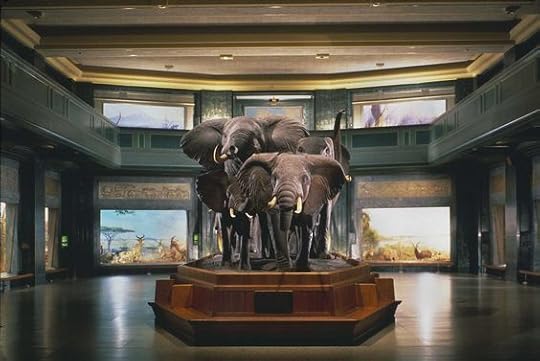
Three and a half stars, rounded up because it had dioramas and the Smithsonian in it. My favorite museum growing up in New York was the Metropolitan Museum of Natural History with its amazing dioramas.
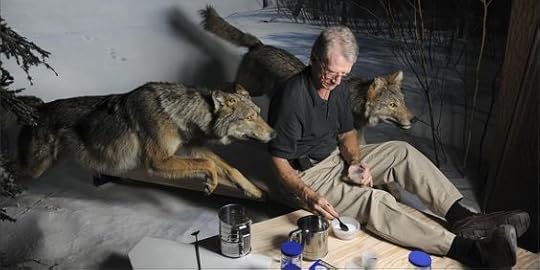
Here a MMNH curator touches up the all-time best hunting wolf diorama.
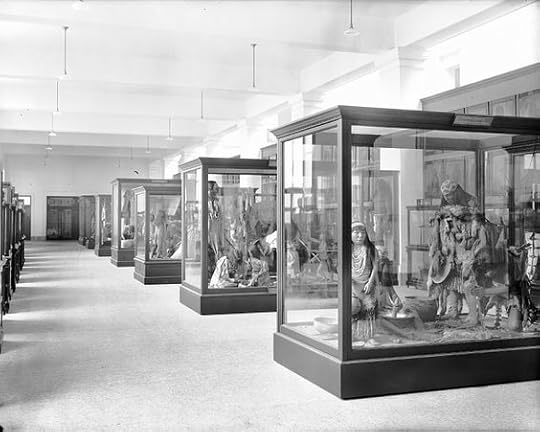
Until reading Tony Hillerman's Talking God I did not realize that the Smithsonian once had dioramas of Native American life. These Victorian installations came to be frowned on as disrespectful and have been removed but they must have been quite something to see and one such diorama figures in a dramatic scene with Tribal Police Officer Jim Chee and Lt. Joe Leaphorn.
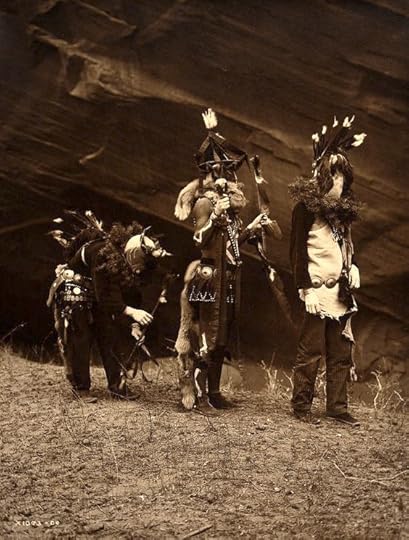
Museum politics and controversies surrounding Native American studies was part of the twisty plot. So was Yeibachai, the great Talking God of the Navajo night chant. These are photographs of the Night ceremony taken by Edward Curtis in 1904. I think the figure on the far right is wearing the Talking God mask.
Another part of the Yeibachai ceremony (it goes on all night).
It is all fascinating and I'm growing quite fond of both Chee and Leaphorn.
Tony Hillerman fans will find Talking God a curious detour in the Leaphorn/Chee series—familiar in character, but geographically adventurous. In this installment, Hillerman carries his Navajo detectives out of the Southwest and into Washington, D.C., embroiling them in a cross-continental mystery involving smashed graves, political intrigue, and a ceremonial mask whose very name hints at mythology and power.
On the positive side: Leaphorn and Chee stay recognizable and true to form. Leaphorn’s quiet, methodical wisdom and Chee’s emotional undertow (especially in matters of the heart) resonate just as in earlier books. His relationship with Mary Landon again underscores the tension between his cultural identity and romantic aspirations. The “classic Hillerman” voice—the atmospheric pacing, the cultural framing, the reflective interludes—remains intact, even when transplanted into urban corridors.
Yet the book is not without its bumps. One of the more frequent criticisms (and one I share) is that the plot sometimes leans on coincidence and contrivance to tie disparate threads together. Kirkus, for instance, notes that Hillerman “heaped-up coincidences” make the narrative less razor-tight than his stronger works. Publishers Weekly called it “somewhat contrived” even while calling it “wonderfully readable.”
The novel’s ambition is to fuse themes of diaspora, identity, and artifact repatriation—but the bridge it builds feels shaky. Why should Leaphorn and Chee be invested in the machinations of exiled radicals and museum politics in D.C.? The narrative presses them into those roles via artifacts and ancestral claims, but the emotional and jurisdictional stakes never quite land. The “why them” question lingers.
Still, Talking God offers something the earlier volumes don’t in a “typical” Hillerman novel: displacement. The detectives are away from their high desert terrains (canyons, mesas, reservation roads) and confronted with a different terrain altogether—museums, shadowy corridors, the urban grid. That novelty gives the book staying power: I often found myself picturing the contrast between the Navajo world and the Washington backdrop. Even if the leap from Southwest to capital feels a bit forced, it’s memorable.
In short: Talking God is a fun read, not Hillerman at his absolute peak, but definitely worth reading if you want to see his characters pushed beyond their comfort zones. It’s particularly interesting in the series for how it challenges place, culture, and plot boundaries—even if it occasionally stumbles over them.
Separate investigations lead Leaphorn and Chee to Washington D.C. and a deadly conspiracy. Another fine mystery from Hillerman. It’s nice to see them out of their element and working in the nation’s capital.
This is a unique mystery in that the voices of the different characters are all brought to life so well. In some mystery books the author is so focused on the mystery that they forget to add that touch of personality to their characters, and voice really is a defining part of a character when you are reading. There are few things more rewarding then reading a good mystery novel and part of being able to do this is keeping characters separate in your mind. The best way to do this if you have a good author is to find something that defines that character to associate with them when reading. In this case the author has given each character such a defined individualized voice that it is easy to distinguish one from another simply from the way that they "speak".
In this book the author pays attention to not only the voice of the main character, but also the supporting characters as well. There are passages that illustrate and remind the reader that the main character is a Navajo and that means that there is a specific manner of talking and vocabulary that goes along with having that ancestry. One of the ways the author does this is through use of Navajo vocabulary. Words such as "bellagaana" which means someone other than Navajo, Hopi, or another Native American group, and "yeibichai" which is a specific ceremony help to reinforce that the character is likely not of the same race as the reader. There was never any doubt as to the meanings of the Navajo words since the author took the time to either explain it explicitly or to build in the context clues around the word to ensure understanding. Then there are the passages that illustrate how much attention to detail the author has in terms of the supporting characters. To put as much effort into the manner of speech of a supporting character just to ensure that the reader understands that the character is lower class, and uneducated as well as Caucasian shows what lengths the author will go to in order to ensure that each character has a separate voice- a separate identity.
What I could use this book for would be to take passages where the main character is speaking or thinking in Navajo. This would help show my students that when they are writing if they want to include another language in their text they most certainly can, and when they do, it normally creates and individuality that is singular to that character alone. Each student is an individual and so should their writing be. The more ways I can teach them to make it their own the more investment they will have in their writings.
One of the marks of great writing is being able to create a villain who doesn't see him/herself as a villain. And in Leroy Fleck, Hillerman has done that. Fleck loves his mother and will do anything for her, living by the code that she instilled in him. Which might be commendable, except it's a code mired in racism, paranoia, and illegal activity.
What takes Fleck to an even further level as a character is the last scene between him and his mama. It's a moment in which Fleck might realize everything he's believed has been a lie, but rather than face that, he goes another way, doubling down on his own understanding of an honor code.
He's a completely distasteful character and Hillerman doesn't flinch from making him so - yet in a way where Fleck believes he's in his rights to do what he does.
Joe Leaphorn is called out to look at corpse found near railroad. The question who he is and how it place aroused he curiosity. The answer takes him to Washington, DC. Jim Chee has an arrest warrant Henry Nighthawk. He learns that Nighthawk will be at an Yeibichai (Talking God). Jim arrest Henry who is immediately bailed out. Jim Chee has vacation coming and goes the nation capitol. He meets Joe Leaphorn there and cases are brought together skillfully. The ending is unusual. The data on the Navajo culture is informative.
Εξίσου καλό με το Ο κλέφτης του χρόνου, ο Ομιλών Θεός μπλέκει στα πόδια του Πινοσέτ, κάνοντας ανατριχιαστική χρήση μιας ανατριχιαστικής χουντικής -ου μην αλλά και όλων των υπολοίπων απολυταρχικών καθεστώτων- συνήθειας: των βασανιστηρίων.
Οι χαρακτήρες εξακολουθούν να είναι ενδιαφέροντες και καλογραμμένοι και τα διλήμματά τους αληθινά. Ένα ξεκούραστο, αν και όχι και τόσο ελαφρύ ανάγνωσμα.
This is not one of my favorites of the series. Other than Leaphorn & Chee, I didn't really care about the others characters. The mystery didn't grab me and I felt it drug in many places. I found myself more worried about the appropriate care of Fleck's mother than anything else!
During the first chapter, I could almost hear Hillerman chortling,as he writes about an academic receiving the bones of her grandparents n her office. This used to be a popular scenario during the 1990's.
From there, we get normal Leaphorn book, although this is the one where he really starts working with Chee.
Maybe I should take a break from the Hillermans for a while.
I like the way the author describes and incorporates the Native American customs and religious beliefs in these stories. I think I need to go back to the beginning of this series as I have been jumping around which may be confusing me in following the characters development. I liked the story, but for some reason it just isn't grabbing me.
It's been a few years since I've read (as audio) the first four in the series. I was quietly hoping someone would obtain the contract and produce the middle ones, but it never seemed to transpire. Maybe someday. And because it's been a few years, and I skipped a handful of books, the story line has moved forward a bit. That being said, it was easy enough to pick up the characters and plot and I didn't feel anything was lost in the story.
I really enjoy these mysteries. These are not "action" or "thriller" mysteries, but contemplative who-did-it books. I find the pacing about perfect - the plot just rolls out much like a newly paved road and because the ride (story) is so enjoyable, you're just pulled along. The little twists and turns keep the story line engaging, the characters have a surprising amount of depth without getting bogged down in details, and the mystery in this instance was a matter of watching Leaphorn and Chee figure it out because the reader knows all along.
If you enjoyed previous books in this series, you'll probably enjoy this one. I will note, there was a change in narrators, and I enjoyed both. Recommended.
This wasn’t my favorite book in the series because of the portrayal of the main villain. He used the N word more than once. There were sections of the story that just fell off. Those sections are outdated for contemporary reading.
Another entertaining procedural by Tony Hillerman. In Talking God, the author weaves a story in which political terrorism, a quest for personal revenge, and a battle against institutional racism converge in an explosive climax. And of course, the book features Hillerman's signature exploration of traditional Navajo spiritualism.
I promised myself after I retired that I would go back and reread all of the Joe Leaphorn/Jim Chee novels in the order that they were written. This book starts out indicating that Leaphorn and Chee are working on separate cases, but are in fact the same one. They both end up in Washington, D.C. as a result of the case. It involves a mask for Talking God.
Hillerman's books are getting better. Sometimes he loses me in the story, but I think a lot of that is because I am listening to them on audiobooks. The narrator changes from book to book. Hillerman even reads a few of them himself.
Hillerman is great with Jim and Joe, but his bad guys are at best sketchy and at worst, caricatures—especially the killer in this one. But the Westerner-in-DC humor is quite pleasant, and I like the Smithsonian setting. Almost a Hitchcock movie.
άλλο ένα πρωτότυπο αστυνομικό με ινδιάνους.... καλή ιστορία... όχι τόσο δυνατή η πλοκή και η λύση όπως ήταν στο άλλο που έχει μεταφραστεί.... αν το βρείτε μην το χάσετε
I wouldn't ague against a 3 star rating; my 4 stars is because I just enjoyed it.
Hillerman writes with a subtle non-pretentious intelligent style. I recommend this especially to those who condescendingly place the pre-Columbian peoples of North America in a culture of special protection (and exploitation).
At the request of the local FBI, Lieutenant Joe Leaphorn ponders how an unidentified body ended up near the reservation with no footprints nearby. Tribal police officer Jim Chee arrests a wanted bone thief, Henry Highhawk, at a tribal ceremony. Both Leaphorn and Chee end up in Washington on parallel investigations during their vacations. The two cases are tied together but how and why? And who is behind both? Then you have a private assassin who is a mama's boy thrown in.
I enjoyed the story. The plot kept me turning the pages. The cultural background of the Navajo was fascinating, and the characters were unique. I hope to read more of Hillerman's books.
Somehow Leaphorn and Chee both wind up in Washington DC trying to solve a mysterious murder. If you can imagine to indians taking on DC, then you can believe anything. And they manage to do this on their vacation time, since no one seems much interested in solving it. Anyway this was a fun read. Maybe the indians ought to take on more issues with DC. We might be better off.
We have both Joe Leaphorn, now retired, and Jim Chee in this book which takes them away to Washington, DC. Naturally, there is a murder, and a fair amount about Navaho fetishes of gods--rather fascinating. One bad guy makes a representation of Talking God. He is a white man who wants to become a Navaho--gets killed. Both women in Chee's life show up
A nice little read with good characters but most of the story took place in Washington D.C. rather than the wonderful tribal lands of the Southwest, which are settings that have a character of their own. Missed them. Still worth the time.
I had not read Talking God, Tony Hillerman’s ninth murder mystery involving the Navajo Tribal Police, previously. It was engaging and satisfying for all the reasons I’ve noted about the previous eight: Hillerman’s writing style, character development, cultural insights, etc.
I also enjoyed this story because it deftly shared the investigations of Lieutenant Leaphorn and Officer Chee as they independently approached aspects of the same crime. Two different paths to the same brush pile, as Leaphorn described it.
Finally, I enjoyed the poke at anthropologists and museums that have no qualms about searching for graves of indigenous humans to take skeletons for study (or hoarding in storerooms), but disturbing more recent graves of non-indigenous people requires court orders or is prohibited outright. Surely, it’s not about race… or delusional ethnic superiority… just sayin’. Hillerman explores and shatters that hypocrisy in this story, adding to my enjoyment of it.
Loved this book. Chee & Leaphorn both - independently and without knowledge of the other - go to Washington DC on their vacation time, to chase up aspects of what turns out to be the same case.
It’s almost funny reading how each is there and who they’re following. And, the character of Fleck, with his soft spot for his cantankerous mama, is well-written, too.
It takes a while for them to find each other, and the murderer - as well as the upcoming murders - and to work together. And, Janet Pete and Mary Landon play havoc with Jim, while the late Emma is still on Joe’s mind.
The ending - they’re still very separate - is also very good.
I found it interesting for the information about the Smithsonian Museum. I also found the psychology of how crime goes from one generation to the next rather interesting. The mystery itself was confusing as was the resolution. In many ways the criminal was the most interesting person this time. I’m hoping Chee has finally moved on the Janet and forgets Mary. I still find Chee irritating. Leaphorn is still the better detective although Chee is improving. I’ll read the next one but I really hope the series gets better.