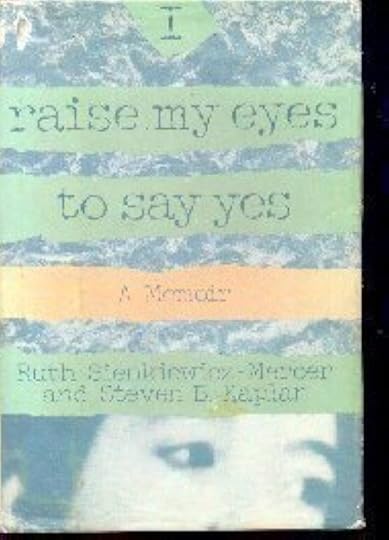
Ruth Sienkiewicz-Mercer was born in 1950. She has never spoken a word; never walked, never fed herself, never combed her own hair. Trapped in a body that is functionally useless, her mind works perfectly. This is her story. Absorbing and heartbreaking, it was written with the collaboration of Ruth's friend, Steven Kaplan. Without any self pity Ruth recounts her early childhood with a loving family and some happy years at a rehabilitation center, then virtual incarceration at the notorious Belchertown State School in Massachusetts. After 16 years she was released and now she enjoys a life of purpose and personal triumph. I Raise My Eyes to Say Yes will permanently alter your perception of the severely disabled and it will inspire you with the extraordinary power of love, thought, and the human spirit.
I ordered this book after it was cited in the 2019 book Forget They Were Ever Born: A Memoir, and I found it to be the perfect companion read.
When in college in the early 70s I went on a field trip to the Lincoln State School in Lincoln, Illinois as part of my special education teacher ed. program, leading up to my career as a special ed. teacher. If I hadn’t seen some of the actual practices Ruth speaks of in this book, I might find some things to be unbelievable. They most certainly are unforgivable.
There are YouTube videos about the Belchertown State School which are worth watching.
It’s truly amazing to see how far we’ve come in both our treatment of people with disabilities and the way communication as a whole has evolved. There’s still so much work to do, but hearing Ruth’s story made me proud to be a school-based PT. It broke my heart to hear about her physical decline and how terrible wheelchairs used to be.
I got to see what it is really like to live life with a terribly severe disability, namely to be capable of only very limited movement and to be incapable of speaking. Many people treated her like an imbecile. She had to keep striving and to be extremely patient with what life had dealt her. She had to deal emotionally with the frustrations which were mountainous. Many thought of her and treated her like she was just a mindless bag of bones. She had to search for those who recognized her as a person and not just a lump that had to be kept alive by being fed and cleaned. It was a painful existence, but somehow she kept up hope and avoided giving up and managed to make a decent life for herself. The book taught me a most valuable lesson on finding meaning in life, no matter what the circumstances.
This book is truly inspiring. Working with preschoolers with a variety of special needs a lot of times you wonder whether or not you are actually teaching them anything and then they'll start doing something and you know they're getting it. It might not always be easy or a quick process but I've really enjoyed it. Now I can look to Ruth for inspiration in those moments. I'm so glad a co-worker recommended this to me. It's those small moments when a student finally gets something that truly make the day magical.
Five stars. One of my favorite books, and one I read for the second time this year with renewed appreciation — and renewed anger at the political moment we are living in.
A Personal Connection
I began my career in human services in Northampton, Massachusetts — the city where Ruth Sienkiewicz-Mercer was born in 1950. I have worked with many people who were residents of the Belchertown State School, along with a few of the well-meaning people who worked there. I met Ruth's husband Norman once, years after her death in 1998; he had cerebral palsy himself and was beloved by the caregivers who worked with him for decades. Norman died in 2010. I was inspired to reread this book by Samuel Beckett's novel The Unnamable, in which a narrator without the ability to move or speak serves as a literary and philosophical device. Ruth was quite literally unable to do these things. Reading Beckett sent me straight back to her.
What the Book Is — And What It Isn't
I Raise My Eyes to Say Yes is one of the most remarkable acts of collaborative storytelling I have ever encountered. Ruth Sienkiewicz-Mercer was born in 1950 and has never spoken a word, never written or typed a sentence. She has had little formal education and reads, at best, at a first-grade level, recognizing only simple words placed before her in a familiar context. She is a quadriplegic, a victim of cerebral palsy, confined to a wheelchair or a bed for every waking hour of her life.
Steven B. Kaplan, her co-author, describes the book's genesis in his preface with characteristic honesty: "This book tells the life story of Ruth Sienkiewicz-Mercer, as recounted by her. It is her autobiography, written with my assistance." Ruth began work on the project in 1976 while still a resident of the Belchertown State School. Kaplan began helping her in 1979 and estimates that he spent 2,000 hours with her collecting her story — hours spent talking with her, being talked to by her, watching her interact with others, asking endless questions, and transcribing her answers through the elaborate word-board system she and her caregivers had developed over years. This does not include the time he spent typing, revising, and rereading drafts back to her for correction. All this for a slender book of 225 pages. I Raise My Eyes to Say Yes was completed in 1988 and published in 1989.
The genre question is genuinely complicated. Ruth could not generate words, type sentences, or spell with any reliability. Kaplan was explicit that "most of the words were not generated by Ruth; she neither spoke them nor transmitted them directly from her creative mind to the written page. But the thoughts and emotions, the impressions and observations expressed by these words, are Ruth's alone." He tested her relentlessly — asking the same questions twice on different days to see if her answers were consistent, watching her eyes to gauge whether his written renderings captured what she had meant. "This was her story all the way, and she made sure that I got it right."
The book is, in the most fundamental sense, pure poetry. Kaplan's description is apt: by necessity, Ruth speaks symbolically. Her every verbal utterance engages language at its most compressed, essential, yet suggestive level. The chapter titles alone tell you this — the word-board fragments that head each section: ".NUMBER.4774." for her arrival at Belchertown, ".GO.AWAY.BSS." for the chapter about finally leaving, ".LINDEN TOWERS." for the beginning of her life in the community. These are not literary devices. They are what Ruth actually said.
The Three-Act Life
I was struck, rereading this book, by how naturally Ruth's story conforms to the three-act structure — exposition, conflict, and resolution — that underlies most Western storytelling. While this structure is often disparaged by literary writers as formulaic, I find it is often simply how stories unfold, because it reflects the shape of human experience. Our lives, too, can be viewed from this perspective.
Chapters one through three constitute Act One: Ruth's early childhood, her family, her interpersonal relationships, her time at better-funded facilities like Crotched Mountain, and the circumstances that led to her placement at Belchertown. These chapters are essential. Without them, without the full picture of Ruth as a person — curious, funny, emotionally rich, passionately interested in the people around her — the Belchertown section becomes merely horrifying. With them, it becomes something harder to look away from: the systematic destruction of a specific, irreplaceable human being by a system that had decided she was not fully a person.
Act Two, the bulk of the narrative, covers sixteen years at Belchertown State School. It is appropriately the longest section. Act Three — chapters nine and the afterword — describes Ruth's life after leaving the institution, her advocacy work, and her marriage to Norman Mercer, who had his own cerebral palsy and his own decades at Belchertown. The book ends with the announcement, in 1989, that Belchertown State School would be closed by 1993.
Belchertown State School: Institutional Entropy
The Belchertown State School was founded with genuine reformist intentions. In its early decades it was considered a progressive facility. Over time — through neglect, overcrowding, underfunding, and the systemic problem that its residents had no voice with which to advocate for themselves — it became something monstrous. I have also read Belchertown State School by Katherine Anderson (Images of America series) and The Girls and Boys of Belchertown: A Social History of the Belchertown State School for the Feeble-Minded by Robert N. Hornick, and the arc is depressingly familiar: good intentions, inadequate resources, the slow accumulation of institutional entropy, and the inevitable exposure.
Ruth's description of her arrival in 1962 is among the most harrowing passages in the book. She was twelve years old. The intake physician — described as "the only physician on duty to service the entire population of 1600 residents" — labeled her an imbecile without meaningful evaluation. She was put in diapers, confined to a flat position in bed, and fed on her back through a method that required her to be crying so food could be shoved down her throat. Her leg braces, which she had worked for years to be able to use, were put in storage because the attendants "couldn't figure out how to work them." A note in her records explained they were "too small." By the time her mother saw her in a swimsuit that summer, the bathing suit that had fit snugly the previous year now "hung on me like a sack."
She arrived weighing almost forty pounds. Within months she was down to thirty. It was not a medical emergency. It was institutional indifference.
She was in solitary confinement during her first week — standard procedure to prevent the spread of illness among new residents — and in many ways she remained in a kind of solitary confinement throughout her years there. Flat on her back, often unable to see staff or other residents directly, she preserved her sanity through memory, imagination, and careful observation of everything around her:
"I retreated into a state of self-induced numbness, occupying my mind with recollections of the past and dreams of the future."
The soundscape of Ward 4 has stayed with me since my first reading: a woman who repeated "I am called Dad, I am called Dad" all day long, her words bouncing around the ward in a chain of echolalia from residents who could only repeat what they had heard. Ruth's description of this has a cinematic quality — she was observing and cataloguing everything around her with a mind that had nothing else to do.
Being Heard
The book's emotional center is the gradual process by which Ruth was recognized as a person. It began, as it so often does, with laughter. One afternoon in 1965 — three years into her time at Belchertown — two attendants were making jokes at a supervisor's expense, not expecting Ruth to understand. She laughed. They were astonished. She gestured furiously to confirm: yes, she had understood. "Once Alice and Wessie discovered that I appreciated adult humor, they started to direct comments to me instead of talking about me."
This small recognition cascaded slowly into others. The word boards. The communication technology developed with Howard Shane, whose "crude" 1971 device was, she notes, revolutionary — a light-bulb-and-wood construction that shared its basic premise with the state-of-the-art electronic devices she used in later years. The involvement of advocates. The friendship with Norman Mercer, who would become her husband. And eventually, Steve Kaplan, who spent 2,000 hours communicating with a woman the institution had written off as an imbecile, and discovered a genius.
There is a remarkable aside in Chapter 7: a young man named John Kerry, a part-time nurse at the Infirmary while attending college, showed unusual sensitivity when delivering the news of her grandmother's death. "I was extremely pleased years later when this man, John Kerry, was elected the junior senator from Massachusetts." She was not wrong to note the historic significance.
Disability and Full Personhood
Ruth speaks openly about her sexuality — her erotic dreams about a nonhandicapped man, her eventual recognition that no nonhandicapped man would be sexually attracted to her, and finally the active and fulfilling sexual relationship she and Norman enjoyed in their marriage. This is important. There is a tendency — well-intentioned and harmful — to desexualize people with severe disabilities, to treat them as children regardless of their age, to assume that their physical limitations extend to their inner lives.
Ruth's account insists on the full complexity of her humanity: her anger at her father for placing her at Belchertown (and her eventual, hard-won understanding of why he did it), her humor, her observations about the people around her, her aesthetic sense, her erotic life, her ambitions, her friendships. She was not simply a victim of cerebral palsy and institutional entropy. She was a heroic figure who rose above her circumstances to enact genuine social change — the Ricci v. Okin lawsuit that she participated in was a landmark in disability rights law in Massachusetts.
The Political Moment — 2026
The Trump administration has spoken about returning to the "good old days" when large institutions like Belchertown State School were the norm for keeping disabled and mentally ill people away from the general community. At the same time, the administration has enacted sweeping cuts to the programs that make community living possible for people with disabilities.
Secretary Kennedy laid off nearly half the staff at the Administration for Community Living in April 2025, which helps fund protection and advocacy agencies, independent living services, and disability research. The administration's 2026 budget proposal calls for cuts of nearly $20.5 billion from the National Institutes of Health — about 40 percent of its current budget — along with approximately $3.6 billion from the Centers for Disease Control and Prevention and $1.1 billion from the Substance Abuse and Mental Health Services Administration.
Disability rights advocates have warned that Medicaid cuts put people with disabilities at particular risk. "When Medicaid is cut, people with disabilities are at the center of the impact," said Barbara Merrill, CEO of the American Network of Community Outcomes and Resources. More than 600,000 Americans were already on waiting lists for community-based waiver services in 2025 — the programs that allow people with disabilities to live in the community rather than in institutions.
The administration has also reportedly prepared regulations that could reduce the share of applicants who qualify for Social Security Disability Insurance by up to 20 percent — what the Center on Budget and Policy Priorities has described as potentially the largest cut in SSDI history. In fiscal year 2023, 30,000 people died while awaiting disability decisions; the administration's DOGE-driven staff cuts at the Social Security Administration have made those waits longer, not shorter.
This is not returning to the "good old days." This is recreating the conditions that produced Belchertown State School — without the funding to run the institutions humanely, and without the political will to listen to the people who would be warehoused in them. Ruth's book is the answer to what happens when those conditions obtain. It took her twelve years and Steve Kaplan's 2,000 hours of patient listening to produce a 225-page book that tells us exactly what it looks like from the inside.
Verdict
Five stars. I Raise My Eyes to Say Yes is a necessary book. It is the story of what happens when a society decides that certain people are not worth listening to — and of what it costs to reverse that decision, one hour at a time. Reading it in 2026 feels less like historical reflection and more like a warning.
Sienkiewicz-Mercer, R., & Kaplan, S. B. (1989). I raise my eyes to say yes: A memoir. Houghton Mifflin Company.
Sienkiewicz-Mercer, R., & Kaplan, S. B. (2019). I raise my eyes to say yes: A memoir [eBook]. https://www.amazon.com/Raise-My-Eyes-... (Original work published 1989)
Center on Budget and Policy Priorities. (2026, March 24). Trump administration plans deep cuts to Social Security Disability Insurance. https://www.cbpp.org/blog/trump-admin...
Title:I Raise My Eyes to Say Yes: A Memoir Author(s): Ruth Sienkiewicz-Mercer (1950–1998), Steven B. Kaplan, Richard Todd (Editor) Year: 1989 Genre: Nonfiction — Memoir/Biography Page count: 233 pages Date(s) read: 8/21/26–8/24/26 Book 169 in 2026
Finally found this book. It's a good memoir by a woman with severe cerebral palsy who spent much of her early life living at the Belchertown State School. I attended third and fourth grade in two dormitory buildings there starting just months after the institution closed. Ruth's father decided to have her institutionalized there after he couldn't get her into better programs for children with disabilities because of the high cost. While her body is quite disabled and she communicates using her eyes and facial movements, her brain is normal, which causes her a lot of frustration because the people around her, including health care professionals, typically assume she is cognitively disabled and/or can't hear or understand then. I was surprised by her description of the State School, which she described as a custodial care facility that was largely neglectful of residents (though it seems like there was improvement in the 1970s). I've mostly heard about the horrible physical and sexual abuse that happened there, but there was none of that in the book. I wonder if she actually didn't experience or witness any, or if she just chose not to share. It was interesting for me to see my friend's ex-boyfriend's father make an appearance (he was one of Ruth's friends from the State School), and I was also interested to learn that John Kerry was supposedly a nurse there (? though I was searching online and found nothing about him being a nurse, much less working in Belchertown). Since I grew up in the area, I also just liked reading about places I knew well, like Rooster's in Amherst. This was a good and easy read, and gives the reader an appreciation for the indignities and discrimination that people with disabilities often are subject to in daily life as a result of society's devaluation of them.
Aangrijpend waargebeurd verhaal over een vrouw die als baby een hersenverlamming krijgt en daardoor aan beide armen en benen verlamd is, en niet kan praten. Door middel van gezichtsuitdrukkingen kan ze ja, nee en misschien zeggen. Later leert ze met ‘woordborden’ volledige gesprekken voeren en haar levensverhaal vertellen. Schrijnend en wraakroepend zijn de toestanden en behandelingen die ze in diverse instituten moet ondergaan; ze wordt lang als zwaar geestelijk gehandicapt beschouwd (terwijl ze dat totaal niet is) en ook als dusdanig behandeld. Onvoorstelbaar bewonderenswaardig is haar moed, kracht (zowel fysiek als mentaal) en positivisme waarmee ze zich al die jaren staande weet te houden.
This was a good read for people who are interested in communication disorders or disabilities. It's an older book, so some of the language is the opposite of neurodiversity-affirming. Still, it's a good testament to presuming competence.
I found the process of how the memoir was written to be fascinating. Sienkiewicz-Mercer would use her device to spell a few words, then Kaplan would ask clarifying questions (presumably mostly yes-no) until he felt he understood the full extent of what she was trying to say. He would then write up the memory, read it back to her for approval, and make edits where she indicated. A few years later, the whole book was finished.
Absolute horrific first-hand account from a young woman who was institutionalized for her disability in the 50s and 60s.
Ruth's story is so important, and this should be required reading for anyone making policy changes that impact the disability community. It's so important to listen and learn from those who don't use speech to communicate.
An amazing book about the life and struggles of a disabled girl, living through real horrors of being in an asylum in the 60s and 70s. Definitely recommend it to everybody. An inspiring story about how Ruth, a child with CP didn’t let anything get in her way of being independent and leaving the asylum. A book that will change your perspective of the disabled community.
This was so cool to read an actual biography by a mute paraplegic. It was completely eye opening to hear about the mistreatment that happened in state school hospital in a town that I used to work in.
I've loved this book since reading it as a teen. I have recommended it to so many people. It is a great way to get a glimpse into a world often hidden to so many.
I wanted to give this book 3 stars because I thought that it dragged a bit and in terms of a pleasurable read, it fell somewhere in the middle for me. That being said, Ruth was in an intense situation that dragged for HER at times. I can't imagine the boredom that she suffered! So I am elevating my rating to 4 stars because I think this is an important book to pick up and read. Ruth acquired cerebral palsy at a young age and thereafter experienced extremely limited mobility in additional to being nonverbal. She was placed in a state institution since her family felt that they could not take care of her at home. She was deemed severely intellectually disabled by doctors around her and was given horrific "care" at the institution, where she was surrounded by other people with many kinds of severe impairments - intellectual, physical, emotional, and social. Eventually, others realize that she is intelligent and that they have not been seeing her attempts to communicate, and she slowly begins a journey through various techniques of communication. I read some reviews of this book that have said things like: "Those were different times." However, many people are still treated in these ways when they are unable to communicate in typical ways. As an SLP, this is an important book to see the power in communication, and how even simple/low-tech solutions can improve life greatly for nonverbal individuals.
I was intrigued by the title and connected with this story in a lot of ways. Ruth was a quadriplegic and had cerebral palsy so she relied on people every day of her life to help her accomplish ordinary tasks. She wrote this book by moving her eyes to answer yes or no questions. She also had word boards. It is crazy what she lived through...being put in a state hospital, etc... A lot of things have changed since then.
The memoir of a woman who lived in institutions most of her life, treated as if she were mentally retarded because of CP that kept her from communicating freely. Tells how she finally managed to get across to someone that she is mentally normal, and how she went from there to building a life with some dignity and freedom. The kind of story that wouldn't be believable if it were a novel. This is how real people live every day.
A book that everyone should read, an eye opener that is inspirational and heartbreaking. This book sheds a light on a topic that some people will want to shy away from, this book doesn't shy away from the truth, it is as tragic as it is beautiful. A wonderful book that deals with the harshness of the topic in a poetic and passionate way. Ruth is a true inspiration, everyone should read this book.
I found this book very inspiring.Ruths strength and perseverance is amazing.Being a caregiver for those who have no communication and one who raises his eyes to say yes I felt it was an important and revealing read.I am glad I can care for truly special people in a good home environment.I hope that having read this book I can do even better in interacting with these wonderful people.
Wow what a powerful book. It shows how someone who is unable to communicate verbal and thought to have been severely disabled was just hidden inside a shell of a body that didn’t work. (if you are looking for this book it is EXTEREMLY hard to find as it is out of print, but I DO own a copy)
I read this when I was around 18ish. Its an autobiography written by a woman with cerebral palsy. Since I only read cheesy romances and fantasy novels at the time I have no idea why I picked it up. But it was really good and really interesting and I'm glad I read it.
Although the story was interesting and pretty much first hand, I found the voice to be almost annoying and the story to drag a little. Granted, the fact that it was written is in itself amazing, but I was left feeling rather underwhelmed. 2.5/5
A little boring, but an inspiring story of someone with severe physical and communication deficits that continues to live an inspiring life, despite a childhood spent in a poorly cared for instituation.
Read this book many years ago. I remember it made a big impression on me, but I can't make a proper review right now. I'll re-read it and give my opinion later.