Have you ever wondered if trees can communicate with each other? Well they can. Recently, scientists have discovered that forests communicate via underground networks of fungal threads knows as 'the wood wide web '.
In this picture book for young children , we meet a little fir tree sapling who is stretching her first leaves into a dark ancient forest full of huge trees. She feels very lonely and she can't reach any light or water. Her worried feeling sinks down to the tips of her roots, which little does she know, are connected to the wood wide web. The fungal network sends her message all over the forest! "little tree needs help!"
The message reaches mother trees who can't spare the energy from their own little ones, others who are sick and can't help but ultimately, one friendly paper birch tree helps her in her time of need. When the winter comes and birch tree needs help in return, the strong, not so little fir tree withe her evergreen leaves can come to the rescue. Our little tree learns that she is part of a loving, caring community , filled with family and kind strangers of entirely different species.
She learns all the ways that there are to care and be cared for, and most importantly that she is not alone. After all, the forest is only as strong as its smallest tree.
Trees can communicate using up to '50 words' and can send messages of distress, warn each other about incoming danger in the form of disease or pests, learn which trees are their parents and which are their offspring. If a tree is in danger, others can send spare sugars and water via the network and even sabotage trees they see as a threat. And they do it all via the wood wide web.
This is a powerful book, that teaches children about a hugely important discovery in contemporary science, about a secret world beneath our feet and most importantly, about the strength that comes with asking for help, and discovering that you are not alone.
In a Nutshell: A nice story highlighting how trees communicate through an underground network.
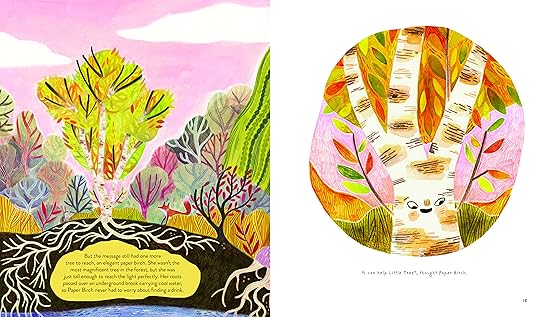
In an ancient forest, a little Douglas fir is trying to grow up but her progress is quite slow as she is surrounded by giant trees and gets little water. When the little tree’s sadness leaves through her roots, the underground fungal network that interconnects the roots of all the trees in the forest spread an SOS alert: ‘Little Tree needs help.’ A paper birch who grows next to a stream responds immediately, sending sugars through her roots to the Douglas fir, who benefits from this act of generosity. The little fir wants to repay the paper birch, and soon, she gets a chance to do so.
I had been aware of the mycorrhizal network connecting tree roots and fungi in a complex subterranean network of communication, thanks to Peter Wohlleben’s ‘The Hidden Life of Trees’. As such, the content of this book was no surprise to me. But I am sure kids will find this information mindboggling. The idea that trees can communicate with each other and even assist each other when needed can make us look at them in a whole new way. Such books are perfect in demonstrating how trees also have awareness.
There are plenty of things to recommend this book: 🌳 The lovely story about the two trees.
🌳 The scientific information about the Wood Wide Web presented in simple terms.
🌳 The message about helping those in need and also about being grateful for favours received and returning the favour when we can.
🌳 The detailed glossary that provides a simple meaning of all the difficult tree-related terms in the book.
🌳 The final note that highlights Professor Suzanne Simard’s discovery of the arboreal WWW.
Of course, the Wood Wide Web as demonstrated in this book is at a very simplistic level as it covers only the communicated need for help and not the other kinds of communication trees indulge in such as alerting each other about dangers. But it should serve the right reading group well, and in a way that they might get encouraged to explore more about tree talks.
The colour pencil illustrations are sweet and work well for the story, but a part of me found the effect of the illustrations quite subdued. I want more vibrant colours.
In short, little nature lovers are sure to find this book a delight. Definitely recommended to classrooms as it offers several learning opportunities. The target age group is 3-7 years.
4.25 stars
My thanks to Quarto Publishing Group and NetGalley for the DRC of “Little Tree and the Wood Wide Web”. This review is voluntary and contains my honest opinion about the book.
I received ARC of “Little Tree and the Wood Wide Web” from NetGalley and Quarto Publishing/Ivy Kids in exchange for an honest review.
This picture book, written by Lucy Brownridge and illustrated by Hannah Abbo, is really educational. The author based the idea for this book on Dr. Suzanne Simard’s discovery of the Wood Wide Web. As a Professor of Forest Ecology in Canada and author of “Finding the Mother Tree,” Simard discovered that mycorrhizal fungus in forests, and particularly among trees like the Douglas Fir and the Paper Birch, were able to communicate and share resources like sugar energy and water
Brownridge is able to communicate this very exciting (and also very difficult concept) to small children through the use of language that is easy for them to comprehend. Abbo did a fantastic job and was likewise able to convey important messages to children via her art. For example, when Little Tree (an immature Douglas Fir) needed both light and water, she sent out a distress signal through the fungi and the artist made this signal appear as tears.
The author and artist duo clearly show how interspecies cooperation helps forests to flourish. However, this story can also be used to inspire kids (and adults!) to help others in times of need. In addition to the text, the author did an excellent job of including a glossary and also an ‘Inspired by the True Story’ section at the end of the book so that young readers can learn more about the subject.
This well-written and beautifully illustrated picture book will likely find its way onto numerous library shelves and, hopefully, on the personal bookshelves of children around the world. I highly recommend this book to all children and especially to those kids who are highly inquisitive about the natural world.
Woo… another wonderful book from my favorite kiddo publishers. This one deals with how the trees in a forest are connected through their root system and communicate with each other. The trees share resources, support, and help each other all through their lives (which spans decades).
Here, we have a little Douglas fir struggling to grow in a dense forest. Without enough rainwater or sunlight, the little one has to make do with what it has. However, when it cries for help, the message is spread across the forest, and the paper birch sends help. Later, when the time comes, the little tree returns the favor.
The book explains the symbiotic relationship between different trees and other elements in nature (fungi, etc.) It presents the Wood Wide Web (fungal network) underneath the earth using a cute and inspiring story of talking trees. I love the presentation and the approach to the topic. I also love how the content is easy for kids to understand. The text is tiny but readable.
The illustrations are vibrant and bold. Personally, I love the sweeping shades and hues in multiple colors. The underground network looks really fab with a dark background. What I love the most is the expressions on the trees. Every tree has eyes, a nose, and a mouth (a simple line). So cute, right?
The book ends with a little glossary and more information about the Wood Wide Web. This is my favorite quote:
“A forest is only as strong as its smallest, little tree.”
To summarize, Little Tree and the Wood Wide Web is a wonderful book to teach children about the marvels of nature and help them better appreciate the lessons about co-existing with each other and helping one another. The way to safeguard the environment is to learn how to live with nature. Take but make sure you give back too!
This book is printed on planet-friendly recycled paper.
I received an ARC from NetGalley and Quarto Publishing Group – Ivy Kids Eco and am voluntarily leaving a review.
This is a really amazing children's book, which shows how trees communicate with each other and help each other through their network.
My daughter and I absolutely loved this book so much. I wish that all children in the world could read this book, as it is so wonderful, interesting and informative. I love trees, and I find it fascinating how they work and communicate with each other, helping each other through tough times like a real family. I highly recommend this book!
Many thanks to the author, publisher and NetGalley for a copy of this book.
This picture book is wonderful! It explains how the mycorrhizal network in the forest works suitable for little children through a kind story of a little fir tree. The illustrations are amazing and beautiful and cute but also accurate. I am familiar with the basic concept of how the wood wide web works but still tears welled up in my eyes all throughout the book thanks to the wonderful implementation of the theme.
I think this is a very important book and a perfect way to introduce children to one of the most wonderful phenomena of nature.
Thank you NetGalley and the publisher for providing the ARC.
A scientific expose on the Douglas Fir tree, revealing all about its stages from seedling to the tree. It tells of the first few years it struggles to survive and what constitutes its survival. An educative book that teaches kids all about trees and their survival.
We're all interconnected, even trees. Although I've actually read a few things on this topic, it was interested to see this idea being set forth for children in such an interesting, easy to understant way. I couldn't help glancing out my own window and wondering what my spruce and birch trees might be talking about, so to speak, as I sat all nice and cozy in my warm home. I know I shed a tear or two when storm damage took down one of my majestic spruce trees, so I pondered what messages it may have been sending to its fellow trees as it ended its life.
I won't try to explain how trees communicate and collaborate since the author, a professor of Forest Ecology in Canada, does such an excellent job making it understandable to all ages. Well, okay, maybe with adult assistance for younger readers but you get my drift. Bottom line, a tree-in-need puts out a call through the web. No, not the World Wide web. The Wood Wide Web. It's all rather fascinating, actually.
More importantly, while teaching how trees communicate and help each other, Brownridge subtly sends the message of the importance of human interaction and collaboration. It's even noted that when Little Tree was finally healthy and able, she returned the favor Paper Birch did for her. It's all told with lovely illustrations, with what I'd dub saturated colors, darker than I'm used to in most children's books, showing the world in what appears to be the depths of a forest as well as the intertwined roots, ie web below.
There should be ample learning moments inspired by the illustrations alone. How are the trees shown alike and different? What sounds might you hear in the forest? What animals might live there? What animals/things do you spy as you look at the pictures....and many more. Thanks #NetGalley and #QuartoPublishingGroup - #IvyKids for taking me for a walk in the forest. We really are never alone, a good thing to remember.
The author cleverly uses a sweet, fictionalized tale of a little, lonely fir tree sapling to introduce children to the concept of the Wood Wide Web, a way that trees can communicate, and even help one another through their root systems. It's a fascinating look at all the activity that is occurring under our feet, and a beautiful way to teach youngsters to appreciate nature. The artwork by Hannah Abbo is truly lovely, and really adds to the enjoyment of the text.
A perfect choice for libraries or your own bookshelf.
Many thanks to NetGalley and Quarto/Ivy Kids Eco for the read.
This unique picture book teaches kids about how trees communicate and pass nutrients to each other. Trees can "talk" through a fungal network that connects with their roots, and the fungus also gains nutrients through this symbiotic relationship. However, even though this book shares this STEM-focused information, it's also a fictional story, personifying the trees and writing about their feelings.
I expected this to be a nonfiction picture book, and I was somewhat surprised by the fictionalized approach and cutesy elements, but even though I thought this was kind of cheesy at times, it has a good message and shares a lot of great, little-known information, with even more facts in the author's note at the end.
I received a free copy from the publisher through Amazon Vine in exchange for an honest review.
I know this book is anthropomorphizing trees and that there's still a lot we don't know about the "Wood Wide Web," but, by golly, is it a cute book that teaches a bit about fungal networks, trees, and about sharing. I also love the fact that it's "inspired by a true story" because the two types of trees cast as our leads, a Douglas fir and a paper birch, do, in fact, often share resources.
... I may or may not have teared up while reading this while staffing a service desk in the library where I work. lol
I have to admit, although I overall did really like the book, I'm not a huge fan of the illustrations. They're fine, just not my fav.
This book is a bit wordy, but it may work alright for an upper elementary storytime.
I thought this illustrated book was a great follow-up read to "21 Things to Do With a Tree" by Jane Wilsher. It's an informative and educational piece about how trees communicate amongst themselves in their times of need, especially paper birch and Douglas fir trees. Kids can learn more about those close relationships between natural elements, like this underground fungal network aptly dubbed "Wood Wide Web". There's only one thing that I liked less, it was the visual design. The pictures are very cluttered with highly saturated colours, it's not a style that appeals to me much.
This picture book puts a fun perspective on how to care about others and how to be cared for. The little tree learns that when others help you that you grow and that you can also help others grow. The illustrations are fun and colorful for young children. Great read to help teach children how to love, care and how to be cared for. Thank you NetGalley, Quarto Publishing Group-Ivy Kids, and Lucy Brownridge for the ARC. I am leaving this review voluntarily and is my own opinion. #netgalley, #littletreeandthewoodwideweb, #quartopublishinggroup-ivykids, #lucybrownridge, #love, #care
A very quickly-read look at the 'wood wide web', the interconnected fungal entity that allows all the trees of the forest to spread messages and nutrition. The personification of the trees seemed too sappy (no pun intended), childlike and cloying for me, and I cannot really see this as the most vital subject for a cash-strapped school library – except for the obvious parallels about inclusion, charity and cooperation that it carries. But if you have the funds for a book on a subject that could be covered just as well by a single page elsewhere, this is not too bad.
Little tree is new to the forest, learning to grow to become big and strong. When little tree struggles to get sunlight she learns how the trees around her can help share their nutrients with her so that she can continue to grow big and strong! This picture book is really amazing at sharing just how the mycelium network, or fungi network underground other wise known as the wood wide web, helps trees to communicate between one another so that they can help each other in many different ways! I love that there are books about what we now know about trees and how interconnected living things really are. Such a wonderful book with beautiful illustrations too!
I would first like to say, the illustration is absolutely stunning. Little Tree and the Wood Wide Web is an informative and educational book that’s easy to digest for children. It’s so interesting to learn how trees communicate amongst themselves and other plants/moss in their network. It’s cute, resourceful, and a valuable tool for raising environmental awareness. This just charmed my nature loving self. I hope it finds it’s way into so many school libraries.
Little Tree and the Wood Wide Web is the real story of how trees communicate to each other and share resources through and underground network grown between them. It's the perfect read-aloud book to teach children about this concept of symbiotic relationships between trees. The story is well told, with artistic illustrations and sweet conversation bubbles. This is a perfect addition for any librarian or garden lover.
Thank you, NetGalley, for providing a review copy.
This was very very cute and I'm so happy that the author went with the Wood Wide web! The whole concept of it is incredible, and a childrens book based on that is exactly what I would read to my own kids. I found a few parts a little strangely worded, but that might just be on me as I don't usually read childrens books. Overall though, I would highly recommend this one to any parent out there wanting to explain and immerse their kids with forests and nature.
Thank you Edelweiss for an advanced copy; however, most of the illustrations were missing for me. I think the point of view of a tree sapling is interesting. I would use this story to accompany a science lesson. It’s a picture book, but the reading level and vocabulary would be a little advanced for some readers.
Wowza! Fascinating scientific facts delivered in a cute and relatable children's story. This is a great resource to teach children about the interconnectedness of trees. It is also a valuable tool for instilling environmental awareness in young readers.
Based on a true story, your young reader will learn about trees and how they work together and live. My daughter enjoyed reading this book as a middle elementary age. The author includes a glossary at the end to further help the reader learn.
This is a beautifully drawn book that combines cute characters with environmental lessons. My little nature lover enjoyed thinking about how trees are alive beyond what she already knew, thinking of them communicating was different for her.
This book was so cute and such a good story about helping others! There was also some fun tid bits about trees in the end. I also really enjoyed the illustrations in this one as well.
I love this true story about how trees come to each other's aid in need of water by using fungus underground through the wood wide web. Beautifully woven!
Little tree is new to the forest, learning to grow to become big and strong. When little tree struggles to get sunlight she learns how the trees around her can help share their nutrients with her so that she can continue to grow big and strong! This picture book is really amazing at sharing just how the mycelium network, or fungi network underground other wise known as the wood wide web, helps trees to communicate between one another so that they can help each other in many different ways! I love that there are books about what we now know about trees and how interconnected living things really are. Such a wonderful book with beautiful illustrations too!
Amazing! 🌲 The science in this is real and I'm just blown away! What an incredible discovery. Beautiful illustrations, beautiful story. Trees are magnificent 🌳..oh, and the fungi too! 🍄
*Temporary access e-copy received via Netgalley in exchange for an honest review.