

What do you think?
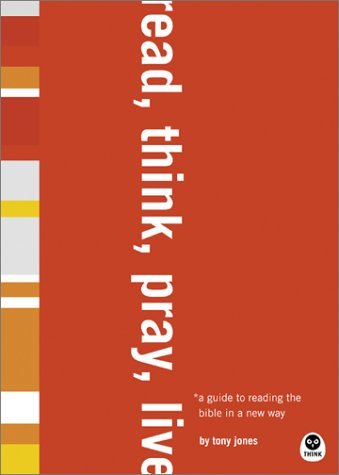
Read. Think. Pray. Live.
Explores the lectio divina method of meditation, Bible study, and prayer, explaining its steps and uses, and provides exercises in entering more deeply into God's presence through the lectio.
- GenresPrayer
128 pages, Paperback
First published July 1, 2003
About the author
Tony Jones
139 books115 followersTony Jones writes historical fiction set in the late Roman world, an age of frontier wars and palace intrigue. His debut trilogy traces the rise of a soldier's son — born to a concubine on the empire's margins — to Constantine the Great, drawn not as a saint or a symbol, but as a man: ambitious, ruthless, and human. He has three adult children, and he lives in Minnesota with his wife and two dogs.
Ratings & Reviews
Friends & Following
Create a free account to discover what your friends think of this book!
Community Reviews
Displaying 1 - 7 of 7 reviews

February 28, 2019
An easy read. Those who were raised in most protestant traditions will likely find this a helpful start for reading and praying the Bible in a deeper way. Those from traditions that never lost this practice will likely benefit more from seeking it out in their own tradition, rather than finding it here.
The criticisms are twofold: one is my personal preference, the other a serious issue.
On a personal level, I dislike the tone and style. It has the air of desperate novelty that so often plagued the protestant youth groups I grew up in. It is a bit too interested in seeming accessable that it sometimes strikes as inauthentic. There are also refrences to Eastern Orthodoxy that, while positive, are somewhat shallow. (I only mention this as someone currently engaged with the Eastern Orthodox Church, it stuck out to me as grating.)
The more serious issue is his choice of Bible translation. For every scripture quoted, he uses The Message. The Message is a paraphrase, and a rather liberal (in the technical use of the word) one at that. While I am not opposed to comparing and contrasting The Message with other versions, the idea that you should rely on a paraphrase for private devotion is ignorant at best, actively harmful at worst. Especially since the practice outlined in the book, Lectio Divina, relies so heavily on meditating on specific words. With The Message, you are reading the writers interpretation of the text, not the text itself.
The book is small, sitting at a bit over 100 pages, and can be effectively skimmed to get the core ideas. Its really those core concepts Reading, Meditating, Praying, and Contemplating that you will want, as the book itself is not as valuble as the concepts it contains.
The criticisms are twofold: one is my personal preference, the other a serious issue.
On a personal level, I dislike the tone and style. It has the air of desperate novelty that so often plagued the protestant youth groups I grew up in. It is a bit too interested in seeming accessable that it sometimes strikes as inauthentic. There are also refrences to Eastern Orthodoxy that, while positive, are somewhat shallow. (I only mention this as someone currently engaged with the Eastern Orthodox Church, it stuck out to me as grating.)
The more serious issue is his choice of Bible translation. For every scripture quoted, he uses The Message. The Message is a paraphrase, and a rather liberal (in the technical use of the word) one at that. While I am not opposed to comparing and contrasting The Message with other versions, the idea that you should rely on a paraphrase for private devotion is ignorant at best, actively harmful at worst. Especially since the practice outlined in the book, Lectio Divina, relies so heavily on meditating on specific words. With The Message, you are reading the writers interpretation of the text, not the text itself.
The book is small, sitting at a bit over 100 pages, and can be effectively skimmed to get the core ideas. Its really those core concepts Reading, Meditating, Praying, and Contemplating that you will want, as the book itself is not as valuble as the concepts it contains.

April 27, 2021
Read, Think, Pray, Live is an interesting little book. It's basically an introduction to lectio divina, or "Divine Reading". What this means in words that we use a bit more is the idea of reading, meditating, and praying using Scripture. It is the idea that the Bible is the living word of God and by praying and meditating on it we can as Christians use that to deepen our connection with God.
Now the good about this book is that I felt it was a fairly good introduction to the topic. While I haven't made lectio divina a staple of my spiritual life, it has been something I've done every once and awhile and have found the practice to be useful. This was the book that introduced me to the practice and for that I do like the book.
The book itself is a bit mixed. There are times where he tries to be a bit too prescriptive about what you need to do which turned me off at times (but there is also no law saying you have to follow everything he says either). He also comes across as trying to sell the latest fad for Christians to do, and how it was always so awesome and that his youth loved it and so on. That's cool, but it's also not what people are always going to respond with, that's just life. I'm not saying Jones is hyping it up too much, but I also tend to be a bit cautious of such presentations.
The most perplexing thing about this book is Jone's use of the Message. While I have no problems with the Message and do think that it can be useful for modern people to hear the Bible paraphrased in a relatable way, I would have liked him to even mention the idea of translations and why he chose the Message for his book. I think going with a strong translation would have been better than going with a paraphrase, at least without mentioning anything about Bible translations at all. Personally, I could see how doing it with different versions could be very interesting, but I think that should have been mentioned a bit more.
So yeah, I really liked the introduction to lectio divina and have enjoyed exploring it within my spiritual practices. The book is easy to read and very accessible, but can also rub you the wrong way. Even with this though I found this to be a useful book that opened up a new avenue of prayer and interaction with the Bible for me.
Now the good about this book is that I felt it was a fairly good introduction to the topic. While I haven't made lectio divina a staple of my spiritual life, it has been something I've done every once and awhile and have found the practice to be useful. This was the book that introduced me to the practice and for that I do like the book.
The book itself is a bit mixed. There are times where he tries to be a bit too prescriptive about what you need to do which turned me off at times (but there is also no law saying you have to follow everything he says either). He also comes across as trying to sell the latest fad for Christians to do, and how it was always so awesome and that his youth loved it and so on. That's cool, but it's also not what people are always going to respond with, that's just life. I'm not saying Jones is hyping it up too much, but I also tend to be a bit cautious of such presentations.
The most perplexing thing about this book is Jone's use of the Message. While I have no problems with the Message and do think that it can be useful for modern people to hear the Bible paraphrased in a relatable way, I would have liked him to even mention the idea of translations and why he chose the Message for his book. I think going with a strong translation would have been better than going with a paraphrase, at least without mentioning anything about Bible translations at all. Personally, I could see how doing it with different versions could be very interesting, but I think that should have been mentioned a bit more.
So yeah, I really liked the introduction to lectio divina and have enjoyed exploring it within my spiritual practices. The book is easy to read and very accessible, but can also rub you the wrong way. Even with this though I found this to be a useful book that opened up a new avenue of prayer and interaction with the Bible for me.
April 24, 2014
Second read of this book. We forget to pray the Bible. We forget and get lost in what we need or want or simply fussing to God about our lives. While there is nothing wrong in talking to God about these matters, we forget to pause, to listen, and to interact with Him. Sometimes we allow ourselves to forget to have a relationship with Him. Sometimes we fall into monologue and this book pulls you out of monologue and into conversation.

August 5, 2008
Awesome outlook on prayer,meditation, and Scripture. I never thought meditation was for me, but this book mapped out a way to start to meditate in a way to hear from God. Haven't tried the method yet, but this was definitely an easy read (written for high-schoolers I think) that was also thought-provoking.

October 15, 2007
great intro into lectio divina and for thinking of how to teach it to others
Read
February 19, 2016a good read

Read
January 2, 2018I loved this. A basic introduction to Lectio Divina. a great tool
Displaying 1 - 7 of 7 reviews