At the end of the sixteenth century the Japanese samurai set their sights on a new foe. Their target was China, their route through Korea. The Japanese were contemptuous of the Koreans; there would be no resistance, and a huge samurai army set off for Pusan in 1592, certain of easy victory. But the Koreans, who had known only peace for two hundred years, rose to the challenge, and there followed a devastating and terrible war. The Japanese advance to China was stalled, while Korea was occupied in an uneasy arrangement with the Japanese. A second Japanese invasion in 1597 unleashed new devastation, but ultimately the samurai warriors were defeated by the combined strength of the Korean and Chinese armies. It had been a time of unbelievable savagery. This book is the most complete account of those two invasions yet written, researched from forgotten archives in Japan, Korea and China, and written by the world's most acclaimed historian of the samurai, the English Oriental specialist Dr Stephen Turnbull. He links the overall history of the war with the experience of ordinary soldiers, as related in diaries and anecdotes, and recounts tales of noble combat and heroism, as well as cowardice and desertion, with technical information on the weapons and tactics of the day. Samurai Invasion is a book that all followers of samurai history will not be able to resist.
Stephen Richard Turnbull is British a historian specializing in eastern military history, especially the samurai of Japan. His books are mainly on Japanese and Mongolian subjects. He attended Cambridge University where he gained his first degree. He currently holds an MA in Theology, MA in Military History and a PhD from the University of Leeds where he is currently a lecturer in Far Eastern Religions. He has also written a number of books on other medieval topics. He is semi-retired but still holds the post of Visiting Professor of Japanese Studies at Akita International University in Japan.
Nota bene: I am combining my reviews of Kenneth M. Swope's A Dragon's Head and a Serpent's Tail: Ming China and the First Great East Asian War, 1592-1598 (2009) and Stephen Turnbull's Samurai Invasion: Japan's Korean War 1592 -1598 (2002) into one. If you've read the one review, then you've read the other.
As if the Japanese depredations on the Asian continent in the 1930's and 40's were not enough, not to mention their decades long colonization of Korea - complete with absolute suppression of the Korean language and culture - in place already before the formal annexation of Korea by the Japanese Empire in 1910, there was an even more brutal precedent.
From 1592 to 1598 the Japanese invaded the Korean peninsula under the command of Toyotomi Hideyoshi, the man who re-unified Japan after a long period of disintegration and civil war, in the largest scale conflict on Earth of the 16th century, involving some 300,000 Japanese and 160,000 Chinese soldiers as well as nearly every man, woman and child on the peninsula. After the first effort had been blunted, Hideyoshi sent in a second wave with the order Mow down everyone universally, without discriminating between young and old, men and women, clergy and the laity—high ranking soldiers on the battlefield, that goes without saying, but also the hill folk, down to the poorest and meanest—and send the heads to Japan. (*)
When the vanguard of the Japanese army disembarked from some 700 ships at Korea's principal port, Pusan, on May 23, 1592, and massacred both the garrison and the inhabitants,(**) Korea was just a convenient stepping stone to the goal Hideyoshi had in mind: replace the Ming dynasty as the hegemon of east Asia (he also had his eyes on India). And, at first, the Japanese samurai, hardened by centuries of internecine conflict, ripped through the hapless Korean armies (who had had two centuries of peace as preparation). The Korean army was completely untrained and poorly equipped, and the Korean generals were unspeakably incompetent. Soon the Korean king was cowering at his border with China and pleading with Emperor Wanli to save his bacon. Korea (actually, the Choson dynasty) was then a vassal of the Ming emperor; perhaps that would have been enough to move Wanli, but, in fact, Hideyoshi had had the temerity to write to Wanli informing him what he would soon be doing to the Chinese. Nonetheless, the Ming army did not enter the fray until January, 1593, except for one small band of 3,000 which foolishly attacked a superior force in a fortified position on August 22, 1592, and was ground to tiny pieces. But by the time the Chinese jumped in seriously, the samurai were already in trouble.
For the Korean people, despite the miserable state the lower classes were in (see below), almost immediately rose up against the cruelty of the Japanese in a kind of guerrilla warfare all across the country, led by local aristocrats and Buddhist priests. Surprisingly, the samurai had much more difficulty handling the maquis than they had dealing with the Choson military. The scattered remnants of the Korean army also began to coalesce under more competent officers.
On top of this, Admiral Yi Sun-sin (1545-1598) had built a so-called Turtle Ship - a low gunship covered with a wood and lacquer (sometimes even metal) deck/roof which offered the Japanese naval little in the way of target but which very effectively poured volleys of rather small cannonballs and massive, ten foot long, iron-tipped arrows into the normal sailing ships of the Japanese (the Japanese ships did not carry cannons - they relied upon clearing the enemy decks with volleys of arquebuses, which were completely ineffective for the Turtle Ships). The Turtle Ships were rigged with fairly small masts which could be dismounted during combat, the maneuvering then being managed by men handling oars extending from the hulls reminiscent of the ancient Mediterranean vessels of war. Even more reminiscent of those times: the Turtle Ships were rigged to ram the enemy vessels.
A miniaturized version of a Turtle Ship clearly showing the "turtle shell" protective covering, the access hatches and the spikes intended to dissuade enemy sailors from boarding the ship.
Admiral Yi's fleet and Turtle Ships (they had three by the time of the crucial engagement at Hansando) sank or drove off the Japanese fleet at every engagement, effectively cutting off the Japanese expeditionary force's means of reinforcement and resupply and forcing it to fight the Chinese and Koreans disadvantageously.
When the Chinese finally committed sizable units to the war, the Japanese were slowly dislodged from northern Korea. However, the samurai were fierce warriors, and every one of their defeats cost the Koreans and Chinese dearly. Nor was every engagement a Japanese defeat. So a truce was called in late Spring, 1593, leaving the Japanese in place in southern Korea, where they murdered and plundered the Korean Untermenschen to their heart's content, and farcical "peace" negotiations between the Chinese and Japanese were carried out for four years. The truce provided Hideyoshi time to build up another huge invasion force, which he let loose in 1597. This time Hideyoshi's goal was more modest: annex half of the peninsula and punish the Korean people.
More destruction and mayhem, more cowardice and courage, and a lot more death ensued. The passages from contemporary accounts translated by Turnbull are harrowing, for the Japanese were after revenge this time. As a Japanese Buddhist priest, Keinen, wrote upon seeing the immediate aftermath of the Japanese siege of Namwon: Whoever sees this Out of all his days Today has become the rest of his life.
Though reforms had been proposed, conservatism and a prostrate economy prevented their implementation. And the factionalism in the Korean royal court had even managed to replace Admiral Yi with the most ineffective and cowardly admiral the Koreans had - Won Kyun - who had scuttled the vessels under his command the day after the attack on Pusan back in 1592! So this time the Japanese navy crushed the Korean navy and landed a new invasion force to face a hapless Korean army once again. Yi was hurriedly reinstated, but the Korean navy now consisted of twelve ships! Remarkably enough, the feisty admiral went out and defeated a Japanese fleet of 133 vessels, which prevented a second occupation of Seoul and precipitated a Japanese withdrawal back to the southern coast.(***)
There were no truces this time, and the Chinese finally committed a very large force. After a year of bitter fighting, the Japanese withdrew from the peninsula only because Hideyoshi died peacefully in his sleep back in Japan. In a few centuries they would return "to finish old business," in the words of the Japanese governor-general of Korea in the early 20th century. (The delay was due to Tokugawa Ieyasu, who founded the Tokugawa Bakufu, which closed Japan to the outside world in 1639. The Tokugawa also executed every single member of Hideyoshi's extended family except one - an adopted son who spent the last 59 years of his life in exile on a tiny island.)
As is not surprising in a series entitled Campaigns and Commanders, Swopes' book emphasizes military matters - training and preparation, strategy and tactics, weaponry and technology, logistics - and provides details about engagements as available. He uses primary sources in Chinese and Japanese but does not read Korean. Published by the University of Oklahoma Press, his is an academic book with extensive notes and bibliography. By contrast, Turnbull's book is heavily illustrated with limited notes and a three page bibliography of sources in English, Japanese and Korean. It, too, is primarily focused on military matters, even providing an Order of Battle for the two main waves, but it is written with a broader audience in mind. Both books also provide a little insight into social and economic matters.(****) Each of the books offered facts, ideas, interpretations the other did not, as Swopes places the events into a wider east Asian context and reports on the thoughts and activities of the Chinese (largely ignored by Turnbull), while Turnbull gives a "grunt's eye" view of the action by employing the many letters, reports, memoirs and chronicles written by the Korean and Japanese participants.
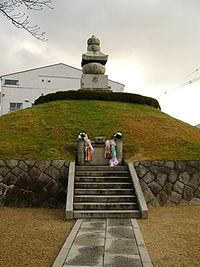
(*) The first wave proved they had no need of such an order. Because the numbers of the massacred became so elevated, the Japanese took to sending just the noses - carefully pickled in brine, catalogued and recorded meticulously by bureaucrats - back to Japan. According to Swope, something between 100,000 to 200,000 noses reached Japan. They were proudly piled in the center of Kyoto in the Hanazuka (literally, the Nose Mound), which is still there, though now called the Mimizuka (Ear Mound):
What a monument to national pride!
(**) This is a report in a Japanese chronicle: We found people running all over the place and trying to hide in the gaps between the houses. Those who could not conceal themselves went off towards the East Gate, where they clasped their hands together, and there came to our ears the Chinese expression, "mano, mano," which was probably them asking for mercy. Taking no notice of what they heard our troops rushed forward and cut them down, slaughtering them as a blood sacrifice to the god of war. Both men, women, and even dogs and cats were beheaded, and 30,000 heads were to be seen.
On the other hand, here is another little story. Early in the war, when a Korean peasant risked his life by moving ahead of the Japanese army's advance to inform the Korean General Yi Il of the imminent arrival of the enemy, Il had the peasant beheaded for endangering the morale of his soldiers! When the Japanese made their appearance, the Korean scouts did not inform their superiors because they knew what had happened to the peasant. That battle went very badly for the Koreans... Particularly Turnbull's book is full of such stories.
(***) Admiral Yi is still Korea's greatest national folk hero; a huge statue of Yi guards the official residence of the President of Korea. Like Nelson, Yi was killed at the moment of his final and possibly greatest victory in the last major naval engagement of the war.
(****) For instance, at the time of the invasion a form of slavery had so distorted Korean society that one-third of the population were slaves; in Seoul it was two-thirds!
Not so far from my house here in Massachusetts, there is a long, sandy beach. A lone pine stands guard by the small dunes near the entrance. On a windy day, you can hear the wind singing in that tree as you look out over a group of rocks that sleep like turtles at the waterline. The cold sand strewn with clam shells and the often-gray skies stretching to the horizon can take your mind flying to the past or the future. How can I imagine the pointless violence of a Japanese samurai army that set off to conquer China and even India because of the wild hubris of a Japanese military strongman? Korea wasn't even their main goal; they only wanted to pass through on their way to "conquer Ming China". Back in 1592, a huge Japanese army suddenly landed near Pusan, the southernmost port of Korea, which had been at peace for two centuries. The Japanese had been involved in civil wars for several centuries and so were supremely ready to fight. The Koreans not only were unprepared, but they argued and refused to cooperate among themselves. Some of their top generals simply ran away. In a blitzkrieg, and with the use of arquebuses (better than the Korean weapons), the Japanese reached the Yalu River in the space of a few months, but supply problems, the Korean guerrillas that sprang up, and the appearance of a huge (if inept) Chinese army come to help the Koreans, turned them back. Only the famous Korean Admiral Yi Sun-sin kept his head and inflicted several major defeats on the Japanese at sea, causing those supply problems later. The Japanese had to retreat to the southern coast where they built a chain of forts and hung on for 6 years. In 1598 it all started up again. Several more huge battles and though the Japanese won most of them, the military strongman (Toyotomi Hideyoshi) died back home and the whole idea collapsed. What was the idea? Well, as I walk along that beach, I can't perceive any idea at all. The Japanese killed hundreds of thousands of people, sent innumerable baskets of salted human noses back to Kyoto, looted, raped and burned most of Korea, and created the conditions under which starvation and disease killed a huge number more. Were they the only ones who ever did this? I despair. We are crazy monkeys. If, however, you are interested in military history or the history of East Asia, this book is a must. It is filled with illustrations, excellent maps, and a very readable text. It is the first book in English that I have ever seen that covers the topic of these tragic events which definitely affected Korean and Chinese history for centuries afterwards. The author does not take a side, does not cast any blame. (Though one must say that the Koreans were hardly to blame for all this.) I can't imagine a better book on a subject about which I knew nearly nothing before. So, while I still feel that the human race hardly learns anything from history, maybe as individuals, we can. Reading this book is one way.
I honestly didn't know three-quarters of the nitty-gritty details about these invasions before I opened Turnbull's book. So I am incredibly thankful to my friend for loaning me this book.
What you might like from seeing it are all the fun period illustrations. Is it a dragon? Is it a turtle? What, just what, is it supposed to represent?
What I liked most about this book was how it added to what I already knew before.
I have seen a couple of the names in the bibliography when I was doing research on Far Eastern Economics for Chinese History, so this has to be a good book.
For a 100 page book it’s perfect to know all the basic stuff about the conflict, but in some cases (like the last part of the conflict) you are left with more questions than answers. For further reading I strongly suggest “The Imjin War” of Samuel Hawley.
The second of the three books on the Imjin War, Turnbull writes from a mostly Japanese perspective. His book tends to favor the Japanese over the Ming and the Koreans.
This is probably the best available account under 100 pages in length of the Japanese invasions of Korea of 1592-98. I mention the length of the work, as Turnbull published another book covering the same material entitled "Samurai Invasion: Japan's Korean War 1592 -1598" in 2002 that runs 256 pages. This shorter version is quite accessible and provides a good introduction to this conflict, but for obvious reasons it condenses the account of the course of the war and is far less specific on the causes of it. For a much more detailed account that makes greater use of primary sources, I would recommend Kenneth M. Swope's "A Dragon's Head and a Serpent's Tail: Ming China and the First Great East Asian War, 1592–1598" (University of Oklahoma Press, 2009), which at a whopping 432 pages is likely to be the definitive account of the Imjin War.
I thought it was a pretty good history book, only it was a little short. I wish he would have talked more on Admiral Yi and the political climate of the time. However, it appears he wrote more extensively on such topics on other books.
I still give this book four starts because I felt it was worth the money. I also felt that it was a good overview of the war as a whole. I was impressed.
Let me end that I do like his style. It is very accessible to the novice historian, such as myself.
A fascinating history of the little-known (outside academic circles) invasions of Korea by Japanese samurai in the late 1500s. Turnbull's eye for a clever anecdote or startling detail adds a lot to the experience, which sounds pretty awful for all involved! Admiral Yi is a particularly fascinating character for Western readers, given the parallels between his story and that of England's Lord Nelson. A final nice touch is the inclusion of excellent 3D maps and references to memorials that could allow readers to travel to parts of Korea that would perhaps never be visited.
Solid overview of the two Japanese invasions of Korea. Broadly speaking, the course of the conflict went from initial Japanese success to Korean resurgence and finally, Chinese intervention. Turnbull summarizes the lead up to the conflict, as well as the capabilities of each participant and how they fared over the course of the conflict. This volume is nicely illustrated and covers the conflict succinctly.
This was a good book on a fascinating subject. Stephen Turnbull continues to deliver high-quality, informative and entertaining samurai content. This book’s text is accompanied by period artworks, illustrations and detailed battle maps.
For anyone who likes samurai history or East Asian history, this book should prove a fascinating read.