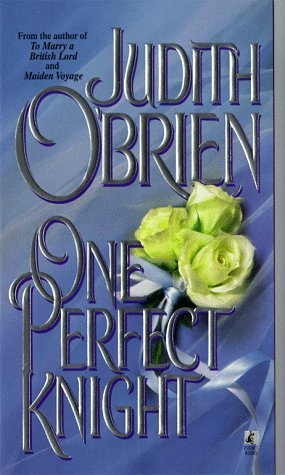
Madison Avenue advertising executive Julie Gaffney is on th lookout for a good man and a love that will last forever. But heroes are few and far between in New York City, and--after one too many disastrous blind dates--Julie has all but given up. Then, while chaperoning a children's birthday party in a suburban medieval theme restaurant, Julie suddenly falls into a cold faint...and awakens in fabled Camelot, face-to-face with the greatest hero of them all--the legendary Lancelot.
Behind the suit of armor is a man of deep passion and sensuous masculinity, a loyal knight who is about to be ensnared in a web of royal deception that will tarnish his name for all time. Entranced by his azure eyes and mesmerizing voice, Julie realizes she has a mission to fulfill. Only she can divert the tragedy that dooms Camelot...and Lancelot. But in saving the kingdom and the knight she has come to love, Julie puts her own heart in great peril....
Writing romance novels has got to be the way to make a living in the world. What other career allows you to send the kids off to school, walk the dog, and vanish into the most fascinating of historical times and places, with the most glorious of men, to escape danger and find everlasting love for the rest of the day?
Like most writers, I knew early on that I wanted to be a writer. Well, almost. Actually, writing was the third choice on my short list of career possibilities, right after Fairy Princess and Prima Ballerina. The first two didn't work out. So after college I moved to New York, where I worked for Seventeen Magazine. Not only had I never really been to New York before, but I believe I was the only editorial assistant in the magazine industry who still wore knee socks. Soon I was promoted to Editor of the "Letters to the Editor" department. Yes, there really IS an editor for the letters to the editor column. But it allowed me to write articles, answer the personal problems of teens (boys and zits were the big topics of concern), and rummage through the back files of the magazine. I found Sylvia Plath's original carbon of a short story she submitted while still in high school. There were articles on up-and-coming talents with names like Judy Holiday, Marlon Brando and Elvis. And very occasionally I was employed as a last-minute makeover subject. That was me looking miserable after getting the "Brideshead Revisited" bob.
Then I lucked into a fabulous job - as a jacket copy writer at a publishing house called Pocket Books. There I first read Jude Deveraux, Judith McNaught and Julie Garwood in manuscript form, and from those I would compose the blurbs for the book covers. It was heaven. I would read straight through my lunch hour, thus accounting for the chicken salad and iced tea on the returned manuscripts. But as much as I loved reading those marvelous stories, what I really wanted to do was to write one. Just one. Just to see what would happen.
Life interfered. I went back into magazines, this time at Self as an editor and writer. I got married, then had my son. I was still on maternity leave, writing general health articles while bouncing a newborn on my knee, that I began to dream once again of writing a romance novel. So that is exactly what I did. And I modestly claim to have written the most horrendous first three chapters of ANY book, in ANY genre, at ANY time in history. Unfortunately, still addled by the turmoil of being a new mom (hey, it's an excuse), I actually sent the wretched chapters to agents and publishers.
The rejections were polite form letters. Dozens of them. I shoved them into a bottom drawer and stuck to articles, becoming a free-lance writer and full-time mom. A few years later I gave romance writing another try. This time I sent it to only one person, Linda Marrow, with whom I had worked at Pocket Books years earlier. I certainly did not expect her to accept the manuscript. But I did hope she would let me know which editor at whatever house just might be interested in my time-travel romance.
Instead, I received a call from Linda three days later, offering me a two book contract.
Now I am a single mom. My son is twelve. I live in Brooklyn. And I'm lucky enough to write romance novels for a living. So please excuse me while I slip into something more comfortable. Such as Civil War Atlanta, or Tudor England, or Georgian Ireland, or....Did I mention how much I love this job?
This is an arthurian romance about Julie, a New Yorker, who ends up in medieval times during a party at a Medieval restaurant. She meets Lancelot and they, of course, fall in love.
I had many problems with this novel but I have to say that I also have very different opinions for the first part of the novel and the second one and I greatly preferred the second part.
Said this, I rated this book with a confrontation to other two similar books I've read: "A Fashionista at King Arthur's Court" and "Believe", both romance, the first one about a modern woman falling in love with Lancelot, the second one with a modern woman falling in love with Galahad. I enjoyed them both and knowing what I could have in such a type of romance (chemistry between the characters and a bit more balance between the romance and the adventure) I had to give to "One Perfect Knight" only two stars.
Surrounded by work and the pressure that comes with it, the heroine dreams of Camelot and of a time with magic and romance and honor. She dreams of Lancelot- the perfect man regardless of the fables that depict him as a adulterer and a villain whos' act of betrayal towards his king caused the fall of the perfect city. While on a trip to Medieval Times with her friends kid, the heroine is suddenly thrust back into the time of Camelot. Even knowing that history doubts the existence of Arthur or the knights of the round table, it's plainly obvious she's living in this world without knowledge on how to return. Upon first meeting, Lancelot believes she's his new squire before realizing that she is in fact a woman. Taking her back to his rooms, he's unsure of what to do with her. She's obviously addled mentally what with her claiming to be from the future, but can't turn her away. He truly in gallant and kind and something about this enchanting creature has him captured. The heroine is surrounded by perfection. The streets are clean and the air smells so beautiful-nothing at all like Manhattan. There is no war, no hunger and everyone is happy . Well at least until one evil soul starts to plant the seeds of doubt. She tries to warn Lancelot of the stories, of the tales spoken of how he'll betray his king and sleep with the queen. He's is furious by such talk and refuses to acknowledge the possibility of such a thing but he doesn't need to. The villain has already turned Arthur against him despite the heroine's warnings. And now, is the middle of the confrontation, the hero and heroine are suddenly thrust forward into the future. There the roles are reversed. The hero is the one who is lost, without purpose, without knowing how to live or survive in such an unhappy and dirty place. The heroine's work, which she takes up immediately upon return, puts the hero on the second shelf. It hurts to have her disregard his fears and uncertainties. He has no money, no knowledge of the stranger world and no way to defend himself as his sword is taken for safe keeping. Plus, the stories have changed from Lancelot the home wrecker to Lancelot the villain, the man responsible for the destruction of Camelot and everything good. Lost, he turns to a homeless shelter, helping those in need, helps him in return. But he doesn't belong in the world, he's rapidly aging and sickening. Soon he will die if he can't return home. The heroine doesn't know how she'll live without him in her life but somehow she must see him returned to Camelot if he's to live at all. This book was bizarre. The first half which is set in Camelot was nice. It was filled with mythology and intrigue. The chemistry between the characters was great and the tension between Lancelot and Arthur was awesome. Then...it's changed. When they were brought forward, it signaled the end of any such courtship between the hero and heroine. Instead, it focused everything on the hero, trying to find his way and to discover a way home. They behaved like roommates for most of the second half and had little to no interaction, let alone passionate moments. I hated the fact that the heroine returned to work and forced the hero to wander the city, alone and searching for purpose. I like the hero as a character but he was rather like a child and I never felt that strength behind him, he was a bit of a push over when it came to maintaining his place in the heroine's life. Just...odd. I can say it was like no other book I've read to date but that doesn't mean it was all that good unfortunately. I say 3 stars to put it in the middle, 50% passing grade but I have no interest in reading it again.
While chaperoning a children's birthday party at a medieval theme restaurant, Julie Gaffney suddenly faints while examining a suit of armor. She awakens in Camelot, face-to-face with the legendary Lancelot. Julie soon realizes she has a mission to fulfill. Only she can stop the destruction of Camelot and save Lancelot from the royal deception that will tarnish his name for all time.
While I've liked other time-travel books by this author, I wasn't crazy about this one. I really didn't see any connection between Julie and Lancelot. Don't know how they suddenly fell in love. Camelot was a very over-the-top fairy tale land. I was glad when the story went back to present day NYC. The rest of the book was trying to get Excalibur and Lancelot back to Camelot. Interesting but no real originality. My rating: 2 Stars.
This is the typical romance story. This book takes the heroine into the medieval time of Camelot. She discovers the plot against the King and Lancelot. She tries to save Camelot and accidently brings Lancelot and Excalibur back to her home in modern day New York. There is much confusion, and their enemy who had come with them stalks them through New York. The heroine must save her love Lancelot and try to change public opinion on Camelot. They save the day, and end up living happily ever after in Camelot. Overall this was an okay story, but the concept was too far out there to actually ever feasibility happen. This is the reason that people read romances, because they can picture the story happening. If you want a more unique concept on Camelot romance read this book.