Views current psychological theory and experimentation on perception and cognition and probes the factors that influence the national and intuitive modes of consciousness
Psychologist Robert Ornstein's wide-ranging and multidisciplinary work has won him awards from more than a dozen organizations, including the American Psychological Association and UNESCO. His pioneering research on the bilateral specialization of the brain has done much to advance our understanding of how we think.
He received his bachelor's degree in psychology from City University of New York in 1964 and his Ph.D. in psychology from Stanford University in 1968. His doctoral thesis won the American Institutes for Research Creative Talent Award and was published immediately as a book, On the Experience of Time.
Since then he has written or co-written more than twenty other books on the nature of the human mind and brain and their relationship to thought, health and individual and social consciousness, which have sold over six million copies and been translated into a dozen other languages. His textbooks have been used in more than 20,000 university classes.
Dr. Ornstein has taught at the University of California Medical Center and Stanford University, and he has lectured at more than 200 colleges and universities in the U.S. and overseas. He is the president and founder of the Institute for the Study of Human Knowledge (ISHK), an educational nonprofit dedicated to bringing important discoveries concerning human nature to the general public.
Among his many honors and awards are the UNESCO award for Best Contribution to Psychology and the American Psychological Foundation Media Award "for increasing the public understanding of psychology."
I bought this book when I was 13 and never read it. I WISH I had. Although published in 1972, the book covers a wide spectrum of topics that are considered mainstream today. These include meditation techniques, mindfulness in activities and present-focus, right-brain vs left-brain physiology and pyschology, psychoactive substances and other methods of entering altered states of consciousness, shamanism, as well as eastern vs western psychology traditions. In addition, he presents a number of studies on parapsychology and brain research that although dated, are quite interesting. He even covers Sufism and Whirling Dervishes. Frankly, this book is an excellent primer (or summary) on the Psychology of Consciousness because it incorporates so much in 250 pages. He also includes an excellent bibliography. I am shocked at how much was already known and culturally popular in the early 70’s. Makes me wonder why we consider the new books on the evolution of consciousness and what it means
This book was published during the left/right hemisphere fad of the seventies, a distinction Ornstein plays on in order to argue for an integration of rational and what he calls "intuitive" functions correlated to traditional Western and Eastern world-views. Although the author is a neuropsychiatrist, this book is quite accessible to laypersons and has been repeatedly updated.
This author was ahead of his time in 1972 with many recommendations that are finally being implemented (for the betterment of humanity) today.
I have been thoroughly enjoying his exploration of consciousness, looking at both Western and Eastern psychology in an objective way. He explores areas of knowledge Westerners rejected for decades because our paradigm was not broad enough to believe in the possibility. Now that, in some areas, we can scientifically see the truth of the rejected claims using Western methods, our paradigm has shifted.
This is a consistent issue with new ideas and it is one reason progress comes much slower than it could.
I am fascinated by many of the recommendations he makes that echo my own recommendation for today. That someone was advocating these beneficial steps so long ago and we still have not adopted them shows the stickiness of outdated ideas that lack a firm foundation. It also shows that anyone who wants to find a better way, leading to a better life for themselves, their families and children, can do so. The knowledge exists. Just as some are early adopters of new technology, there is nothing stopping some from benefiting from these ideas--we don't have to wait for the crowd to take advantage of them.
I really enjoyed some of the stories and analogies he uses that are not well-worn from repeated use elsewhere.
Even though I am familiar with most of what he wrote about, I found his perspectives helped me broaden my own perspective further in several areas...thus creating an even clearer picture of reality and human potential.
I've had this for a long, long time, finally read it. Interesting about right and left brain functions. A newer edition came out in 1996, I'd be interested to see how the theories and knowledge have changed.
A critical and eminently readable update of a classic of modern psychology. A practical taxonomy of the mind, illuminated by scientific and traditional psychology.A gateway to new possibilities . First in Ornstein’s trilogy culminating with his latest bestseller God 4.0
I read this book "back in the day", high school or college, and in rereading it, I can see how it guided so much of my approach to life, and to science in general. I learned to have an open mind about things that the mainstream considers esoteric. That does not mean you have to go chasing every new, unusual idea, nor that you have to fall for the propaganda of TM or ESP or UFOs. The author does a great job of surveying "esoteric" ideas while making his point that the sciences, in particular psychology, need to open up not only to the study of these ideas, but a different approach as appropriate. This book really brought back fond memories for me.
I started the 2nd edition (1977) but midway changed to 3rd (1986) which integrates more material from Idries Shah, particularly the teaching-story (especially in Ch 8). Many chapters begin with Nasruddin teasers that help to make translations across the right & left hemispheres. Arthur Deikman's essay on "Deautomatization and the Mystic Experience" is also included and identifies 5 principal features: intense realness, unusual sensations, unity, ineffability, and trans-sensate phenomena. Some of these seem characteristic of Boyd's "Particular Level" and thus have application to that feature of teaching-stories. The concluding chapter effectively draws together themes into suggestions for application including a Sufi perspective on "work" as a space for extending consciousness including the point that "the individual, alone, is not the 'unit' of enlightenment, or higher understanding. It is the group, correctly organized, that has this possibility" (p. 292). While drawing on traditions, Ornstein stresses that "any formulation must undergo a fresh adaptation" in order to serve evolving consciousness, and yet the model remains "speak to those in accordance with their understanding." The variance in levels of understanding affirms the need for discursive forms that function on multiple levels, thus supporting again the need for the teaching-story and the connection with Idries Shah. "This deepened understanding of life is conveyed through stories, myths, and legends, in which man's place in the world is explained and conveyed from generation to generation" (p. 294).
This book begins with great originality and then begins to sputter and repeat itself. Its greatest originality lies in casting sensory receptors as agents of restriction, primarily, and not reception.
Something like:
Our normal personal consciousness is not a complete, passive registration of the external environment, but a highly evolved, selective, personal construction that is aimed primarily at individual biological survival. ... All humans have evolved with identical sense organs, which select only certain aspects of the flux of available stimulation. (p. 42)
The book's second half repeats itself three or four times unfortunately.
An excellent, if slightly dated, overview of psychobiological theories of consciousness. Accessible but without oversimplifying, Ornstein presents what was known about consciousness in the late 60s--much of which has not significantly changed, even with the advent of advanced imaging technologies. The coverage of William James's work on consciousness and its later corollaries in the empirical literature was particularly comprehensive. A great introduction to some of the foundations of modern consciousness research.
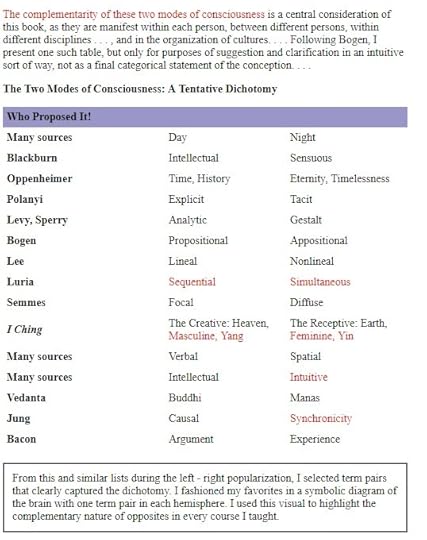
I've been re-reading and re-reading this book over the years. The most helpful part of it is (for me) was his page outlining various writers comparing and contrasting the "Two Modes of Consciousness" (in Chapter 2, pp. 36-39 of the 1972 edition):
I'd really love to write a research report on each of these contrasting modes, at some point. :) But Ornstein deserves credit for putting the two side-by-side in such a perspicuous way.