Walter Kempowski was a German writer. He was known for his series of novels called German Chronicle ("Deutsche Chronik") and the monumental Echolot ("Sonar"), a collage of autobiographical reports, letters and other documents by contemporary witnesses of the Second World War.
This is the second book (of nine) of the German Chronicle by Walter Kempowski. As with the first novel, there’s no English blurb available, so here’s my translation:
Karl Kempowski and his young wife Grethe have no easy start after the end of World War 1. They have to renounce the nobility of bourgeois villas and rent a room in the workers’ quarter of Rostock; economic depression threatens the shipping company run by Karl’s father Robert William Kempowski. Three children arrive, the youngest one being the author Walter; their school-time falls into the years in which Germany’s greatest downfall begins. Walter Kempowski is telling about his family and people who cross their path; with accuracy, with humor, and irony, which is so typical for his style.
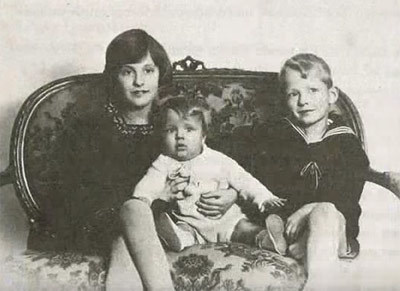
[the 3rd generation of the Kempowskis. From left to right: Ulla, Walter, Robert (photo credit unknown, taken from a clip on youtube)]
I really don’t get it. Why does this book has so few ratings, not to mention reviews, here on Goodreads (an even less so on Amazon)? Is it because family novels, especially those portraying families from “the old times”, have gone out of style? Or is it because the time between World War 1 and 2 in which the story is set, is perceived as uninteresting? Or maybe it’s the setting–the city of Rostock near the coast of the Baltic Sea–, that’s putting people off? I wish I knew. For me this was an excellent read, even slightly better than the first book. It has this certain kind of pull that makes you read on and on. Even the smallest episodes become engrossing once you are familiar with the protagonists. At the risk of deter even more readers, I have to say, that in this respect the novel reminds me somewhat of Karl Ove Knausgård’s My Struggle. But in contrast to Knausgård the family’s struggle in this book to carry on is a real one.
Depression and hyper-inflation hits hard. It doesn’t look that way at first, so a decision is made to acquire a third steamship for the fleet. Only a couple of years later all three ships are lying side by side in the harbor, where they don’t belong, and further business deals are getting harder and harder to find. At the height of the inflation people are buying bread for billions of Reichsmark, and decorating their rooms with money bills because wallpaper would be too expensive. It’s not easy for Grethe and Karl to raise their children during those times. But they manage somehow, and things are getting better economically when the “Führer” entered the stage in 1933.
This, of course, is the most engrossing part of the novel. Kempowski somehow found a way to take the reader deep into the sensitivities of the German people in pre-war Nazi Germany while at the same time keeping a light and conversational tone. Some slight remarks about how things are better now since Hitler is there, a change in greeting from “Guten Tag” to “Heil Hitler” (and then back), pictures of Hitler suddenly appearing in classrooms and elsewhere (even doll-houses), a change in the spelling-alphabet (Jewish names got replaced with German ones), a hen-party where the ladies talk about the pros and cons of Jewish artists, and so on. In this novel it’s the minor things that are important. It’s not the marauding SA-troops, it’s not the visits by the Gestapo at night, although this happens too. At one time even a member of Grethe’s family disappears, and later dies for reasons unexplained. But it was only an in-law, so he’s pitied, but not too much. In fact, it seems the Kempowskis are not so much anti-Nazi. They’re not pro-Nazi either. One day Hitler and Mussolini visit a nearby military exercise and the family gets excited to see him, just like they got excited to see the emperor Wilhelm II, when he visited (in Book 1). Grethe waved her handkerchief and yelled “Hello” when Hitler passes by on a train, just like she did when the emperor came. But of course she should have yelled “Heil” and she promptly got indignant looks from the crowd. Karl is torn between sympathy and hate for the Nazis and this inner conflict will surely become more interesting in the next novel.
People nowadays often wonder how Hitler was able to gain his power. How could the Germans vote for the Nazi-party? This book at least helps to find some answers. Between 1933 and 1937 (that’s when the novel ends) people in the street where just happy to gain back something that they thought they had lost. Of course they also knew that there are things happening that are not “so nice”. But those topics were suppressed or tried to be rationalized by the common citizen. Best not even talk about it. “Surely it’s not that bad”, “Where wood is chopped, chips must fly", “These things will certainly cease soon", etc. You have to read very carefully to get all those hints, and I’m sure I missed a lot of them too.
But it’s not at all only economic depression and Nazis that make this book so great. The main parts deal with the usual life of an ordinary family from the upper-middle class. There are many scenes of little or no relevance for the whole story, just like in everyone’s life, I guess. But the way in which those scenes are delivered is superb. Personally I’m fond of school episodes and I got quite a few of those here. And whenever the three generations meet at one place it’s a real treat. Their “Schnack” (that’s northern German for chitchat) is as real as life. An when they talk about their memories from years back it’s as if they’re talking about your own memories, and you almost feel like part of the family (a silent part).
It seems that this novel has never been translated into another language, at least I didn’t find any translations, and that’s a real shame. Personally I think this book helps more in figuring out Germany and the Germans in the Weimar Republic and the beginning of the Nazi-regime than many history books.