

What do you think?

¡Sí, Se Puede! / Yes, We Can!: Janitor Strike in L.A.
¡Sí, Se Puede! / Yes, We Can! is a bilingual fictional story set against the backdrop of the successful janitors’ strike in Los Angeles in 2000. It tells about Carlitos, whose mother is a janitor. Every night, he sleeps while his mother cleans in one of the skyscrapers in downtown L.A. When she comes home, she waves Carlitos off to school before she goes to sleep. One night, his mamá explains that she can’t make enough money to support him and his abuelita the way they need unless she makes more money as a janitor. She and the other janitors have decided to go on strike.
How will Carlitos support his mother? Carlitos wants to help but he cannot think of a way until his teacher, Miss Lopez, explains in class how her own grandfather had fought for better wages for farmworkers when he first came to the United States. He and the other children in his class join the marchers with a very special sign for his mom!
¡Sí, Se Puede! is a Jane Addams Peace Award Honor Book, a Skipping Stones Honor Book, as well as a selection for The Best of Beyond Difference, a recommended list of the top 10 diversity books published in 2002.
Diana Cohn, the author, is a social activist. As an elementary teacher, she discovered there were few books for children that discussed social issues, so she began to write as an avocation. She now works as Program Director for the Solidago Foundation, a foundation that supports communities working for economic and environmental justice. She lives on a houseboat in Sausalito, California.
Francisco Delgado, the illustrator, grew up in Juárez, Chihuahua, but completed high school in El Paso, Texas. He will -receive his MFA at Yale in Painting, Drawing, and Printmaking in May 2002. Francisco is becoming known nationally for his political paintings that satirize U.S. icons blind to the mestizo and immigrant communities of Mexico. He lives in New Haven, Connecticut. Luis J. Rodriguez (Always Running) adds the afterword and a poem.
How will Carlitos support his mother? Carlitos wants to help but he cannot think of a way until his teacher, Miss Lopez, explains in class how her own grandfather had fought for better wages for farmworkers when he first came to the United States. He and the other children in his class join the marchers with a very special sign for his mom!
¡Sí, Se Puede! is a Jane Addams Peace Award Honor Book, a Skipping Stones Honor Book, as well as a selection for The Best of Beyond Difference, a recommended list of the top 10 diversity books published in 2002.
Diana Cohn, the author, is a social activist. As an elementary teacher, she discovered there were few books for children that discussed social issues, so she began to write as an avocation. She now works as Program Director for the Solidago Foundation, a foundation that supports communities working for economic and environmental justice. She lives on a houseboat in Sausalito, California.
Francisco Delgado, the illustrator, grew up in Juárez, Chihuahua, but completed high school in El Paso, Texas. He will -receive his MFA at Yale in Painting, Drawing, and Printmaking in May 2002. Francisco is becoming known nationally for his political paintings that satirize U.S. icons blind to the mestizo and immigrant communities of Mexico. He lives in New Haven, Connecticut. Luis J. Rodriguez (Always Running) adds the afterword and a poem.
32 pages, Paperback
First published January 1, 2005
Ratings & Reviews
Friends & Following
Create a free account to discover what your friends think of this book!
Community Reviews
Displaying 1 - 30 of 42 reviews
October 11, 2014
¡Sí, Se Puede!is a historical fiction book because it is based on an actual janitor’s strike that occurred in Los Angeles in 2000. The book tells the story of a young Hispanic boy named Carlitos who lives with his mom and grandmother. Carlitos’s mom is a janitor who is frustrated that her low wages do not reflect the long hours and effort that her job demands. Consequently, she has decided to go on strike because her meager wages do not allow her to adequately support her family. To help the janitors on strike, Carlitos and his classmates create signs and join the janitors. Finally, with the community’s support, the janitors receive an increase in wages.
Most of the characters are Hispanic. However, what is unique about this book is that it demonstrates that there is diversity within this one culture; the characters originate from different Hispanic countries, including Mexico, Nicaragua, and El Salvador. Rather than oversimplifying the lives of the characters, the book presents issues that reflect real-life struggles. Children are constantly provided with things to critically think about and consider because Carlitos’s mom explicitly tells him that her low salary does not allow her to cover all their living expenses or his grandmother’s healthcare. Carlitos’s mom goes on to tell him that she is unable to spend time with him because she must clean other homes during the weekend in order to make ends meet. Because Francisco Delgado, the illustrator, is a Mexican-American, the book’s images accurately depict realistic and convincing Hispanic characters.
The book is written in Spanish and English, allowing students who are not strong in English to enjoy the story. Additionally, this book allows children to read with their parents who may only speak Spanish. All Spanish terms used are surrounded by sufficient context to allow non-Spanish speakers to figure out what the term means. By using large text fonts and including a Spanish glossary, ¡Sí, Se Puede! may be used in a read aloud or is appropriate for young elementary school children.
July 30, 2012
LOVE this book (and so does my preschooler!). The story of janitors fighting for justice is seen through the eyes of Carlos, a child whose mama is one of the janitors organizing a strike. His mama explains to him why they are striking; then he talks about the strike with his class and learns that some other kids have parents who are on strike as well. He and his teacher and classmates end up making signs and marching with the workers. After the janitors' successful struggle, the book ends with Carlos and his mama marching to support other workers fighting for pay raises. I felt this book really told the story on a level a child can understand, and conveyed the important messages and concepts without any jargon.

Read
November 2, 2010This book would be a excellent introduction to issues of protest and social justice for children. It could also be used to introduce the struggles and triumphs of Cesar Chavez as it puts his ideas into a modern context and shows that we are still working for justice and recognition for many. I love the support the characters show for one another and that the story is written in both English and Spanish.

October 11, 2018
https://raisethemrighteous.com/2018/0...
¡Sí, Se Puede! / Yes, We Can! (2005), a bilingual text written by Diana Cohn and illustrated by Francisco Delgado, explores the Los Angeles Janitor Strike of 2010 from the perspective of a family participating in it. The text opens with the mother of a young boy, Carlitos, tucking him into bed before she leaves for work. The boy’s bedroom is tidy and bright, and Delgado’s bold and detailed illustration captures the young boy’s sleepiness and his mother’s love as they share a glance.
In the next image, it is Carlito’s mother who is sleepy. She is depicted mopping floors in an empty office building, eyelids heavy, as she completes critical but invisible labor. The following morning, Carlitos’ mother is back at the kitchen table, as always, waiting to greet Carlitos when he wakes up. She walks him to the bus before heading home to sleep. Although mother and son are not able to spend as much time together as they would like, Carlitos’ abuelita is present to help raise the young boy. The family of three take good care of one another, providing the reader with a strong image of intergenerational love and support, which is rarely foregrounded in children’s books focused on white families, but is often present in work by people of color and new immigrant literature.
The cycle of work, sleep, and a little bit of family time, is broken one night when Carlitos’ mother sits the boy on her lap and explains that she cannot take care of him and his abuelita the way she wants to. Even with working extra jobs on the weekend she cannot afford abuelita’s medication. Far from trying to protect Carlitos from the reality of their lives and the social world they inhabit, Carlitos mother explains that her full-time job as a janitor is undervalued and underpaid. Carlitos understands that his mother will join other janitors to strike for more money and better work conditions.
The next image, and several subsequent ones, are of his mother and other community members on strike. Carlitos’ mother is proud of her work and every night she reads him newspaper articles about the strike. Carlitos is, in turn, proud of his mother. One day he clips out the newspaper articles and takes them to school.
The classroom is adorned with a “Viva Cesar Chavez” poster, and once the children pass the articles around and start discussing the strike they realize many of their family members are involved. Their teacher, Miss Lopez, shares a personal story about her grandfather being treated “just as if he wasn’t a person” when he came to the US as a farm worker. She explains how, like the janitors, farm workers united to demand a better life, and that their demands were met. Sharing stories about their personal stakes in the strike as well as Miss Lopez’s story of her grandfather’s success, encourages the children to feel like members of a community who can demand change, not isolated individuals whose experiences of poverty and prejudice are the cause of personal or parental shortcomings.
At home, Carlitos’ mother continues to share stories about the strike, her pride in participating, and awe of the community outpouring of support. One evening, Carlitos sees his mother on TV giving a speech and his pride in her encourages him to find a way to participate.
The next day he tells his teacher he wants to join the protest against poor wages; many students decide to make posters and join the protest as well. In class, they paint signs demanding justice for janitors and celebrating the important labor they do. Carlitos’ sign reads “I love my Mama! She is a janitor.” The following day, Miss Lopez brings several students on a bus to the downtown LA strike. When Carlitos’ mother sees the children she is so happy she holds back tears. Within a few weeks the strike ends, successfully demonstrated the power of community. Following the strike, Carlitos has a happy dream that a band of mustached angels are singing to his mother as she works.
Importantly, Cohn makes clear that when the lives of workers are improved the lives of families are improved. She write: “Now my mama smiles a whole lot more. Abuelita’s sore bones feel so much better. She walks with Mama and me to the school bus in the morning. Mama no longer has to clean houses and wash clothes on the weekends. Instead, we go to the park and on our way home, she lets me buy a paleta or a churro from the man who sells sweets on the corner.” In this story of family members and community taking care of each other, lives are seen as richly interconnected.
Although the text could easily have ended here, it doesn’t. The lesson of community is reiterated at the text’s close. On a Saturday morning, Carlitos’ mother receives a phone call from a person who cleans hotel rooms. Her friend is interested in striking for better pay. Mother informs son that she needs to help the new strikers as others helped her. Later that day, as she heads for the door, Carlitos runs after her, protest sign in hand.
This is a great book. It’s sure to encourage thoughtful discussion among readers. I particularly appreciate Cohn’s focus on Carlitos’ perspective, which allows her to represent children as agents of social change, community members, and emotionally literate family members. Even more, I enjoyed her subtle ability to show the complexity of labor, particularly invisible labor, like that of nighttime janitors, which is easy to ignore until we are forced to look at it. A very smart text, I certainly plan on adding it to my library, and recommend it for yours.
¡Sí, Se Puede! / Yes, We Can! (2005), a bilingual text written by Diana Cohn and illustrated by Francisco Delgado, explores the Los Angeles Janitor Strike of 2010 from the perspective of a family participating in it. The text opens with the mother of a young boy, Carlitos, tucking him into bed before she leaves for work. The boy’s bedroom is tidy and bright, and Delgado’s bold and detailed illustration captures the young boy’s sleepiness and his mother’s love as they share a glance.
In the next image, it is Carlito’s mother who is sleepy. She is depicted mopping floors in an empty office building, eyelids heavy, as she completes critical but invisible labor. The following morning, Carlitos’ mother is back at the kitchen table, as always, waiting to greet Carlitos when he wakes up. She walks him to the bus before heading home to sleep. Although mother and son are not able to spend as much time together as they would like, Carlitos’ abuelita is present to help raise the young boy. The family of three take good care of one another, providing the reader with a strong image of intergenerational love and support, which is rarely foregrounded in children’s books focused on white families, but is often present in work by people of color and new immigrant literature.
The cycle of work, sleep, and a little bit of family time, is broken one night when Carlitos’ mother sits the boy on her lap and explains that she cannot take care of him and his abuelita the way she wants to. Even with working extra jobs on the weekend she cannot afford abuelita’s medication. Far from trying to protect Carlitos from the reality of their lives and the social world they inhabit, Carlitos mother explains that her full-time job as a janitor is undervalued and underpaid. Carlitos understands that his mother will join other janitors to strike for more money and better work conditions.
The next image, and several subsequent ones, are of his mother and other community members on strike. Carlitos’ mother is proud of her work and every night she reads him newspaper articles about the strike. Carlitos is, in turn, proud of his mother. One day he clips out the newspaper articles and takes them to school.
The classroom is adorned with a “Viva Cesar Chavez” poster, and once the children pass the articles around and start discussing the strike they realize many of their family members are involved. Their teacher, Miss Lopez, shares a personal story about her grandfather being treated “just as if he wasn’t a person” when he came to the US as a farm worker. She explains how, like the janitors, farm workers united to demand a better life, and that their demands were met. Sharing stories about their personal stakes in the strike as well as Miss Lopez’s story of her grandfather’s success, encourages the children to feel like members of a community who can demand change, not isolated individuals whose experiences of poverty and prejudice are the cause of personal or parental shortcomings.
At home, Carlitos’ mother continues to share stories about the strike, her pride in participating, and awe of the community outpouring of support. One evening, Carlitos sees his mother on TV giving a speech and his pride in her encourages him to find a way to participate.
The next day he tells his teacher he wants to join the protest against poor wages; many students decide to make posters and join the protest as well. In class, they paint signs demanding justice for janitors and celebrating the important labor they do. Carlitos’ sign reads “I love my Mama! She is a janitor.” The following day, Miss Lopez brings several students on a bus to the downtown LA strike. When Carlitos’ mother sees the children she is so happy she holds back tears. Within a few weeks the strike ends, successfully demonstrated the power of community. Following the strike, Carlitos has a happy dream that a band of mustached angels are singing to his mother as she works.
Importantly, Cohn makes clear that when the lives of workers are improved the lives of families are improved. She write: “Now my mama smiles a whole lot more. Abuelita’s sore bones feel so much better. She walks with Mama and me to the school bus in the morning. Mama no longer has to clean houses and wash clothes on the weekends. Instead, we go to the park and on our way home, she lets me buy a paleta or a churro from the man who sells sweets on the corner.” In this story of family members and community taking care of each other, lives are seen as richly interconnected.
Although the text could easily have ended here, it doesn’t. The lesson of community is reiterated at the text’s close. On a Saturday morning, Carlitos’ mother receives a phone call from a person who cleans hotel rooms. Her friend is interested in striking for better pay. Mother informs son that she needs to help the new strikers as others helped her. Later that day, as she heads for the door, Carlitos runs after her, protest sign in hand.
This is a great book. It’s sure to encourage thoughtful discussion among readers. I particularly appreciate Cohn’s focus on Carlitos’ perspective, which allows her to represent children as agents of social change, community members, and emotionally literate family members. Even more, I enjoyed her subtle ability to show the complexity of labor, particularly invisible labor, like that of nighttime janitors, which is easy to ignore until we are forced to look at it. A very smart text, I certainly plan on adding it to my library, and recommend it for yours.
September 22, 2020
5/5 (physical book)
This book is a great representation of labor strikes written in a format for young readers to understand. It sparks conversation about how labor workers are treated and what can happen when voices are used.
I also love that it is written in bilingual text.
The illustrations paired with the text make this a necessary read and conversation.
Highly, highly recommend!
This book is a great representation of labor strikes written in a format for young readers to understand. It sparks conversation about how labor workers are treated and what can happen when voices are used.
I also love that it is written in bilingual text.
The illustrations paired with the text make this a necessary read and conversation.
Highly, highly recommend!

May 5, 2017
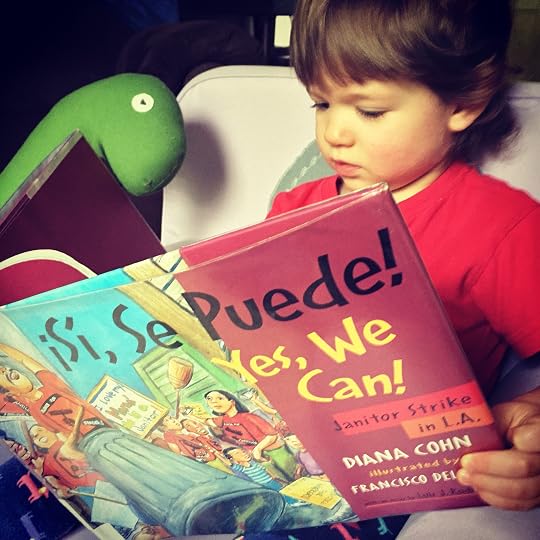
This review was originally written for The Baby Bookworm. Visit us for new picture books reviews daily!
¡Hola amigos, y feliz cinco de Mayo! To celebrate, we wanted to read a book that recognizes a group of brave Latin-Americans, as well as their language, with the wonderful ¡Sí, Se Puede!/Yes We Can!: Janitor Strike In L.A., written by Diana Cohn and illustrated by Francisco Delgado, the story of the 2000 L.A. janitor’s union strike through the eyes of one Mexican-American family.
Carlos, or Carlitos as his mother calls him, is tucked in every night with her warm words: “Sleep with the angels.” Then his Mamá takes a bus downtown and spends all night cleaning the office buildings. As hard as she works, she still must work two more jobs to make ends meet, and she cannot afford Carlos’ abuelita’s medication. So one night, she sits Carlos down and explains that she and the other janitors in her union are going on strike, demanding fair compensation for all the hard work they do. Carlos supports his mother’s choice, and wishes he could help her. Finding that his classmates also have family members on strike, he knows exactly what to do. Following his mother’s example, he organizes, makes signs, and takes the lead to support the striking workers in their fight for fair pay.
This was a wonderfully moving story about a strike that changed that lives of many disenfranchised workers. Through the events of the strike, Cohn also tells a story of family, community, and the fundamental right to equal pay for equal work. The illustrations are gorgeous, blending the colors and styles of traditional South American art with a modern tale. The length might be stretching it for the littlest readers, but JJ sat through it happily and loved the art. Best of all, the text is presented in both English and Spanish, so readers of all ages and levels of fluency in each can enjoy the story AND connect the two languages to each other. This book is positively fantastic, and we highly recommend it. Definitely Baby Bookworm approved!
Be sure to check out The Baby Bookworm for more reviews!
February 26, 2015
personal reaction- Growing up, I would go to Mexico all the time with my family, for my grandpa owned a house in Acapulco. By reading this book, i was able to reflect on my childhood and think of all the fun times my family and I shared. This book helped me think of these memories because of the translation of English to Spanish in the book. Walking through the town of Acapulco, i would listen into the fast pace language spoken by the people. This book provides an english and Spanish translation of the story. This is why i enjoyed the book the most. The illustrations are also colorful and bright that forced me to keep on wanting to read.
purpose/use in the classroom- This book is a great read aloud to read before many units. First it can be read before discussing places around the world that speaks Spanish. Second, it can also be read before starting a Spanish speaking lesson or unit. It can also be read before a social studies unit when focusing on what strikes are. This book is most appropriate to read to second graders. During this grade, students are learning basic Spanish and are also learning more in social studies units. They will be able to understand the topic of strikes. The vocab used in this book is also simple and clear for these young aged students to understand, for example marching, support, and janitors. But there are some words that students may be unfamiliar with that teachers will have to discuss, for example rallies. Overall this is a great read aloud to teach students to stand up for what they believe in while at the same time learning more about another language.
purpose/use in the classroom- This book is a great read aloud to read before many units. First it can be read before discussing places around the world that speaks Spanish. Second, it can also be read before starting a Spanish speaking lesson or unit. It can also be read before a social studies unit when focusing on what strikes are. This book is most appropriate to read to second graders. During this grade, students are learning basic Spanish and are also learning more in social studies units. They will be able to understand the topic of strikes. The vocab used in this book is also simple and clear for these young aged students to understand, for example marching, support, and janitors. But there are some words that students may be unfamiliar with that teachers will have to discuss, for example rallies. Overall this is a great read aloud to teach students to stand up for what they believe in while at the same time learning more about another language.
September 19, 2016
This book tells the story of Carlitos and his family. The mother is a janitor who is fighting for better working conditions that will allow her to support her family. The mother and her co-workers go on strike and win allowing the mother to spend more time with her family. The story of Carlitos is fictional, but the strike and its outcome are factual. There were many aspects of this book that I enjoyed. First, it is a bilingual book written in Spanish and in English. The text is side by side and would allow students that can read Spanish enjoy this story. Second, all of the characters are people of color, but they are not all the same. Some of characters are from Nicaragua and Honduras not just from Mexico. This showed the diversity within the Latino community in Los Angeles. Third, this is the story of a single mother raising her young son. This type of family structure is not often portrayed in mainstream literature. Fourth, the ending is not just a happy one. The mother continues to show solidarity for other workers that are fighting for better working conditions and pay. All of the different layers of the story could lead to interesting conversations with students about social justice issues.
June 2, 2017
This book is about a boy and his mother who live in Los Angeles, California. The mother works as janitor and decides to join a march for better pay for all janitors who are paid unfairly. This march inspires many people and the boy decides to join by making posters with his classmates. After an inspiring march, the goal is achieved and the family can now pay for more things that are needed. The mother then joins another march as many unite again for what is fair and her son joins again. The book tells the story of the janitor strike in L.A. and it does it in a tale of a family who are in the middle of it and help in the fight for what is right. This book works as an important telling of this monumental event, but does not do much more after that.
The media of the book is colored pencil that blends all the activity in the pages well to the point of increasing all important parts to the middle of the pages. The art along with the writing keep the story focused on what is important, and this is beneficial as the characters are not very interesting, to me, so the historical occurring has to keep the book interesting. This book serves as story support in a lesson of rallies and marches in the U.S. that have stood for something important.
The media of the book is colored pencil that blends all the activity in the pages well to the point of increasing all important parts to the middle of the pages. The art along with the writing keep the story focused on what is important, and this is beneficial as the characters are not very interesting, to me, so the historical occurring has to keep the book interesting. This book serves as story support in a lesson of rallies and marches in the U.S. that have stood for something important.
February 5, 2012
This book addresses very important social issues and demonstrates that children can also be involved in them. I recommend this book to every children of every age, and I recommend having a discussion about words that appear in the story but the children might not have heard, like strike, union, etc. I think it is very important that the story is bilingual so it can be more accessible to Spanish speakers all over this country, and hopefully it reaches other countries.

November 7, 2018
This bilingual picture book is a very well-told account of the 2000 janitors' strike in LA. Inspired by and based off a real activist, Dolores Sanchez, we follow Carlos and his mom's work in the service industry to create more equitable pay and respect. This book portrays service work with the dignity and respect it deserves and is a compelling blend of lovely artwork, neutral/persuasive fact-telling, and heart-warming family moments that all readers can relate to.

Read
January 24, 2011In this story a little boy Carlitos is faced with a difficult situation when he learns his mom is not making enough money to take care of him and get the medicine his grandmother needs. They have a protest to change their working conditions and it works! This is a relavant story b/c it's ture and many families still struggle with finances and similar issues.
April 10, 2011
In this story a little boy watches his mom go through a diffifcult time with her job as a janitor. The boy's mom leads her co-workers in a strike and want a raise. This is a book that could be used in social studies to explain how workers will go on strike against their jobs or government at times to stress a point or make a demand.
Want to Read
June 25, 2014!Si, Se Puede!/Yes, We Can! tells a story through the perspective of a young boy who's mom works as a janitor who has to go on strike in order to make enough money to support their family. I would use this book as a read-aloud to highlight that poverty exists all over the country not just in New York and that there are ways in which to rise above or fight against poverty
March 22, 2017
A Very diverse book that talks about the movement of the hard working Mexican community. This book is written by Diana Cohn and is about a story about a proud son of a hard working mother who is a janitor. !Si, Se Puede!/Yes, We Can! will be in my classroom because I know that many of my students will see this as a mirror that they can relate to.
This entire review has been hidden because of spoilers.
November 4, 2011
I thoroughly enjoyed reading this story about a boy who learned from his surroundings to stand up for what he believes in. It was inspirational to how a young mind can be influenced to do the right thing, regardless of the outcome.
September 17, 2012
This book talks about the current problems facing low wage jobs from immigrants workers and how one child wanted to make things better for his mother. The book was inspired by the actions of Cesar Chavez and his struggles for better pay and conditions for farm workers.
Read
December 10, 2012Elementary. I really wish I had this book during the strike. Even middle school students trouble with the idea of social struggle. I would put this book aside for large "social issue" marches such as the immigration marches of several years ago.

October 18, 2017
A great book to keep in class. I loved how it was bilingual and how it talked of true events. It was a bit long so I’m not sure if it would be something I would read aloud to a lower grade level class.

March 5, 2018
This is a great book for helping students understand unions and activism. It features a child who participates and makes a difference in the strike. In this time of children stepping forth and insisting on change, it is a worth a read.

March 23, 2018
I loved not only that this is written in both Spanish and English and would be great for a bilingual classroom or student. But also because It shows an unconventional perfect family with the working class mother and the LA issue of the strike as well this was very informative! Loved it!

September 7, 2007
I try not to cry when I read this book, but it's difficult.

January 21, 2008
It's a children's book, written from the point of view of a boy whose mother joins the janitors' strike in Los Angeles. A wonderful little tale of solidarity, dignity, struggle and justice.

September 27, 2010
I loved the story and its simplicity. I also loved the fact that it was written in both English and Spanish.
Read
November 28, 2011A dual-language book. This can be used to talk about jobs and difficult situations in families
April 21, 2015
I was choking back sobs while I read this out loud to my son. Solidarity!

January 17, 2017
Bilingual. Told from child's perspective as he learns about his mother's involvement in the LA janitor strike.
April 24, 2018
3.5 stars
a good story. just enough heart. i look forward to reading it to my students.
a good story. just enough heart. i look forward to reading it to my students.

June 19, 2020
Carlitos’ mother is a janitor in Los Angeles. She explains to Carlitos that she is striking, as she and other janitors are not being paid fairly. Carlitos wonders how he could support his mother then decides to bring his class (with the help of his teacher) to the rally with signs they have made. After the story concludes, there is a biography of a real-life janitor/union organizer who participated in the strike. The colorful pictures warmly depict Carlitos’ home, school classroom, and the people of Los Angeles coming together to support the janitors. In the end, the strike is successful, and Carlitos and his mother join a strike of hotel workers in solidarity, continuing to be part of the movement for fair pay and labor rights.
Using the book for teaching/learning:
-A man who walks out of his office to join the rally admits “he’d never thought about the janitors who clean his office.” Who cleans our classroom?
-Have students conduct an interview with the janitor in our classroom
-Write letters to the school janitors expressing appreciation for their work
-Some children may have family members who are union members. When I observed at one Chicago Public Schools school, a second grader was working on the difference between “opera” and “symphony” on a Mozart worksheet. She remarked to me, “They’re on strike now because the people selling the tickets are making more than the people making the music.” A project could be that students research local union strikes and write a newspaper article about them, or research about the Los Angeles janitors strike, then write a newspaper article. Perhaps groups could write about different strikes then compile into a newspaper of their own creation.
Considerations for use with dual-language learners (DLLs): This book is in both English and Spanish. For a student who has strong literacy skills in their home language of Spanish, this book could be a great tool for continuing to strengthen their academic proficiency in their home language while allowing them to build their English skills, as they would have the Spanish section as a reference when reading in English. This book provides representation for Latinx students. Some DLLs may have home languages other than Spanish but may very well have family members in unions (along with non-DLL students), which could provide representation of their experiences. The discussion between Carlitos, his mother, and grandmother about leaving their home country for a better life in the States would resonate with a variety of DLLs with experiences of immigration.
Using the book for teaching/learning:
-A man who walks out of his office to join the rally admits “he’d never thought about the janitors who clean his office.” Who cleans our classroom?
-Have students conduct an interview with the janitor in our classroom
-Write letters to the school janitors expressing appreciation for their work
-Some children may have family members who are union members. When I observed at one Chicago Public Schools school, a second grader was working on the difference between “opera” and “symphony” on a Mozart worksheet. She remarked to me, “They’re on strike now because the people selling the tickets are making more than the people making the music.” A project could be that students research local union strikes and write a newspaper article about them, or research about the Los Angeles janitors strike, then write a newspaper article. Perhaps groups could write about different strikes then compile into a newspaper of their own creation.
Considerations for use with dual-language learners (DLLs): This book is in both English and Spanish. For a student who has strong literacy skills in their home language of Spanish, this book could be a great tool for continuing to strengthen their academic proficiency in their home language while allowing them to build their English skills, as they would have the Spanish section as a reference when reading in English. This book provides representation for Latinx students. Some DLLs may have home languages other than Spanish but may very well have family members in unions (along with non-DLL students), which could provide representation of their experiences. The discussion between Carlitos, his mother, and grandmother about leaving their home country for a better life in the States would resonate with a variety of DLLs with experiences of immigration.
April 27, 2019
This book received the Jane Addams Peace Award in 2002 and it is easy to understand why. I would classify this book as very complex because it exposes students to a different location within the US and different cultures. On the first page of the story, it discusses riding a bus downtown and seeing skyscrapers. One really cool thing about this book is that it has English text and then translates it into Spanish. The illustrations help one interpret the text. The sentence structure is also very complex with many compound sentences. The pages following the story introduce complex topics to the reader such as solidarity and labor unions.
I really enjoyed this book because of the story and how empowering it is. This book is about a boy, Carlitos, whose mom is a janitor in L. A. His mom says she cannot continue to support him and his abuelita if she does not earn more money, so she and the other janitors go on strike. Students can see that their combined efforts can make a difference in many people’s lives. Because of the story and complexity, I would recommend this book to students grades first through fourth. This book would be a fun way to introduce how students can make a difference. The students could think of something within their school that they may want to change and discuss how to make that change happen.
I think the artistic medium is colored pencils because the lines from the strokes of the pencil are visible in each illustration. I would also classify the artistic style as cartoon because while the illustrations have a touch of realism, there are still aspects that cause it to look more cartoon and less like a picture. For example, the characters facial expressions are too exaggerated to be realistic. The illustrations cross the gutters but do not create a full two page spread. The end pages show a group of people standing in solidarity holding candles while wearing matching t-shirts. These end pages give people a hint to the serious topic that will be introduced.
I really enjoyed this book because of the story and how empowering it is. This book is about a boy, Carlitos, whose mom is a janitor in L. A. His mom says she cannot continue to support him and his abuelita if she does not earn more money, so she and the other janitors go on strike. Students can see that their combined efforts can make a difference in many people’s lives. Because of the story and complexity, I would recommend this book to students grades first through fourth. This book would be a fun way to introduce how students can make a difference. The students could think of something within their school that they may want to change and discuss how to make that change happen.
I think the artistic medium is colored pencils because the lines from the strokes of the pencil are visible in each illustration. I would also classify the artistic style as cartoon because while the illustrations have a touch of realism, there are still aspects that cause it to look more cartoon and less like a picture. For example, the characters facial expressions are too exaggerated to be realistic. The illustrations cross the gutters but do not create a full two page spread. The end pages show a group of people standing in solidarity holding candles while wearing matching t-shirts. These end pages give people a hint to the serious topic that will be introduced.
Displaying 1 - 30 of 42 reviews