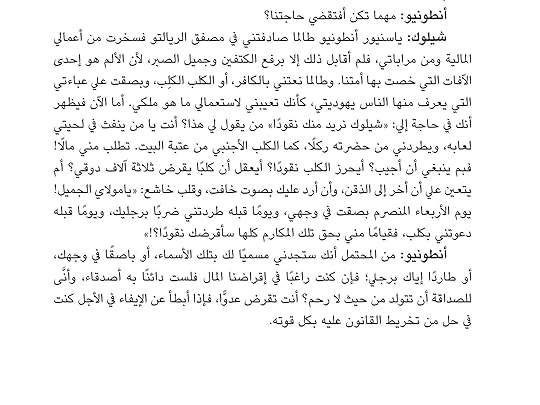
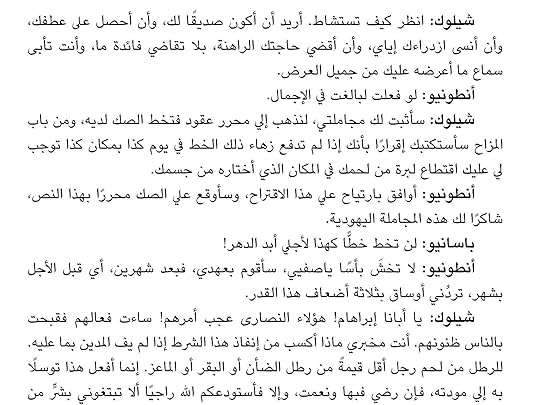
The merchant Antonio of Venice has been cruel to Shylock – gratuitously and publicly cruel. Indeed, Antonio has spat upon Shylock in public, kicked Shylock in public, for no other reason than that his society permits him to treat people of a minority religion demeaningly: and that is the first thing that one must keep in mind when reading William Shakespeare’s The Merchant of Venice. This “problem comedy” has a lot of problematic aspects, to be sure, but it can also offer many rewards to the careful reader or the thoughtful playgoer.
As the play begins, that “merchant of Venice,” Antonio, states that he is afflicted with an unaccountable melancholy: “In sooth, I know not why I am so sad.” Expressing no hope for finding happiness for himself – “I hold the world but as the world…/A stage, where every man must play a part,/And mine a sad one” – Antonio settles for trying to use his money and power to help his friend, the noble but poor Bassanio, win the hand of Portia, a young and beautiful woman who is also heiress to a vast fortune.
Gratiano, Antonio’s friend, does his level best to talk Antonio out of his melancholy mood. Rather like Mercutio with Romeo, Gratiano declares that melancholy is often but a pose of wisdom: he gently mocks Antonio's serious disposition by declaring that “I am Sir Oracle,/And when I ope my lips, let no dog bark!” Bassanio, for his part, dismisses Gratiano’s attempts at humour, stating that “Gratiano speaks an infinite deal of nothing, more than any man in all Venice.” Yet it is ironic that Gratiano, in his attempts to cheer Antonio out of melancholy, says to him, “Let me play the fool”; for Antonio himself will soon be fooled into making a potentially deadly bargain.
Portia, the brave and intelligent young woman who will emerge as the true hero of The Merchant of Venice, is introduced in terms that make her sound rather like Antonio, as she tells her waiting-woman Nerissa that “By my troth, Nerissa, my little body is aweary of this great world.” Because of her youth, beauty, and wealth, she is much sought by suitors; but her suitors are, by and large, a sorry lot, and she says of one, “God made him, and therefore let him pass for a man.” While she knows that she should be grateful for the advantages that she enjoys, she reflects wryly upon her tendency to sermonize against herself, stating that “It is a good divine that follows his own instructions.” Her hope of finding true love, rather than a strictly mercenary marriage arrangement, reinforces the play’s thematic idea that “All that glisters is not gold”.
Antonio meanwhile has contracted with the Jewish moneylender Shylock to borrow 3,000 ducats – a substantial sum – with repayment due in three months. Antonio and Shylock have a long history of mutual dislike; when Shylock speaks piously of Jacob in the Old Testament, Antonio’s response is to whisper to Bassanio, “Mark you this, Bassanio,/The devil can cite Scripture for his purpose.” For his part, Shylock reminds Antonio that “You call me misbeliever, cutthroat dog,/And spit upon my Jewish gabardine”.
Nonetheless, Shylock agrees to lend Antonio the requested money; and, pretending that it is all in a spirit of fun, stipulates that the forfeit, if Antonio fails to repay the debt on time, will be “an equal pound/Of your fair flesh, to be cut off and taken/In what part of your body pleaseth me.” The original “pound of flesh” deal has been entered upon.
The premise of this supposed comedy is so grim and heavy that it makes sense that Shakespeare places strong emphasis on “low comedy,” through the character of Launcelot Gobbo, Shylock’s servant. While deliberating on whether to leave Shylock’s employment, Launcelot briefly plays a oddly cruel practical joke on his blind old father, pretending to be a stranger reporting Launcelot's death! Finally, however, Launcelot reveals his true identity, and adding, in a reversion of a proverb of Shakespeare's time, “It is a wise father than knows his own child.” Like many others among Shakespeare’s fools, Launcelot Gobbo has some wisdom to offer, as when he suggests that “Truth will come to light; murder cannot be hid long…in the end truth will out.”
Indeed, there is more trouble in Shylock’s household than the moneylender realizes. His daughter Jessica, who is in love with a young Venetian named Lorenzo, disguises herself as a boy so she can leave Shylock’s house and elope with Lorenzo, remarking in the process that “love is blind, and cannot see/The pretty follies that themselves commit”.
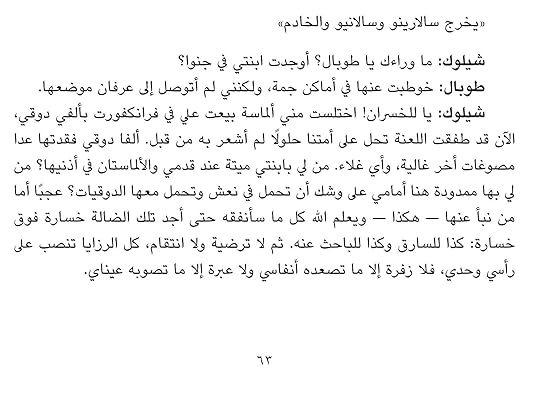
But “what news on the Rialto?” (a phrase that reminds me of what a novel thing it was to read The Merchant of Venice while visiting Venice - to say "what news on the Rialto?" while walking on the historic bridge that was the heart of the Venetian finance community, like Wall Street in New York.)
Evidently, the gossip on the Rialto, and throughout the central financial district of Venice, deals with the business reverses that Antonio has been facing, as one after another of his ships is reported to have wrecked – increasing the prospect that Antonio may have to pay Shylock that pound of flesh after all. Shylock, asked by Antonio’s friends Salerio and Solanio why he will insist on the actual pound of flesh – after all, it will have no financial value, and he can gain no profit from it – responds with one of the most famous speeches in the play:
“I am a Jew. Hath not a Jew eyes? Hath not a Jew hands, organs, dimensions, senses, affections, passions? Fed with the same food, hurt with the same weapons, subject to the same diseases, healed by the same means, warmed and cooled by the same winter and summer as a Christian is? If you prick us, do we not bleed? If you tickle us, do we not laugh? If you poison us, do we not die? And if you wrong us, shall we not revenge? If we are like you in the rest, we will resemble you in that….The villainy you teach me I will execute, and it shall go hard but I will better the instruction.”
Perhaps we have reached here a good place at which to address claims that this play is anti-Semitic. There is no question that Elizabethan drama was filled with anti-Semitic stereotypes of Jewish characters – almost invariably moneylenders (Christians in states like Venice were not allowed to lend money at interest). These Jewish characters in Elizabethan plays are almost invariably stereotypical foils – obsessed with religious difference, contemptuous of Christians, ever looking to achieve some sort of victory over members of the majority religion. I understand the reasons why many Jewish readers of this play are highly offended by it – and why The Merchant of Venice continues be one of the Shakespeare plays mostly frequently challenged at, or banned from, American schools and libraries.
But Shakespeare seems to be doing something here that is quite different from what other writers of his time were doing. While the reader or playgoer may disapprove of any character, from any background, seeking revenge, the fact remains that Shylock has understandable motivations for seeking revenge against a man who has regularly assaulted and humiliated him; Shylock’s is not “motiveless malignity” like that of Iago from Othello or Don John from Much Ado About Nothing.
Furthermore, Shylock may be another example of Shakespeare’s interest in the perspective of the outsider. As a man of artistic insight in a world of materialistic getting and spending, Shakespeare may have felt very much an outsider in his own time and place. It may therefore be no accident that Shakespeare often wrote about outsiders – Othello as a black man in a white world; Hamlet as a Renaissance man of reason in a medieval world of revenge; women like Twelfth Night’s Viola or As You Like It's Rosalind, who must disguise themselves as men in order to survive in a man’s world. Shylock, as a Jewish man in a Christian world, fits well within that continuum. The revenge that he is seeking is wrong; but many people of every religion, or of no religion at all, have sought wrongful revenge from just the same sort of motivations.
Moreover, Shakespeare shows the illogic and irrationality of prejudice at a number of points throughout the play. When Launcelot the clown jokes with Jessica, after her successful elopement with Lorenzo, he states his belief – or his pretended belief – that Jessica is inevitably damned as the daughter of a Jewish man, even if she converts to Christianity, as “the sins of the father are to be laid upon the children.” When Jessica protests that she plans to convert to Christianity, Launcelot protests that increasing the number of Christians will have its own set of adverse effects: “We were Christians enow before….This making of Christians will raise the price of hogs. If we grow all to be pork-eaters, we shall not shortly have a rasher on the coals for money.”
While couched in terms of verbal humour – the kind of verbal wordplay that Elizabethan audiences expected from their drama – the dialogue raises a serious point: those people of one group who are prejudiced against members of another group will always find a rationalization, or an excuse, for continuing in their prejudiced thinking.
Meanwhile, the love between Bassanio and Portia blossoms, as Bassanio successfully negotiates the marriage game ordained by Portia’s late father, choosing correctly among three caskets to the accompaniment of a song that asks, “Tell me, where is fancy bred,/Or in the heart, or in the head?” – an apt lyric in the context of a developing love relationship.
But the courtship is temporarily interrupted when Portia and Bassanio learn that the time for the payment of Antonio’s pound-of-flesh forfeit is at hand; and both characters – Portia separately, and disguised as a man – make their way from Portia’s Belmont estate to the Venice courtroom where Antonio’s case is to be decided. It is at this point that The Merchant of Venice provides some of the finest courtroom drama in Shakespeare’s entire oeuvre.
Antonio, fully believing that he is about to suffer a slow and painful death, rises to a sense of tragic dignity: "I am a tainted wether of the flock,/Meetest [most appropriate] for death." Portia has meanwhile arrived at the court, disguised as the brilliant young male lawyer Balthasar, of whom a letter of reference says that "I never knew so young a body with so old a head." Portia undertakes the defence of Antonio in the Venetian courtroom; and it is in this context that Portia offers her plea on behalf of mercy, in perhaps the most famous poetic passage from this play:
“The quality of mercy is not strained,
It droppeth as the gentle rain from heaven
Upon the place beneath. It is twice blest –
It blesseth him that gives, and him that takes.
’Tis mightiest in the mightiest. It becomes
The thronèd monarch better than his crown.
His sceptre shows the force of temporal power,
The attribute to awe and majesty,
Wherein doth sit the dread and fear of kings;
But mercy is above this sceptred sway,
It is enthronèd in the hearts of kings,
It is an attribute to God himself;
And earthly power doth then show likest God’s
When mercy seasons justice.”
It may be the most eloquent defence of mercy in all of literature. Mercy is an absolute: it cannot be portioned out. It either exists or does not exist. It is a higher and nobler form of power than the power to enforce law through punishment. It is the way in which a human being approaches closest to the power and majesty of God.
Shylock rejects this plea for mercy; he is absolutely determined upon revenge – not because he is Jewish, but because he has committed himself to bad moral choices. But Portia still has a couple of tricks up her men’s-clothing sleeve – one that any fan of last-minute theatrics in courtroom drama will appreciate. It out-Grishams Grisham.
Indeed, it is such a great scene, one of Shakespeare’s best, that the only thing that is wrong with it is that it all happens in Act IV, scene i. There is still half of one act and all of another to go, much of which is taken up by some not-terribly-engaging mistaken-identity comedy. Yet even here, there are some interesting things going on.
Lorenzo and Jessica, newly married, await Portia at Belmont. Lorenzo is entranced by the romantic quality of the evening and the beauty of his young wife: he remarks, "How sweet the moonlight sleeps upon this bank", and adds, "The moon shines bright. In such a night as this..." Jessica, by contrast, states that "I am never merry when I hear sweet music." Lorenzo can complain that Jessica's not getting into the spirit of things - "The man that hath no music in himself...Is fit for treasons, stratagems, and spoils" - but I think Lorenzo is missing the point. Jessica has given up much - the religious faith of her birth and upbringing, her relationship with a father who clearly loved her - to be with Lorenzo. Perhaps, at this point in her life, she is wondering just how happy her happy ending is really going to be.
Portia meanwhile remains the moral centre of the play. Seeing the lights of Belmont as she and Nerissa arrive there, she remarks, "How far that little candle throws his beams!/So shines a good deed in a naughty world."
Against the perfect peace of that beautiful northeastern-Italian evening - "Peace - how the moon sleeps with Endymion/And would not be awaked!" - Portia and Nerissa play their little practical joke against Bassanio and Gratiano. I'm not quite sure what purpose it all serves - except, perhaps to provide one more example of marginalized outsiders (women, in this instance) getting the better of the insiders: upper-class Christian white men who enjoy exclusive access to full power and participation in the Venice of Shakespeare's play, as they did in the England of Shakespeare's time.
Notwithstanding the anti-climactic quality of this last part of the play, The Merchant of Venice is a powerful drama that raises troubling questions about human community, prejudice, and cultural identity.