Neil Philip is a writer, folklorist and poet. He is married to the artist Emma Bradford, and lives in the Cotswolds, England. Neil loves words, poetry, and the art of storytelling in all its forms. Among his many books are A Fine Anger, Victorian Village Life, The Cinderella Story, The Penguin Book of English Folktales, Mythology (with Philip Wilkinson), The Great Mystery, War and the Pity of War, The New Oxford Book of Childrens Verse, The Tale of Sir Gawain, Horse Hooves & Chicken Feet, and The Adventures of Odysseus. Neil has contributed to numerous journals, including The Times, and Signal: Approaches to Childrens Books, and has also written for stage, screen, and radio. His work has won numerous awards and honours, including the Aesop Award of the American Folklore Society and the Literary Criticism Book Award of the Childrens Literature Association. Outside of the storied world, Neil is passionate about cats, art, music, France, food & wine, and friendship.
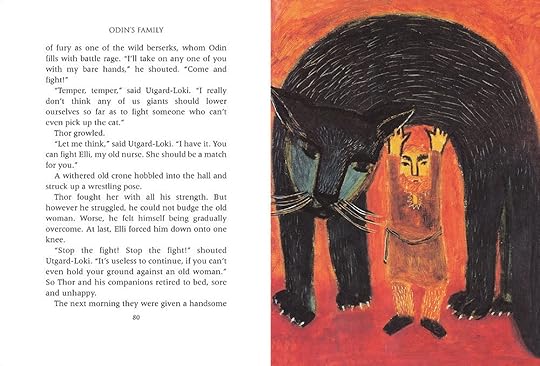
Be warned - though this title is aimed at middle-grade readers, the author does not skimp on the sex and violence. The fine collection features excellent retellings of the classic tales. The stories themselves are probably worth four stars, but the artwork by Maryclare Foa is expressive and exciting, and pushes the book into "must see" territory.
I wondered what all the fuss was about Norse mythology after reading C.S. Lewis and Tolkein, who both loved and were heavily influenced by it, and this was a wonderful overview for a beginner like me. It's just right to read out loud to a lower grade schooler, or for an upper grade schooler or middle schooler to read on his/her own, and there are just enough colorful illustrations scattered throughout to enhance the storytelling without distracting from it. Being such an infant in the study of Norse mythology, I don't feel qualified to grapple much with the content, or even Philip's treatment of it, except to say that his presentation was clear and interesting. I appreciated the "who's who" glossary at the end as well as the afterward what described the origins and sources for the mythology, and its continuing influence on the world today. I was intrigued by some very startling similarities at certain points of the story to Judeo-Christian beliefs, but was similarly interested to notice that the bit about the origins of life in the universe seemed more like the Big Bang Theory than anything in the realm of Intelligent Design. Of course, most of the mythology didn't seem like anything I'd ever encountered before in religion or in philosophy, and I look forward to thinking through it all more in the future. I'll probably read Nordic Gods and Heroes next, which is also recommended in The Well-Trained Mind for logic stage students.
A wonderful retelling of Norse myths. Can stand alongside D'Aulaires'. Some of the details were different from what I remembered, but that's bound to happen given the source material. The illustrations are very different from those in D'Aulaires', but they have a nice, simple quality to them and their interpretation of the characters are very much their own thing.
Read this if you're at all interested in Norse mythology.
I had started reading this with my kids in June of 2021, and ended up putting it aside for more pressing concerns. I recently came back to it, re-started it, and completed it with them. It's a little too baby-ish for them now (maybe losing it for more than a year was at fault - they are currently 8 & 10), but anyway, it gave them a simple version of the most prominent Norse myths, slightly edited for content . . .
This book was okay. It is geared toward a younger audience. However, it does have a few darker themes or ideas that might scare younger children. It does give an interesting viewpoint on the Norse Gods. I would recommend reading it once for information's sake; but, I don't think I will ever read it again for the fun of it.
Odin's Family: Myths of the Vikings is a highly accessible retelling of the Norse myths by Neil Philip. It completely captivated my 10-year-old. It's specifically written for children and packed with colorful illustrations by Maryclare Foa. I enjoyed it much more than D'Aulaires' Book of Norse Myths.
Overall this is a good book for introducing a young child to Norse mythology. Not too graphic, but not watered down too much either. As an adult, I had trouble with all the names, but the glossary in the back helps there. The illustrations are good and, again, not too graphic or disturbing.
Read this as I was curious about Norse mythology (having really only ever known much, before, about the Greeks, Romans, and Egyptians). I smiled at the glaring inconsistencies, grimaced at the gore, and was glad to learn about a new-to-me culture.