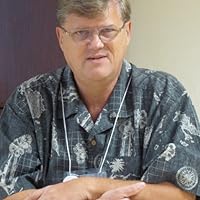
Pseudonym A. A. Craig, Michael Karageorge, Winston P. Sanders, P. A. Kingsley.
Poul William Anderson was an American science fiction author who began his career during one of the Golden Ages of the genre and continued to write and remain popular into the 21st century. Anderson also authored several works of fantasy, historical novels, and a prodigious number of short stories. He received numerous awards for his writing, including seven Hugo Awards and three Nebula Awards.
Anderson received a degree in physics from the University of Minnesota in 1948. He married Karen Kruse in 1953. They had one daughter, Astrid, who is married to science fiction author Greg Bear. Anderson was the sixth President of Science Fiction and Fantasy Writers of America, taking office in 1972. He was a member of the Swordsmen and Sorcerers' Guild of America, a loose-knit group of Heroic Fantasy authors founded in the 1960s, some of whose works were anthologized in Lin Carter's Flashing Swords! anthologies. He was a founding member of the Society for Creative Anachronism. Robert A. Heinlein dedicated his 1985 novel The Cat Who Walks Through Walls to Anderson and eight of the other members of the Citizens' Advisory Council on National Space Policy.[2][3]
Poul Anderson died of cancer on July 31, 2001, after a month in the hospital. Several of his novels were published posthumously.
Reading (or re-reading) science fiction of the Golden Age, I am struck again by the combination of intellectual complexity and literary simplicity. In other words, writers like Paul Anderson or Issac Asimov have astounding ideas but in terms of writing, their works are straightforward - if you want to be charitable - and primitive - if you don't. Much of SF today seems to suffer from the opposite problem: greater literary sophistication but recycled or incoherent concepts. So what's more important: idea or execution? This is not the question asked in this book but it's worth pondering anyway.
Some time in the early 1950s, a publisher named Twaine (I've also seen it spelled Twayne) had a novel (ooh sorry for the pun) idea: get a bona fide scientist to visualize, in detail, a fictional alien planet that could actually exist according to known physical laws: its star type, its orbital characteristics, its climate and age, and the various life forms that might have evolved there—including, perhaps, intelligent natives. Then hand that world off to three well-known science fiction writers and have them set unrelated stories around that world. The result was known as a Twaine Triplet.
The scientist Twaine chose was John Drury Clark, whose Wikipedia entry describes him as "a noted American rocket fuel developer, chemist, and science fiction writer and fan. He was instrumental in the revival of interest in Robert E. Howard's Conan stories and influenced the writing careers of L. Sprague de Camp, Fletcher Pratt, and other authors."
The first triplet was published in 1952 under the title The Petrified Planet, and featured stories by Fletcher Pratt, H. Beam Piper and Judith Merril. Twaine apparently decided it was successful enough that he commissioned Clark to create another world, which Clark called Lagrange, and he convinced Isaac Asimov, Poul Anderson, and James Blish to write the stories.
Unfortunately Blish never wrote his story, for whatever reason; so the triplet never got published as such. But Luckily the other two stories were published in other anthologies of those authors' works. Asimov's work is called Sucker Bait and can be found in The Martian Way and Other Stories, published in 1955 (which I have reviewed separately); Anderson's contribution was called Question and Answer and was published as a standalone short novel in 1956. The edition I read came out in 1978 and included an introduction by Anderson explaining much of the above.
In Anderson's tale, scientists from an overcrowded Earth have invented a warp drive and exploration of the galaxy has begun [the population in the story is 7 billion, a point we reached in 2011; that must have seemed catastrophic in 1952, when world population was about 2.6 billion], but explorers had found essentially no colonizable planets not already occupied by technological species. One promising world, Lagrange, had been visited by the survey ship De Gama, but they never reported back. Only by great effort could the private Lagrange Institute raise the funds for a follow-up/rescue mission. This story recounts that expedition and the events that befall it. I'll say no more about the plot in order to avoid spoilers.
Anyone who has read my reviews of other books and stories by Poul Anderson know that he my very favorite of all science fiction authors. Therefore I was getting a little disappointed and frustrated by the time I was about 2/3 of the way through this book and found that the plot seemed very linear and predictable, the characters were two-dimensional ethnic stereotypes (e.g., the one German in the expedition is a weapons expert, short-tempered and aggressive, and speaks in a heavy Sergeant Schulz accent), and the main protagonist was weak-willed and unlikable. I was ready to chalk this up to the fact that Anderson was still in the early phase of his work (his first story had only been published in 1947, five years earlier), and write this story off as having prototype elements of his later, more masterful works, but not being a very great effort in and of itself.
Luckily that changed in the last third of the book. Anderson throws in one massive plot twist, then just when you think you see where things are going, twists it right back orthogonally to the two previous plot trajectories. The characters, including the main protagonist Lorenzen, come into their own, and have a monumental decision to make. The end of the books is quite satisfying, but at the same time unresolved and leads the reader to speculation. Very artfully done. I still say the story is obviously not as well-crafted as Anderson's later works, but you can clearly see the raw talent for story and compelling details even at this early stage.
My high hopes for this early Anderson novella were dashed by the ending, and although I won't give out any detailed spoilers here, I will address my disappointment in general terms. This story was written in response to a challenge issued to Anderson, Isaac Asmiov, and James Blish: Given a fictional, Earth-like planet, Troas, "designed by a professional scientist" (as Anderson informs us in his Introduction), each author was asked to write a story around it, which were originally intended to be published as a single collection. Evidently Blish never completed his manuscript, so Anderson and Asimov published their versions separately (with the latter's appearing under the title "Sucker Bait").
On the plus side, Anderson's story is fast-paced and offers enough twists and turns to keep the reader guessing. Despite this, the solution to one of the several major mysteries posed by this tale was obvious from early on, but there were a number of others which were held in effective suspense until their reveals as the story worked up to its climax. In fact, the premise that Anderson sets up is so juicy that the reader is a bit disappointed that, when publishing this as a stand-alone novel, he did not choose to revise it and flesh it out. Its slim 150 pages could easily have filled twice as many without growing tedious or resorting to padding, especially given the thin character development and the many lost opportunities to delve into extraterrestrial culture in a more detailed manner. From that perspective, then, "Question and Answer" feels a little lightweight, despite the highly provocative nature of its central themes.
That alone might have garnered this book a four-star rating as opposed to five, but it was the ending which really left a bad taste in my mouth. First is its anticlimactic character. Having built up considerable suspense on numerous points, Anderson allows all of that tension to bleed out like air hissing from a slashed tire, as opposed to the explosive "POP!" of an over-inflated balloon. Aside from this, however, the author's political philosophy, a sort of Randian libertarianism, diminishes his vision, in the opinion of this reader. When faced with the choice of the slow, careful, thoughtful development of the human race and simply forging ahead in a damn-the-torpedoes, might-makes-right, manifest destiny manner, Anderson chooses the latter. It is hard to understand how an author who is so thoughtful in so many ways (e.g., he eschews the use of the term "Oriental" in favor of "Asian" in this 1954 work) can be so blind to the forest, but I suspect this characteristic emerges in other works of his as well.
I read this book in 2020, while under quarantine, ordered by my doctor due to my heart condition. The protagonist of this story is exactly the kind of person who would insist on his right to mill around in a big public crowd without a mask, and would kick against any restriction on that "right" (actually a privilege) on the basis that it would be injurious to his personal freedom. And the word for that, if my vocabulary serves me well, is: Yech!
Big set up to tell us mankind still has animal instinct and passions, but we think he is capable of big things. He should be free to explore and determine his fate - not a fate determined by a small group of psychologists.
Anderson's writing is heavy-handed. Even if he wants to moralize or preach, I wish he wouldn't also suck the fun out of his stories.
I enjoyed this book and that it had a true message it spent a long time building. However, for a short book, I felt that Anderson spent too much time building context and character background and not enough time building characters themselves. Again I enjoyed but not in my top science fiction stories by far.
Like a lot of 50s SF, the plot is a rollicking space opera until the last 5 pages. Then the final denouement is announced. Not backed up by anything in the previous 142 pages, and not really justified by any realistic interpretation of sociology.
This is a fine example of Anderson's 50s SF, with a multi-cultural crew trying to fathom the nature of the aliens they make contact with on a previously unexplored planet. Some nice surprises along the way, though most of his later work is even better.
Very short and fast-paced, but I enjoyed it. Nice descriptions of the scenery in particular. The ending felt a bit odd and abrupt, with a resolution that felt really out of character for one member of the cast. It almost makes the book seem like a prologue for something much longer!
A good plot and overall story idea that could have take at lest 500 pages to really developed; not a mere 140 something. The aliens in the book were a good source that was wasted as well.