Jump to ratings and reviews
Rate this book

The Grand Strategy of the Byzantine Empire

Rate this book
In this book, the distinguished writer Edward Luttwak presents the grand strategy of the eastern Roman empire we know as Byzantine, which lasted more than twice as long as the more familiar western Roman empire, eight hundred years by the shortest definition. This extraordinary endurance is all the more remarkable because the Byzantine empire was favored neither by geography nor by military preponderance. Yet it was the western empire that dissolved during the fifth century. The Byzantine empire so greatly outlasted its western counterpart because its rulers were able to adapt strategically to diminished circumstances, by devising new ways of coping with successive enemies. It relied less on military strength and more on persuasion―to recruit allies, dissuade threatening neighbors, and manipulate potential enemies into attacking one another instead. Even when the Byzantines fought―which they often did with great skill―they were less inclined to destroy their enemies than to contain them, for they were aware that today’s enemies could be tomorrow’s allies. Born in the fifth century when the formidable threat of Attila’s Huns were deflected with a minimum of force, Byzantine strategy continued to be refined over the centuries, incidentally leaving for us several fascinating guidebooks to statecraft and war.

The Grand Strategy of the Byzantine Empire is a broad, interpretive account of Byzantine strategy, intelligence, and diplomacy over the course of eight centuries that will appeal to scholars, classicists, military history buffs, and professional soldiers.

512 pages, Hardcover

First published January 1, 2009

104 people are currently reading
2103 people want to read

About the author

Edward N. Luttwak

66 books217 followers
Edward Nicolae Luttwak is a military strategist, political scientist and historian who has published works on military strategy, history, and international relations. Born in Arad, Romania, he studied in Palermo, Sicily, in England, LSE (BSc) & at Johns Hopkins (PhD). He speaks five languages. He serves or has served as a consultant to the Office of the Secretary of Defense, the National Security Council, the U.S. Department of State, the U.S. Army, Navy, and Air Force; he is/has been an adviser to Treaty Allies of the United States. He is chairman of the board of Aircraft Purchase Fleet Limited (APFL), an aviation lessor, and he founded and directs a conservation cattle ranch in the Bolivian Amazon. He is the author of various
books and more articles including: The Rise of China vs the Logic of Strategy, Coup d'Etat: a practical handbook, Strategy: The Logic of War and Peace, The Grand Strategy of the Byzantine Empire, The Grand Strategy of the Roman Empire, The Endangered American Dream, and Turbo-Capitalism: Winners and Losers in the Global Economy. His books are also published in: Arabic, Chinese (both Beijing simplified and Taipei traditional), Czech, Danish, Dutch, Estonian, Finnish, French, German, Greek, Hebrew, Indonesian (Bahasa), Italian, Japanese, Korean, Mongolian, Norwegian, Polish, Portuguese (and Brazilian Portuguese) Romanian, Russian, Spanish (Castilian, Spain, in Argentina and in Venezuela), Swedish, and Turkish. Before ever writing of strategy and war, he was combat-trained (Oxfordshire & Buckinghamshire Light Infantry) and fought as a volunteer or a contractor in several countries on two continents. He likes Hebrew songs and the Greek & Latin classics. His best article is "Homer Inc." in the London Review of Books.

Ratings & Reviews

What do you think?
Rate this book

Friends & Following

Create a free account to discover what your friends think of this book!

Community Reviews

5 stars
202 (31%)
4 stars
269 (42%)
3 stars
125 (19%)
2 stars
39 (6%)
1 star
5 (<1%)
Displaying 1 - 30 of 68 reviews
Profile Image for Mike.
570 reviews449 followers
March 1, 2016
I was very disappointed with this book. The Byzantine Empire has a fascinating history and faced many seemingly insurmountable challenges over the course of its existence. I thought a book that described how they accomplished this would be very engaging and fascinating. While I still believe that to be the case, that book is not Luttwak's "The Grand Strategy of the Byzantine Empire".

I found several major problems with this book. The most obvious was the organization. Luttwak split the book into two sections: diplomacy and military. On face this may make sense but in delivering the information Luttwak jumps around quite a bit chronologically. Over the course of a chapter Luttwak might cover events separated by hundreds of years without discussing any intermediate events. Further, many events are mentioned multiple times as they are relevant to whatever Luttwak is discussing in a chapter.

Luttwak never really establishes the story of the Byzantine Empire at a high level to provide a common reference between himself and the reader. I came to the book with a decent knowledge of Byzantine Empire but stumbled through a good amount of the book before I was able to put the major events in their proper perspective. This greatly diminished my ability to soak up what Luttwak was discussing. On a more minor note: Luttwak very infrequently uses sub-headings in chapters and when he does he often moves on to another subject within that heading without any formal indication. This book needed a stronger editor to organize the flow of Luttwak's thoughts.

I love maps. I think they are spiffy and, when done right, can be worth much more than a thousand words. While Luttak does have some maps, they are scattered throughout the book. What I think would have been more effective was a central location for all the maps showing the major periods of Byzantine Rule as well as their main rivals. That would have made it much easier to get my bearings regarding Byzantine's strategic position in a given point of time. Instead Luttwak provides a limited number of maps and, because he does not follow a purely chronological account of Byzantine, they are somewhat subjectively assigned to different parts of the book.

But by far the most glaring issue I had with the book was the Military Strategy section. I was expecting a discussion of Byzintine military operations and how strategy informed them. Why they had a certain army composition, why they fought the way they did, why they won/lost and how they adapted. Instead I got a glorified cliff notes version of a whole bunch of Byzantine Military manuals. And not even very interesting ones. These outlined how troops should be trained, how much food they should carry, how they should be equipped, etc. While I recognize these are important documents that informed how the Byzantine Empire approached military matters Luttwak did very little to connect what these manuals discussed with how they were operationally realized. The military section was WAAAAAAAAAAAAAAAAAAAAAAAAY too heavy on discussing theoretical military matters without linking it back to Byzantium's actual behavior. These manuals could have been discussed at a much higher level without losing any important information. This treatment would have left more space for the actual military strategy of the Byzantine Empire instead of the theory of several military manuals.

There were some parts of the book I did like. The use of prestige to negotiate with foreign powers, how the Orthodox church and faith played into statecraft, and the the sheer weight of numbers that continuously came off the great Eurasian steppe into Byzantine's sphere ofinfluence. But these interesting sections were weakened by the poor organizational structure of the book as a whole. By the end I felt much like Luttwak did about The Strategikon of Kekaumenos on page 387: "The composition of the text... meanders from theme to theme and back again with much repetition..." Quite possibly the least self-aware statement I have read in recent memory.
Profile Image for Charles.
616 reviews117 followers
May 15, 2024
History of Byzantine military doctrine and diplomatic efforts to secure the Empire.

I've read several of Luttwak's books. This is not the best, although its not the worst either.

The book is in three sections: Invention of Strategy, Diplomacy, and Art of War. The first sections are a survey of the Military and Diplomatic history of the empire. The last section is an extended annotation of surviving Byzantine books and documents. Only the first two sections are worth reading.

In general, I have several issues with this book. The writing is unclear, the use of maps and diagrams is poorly executed, strange examples are made, organization of the book is peculiar.

Luttwak certainly is a scholar. Unfortunately, his erudition limits his communication with the reader. For example, I have never used the word refulgent without intended irony in a sentence. There were several modern English words used in the narrative that did send me to the dictionary. The author's prose is needlessly complex and a burden to the reader.

The maps are too few, improperly crafted and unevenly distributed. The place names of the Roman Empire are very different from the modern. Luttwak adopted this charming notation of "Iconium (ancient) = Ikonyon = Konya (modern)" to describe place names. (Why the unreferenced intermediate name is needed, I don't know.) However, many locations called-out in the narrative are not shown in the maps. (I had to go to the Internet to find the location of Konya in modern Turkey.) In addition, some sections that would have benefited from maps have no maps at all. For example while the Byzantine/Turkic relations section has adequate maps, the Byzantine /Bulgar relations section has none.

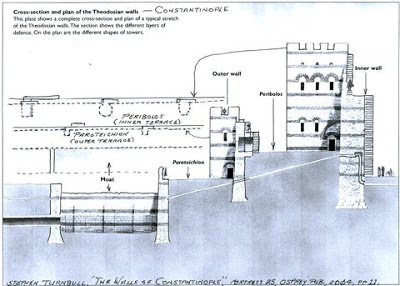
There are no diagrams or illustrations. Many lengthy and complicated paragraphs could have been saved with the use of a few artfully chosen diagrams or illustrations. For example, there is lengthy description on the construction of Constantinople's fortifications and their contribution to the survival of the empire. The diagram below or similar would have been appreciated.

Theodosian Wall

Luttwack's use of analogy is also peculiar. In many places he makes comparisons to ancient military situations with WWII military situations. A millennia and a half separate the two time periods. For example, he quotes von Clausewitz (1830 CE) on mountains and defense of passes, to explain a Byzantine operational error. I would have thought that the battle of Thermopylae (480 BCE) is a better example of the use of terrain being the more potent pre-industrial war force multiplier.

Luttwack also misses some key opportunities. I believe that ancient men (and women) thought differently then we do today. For example, a key factor in the survival of the Eastern Roman empire was its geography. At one point he states the Romans as thinking of geography was in terms of routes and itineraries, while modern men think in terms of spaces and maps . Similar statements on differences in thought are made in at least two other places. Not describing these differences are a lost opportunity for making his points more clear.

Most books of this type are organized in a timeline-like fashion. The first two sections of the book follow this example. However, the third section, is a review of surviving books on strategy from the period. The snippets from each manuscript can be interesting. However, I don't understand why this discussion wasn't integrated into the narrative of the first two sections?

This book was not as I expected. I imagine its intended to be an Academic work on the subject. However marketing has put it in the hands of a more general, although focused audience.
The book needs some serious copy editing to improve its readability for all readers. Otherwise, I can't recommend this as the best work on the subject.

Coincidentally, I ended-up reading both this book and The Fall of the Roman Empire: A New History of Rome and the Barbarians ( (Review.) The books overlap somewhat in their historical narrative until 500CE and on certain key topical points. Heather's book is much more readable.
Profile Image for Eadweard.
604 reviews521 followers
March 14, 2016
Highly enjoyable and very well researched book, there's a lot of information for those that want to learn more about the way the ERE fought its wars, conducted 'diplomacy' and how its military differed from the military of earlier periods.

Summarized:


More reliance on cavalry and mounted archers (at least during the earlier centuries), ambushes and skirmishes than up front / pitched battles (harder to replace / train men and replenish resources). Today's enemy can be tomorrow's ally; germanic tribes, huns, slavs, avars, bulgars, cumans, pechenegs, khazars, arabs, turks, western europeans... they sure had many...
----


I. The Invention of Byzantine Strategy
1. Attila and The Crisis of Empire
2. The Emergence of New Strategy


II. Byzantine Diplomacy: The Myth and the Methods
3. Envoys
4. Religion and Statecraft
5. The Uses of Imperial Prestige
6. Dynastic Marriages
7. The Geography of Power
8. Bulghars and Bulgarians
9. The Muslim Arabs and Turks


III. The Byzantine Art of War
10. The Classical Inheritance
11. The Strategikon of Maurikios
12. After the Strategikon
13. Leo VI and Naval Warfare
14. The Tenth Century Military Renaissance
15. Strategic Maneuver: Herakleios Defeats Persia
Profile Image for Betawolf.
390 reviews1,481 followers
September 9, 2022

For centuries, the eastern Empire stood alone, surrounded by a sea of foes that several times reached the walls of its great city. They defended it, of necessity, with cunning rather than strength of arms. This is a book almost tailor-made for war nerds, the learned author not so much giving you an accessible tour of the Byzantine world as grabbing you by the neck and taking you through all of what he considers the best bits, with liberal quotations of original texts, wartime reminiscences and snarky asides on the work of some of his peers thrown in for good measure. Some of the resulting chapters are amazing -- Luttwak will make sure you _get_ the distinction between the different types of bow, and what that might mean for an army, in the sort of detail that brings the topic vividly to life.

The subject is not only well-painted but also rich, and Luttwak does a good job of showing how the Byzantine situation propelled the development of its diplomatic and military coping strategies. The eccentric nature of his coverage means you are never quite sure what he will cover next, which unfortunately sometimes does render some confusion. The lack of any chronological organisation can be confusing sometimes, as Luttwak switches from the narrative of a particularly interesting campaign in the 10th century to one from centuries earlier, developing a theme rather than describing an evolution of ideas. Nonetheless, this is an enjoyable read with some well-developed and substantiated points, delivered with flair.
Profile Image for Nick.
Author 4 books21 followers
July 15, 2025
Near perfect, that sums up this book to me. Does it tell you everything about the byzantines? No but I finally got an answer on what byzantine meant. Not a simple question nor answer, but I finally got a sense of the dynamics, the policies, concerns, setbacks and opportunities that made the history of the Byzantine empire. Edward Luttwak not only made the empire a fascinating subject, he shattered the overpresent idea of the outdated living relic that was the byzantine empire as it is portrayed in most history courses (especially after the rise of Islam).

Edward Luttwak has a distinctly geo-political militaristic view on societies and politics, a view that has it's limitations; art, theology, social norms are only relevant if they relate to a military and geo-political dilemma. However, all history books have their focus and without a specific thematic lens. history often is a maddening mess of events, impressions, bits and pieces scattered by the dynamics of time to be forced in a narrative that somehow stays coherent. Edward Luttwak has his lens and I liked it, for a contemporary strict militaristic/ geopolitical historical approach is rather rare, culture studies and the globalization approach are king and queen these last 20 years.

The general impression I got was that the Byzantines despite their unapologetic dedication to religious dogma's, their unrelenting nostalgia goggles on Greek and Roman politics and warfare and seemingly incoherent geopolitical strategy were in fact a guided by a coherent, selfaware and realistic set of goals and principals. throughout the book Luttwak analyses step by step why the Byzantine strategy differed from the Roman and why to 19th and mid 20th century historians the Byzantines are consistently described as a miracle survivor. 19th and mid 20th century historians were influenced by the ideology of their time, the social darwinian logic that states and nations fight to the death to ensure survival. The Romans fought relentless wars lasting decades and with massive pitched battles of heavy infantry slaughtering each other, a war mentality quite familiar to American officers in the US civil war or British and soviet generals in the first ad second world war, the butchers bill to be paid for victory that can only be total and without condition. therefore it is quite understanding why the Byzantines who preferred smaller yet more elite armies combined with local auxiliary forces and supporting mass infantry archers, who avoided pitched battles to the death and nearly never utterly destroyed their enemies were considered fools by historians so many decades.

However in our current age increasingly ever since the Vietnam war a new understanding has been growing on the topic of war that is remarkably similar to the byzantine one. Wars are no longer won on the field of the battle with distinct battle lines. They are more similar to the byzantine approach to war involving, extensive reconnaissance, very precise use of force by flexible expensively equipped, paid and trained forces, well funded pragmatic diplomacy, recruiting (bribing) local allies, studying the motives and psychology of the enemy and preferring a subdued enemy over a v anguished one. All of that is becoming an increasingly popular notion among generals and experts who have seen the face of war change the last few decades. They are however challenged by politicians and demagogues who can see geopolitics only as a ruthless winner takes all domination and conflict as total war to the death with the image of mega bombardments as the ideal way of warfare regardless of its efficiency. To make the analogy complete, in the byzantine empire the nostalgic memory of the Roman times of total annihilation and eternal conquest at times surplanted the proven byzantine strategy often with catastrophic results in the long run.

This sense of; these Byzantine policies are more familiar then I expected, was the general vibe I got in nearly every chapter and Luttwak does an excellent job explaining how seemingly bizarre policies fitted in a wider approach and made sense from a different point of view. For example, a common rejection of Byzantine administrative policy was the extensive use of titles with little to no functionality. From an administrative point of view this made little sense and resulted in provinces being taxed and ruled by different people in name but similar in reality. From a political point of view however it did made sense; for the vague differences in hierarchy allowed for clever neutralizing of potential rivals who had trouble determine their relative political position and thus made it more difficult for them to collaborate and undermine the imperial authority. This smart use of fancy titles and positions to divide and conquer rivals is eerily similar to contemporary practices in bureaucratic entities (both corporate, parliamentary or socialist) to prevent a bottom up reversal of power, inefficient yes, but effective yes!

But even for people who simply want a coherent overview of the geopolitical changes, challenges, warfare and Byzantine plans to prepare for and counter them, this book is what you are looking for. most impressive was it's inclusion of an unrivaled overview of Byzantine military field manuals, arms description (I would have loved illustrations), soldier training and art of war. It is an accessible book for novices and for those with a little bit more familiar with the content, the above reflection on how familiar the Byzantine ways are, offers more then enough for anyone who wishes to dive in the Byzantine history. Only a few minor aspects reduce it to four in stead of five stars. Even though unique, the manuals are interesting but get a bit repetitive after a while and I would have preferred a more chronological approach and less jumping forwards and backwards between chapters. Finally even though Luttwak does not treat the Byzantines as a failure he does stick to one tradition concerning Byzantine historiography, the empire after the reconquest of constantinople (occupied for half a century by crusaders) in 1261 is not considered of any interest. Even if the empire survived for two further centuries (diminishing steadily) Luttvak does not spent any time on it and it's exclusion makes this a near but not full historical overview of the Byzantine empire ( Luttvak does not consider the post 1204 Byzantines an empire so in theory he does cover the empire's history).

in short, if your into military history and want a more exotic subject, get a copy and start reading.
Profile Image for icaro.
502 reviews46 followers
April 9, 2019
Un libro straordinario. L'autore ha una tesi forte che argomenta in modo convincente per tutto il trattato. Competenze accademiche di altissimo livello che Luttwack non usa (solo) per sfoggio ma per una sottile e continua analogia con il presente. La prima parte mi ha interessato di più (storia politica, storia militare, a grandi linee, dell'impero bizantino). Ma, sorprendentemente, mi ha entusiasmato la seconda che tratta un argomento (dettagli di storia e teoria militari bizantine) che mi interessa meno di zero. E, nonostante qualche frecciatina anti russa o anti islamica (sennò che Luttwack sarebbe?) il libro è anche 'ideologicamente ' equilibrato nel suo sguardo al presente. Gran lettura dalla quale, oltretutto, i bizantini escono con una grandezza politica che molti stereotipi scolastici ci hanno consegnato malamente incrostata di banalità.

Profile Image for Matas Maldeikis.
142 reviews192 followers
June 6, 2023
Bizantija, būdama daug nepalankesnėje geografijoje nei Roma, sugebėjo išlikti 800 metų ilgiau. Reiškia kažką jie darė gerai. Jeigu tu ne istorikas - pirkti neverta nes viskas susiveda i kelis puslapius. Tačiau jeigu nori suprasti Bizantiją- tai būtent ta knyga.
Profile Image for Steven Peterson.
Author 19 books324 followers
December 10, 2011
In this volume, Edward Luttwak explores the strategy of the Byzantine Empire, as it strove to flourish and sometimes just survive, surrounded by enemies. Luttwak begins by saying (Page ix): "This book is devoted to one dimension of Byzantine history: the application of method and ingenuity in the use of both persuasion and force--that is to say, strategy in all its aspects, from higher statecraft down to military tactics."

The book begins with the crisis caused by Attila and the Huns. This serves as something of a case study, as Luttwak begins in his discursive fashion to outline the grand strategy used by the Byzantine Empire to continue. The book describes two separate aspects of this strategy: diplomacy and military considerations. The end result is a fairly compelling argument as to how the Empire flourished and continued so long after the demise of the Western Roman Empire, as Rome fell and the Eastern Empire (Byzantine) continued into the 15th century. Surrounded by so many enemies, how did this Empire survive? That is, of course, the point of the book to explain.

Diplomatic methods included the sending of diplomats to negotiate (and bribe or pay off) potential enemies; religion; prestige (the Empire treated envoys from potential enemies extremely well when they came to Constantinople); marriage (marrying off royal family to potential or actual enemies); trying to deal with strong potential enemies, such as Bulgarians and Arabs and Turks).

Military methods? The Byzantines recruited allies (including the use of treasure to buy their support); they allowed enemy forces to escape destruction on occasion, knowing that their opponents today might become their allies later; they avoided major pitched battles to preserve their relatively modest forces; they developed a technology and strategy of battle that gave them the best chance of emerging victorious. One interesting aspect of this section of the book is summaries of experts' views of the proper strategies for the Empire to carry out in military conflict. And, yes, the book speaks to the nature of "Greek fire," a weapon often spoken of when addressing thje technology of the Byzantine Empire.

Some issues, though. First, maps are not always so instructive. Anatolia is mentioned often, but this area isn't so apparent on the maps provided. Readers would be hard put to find out where Anatolia is. The book also sometimes jumps back and forth in time and can be confusing. Moreover, the volume does not really speak much of the devastating defeat by the Crusaders in the 13th century; nor is there a lot of discussion as to how the Empire survived even in its shrunken form after regaining sovereignty after that.

All in all, though, in my view (as a nonexpert, needless to say) this is a strong volume.
Profile Image for D..
15 reviews
May 15, 2013
A good study on Byzantium's strategic realities and how the Empire dealt with them. While the tools of warfare and communication have changed, the basic threats faced by the empire, and the responses to those threats have changed little since the fall of the Western Empire. Rising and shifting geopolitical rivals, the ebb and flow the tax base, and a shrinking military were met with retrenchment, soft power, and proxy wars, making this study relevant to the modern policy maker.

However, the author's occasional racist editorial comment makes it hard for me to recommend this book without caveat:

It is with a high compliment that the author of the Strategikon begins his comments: "The light-haired races place a great value on freedom." Earlier he had described the Persians as a "servile" lot, who "obey their rulers out of fear"—some things never change after millennia…


Passages such as this are a little jarring, but fortunately not found widely. Also be aware of his tendency to be inconsistent in the transliteration of names. This doesn't appear to be an issue with the greek names, but the Umayyad caliph is at one point rendered both "Sulayman" and "Suleiman" in the same paragraph.

If one keeps in mind the authors biases, this is still a good read.
Profile Image for Katie.
161 reviews52 followers
April 15, 2019
I must confess that, as I read this specifically for an essay, there were parts I skimmed. Nevertheless, everything I read was of an exceptionally fine quality, analysis, and understanding. Surprisingly rare in the world of strategic studies, the author has a very solid grasp of the differences between the grand-strategic, theatre-strategic, operational, and tactical levels. I learned a great deal of the sophistication in Byzantine strategy and diplomacy - this is very clearly an excellent work.
Profile Image for Ryan.
269 reviews
December 14, 2011
Exhaustively researched and insanely detailed - Luttwak covers the range from strategic planning to physical construction of a compound bow and fodder requirements for various kinds of horses - this is the sort of book that makes me despair of ever producing any academic work of real quality. On the other hand, it's a bit oddly arranged in parts, and gives the impression that the author's notoriety and credentials have earned him something of a holiday from editors.
Profile Image for Nathan Albright.
4,488 reviews162 followers
January 16, 2016
I must admit, I'm very fond of reading books about grand strategy and pondering about the subject, although it is rare to find many books on the subject [1]. This is a large book, at a little more than 400 pages of material, but it is a worthwhile book to read for those who are interested not only in the history of the Byzantine Empire, but also its contemporary relevance. The author demonstrates both his command of elegant prose, his thoughtful command of important sources of diplomatic and military theory and practice, his ability to wade into scholarly controversies over the value of Byzantine texts and the characteristic Byzantine tendency to value antiquarian sayings but also show an astonishing command of realpolitik. The author is fulsome in praise towards the scholars who helped him with his work by sharing their own translations and manuscripts with him, and he bemoans the fact that inferior Roman texts have been well-remembered while better Byzantine texts have been forgotten and left to languish in obscurity. This book does a good work, for example, in helping audiences gain a greater appreciation of the military manuals of the Byzantine Empire, which deserve a definitive collection of their own [2] that is popularly accessible at a low cost. While we wait for that to happen, one can enjoy books like this which provide a comprehensive review of the lengthy tradition of Byzantine military texts with a practical bent that show how an empire with many enemies and a vulnerable position maintained its survival for a millennium when more heralded empires like the Roman Empire or Ottoman Empire were unable to do so.

In terms of its contents, this book is divided into three parts and over a dozen smaller chapters that cover about 430 pages or so of core material, along with helpful appendices and a lengthy section with endnotes and an index after that. The first part looks at the invention of the characteristic Byzantine strategy, which began with the threat of Attila the Hun towards the end of the Roman Empire and continued through about two centuries of history in what the author considers the "Late Roman" period of the Byzantine Empire, which lasted until the full emergence of a Byzantine successor state in the aftermath of the Muslim conquests. The author then spends seven chapters discussing Byzantine diplomacy, from their use of envoys, to the role of Orthodox religion in serving the interests of the empire, to the use of imperial prestige to overawe potential opponents, to their fondness for dynastic marriages, to their recognition of the geography of power, to their struggle to control Bulgaria, to their relations with the Muslim Arabs and the Turks who eventually conquered Constantinople in 1453 after a long period of conflict and tension. The final five chapters of the book examine the Byzantine Art of War, a subject that deserves to be better known, with chapters on the classical inheritance from Greece and Rome, the Strategikon of Maurikios (better known in English as Maurice), the Byzantine texts after the Strategikon, Leo VI and his writings on naval warfare, a chapter which puts Greek fire in its proper context, the tenth-century military renaissance, which included many texts written about military practice, as well as a case study of strategic maneuver in Herakleios' defeat of the Persian threat of the early 7th century. The book concludes with a discussion of grand strategy that summarizes the author's points effectively and then moves on to an appendix that seeks to defend the author's contentions about the feasibility of grand strategy in Byzantine times in the absence of a general staff or people with specialized functions as a diplomatic corps.

In many ways, this book is both immensely quotable and relevant for its reading audience [3]. The author frequently quotes the noted Latin justification of war preparations, si vis pacem para bellum, which, roughly translated, means, "If you want to see peace, prepare for war." This is, of course, the reason why even people of a pacifist nature should study warfare [4]. The author also provides an understanding of Byzantine strategic thought, despite the inevitable simplifications that occur when telescoping texts from many centuries into a particular presentation, that is of particular use to the United States and to Western civilization in general. Byzantine grand strategy, that is, the integration of political, economic, military, and diplomatic aims into a coherent but often paradoxical and unpredictable set of operating principles and behaviors, is well-suited to our time and situations. The author shows a Byzantine empire with limited demographic resources and a core of immensely trained and often irreplaceable soldiers, vulnerable frontiers, far more numerous and powerful enemies, and a realization that today's ally could be tomorrow's enemy, and vice versa. Focusing on goals of survival rather than annihilation of the empire's enemies, and the subversion of enemies through bribery and flattery, and the development of internal unity fostered on cultural and religious factors as well as an espirit d'corps, the empire sought to use its strengths in logistics and culture to compensate for weaknesses in manpower in a time of limited budgets but potentially unlimited warfare. Our own nation would do well to adopt such means ourselves, especially given the reality of limited military budgets in an age of austerity and enforced fiscal responsibility. To do, though, requires that we engage in a more careful husbanding of our own resources, human and material, and that we make a better effort to understand our potential enemies, which requires empathy and understanding.

[1] See, for example:

https://edgeinducedcohesion.wordpress...

https://edgeinducedcohesion.wordpress...

[2] See, for example:

https://edgeinducedcohesion.wordpress...

https://edgeinducedcohesion.wordpress...

[3] Among its most worthwhile quotes are as follows:

"The strategical success of the Byzantine empire was of a different order than any number of tactical victories or defeats: it was a sustained ability, century after century, to generate disproportionate power from whatever military strength could be mustered, by combining it with all the arts of persuasion, guided by superior information. The current terms would be diplomacy and intelligence, if one could disregard their largely bureaucratic character in modern conditions--all use of those words in what follows is to be understood in inverted commas (6)."

"The envoys we send out should be men who have the reputation of being religious, who have never been denounced for any crime or publicly condemned. They should be naturally intelligent and public spirited enough to be willing to risk their own lives...and they should undertake their mission eagerly and not under compulsion...Envoys should appear gracious, truly noble, and generous to the extent of their powers. They should speak with respect of both their own country and that of the enemy and never speak disparagingly of it (101)."

"Illiteracy among cavalry officers did not prevent the study, dissemination, and retention of entire repertoires of tactics originally learned from books. That indeed was a comparative advantage of the Byzantines, whose own military literature was more useful than the earlier Roman, so far as we know, including lost texts by Cato, Celsus, Frontinus--whose Strategemata survies--and Paternus (239)."

"When relational maneuver is successful, it changes the effective military balance by circumventing the enemy's strengths and exploiting his weaknesses. If in a straight contest of attrition, 3,000 equal-quality soldiers must prevail over 1,000, barring extraordinary circumstances, with relational operational methods or tactics, it can easily happen that 1,000 can defeat 3,000. Or if the numbers are even, 1,000 can defeat 1,000 but with many fewer casualties, or with the expenditure of fewer resources, or both.

So why would anyone ever fight in any other way?

The first reason is that to uncover the enemy strengths to be avoided and weaknesses that can be exploited, the enemy itself must be understood, and that requires an intellectual effort, and also an emotional effort to overcome hatred, for there can be no deep understanding without empathy (287)."

"The Praecepta Miltaria contains the most concentrated expression of the Byzantine style of war. It is not Homeric combat for personal glory, nor the grand heroic warfare of Alexander, nor the relentless destruction of the enemy of classic Roman warfare. The Byzantine field commander depicted in the text is neither a devotee of holy war equally content with glorious victory or glorious martyrdom, nor an adventurer hoping for success. His task is to campaign successfully, occasionally by fighting battles but mostly not; he is to fight only victorious battles, an aim that can be achieved by carefully avoiding anything resembling a fair fight: "Avoid not only an enemy force of superior strength but also one of equal strength (375)."

[4] See, for example:

https://edgeinducedcohesion.wordpress...

https://edgeinducedcohesion.wordpress...

https://edgeinducedcohesion.wordpress...
Profile Image for Mircea.
Author 2 books19 followers
September 13, 2023
The fact that the byzantines weren't bathing like the Romans did before (because they were Christians and the Church didn't encourage bathing) meant that they could stay near barbarians without problems since they would not be deranged by their foul smells. Therefore, byzantines managed to learn and understand different cultures and lead diplomatic missions, leaving war as a last resort movement

There are lots of fun and interesting facts as well as generous explanations and details.
Profile Image for Thomas.
82 reviews
February 22, 2022
An excellent insight into the what Luttwak dubs "The strategic culture" of the Byzantine empire up until the reign of Basil II.
However, discussion of the Komnenian era and beyond would have been appreciated
183 reviews6 followers
July 27, 2011
Edward Luttwak took two decades to write "The Grand Strategy of the Byzantine Empire". And the time and love he put into this book shows it. It traces the Byzantine Empire politically and militarily from creation through final destruction. However, it concentrates on the period from founding through the First Crusade.

Of particular interest to Luttwak was how the Byzantine Empire managed to survive multiple invasions by horse-based armies coming out of the steppes. No other European and few other middle eastern countries managed win against them even once, let alone over and over.

I found his analysis fascinating. He noted that most of the Turkic horse invaders came in relatively small numbers, had incredible mobility due to large horse herds, and employed the compound bow to strike out at a tactical distance that provided near invulnerability. Infantry armies could not respond to this combination of tactical and strategic mobility combined with the range of the compound bow. He traced how Byzantium developed a winning combination of a small number of highly trained and versatile heavy cavalryman supported by a semi-professional infantry and light cavalry army.

An example of his care and attention to detail is how he identified and traced each of the many opponents that the Byzantine faced. For example, he follows one Turkic 'wave', the Alans, to where they finally settled, and live to this day, being now known as the Ossetians.

He also discusses the other opponents including the Germans, the Slavs and the Sassanians. And some of the issues Byzanium faced. What do you do when one morning, without warning, you awake to find thousands of Vikings in hundreds of ships sailing into your capitol? Or when there is an invading Avar and Bulgarian Army on one side of your capitol and an invading Sassanian Army on the other side?

Edward Luttwak is a "Balance of Power" guy. And this book shows it. Over and over the reader hears "The Byzantine Strategy was too not destroy opponents. First because somebody else would simply fill their spot. And second because today's opponent will be tomorrow's ally".

Being of a generation that saw the total destruction of enemies Germany and Japan in the Second World War and the collapse of the Soviet Union at the end of the Cold War, this is very unexpected. Yet, many could argue that the position of the United States in the second half of the 20th Century is less typical of human history than Luttwak's Byzantine Empire.

The book itself is so detail oriented that it can be a slow read. However, for those with an interest in the period, the effort is well rewarded. I highly recommend it.
11 reviews
March 15, 2019
Extremely meticulous, full of interesting passages and ideas but a bit challenging for the non-specialist. Enjoyable!
Profile Image for Giovanni Dall'Orto.
42 reviews7 followers
November 27, 2010
Un libro che dedica sette pagine a spiegarmi in cosa consistesse l'arco composito, innovazione portata nel secolo V d.C. dalle popolazioni della steppa al bacino mediterraneo, non può essere cattivo. Ma solo a patto che riesca a farmi leggere quelle sette pagine con vivo interesse, senza farmi rendere conto del fatto che mi sono appena sciroppato una mini-monografia su un tema delirantemente astruso...

Ho comprato questo libro (25 euretti... ahi! :-( ) perché penso che il ruolo e l'importanza dei bizantini sia stata deliberatamente sminuita dalla storia che abbiamo studiato. Mille anni di vita d'un impero mondiale - potenza militare, religiosa, culturale, politica, economica - liquidati in poche frasi.
Be', non mi sono pentito, perché vi ho trovato un affresco di grandi dimensioni, che spazia dalle tecniche alle tattiche alla cultura alle riflessioni storico-strategiche.

Il fatto che il suo autore sia un politico della destra statunitense, nonché consigliere militare del governo, a mio parere non fa che rendere ancora più interessante il testo, lungi dal diminuirne il valore, come taluno lamenta. Perché, come ci ricordava Croce, "ogni storia è storia contemporanea", e il fatto che un consigliere dell'impero egemone al mondo s'interroghi sulle ragioni della millenaria tenuta d'un altro impero offre un affascinantissimo esempio d'intelligenza politica e analitica al lavoro.

Luttwark è infatti una di quelle raffinate intelligenze politiche di spicco che di tanto in tanto la destra riesce a produrre (come ad esempio Henry Kissinger prima di lui), tanto più pericolose e perniciose quanto più acute e intelligenti sono.
Se si possono esecrarne le teorie e soprattutto le azioni (Luttwark ha partecipato a "interrogatori" di "terroristi"... e ho detto tutto), non si può negare che esse siano in grado di creare "narrazioni" coerenti del reale, tanto convincenti da non poter essere liquidate senza ribattere con narrazioni altrettanto convincenti. Si possono amare o odiare, ma non ignorare. E in ogni caso, obbligano a pensare.

La tesi centrale del volume, svolta con estrema lucidità e intelligenza per quasi 550 pagine, è che l'impero bizantino, a differenza del suo predecessore (l'impero romano, alla cui strategia militare Luttwark aveva dedicato un precedente volume http://www.giovannidallorto.com/libri... ) non s'illuse mai sul fatto che la forza militare potesse dare da sola risposte "definitive" nell'incessante lotta contro i popoli che premevano ai suoi confini.
La strategia bizantina fu infatti sempre flessibile, alternando spedizioni militari a trattati, ad alleanze (specie se mettevano due nemici l'uno contro l'altro), all'influenza culturale tramite conversione al cristianesimo, all'educazione degli ostaggi nella cultura bizantina (questo oggi lo chiamiamo "soft power"), al pagamento di tributi... Anzi, ogni volta che pagare tributi ai barbari si rivelava meno costoso che intraprendere un'azione militare, i bizantini non esitarono a pagare, anche allo scopo di creare potenze-"cuscinetto" ai propri confini, che combattessero per conto loro la congerie di popoli che dalla Cina e dalla Mongolia continuavano ad arrivare a getto continuo in direzione dell'Europa.

Non è difficile in quest'analisi cogliere subito lo spunto polemico verso la rozzezza d'analisi dei vari Cheney, che nel ricorso alla diplomazia vedevano solo vigliaccheria, nonché un cedimento da "femminucce" degno di quegli europei che "vengono da Venere", mentre gli americani vengono da Marte e quindi spaccano tutto e non trattano mai (e s'è visto poi come sia finita).

Con un sorriso di compatimento Luttwark dimostra invece che nella situazione creatasi a partire dal V secolo d.C. (soprattutto dopo Giustiniano, la cui ripresa della strategia romana tradizionale naufragò nello sterminio causato dall'epidemia di peste bubbonica che gli spopolò l'impero) i bizantini si resero conto rapidamente del fatto che distruggere completamente un nemico (come usavano fare i romani con tutti coloro che "non avevano la saggezza di riconoscere la convenienza della sottomissione") significava creare uno spazio vuoto che avrebbe attratto entro breve l'insediamento di nuove popolazioni, e quindi nuovi nemici, magari più temibili dei precedenti.
Il nemico di oggi poteva essere l'alleato, o la truppa ausiliaria, o la truppa mercenaria, di domani. Andava battuto, ma non sterminato. E se poteva essere placato con l'oro anziché col ferro, tanto meglio. Specie poi se l'oro veniva usato (da chi aveva abbondanza di cavalli, carne di cavallo, pelli di cavallo, latte di cavalla, e crini di cavallo -- e basta) per comprare merci di lusso bizantine....

Anche qui non è difficile vedere il parallelo col "pasticcio" iracheno, nel quale la liquidazione totale di uno stato avversario, ma al tempo stesso nemico giurato dei fanatici sunniti e della teocrazia iraniana, ha creato un immenso "buco" geopolitico nel quale Iran e al Qaeda si sono ficcati a testa bassa, senza più nessuno che li contrastasse.

Si noti comunque che questo libro è perfettamente leggibile e godibile anzche senza tener conto dei bersagli polemici del suo autore. Anzi, a volte il suo ragionamento è così sottile che il parallelo col presente sfuggirà ai più (come è totalmente sfuggito al recensore "levtrotzi" su questo stesso sito, che a leggere quel che ne scrive sembra abbia letto un libro diverso da quello che ho letto io).

In altre parole, il saggio di Luttwark è del tutto godibile anche se ci si vuole limitare unicamente a ragionare sul fatto se sia o no storicamente corretto affermare, come fa Luttwark, che so, che il cavallino mongolo e l'arco composito introdotti dagli Unni rivoluzionarono le tecniche di combattimento del mondo tardoromano.

E allora seguiamo questo ragionamento, per vedere come Luttwark argomenti, senza bisogno di paralleli col presente.
L'esercito romano professionista, imperniato sulla fanteria, era una "macchina assassina" (quasi) imbattibile sul campo, e tale rimase fino alla fine dell'impero (si pensi alle vittorie di Stilicone o Ezio). Tuttavia il costo del suo mantenimento si rivelò proibitivo contro popoli che non inviavano eserciti, ma erano essi stessi eserciti, per di più di cavalleria, per di più armati di un'arma dalla potenza perforante fin lì inaudita (in grado di bucare scudi e corazze e maglie di metallo).

La mobilità di questi nuovi nemici era stupefacente, e permetteva loro di sfuggire alle sconfitte semplicemente abbandonando il campo, salvo riapparire immediatamente dopo, intatti e soprattutto imbattuti.

L'esercito romano (e i bizantini erano i romani della parte orientale dell'impero) dovette essere ripensato, adottando armi e tattiche dei nemici, cosa che i bizantini riuscirono a fare in tempi relativamente brevi, o almeno sufficientemente brevi da evitare il crollo che invece colpì la parte occidentale, e il millenario medioevo che ne conseguì.

Ma al tempo stesso, vista l'impossibilità di essere a loro volta popolo-esercito (cosa pensabile solo per allevatori di bestiame nomadi), per i bizantini si rivelò sempre utopistico riuscire ad avere un esercito professionale sufficientemente ampio da sconfiggere tutti i popoli che attaccavano da tutti i lati, spesso in contemporanea.
Da qui la necessità di evolvere una raffinata capacità strategica (riassunta in trattati di strategia a cui Luttwark dedica un'analisi individuale assolutamente deliziosa) che permise all'impero bizantino di sopravvivere mille anni.
E soprattutto gli permise di sopravvivere a tutti gli altri imperi che cercarono di abbatterlo, dagli alani agli unni, dai parti agli arabi, dai variaghi ai bulgari, dai turchi selgiuchidi fino ai regni crociati... l'elenco è lunghissimo. Anche se infine arrivò la capitolazione davanti ai turchi ottomani... ma nessun impero è eterno, e mille anni possono bastare, grazie.

"I nemici dell'Impero potevano distruggere il suo esercito e la sua flotta in battaglia, ma non la sua grande strategia. Fu questo che permise all'Impero di resistere così a lungo. La sua forza maggiore era intangibile e non soggetta a attacchi diretti". (p. 23).

Analisi corretta? Semplice "peroratio pro domo sua"?
Leggete questo trattao e decidete da soli se amarlo o detestarlo.
Io, palesemente, l'ho amato; forse invece voi l'odierete. Ma anche se così fosse, sono certo del fatto che vi farà pensare, fornendovi nel contempo mille informazioni interessanti (assolutamente imperdibili le parti sui macchinari, e sulla flotta!), che noi non-specialisti non sospettavamo neppure esistessero, raccontate con un tono piano, colloquiale, privo della boria autoreferenziale e della pedanteria tipica degli scrittori "accademici". Scusate se è poco.

(P.S.: Unica lagnanza: quando la pianteranno gli editori di raccogliere le note a fondo volume, quando per verificare la fondatezza d'una tesi provocatoria è molto frequente la necessità di andare a controllare in nota la fonte? Tutto questo andare avanti e indietro è un supplizio! :-( ).
Profile Image for Andreas Schmidt.
810 reviews11 followers
September 5, 2017
Dettagliatissimo
Luttwak si classifica come uno storico eccellente; questo testo ne è l'esempio. Malgrado abbia poco apprezzato, in buona sostanza, il testo precedente (La grande strategia dell'impero romano), questo sui romani d'Oriente mi sembra di gran lunga più ponderato. Al contrario del caotico "Bisanzio", letto qualche giorno fa, in cui si trattava del gossip sugli imperatori dei romani d'Oriente, questo testo rimane fortemente critico sulla strategia che ha condotto al successo un impero sopravvissuto fino al 1453 d.C. Luttwak non risparmia considerazioni sulle tattiche di guerra dei popoli antichi, cosa che trovo in effetti sublime; un conto è narrare il fatto in sé, e ogni storico ne è capace, tutt'altro è il pragmatismo con cui si affronta il fatto storico. Come funziona l'arco composito e come lo si mette in pratica sul campo di battaglia? Questa è una delle domande che si pone Luttwak, e ripropone nel testo, il che lo trasforma quasi in uno scienziato della storia. Apprezzo inoltre il modo in cui l'autore è in grado di ordinare le informazioni che espone, sempre legate all'obiettivo principale, ossia quello di esporre la strategia; per fare questo non sparpaglia quasi mai nel testo le date, avanti e indietro per ogni imperatore/stratega/generale. Se c'è un testo che è in grado di fare chiarezza sul come si muoveva l'uomo nel VI secolo dopo Cristo in Europa e in particolare nell'impero romano d'Oriente, è proprio questo. Apprezzo invece un po' meno l'idea di prendere esempi e parlare dei manuali di strategia scritti nel periodo imperiale; anche se lo stile verte comunque sul verificare sul campo i concetti esposti, alla fine si lascia troppo spazio a questi manuali, anche se l'autore assicura che la dignità di queste opere è stata per troppo tempo sottovalutata. Nel complesso, è un libro molto istruttivo.
Profile Image for Basilius.
129 reviews34 followers
June 26, 2018
Naturally, therefore, more often than not, the great names of strategy—Napoleon, most notably—ultimately failed…We have seen how preoccupied the Byzantines were with the need to maximize every possible tactical and operational advantage, while studiously trying not to depend on military strength any more than they had to.

It’s funny: the Roman Empire is the most famous (or infamous) empire in the Western tradition, known even by Eastern observers, having lasted over five hundred years and conquering around 20% of the Earth’s peoples. It encompassed most of Europe, all the Mediterranean, Asia Minor, and North Africa. In its prime it was an indestructible military juggernaut and formed a coherent political unit perhaps never seen again. It stands in our imaginations as the epitome of imperium, invoking both disgust and awe. And yet we seem to forget that the empire didn’t die out in 476 CE, but lived on, for almost a thousand more years in its Eastern reflection. Some may know the name, but few know the success and tenacity of the Byzantine Empire. Clinging on until 1453 CE (1204 if you wanna be stingy), the Byzantines were Romans adapted to the Medieval Age, and their tri-part identity—Orthodox Christian in religion, Roman in military, and Greek in culture—a heritage phenomenally blessed—provided the resources by which their ingenuity and pride forged a millennium-long civilization. We do it injustice by forgetting it.

Edward N. Luttwak, a man who I hesitate to call a historian, is better described as a “historical strategist,” in that he looks at the actions and operations of historical empires and extrapolates—or reverse engineers, or infers—their “grand strategies.” The Grand Strategy of the Byzantine Empire is an example. An alternate title could easily be “How Byzantium Survived,” as Luttwak observes the chief motivation behind all Byzantine political/military action as ultimately defensive; the empire was surrounded by innumerable foes with bigger militaries and comparable technology, and the emperors understood that, in order to survive, Western Roman tactics/strategies would not suffice. They would need to create something new. The book is organized into three sections: historical context, grand strategy, and military tactics. Luttwak binds these areas together to form one coherent explanation for why the Byzantines lasted so long, why they finally died, and what we can learn from them today.

I’ll start by saying that I find Luttwak to be a questionable scholar. He’s not a historian proper, his political science is second rate, and even if we accept him as a professional “strategist” he does not instill enough confidence in me to blindly accept his maxims as other greatest strategists have. In other words, he is not as persuasive as he should be. That said, I love me some macro-synthesizers, and like Jared Diamond Luttwak assigns himself a monstrous task which I think he successfully delivers. Looking at a thousand years of Byzantine political and military choices we see one clear vein: the empire avoided war at all costs, and harnessed, to its full capacity, “soft power” (such as diplomacy, espionage, bribery, propaganda) over “hard power” (killing your enemies with swords). If forced to use hard power, the empire preferred raiding, ambushes, and unexpected or multi-angle approaches, versus the massive, direct, attrition-based war that their Western brethren often relied. In other words, the Byzantines still had a badass and powerful military (comparable to classical Rome at their peak, in the 10/11th century), but used it only as a last resort, and more often as support for their soft power. By maximizing their resources and learning to play enemies off of each other, the Eastern Roman Empire lasted a thousand more years after the Western half fell.

This is the thesis at any rate, and the book itself is stuffed with fun specifics, anecdotes, historical surveys, and “life lessons” that support Luttwak’s theme. It examines how the Byzantines dealt with their infinite enemies: The Huns and their postmortem simulacrums, Balkan tribes (most famously Bulgaria), the Sassanid Persians, Muslims, and Turks of Asia, Vikings from Northern Europe and proto-Russians from Ukraine, the Catholic Church at old Rome, Europeans during the Crusades, and finally the Venetians. We see the evolution of their military technology and its applications, with an inherited classical tradition adapted for dynamic medieval needs (the highlights being composite bows, Cataphracts, and the Dromon ‘greek fire’). We learn about the politics of religion and how Eastern Orthodoxy clashed with Catholicism. We study the architecture of Constantinople: its walls, its harbor, and of course the Hagia Sophia. We survey the empire’s leaders—which were good (Justinian, Basil II) and which were not (anyone after ~1200 CE). Hell, even imperial taxation gets a few paragraphs. Luttwak incorporates everything he can, whether it be cultural, intellectual, military, economic, political, even the kitchen sink, all in an effort to prove that the Byzantine Empire was a smooth, fine-tuned machine for one chief purpose: to survive.

And survive it did. People forget the Byzantines because they do not conquer our imaginations the same way the Western Roman Empire conquered the world. Even if this were true—I personally feel the Eastern half had a superior culture, comparable architecture, and a fascinating military—we should remember that the success of any civilization can be measured in years. In that respect, Byzantium was the better empire. But we can also conceptualize it as a continuation of Rome—a sequel to the saga—without artificially designating a break. And more than that, the purple empire was also the last bastion of pagan Hellenism and the originator of the one true religion, Christian Orthodoxy. The Byzantines had a lot to survive for. Luttwak does well in explaining why they succeeded, while also implicitly advocating for a superior grand strategy. Avoid war, maximize soft power, bring overwhelming military power to bear ONLY when necessary, and never lose sight of the real goals. This is solid strategy, even if we don’t find it as romantic or epic as Caesar. Why not?

In the final siege of Constantinople, when the Turks were bearing down on the holy city on May 29th, 1453, the last emperor Constantine XI Palaiologis, instead of accepting surrender terms, or fleeing, or committing suicide, led the last defense of the city in person, sword in hand, and was cut down with his royal guard to the last man. This is not the King of a cowardly or “declining” city. This is the glory of Greece and the grandeur of Rome, the sword of Christ, giving his life after all other options were exhausted. What can be more romantically epic than that?
Profile Image for Liquidlasagna.
2,974 reviews108 followers
August 13, 2023
good strategy
fair on history

---

The Bryn Mawr Classical Review

The Grand Strategy of the Byzantine Empire

The Grand Strategy of the Byzantine Empire is not as bold in its assertions as its controversial predecessor, The Grand Strategy of the Roman Empire (1976). The basic idea, that the Byzantines preferred persuasion and co-option over decisive battles, is well established.

The book’s strength lies in the conceptual apparatus of strategic theory that Luttwak brings to the Byzantine military manuals in the third part, and it will provide an attractive introduction to some aspects of diplomatic and military history. Interest in Byzantium by scholars in other fields is certainly to be encouraged, but Luttwak is no Byzantinist (for example, he relies entirely on translations for the primary sources, even online translations, and too often on outdated scholarship).

The following critical review is written from the standpoint of a Byzantinist who requires a closer engagement with the field by anyone who would make a “grand” argument about Byzantium.

Part I lays out the fundamental axioms of Byzantine strategy and offers a historical argument for its origin. The Byzantines avoided the risks of decisive military confrontations and sought rather to contain or co-opt their enemies, in order to preserve their own soldiers, who would be needed to contain the next enemy, and because the enemy of today was a potential ally against the enemy of tomorrow (given the waves of barbarians that the empire faced during its long history). Ideally, barbarians should be paid to go away or attack others, rather than fought. Luttwak traces the emergence of this policy to the confrontation with Attila and the Huns. Hunnic armies were fast, large, and almost impossible to destroy in the field, given their tactics and use of the composite reflex bow. It was then that Byzantine diplomacy came to the fore, and it would dominate their strategy thereafter. Moreover, it was in response to this threat that the Byzantine army became predominantly cavalry-oriented, with mounted archers replacing the heavy infantry of the Roman past.

Luttwak is generally stronger at formulating the principles of strategy than making historical arguments. Certainly the experience of Attila shaped the ongoing evolution of Byzantine strategy, but the case made here leaves too many questions unanswered. First, for a century before Attila the empire had been dealing with many Goths in a typically “Byzantine” way as with the Huns before Attila. Second, it is not clear, as Luttwak asserts (54-55, 61), that the eastern armies would have lost in battle against Attila. Luttwak has already described how the western armies (famously) defeated him in 451, though he downplays this as a temporary check (43-45). But his argument (following Iordanes) that the “proto-Byzantine” Aetius did not then utterly destroy Attila in order to use the Huns as potential leverage against the Goths indicates that it was a victory (44). He also ignores the defeat of the Huns before Toulouse in 439, where losses were so high that Attila could act against the East in 441 only in violation of a treaty and when Theodosios II had sent many units to the West, against the Vandals. The East, then, need not have regarded Attila as an “unmanageable threat” (12) or “an irresistible force” (78). It was cheaper to pay him off but he did not pose a threat to the empire’s existence. This reflects a deeper problem in the assessment of Attila’s significance, a point on which Luttwak dissents from his main sources, E. A. Thompson and O. Maenchen-Helfen, who regarded Attila as overrated. He became a figure of the imagination, but his handful of raids and ultimate goal (basically, extortion) did not change history. Luttwak invokes his presence in the Nibelungenlied and Icelandic sagas (18-19), but Attila’s contemporary king Arthur shows clearly that late medieval literature is no guide to Roman history. Even he admits that “under Attila the Huns remained raiders rather conquerors [sic]” (36) and that they avoided combat, preferring localized attacks to “set the stage for. . . extortion” (38-39). The so-called empire of the Huns has recently been called “a protection racket on a grand scale,” and “in direct encounters with the Roman army the Hun record is not particularly impressive.”1

Another component of Luttwak’s argument is open to objection, namely that after Attila the Byzantine army came to rely primarily on cavalry (20-21, 56; cf. 26: “the core of the army,” 78: “the primary force,” 260: “the dominant arm”). The cavalry doctrine emerged out of nineteenth-century generalizations about the knightly culture of the Middle Ages (whereas antiquity had citizen militias), and is based largely on one text, the preface of Prokopios’ Wars, which Luttwak, like many before, duly quotes (57) and takes at face value. Certainly, cavalry became more important after 500, and was more prominent in certain kinds of operations, especially against mounted enemies, but the core of the Roman army remained infantry. This emerges from scholarship that Luttwak apparently did not consult,2 and is indicated by evidence that he himself presents later from the Byzantine manuals (300-301, 312, 349, 363-364 and 369-370) that presuppose mostly infantry armies, and go beyond the concession at 273: “even at the height of the cavalry era there was a need for some infantry.” Maurikios’ Strategikon is about cavalry operations (267) but this is misleading: it refers to a separate work on the infantry (2.2), possibly lost. The wars with the Avars in Theophylaktos are also cited by Luttwak as proof of the cavalry thesis (60), but the narrative is not explicit and seems to me to concern infantry legions instead. As for Prokopios’ preface, I have argued that it should not be taken at face value, for it was part of his ironic stance toward Justinian, to which end it concocts a fantastic warrior type.3 This text offers no sound basis on which to reconstruct military history. Prokopios was, moreover, a partisan of infantry on grounds that Luttwak inadvertently reveals (293): enemy “cavalry could be readily halted by infantry in disciplined ranks, so long as there were enough bowmen to prevent the steppe archers from simply standing in front of them to discharge their arrows.” Finally, Luttwak overlooks the possibility that the Byzantines learned cavalry skills from their eastern neighbors;4 here too he possibly overrates Hunnic influence.

Part II is on the instruments and context of Byzantine diplomacy. Chapter 3 treats envoys, focusing on late antiquity, and repeats the sophism that there were “no professional diplomats. . . no minister for foreign affairs” (107, also 6). It would be refreshing for someone to challenge this. A good place to start would be Justinian’s long-serving magister officiorum, Petros Patrikios, who was more of a diplomat and minister of foreign affairs than many modern professionals. Surprisingly, he is not even mentioned in this book. A more rigorous comparison would probably weaken the argument that the magister could not have been “a proper foreign minister, for sheer lack of time” (108-109), given the number of bureaus under him. The same could be said about many modern ministries, and in some countries the office of foreign minister is held by the prime minister. The account of diplomatic immunity (101-105) overlooks the crucial exchange in Prokopios between Petros by Theodahad. Chapter 4 is a brief survey of the sacred attractions of Constantinople, but shirks an analysis of how religion promoted, or was used to promote, diplomacy. The dealings of Romanos I and Symeon would have been ideal for this purpose, but they are narrated in mostly untranslated sources. Chapter 5 on court ceremonies discusses some excerpts from the Book of Ceremonies. Chapter 6 on “dynastic” (recte diplomatic) marriages lapses into a list with little analysis, and misses a major recent monograph.5 Chapter 7 on “the geography of power” is a selective commentary on the forms of address set forth in the Book of Ceremonies for addressing foreign leaders. General background information is offered here and there, but no explanation as to why this moment was chosen, why this text, or how exactly the chapter contributes to the main argument. Only the discussion of the Pechenegs (158-161) seems strictly relevant, and here Luttwak turns to the De administrando imperio. He would have found more support for his thesis in that text.

There follow two focused discussions, dealing with the Bulgarians and the Muslims (Chapters 8-9). The first is a narrative survey of warfare and diplomacy, at times anthologizing sources. Luttwak loses sight of his main argument and delights in the details of campaigns (some of which seem to contradict his main thesis: see below). The narrative is discontinuous. It offers snapshots of relations with Symeon and jumps ahead to Samuel and Basileios II. Chapter 9 begins by discussing the tax systems of late Rome and Sasanian Iran, and then turns to the treatment of religious minorities by Byzantium and the Muslims. The relevance of this to strategy is unclear (nor of the note at 453 n. 24 on Luther’s furor against the Jews). Perhaps we are meant to conclude that intolerance made minorities welcome the Arabs, though this is not strictly about strategy. Luttwak seems to be unaware that some of these later narratives of “treason” may have aimed to curry favor with Muslim overlords.6 We return to strategic analysis only at the end of the chapter, with the Seljuks. Overall, part II of the book is the weakest in terms of analysis and originality.

Part III is the most successful in the book, consisting of five chapters (10-14) that survey the military manuals from antiquity to the eleventh century, and one (15) that examines the strategic dimension of Herakleios’ defeat of Persia. At first sight the survey chapters might seem to paraphrase the military treatises; in fact, Luttwak uses his expertise as a strategic theorist to good effect, bringing out the logic behind the texts’ recommendations. I recommend the discussion of the concept and practice of elastic defense (343-345), where comparative evidence is deployed well. At 326 Luttwak dismisses the overall value of Greek fire. At 387-392 he surprisingly omits Kekaumenos’ potentially treasonous advice to foreign border lords on how they might maintain independence from Constantinople. Unfortunately, Luttwak does not discuss in chapter 13 how naval strategy was integrated with land warfare.

The book’s strengths reflect its author’s expertise in strategic theory, but from the standpoint of Byzantine studies here are too many annoying errors throughout.7 More troubling are problems in the book’s methodology.

Other than the manuals, the literary sources are taken at face value (as we saw with Prokopios). For example, there is no analysis of the ethnographic conventions behind Ammianus’ account of the Huns.8 Sidonius, we are told, was “not led astray by poetic needs — he is describing [riding skills] quite accurately” (28), but elsewhere “panic” or “poetic needs” are allowed (43). This is about the extent of literary sophistication brought to bear on the sources. Contra 63, the reasons why Priskos wrote his account of the embassy to Attila had little to do with the context (personal, literary, or ideological) of Tacitus’ Germania. Luttwak’s dismissal of Prokopios’ account of the plague on the grounds that it imitates classical models (87-88) is about sixty years out-of-date;9 he then paradoxically endorses that account because other sources confirm it. He viciously dismisses Said and all classicists who study the representation of “the Other” in literature (448 n. 1) — “an evil fashion.” At 252 he laments the takeover of philosophy by linguistics, preferring that it instill “tranquility.” There is no Linguistic Turn here, in more senses than one.

There is also no analysis of the interplay between command structure and strategy nor of the empire’s military organization and the nature of its units (they are briefly mentioned at 178, with a reference to the entry in the Oxford Dictionary of Byzantium). We are left with a vague impression of the actual army with which the grand strategy was implemented. There are also no discussions of the criteria for appointing officers; of the relation between the army and civilians; of how the Byzantines perceived war in the first place; of their idea of Holy War (mentioned in a parenthesis at 412 and a note at 470), which would surely influence strategy; or of changes, gradual or dramatic, in strategy between 400 and 1100 (a glimpse only at 369-370, and an acknowledgment in the last paragraph: 417-418).

One passage implies a more evolutionary view (13: “it was only under Herakleios…that the distinctive grand strategy…was fully formed”), but this methodological challenge is not taken up. At 112 the shift from force to diplomacy is upheld as the turning point between (later) Rome and Byzantium, but Luttwak states at the top of the same page that emperors from Augustus to Marcus Aurelius “preferred gold to iron whenever enemies were more cheaply bought off than fought.” So despite the showcasing of Attila, the transition from Rome to Byzantium remains hazy.

Strategic doctrine prevails over history, and is mostly static. Except for Nikephoros I, who “decided to rely entirely on his own military strength” (177) and so came to grief (see 183 for his error), there is no analysis of the generals who ignored what Luttwak postulates as Byzantine strategy but succeeded. He thinks these were only Justinian and Basileios II (284), but the long reconquest produced many who preferred war over diplomacy (Kourkouas, Nikephoros Phokas, Ioannes Tzimiskes, etc.).

The most important methodological problem, however, is that Luttwak seems not to know that the Byzantines fought civil wars about as often as they fought foreign ones,10 and that, accordingly, their command structure and strategy were designed to cope with internal threats, both real and imagined. Even the very emergence of their distinctive strategic mode may have had more to do with playing against each other the Gothic warlords absorbed into the system in the late fourth century than it did with Attila.

The exposition is punctuated by weird statements and outdated notions. There is no validity to the claim that Byzantium after 1259 was a Greek kingdom rather than an empire (6, 56, 70, 234). Iconoclasm was not a struggle between “the Hellenic proclivity for imagery” and “abstract Jewish monotheism” (118). There was no thing such as “European civilization” in the early Middle Ages (124). No regional “zone” rejected Hellenism in late antiquity and non-Greek-speakers did not overlap with non-Chalcedonians (410). Why are Penelope’s suitors called “the Ithaca provincials”? (25) What does it mean exactly that Belisarios “is still remembered today by unlettered Romans” (80), that the modern names of rivers are more “accurate” than their medieval ones (34, 42), or that for the Byzantines only an ancient Greek text could be classical but not a Roman one (249)? And is the following a joke? “Christianity certainly helped to combat prejudice—not only because of its universal embrace but also because it dissuaded its followers from bathing, and therefore removed the barrier of smell that greatly inhibited Roman intimacy with barbarians” (145).

Such statements are made parenthetically and do not affect the argument. But there are times where substantive disagreement is possible, for example that “war cries and arms waving served exactly the same function as displays of nuclear weapons during the Cold War” (111), or “that almost all the Byzantines we know of were intensely devout Christians is beyond question” (113). Contra 108, late Roman arms factories were not a “military-industrial complex” as they were owned by the state. Contra 137, the reluctance to marry princesses to foreigners had little to do with “the claimed position of the emperor as God’s viceroy on earth. . . who must exist on a higher plane than all other rulers.” This is a function of the modern “theologization” of Byzantium. Konstantinos VII gives a different excuse (quoted at 139), premised on national differences. If Greeks and Byzantines did not know the word “strategy” (412), then what did the title Strategikon and its like mean? At 129 we are told that imperial power was “unlimited by laws” but at 280 that “it was regulated by laws.” Luttwak is more confident that the sixth-century plague “wrecked the entire state and its army” than are the historians on whom he relies (13, 89-92). The jury is still out on that one. At 125 Luttwak mocks the court hydraulic devices as “little more than childish foolery,” but a few pages later he has observed that the “immanent presence of power” at political capitals is “scorned only by those with no access to it” (129).

Luttwak has much that is useful to say about the Byzantines’ strategy, especially when discussing their military manuals. His book, however, is not so strong when it comes to Byzantine history. It is out of touch with the state of the field. More precision and better information would have smoothed the union of history and strategic theory that is attempted here.

Anthony Kaldellis, Ohio State University
Profile Image for Sam Schulman.
256 reviews96 followers
December 9, 2009
Facinating comparative defense of the Byzantines over the Roman (Latin) empire - they lasted longer though geographically they were far more exposed with very little strategic depth, and their enemies were far more formidable than the Romans' enemies - the Azars and Huns and Mongols made the Allemanis look like a private school cheerleading squad.
On the other hand, every time Luttwak wows you by showing how much cleverer he is than Gibbon, etc., I remember how he confidently predicted that the Allies would need 80,000 body bags to defeat Saddam in the first Gulf War - so one wonders.
It is also covertly an argument for America's position-to-come in the world - never powerful enough to take on the most powerful enemies, but with just enough cunning and common sense to pick our battles and ignore others. However the truth is that this was as true for the years since WWII as it will be for the years after 9/11. Still, once you get past Luttwak's vanity, there is much here that you never knew.
Profile Image for Ciobanu Petru.
34 reviews1 follower
August 29, 2017
A very detailed and mind-changing book when it comes to changing preset ideas of what is a ”difficult and no-end-in-sight situation” and how such apparent disadvantages as a center position in a general battlefield (fluidity of movement), apparently ”stupid” decisions as keeping you enemies weak rather than destroy them (you being surrounded by enemies means that destroying the ones around you at the moment only makes room for the new ones) , marital allegiances and pragmatical decisions rather than religious ones - can help you survive and even flourish in the harshest of situations.
But, in the same time, there are a lot of small,unnecessary details that are not very helping for any actual, nowadays battlefield situation - i understand the necessity to reflect ALL of the historical details in order to let the reader form it's own "HOLISTIC" idea from a lot of small details, but still, i think it bores the readers most of the time because, well - this is how attention for most of us work probably.
Profile Image for Jordan.
11 reviews
December 23, 2018
This book is exceptional in some areas yet falls short in others, which is unfortunate because it's clear Luttwak knows his material.

Strengths:
-Byzantine understanding of the nature of power and their employment of it (the central idea of the book)
-Tactical, operational, strategic (theater) and strategic (grand) levels of analysis
-Analysis of technology and the impacts at each level of the above, especially the Huns' employment of the composite bow. Should be required reading in the military.
-Influence of geography on Byzantine tactics, operations and strategy

Weaknesses:
-Difficult writing and organization, especially mixing chronological and thematic organization
-Limited discussion of the impacts of Byzantine administration, theme system and politics on the above, except for taxation, which gets decent treatment
-Significance and impacts of religion in society, the officer corps and among the soldiery
-Not much attention to the final few centuries prior to 1453, although there probably isn't much new to say about Byzantine grand strategy by that point
23 reviews2 followers
August 16, 2023
There are sections of this book that are interesting. However, it’s something of a disorganized mess. Luttwak, in my opinion, never fully manages to sustain his argument due to this disorganization. Plus he occasionally says things about Muslims generally and Persians specifically that seem a little bigoted.
Profile Image for Gordon Goodwin.
199 reviews8 followers
October 4, 2023
Luttwak is all over the place, with an at times tenuous connection to his sources. Foreign policy sections marred by Luttwak's overt Islamophobic bigotry. Needless to say it's weird a discredited conservative commentator wrote an entire book on a subject he clearly doesn't know that much about--but then again that's most books written by conservative commentators.
156 reviews31 followers
October 21, 2020
I learned much while reading this exploration of Byzantine strategy over the course of much of the empire's history. That isn't to say I particularly enjoyed it.

The text is packed to the brim with information. Every page is bursting with detail. That is, surprisingly, the book's largest flaw. The best history books I have read communicate the author's thesis and/or relate information in a way that is both educational while still being well written and in a sense readable.

Luttwak constantly digresses into irrelevant historical detail. These include as many as four different spellings of a historical name, a name or phrase's root word and that root word's other etymological evolutions, describing an irrelevant but (possibly) interesting side event in detail rather than summarizing or leaving out altogether (these are what footnotes are for, but he does not use them).

The other weakness of the book is one of organization. I understand he was writing about larger themes that spanned centuries, but within a single chapter he will cite people and events from the 8th century, followed by others from the 5th, then from the 6th, then up to the 9th, etc. He will provide just enough information on each to show how it relates to the chapter's topic, but not enough to put them in context to each other. This leaves the reader often confused after being pummeled with a litany of names, places, dates, and events without any of the proper context. It would have been better to discuss single examples in greater detail and mention the others in passing, something like "similar events would play out over the centuries against future enemies, many of them steppe warriors similar to the Avars discussed here."

The best chapter of the book is the second to last where he does exactly this. He discusses at length one of the empire's greatest crises and how many of the strategies discussed in the book were used to pull off a miraculous victory. No irrelevant digressions, no confusing references to names and places not yet encountered - here he stuck to the topic at hand and related the events to his central thesis. The worst chapter is the minute dissection of several handbooks written by Byzantine generals and military theorists over the centuries. These would have been necessary references for the author, but are full of irrelevant information to a reader.

I give the book three stars because it is very informative and worth keeping as a reference for anyone interested in military history. I cannot give it more, however, because the writing and organization could have been much better. Luttwak is not a historian by trade and I think a trap non-historians fall into when writing history is they come off as being desperate to prove that they did their research and know as much about the topic at hand as any university professor, causing them to abandon the virtue of brevity and losing focus.
Profile Image for Mihai Zodian.
153 reviews52 followers
June 11, 2025
The Grand Strategy of the Byzantine Empire is the best work by Edward Luttwak that I've read. The author is more mature in his arguments and less simplistic in analysis. The result is a consistently strong work, which reverses the image of perfidious Constantinople. I recommend it to any reader interested in wars, history, and even the contemporary landscape.

The book should be read as an illustration of the paradoxical logic of strategy, one of Luttwak's favorite ideas, inspired by Clausewitz. The weaker side is the one that survives; the most effective strategy doesn't require institutions or policy papers, and the best intelligence doesn't rely on a special service. You win the war by not fighting it, like in Sun Tzu, meaning that you should save your strength for the next fight, since conflict was a never-ending reality for the Byzantium, the modern name for the Eastern Roman Empire. Its strong points are the historical and textual interpretations, and its drawbacks, a residual tendency to simplify, even to exaggerate the originality of some ideas.

Grand strategy means here the combination of means for the goals of the state, usually survival and winning wars. Luttwak argues that, contrary to their Roman Imperial predecessors, the Byzantines were not acting from a position of strength. To compensate, they used an effective strategy, inspired by their culture (Eastern Orthodox, Greek, and Roman), which relied on military power, divide et impera diplomacy and the propaganda of splendor and religion. The key was to use the force rarely, in the decisive moment, and this is the reason why the book may hold lessons for today, when the Western order is pressed in Europe, the Middle East, Asia-Pacific, and by internal struggle.

Luttwak's favorite example is Emperor Heraclius' major campaign against Persia in 624. During a long war, going on for decades, the Empire had to fight against two major enemies, Iran and the Avars, and the odds were against it. Heraclius decided to avoid a direct confrontation on the central front, pushed towards the backdoor, from Armenia, into the north of the enemy's realm, starting a series of raids. He combined maneuver with diplomacy, found new allies, his capital held against both besiegers (626), then he pushed further, the Persian Shah, Chosroes II was killed, and peace followed.

History is not without its ironies. A few years later, the Muslim forces, new at that time, defeated the Byzantines, close to the Golan Heights and took down Persia. One reason for this surprising victory was the exhaustion caused by the previous wars. The Eastern Roman Empire survived, in a diminished form, and this endurance protected Europe, but the result shows that even a good strategy has its limits and that war remains a bet even for the wisest players.
Profile Image for Farhad Zaker.
27 reviews
May 15, 2024
This is a successor to the magnum opus of the author, the Grand Strategy of the Roman Empire. It is written from an strategical point of view, as compared to the most of the books out there written by the historians that pay more attention to the text and archeological evidence than the logic of their use. The author prioritizes the logic of strategy within the historical context, which is a breath of fresh air among byzantine academic literature.
The gist of the book is that sustained defense replaced the conquest in roman psyche, and they prioritized maneuver over decisive battles, and utilized politics in times of war to turn enemy's allies and defeat the enemy by spending foreign blood at the cost of roman gold. This was a logical strategic transition with the arrival of steppe nomads and the rise of cavalry as their counter, whose training and maintenance took more resources than legionnaires of the old empire. The empire ended as the internal feud consumed their limited resources, constrained even more in the aftermath of a series of costly wars during the reign of Manuel Komnenos. This ended up including foreign mercenaries, who had no respect the legitimacy of the Orthodox Church and the ancient roman superiority, leading to the fourth crusade being directed towards Constantinople and dismantling of the Empire at 1204.
However, it falls short of its predecessor's exact and to-the-point approach, which in my opinion is ok since this a more recent text. First things first, the way this book is organized make it more like an organized glossary of the data you want to use to write the book. For one, it lacks the timeline from its predecessor. I think it would have helped if the chapter about the books (strategikon etc) was incorporated within the previous chapters, and the whole book was organized in several historical eras. In my opinion, it would have helped with the overall conclusion that one might keep in mind for the long term.
One more item is that sparsely throughout the book, the author expresses some social and religious commentary. I am not a historian by trade, but I found them blunt and unnecessary. One example is setting dispensable jihadis/rare peaceful byzantine farmer duality, religious stupid mob\philhellene smart caste in Syria and Egypt provinces and some other subtle examples comes to mind. I do not state that he is necessarily wrong; but I think these are out of the scope of this book.
One more complain: the book is written to be hard to read, which I found annoying since it nullifies the whole point of writing a book to transfer knowledge.
Profile Image for Dvd (#).
512 reviews93 followers
September 27, 2017
Luttwak lo si vede spesso e volentieri in TV, ospite di tolcscio più o meno interessanti, a parlare del più o del meno. Spesso di politica internazionale. Non è sicuramente un uomo a pelle simpatico ed è tendenzialmente destrorso e reazionario.

Tuttavia, non scambiamo l'intelligenza e la competenza con la simpatia. Spesso queste cose non vanno a braccetto, e spesso la simpatia è solo un artificio ad uso del politicante avido e consumo dell'elettore livido, una maschera di cera da indossare quando si va in onda. O in streaming. Ne abbiamo un esempio emblematico nel ns pacioso ex Presidente del Consiglio.

Ciò detto, il libro è interessante e molto documentato. Molto interessanti le prime due parti (I. L'invenzione della strategia bizantina; II. Diplomazia bizantina); noiosa a livelli da anestesia la terza parte (III. L'arte bizantina della guerra), che ahimè è anche la più lunga.
Le prime due parti presentano in linea generale la strategia tipica seguita dall'Impero bizantino nella sua lunghissima storia (o almeno, quella che l'autore individua essere una strategia lineare e coerente seguita nel corso dei secoli): una strategia imperniata sulla diplomazia, sulla corruzione del nemico, sulla difesa (e sull'attacco solo se proprio non c'è alternativa, e anche allora, pur in caso di vittoria, nel segno del minimo sforzo e, udite udite, del minimo danno all'avversario). D'altra parte Costantinopoli si muove in una situazione drammatica, con risorse limitate e nemici formidabili e sempre diversi accalcati a tutte le frontiere. Il nemico di oggi può diventare l'alleato di domani e non conviene eliminarlo per aprire poi le porte a un altro, nuovo fresco e magari anche più pericoloso.

Questa strana e complessa strategia, richiamata continuamente in tutta la noiosissima terza parte (estratti di numerosi trattati militari bizantini), appare evidentemente diversa da quella - frontale e devastante - utilizzata usualmente dai predecessori romani. Fare il deserto, disintegrare l'avversario. D'altra parte le risorse erano molte meno, e i nemici molti di più.
In definitiva una buona prima metà, leggibile e interessante, nonostante un certo vezzo a saltare storicamente di palo in frasca (da un'epoca all'altra), il che rende abbastanza complesso districarsi senza una buona conoscenza bizantina di base.
Una seconda metà indigeribile, probabilmente fra le pagine più noiose mai lette da me, ripetitiva oltre misura.
222 reviews3 followers
August 29, 2022
Not exactly a page turner simply because of the subject matter involved, but nonetheless an incredibly informative work on the underlying "Grand Strategy" of what we persist in calling the Byzantine Empire. Luttwak puts forward a compelling case that despite stretching over a massive period of time and an ever-evolving cast of enemies and allies, the Byzantines nonetheless held a generally coherent long term grand strategy that was largely responsible for their ability to keep something resembling an empire together for 800+ years, a remarkable length of time. The book does a good job of highlighting the challenges facing the Byzantines and how those challenges differed from what would have been confronted by the earlier (more Western) Roman Empire, demonstrating how these challenges led to different strategic solutions from those utilized by their forebears. I learned a lot from this book and do recommend it for anyone interested in Byzantine history, the strategic considerations involved in inter-"national" relations/foreign affairs, or military history and strategy. Just provide yourself plenty of time to get through it, as much of it is, necessarily, a bit on the dry side.
Displaying 1 - 30 of 68 reviews

Can't find what you're looking for?

Get help and learn more about the design.