

What do you think?
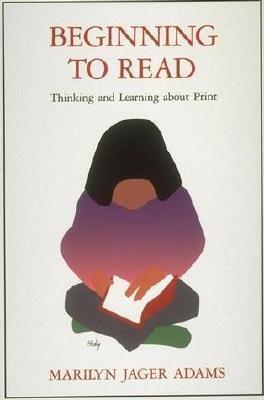
Beginning to Read: Thinking and Learning about Print
Beginning to Read reconciles the debate that has divided theorists for decades over what is the "right" way to help children learn to read. Beginning to Read reconciles the debate that has divided theorists for decades over the "right" way to help children learn to read. Drawing on a rich array of research on the nature and development of reading proficiency, Adams shows educators that they need not remain trapped in the phonics versus teaching-for-meaning dilemma. She proposes that phonics can work together with the whole language approach to teaching reading and provides an integrated treatment of the knowledge and process involved in skillful reading, the issues surrounding their acquisition, and the implications for reading instruction. A Bradford Book
504 pages, Paperback
First published January 1, 1990
Ratings & Reviews
Friends & Following
Create a free account to discover what your friends think of this book!
Community Reviews
Displaying 1 - 10 of 10 reviews

July 2, 2018
Summary: A fantastic overview of reading that breaks down the components of what the act of reading actually is.
I've been researching this topic as I've become increasingly aware that one of the major unfair advantages/advantages one creates for oneself is reading speed. Formal education usually stops at the point at which one demonstrates the ability to open a book. However, if most can only read 15-30pg per hour and I can read closer to 250pg/hr, then I have a distinctive advantage in career, educational acquisition, etc over others. And this gap cannot be overcome by summarizing material in soundbites as has recently been the solution postulated by some companies. After all, I still have the whole book in my head while others have only the summary. Think Crouching Tiger Hidden Dragon.
This book introduces the concept of a skillful reader.
P. 29: "Perhaps the most striking characteristic of skillful readers is the speed and effortlessness with which they can breeze through text."
My client, who has chosen to tackle this issue and provide solutions, recommended this book as a start to understanding the components of reading. Typically students and adults that cannot get their speeds up b/c they are missing some of the micro-facets of reading. It is these facets that slow them down.
Adams does a great job defining these elements in a review of decades of research. I'm going to give them names, though she does not:
P. 30 Visual recognition. "...skillful readers visually process virtually every individual letter of every word they read, and this is true whether they are reading isolated words or meaningful connected text." "Research also negates the notion that skillful readers use contextual guidance to preselect the meanings of the words they will read."
P. 31 Word Recognition. "...readers who are unable to recognize individual letters and spelling patterns quickly, effortlessly, and automatically and to transform them into words and meanings are very likely to choose not to read at all..."
P. 33 Mapping to Definition. "Reading depends first and foremost on visual letter recognition. To be fluent and productive, however, reading also depends on ready knowledge of words - their spellings, meanings, and pronunciations - and on consideration of the contexts in which they occur."
She then describes a 4 processor systems that are bound together that includes: Context, Meaning, Phonological (sound), and Orthographic (visual).
Each of these then has a mound of research and means by which you can further strengthen and stimulate capabilities.
I'm really into this research b/c in a way, what we currently know about how much and how fast the brain can processes is limited by what those that do the research are capable of. But what if my max speed of reading isn't 250, but it's 500? B/c we value reading in a binary format (can or cannot) vs. as a skill like tennis (levels of reading speed) we just don't know. I'm curious for me and my own capabilities, but I'm not even important! What if I could get everyone's speed up to 100pg/hour or even 250? Then people can read a whole book in 2.5-4 hours, if they wanted to... why not? How does the world change? What other amazing innovations and transformations are possible if this is common place?
I don't think this is what Adams was trying to do. But for me and my curiosity - this summary offers a great starting place to think about how you might go about doing that for even the small portion of the population you might be able to influence.
I've been researching this topic as I've become increasingly aware that one of the major unfair advantages/advantages one creates for oneself is reading speed. Formal education usually stops at the point at which one demonstrates the ability to open a book. However, if most can only read 15-30pg per hour and I can read closer to 250pg/hr, then I have a distinctive advantage in career, educational acquisition, etc over others. And this gap cannot be overcome by summarizing material in soundbites as has recently been the solution postulated by some companies. After all, I still have the whole book in my head while others have only the summary. Think Crouching Tiger Hidden Dragon.
This book introduces the concept of a skillful reader.
P. 29: "Perhaps the most striking characteristic of skillful readers is the speed and effortlessness with which they can breeze through text."
My client, who has chosen to tackle this issue and provide solutions, recommended this book as a start to understanding the components of reading. Typically students and adults that cannot get their speeds up b/c they are missing some of the micro-facets of reading. It is these facets that slow them down.
Adams does a great job defining these elements in a review of decades of research. I'm going to give them names, though she does not:
P. 30 Visual recognition. "...skillful readers visually process virtually every individual letter of every word they read, and this is true whether they are reading isolated words or meaningful connected text." "Research also negates the notion that skillful readers use contextual guidance to preselect the meanings of the words they will read."
P. 31 Word Recognition. "...readers who are unable to recognize individual letters and spelling patterns quickly, effortlessly, and automatically and to transform them into words and meanings are very likely to choose not to read at all..."
P. 33 Mapping to Definition. "Reading depends first and foremost on visual letter recognition. To be fluent and productive, however, reading also depends on ready knowledge of words - their spellings, meanings, and pronunciations - and on consideration of the contexts in which they occur."
She then describes a 4 processor systems that are bound together that includes: Context, Meaning, Phonological (sound), and Orthographic (visual).
Each of these then has a mound of research and means by which you can further strengthen and stimulate capabilities.
I'm really into this research b/c in a way, what we currently know about how much and how fast the brain can processes is limited by what those that do the research are capable of. But what if my max speed of reading isn't 250, but it's 500? B/c we value reading in a binary format (can or cannot) vs. as a skill like tennis (levels of reading speed) we just don't know. I'm curious for me and my own capabilities, but I'm not even important! What if I could get everyone's speed up to 100pg/hour or even 250? Then people can read a whole book in 2.5-4 hours, if they wanted to... why not? How does the world change? What other amazing innovations and transformations are possible if this is common place?
I don't think this is what Adams was trying to do. But for me and my curiosity - this summary offers a great starting place to think about how you might go about doing that for even the small portion of the population you might be able to influence.

May 12, 2013
I read this book in 2008. Fascinating look at the separate processors and the interrelation regarding the myriad of skills needed to read. Very technical and brimming with both brain and reading research. I need to read it again because it is impossible to remember all that should be remembered. To those who see teaching reading akin to a calling, the book is such a gift. For those who rage about the right and wrong way to teach reading, don't waste your time. Those would be reading it for the wrong reasons.

April 12, 2011
If you are at all concerned about phonemic awareness and helping your students learn to read, then this is a must-read. It can be very technical, but it's an invaluable resource.

March 1, 2025
This is my Bible. I read this cover to cover when I began my teaching career and treasured the lessons, examples, comparisons, great writing of Ms. Adams. I implemented her lessons in my primary classrooms, even when at the time, whole language was the prevailing cultural practice and the basal readers we were given were woefully inadequate to teach beginning reading to 1st and 2nd graders. Thankfully I was still teaching during CA adoption of new curriculum that had a phonics program integrated in to the literature in the reading text. What a difference it made! And then they abandoned the wonderful lessons learned!
Now I’ve reread most of the book as I’ve begun thinking about the instruction my grandkids received and continue to receive so I can think of ways I can supplement in an engaging way. I can’t believe the science of reading is still being ignored. Shameful, disheartening!
Now I’ve reread most of the book as I’ve begun thinking about the instruction my grandkids received and continue to receive so I can think of ways I can supplement in an engaging way. I can’t believe the science of reading is still being ignored. Shameful, disheartening!
January 21, 2023
Wish I'd read this back in 1990 when it was first published.
It's too bad a lot of people in early education didn't read it, or still haven't read it.
30 years later, and we STILL are not teaching ALL children how to read?
Reading Education Classic
It's too bad a lot of people in early education didn't read it, or still haven't read it.
30 years later, and we STILL are not teaching ALL children how to read?
Reading Education Classic
January 13, 2023
Actually have 2 copies so I can lend out one.

November 1, 2023
Outdated now in terms of a scientific literature review. Nevertheless, still valuable because of how clearly studies are explained and how well concepts are interwoven while keeping the big picture in mind.
Also, this book has a lot on the crucial early precursors of reading, whereas most books on reading focus on elementary school. This is especially important when considering inequities in literacy, because what needs to be taught in school depends entirely on the knowledge and skills the kids are coming in with. The author goes over the research backing up the common sense real-world experience that children in middle-class literacy environments learn letter names first (i.e. singing the ABC song around age 2) then the shapes of the letters (fridge magnets, etc.), then the sounds that go with the letter names and shapes (e.g. their names), and then they begin combining that Alphabetic Principle with concepts from being read to, so that they can start school ready to "learn to read."
Even though the author tries hard to admit the limitations of the existing research, and to find common ground instead of inflaming the "reading wars," the book's sponsor included an afterword rebuttal from the "whole language" side of the war. In the context of the recent developments like Emily Hanford's podcasts, this is of great historical interest for the unfortunately ongoing debate.
This made me think of Four Revolutions in the Earth Sciences: From Heresy to Truth, which is about academic experts stubbornly clinging to dogma as opposed to evidence. It is disheartening that this keeps happening over and over in every field.
Related, also recommended:
Pivotal Research in Early Literacy: Foundational Studies and Current Practices

Also, this book has a lot on the crucial early precursors of reading, whereas most books on reading focus on elementary school. This is especially important when considering inequities in literacy, because what needs to be taught in school depends entirely on the knowledge and skills the kids are coming in with. The author goes over the research backing up the common sense real-world experience that children in middle-class literacy environments learn letter names first (i.e. singing the ABC song around age 2) then the shapes of the letters (fridge magnets, etc.), then the sounds that go with the letter names and shapes (e.g. their names), and then they begin combining that Alphabetic Principle with concepts from being read to, so that they can start school ready to "learn to read."
Even though the author tries hard to admit the limitations of the existing research, and to find common ground instead of inflaming the "reading wars," the book's sponsor included an afterword rebuttal from the "whole language" side of the war. In the context of the recent developments like Emily Hanford's podcasts, this is of great historical interest for the unfortunately ongoing debate.
This made me think of Four Revolutions in the Earth Sciences: From Heresy to Truth, which is about academic experts stubbornly clinging to dogma as opposed to evidence. It is disheartening that this keeps happening over and over in every field.
Related, also recommended:
Pivotal Research in Early Literacy: Foundational Studies and Current Practices

July 27, 2016
Time Machine
Academic Review Of Reading That Is Not Fun To Read, July 31, 2004
This book contains gems: there is no question about that. The `reading-literacy' project was given solid funding by the government and Ms. Adams has done a superlative job of surveying the literature and coming up with reasonable conclusions.
That said, there is a problem. And the problem is that "Beginning to Read" was written for bureaucrats. The straightforward language we might expect from an educator and researcher is therefore made obscure, obtuse, and overly `officious'. [No doubt pleasing to the edu-crats.]
For example, (from page 413; the summary): "It is because of the process of comprehension consists of actively searching the overlap among words for syntactic and semantic coherence that reading depends so critically on the speed and automaticity of word recognition."
[Or, in other words, reading comprehension depends on speed and automatic word recognition so that the nascent reader can make use of syntax and semantics. ]
Not incomprehensible in it's original form, Adam's verbiage is awkward and somehow embarrassing for a book that is supposed to be about `reading' and `comprehension'.
Three Stars. A comprehensive survey of current and past literature, this book attempts--and in my opinion succeeds-- in reconciling the phonics versus whole language camps. However, expect a slog of it. [Unless of course you are an edu-crat in which case the officiousness will sound very convincing indeed-lol]
Anyone else interested in this topic but with less time might find the same information in a `tastier' format in the following books: Mem Fox's "Reading Magic"; and the slightly less digestible "Raising Lifelong Learners" by Lucy McCormick Calkins.
Academic Review Of Reading That Is Not Fun To Read, July 31, 2004
This book contains gems: there is no question about that. The `reading-literacy' project was given solid funding by the government and Ms. Adams has done a superlative job of surveying the literature and coming up with reasonable conclusions.
That said, there is a problem. And the problem is that "Beginning to Read" was written for bureaucrats. The straightforward language we might expect from an educator and researcher is therefore made obscure, obtuse, and overly `officious'. [No doubt pleasing to the edu-crats.]
For example, (from page 413; the summary): "It is because of the process of comprehension consists of actively searching the overlap among words for syntactic and semantic coherence that reading depends so critically on the speed and automaticity of word recognition."
[Or, in other words, reading comprehension depends on speed and automatic word recognition so that the nascent reader can make use of syntax and semantics. ]
Not incomprehensible in it's original form, Adam's verbiage is awkward and somehow embarrassing for a book that is supposed to be about `reading' and `comprehension'.
Three Stars. A comprehensive survey of current and past literature, this book attempts--and in my opinion succeeds-- in reconciling the phonics versus whole language camps. However, expect a slog of it. [Unless of course you are an edu-crat in which case the officiousness will sound very convincing indeed-lol]
Anyone else interested in this topic but with less time might find the same information in a `tastier' format in the following books: Mem Fox's "Reading Magic"; and the slightly less digestible "Raising Lifelong Learners" by Lucy McCormick Calkins.

September 23, 2009
A very scholarly (read: technical) and well-researched book about best approaches for teaching kids to read. Focuses more on analyzing research and it's implications for the classroom than on actual lesson planning.
May 1, 2008
Must read for all teachers in the primary grades!
(Read the summary version tho!)
(Read the summary version tho!)
Displaying 1 - 10 of 10 reviews