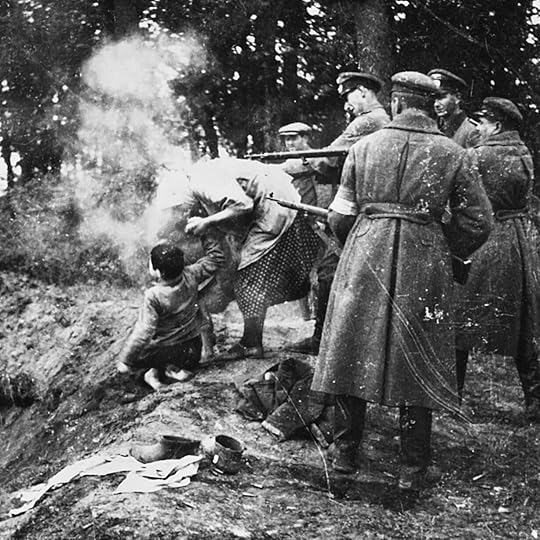
This book unveils the story behind a photograph which depicts the murder of a woman and her young son at the edge of a mass grave in the.Ukraine during World War II - in October of 1941. It is meticulously researched and surprisingly readable given the horrific subject matter. Lower takes apart the various aspects of the story piece by piece - the town of Miropol where it happened, the killers, the photographer, the murdered family, the history of the excavation of the gravesite, and finally what justice what reached.
One of the things that struck was that the murders of the Jewish people in the Holocaust had the goal of destroying entire families. "In 1920, the founders of the Nazi party unveiled their manifesto, the so-called Twenty-five points which called for the restoration of a Greater Germany, the removal of Jews as citizens of the German nation, and the promotion of a racial state. Point Twenty-One declared that the state must care for the nation's health through the protection of mother and child. [...] Images of Holocaust victims, like the Miropol photo of the Madonna like mother and child, reveal how a western aesthetic valuing maternal love and sacrifice can be simultaneously consecrated and desecrated. Nazi policy was two-pronged: family welfare and family destruction." (pg 107)
In light of the recent discovery of the remains of 215 children buried at the site of the former Kamloops Indian Residential School in Kamloops, BC, the thought above haunts me. The goal of the former Indian residential school system in Canada was to "take the Indian out of the child" - a genocide perpetrated by the government of Canada and aided by various churches. Taking the children from their families was an attempt at the destruction of Indigenous peoples' family culture.
***SPOILER ALERT***
In the epilogue of the book Lower goes back to the photograph and looks at a seemingly insignificant part of the the photo - a pair of men's boots sitting on the edge of the ravine that became the mass grave, presumably belonging to the husband of the woman being murdered in the photo, pointing out that as head of the family, he would have likely been murdered first. Lower includes a few stanzas of the poem by Yiddish poet Abraham Sutzkever, "A Load of Shoes"
One of my friends in the book club I belong to hates reading stories about the Holocaust, fiction or non-fiction. She says she's tired of reading about all that death and destruction. As someone who has anscestors with Jewish heritage it is always difficult for me to look away from these images and stories. In Lower's final chapter of the book she addresses need to keep looking at the photos of these atrocities and learning about the stories behind them. . "Atrocity images, especially the rare ones that attest to acts of genocide, the crime of all crimes, offend and shame us. When we turn away from them, we promote ignorance. When we display them in museums without captions and download them from the internet with no historical context, we denigrate the victims. And when we stop researching them, we cease care about historical justice, the threat of genocide, and the murdered missing."
Here's the entire poem described above:
"A Load of Shoes" by Avraham Sutzkever, Vilna Ghetto, January 1, 1943
The cartwheels rush, quivering.
What is their burden?
Shoes, shivering.
The cart is like
a great hall:
the shoes crushed together
as though at a ball.
A wedding? A party?
Have I gone blind?
Who have these shoes
left behind?
The heels clatter
with a fearsome din,
transported from Vilna
to Berlin.
I should be still,
my tongue is like meat,
but the truth, shoes,
where are your feet?
The feet from these boots
With buttons outside
or these, with no body?
or these, with no bride?
Where is the child
who fit in these?
Is the maiden barefoot
who bought these?
Slippers and pumps,
Look, there are my mother’s:
her Sabbath pair
in with the others.
The heels clatter
with a fearsome din,
transported from Vilna
to Berlin.