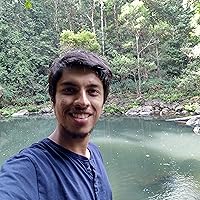
Born and raised in Bangalore, Vikram Sampath completed his schooling in Bangalore at the Sri Aurobindo Memorial School and Bishop Cotton Boys' School. He thereafter obtained a Bachelors in Engineering in Electronics and a Masters in Mathematics from one of India's most reputed schools, BITS-Pilani. He then went on to obtain an MBA in Finance from S P Jain Institute of Management and Research, Mumbai. Vikram has worked in many leading multinational firms like GE Money and Citibank and currently is a Team Leader with a information technology company in Bangalore.
His first book, Splendours of Royal Mysore: The Untold Story of the Wodeyars has been widely acclaimed across India, and has been termed as one of the most definitive accounts on the Mysore royal family in recent times. His second book "My Name is Gauhar Jaan!" - The Life and Times of a Musician is the biography of Gauhar Jaan, India's first classical musician to record on the gramophone. The book has been hailed by several luminaries in India and abroad, and has also won the prestigious ARSC (Association of Recorded Sound Collections) International Award for Excellence in Historical Research - the first Indian book to have ever won this honour. Vikram's third book Voice of the Veena: S Balachander - A Biography narrates the story of eminent Veena maestro late Padmabhushan Dr. S Balachander.
Vikram has been a Fellow at the Institute for Advanced Study (Wissenschaftskolleg) in Berlin, Germany (for 2010-11) where he studied the early gramophone recordings of Indian music. He has also established the Archive of Indian Music (AIM) as a private Trust that seeks to digitize and preserve old gramophone recordings of India.
Vikram publishes regularly in leading Indian dailies and magazines on a wide array of topics. In addition, Vikram is also a serious student of Carnatic Classical vocal music and has been training under various eminent practitioners of the art form. Subjects related to history, music, art and culture are close to his heart.
Politics, geography, demography, economy, art and many other elements of chronology related to Mysore are explored in such a way that the truth of the Mysore since the fall of Vijayanagar to the neutralization of the Wodeyars by the East India Company becomes apparent with every section of the book, With the author's extensive knowledge of Music the heriatge of musical landscape is documented in great detail, there were also many instances the author has made the crux of court scenes come to life; with many paramanas and technical details on the art, he highlights the dominance of Indian Art by and that has yet to become a renaissance Understanding the battle strategy, dynamics of holding people, and the key decisions made by women at that time helped Mysore survive throughout various seasons. It is a maze of information to contemplate. You will be captivated throughout the journey - but, until you realize that you are are an avid history buff, it will be cumbersome process to complete this book.
Vikram Sampath has made a great effort in telling the story of the 600 year old Wodeyar dynasty of Mysore. The author has covered the entire history of Mysore in great detail. The golden era of Raja Wodeyar, Ranadhira Kanthirava Narasaraja Wodeyar, Chikkadevaraja Wodeyar are extensively covered. How Mysore emerged as one of the major powers in south India is described very well. The decline of the dynasty after the reign of Chikkadevaraja Wodeyar and the rise of Haidar Ali and Tipu Sultan are covered. The Anglo-Mysore wars and the complex character of Tipu Sultan are described excellently. Author has written about both aspects of Tipu. Tipu's military genius, bravery on one hand and his bigotry and atrocities on the other hand are both covered in detail. Kudos to the author for providing both sides of the story.
The fall of Tipu and the return of the Wodeyars to the power due to the incredible spirit of Maharani Lakshmammanni are covered. The role played by the great statesman Dewan Purnaiah in governance under Mummadi Krishnaraja Wodeyar is described very well. The mixed rule of Mummadi Krishnaraja Wodeyar is covered. On one end, arts, culture, music flourished under him but law and order declined, prompting the British to take control of the kingdom and appoint commissioners to govern the kingdom of Mysore.
The rule of benevolent British commissioners like Mark Cubbon and Bowring have been described and their contributions have been mentioned. The efforts of Mummadi Krishnaraja Wodeyar to get back his kingdom, how he redeemed himself, and the issue of rendition is worth reading. The rule of the reformer king Chamarajendra Wodeyar-X is an excellent read. What a great man he was. Reading about Rajarishi Krishnaraja Wadiyar-IV made me cry. He was easily the greatest king in the modern history of India. Role played by visionary dewans like Seshadri Iyer, Rangacharlu, Sir M Visvesaraya, Sir Mirza Ismail in improving Mysore is a joy to read.
The incredible contributions of Jayachamarajendra Wadiyar and his rule which coincided with Indian independence is covered very well. How Mysore became the best governed state in India and one of the best governed states in the world is a joy to read. Mysore was a hub for culture, literature, arts, architecture, literature, dance, and music. All these details are excellently covered . The benevolent rule of the Mysore Maharajas laid the foundation on which the modern state of Karnataka was built. Reason why Karnataka is now a hub for science, technology, and innovation in today's India is because of this foundation laid by the Mysore rule. Hats off to Vikram Sampath for writing such an amazing book. It's a must read for everyone who wants to know about the history of Karnataka
Brilliant effort by the author. Yes, may get somewhat boring because not all parts of the book are as bright, but can't stop commending the author for his efforts. The author is from Mysore region, but has made a reasonable effort to be neutral and not biased to the kings/clans of Mysore. May be somewhat terse/dull in places and the book may be slightly long (covers from 1300s to 1900s), but I would definitely recommend it if you're a history buff.
P.S.: I'm very much interested in the history of South India, and had a general idea of its kingdoms/history before reading this book, and hence I like it very much.
Look nowhere else for a more comprehensive yet elaborate and detailed description of the history of Mysore. This book will definitely tell you all that happened in the province with a satisfying peep at the neighbours as well.
Splendors of Royal Mysore is the first book by the new-age historian Dr. Vikram Sampath. The author traces the 600-years history of the Royal House of Mysuru, starting from 1399CE. The book looks at the high of the glorious Vijayanagar Empire and its fall, the rise and decimation of Srirangapatanam and the foundation of one of the oldest extant dynasties of India, the Wodeyars and its struggle for survival against the Islamic rule and foreign colonizers. Dr. Sampath gives a detailed account of the marvelous heights the Empire attained and the horrific pits it fell down in under the rules of various Maharajas with ample references and citations from contemporary and historical studies and documents. The book is a well-rounded documentation of the Royal Mysore under the changing leadership, the socio-political-economic changes that occurred in India and worldwide during its six-centuries long history. The power and class struggle, intrigues and treaties, the human greed and ingenuity, the evolving art and culture; all the various aspects when combined together gives a fuller picture of the history of any period. This is the first book by Dr. Sampath, however, his narration style, the deep research that shows in the vast canvas of 600-years' time-period he draws on, the ample references shared belies this fact. The author has tried to give his writing a secular tone and leave the readers with his questions and his thoughts to decide for themselves but at times they come out as biased and gives us glimpses of how we have been conditioned in our study of Indian History by decades of distortions and misrepresentation. The book also drags at few places and could have been edited better or trimmed down. Overall, it's a good book for people who like to read on Indian History and delve deeper into the great empires of the eras gone by.
Vikram Sampath needs to be applauded for the sheer detail he brings on the history of Wodeyars and the Mysore state right from AD 1399 - 1947. This is a pretty long timeline and the author has painstakingly covered different aspects of the society during this time. In times when armchair historians bring their political leanings in interpreting history, the author steadfastly maintains a neutral perspective. This is amply clear when reading the Interregnum period of Haider Ali and Tipu Sultan. Tipu and Haider Ali's indiscriminate violence and conversion in Malabar region is covered as much as their administrative rule and their opposition to British rule. Thankfully he also presents an unbiased picture of Wodeyar rule criticising the weak rulers and the effect they had on the Mysore state.
Two issues I have with the book though: - It needs to be edited and made a little more concise. Parts of the book are repeated and would do good with a thorough editing - The kindle version of the book needs to be properly proof-read as there are spelling errors at several places.
“The Splendours of Mysore” by Vikram Sampath is a rich dive into the history of Mysore and the Wodeyar dynasty. I was genuinely captivated by how deeply researched it is. Sampath skillfully balances intricate details with a narrative flow that kept me fully engaged, making the complex history of Mysore easy to absorb. The book is quite thick as each king gets his due as Sampath navigates through their political intrigue and cultural contributions, trying his best to distinguish between myth and facts.
What especially struck me was the detailed treatment of the Haider Ali and Tipu Sultan era. Sampath dives into their reigns with the same balanced approach, giving credit where due—be it Tipu’s military innovations or Haider Ali’s strategic prowess—while also pointing out their flaws or missteps. What I appreciated is that Sampath doesn’t romanticize any of the great rulers blindly. If a ruler fell short or made questionable decisions, he doesn’t shy away from critiquing them. That honesty makes the history feel even more authentic. If you’re curious about parts of India’s glorious past, this is a must-read. It’s both enlightening and entertaining!
Royals of Splendour: Mysore by Vikram Sampath is an extensively researched masterpiece spanning over 800 pages. It meticulously traces the journey of the Wadiyar dynasty, from Yaduraya to Jayachamaraja Wadiyar, covering over 600 years of their rule.
The book captures the dynasty’s tumultuous struggle for power and survival, weaving together anecdotes, legends, stories, and well-documented historical facts about the Wadiyars, the princely state of Mysore, and the rich heritage of Karnataka.
It stands as a remarkable encyclopedia on Mysore and Karnataka’s history. Gratitude to Vikram Sampath for bringing this monumental work to life.
My thirst to know the history of my state has been quenched by this Book. It's a thoroughly researched history of Karnataka, written in a simple language. On controversial issues like Tipu Sultan, Vikram places all the facts and divergent views before the readers and leaves the judgment to the reader. His coverage of the language, culture, and arts of the time is unparalleled and only someone who is in love with the State and its culture could have captured its beauty in such depth. This book covers the period till India attains independence.
As the title suggests, a very detailed history of Mysore. The author states that his idea was to write a balanced, unvarnished history of the Wodeyars. Well, I must admit that he has more or less succeeded in this- but unfortunately, it has come at the cost of readability. The book is like reading an NCERT textbook on history. The storytelling is missing for most of the book- the exception however is when it comes to Hyder Ali and Tippu sultan, which is quite captivating. Perhaps their story itself was such that, being fascinating could not be helped.
It helps to have a visual map of Southern India or at least a good familiarity with its geography to visualize the stories- without which it becomes a mundane read.
This is an exceptionally well written book with an astoundingly voluminous collection of names that have contributed to the vast richness of the culture of Mysore. It has to be a herculean effort to gather information and to compile it so well.
On my own, I would never pick a 700-page history book! It is due to the Indic Book Club that I have this book in my possession. Oh, what a treasure it is. There is no way that I think I am qualified to 'review' such a book but doing so only to express my joy at having read it.
My first thought was, the cover is lovely.
About Haider Ali and Tipu We had seen the TV show Tipu Sultan when we were in school. That was all the knowledge I consciously remembered about Mysore. My parents had taken me to Mysore Palace when I was six years old and shared a bit of the history with me. But over time, the Wodeyars were wiped out totally from my memory and planted firmly upon it was the glorious empire of Tipu Sultan. I now believed the Sultans had ruled Mysore forever. Imagine my surprise when I discover that their rule was limited to the two kings, (Haider Ali and Tipu) and lasted for a mere 39 years.
About the Wodeyar Dynasty Vikram Sampath's painstaking research reflects in every page. He has included every myth and every fact connected to Mysore. The book is objective and impressively clear of all biases. He said what is as is. He dismissed myths with logic and reasoning. He supported facts with more facts and more logic.
It was truly a delight to read about the genesis of the Wodeyar dynasty. Raja Devaraya of Dwarka (in current-day Gujarat) had everything going for him. Yaduvanshis of the Lunar dynasty, drew their ancestry from Krishna himself, his kingdom was successful peace prevailed all around. He had two worthy and brave sons Yaduraya and Krishnaraya, who could take over from him when need be. But there is a calling. Now his son Yaduraya has to leave his palace and travel to the South of the Vindhyas, to the Kingdom of Mahisuru where he must take the darshan of Mata Chamundeshwari. Little would anyone know that Yaduraya would eventually become the leader of thirty-three villages and... that his little reign would morph into the prosperous and powerful Wodeyar Empire that would thrive for centuries, till 1947... and even after that.
As one reads, the personalities of the various kings come alive. The impact of their policies on the cities can be visualised. For instance, one Wodeyar King who was so particular about details that he would personally test the weapons and animals for his use before approving them. His capital city was abundant with delicious fruit trees, sprawling multistorey mansions, and numerous temples brimming with cows and Brahmins. At other times, we see uninspired Kings who let their kingdoms slip into the hands of their ministers. Interestingly, there is abundant mention of the sacred religious practices followed by the Wodeyar Kings (as mentioned in their own records) and the fascinating miracles made by the presiding deities of the land.
The dynasty is not mentioned in isolation. When one reads one does understand that this dynasty consolidated the pieces scattered after the brutal collapse of the grand Vijayanagar Empire. Meanwhile, we are kept abreast with the steady rise of the Maratha Empire and the Mughal Empire's struggle to survive.
The mystery that was Tipu There eventually is no mystery after all. Yes, he was brave and formidable opposition to the British but at the same time, there are ample state papers in Tipu's own handwriting among other documents with instructions detailing how the non-Muslim soldiers should be killed (slowly and cruelly), how their Hindu wives must be distributed among 'musalmans' and other such instructions that were equally depraved. Clearly, a lot was not included in the TV serial, 'The sword of Tipu Sultan' which I sat and watched as a ten-year-old girl, rooting week after week for the brave, righteous and patriotic Tipu portrayed on TV.
The book covers British rule and the struggle for Swaraj, obviously. Then there are entire chapters on classical music, dance, popular arts and traditions, architecture, paintings etc. of the time.
The six pages of the bibliography suggest the mammoth effort and research that has gone into this magnum opus. It is a monument built on every detail available on the 'Wodeyars'. A treat for history readers. A treasure trove of information and a delightful read. It is six hundred years compressed into 700 pages.
Review of ‘Splendours Of Royal Mysore: The Untold Story Of The Wodeyars’ by Vikram Sampath: #1000reviewersclub #indicbookclub This is the fifth book I have received from Indic Book Club. My thanks and heartfelt gratitude to Abhinav Agarwal sir for giving me this opportunity. I will start the review with an honest admission that I am not the fittest person with the right type of competence to review this book. This book requires immense addiction/knowledge to history, strong permeation capacity and intense focus/concentration. I may not tick off all the necessary boxes. Anyway, in my view, the book has the same point as its Pro and Con. Pro : very INFORMATIVE Con: VERY informative This is a huge project to take up on and the author should be applauded for that reason alone. However, the writing style got a bit textbook like in some places – I could almost hear my history teacher shouting at me “ Hey Arunita, write a short note on the Fourth Anglo-Mysore War” and shuddered. A bit more sharp editing could have done away with some unnecessary loose fat from the book. Other than that this is truly a magnum opus!!! Loved the photos. Those were really an added bonus. If you are a history buff, you can definitely give it a go.
Although I admire Vikram Sampath and have appreciated his books on Savarkar & Gauhar Jaan, his history of Mysore disappointed. It's exactly what a history book meant for the general public ought not to be: it's all about 'maps and chaps'. A whole litany of rulers and ministers and generals and battles and geographies won and areas lost.
Sampath obviously did a lot of research before writing this, his first book perhaps. And was apparently loathe to discard any of his material. So this thick book is crammed with boring details. So boring that I went through most of the book just turning the pages.
Quite a comprehensive history of Mysore which I was just not aware of. In some cases, the quoting of entire sections from references does give it a lot of depth though it also leads to dragging it a bit. The reference sections and the notes also take up quite a big portion of the book pages. Wonder if those can be made more succinct
My interest in Vikram's books was piqued after reading his books on Savarkar and he seems to have selected an ecelectic choice of subjects
This is a ambitious effort by the author, but the ambition doesn't get enough justice. Stress is never given on interesting content, instead the reader faces walls of text and information to point where it reminded me of my high school history text books. As you approach the end of the book, it is as if the author has lost all hope and quite helplessly quotes paragraph after paragraph of text from other books and un important letters. I might be too critical of the book as writing about an entire dynasty spanning centuries is not easy. Although the research has been done right, it stops at that and the content of the book in no way captures your imagination.