Nan Weaver has made a life of her own. From a working-class background and a conventional marriage, from years of boredom and too much booze, she has emerged in middle age as a professor at a prestigious university, a feminist, a woman who has chosen friendships rather than romance.
Now she is fighting: for women's freedom from fear on the one hand, and for tenure - the right to know she can go on teaching - on the other; and to reconcile her past with her present, her relationship with her sister Shirley with her commitment to her students.
Then there is a murder in the English department. The victim is a colleague well known to Nan as a man who sexually harasses women. And Nan is known as the woman behind the university's growing campaign against sexual harassment.
Murder in the English Department is a story about loyalty, ethics and love, a novel of ideas suspended against an untraditional murder mystery. It is also a story about women, about women understanding each other's differences, respecting each other's choices, needing each other's support.
Valerie Miner is the award-winning author of fifteen books. Her new story collection, Bread and Salt, will be published in September, 2020. Her latest novel, Traveling with Spirits, will be published in September, 2013. Other novels include After Eden, Range of Light, A Walking Fire, Winter's Edge, Blood Sisters, All Good Women, Movement: A Novel in Stories, and Murder in the English Department. Her short fiction books include Abundant Light, The Night Singers and Trespassing. Her collection of essays is Rumors from the Cauldron: Selected Essays, Reviews and Reportage. In 2002, The Low Road: A Scottish Family Memoir was a Finalist for the PEN USA Creative Non-Fiction Award. Abundant Light was a 2005 Fiction Finalist for the Lambda Literary Awards. Valerie Miner’s work has appeared in The Georgia Review, Triquarterly, Salmagundi, New Letters, Ploughshares, The Village Voice, Prairie Schooner, The Gettysburg Review, The T.L.S., The Women’s Review of Books, The Nation and other journals. Her stories and essays are published in more than sixty anthologies. A number of her pieces have been dramatized on BBC Radio 4. Her work has been translated into German, Turkish, Danish, Italian, Spanish, French, Swedish and Dutch. In addition to single-authored projects, she has collaborated on books, museum exhibits as well as theatre. She has won fellowships and awards from The Rockefeller Foundation, The McKnight Foundation, The NEA, The Jerome Foundation, The Heinz Foundation, The Australia Council Literary Arts Board and numerous other sources. She has received Fulbright Fellowships to Tunisia, India and Indonesia. Winner of a Distinguished Teaching Award, she has taught for over twenty-five years and is now a professor and artist in residence at Stanford University. She travels internationally giving readings, lectures, and workshops. She and her partner live in San Francisco and Mendocino County, California. Her website is www.valerieminer.com
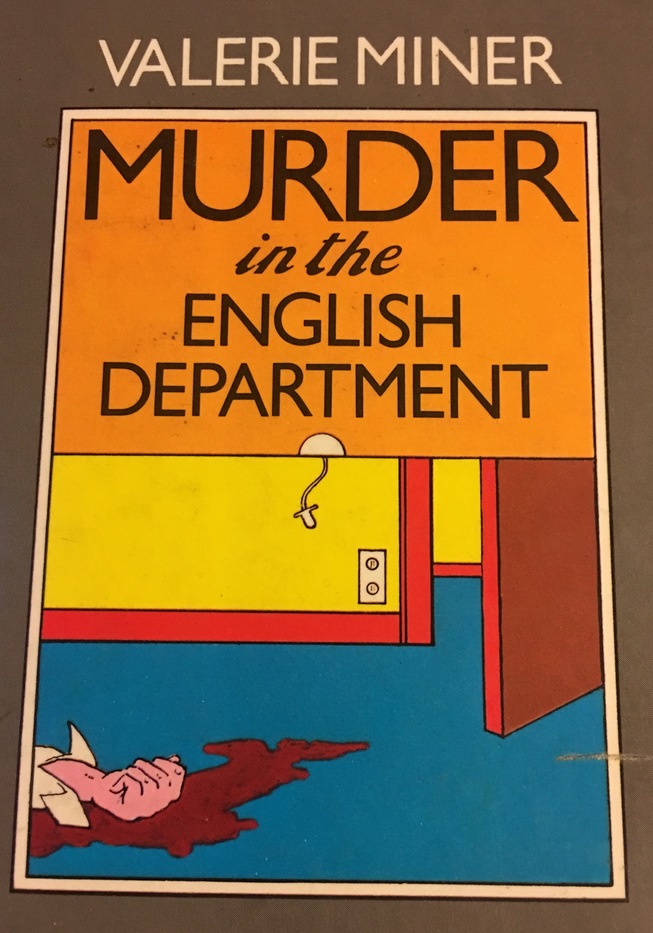
Library sales in my town are (on opening day, in the early hours) a bit like Walmart at Christmas time: if you hope to get a good haul, you shoulder in and fill your basket quickly and grabbily and somewhat indiscriminately before the tables and shelves end up like carrion leavings. The title and cover for this book
made it seem like a pretty safe and generic choice to grab while elbowing someone in my path to shinier treasures. It turned out to be, well, other than I was expecting. There is indeed a murder. In the English Department of Berkeley, no less. But it's all just window dressing for a platform of women's rights campaigning. I don't say that in disappointment; it was a pleasant surprise.
Murder in the English Department is an early offering from an author who has gone on to win awards and fellowships and be recognised as a distinguished Professor.
The book deals with women's rights on University campuses, and waxes hard on the very real struggles of strong women in both their professions and their home lives. It's important stuff, and I applaud anyone who sensibly and intellectually tackles it in literature. Still, this felt very much like the early offering that it was. Perhaps it felt different when it was first published, but it seemed a bit cliched in it's presentation, and more self-righteous than impassioned. The tie-in to the actual action was weak, and I found myself disinterested. Not unhappy, but not invested either. And alas, indifference is one of the worst reviews I feel like I can give.
Perhaps someday I will track down one of her most recent novels. I'd like to see if her voice and style has evolved.
The first mystery to be solved here is trying to figure out why this book was accepted for publication, especially by St. Martin’s, who published the original hardback edition in 1982. In the first chapter the author describes a scene by having the protagonist, Nan Weaver, talk first to herself, then to her car about what she is seeing. Then she spends a long paragraph in which Nan tries to convince herself that holding a conversation with her car is not crazy. Then there is a loose transition to a faculty party where a clichéd and forced couple of conversations fix Nan as a rabble-rousing feminist. Now it is good that Nan is a rabble-rousing feminist; in fact the plot is based on this. But jeez, there would have been so many better ways to establish this.
It’s hard to decide which of the two major settings—the Berkeley campus or Nan’s sister’s house in a nearby city—is the more unpleasant. Both host a number of stock characters that say and do things exactly as you expected them to but hoped they wouldn’t. Reading this book was like watching clothes dry; it was a chore to make it through almost every single page.
The book is not a mystery, despite the title. Instead, this story about the murder of a college professor reads s more like a feminist tract than literary fiction. Nan’s friend Amy is a ‘feminist lawyer,’ her friend Francie is a ‘feminist therapist,’ and her niece, mousy as she is, is a member of the ‘feminist caucus.’ Nan, in fact, thinks she knows who murdered the professor but keeps silent to protect a sister—even to the point of going to jail herself. These are all important and good things, but none are presented very comfortably or very interestingly.
The book has been reprinted several times by several different publishers, but in sampling the most recent e-book edition, I can’t see that any of the very necessary edits have been made. Call it a curiosity from the 1980s feminist movement and read it after you have read everything else first, but don’t give it more than 2 stars.
Note: This review is included in my book The Art of the Lesbian Mystery Novel, along with information on over 930 other lesbian mysteries by over 310 authors.
Early, 1983, feminist mystery involving getting tenure versus outspoken feminist politics. Not the best writing or plot ever, but worth picking up at the sidewalk sale of your local feminist bookstore (you know where that is, right?).
What an odd book. It's an academic mystery set in Berkeley. It's strangely heavy-handed and focuses on "big issues" such as feminism and class. While Miner aims to present nuanced characters, they seem more like stereotypes. Not subtle at all.