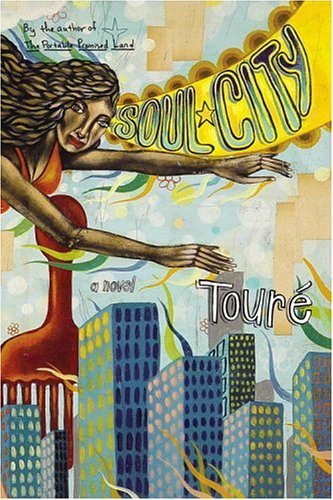
From the wildly popular author of the groundbreaking debut The Portable Promised Land comes an inventive and hilarious first novel about an African-American utopia threatened by the darker side of human nature. Welcome to Soul City, where roses bloom in the cracks of the sidewalk along Cornbread Boulevard, musical genres become political platforms, and children use their allowance money to buy records from the Vinyl Man. Its an unusually peaceful and magical American community with a strong heritage and sense of unity--at least, thats how journalist Cadillac Jackson first finds it. When Jackson visits Soul City on a magazine assignment, a mayoral election is imminent and candidates from opposing parties are battling to control the citys soundtrack. Amidst the increasingly hostile campaign, Cadillac falls for Mahogany Sunflower, a beautiful Soul Cityzen, and begins a struggle to shed the embattled African-American identity hes been taught to adopt, in order to exist in a community where the content of his character really does determine a black mans identity. What he discovers reveals as much about himself as it does about human nature and the meaning of race in America.
Toure, Toure, Toure...trying so desperately to be looked at as a "new Negroe", as one who broke the mold, apart from the pack Negro. Soul City, the city of Harlem in a fever dream, where every possible Black Stereotype exists, is scathingly satirized, and chronicled. But while Toure thinks he's tipping sacred cows, he's only adding himself to a long list of authors and comedians willing to "go there". The only difference that I can see is that those others, Langston Hughes, Pervical Everret, Rchard Pryor, and Chris Rock to name just a few, have done it with love while your observations seem full of self hate and malice. I get enough of that from history books, movies and television...Oh thats right, you comment for CNN nowadays, don't you?
Terrific idea; so-so execution. I like Toure as a journalist, and that includes both his roles as music critic and defender of all-things-black. And I like the concept here of both celebrating and commenting on black culture through a series of references and symbols from pop culture, music, literature, and history. But I feel like, as symbols, most of them are underdeveloped, and not as clever as Toure might like to think. The characters are flat, the central narrative very loose, and the prose a little awkward, particularly as far as the dialogue goes. But the book's episodic nature means that, for every segment that falls flat, there's one that's rather enchanting, profound, or at least memorably weird, so the thing is definitely worth reading. Quick, too!
I read Soul City several years ago, and what I really liked about it was the fantastical trip it took me on. I literally felt like I was in an alternate universe with musical beings living a supernatural life. And it was so visual. I laughed out loud often at his characterizations and descriptions. I could literally hear the music as I was reading. I disappeared into it every time I read a story. I feel you on the disjointedness, but it put me in the mind of Pulp Fiction. You just kinda have to get it when you get it. I like people who are able to take me places. I missed that world when I finished the book. It was out there though...that boy has some imagination and unique way with words- just like a good writer should.
I selected this book for my book club. I'll say when I picked it up I purchased it purely on watching his pop culture segments on CNN, specifically during the primary election season.
While on the surface, while reading this book my first thought was this is some crap. But after you continue to read there are a lot of deeper issues planted within. He may take a satiracal approach but it broaches real issues in the African American community. Specifically dealing with our lack of pride, things that derail our focus to our main purpose. In addition it also targets ways we take advantage of one another or we blindly follow our own.
Soul City was just okay. While the story gives interesting commentary about black culture and stereotypes, it is a bit all over the place. I really had a hard time connecting with the main character, Cadillac Jackson. In fact, he is not really the main character, Soul City is. And while all of the stories were funny, witty, and clever and some thought provoking, the overall story was disjointed.
I was pretty into this book. Not quite at first, but it stuck faithfully to its own mythology, and was a smart, very smart and inventive look into what it means to be black in America. Tongue and cheek and simultaneously entirely serious, this book accomplishes what it sets out to do and is magical, devastating, and uplifting.
What a romp! Cadillac Jackson, the Big Mama's, Jigaboo Shampoo: it's just a crazy bit of black fun. It's not a serious read - but it did make me think about why some things are only racist when they come from outside the race. There would be a hit out on this guy if he wasn't black, and it would probably be justified. All that aside, it's a great, fun book.
This was pretty disappointing. I LOVED The Portable Promised Land, and was feverishly looking forward to a novel's worth of Soul City. But it seemed that Toure didn't really know what he wanted to communicate to the readers.
The idea of Soul City as a metaphor for American black culture is an intriguing one, put to beautiful effect in The Portable Promised Land. But in this book, nothing really develops, and there were missed opportunities to expand on previous concepts. Like, for instance, who exactly WAS the vaguely sinister George Burns-lookalike who owned the apparent Club of the Damned? Almost certainly the Devil hisself, but he didn't so much as make an appearance. I was hoping for at least a few more details on what the Lost Soul waitstaff had done to earn their fate, but no such luck.
In The Portable Promised Land, there was a three-story arc that followed the career trajectory of a militant female rapper. Her philosophies were eloquently angry enough that I got a tingling between my shoulderblades asking me where I was going to be hiding my white ass when the Revolution came, but by the end of the third story I'd been brought to a heartbreaking sadness by her eventual fate. Nothing in Soul City came near that kind of character development, and I regret that.
Short, easy read. Fun and light, most of the time, but sometimes I think the author was trying hard to add a "message" or drive home a point that wasn't necessary if this was supposed to be fun and light. I like Toure and appreciate his cultural critiques - his MSNBC show is cool, he's a prolific Twitter-er, and he's written some fantastic pieces elsewhere. . However, this book was not one of his more explicitly deep or thought-provoking pieces (unlike his Who's Afraid of Post-Blackness?, which I enjoyed much more). It includes many, many references to culturally significant musicians, historical events, and racial/ethnic stereotypes. He turns many of these on their heads, which is interesting but not necessarily too far from Blaxploitation, IMHO. Besides that, it was choppy and uneven in places, and sometimes the plots and subplots got too fantastic (people fly, some eat magical biscuits)....I wanted to like this book more than I actually did, and my disappointment is reflected in the low number of stars I've given this.
This is one of the funniest, most imaginative books I've ever read. Ostensibly about "Cadillac"- a journalist trying to describe "Soul City" for a book, this is an accurate vibe of black life. It rolls along; no, it hops, skips, jumps--it carries you along with it on a melliflous spoof/parody of everything black & our attitudes toward it. Fun reading!
Most of Soul City bops along like an acid-fueled funk song. Over the top characters in an over the top city and its hard truths roll over you like warm waves. Soul City is part allegory, part fairytale, part Black history. The story ends suddenly, each loose end tied up in its own small paragraph, and it is most unsatisfying because it feels like a copout.
this is the most skillful hideous/gorgeous magi-real satire book by a U.S.American that i've possibly ever read. very garcia marquez. very loving and critical of "Black culture." can't claim to have caught ALL the references and ALL the cameos but... so glad i stumbled upon it in the stacks.
A decent follow up to the Portable Promised Land, this was indeed an entertaining read, though it's tongue-in-cheeck cynicism and reliance on pop references to keep it's satirical narrative going get somewhat tiresome.
I LOVED this book! It pulls a lot from African American history to build the characters and tell the story. Very creative in how it is written and "soulful", but not in the way you'd expect
I'm sure this was meant to be a fable, but it came across flat, stereotypical, and racist to me. I guess I'm not able to read it through the right lens.
\The imaginative book tells the history and current happenings of Soul City, a fictitious Harlem on steroids. I loved it. I wish it were real and I could escape there during a bout of race fatigue