

What do you think?

The Autobiography of Fidel Castro
An audacious “biography” of the ex-president of Cuba told in Castro’s own outrageous, bombastic voice.
Prize-winning author and journalist Norberto Fuentes was once a revolutionary: a writer with privileged access to Fidel Castro’s inner circle during some the most challenging years of the revolution. But in the late 1990s, as the regime began sending its oldest comrades to the firing squad, he became A Man Who Knew Too Much. Escaping a death sentence and now living in exile, Fuentes has written a brilliant, satirical, and utterly captivating “autobiography” of the Cuban leader—in Fidel’s own arrogant and seductive language—discussing everything from Castro’s early sexual experiences in Birán to his true feelings about Che Guevara and his philosophy on murder, legacy, and state secrets. Critics have long admired Fuentes’s writing; one U.S. article called him “Norman Mailer’s Cuban pen pal.” Akin to Gertrude Stein’s The Autobiography of Alice B. Toklas, or Edmund Morris’s Dutch, this wickedly entertaining, true-to-life masterpiece is as imaginative and outsized as Castro himself.
Prize-winning author and journalist Norberto Fuentes was once a revolutionary: a writer with privileged access to Fidel Castro’s inner circle during some the most challenging years of the revolution. But in the late 1990s, as the regime began sending its oldest comrades to the firing squad, he became A Man Who Knew Too Much. Escaping a death sentence and now living in exile, Fuentes has written a brilliant, satirical, and utterly captivating “autobiography” of the Cuban leader—in Fidel’s own arrogant and seductive language—discussing everything from Castro’s early sexual experiences in Birán to his true feelings about Che Guevara and his philosophy on murder, legacy, and state secrets. Critics have long admired Fuentes’s writing; one U.S. article called him “Norman Mailer’s Cuban pen pal.” Akin to Gertrude Stein’s The Autobiography of Alice B. Toklas, or Edmund Morris’s Dutch, this wickedly entertaining, true-to-life masterpiece is as imaginative and outsized as Castro himself.
- GenresBiographyNonfiction
567 pages, Hardcover
First published June 30, 2004
About the author
Norberto Fuentes
34 books11 followersJournalist, award-winning fiction author, and former member of the Cuban revolution, Norberto Fuentes has written ten books, including Hemingway in Cuba. His work has been praised by writers such as Italo Calvino, William Kennedy, and Gabriel García Márquez. He left Cuba in 1994 and now lives in exile in Florida.
Ratings & Reviews
Friends & Following
Create a free account to discover what your friends think of this book!
Community Reviews
Displaying 1 - 16 of 16 reviews

September 27, 2009
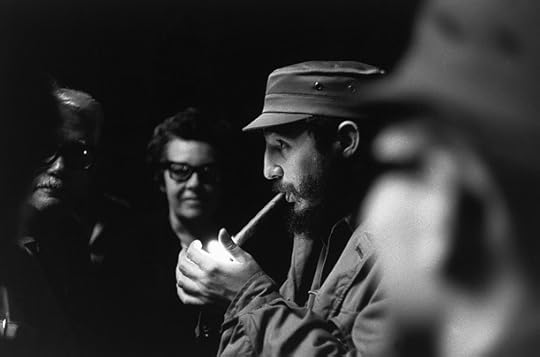
why do the bad guys always dress better? JFK was alright in his saville row suit and brooks brothers shirt, but really - the fascists communists and tyrants are mean bastards but they look cool and iconic and iconoclastic. compare fidel and some of his american counterparts through the years:

badass. (check out che and camilo on the side)

gross.

aaaaaahhhhh!

the flight suit actually makes him look like an even bigger douchebag.
i must admit that obama looks pretty cool.
but that might be just because i'm a skinny whiteboy and he's a cool black guy.
anyway...
even more than neologisms, i love fauxgraphies (faux-biographies -- yes, you're welcome). borges is really the grandaddy of the form, telling fantastical tales about all sorts of readers writers thinkers and explorers in the form of the short fauxgraphy or faux-bibliography. i haven't read alice b. toklas, but that's a biggie. and you've gotta love dutch, edmond morris's courageous demented and thoroughly kaufmanesque take on the reagan presidency.
so charles slaps a bigass 570 pg ARC in my hands called THE AUTOBIOGRAPHY OF FIDEL CASTRO by norberto fuentes and i crap my pants. check it: fuentes was a journalist in deep with castro and the inner circle and skips outta coo-ba in the 90s, settles in miami, writes a few books about hemingway, and now an 'autobiography' from castro's perspective.
about 12 years ago, running around manhattan all brash outrageous and free, shooting all kinda grungy & pretentious-as-hell 16 mm films (an all female western on the streets of queens! horrible! an adaptation of the flannery o'connor story 'good country people' in a small church in brooklyn. puke!) i wanted to figure a way to make a narrative film without characters. i was kinda obsessed with the ineffable beingness of objects (youth! more puke!) and was bowled over by the 'missed meeting' section of antonioni's l'eclisse... never could figure a way to do it because it could never be interesting in anything but the short or experimental form. narrative art, for the most part, is a lot of sound and fury obscuring or illuminating one thing: human behavior. and this is why i love biographies. they offer a history lesson through the eyes of a character. easier to identify with a character than a sequence of events.
[image error]
but biography is a pile of bullshit. and this is why i love the fauxgraphy: it's all out on the table. all those annoying but kinda interesting modernist and pomo-ey questions about identity and fact and fiction and authorship and authenticity and (the impossibility of) truth are all over the fauxgraphy. and it doesn't even have to make the slightest effort! (in fact, it works best when played straight) all that junk is an intrinsic and inherent part of the whole mess and the 'faux' part is kinda giving it to you right there, eh? in plain words: no bullshit. they're serving you a steaming pile and they ain't rebranding.
well, i really loved this one. but i can't say most will. it's a strange strange bird. and it makes me wanna do a few things:
1. smoke a cuban cigar.
2. chop off the top of a pineapple (with a machete, naturally), scoop out the meat, fill it with rum, sit it in the freezer for a week, and then get stupidly drunk with a cuban senorita under a palm tree rimmed with moonlight.
3. start a revolution.
4. go to cuba before the castros kick off.
i priced jetblue flights from l.a. to the dominican republic. CHEAP AS HELL. i figure from the DR i can skip into haiti for a bit than hook a flight (a boat?) to cuba. gotta get there before the castros die. that day comes and: MTV SPRING BREAK HAVANA BAYBEEEEEE!!!!!

gross. so so gross.
badass. (check out che and camilo on the side)
gross.
aaaaaahhhhh!
the flight suit actually makes him look like an even bigger douchebag.
i must admit that obama looks pretty cool.
but that might be just because i'm a skinny whiteboy and he's a cool black guy.
anyway...
even more than neologisms, i love fauxgraphies (faux-biographies -- yes, you're welcome). borges is really the grandaddy of the form, telling fantastical tales about all sorts of readers writers thinkers and explorers in the form of the short fauxgraphy or faux-bibliography. i haven't read alice b. toklas, but that's a biggie. and you've gotta love dutch, edmond morris's courageous demented and thoroughly kaufmanesque take on the reagan presidency.
so charles slaps a bigass 570 pg ARC in my hands called THE AUTOBIOGRAPHY OF FIDEL CASTRO by norberto fuentes and i crap my pants. check it: fuentes was a journalist in deep with castro and the inner circle and skips outta coo-ba in the 90s, settles in miami, writes a few books about hemingway, and now an 'autobiography' from castro's perspective.
about 12 years ago, running around manhattan all brash outrageous and free, shooting all kinda grungy & pretentious-as-hell 16 mm films (an all female western on the streets of queens! horrible! an adaptation of the flannery o'connor story 'good country people' in a small church in brooklyn. puke!) i wanted to figure a way to make a narrative film without characters. i was kinda obsessed with the ineffable beingness of objects (youth! more puke!) and was bowled over by the 'missed meeting' section of antonioni's l'eclisse... never could figure a way to do it because it could never be interesting in anything but the short or experimental form. narrative art, for the most part, is a lot of sound and fury obscuring or illuminating one thing: human behavior. and this is why i love biographies. they offer a history lesson through the eyes of a character. easier to identify with a character than a sequence of events.
[image error]
but biography is a pile of bullshit. and this is why i love the fauxgraphy: it's all out on the table. all those annoying but kinda interesting modernist and pomo-ey questions about identity and fact and fiction and authorship and authenticity and (the impossibility of) truth are all over the fauxgraphy. and it doesn't even have to make the slightest effort! (in fact, it works best when played straight) all that junk is an intrinsic and inherent part of the whole mess and the 'faux' part is kinda giving it to you right there, eh? in plain words: no bullshit. they're serving you a steaming pile and they ain't rebranding.
well, i really loved this one. but i can't say most will. it's a strange strange bird. and it makes me wanna do a few things:
1. smoke a cuban cigar.
2. chop off the top of a pineapple (with a machete, naturally), scoop out the meat, fill it with rum, sit it in the freezer for a week, and then get stupidly drunk with a cuban senorita under a palm tree rimmed with moonlight.
3. start a revolution.
4. go to cuba before the castros kick off.
i priced jetblue flights from l.a. to the dominican republic. CHEAP AS HELL. i figure from the DR i can skip into haiti for a bit than hook a flight (a boat?) to cuba. gotta get there before the castros die. that day comes and: MTV SPRING BREAK HAVANA BAYBEEEEEE!!!!!
gross. so so gross.
December 25, 2017
Having learned about the Red Scare and the Cold War in school in the States, I've never really learned about the story of Communism from a Communist side, which, as I think about it, is frankly quite ironic. For me, especially as a student taught through the American perspective, the mention of the word "Communist" would have led me to think of things like corruption, forced collectivization, mass murders and that horrid propaganda poster of a spider with the words "Communism is coming" that haunted me through half my childhood.
However, this book showed me Communism from a more Communist perspective. This book wasn't exactly written by Castro himself, but it was a mimic of his voice by one of his comrades, Fuentes. I think that the fact that this supposed AUTObiography wasn't written by Castro himself was also a reason a greatly enjoyed the book. This book was, in some ways, a revenge on Castro by the man whom he exiled. Fuentes has planned to write this book to reveal the true Castro.
To me, before the publishing of this book, Castro was more myth than man. His face was an icon of Communism that you would see on t-shirts and mugs. But I didn't really know, truly, what type of politician Castro was. Although some of the characteristics of Castro were quite obviously exaggerated, I think, for the most part, it managed to appeal Castro as something more human. The book described Castro as somewhat of a monstrous egoist, who did great things for the purpose of making history. In the book "Castro" goes as far as saying "I hold myself in very high esteem" (this part made me laugh). As I said, obviously exaggerated, in an extremely comical way. But nonetheless, still containing grains of truth about Castro and overall making him seem more flesh and bone.
Moreover, this book also managed to provide a lot of insightful information and philosophies. I think in the end, since the book is about Castro, the overarching theme was revolution.
The key to any successful revolution is to control the people, or, as "Castro" says, the streets. In essence, a country or nation will always be run by the people, not the government, be it Communist, Monarchical or Democratic. This is because society is always run by the people at the top of the pyramid, not the social class pyramid, but the power pyramid. Strength lies in numbers, in voices, and as long as there are more people than there are governments, power will never leave the people. And as long as people are willing to give up their power to you through social contract, you will have the power. That is what "Castro" tries to tell us. In the dictionary, revolution is defined a forcible overthrow of the government. But that isn't the true meaning of revolution. Revolution is diverting the flow of the power of the people from the original government to you. Karl Marx, the father of Communism once said that revolutions are theatrical events, both more and less real than everyday life. In this book, "Castro" confirms this by describing the revolution as a "miracle of the imagination". To him, the battle is not the most important part of the revolution. It's the story. It is the way Castro's ideas, his background, his histories, are presented to the people. The battle is only an event that takes place so that the story can move to encompass that too. The physical revolution is not what matters. It is the oral revolution that truly counts for something. It is the word of mouth that convinces people, not the brandishing of weapons. The true battle occurs in the mind, where the leaders of the revolution attempts to create the best story, the best advertisement, to attract the people.
Revolution is a battle of the people, not of the governments and rebels. Revolution is a battle of ideas, not of arms.
This was one of the best books I've read this holiday, but I couldn't bring myself to give it five stars because I felt like it was a little bit sloppy and more research could have been put into it, since I noticed that Fuentes got more than one date wrong.
However, this book showed me Communism from a more Communist perspective. This book wasn't exactly written by Castro himself, but it was a mimic of his voice by one of his comrades, Fuentes. I think that the fact that this supposed AUTObiography wasn't written by Castro himself was also a reason a greatly enjoyed the book. This book was, in some ways, a revenge on Castro by the man whom he exiled. Fuentes has planned to write this book to reveal the true Castro.
To me, before the publishing of this book, Castro was more myth than man. His face was an icon of Communism that you would see on t-shirts and mugs. But I didn't really know, truly, what type of politician Castro was. Although some of the characteristics of Castro were quite obviously exaggerated, I think, for the most part, it managed to appeal Castro as something more human. The book described Castro as somewhat of a monstrous egoist, who did great things for the purpose of making history. In the book "Castro" goes as far as saying "I hold myself in very high esteem" (this part made me laugh). As I said, obviously exaggerated, in an extremely comical way. But nonetheless, still containing grains of truth about Castro and overall making him seem more flesh and bone.
Moreover, this book also managed to provide a lot of insightful information and philosophies. I think in the end, since the book is about Castro, the overarching theme was revolution.
The key to any successful revolution is to control the people, or, as "Castro" says, the streets. In essence, a country or nation will always be run by the people, not the government, be it Communist, Monarchical or Democratic. This is because society is always run by the people at the top of the pyramid, not the social class pyramid, but the power pyramid. Strength lies in numbers, in voices, and as long as there are more people than there are governments, power will never leave the people. And as long as people are willing to give up their power to you through social contract, you will have the power. That is what "Castro" tries to tell us. In the dictionary, revolution is defined a forcible overthrow of the government. But that isn't the true meaning of revolution. Revolution is diverting the flow of the power of the people from the original government to you. Karl Marx, the father of Communism once said that revolutions are theatrical events, both more and less real than everyday life. In this book, "Castro" confirms this by describing the revolution as a "miracle of the imagination". To him, the battle is not the most important part of the revolution. It's the story. It is the way Castro's ideas, his background, his histories, are presented to the people. The battle is only an event that takes place so that the story can move to encompass that too. The physical revolution is not what matters. It is the oral revolution that truly counts for something. It is the word of mouth that convinces people, not the brandishing of weapons. The true battle occurs in the mind, where the leaders of the revolution attempts to create the best story, the best advertisement, to attract the people.
Revolution is a battle of the people, not of the governments and rebels. Revolution is a battle of ideas, not of arms.
This was one of the best books I've read this holiday, but I couldn't bring myself to give it five stars because I felt like it was a little bit sloppy and more research could have been put into it, since I noticed that Fuentes got more than one date wrong.

Want to Read
October 30, 2009ever since reading these damn ellroy books, my watchwords have been "let's kill communists!" strange for a young man with a CPUSA poster on his walls, but there you go. let's ride this wave while it's heavy, and learn more about a part of the world i've never really studied.

February 27, 2023
Sometimes, I pull a book out of a box and discover that the front dust cover flap is inserted in the book, marking a page. I started to read this book, but I have no memory of what I read, so I start again.
There have been a couple of times in the last six months or so when I stopped reading a book and put it aside, because I just didn’t see the value of reading further. I was thinking of doing the same with this book, but the dust jacket blurbs from William Kennedy, Russell Banks, Daniel Patrick Moynihan, Gabriel García Márquez, and Italo Calvino convinced me to continue on. The length of the book also convinced me. It is a long book, and I like long books, because long books have a way of sucking the reader into their imaginary landscapes. And this book did initially, but about half way through I lost interest, but I soldiered on to the end, because I had enough of a stake in the book that I felt the impulse to finish it.
"The Autobiography of Fidel Castro" is a fictional autobiography by Norberto Fuentes, a Cuban writer and journalist. This book is single volume, slimmed down (564 pages) from a much longer 2 volume version. Writing this book, Fuentes authors the autobiography that Castro never wrote, or he writes the autobiography that he imagines Castro would have written: the way Castro thinks about how he became what he became, the way Castro imagines himself as a character, moving from and heading toward a thesis that defines that character (Castro=Cuban Revolution).
Problem 1: The narrator and the book are ponderous. That Castro can ponder his life is fascinating. That he thinks about particular events, feelings, ideas is admirable, but that he ponders every last aspect of his life, Cuba, and the world becomes tedious.
Problem 2: Castro’s character is static, flat. It doesn’t develop. He begins the book as a paranoid monomaniac concerned for the survival of Castro=Cuban Revolution, and he remains the same throughout. There is no character development. While obviously Cuba and the world change, Castro does not, and the ego that runs this novel fades everything else into an indistinct background of personal, local and global affairs. Whatever decisions he makes or actions he takes, however ruthless and deadly to others, he subsumes/theorizes them into his revolutionary telos, or it might be better to say his teleological I. All those who are killed, by his hand or at his command, just become something to think about, something to be woven into the I=Revolution narrative. In essence, Castro exercises a warped dialectic that subsumes everything into his Castro=Revolution synthesis. And because there is so much to be woven into that narrative, every event, encounter, or moment must be pondered and taken up. Tedious. I understand that Fuentes is creating a psychologically verisimilar portrait of Castro–and thus true to life–but Castro and his narrative are still tedious. The one break is the Cuban Missile Crisis, when Castro is out of his depths and cannot use his Machiavellian wiles to weave all the events and players into his I=Revolution narrative. As a result, he narrates events as something of an outsider, because he cannot figure out how to assert himself as puppetmaster inside the global conflict between the US and USSR. For a few pages, the novel picks up momentum. Once past the Cuban Missile Crisis, there is only about 50 pages, out of 564 pages, dedicated to the next four decades. Such a quick denouement telegraphs Fuentes’ view of Castro’s life peaking in 1962. For Castro the narrator, his will to power sidelined, there seems to be little worth talking about anymore, and the ending just subsides into a whimper.
I think that Fuentes successfully creates the character he intends to, but the novel is too long and Castro is too long-winded and narcissistic, so I became a disengaged reader.
There have been a couple of times in the last six months or so when I stopped reading a book and put it aside, because I just didn’t see the value of reading further. I was thinking of doing the same with this book, but the dust jacket blurbs from William Kennedy, Russell Banks, Daniel Patrick Moynihan, Gabriel García Márquez, and Italo Calvino convinced me to continue on. The length of the book also convinced me. It is a long book, and I like long books, because long books have a way of sucking the reader into their imaginary landscapes. And this book did initially, but about half way through I lost interest, but I soldiered on to the end, because I had enough of a stake in the book that I felt the impulse to finish it.
"The Autobiography of Fidel Castro" is a fictional autobiography by Norberto Fuentes, a Cuban writer and journalist. This book is single volume, slimmed down (564 pages) from a much longer 2 volume version. Writing this book, Fuentes authors the autobiography that Castro never wrote, or he writes the autobiography that he imagines Castro would have written: the way Castro thinks about how he became what he became, the way Castro imagines himself as a character, moving from and heading toward a thesis that defines that character (Castro=Cuban Revolution).
Problem 1: The narrator and the book are ponderous. That Castro can ponder his life is fascinating. That he thinks about particular events, feelings, ideas is admirable, but that he ponders every last aspect of his life, Cuba, and the world becomes tedious.
Problem 2: Castro’s character is static, flat. It doesn’t develop. He begins the book as a paranoid monomaniac concerned for the survival of Castro=Cuban Revolution, and he remains the same throughout. There is no character development. While obviously Cuba and the world change, Castro does not, and the ego that runs this novel fades everything else into an indistinct background of personal, local and global affairs. Whatever decisions he makes or actions he takes, however ruthless and deadly to others, he subsumes/theorizes them into his revolutionary telos, or it might be better to say his teleological I. All those who are killed, by his hand or at his command, just become something to think about, something to be woven into the I=Revolution narrative. In essence, Castro exercises a warped dialectic that subsumes everything into his Castro=Revolution synthesis. And because there is so much to be woven into that narrative, every event, encounter, or moment must be pondered and taken up. Tedious. I understand that Fuentes is creating a psychologically verisimilar portrait of Castro–and thus true to life–but Castro and his narrative are still tedious. The one break is the Cuban Missile Crisis, when Castro is out of his depths and cannot use his Machiavellian wiles to weave all the events and players into his I=Revolution narrative. As a result, he narrates events as something of an outsider, because he cannot figure out how to assert himself as puppetmaster inside the global conflict between the US and USSR. For a few pages, the novel picks up momentum. Once past the Cuban Missile Crisis, there is only about 50 pages, out of 564 pages, dedicated to the next four decades. Such a quick denouement telegraphs Fuentes’ view of Castro’s life peaking in 1962. For Castro the narrator, his will to power sidelined, there seems to be little worth talking about anymore, and the ending just subsides into a whimper.
I think that Fuentes successfully creates the character he intends to, but the novel is too long and Castro is too long-winded and narcissistic, so I became a disengaged reader.
January 17, 2026
leer la historia de américa latina desde la perspectiva de una de las grandes voces (cuya revolución inspiró a todo un continente) es, desde luego, además de interesante, muy fascinante. todos los intentos de destrozar la independencia y de diezmar la cultura, la política, la economía, los recursos del pueblo latinoamericano (el continente, en realidad) dan más rabia después de escuchar la perspectiva de castro. siempre se levantó contra el imperialismo y no dudó en sacarle los colores a estados unidos. hoy en día muchas de sus frases continúan siendo ciertas.

October 12, 2025
Coming from a long time interest in Cuban culture, politics and history this has been a fascinting read.
January 23, 2010
Well, it wasn't a book I had intended to read and just happened to fall upon it recently. I was only given two weeks to check out the book, since it was new to the library (and it had a hold so I couldn't renew it). So I didn't get to finish the almost 550 pages. And it wasn't holding my attention enough to easily read 100 pages or so in one sitting. Needless to say, I gave it only two stars based on how far I got (first two sections - not chapters). It was an intriguing read with the arrogant, matter-of-fact personality brought to it (even if it wasn't really Fidel's writing), during the moments when I was able to focus. Well-written, but I don't know if my occasional lack of concentration while reading was due to things on the brain taking over, or if the "story" simply wasn't keeping a strong enough hold on me. It tended to jump around in stories/incidents and threw me off a bit at times where I'd have to read the part over. I'm gonna give it another shot, but not sure when. I have a list of other "to-reads" I'm eager to hit...

February 8, 2010
In this "deliciously wicked" (San Francisco Chronicle) infusion of history and satire, Fuentes truly captures the spirit of Fidel Castro--monumentally proud, manipulative, and cynical. He skillfully imitates the Cuban leader's voice, though the New York Times declared that Fuentes's Castro sometimes sinks into the realm of caricature, and the San Francisco Chronicle complained that he is devoid of all positive human emotions--something his most virulent enemies do not even assert. Despite his slight tendency toward exaggeration, critics praised Fuentes's ability to bring the curmudgeonly, eccentric leader vividly and humorously to life. They also applauded Anna Kushner's careful revisions and elegant translation. This enlightening and entertaining "part story, part pedagogy" is likely to be the best account of Castro for many years to come. This is an excerpt from a review published in Bookmarks magazine.

November 9, 2009
I don't know what to make of this one. It's fiction cast as an autobiography of Fidel Castro--a long, rambling chronicle that, on the one hand, reads so much like nonfiction that it's hard to take seriously as a literary effort but that, on the other hand, has such an anti-Castro polemic intent that it's hard to take seriously as history. The point is that, for Castro, the revolution had nothing to do with ideology; he himself was the revolution, and whatever strategy put & kept him in power was justified, while anything that opposed him was counterrevolutionary. The author's obsession with naming all the names involved in every action got pretty tedious at times. It represents yet another failed opportunity to do for the Cuban Revolution what so many fine writers have done for the Chinese Revolution and its aftermath.

March 21, 2016
Disappointed that this is the abridgment (not sure if the original has been translated yet), but what a life! The man lands on the shores of Cuba with 82 men, takes over the island and defies an empire for the past fifty years; Shakespeare's eulogy to Brutus serves Castro well:
"He only in a general honest thought
And common good to all, made one of them.
His life was gentle, and the elements
So mixed in him that Nature might stand up
And say to all the world, “This was a man.”
"He only in a general honest thought
And common good to all, made one of them.
His life was gentle, and the elements
So mixed in him that Nature might stand up
And say to all the world, “This was a man.”

October 10, 2016
Could not finish. I'm sorry, this book was all over the place. I did enjoy the part of the story that had to do with his childhood and the place where he grew up. I never got to the part of his life that had to do with the revolution and how he came to power. Maybe I just wasn't focused enough at the time to care to decipher what he wanted the reader to know. Over all, it's up to you, read it or don't. You won't be missing anything.
Read
October 17, 2012Honestly if someone has never been a reader and wanted to take up the habit of reading: he/she should not read this as his/her first book. Honestly this book doesnt have to be read at all. Its boring, most of it just seem like a fairy tale, its not captivating, its actually the worst book I've read and I think its a waste of time and money.

December 5, 2009
A best-seller to pneumoniaphiles and 20th century clones of Third Reich head of propaganda Heinz Heini. The book is a blueprint of how to censor opposition and murder originators. A 'must-read' for internet censors and anti-establishment currmugions.
October 12, 2011
As with all books about this personality, there is going to be some controversy and some things that are just plain unbelievable. This source however served as Fidel's number 2 for several years and probably has the most accurate first-person voice. And it's well written too!
September 23, 2011
it helps if you are interested in cuba and/or castro. hard to get through at times...but once you get into it..its fascinating.

November 27, 2015
dIDN'T FINISH.
Displaying 1 - 16 of 16 reviews