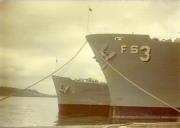
It was 1994, but Gwillam Forte was an entrepreneur of the old school. Twenty-three disabled Veterans needed a reason to live, so he gave them a rusty hulk - the battleship U.S.S. Texas - and unlimited funds to make her beautiful and seaworthy in time for Independence Day, 2000.
But the world changed quickly and for the worse. By 1998, the Texas and her supermodern weapons were needed for duty far more important than guarding the National Monument in which she rode at anchor.
US writer, formerly known for numerous men's action-adventure tales, who began publishing sf with The Grotto of the Formigans (1980), a novel about African grotto Monsters, and who came to more general notice with his Ayes of Texas sequence: The Ayes of Texas (1982), Texas on the Rocks (1986) and Texas Triumphant (1987). The political premises underlying the series – in the late 1990s the USSR, having hoodwinked the supinely liberal US media, has come to dominate the world – have dated, though the American assumption that its media are liberal is still conventional wisdom; the exuberance of the tales themselves remains winning. The protagonist, a triple-amputee World War Two veteran from the newly free Republic of Texas, arms an old battleship (itself called Texas), and sails off to fight the Russians. Much blood is spilt, and a good time is had by all; by the close of the third volume, however, a genuinely sophisticated dubiousness about the nature of the USSR/USA Cold War conflict complicates what might have seemed an unduly simplified picture: the sequence merits revisiting. F-Cubed (1989) is a less entrancing Technothriller; but Mixed Doubles (1989) enjoyably depicts the attempts of a contemporary failed composer who travels back in time to steal Music from those more talented than himself. [JC] - See more at: http://www.sf-encyclopedia.com/entry/...
This is a five-star rating not as an indication of quality, but of the enjoyment from reading this. It is the same feeling you get from watching the original Red Dawn in the mid-2000s. The 1982 view of the 1998 future from the 2013 present is adorable in parts, prescient in others, and entertaining all around.
The characters were flatter than flat, with their motivations more simplistic than Mike Hammer, but that only makes this better. It so self-consciously does not hold up that you can hear Da Cruz's WWII Marine growling through the text. If your grandfather took Isaac Asimov's lunch money and bet it against Tom Clancy that he could write a more jingoistic book overnight, this would be the result.
As a Texan, the Don't-Tread-On-Me throughline shows you how even in Reagan years, the State has had an infatuation with an alternative Republic and its viability. That this is science fiction is only fitting.
It starts somewhat slow, and is more technical jargon than story. The only thing that's keeping me from giving this book a thumbs down is that the story is somewhat movie-worthy. The blurb talks about how the main character, Gwilliam Forte, gave twenty three disabled veterans a reason to live. It makes you think that they had more roles in the story but they really only appeared in the first half of the book. It's so heavy on the technical side, that I felt lost sometimes. But for fans of military tactics and navy warfare, this is definitely the book for you.
It is a very sparse storyline, meaning that plotlines, characters, technologies, political situations, etc. are given a skeletal framework, but never really fleshed out. On the plus side, it's short.
Do blatantly misogynistic elements in a story make you violently enraged, or inclined to laugh till your stomach muscles hurt, or something in between those extremes? Whatever it is, this story will probably provoke that response.
"The Ayes of Texas" falls into a class of "near future" science fiction in which the "near future" setting in which it takes place is now in the past. The "near future" science fiction setting for "The Ayes of Texas" is 1994-1998.
I have to admit that I'm actually kind of fascinated by these kinds of books. It's kind of like pulling up old issues of "Popular Mechanics" from past decades to see what they predicted about future technologies. And, you get the added bonus of seeing what kind of political climate they predict. Sometimes the technology predictions are uncannily accurate, but most of the time they are humorously optimistic, and the political stuff is most often hilariously off the mark.
I remember reading this when I was in middle school (back around the time of publishing of the book) and it was a good read then...fitting in nicely with watching Star Blazers on T.V. Even then some of the political premises were difficult to suspend belief about, but in the end the story is at least as good, if not better, than some of the major blockbuster scripts of late.
Ridiculously amazing cold war fun. I first read this about the time that the event in the book were supposed to be taking place, and as a proud Texan was kind of sad to see the U.S.S. Texas just sitting idle in the dock and not out cruising the ship channel with a vengeance.
If you are a fan of the last stand of the men at the Alamo in Texas then this is the SiFi book for you. A lone ancient refitted battleship of the Texas navy fights the Russian Navy to save the US. Very recommended
Ugh, no. This book is both silly and terrible. The author served in the US Navy aboard the real USS Texas, and then turned around and coughed up a silly fanboy fantasy that his beloved ship somehow saves the world. The ship would have been 80 years old at the time, and even right now [2016] the sad old museum ship leaks like a sieve. Yet here somehow this tired old warship from both World Wars is somehow the only thing saving us from those pesky world-dominating Soviets? Nonsense.
If it was intended to be a tribute by a sailor to the ship he was once stationed on, as I believe is the case here, it is still a fairly awful book. I couldn't get past the half-way mark before giving up on this very silly book.
P.S. Wait. This is the first of a trilogy of dumb AF USS Texas books, all centered around this rusty old battleship single-handedly sticking it to the commies? lol, k. :P
Such a fun book. This alternative future where the soviets are a supreme force to be feared feels just like an action movie from the 90s. A rich man full of business acumen a mostly sound morals takes it upon himself to do what has to be done for Texas! While it's sensational and has a plot hole here or there, (and a surprising amount of death) it's a really fun read. From the cover art, "Particle beam weapons and a fleet of modern warships vs. one decrepit battleship and two dozen disabled Texans - the enemy had to be crazy."
Very silly in parts, I'd read a quarter of the book before realising it was funny !! Loved the matter of fact delivery and the setting the scene chapters were all encompassing to say the least. A good light hearted satiracal political / military / technical offering that would be perfect for a beach or a long wait at the airport. It was perfect for me on a day off ill from work.
On the one hand I did enjoy it in the way I can enjoy an episode of The A-Team. It really is an enjoyable story. Just look at other reviews or a blurb to see what kinds of story it is, which is of a type I like. This would have meant 3 or even 4 stars. I enjoy kids books, old books, even old kids books.. they don't have to be sophisticated, believable or pc today, for me to enjoy them.
However, it is also highly jingoistic, still something I can ignore, I am no pacifist.. and it requires a lot of suspension of disbelief, again.. I can do that. Women are objectified, some 'bad words' used.. but it is an old book. Times change.
The real problem starts with the extremely black and white view about people, politics, good and evil the author displays. Texas is good, conservatives are smart, liberals incredibly dumb, short sighted and journalists apparently plain evil. I am personally much more middle of the road, conservative on this, liberal on that.. but it is this raking together of groups of people in to uniform , clearly defined and strongly judged blocks that grates. At the end somehow there is a need to add that borders are closed to immigration and this seems to herald a new golden age. You can argue the story needs the other stuff, but this was just there.. Maybe it is the current political climate that makes this sting more, but it does.
I wanted to like this book. I really did. I wanted to like this book so much that I kept reading past the first 200 pages of jargon and a half fleshed out story just for the final 50 pages of fun. And you know what? I’m not mad. It paid off in the end.
The Ayes of Texas is a book with a remarkable premise. Now taking place in the past, but written as near future sci-fi, the book parades fairly outlandish technology all throughout it. In addition, the politics would have been far fetched when it was written, but are laughably bad retrospectively. Despite these grievances, even when the writing failed it, I was never uninterested in the story itself.
As a Texan, I can truly think of nothing more exciting than the idea of fixing up the U.S.S. Texas and single handedly taking on the Soviet Union. It’s almost a credit to the author for nearly finding a way to prove me wrong with how surprisingly unenjoyable the reading experience was. However, for the most bizarre reason of all—call it morbid fascination—that fact will not inhibit me from recommending it to everyone I know.
So what did I think? You tell me, because I haven’t the faintest idea.
okay, okay. . .so i believe in the Republic of Texas more than the U.S. . .this is one nice book about a US-Texas-USSR conflict. even though it was soon outdated by the fall of Communism and the Cold War, it remains (to me) an intesnely exciting book. . .