This book examines the daily lives of Roman women by focusing on the mundane and less celebrated aspects of daily life - family and household, work and leisure, worship and social obligations - of women of different social ranks. Using a variety of sources, including literary texts, letters, inscriptions, coins, tableware, furniture, and the fine arts, from the late Republic to the high Imperial period, Eve D'Ambra shows how these sources serve as objects of social analysis, rather than simply as documents that recreate how life was lived. She also demonstrates how texts and material objects take part in shaping realities and what they can tell us about the texture of lives and social attitudes, if not emotions of women in Roman antiquity.
This is an excellent and richly illustrated book which provides an introduction and overview of the available sources concerning the lives of women in ancient Rome. It explores women's lives through four broad topics: gender and status, marriage and the family, women's work, and public life.
While clearly researched in a lot of detail, the book also sets out clearly the limitations of the original sources: 99.5% of the contemporary written sources are authored by men (no surprises there), and the rest are either objects/memorials/tombstones commissioned by someone who had a stake in how the women figuring in them were represented (i.e. husbands, mothers or fathers keen to represent their wife/daughter/sister as an upstanding individual beyond reproach), or are difficult to interpret because they have lost their context. There is also a bias in representation in that most of the sources and monuments concern wealthy, high-status or even imperial women, while almost completely overlooking lower class women and those of ill repute, such as prostitutes.
One thing that is very clear across the book is the level of control men had over women, as well as the many imaginative reasons men used to justify such control, which can all be summed up in this quote:
Gender fit into a hierarchical system in which the male was superior, the female inferior and likened to other weak and wayward creatures, such as the non-Roman, the young, and untamed animals, all of whom required the firm hand of Roman male authority. According to medical authorities who could only consider the male form as achieving perfection, the female body was inherently defective. Maidens, young women physically developed and ready for marriage in their teens, required the most supervision because their budding sexuality left them vulnerable to physical desires that they might not be able to control. Female sexual desire was considered a dangerous, antisocial force by male authorities who saw it as a base appetite better suited to animals than humans. [...] Marriage solved the problem [...], completed the female, invested her with a social presence, and saved her from her innate incompetence. [...] The adolescent girl, often represented in the visual arts as part child, part woman on the brink of growing up, was domesticated by marriage.
Wow.
There is evidence to back every single statement above, by the way. D'Ambra proceeds to engagingly illustrate how many aspects of Roman women's lives and daily activities, from make-up to religious rites, fitted into and reinforced this worldview. A well-dressed, modestly made up woman brings honour to her husband. A priestess is often given the title to complement her spouse's political or military achievements. Even the mythical kidnap and rape of the Sabine women, who then refuse to leave their Roman husbands, is a subtle metaphor for Rome's expansionist policies, recast as a willing and beneficial partnership between equals.
Despite the presence of these passages, dedicated to highlight in detail the frankly breathtaking male bias in the Romans' worldview, D'Ambra also manages to outline through brief biographical sketches the lives of some women who did manage to defy the status quo and enjoy some independence, privileges, and even careers of their own. Much like other enterprising women in more recent times, they also had to tread the fine line between meriting praise because of their skills and deserving blame because of their "unnatural", "unfeminine" and overarching ambition. Sadly and predictably, these were almost exclusively elite, wealthy women, and only some "career" paths (such as the priesthood and to some extent philanthropy) were open to them. Due to lack of evidence, far less is said of lower class women who worked as shop sellers, barmaids, musicians, dancers, et cetera. As with "disreputable" women in other societies before and after the Romans, they probably had more freedom in some ways than married upper class matrons, at least from the judgement of others. But they also had less money and time to dispose of as they wished, and their voices are lost to us today. I doubt the snobbery of contemporary Roman writers towards them would have affected them much.
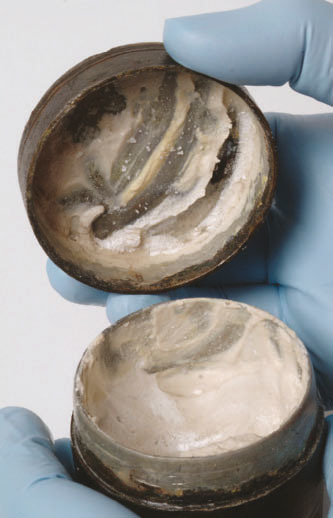
Other sections of the book discuss more practical aspect of women's lives through a study of archaeological artefacts that would have been used mainly by women. Many of the examples mentioned in the text and images are very beautiful or very affecting, or both: an amber compact in the form of a shelf, hinting at the birth of Venus; a beautifully carved ivory doll with moveable arms and legs; a marble ash urn in the shape of a wool basket, a striking reminder of the association between wool working, womanhood and "feminine virtue"; a jar of cream from Roman London, so tightly sealed that it preserved not just its contents but also the fingerprints of its owner.
As an archaeologist, I find these intimate objects incredibly interesting. They really help in bringing the world of these women to life, despite a gap of 2000 years and an abyss in our perceptions of the world. These snippets of life add to the picture presented by the other sources, despite a lingering sense that we have only scratched the surface and don't know as much about these women as we would like. This book is a good start, however.
A wonderful book on women's lives in the Roman world. For once, the focus is on material culture, and trying as much as possible to reconstruct the experiences of Roman women. Rich with images and archaeological finds, Roman Women is an excellent resource for anyone seeking to understand the lives of women in Ancient Rome. D'Ambra has given a treasure trove to historians, anthropologists, and novelists alike in Roman Women.
One of the delights of this book is the use Dr. D'Ambra makes of portraits, funerary reliefs, coins, and other visual media to illustrate her work. Indeed, these material remains were as prominent as written sources in piecing together a picture of the roles and experiences of women in ancient Rome. This slim volume does not go deep enough to be the definitive text on the topic, but it is quite wonderful, none-the-less.
D'Ambra surveys the role of women in Roman society in four main areas: Gender and Status, Marriage and the Family, Women's Work, and Public Life. This is a broad survey in a mere 180 pages. However, she successfully shows that Roman society differed from modern societies in very basic ways, and that these differences altered how women were perceived and how they functioned in that society. The book is not an in-depth examination, but it is a good introduction to Roman women for those interested in history, anthropology, sociology, etc. There are two reasons I could not rate this higher. First, the book needs a thorough editing. It has numerous agreement and syntax errors, and there are more than a few typos. Secondly, D'Ambra's writing style can be challenging at times. Flow within sentences and paragraphs is often choppy, which makes the reader work harder than he/she should. Also, the transition from one topic to another is not always smooth.
A very useful introduction to the lives of Roman women for the novice or intermediate student of the subject.
I purchased this book in order to better understand the societal role and expectation of Roman women before tucking into another book on the empress Vibia Sabina, and glad I indeed am that I read it.
D'Ambra's book covers a very wide span of Roman history, but mostly covers the period between the Punic Wars and the early imperial period. Within this time frame she looks at the gendered roles of women, societal expectations at ordinary and elite levels, women's roles in civic politics' as benefactors, as well as their role in the state religion.
Of primary focus is societies expectation of women to be dutiful and virtuous daughters, wives and, most importantly, mothers. It was they who were expected to manage the household affairs, rear their children, whilst avoiding an sort of scandal which could lead to a divorce, shunning or even death. Though not confined to their homes and having relative freedom of movement, women were restricted by limited career choices and legal protection, control by the head of their household (especially if from an elite family), even the possibility of slavery - though citizens they were barred from engaging in politics and would need a guardian to vouch for them in court cases or even where their 'free status' was brought into question.
While women were second class citizens in the Ancient World as a whole, Rome being no exception, this work shows that they could at times have their say and act as a collective force for change in their own interest, albeit very rarely. They could not simply be ignored. Many indeed were shop owners, heiresses to large fortunes, and in some cases extremally wealthy patronesses, who broke the mold by their excessive benefactions. For this we can have nothing but admiration both for those women who fought against the odds and who's names and exploits have come down to us, be it a power leader, empress or shop keeper, or those who's names are forgotten. Roman and ancient Mediterranean women as a whole were to a greater or lesser degree (depending on culture and civic community) the victims of a patriarchal society and regime which attempted to keep them in their place, hidden away and docile, but who no doubt did their best to persevere, be it for virtue and family or simply for themselves
This book felt like it had more to say about everyday life for Roman women, though it was a brief overview. It gives enough details to understand things but not so much it feels like a drag. The writing was approachable for laymen like me, too, lol.
Being a Cambridge publication it is an academic book, but don't let that put you off reading it. This is a fabulous work which examines the position of women in Ancient Rome. The author looks at a range of sources, including literature, art, public/private records, inscriptions and monuments. The book has references, a glossary and a useful list of Roman authors.
I'm currently reading Tacitus and this book just made me want to read more of the sources that the author refers to.
What was interesting was seeing how some beliefs about Roman women's lives was contradictory to actual women's experiences, how they dressed, behaved and were part of society. Women did not make the laws, but their profile was heightened by things such as religious practice, earning their own income or property, age and status.
Women at this time had little autonomy in regards to their lives, sometimes maintained by husbands, family members, guardians, or other women. However, there are examples of women who were the exception and had more control over themselves or had access to public life and D'Ambra examines how these women were viewed and represented. In monuments, personal records and art, some women were business people, artisans, priestesses or prominent individuals with huge political influence.
A very thought provoking, engaging and highly readable book
I picked this book up at the British Museum because my research library was feeling a bit dated and I thought there might be some new and exciting information come out in the last several years. I should have read the introduction more thoroughly: "Cambridge Introduction to Roman Civilization is a program of books designed for use by students who have no prior knowledge of or familiarity with Roman antiquity."
Roman Women is a good example of its type. It's well researched and written for the lay person. I would recommend this to someone who is new in the field or wants a thorough overview. I liked the way D'Ambra put archaeological findings in context, analyzing them for social value, not literal descriptions of how life was lived.
My problem with the book is a personal one, in that it didn't meet my needs. It's not the book's fault. I was looking for more advanced material.