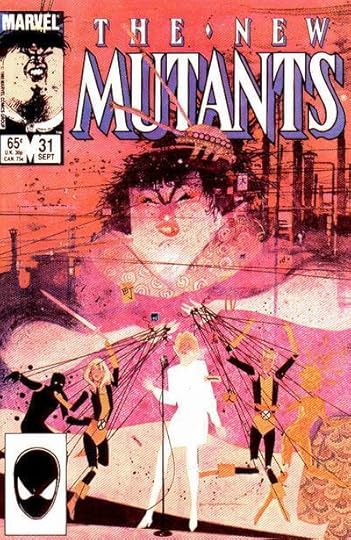
To rescue their mentor's son and their ex-leader, the New Mutants travel across the world, to the past and the future, and deep into the astral plane But to rescue their friends, they must face enemies hiding inside them - and within themselves Plus: The Beyonder Guest-starring Professor X, Storm, Shadowcat, Dazzler, Magneto, the White Queen, and additional X-associates Also featuring the first appearance of Strong Guy Collects New Mutants #26-34.
Chris Claremont is a writer of American comic books, best known for his 16-year (1975-1991) stint on Uncanny X-Men, during which the series became one of the comic book industry's most successful properties.
Claremont has written many stories for other publishers including the Star Trek Debt of Honor graphic novel, his creator-owned Sovereign Seven for DC Comics and Aliens vs Predator for Dark Horse Comics. He also wrote a few issues of the series WildC.A.T.s (volume 1, issues #10-13) at Image Comics, which introduced his creator-owned character, Huntsman.
Outside of comics, Claremont co-wrote the Chronicles of the Shadow War trilogy, Shadow Moon (1995), Shadow Dawn (1996), and Shadow Star (1999), with George Lucas. This trilogy continues the story of Elora Danan from the movie Willow. In the 1980s, he also wrote a science fiction trilogy about female starship pilot Nicole Shea, consisting of First Flight (1987), Grounded! (1991), and Sundowner (1994). Claremont was also a contributor to the Wild Cards anthology series.
This volume includes the end of the Bill Sienkiewicz's astonishing run of art with three awesome and highly memorable story arcs: Legion, Secret Wars II and the insanely cray cray Farouk / Bad Karma drama! Gone but not forgotten, I pretty much see the Bill Sienkiewicz run as the all-time best for this series! 8 out of 12. Collecting The New Mutants #26 to #34 Legion! And yes the TV show Legion was created from this story arc! Bad Karma!
This collection includes three, more or less, interlinked story arcs. The first deals with Professor Xavier's attempt to help heal his son's poor mental condition. The second concerns the rest of the team's attempt to rescue two kidnapped members from the clutches of the mutant gladiators with the help of Dazzler. The third brings the splintered team back together and with Storm's help they combat Xavier's oldest and perhaps deadliest foe who one resides within the body of a comrade and former teammate they believe to have been killed. Bill Sienkiewicz supplies art for the first two arcs and Steve Leialoha steps in for the closing arc. Other than the terrible inclusion (or make that intrusion) of the Beyonder subplot things flow pretty well. The weakest stuffis clearing the issues that have the Beyonder and Rachel Summers conflict/subplot to contend with, thankfully this is brief. Most of the middle arc seems forced and rushed, the Beyonder material doesn't help, but with inclusion of Dazzler, one wonders if this was not just some badly plotted attempt to generate some last minute for the Dazzler's soon to be cancelled solo title.
Un'altra raccolta di storie più che buone, tra le quali spicca la saga di Legione e delle sue personalità multiple, effetto di quando il suo potere si manifestò durante un attentato terroristico. Ogni personalità ha un potere diverso e per i Nuovi Mutanti e Xavier sarà dura uscirne. Rispetto alla mia prima lettura, vecchia di oramai 30 anni, non ho mutato parere: questa storia è troppo lunga e troppo astratta. Sebbene alcune delle tavole, principalmente le splash-pages, sia ancora ottime, le normali tavole peccano di una difficoltà di lettura, principalmente per quanto riguarda la parte della sequenza narrativa. Le storie successive, con l'Areana e i Gladiatori, la vendetta di Empath, il ritorno di Dazzler e la prima apparizione di Guido Carosella, mentre l'Arcano arriva sulla Terra ed inizi Secret Wars II, risultano troppo confuse per essere prettamente godibili. Nelle ultime storie poi Sienkiewicz abbandona la serie, sostituito da Leialoha che ne scimmiotta lo stile con effetto veramente pessimo. E dire che la storia del ritorno di Karma, posseduta dal Re Delle Ombre, in sè non sarebbe affatto male. Forse troppo verbosa. 3 stelle.
And this is where I stopped reading this series when it first came out. I’m a big guy — okay, a fat guy — and to read so many slurs against Xi’an’s weight when she reappeared was hurtful. Gross ... obscenity ... pig ... blimp ... bloat ... fatso ...... and these were all things says by our heroes. As such, this was part of the philosophy of the writers and thus all of Marvel corporate.
Into the mindscape of Legion, and the intros of his personalities. Magik's powers and mysterious origins continue to intrigue, and her tussle with Warlock. Beware the Beyonder.. No, I mean seriously, try to avoid.
Glad to have finally read this for the sake of seeing David Haller/Legion's first published trials with his multiple superpowered personalities. Hard to say for certain if this was before or after the Shadow King getting his hooks into David, but I think we're meant to read it as before. At different points, Chris Claremont describes David as "autistic," "schizophrenic," and of course suffering dissociative identity disorder. I had to sort of bite my knuckle as I read much of this, but I also know conflated language around psychological disorders was super common in the '80s and '90s.
Most of the issues in the middle of this collection aren't worth reading, but I goddamn love Warlock, and kept hoping for some key moments in the various characters' lives.
More on the writer's language use: - Claremont's habit of having characters awkwardly say unnecessary descriptive words such as "blithely" and "proverbial" while they're in the middle of avoiding getting killed is really wearing on my patience. - He had previously said in interviews that the phrase "The New Mutants" was more of a placeholder and reference to their initial role than it was a team name. I was happy to see him say they would probably never utter the phrase self-referentially, so it was a slight disappointment to see them using it like a team name throughout this book. - I was initially really excited for the diversity of characters being introduced when New Mutants debuted, and accepted the often corny accents several of the characters spoke with. But now, particularly with Karma's sprinklings of French expressions that only Americans say, his lack of research and effort is really getting on my nerves. - When we're reintroduced to Karma, who was SUCH a promising character - the first and oldest founding team member; a rugged, experienced, natural leader; a queer Vietnamese woman who also speaks French - she has been drastically transformed into a single-minded, ~550lb. villain stereotype. Her nuance and potential seem to have been discarded ruthlessly by the creative team, for the sake of dragging us through pain. The protagonist kids repeatedly call her "fatso," "bloat," and "blimp," over and over and over. Ugh.
The first story in this collection introduces Legion, a character who can be used super creatively, and was the focus of one of the best Marvel related TV shows they've come up with. Certainly the best pre-streaming TV show. Unfortunately, much of the first Legion arc uses a dated, problematic trope that makes it cringey to read. While this trope is only introduced so that Claremont can invert it is admirable. The end of the story does make it so that the characters using the problematic language and ideals turn out to be wrong and learn a lesson, that doesn't make the journey there any easier to read. It's not quite as bad as Claremont dropping the N-bomb in X-Men: God Loves, Man Kills to prove a point about racism but it's pretty close and it's drawn out for Much Longer.
Apart from that, though, this collection is just sort of forgettable. It introduces a couple of characters who will be fleshed out by other writers later, and it tosses Lilah Cheney and Dazzler but it doesn't do anything particularly interesting with them.
Bill Sienkiewicz's art, which was groundbreaking in early volumes just seems commonplace and not inventive in this volume. He has some great work on other books for decades after this, but his New Mutant work, while better and more interestingly stylized than many of his peers at this point, feels stale here. At least from a lens of reading it in 2024.
If you've loved the New Mutants series overall, I don't think this will turn you off of the title. It's not terrible, it's just not nearly as good as most of what's come before it.
Bill Sienkiewicz's art is as tremendous as ever, and the Legion plot, with our heroes traversing a fractured mindscape, unlocks Sienkiewicz's expressionist imagination to fully express this tortured psyche. I will say, however, that although Legion is a great classic storyline, there are some elements to it that are pretty uncomfortable. It's kinda fucked up that this is a story about an Israeli kid vs. a parasitic foreign entity within his mind referred to simply as "The Arab." That could have been a thought-provoking narrative about the way Zionist propaganda has cemented this Palestinian bogeyman into the psyches of Israeli children, but no, this really is a generic "terrorist" (synonym for "Arab") that has invaded his mind, even if he eventually learns from the pure-hearted Israeli child that violence and hate are wrong. Yikes.
Beyond that, this issue is a mix of really great New Mutants teamwork (I particularly like Magik's increasing role on the team) and some usual editorial Event Comic incursion into the storyline with some bullshit with the Beyonder in Secret Wars II. Karma returns, possessed by the Shadow King, in a pretty great finale (even if it relies on some pretty disgusting short-hand of fat=monstrous.)
Sounds like a lot of negatives, but at the end of the day the baseline of New Mutants is pretty great and this represents the end of Bill Sienkiewicz's art on the series, which in my opinion is one of the greatest runs of artwork in Marvel comics.
I am an avowed Claremont X-Fan and have worked my way through a few hundred issues of his runs over the last few years. When I finally started New Mutants this year, I was extremely excited to see the stories, having heard so many good things about them. The series hasn't been a disappointment per se, but the inconsistent quality is glaring and this volume represents this more than any previous edition.
The art and character writing is, as always, airtight and verging on perfect. sienkiewicz is a legend and I've written previously about how well his abstract, expansive drawings encapsulate the teenage confusion at the core of New Mutants. The characters relationships here solidify and are written as well as ever. The big problems with Volume 4 lie in its story elements and the dreadful inclusion of a Beyonder, Secret Wars II storyline (thanks, Jim Shooter!). The first storyline is about David Haller, aka Legion, Professor X's hidden son. This is well drawn and fascinating, as the team ventures into David's mind, but is really hard to read in 2018 as it is inundated with inappropriate, outdated or simply incorrect labeling of mental health issues. It's really, really challenging to get through. Likewise, the storyline that has the gang traveling across the world to rescue Karma is.... problematic to say the very least. Jay & Miles discuss this on X-Plain the X-Men, but the equation of weight gain or being fat with being amoral or evil is a constant in fiction, and it's executed to an extreme here. It mars a compelling story about where Karma has been and what the long lost demon that's overtaken her has done.
I hated the sections of this that felt dated, but overall the strong art and generally great writing make it solid, if not the best new mutants volume.
3.5 stars rounded up... Starting with the Legion arc and heading into the Gladiator games (which throws Dazzler into the mix too), this collection is all over the place. I'm not a fan of Sienkiewicz' artwork, so that definitely draws the rating down some, but the characters show a lot of growth and development in these arcs. I've always been a fan of Illyana, and she begins to shine in these issues. Sam and Bobby are the key players, and Kitty does a lot of growing up in this time frame (but mostly by way of the Uncanny and her solo story with Wolverine... but the growth carries into these books too). This run also ties into The Secret Wars II, with books 29 and 30. All said, a good read that introduces some key characters and plots for the team.
(Personal note: I read #26-28 because I wanted to read David Haller’s first appearance. I did not actually read the whole volume)
For what I read, I quite enjoyed it. It was nice to get a sense of comic David. That said though, comics are weird, especially old comics. It did not seem like they used the term ‘schizophrenia’ right and Charles was very oblivious not to realise David was his son immediately. The art was also not my cup of tea. Nevertheless, still enjoyable. Probably won’t reread it (unless I someday forget all I know about David) but we’ll see.
I bought Nos. 30, 33 and 34 off of the stands back in the day. I am not a fan of Bill Sienkewicz's hyper-scratchy artwork. Sometimes "progress" as an artist is bad! Steve Leialoha steps in and is a breath of fresh air. Chris Claremont still had his craft at this time, but when you read a bunch of these issues in a row it wears thin. His repetition worked well in monthly intervals, not so well in marathon sittings.
Collects The New mutants #26-34 (April 1985 - December 1985). Kind of a bit of a muddle trying to keep track of where everyone is (and why) and there are a couple of brief interruptions from the Secret Wars 2 storyline, but Bill Sienkiewicz's art is as magnificent as ever. Too bad his run ends with number 31 in this issue. The reproduced cover paintings in the back are just phenomenal.
I’ll miss Sienkiewicz, but his replacement does an okay job of imitating his style. It’s more interesting to look at than the main series art, at least. But hey, the writing is still fun and I dig all the weirdo psychic battle stuff so I had a good time overall. Also it’s really funny how they keep saying Legion “became” autistic when that’s not how it works at all.
i love legion but god having this story done in the 80s is so tragic the way dave halley is described honestly wasnt even cool back then what do you mean “tell me about the event that caused his autism” ill kill you
Solid storytelling overall, the artwork drives me nuts. they did a disservice to Dazzler, here. I think one tragedy of marvel crossovers is they sacrifice the visiting character's integrity for plot or ego purposes.
The Legion story here was exceptional with another strong showing from artist Bill Sienkiewicz. The rest is a frankly just a mess. Not Claremont’s best work.
It was nice to finally read the early Legion stories, having read the '95 Legion Quest leading up to the Age of Apocalypse a couple of times already. The amazing thing is Claremont does an even better job of capturing Legion's cacophonous mindscape than the '95 writers. We had last heard from Gabrielle Haller during the From the Ashes storyline, in the regular X-Men series, so it was nice to finally get that strand picked back up again. Xavier has plenty of his own problems as well, dealing with old flames (Haller and McTaggart) and recent physical attacks leaving him physically/mentally off his game (not an ideal time to tackle David Haller). It's bizarre anyone believes any of Legion's personalities, making the characterization feel a bit skewed - though everything is skewed and anarchic thanks to Sienkiewicz's artwork (no offense to McLeod or Leialoha, but their style would have ruined this storyline). The ending is rather hurried and forced, which we probably should have seen coming: Claremont does a great job setting up unconquerable conflicts, when it comes time to resolving them, he does rely a smidge on the deus ex machina (I'm tempted to say "too much," but I'm enjoying his writing more than most, so I tend to let him slide a bit - it is rather classical, after all). The brief overlap with Secret Wars II is not as burdensome as it seems like it might be from a distance, so no readers should feel they are obligated to read a whole lot of other issues before continuing half-way through this collection (I'm just glad the issues are in here, and not missing since they are included in the Secret Wars II Omnibus). The Gladiators conflict is a tad weak on the whole, and Illyana is starting to become the go-to girl in every situation, and Warlock has already become more annoying than interesting, so things are going to need to get somewhere different soon, as I'm sure they will. The future encounter seems a little forced and irrelevant, almost like they are trying to foreshadow the Infinity War, but at least they are starting to resolve the long-standing "hey, what about Karma?" thread. We are nowhere near where we started back in issue 1, but Claremont does not forget about anything (or anyone), so we should be in good hands.
I found this collection to be a mixed bag. Some good, some bad, and a little bit of great.
First, we are introduced to Charles Xavier's son, David Haller aka Legion (a high level telepath). The first three issues chronicle Xavier and a few of his New Mutants trying to save Legion from his own mind. There are also several scenes that update us on the events in Magneto's life, and how he just might be mellowing out.
Issue #29 brings us back to New York to see how Cannonball, Magik, Magma and Sunspot are faring while the others are away. There is an underground mutant gladiator "club" that steals away Magma and Sunspot to fight in the arena while the others join Dazzler to try to save them.
Along with those thrilling plots, we get the Beyonder (and part of Secret Wars II), Magneto joining the good guys, guest appearance by Storm, and the return of long lost New Mutant, Karma!
The artists for these issues were Bill Sienkiewicz and Steve Leialoha. The Sienkiewicz experiment was the focus of all the issues in New Mutants Classic Vol. 3, but only #26-31 were his here. For a while, his work feels bold and new, but by the time issue 31 comes along the style begins to feel tired and overdone. Along comes Leialoha to save the day. He begins to soften things a little from his predecessor. Leialoha still has bold lines and intense shading, but he shifts things closer to the traditional comic look.
This volume was all over the place. The plotting was a little inconsistent (and Secret Wars is partly to blame). I like this era of the New Mutants series because they really start to grow up. These issues set up the next volume which really takes these characters out of childhood and into the real superhero business.
We're in the meat of Chris Claremont's "New Mutants" run now, and the stories here seems more ambitious than good. We start with a jaunt to Muir Island where Professor X works to save the troubled, overpowered son he didn't know he had: David, aka Legion. The psychic teen is so named for the multiple personalities literally warring within his fractured mindscape--and expressing themselves in untidy bits of telekinesis and pyrotechnic displays. In his last issues on the series, Bill Sienkiewicz does a nice job capturing this tortured mind space, but the journey there doesn't have much dramatic interest. Worse, Claremont goes all in with the sweet talk in the dialogue--"poppet" this and "mummy" that--and it can be tough to stomach.
After this sojourn to Scotland, the team hits L.A., where they get caught up in the city's underground gladiatorial ring. I'd unfortunately just read the "Beauty and the Beast" graphic novel that covers the same turf, so I was pretty tired of the concept at this point. There is some nice angst when a former team member is revealed to be a new villain, and I enjoyed the young mutants being outmatched before scrapping their way back to a victory. (The big plan at the end isn't very plausible, though, requiring the villain to basically not turn his head for minutes at a time.) I didn't like the punk scumbag New Mutants from new artist Steve Leialoha either, but the rest of his stuff was ok.
Is this essential? If you're an X-men fan and invested in the characters, it's probably worth reading. If not, you can skip it pretty safely.
In this volume: we get american opinions on the arab-israeli conflict and spend half the time inside the brain of xavier's boring as hell son. The other half deals with a villain that turns people evil in a way that manifests by making them obese so great message there.
So the whole "if only Palestinians and Israelis could meet face to face everything would be fine" is implied and I have huge problems with that message regardless of intentions. But since this was written in the 1980s when decent information about the issues was very scarce I have very different expectations for a book written in this time than I do certain other comics that have pulled the same thing 5 or 10 years ago but YMMV. Also weirdly enough this predates when that narrative became popular by a lot, it didn't become normalized till the 1990s. If you can get past that and how they handle Karma in this volume the rest of the story is actually decent, it's otherwise got some pretty great development for Dani and Magik especially.
This entire review has been hidden because of spoilers.
Overall, a step down from the previous volume in both writing and art. Sienkiewicz's art during the Legion story is still pretty wild, but it's also less vivid than than was in the Demon Bear Saga. I think the more muted colors might be the cause. Steve Leialoha replaces Sienkiewicz for the last 3 issues and I just didn't like his work. It seemed like a bad Sienkiewicz impression with none of his inventiveness but all of his scratchy strokes and "ugliness".
From a writing perspective, the Legion story is interesting, albeit kind of baffling and also a re-write of his Proteus story. However, I didn't like the Gladiators or Karma stories nearly as much.
This volume of New Mutants introduces David “Legion” Haller, and if there was ever an artist to illustrate this character it’s Bill Sienkiewicz. Sienkiewicz is a brilliant artist, but his work almost gets exhausting to look at after a while because it’s so dynamic. (This is a compliment, I promise!) Artistic duties for the next arc come to us via Steve Leialoha, whose work I’m personally not taken with. Leialoha’s covers are fantastic, but his interiors seem rushed, which is a shame because it seems he has the potential to handle the characters well.