Jump to ratings and reviews
Rate this book

Tradition and Apocalypse: An Essay on the Future of Christian Belief

Rate this book
In the two thousand years that have elapsed since the time of Christ, Christians have been as much divided by their faith as united, as much at odds as in communion. And the contents of Christian confession have developed with astonishing energy. How can believers claim a faith that has been passed down through the ages while recognizing the real historical contingencies that have shaped both their doctrines and their divisions? In this carefully argued essay, David Bentley Hart critiques the concept of tradition that has become dominant in Christian thought as fundamentally incoherent. He puts forth a convincing new explanation of Christian tradition, one that is obedient to the nature of Christianity not only as a revealed creed embodied in historical events but as the apocalyptic revelation of a history that is largely identical with the eternal truth it supposedly discloses. Hart shows that Christian tradition is sustained not simply by its preservation of the past, but more essentially by its anticipation of the future. He offers a compelling portrayal of a living tradition held together by apocalyptic expectation--the promised transformation of all things in God.

Audio CD

Published February 8, 2022

41 people are currently reading
450 people want to read

About the author

David Bentley Hart

44 books700 followers
David Bentley Hart, an Eastern Orthodox scholar of religion and a philosopher, writer, and cultural commentator, is a fellow at the Notre Dame Institute for Advanced Study. He lives in South Bend, IN.

Ratings & Reviews

What do you think?
Rate this book

Friends & Following

Create a free account to discover what your friends think of this book!

Community Reviews

5 stars
114 (40%)
4 stars
109 (38%)
3 stars
43 (15%)
2 stars
15 (5%)
1 star
3 (1%)
Displaying 1 - 30 of 60 reviews
Profile Image for Paul H..
873 reviews463 followers
April 2, 2023
Truly, awe-inspiringly terrible -- possibly the worst book that someone this intelligent is capable of writing. Honestly I don't even know where to begin; I have a bunch of notes in the margins and may try to shape them into a proper review at a later date, but I'm not sure if there's a point. Hart's pretentiousness and overweening self-regard, always his least appealing traits, have metastasized and taken over his personality; his pet theories / foibles / peeves have now completely cannibalized his reason. This book is a snarky Tweet with footnotes (at best).

The opening sections on Newman and Blondel are okay, mediocre but worth reading (he gets Blondel wrong, but whatever); all the material after that is horrendously bad. Everything that he critiques is a straw man -- e.g., I don't think a single Neo-Thomist has ever been as rabidly close-minded as Hart pretends, the early Church was not even remotely an anarchist-communist cult, etc. And every reasonable statement that he makes about the use/abuse of tradition is already held by the vast majority of believing Christians -- despite Hart's self-conception as a brave, lone voice in the wilderness.

He shamelessly harps on about his previous book (on universal salvation), insulting completely reasonable critical reviewers, etc., and weakly attempts to defend his idiosyncratic views -- shared by roughly zero of the Church Fathers, or any other theologians -- using the argument that his positions are held in line with "final causality," looking forward to the Kingdom of Heaven. This serves as a profoundly vacuous counterpoint to doctrine / dogma / hermeneutical positioning / authority -- i.e., the imperfect yet necessary methods that every Christian on Earth actually uses (except for Hart). Hart's conception of theology as oriented toward a heavenly final end is completely open-ended and can be interpreted to mean literally anything, which is, indeed, the point; it's the single dumbest argument that I've ever seen a theologian make. If a doctrine aligns with Hart's inner sense of goodness and truth, then it is true -- no synods needed!

Hart seems to be unaware that the vast majority of Christian theology has been formulated provisionally in light of negative theology / divine mysteries / etc., and with an eye to the apocalypse as the end of all things. Again, it's clear that Hart is simply using this concept as an excuse to hold a series of fanciful positions that amount to "quirky Protestant academic pretending to be Orthodox." Congratulations, David, you're a big fan of Origen and Eckhart and the Vedanta and you're 'not like other Christians' -- maybe try to actually make an argument, instead of calling all your opponents psychopaths?
Profile Image for David .
1,349 reviews198 followers
February 14, 2022
Who Should Read This Book - Readers interested in the past and future of Christian faith and practice.

What’s the Big Takeaway - Tradition is not about looking into the past to find some imaginary line of faith and practice that has never changed, the beauty of tradition is opening new paths and avenues in the future moving towards the ultimate Good.

And a quote - “The tradition has always advanced not only by discovering new implications in what at present it understands as orthodox Christian confession and practice, but also by learning to shed a great man of the conceptual forms and expressions that until a given moment - a moment that always seemed like a ‘completed’ present in the course of dogmatic evolution - had been considered part of the faith’s essence” 151)

When we speak of Christian tradition what are we talking about? This is the question with which Hart begins his latest book, a concise (only 188 pages!) essay (as the subtitle says) on Tradition. Hart identifies the problem in part being that while everyone talks about tradition, its hard to define what it is. A large part of the challenge is that the findings of history rarely support the ideas of tradition we have. Rather than one clear line of orthodoxy that goes straight back to the beginning and never wavers, we see a variety of ideas all with equal sway in their own time. It is only after the fact, once the issue is settled, that the losing voices are marginalized (and deemed heretical).

Along with this, when we look at the earliest Christians to whom we might imagine we are wholly of one mind, we quickly, if we are honest, recognize their faith and practice is completely foreign to us. Hart demonstrates this early on (p. 34-36) with a description of the truly radical nature of the apostolic church - nonviolent, renouncing wealth, refusing military service and so on. He writes, “It would be no exaggeration to say that, viewed entirely in historical perspective, cultural and institutional ‘Christianity’ has, for most of its history, consisted in the systematic negation of the Christianity of Christ, the apostles, and the earliest church” (36).

One similar memorable phrase comes near the end of the book:

“Only in cases of moral departure from the explicit teachings of Christ can one easily identity what one can rightly call heresies. A professed Christian, for instance, so detached from the teachings of Jesus that he or she is willing to argue in favor of capital punishment, or to claim that Christians may blamelessly acquire and keep vast personal wealth, or to embrace libertarian social theory, or to support a certain recently unseated Republican president of the United States…beyond such obvious examples as those, however, judgment is best withheld” 169)

He notes other cases throughout the book. One such is Arius, remembered as the arch-heretic who opposed the Nicene formulation of God as three coequal persons. Hart argues that what Arius taught was not out of bounds in his day and actually had precedents in Clement and Origen. Only after the Nicene settlement was history reinterpreted to portray Arius as the obvious blatant heretic he always was.

Hart’s point is that the best moves of tradition are the ones that do not close all doors (such as closing out the heresy of Arius) but open new doors for bountiful theological growth and speculation. The Nicene settlement did not end the discussion, it opened it up to move and grow in new and exciting ways.

Hart argues for a needed future component in our understanding of tradition. He first talks about this in chapter two (Tradition and Causality). Here he talks about the four types of causes taught by Aristotle and recognized as how the world works throughout the medieval era. Key in this is the element of teleology, or final causality. A thing is not known in its brute mechanical force of what it is now, but is only fully known when its final purpose is revealed. This understanding of final causes was lost in the transition to the modern age, with our scientific worldview looking only at things as they are. Here Hart is touching on something I’ve read about elsewhere, in the likes of Charles Taylor and Alasdair MacIntyre, and it seems a basic and accepted truth of the modern over against the premodern world.

When Hart talks about two previous works (by Newman and Blondel) that tried to define Christian tradition (and the chapters summarizing these works are the slowest part of the book), one of the main problems is they only look to the past. But tradition has an unfolding, future element:

“It is the future’s reciprocal and more original openness to tradition that endows tradition with whatever intrinsic rational unity it might possess. Only by seeing something of the end of tradition’s course - something of its final cause - can one see its unity as a formal truth rather than as a mere confluence of material and mechanically efficient forces” (92).

What this may look like takes us back to Arius. Hart argues that tradition, just like scripture, always need be interpreted. In digging deeper into this tradition, “the Nicene party discovered a deeper logic written throughout the tradition they had received, but in a language that had to be deciphered, and for which they only now were able to produce the key” (126). The question is, how are humans to be brought to God (deified)? If the Son brings us to God (the Father) then the Son must be fully God. But to bring US to the Father, the Son must be human as well.

When Hart turns to the Cappadocians, specifically Basil, he writes, “Every step of Basil’s argument is governed by a single compelling question: What do Christians mean when they say that they have been saved in and by Christ, by the power of the Holy Spirit? What does it mean to speak of being deified in Christ? By the end, his case - and there simply is no more systematic treatment of the issue in patriotic literature - powerfully suggests that only the full ‘homoousian’ Trinitarian position makes it possible to view Christian belief as a coherent vision of God’s action in Christ” (127).

In other words, the tradition is not merely seen in looking back at who was more faithful to the beliefs of those even further back the line. The tradition is seen in how this innovative belief opened up avenues for new steps in theology that makes even better sense of what came before.

I haven’t even gotten into the last two chapters, where my pen died due to underlining so much!

The last two chapters kind of bring it all together and provide a way forward. Well, as much a way forward as a theologian and philosopher such as Hart will give us. There is a lot to ruminate on here, with gems such as this:

“By remembering a first interruption, awaiting a last interruption, and attempting to sustain the theme uniting them in the interval” (145).

And,

“The tradition has always advanced not only by discovering new implications in what at present it understands as orthodox Christian confession and practice, but also by learning to shed a great man of the conceptual forms and expressions that until a given moment - a moment that always seemed like a ‘completed’ present in the course of dogmatic evolution - had been considered part of the faith’s essence” 151)

And, recognizing he does not know what the future holds, he argues we might have some idea:

“There is an entire language and conceptual grammar of divine proximity and intimacy not only in the New Testament but in scripture as a whole that indicates the only kind of end that Christian faith could possible stretch out toward: the divine image in humankind…” (157)

It is no surprise that Hart encourages Christians listen to voices that the past tradition may have silenced:

“Reflective believers should always feel lincensed to return to what went before and to reclaim certain things formerly rejected or forced to the margins, while perhaps at the same time demoting other things from the eminence formerly conferred upon them” (180).

Here he lifts up John Scotus Eriugena, Meister Eckhart, Origen and Nicholas of Cusa. He mentions Sergei Bulgakov. I know I’ve noted that theology would be much better to listen more to Pseudo-Dionysius, Maximus the Confessor and Isaac the Syrian which is a point I admit I learned from Hart.

One of the more provocative statements comes in the last few pages, as Hart argues Christians ought to look even outside our own historical and cultural continuum to learn from other religious resources, specifically mentioning Vedanta. As with his discussion of causality above, this argument is based on noting that the idea of “religions” as unified ideologies either wholly true or wholly false is a modern creation. In other words, thinking the religion “Christianity” is true while another religion, say “Hinduism” is false makes little sense (and even CS Lewis noted this, in his own way, by recognizing the commonalities in religions).’’

Hart cautions that he is not speaking of appropriation. He also says he is not saying Christianity rob a few ideas from other faiths. This is often how the relation of Christianity and Platonism is explained in the early church, with Christianity borrowing a few ideas from Platonism. He argues:

“Christianity did not plunder Platonism. Christian and Platonism traditions converged, because both were summoned by and aspired to a horizon of spiritual intimacy with the divine, one that for Christians is understood as the final realization of what was achieved in the person of Christ. Each tradition, by practicing the universal human virtue of religion, found the other along the way” (186).

This way, Hart says, is still open. In this we move towards the cosmic ending where faith and hope fade and love remains.

Overall, this is a brilliant book. During those chapters discussing Newman and Blondel, I was kind of bored. But the rest is brilliant. There is a lot to chew on. Perhaps what I appreciate most though, from such a thoughtful scholar, is the emphasis on action. The worst heresy is anti-Christian action much more than wrong belief.
Profile Image for Scriptor Ignotus.
597 reviews276 followers
March 12, 2024
Every religious tradition, in its historical-material aspect, undergoes profound disjunctions and radical transmutations as it passes through centuries of social disruption, political manipulation, intellectual disputation, and cultural ferment. But for Christianity, the question of tradition—understood in its proper theological sense as a living, organic unity with an intrinsic rational coherence and a vital will to self-perpetuation through self-articulation—is especially fraught, due primarily to the astonishing precarity with which it yokes its entire metaphysical content to a unique, local (and for us now quite obscure) series of historical events.

The Gospel, Hart reminds us, is not a perennial wisdom delivered through the vehicle of temporal happenstances from which it is ultimately severable—it is not Dharma. It is, rather, an historical episode which discloses itself as the ultimate, universal reality, purporting in some sense to transfigure and redeem the whole course of human events, from which it cannot be abstracted, by revealing itself as the secret entelechy of all things. The entire edifice of Christian tradition, from the first proclamation by a mysterious Galilean renunciant that “the time is fulfilled, and the kingdom of God is at hand”—the martyrial witness of the apostles; the convoluted and (to the unapologetic eye) blindly fortuitous development of doctrine; the Papacy and the Orthodox Patriarchates; the Tridentine Mass and the Divine Liturgy of Saint John Chrysostom; the Crusades, the Reformation, the Great Awakenings; the troubadours and the Victorian novel; Origen, Augustine, Dante, Julian of Norwich, Bach, Bernini, Dostoevsky, Sergei Bulgakov, and Howard Thurman—is balanced, like an elephant on a tightrope, upon something that happened; indeed something that happened, and was first interpreted, in a cultural, mythological, and cosmological context radically divorced from that of the religious civilization that sprouted from its seed.

It is difficult to overstate how profoundly alien the worldview and praxis of Jesus, the apostles, and the Christian communities of the first century are to the religious consciousness of the average twenty-first century believer; and most of all to the self-understanding of those who claim the mantle of Christian “traditionalism,” but whose concept of the “original and immutable” deposit of faith is usually little more than the detritus of an early modern construct; a deracinated moment of cultural inertia to which they cling from a kind of—as Hart puts it—“ecclesiastical fetishism,” which, in its most benign forms, becomes an eccentric nostalgia, and, at its most malignant, a monstrous parody of the Christian Way. The New Testament is entirely unconcerned with “tradition” in the colloquial sense: as a pitting of the past against the future, a reactionary effort to guard an indurated and irrational fragment of history from the ravages of time. The genius of Christianity is not sapiential or institutional, but apocalyptic.

The Gospel is an insolent, celebratory riot against the entire logic of history. A crucified Jewish peasant, feared by the religious and political authorities, hated by the mob, and abandoned by his followers, has been vindicated by God, raised from the dead, and made Lord and judge of the cosmos. The entire cosmic order is being overturned: not only the rich and powerful of human society, but the angelic “principalities” and “powers,” the “spiritual forces of evil in the heavenly places,” have been deposed from their usurpative rule by a most unlikely champion whom God has kept hidden from the foundation of the world. The partitions of law have been dismantled; distinctions of ethnicity, class, and sex have been relativized, if not abolished; and very soon—Jesus and the apostles believed it would happen in their generation—the current age of the world as we know it will pass away in a fiery consummation and a new age of creation will begin. The Gospel is a refutation of history as such; a rending of the veil of history in its fallen aspect—history as a theater of violence, cruelty, injustice, and futility; a blind frenzy of suffering and strife without formal and final causality (in the Aristotelean sense) and thus without redemption—and a revelation of its “secret, redemptive rationale,” which for now we glimpse only in part, but which promises to unveil itself fully at some future apocalyptic horizon. It is a glimpse of eternity crashing in through the ceiling of history and spoiling its illusion of self-contained inevitability. It is, like all apocalyptic, the counterstory of history, the full meaning of which can only be known at the end, when the scroll of destiny is at last unfurled.

How then can one articulate the possibility of a living, unitive, and internally-coherent Christian tradition that accounts for both its apocalyptic novum and the sundry (and often quite divergent) political, cultural, ecclesiastical, mythological, and intellectual forms it has assumed across time and space?

If Christian tradition is to have any coherence; if it is to have any hope of resolving the irresolvable disjuncture between history and dogma—of navigating the twin shoals of “historicism” (tradition as the product of purposeless, mechanistic historical fortuities with no metahistorical remainder) and “extrinsicism” (tradition as immutable dogma extrinsic to its historical “articulation”), as Maurice Blondel tried unsuccessfully to do—it must, like Jesus of Nazareth, orient itself toward the future, earnestly pursuing and embracing the dialectical tension between Gospel and history—between the Kingdom that was promised and the Church that arrived—as the very life and logic of its self-disclosure and ultimate fulfillment.

It must recognize that the apocalyptic novelty of the Christian event can never be exhausted by the historical simulacra in which it is embodied; that it is the nimbus glowing around and behind such forms, and that it may supersede them as it grows into its rational end. It cannot be a sect, but must instead be the locus of an “ever fuller unveiling” of divine truth; and since what is ultimately true must be universally true, it must expect to find spiritual companions in its quest for the Kingdom. Who is to say that Christian tradition, with perfect fidelity to its intrinsic rationality, could not, as Hart suggests, explore the conceptual grammar of Vedānta to explicate the mysteries of divine incarnation, human deification, and the nonduality of divine and created spirit? Such a development would be no more extraordinary than its long-completed absorption of Platonism.

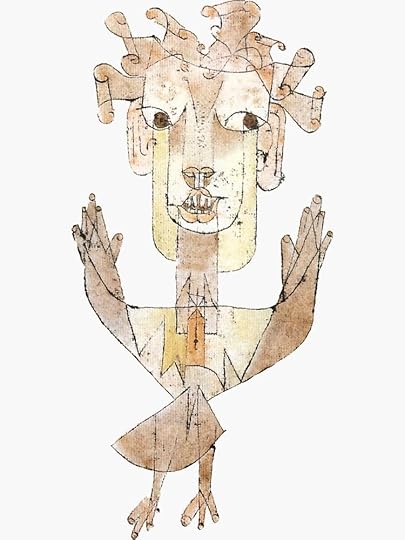
Above all, tradition cannot succumb to the idolatry of traditionalism. It cannot face backward, like Walter Benjamin’s Angel of History, as it is borne along by the winds of change to a destiny it cannot see or even conceive of. Such a disposition will never see the light of eternity, but only the wreckage of history. It will not share the Gospel's hopeful anticipation of the invasion of our fallen plane by truth and justice; it will be nothing more than the somber, nostalgic recollection of a promise unfulfilled, and a past unredeemed.

description

New Vocabulary:

Proleptic: in anticipation of something.

Divigation: wandering or straying.

Catachrestic: used in the wrong way, ex. saying “geometry” when one meant to say “geology.”

Curvet: a graceful leap, i.e. of a horse. A curve.

Unhouseled: not having received the eucharist.

Recondite: little known, hidden.

Diegetic: pertaining to narrative or plot.

Bricolage: creation from a diverse array of available things.

Adiaphoral: indifferent or inessential. Kindle couldn’t define this one.

Indurated: hardened.

Anarthrous: without joints or articulated limbs, i.e. not connected to anything.

Misprision: an erroneous judgment.
Profile Image for Todd Decker.
73 reviews7 followers
February 9, 2022
The subject is tradition and its place in Christian faith. Hart develops a theology of tradition as a process of progressive revelation (apocalypse) toward truth. He contrasts this with "traditionalism", basically tradition for tradition's sake. His thesis is that behind Christian tradition there a substantial, enduring truth that is not fully revealed but rather seen through a glass darkly (1 Corinthians 13:12). This means that even if the underlying truth is constant and absolute its revelation in Christian tradition changes over time and in response to contingent historical circumstances (ex: Roman imperial politics). Christian tradition should be informed by the past but it should also look toward the future. That is the most genuine expression of early apocalyptic Christianity, when Christians lived in fervid anticipation of what was to come. One of the most interesting theology books I've ever read.
Profile Image for Barry.
1,230 reviews58 followers
July 3, 2022
This book is pretty interesting. It’s likely to be controversial. Hart clearly enjoys his role as an iconoclast and provocateur and here sets his sights on the notion of Church Tradition. He specifically addresses two books, An Essay on the Development of Christian Doctrine by John Henry Newman, and History and Dogma by Maurice Blondel, both of which purport to demonstrate a continuous thread of doctrinal truth which can be clearly traced from the teachings of Jesus and NT writings through the beliefs of the early church, the teachings of the early Church Fathers, the decisions of the Church councils, and the subsequent official church doctrinal proclamations. I should admit that I haven’t read the books he discusses, and surely the authors would have some useful rejoinders were they around to make them, but I think Hart makes a pretty good case that such a continuous historical thread is illusory at best.

If we cannot trust an unbroken church tradition as a guide — and Hart perfunctorily waves away the possibility of scripture as the final authority— then where should such authority reside? How do we determine which dogmas are actually true? Well, he says instead of looking backward through church history, or focusing on a more careful interpretation of scripture, we should instead look ahead to the apocalypse, to the ultimate vision of the Kingdom of God.

It’s probably foolish for me to publicly (ish) contradict a guy as uber-smart as Hart, but I’m not sure that his proposed solution is any less vague or any more satisfying. Of course as a universalist, his apocalyptic vision differs significantly from that of many traditional Christians, past and present. And (perhaps therefore?) he is strangely reticent to expound on how exactly how this apocalyptic outlook should impact our theology. Not that he’s short on opinions on where Christians have gone wrong.

When discussing the history of Christian theology Hart seems strangely tolerant of a number of early Christian belief systems and dogmas that were eventually determined to be heretical, implying that the church and its councils heavy-handedly stamped out diverse but legitimate alternative views. Yet he is surprisingly intolerant of many of the diverse views of current-day Christians. He cannot help but to express his contempt for certain views that he would regard as anathema. He tends to get squishy when describing which theological claims should be accepted as true, but is vehemently confident that certain dogmas are false: substitutionary atonement, papal infallibility, Biblical innerancy, the traditional doctrine of hell, original sin, Thomism, libertarianism, right-wing Catholic integralism, and support for capital punishment or Trump. Apparently his personal list of heresies is even longer than this, but he eventually bites his tongue to “avoid giving offense.”

He seems to regard the falsity of these common theological positions to be self-evident. Since he cannot make an appeal to truth based on Church Tradition and/or inerrant scripture, I suppose that he’s certain that these other views are wrong because he cannot imagine them in his version of the eschaton.

This all leaves me with a number of questions. Apparently there are certain core truths which he is able to see clearly even now. But he doesn’t clarify what these truths are or how he arrived at them. Are they also self-evident? Are there certain axiomatic Christian truths, and if so where do we find them? And from whence do they derive their authority? If neither scripture nor Church Tradition is authoritative, then what is? Does he decide truth based on his moral intuition guided by the philosophical climate of the day? If Hart decides what is universally true based on his own moral intuition, is he prepared to accept the rest of us doing the same based on our own intuitions? Or are we obligated to defer to his moral intuitions? And what about doctrinal developments over time? Is doctrine just supposed to evolve according some Hegelian Spirit of the Age? Are we to trust that it’s all the leading of the Holy Spirit of the Age? He’s says that he’s unwilling to go that far, but I’m still not sure where it leaves us.

When I went back through the book to search for core Christian truths that Hart seems to affirm, I found three. First of all, Love. Well sure. Every single Christian agrees. He also stresses that there should be no alliance between the Kingdom of God and the world’s political structures of power. And also that the early church had it right when they lived like an anarcho-syndicalist commune. Surely these are important aspects of the faith and perhaps deserve further emphasis, but they are hardly sufficient as the foundational truths on which the church is to be built.

In all, I actually enjoyed this book more than this contrarian review might otherwise suggest. He raises some critical issues that require further reflection and discussion, and there’s a lot here to ponder. I think Hart’s advice is important that we look forward to the vision of a fully realized union with Christ instead of backward to church history. Surely Newman and Blondel would agree that we should keep this vision in mind. But in addition to, rather than instead of, scripture and church tradition. Maybe it’s more an issue of emphasis?

I also appreciate that Hart argues for a posture of humility in determining the historical thread of core truths when looking backward through time or extrapolating where they will lead in the future. I’ve read enough of Hart’s books to know that he is hardly the poster boy for epistemic humility, but he genuinely seems to be striving to lean in that direction here. But just because he’s unable to follow his own advice doesn’t mean he’s wrong.
Profile Image for Dan.
558 reviews148 followers
February 14, 2022
The relationship between historical facts/contingencies and dogma/absolute truth in Christian faith always baffled the theologians. When for the early Christians, the world did not end as expected and promised (i.e. apocalypse), systematic theology/dogma was created as a form of disappointment/justification. This early dogma incorporated their limited tradition, current experiences, and the expectation that the world will eventually end as promised. As a living process in the history, the tradition was recollected only as needed, was further assimilated with the new experiences, and in the light of the glimpsed future. Dogma changed accordingly, and also initiated this process. The promise that one day will see truth face to face and not through a glass darkly was never realized in history, but it was promised and believed as such.
Even if not mentioned in this book at all, it seems to me that Heidegger lurks in the background through concepts like: temporarily with its future preponderance, truth understood as unconcealment and revealed in history, historiology vs. history, the overcoming of theory and practice, event, and so on.
Profile Image for Steve.
1,451 reviews102 followers
June 18, 2022
David Bentley Hart thinks that doctrinal development, as expounded by John Henry Newman and Maurice Blondel, is a kind of “survival of the fittest” reduced to “the survivors survive” rather than a real development of orthodoxy. He believes that Arius and others represented streams of accepted forms of Christianity in their own time.

So what is the alternative? Apocalyticism. That breaking in of a new kingdom and age into the old world, moving all things through Christ towards a deified creation. This needs to be stressed to break the grip of individualism.

Whilst we might welcome Hart’s attempt to propose a “cosmic gospel” in our age of radical individualism, must we be forced to choose between them?

Hart is of course driving forward his, what I’ll call , “ontological universalism”- I.e., everything by necessity of being created is destined for glorification/deification. The price of this ticket means the following are thrown under the bus: original sin, predestination, penal substitution, historic fall, and much more. Calvin is a theological Donald Trump. The door is open for insights from other religions. Talking of buses, we are all “on the bus”, it’s just that Christians have better seats- except for John Calvin who runs behind..
Profile Image for Jon Coutts.
Author 3 books38 followers
January 28, 2023
In this brash but helpful book, DBH breaks down the shortcomings of historicist and dogmatic attempts to unify tradition (as represented by Newman and Blondel), and instead proposes an apocalyptic in-breaking whereby "the life of the tradition is sustained by the lure of a future yet to be fully revealed" (161). I found this a compelling corrective and expansion on Blondel, and was not bothered by its scant reference to Christ and Spirit (since they were clearly more operative than a mere tally of name-drops would suggest). I'm less persuaded by its "ultimate horizon" of deification, however. In fact I wonder if this is where the character of Jesus the Jewish Messiah can be seen to under-inform the work, leaving us with a resurrection-eschaton that is less embodied and creaturely than might otherwise be imagined.
Profile Image for Ryan Turnbull.
43 reviews3 followers
August 6, 2024
Interesting book marred by Hart’s characteristic arrogance and pomposity. Usefully deconstructs attempts to treat “the tradition” as one settled thing, and is at its best when critiquing Newman and Blondel’s attempts to get around this problem. Ultimately though, Hart crashes on the rocks of his own hubris by refusing to either a)actually engage the tradition in more than a hand-waving fashion which leads b) to such a shocking paucity of citation that he misses some really obvious conversation partners that could have made his final constructive project much more robust (thinking specifically here of the work Kevin Hector has done on the role of the Spirit in allowing us to recognize how to move forward in a tradition and Alastair McIntyre’s Wittgensteinian account of tradition). Worth reading, but the final chapter just kind of collapses into him ranting about how everybody who disagrees with him is an idiot which… ok.
Profile Image for Jon Adler.
119 reviews2 followers
January 22, 2025
Phenomenal essay, deeply helpful for me in contextualizing the various approaches to "tradition" I've encountered across so many disparate Christian movements earlier in my life.

Hart starts by examining two previous scholarly attempts to understand the loping, clunkily-unfurling journey of "Christian tradition" - one by John Henry Newman in 1878, the other by Maurice Blondel in 1904. He points out how both authors end up needing to contradict their own arguments to arrive at their conclusions, and, despite his fair and comprehensive critiques, he recognizes the significance of such efforts in the first place.

What has drawn me to Hart's scholarship and writing as an adult is the way his arguments are so rigorously researched. I'm sure many thinkers could arrive at his conclusions and skip a few steps, but I really appreciate Hart's posture as a scholar, and the fact that he, you know, knows what he's talking about.

His discussion of the clear Platonic influence on the New Testament was helpful. So were his expositions on the Councils of Nicea and Chalcedon. I appreciated his commentary on Arius; Hart points out that Arius has been treated a bit unfairly by the subsequent centuries of the church - when in reality, Arius was defending one of the main perspectives on Christ's divinity held by the early church. The "Aryan Heresy" was the conservative approach to understanding the New Testament, not an attempt to somehow subvert Christ's importance by designating him as a created being.

I took many pictures of pages from this book for future reference. While long-winded, many of Hart's claims about the history of Christian theology and practice precisely address questions I have had about how "the church" today arrived at certain dogmatic conclusions. This, of course, corresponds to his task with That All Shall Be Saved, which he brings up at the very end of this work as an example of how unwilling its critics were to recognize the possible fallibility of their own traditions.

As someone who strives to not accept any principle or truth based on tautologies, this book was exactly what I needed. Hart's sincerity throughout the endeavor makes for a unique blend of sharp scholarship with humility and a willingness to be fairly critical of every stream of Christianity that claims its traditions superior.
Profile Image for Robert D. Cornwall.
Author 35 books125 followers
March 9, 2022
What does tradition have to do with apocalypse? One has to do with the past and the other with the future, or so we would think. But perhaps there's more to it than that!

David Bentley Hart is an intriguing person. He's a convert to Eastern Orthodoxy, and yet he's hard to peg down. He's a political liberal, believes strongly in universal salvation, and strongly opposes, or so it seems, the Neo-Palamism that holds sway among many Orthodox. He's a convert but concerned about the impact of Protestant Fundamentalist converts who have had an inordinate influence on Orthodoxy. His prose is lively and yet dense. He pushes his argument hard, often using words that require a look at the dictionary even for those who are highly educated. In other words, this is not an easy read, but worth the effort.

Hart opens the essay (that is what he calls this book) by declaring that "'tradition' in the theological sense, however lucid and cogent it might appear to the eyes of faith, is incorrigibly obscure and incoherent" (p. 1). This is true even with regard to the form that Christian theologians have embraced since John Henry Newman published his "Essay on the Development of Christian Doctrine." He spends much of the first couple of chapters engaging with Newman and Maurice Blondel, whom he believes are the only persons who have contributed anything of value on this matter. And, ultimately, he believes that they failed in their effort to lay out a cogent argument for doctrinal development. I was surprised that he made no mention of Jaroslav Pelikan's book on Tradition, but apparently, that was not on his radar.

The book is comprised of seven chapters, all of which explore the concept of tradition, with only the final two chapters bringing apocalypse into the conversation. I will admit I was expecting more on apocalypse, but it is the endpoint of the conversation. Thus, he speaks first to the relationship between tradition and traditionalism. One thing that is clear is that Hart is not averse to tradition, but he doesn't believe that there is an intrinsic unity to tradition. In other words, there are traditions but not Tradition.

Having laid this foundation, he moves to the question of causality. Here, he's concerned about the existence of a logically necessary development of tradition. This is wrapped up in questions of metaphysics, but the point being the question of whether there is an inherent natural end, such that everything is moving toward its endpoint. That leads in chapter 3 to a further conversation about development. The issue is not whether there has been development, but whether it is necessary. This is largely a chapter focused on Newman's criteria for judging theological development, as well as a look at Blondel's later effort. His conclusion is that "ultimately, Newman's treatise proved, if it proved anything at all, that any attempt to demonstrate from the historical evidence that the development of 'orthodox' Christian doctrine has been a process of disclosure -- the progressive explication of a content latent in the faith from its inception -- is simply hopeless." (p. 88). Newman made a good try, but in the end, it failed.

From development, we move to history. Here he explodes the idea that there is an unambiguous seamless process of doctrinal development that can be shown through the study of history. It simply doesn't exist. Here is where apocalypse seeps in. Tradition is not simply the doctrines of the past, tradition if it is to have meaning must be approached from where it is going. He's concerned about those who believe that doctrine is fixed, even if being revealed over time. As he notes in chapter give, on Tradition and Doctrine, Tradition that is fully theological must be continually reconstructed, with new understandings of things being reinterpreted and refashioned. moving toward an inevitable history, but most be interpreted from the future. He writes that "From the time of Jesus himself to the present, there has always been a struggle within the tradition between the guardians of religious and social stability and the apocalyptic ferment of the Gospel But, of course, the Gospel is nothing if it is not apocalyptic." (p. 131). We're nearing the end of the essay but the key point is about to be unveiled -- the relationship of tradition and apocalypse in two chapters!

Chapter Six is titled "Tradition and Apocalypse." He notes that in the earlies generations of the church there was no fixed doctrine or structure. There was a diversity of expression. One key reason was the belief that the second coming was close at hand, bringing judgment on the world. Yes, the Kingdom of God defined the vision of the church. So doctrinal purity wasn't at the top of the list of concerns. That developed later. He writes that "We should therefore never forget that official doctrine is, above all else, a language of disillusionment." (p. 134). While things did settle in after a while, Hart believes that there is something inherently self-destructive within Christianity. That is, "there is, simply said, a distinct element of the ungovernable and seditious within the Gospel's power to persuade, one that we ignore only at the cost of fundamentally misunderstanding its most essential character." (p. 137). This from someone who is part of the Eastern Orthodox tradition. Further on, he suggests that if tradition is a truly living thing, then it is a "handing over." That is, it involves handing over through time, "a transmission, the impartation of a gift that remains sealed, a giving always deferred toward a future not yet known --- that the secret inner presence in tradition can be made manifest at all." This gift must be kept sealed till the end. (p. 140).

Hart closes with a chapter titled "Tradition as Apocalypse." What he has in mind is an ideal, one that is essential and yet inexhaustible. He finds the efforts of Newman and Blondel insufficient to the task, but he does seem to believe that development has taken place and that it's leading somewhere. He envisions a unity and yet not a narrow one. He's concerned about varieties of fundamentalism, of the Protestant kind, but others as well. He doesn't believe that there is a doctrinal unity among the Fathers that can be embraced, a vision he equates with Neo-Palamism. AS an Orthodox philosopher, he finds Sergius Bulgakov and Maximus the Confessor to be the most potent conversationalists as he envisions the future.

I'm not sure what to make of the book. It's definitely polemical at points. It challenges our certainties. It pushes our buttons. But it can be a bit overwhelming. In the end, I find him to be convincing at many points, including his insistence on universal salvation. So, take and read for yourself.


Profile Image for Christopher Good.
167 reviews12 followers
March 9, 2024
Six out of ten. (Perhaps it should be seven.)

I listened to this as an audiobook, which was a choice that cut both ways. Pro: I wouldn't likely have bought it of my own accord. Con: better control of the pace (read: a little more time to digest) would have helped me follow the argument better. The narrator, though, did a terrific job with some of DBH's lofty diction - other than being unable to correctly pronounce the word "integral".

Hart does a good job of drawing out the differences between "tradition" and what he calls "traditionalism". He also sets up his argument well by pointing out several "orthodox" Christian doctrines with troubling or absent lines of transmission. His characterizations of Newman's and Blondel's arguments for tradition are fair (though perhaps not excessively charitable) and demonstrate the paucity of those arguments.

I also really like the way Hart redirects to the future as the proper focus of Christian tradition. Attempts to preserve the past easily (inevitably?) lead to corruption - in the senses of both misdirection and death. Only an eschatologically oriented indefatigability can provide our tradition with the continued vitality we need to fulfil our mission in the world.

However, I feel the case against "traditionalism" is overstated. Hart's argument from historical incoherence is misleading, I think. But more importantly, he seems to have a lower view of Biblical revelation than any I would currently accept. Enough is spelled out within Scripture to provide a stable framework from which to build a legitimate Christian tradition. And the future-orientation Hart argues for shouldn't feel a need to conflict with the content of that revelation.

Though I don't necessarily endorse its conclusions, this book is an important contribution to the story of Christian tradition and doctrinal development. People interested in these things should read it. I should probably read it again.
Profile Image for Elliot.
170 reviews5 followers
July 2, 2022
In Tradition and Apocalypse, DBH expands into book length his previous essay “Tradition and Authority: A Vaguely Gnostic Meditation��� from 2018. Examining the theological concept of tradition, DBH seeks “a concept of tradition that can account both for everything in Christian belief that has not changed over time as well as everything that has” (5). A towering task, in typical DBH fashion. In the first half of the book, Hart examines the previous attempts at this task on the part of John Henry Newman and Maurice Blondel. Both fail for their need to impose an extrinsic coherence on the Christian tradition, though Hart credits Blondel with the more sophisticated attempt. Hart’s solution is ultimately in apocalypse: that is an understanding of Christian faith that is always open to the inbreaking unveiling of the fullness/plentitude of God’s future (strong overlaps with Moltmann’s Theology of Hope). Hart argues for a “hazily Hegelian” (157), as opposed to purely material/historicist, understanding of History that contains an immanent rationality, is open to the realm of Spirit, and reveals its coherence in its End (and here, Hart endorses both a Hegelian and Aristotelian teleology of final causes). One maintains, therefore, a radical openness (158) to innovation and the future. This is ultimately an anti-conservative understanding of tradition. (Hart has a wonderful section on Nicea as progressive in opposition to Arius’ conservatism/biblicism- see 111-129. One of the highlights of the book.) In conclusion, this is a book that makes a compelling case for a charitable and open reading of the tradition and it’s future. Highly recommended.
Profile Image for Joshua Henreckson.
22 reviews1 follower
March 23, 2025
Not a perfect, totally comprehensive read, or (as Hart regularly admits) one that leaves the reader with a terribly concrete sense of "what now?" Hart's rhetoric can be as blunt and pugnacious as usual, and the short length of this book means that some of his examples and ideological opponents are brought up and quickly dispatched without the depth of engagement that I would've ideally liked, especially in the closing sections. (It helps that I tend to agree with his takedowns, I'll admit.)

Still, I found myself buying in more and more as I got nearer the end. Hart's... unapologetic style is perfectly suited for the dual task of this book: looking unflinchingly back at a historical tradition littered with division, changing worldviews, disappointed theological expectations, cruelty, and the corrupting whims of power and politics and then equally confidently looking forward to a promised apocalyptic end for that same tradition that can right the "shipwreck" not just of humanity but of the Church.

Taken together, his arguments steer around the pitfall that both conservative and progressive theology can fall into - of retroactively imagining a tradition that perfectly affirms all our current stances - while also giving a more viable answer to the cynicism of pure historicism. And, crucially for me, despite all Hart's bluster, his arguments push toward a far more honest, open, generous, humble, and brave stance of faith.
Profile Image for Avery Amstutz.
145 reviews13 followers
February 10, 2024
this was worth re-reading

I will probably write a longer review at another time but let it suffice to say that this book is should be read, not because it is a finalization of the topic, but because it is a critical and inventive voice to the conversation. While this book contains Hart’s trademark caustic commentary, I think this book should be read by anyone who engages the Christian faith in more than assenting, incurious way. Above all I wish this book would have been apart of my conversations with Profs on the theological Tradition. I find many of Harts tentative conclusions to be complimentary to my own Anabaptist faith. As a follower of a tradition that was birthed as an overthrow of established “Tradition”, Hart provides language for theological renewal that is neither primitivist, traditionalist, nihilist, or whimsical. Theology done in the light of Apocalypse, both past and future, gives the Anabaptist tradition a space to reject both the primitivism/fundamentalism/traditionalism of the conservatives, and the relativism and nihilism present in its liberal expressions.

These are my current and unedited thoughts on this book.
12 reviews
May 19, 2022

This is an excellent book for an honest (if a bit pretentious) look at church history and claims of absolutism/fundamentalism stemming from tradition. J. P. Newman and M. Blondel’s model’s are critiqued without demonization, and Hart is able to bring together brilliant elements of orthodox Theosis, apocalyptic-Christocentric teleology, and a multivalent use and critique of Hegel’s “thesis, antithesis, and synthesis” model of historiography. The emphasis on faith as trust is exceptionally developed and gives the worldwide church a practical and ecumenical model in which fidelity to God as the purpose and end of all tradition(s) is the guiding light to which all other dogmatic symbols seek to reveal.

In short, if you liked Pete Enns’ scriptural paradigm of Christotelic relecture in “The Sin of Certainty”, you will find this to be an amiable counterpart for that same discussion—albeit aimed and applied to tradition.
Profile Image for Caleb Moore.
73 reviews
November 6, 2025
Hart has proposed a mostly helpful interaction and understanding of Christian Tradition which leaves space for the church to still value the past while focusing on the forward that we as Christians look for hope and reconciliation. While I can't say I understand now agree with everything within the book, I can say that the argument one must take seriously and consider it's very important pieces, which encourage the church not to be static or lost, but engage with, listen to and have faith that is real and honest within their reality.
103 reviews
February 7, 2023
I’m sure this is the kind of book that will drive a lot of people nuts, but I found it non-controversial for the most part. It’s easy to get lost in the weeds in places—especially when he’s dismantling Newman’s and Blondel’s arguments—but otherwise the writing is… fun? Cantankerous, perhaps, but in the best way.

It was a real trip to read this parallel to some excerpts from the church fathers. It also seems like it pairs nicely with Samuel Wells’s book on Improvisation.
Profile Image for Grzegorz .
42 reviews
August 14, 2023
Extremely thought-provoking. Probably scandalous to many, but it was very impactful for me.
Profile Image for Jonathan Latshaw.
86 reviews14 followers
January 24, 2025
This book left me with a similar desire as did That All Shall Be Saved — a desire for DBH to lean more heavily into Christology. I found most of the criticism of TASBS to fail to actually deal with the substance of his arguments. But, I thought his lack of Christology was/is a legitimate critique. To a less degree here, but I thought he had a few sections of this book that seemed to offer an opportunity for a deeper exploration into DBH’s christology which he declined to take. All-in-all, pieces of this book where certainly helpful in considering the questions surrounding church tradition, history, and her future.
Profile Image for Josh Olds.
1,012 reviews107 followers
April 23, 2022
I’ve been told for some time that I needed to read David Bentley Hart. Not knowing quite where to start (though his That All Shall Be Saved is on my shelf), I ended up beginning with his latest—Tradition and Apocalypse. At the heart of his message is simply this: Christian tradition has always been wider than most Christians have considered it, which should lead us into an understanding and acceptance of a Christianity (or Christianities) that is wider and more inclusive today. However, Hart also muses that there will always be this divide between those who so Christianity as an enduring institution and those who see Christianity as denominationalized and divided into a collection of beliefs that move about due to cultural and historical influences.

Integral to Hart’s arguments are assessments and critiques of John Henry Newman’s Essay on the Development of Doctrine and Maurice Blondel’s Histoire et Dogme. Hart attacks these classics on Christian tradition with vigor, and also with the assumption that the reader already has the context needed to understand Newman and Blondel’s situations. Tradition and Apocalypse would have been stronger if Hart either gave readers a fuller background to both Newman and Blondel or wrote his arguments without resorting to the problematization of past scholars. While I doubt Hart would agree, the reference to Newman and Blondel directly does not appear necessary for his argument. Hart concludes that both of these books are valuable, but unsuccessful because they are essentially tautological, beginning with the assumption that doctrine developed as it did and was legitimate simply because it happened. This is a valid point, but what I’ve explained in a sentence takes part multitudinous and unnecessary pages.

My primary criticism of the book is going to be David Bentley Hart’s style of writing. This is something he is consistent with to the point that he’s known for it, but it still bears a friendly, gentle critique. To goal of communication is to be understood. It’s about the reception of what one is communicating. Hart’s writing style is probably best described as a florid string of fustian magniloquence that wavers between poetical philosophizing and frustrating Daedalian obfuscation. And if you needed a dictionary to understand that sentence, you’ll want one by your side while reading Tradition and Apocalypse.

After a fifteen page highly academic musing on the concept of “traditionalism,” wherein modern people appeal to the simplicity of an ancient tradition, but that tradition only seems simple because it has been simplified and mythologized. When he finally pauses for a breather, you get this sentence: “Admittedly, this entire topic might seem rather recherché from the vantage of the ordinary believer.” After looking up recherché (obscure), I’m inclined to agree.

This style does have the benefit of causing the reader to slow down and consider Hart’s arguments closely. There’s no speed-reading through this book. Academic language is expected in an academic book, but Hart’s overuse alienates him from much of his intended reading audience. It also allows him to pad the book’s length as he uses many words to describe what would have been just as sufficiently described in a few sentences. In all, Tradition and Apocalypse could have been an academic journal article or conference lecture—and indeed, that was its genesis. Rather than expand the material, Hart appears of have expanded the verbiage, adding content but not much depth to this book-length treatment of the topic.

Overall, then, for those wanting to explore David Bentley Hart’s thoughts on the future of Christian belief vis a vis a reflection on the wideness of Christian tradition, I would first consider his conference lecture or his chapter “Tradition and Authority: A Vaguely Gnostic Meditation” in The Idea of Tradition in the Late Modern World: An Ecumenical and Interreligious Conversation.

P.S. – Tradition and Apocalypse has one of the most beautiful book covers I’ve ever seen.
Profile Image for Terese.
981 reviews29 followers
December 18, 2025
”[the ideas of Christian tradition] inhabit history, they possess material and conceptual antecedents and consequence that can always be read, and read exhaustively, in purely historical and even mechanical terms. There is nothing in the historical record that floats miraculously free of the casual currents of historical eventuality, to claim that there is amounts to nothing more than an unproven and unprovable statement of faith.”

In today’s edition of a lot of words were used to stress something self-evident ^^

You know that the essay you have spent hours on was a waste of time when even it’s author points out that it’s fruits were ”meagre”, and indeed they were.

I was mildly engaged at the start, you don’t read Hart without expecting some snark and I’m familiar enough with his cantankerous tone not to take it too seriously, but after he was done with Blondel… I had to force myself to continue through this mess of an essay. I’m usually capitvated, even when I don’t agree, but this time (strangely) he just reminded me or what it is like reading Bart Ehrman. Tedious.

While I lost interest in both his Arian digression and historical-critical Genesis discussion, I did still continue, hoping there would be some ultimate point of it all that would make it worth it.

There wasn’t for me. Who was that for? I can’t tell what audience he imagined for this. It seems well reviewed though, so perhaps I’m the odd one here.

What made it even more tedious was that, of course, he decides to round off the essay, where he has himself stated that what he presents is a ”humble” argument, that others may or may not adopt, by loudly proclaiming who is and isn’t a Christian. Even as someone who doesn’t belong to his pet peeve heretic groups, this was just obnoxious and redundant. Save it for Twitter, sir.

People with large wealth, got to go. (This mostly made me want to Google his networth and see what percentage Hart gives up to live, truly, after the words of Christ. Anybody who’s seen him knows that he looks and sounds like a well-fed and well to-do hobbit. I cannot but imagine that he lives quite a comfortable life, so at what point of wealth does he mean one stops being a Christian? I’ve no patience for the Health and Wealth Gospel, but I’ve even less patience for these kinds of throw away judgements)
Right wing Catholic integralists, got to go.
Capital punishment supporters, got to go.
Trump supporters, got to go.

I might’ve given this two stars if not for the dragged out and tedious ending. So I’ll do it, the first one star on this app. Sorry not sorry. What a waste of time from an author I usually enjoy.
Profile Image for Austin.
64 reviews3 followers
March 16, 2022
What importance and insight is present in this essay is relentlessly overshadowed by Hart’s inane, wildly overblown rhetoric. He increasingly settles for mockery and caricature in lieu of logic, and each time he arrives somewhere worthwhile as the result of some argument, he squanders the ground gained by using it as an opportunity to score random and disconnected rhetorical points against people and ideas he hates. (Almost none of these are directed at me or things I value, and yet it is so overblown that it still drove me crazy).

Ironically, he argues persuasively that in order to speak on this issue, one requires the moral and intellectual virtues. I’ve personally seen him argue in other contexts—in defense of his childishly preening behavior—that the church needs ‘assholes’ and that being morally corrupt is irrelevant to the vocation of the theologian. The tone of this manuscript suggests he has yet to recognize this inconsistency in his thinking.

There is a lot of interesting stuff buried in between the junk here, so I recommend it to those engaged with questions regarding the nature of tradition. Hopefully someone can come along and make similar arguments in a manner fitting to the subject at hand so that this book can be left to the dustbin of history where it belongs.

I’m sympathetic to a lot of his argument here, but I think he gives far too much ground to historicism, as if it weren’t driven substantially by its own philosophical, even theological, ends (‘tradition’). This assumption seems to drive a considerable amount of his argument, and it deserves far more scrutiny, to say the least. But I do like the idea of tradition as final cause, and the critiques of seeing it as an efficient cause.
Profile Image for Alexander.
120 reviews
October 30, 2024
What’s good in Hart’s book arrives in Chs. 5–7. It is his idea of tradition being tied to devotion to a mystery, a holy of holies, a revelation entrusted to, but never fully understood by the human beings who make up the church; something never seen straight on, but always in a mirror, or in an image formed by various doctrinal confession of greater or lesser faithfulness to the original object, the mystery that is clarified but never fully exhausted or brought into sharp focus by all these dogmas, confessions, and creeds.

Hart also writes with grace and beauty regarding this idea, which is also surely on the right track. He says “Every doctrinal decision is a decision toward a future never yet wholly disclosed” (p. 110) and says that tradition’s “sources of life” are found “not only in its past, but also in those formal and final causes that are continuously shaping it and constantly calling it beyond itself” (p. 113). The reason for this is that the final cause of the oak tree is not ever fully evident in the acorn or sapling but only in the full-grown tree itself; likewise, only “the clarifying light of … final causality … made sense of the tradition as a genuine unity” (p. 126). The result is that tradition is not conceived in terms of a proposition handed down, along with the logical entailments and particular applications of this proposition (a view that would locate the tradition’s source of life wholly in the past), but in terms of “that future, as yet to be fully revealed, but always in the process of being revealed” (p. 127).

This is appropriate, according to Hart, because the kerygma, the deposit of faith that the church received through Christ and the Apostles, was itself an “apocalypse,” that is, a “sudden unveiling of a mystery hidden in God before the foundation of the world in a historical event without any possible precedent or any conceivable sequel” (p. 135). Such an apocalypse, or “eschatological irruption of eternity into temporal history” (p. 136), might be a proclamation of good news, an announcement of a victory, a mandate to accept a new king and a new way of life, a summons to a new and glorious position—all possible translations of kerygma—but it is not a proposition delivered over to the church in which every term can be spelled out without further ado; the proclamation whose announcement was a surprise and a mystery unveiled itself contains ideas that appear enigmatic, their meaning uncertain or unclear to its recipients, until the end of time when the apocalypse is completed with the ultimate renewing of all things.

According to Hart, “that gift must remained sealed until the very end, so that the glory will no dissipate into ordinary time” (p. 140). So strong is this requirement that the gift remain sealed that Hart says “Anyone who arrogates to himself the power to say with absolute finality what the one true tradition is will invariably prove something of a fool, and usually something of a thug, and on no account must ever be credited or even countenanced” (p. 141). Why exactly this is—can no one proclaim with absolute finality on some or other aspect of that tradition without being a fool?—seems to be that for Hart the newness, the unexpectedness of the original kerygma was “an unanticipated awakening to something hitherto unknown that then requires the entirety of history to interpret” (p. 143). Naturally, if something cannot be known until it is interpreted, and cannot be interpreted until the end of history, then the gift-wrap is invincible indeed to ordinary time.

Faith is the appropriate relation of the believer to the kerygma in time. Moreover, faith “lives within and positively requires this hiddenness” because faith is not the assurance that one possesses the fullness of truth, but is rather a fidelity to the future disclosure of the full meaning of what little one already knows. The venture of belief is, before all else, a trust in the reality of a vital and essential truth that transcends the forms it animates (p. 104).

One of the virtues of this conception of tradition is that it avoids the pitfall of believing that what was entrusted to the church was principally something like a logical system of propositions to be grasped by mental assent to a set of propositions, a body of truths whose development could only take the form of logical entailments from the original set of propositions or the conjunction of those propositions with other propositions obtained from sources other than revelation. For example, this might occur if someone took the Nicene Creed to be a metaphysical doctrine that delivered the truth about God itself, which was the truth about God, even the definition or essence of God—rather than a set of guardrails for talking about God, which leads quickly to a rather arid “God of the philosophers.”

Now for what is not so good. Hart has been described as a masterful and precise writer, and as a beautiful one, but that is not in evidence in this book. Far too often his prose is overly diffuse and rarely is it particularly precise in its descriptions, explanations, or arguments. There is beautiful writing, as mentioned above, but it may be outweighed by the sheer volume of snarky writing, for which he is also famous.

But besides such concerns, there are some vices to Hart’s presentation of his idea.

The first vice is that Hart, although he engages with earlier writers on the idea of tradition, does this only in terms of naming his opponents, Newman and Blondel. He does not relate the positive idea to any previous writers. It is possible (though I am inclined to doubt this) that Hart is the first author to put each part of this idea into conjunction with each other. Each part, however, has been discussed by other authors.

Let’s begin with the less significant and move to the more significant. Hart tosses out the idea that dogmatic formulations “are not really explanations of anything, so much as constraints upon certain forms of thought or (more accurately) language” (p. 159). This idea, which is so important, could have, and should have, been developed at the beginning—and, since it is not novel to Hart, but an important idea for the Cappodocian Fathers, especially Nazianzus, and much discussed in the literature on this period, e.g. by Lewis Ayres, George Lindbeck, and Keith Goad; and since the case of the Cappodicians is practically the only case of doctrinal development he actually engages with in any detail, it would have greatly improved the book to show the roots of that idea and how it interacted with the idea of apocalyptic openness he wants to center.

Next, and somewhat more significant, the view of faith or piety as involving a kind of openness to a continually unfolding reality, a reality that is never fully in view but is gradually revealed as we become more and more akin to it, is left extremely vague in Hart’s book. But here the problem is greater. First of all, the idea would be more persuasive if he showed its roots in the ancient thought of the church, which he could do with (again) the Cappodocian Fathers, this time with Gregory of Nyssa. Secondly, the idea has been developed in contemporary philosophy as well by Talbot Brewer, e.g. in The Retrieval of Ethics. Brewer works this out through his concept of “dialectical desire” and has devoted significant attention to how such desire works not to transform the world to fit what we want but to transform us to fit the object to which we are devoted. Here, as an Orthodox theologian, Hart surely ought to be eager to show that his view has roots in the most important theologians of this tradition; as a universalist, he should be happy to develop the resources found in the most significant universalist of the patristic age, Gregory of Nyssa; as a philosopher, he ought to be eager to develop the conceptual guts of his view. Disappointingly, he doesn’t do these things, and his viewpoint is left appearing both as if a deus ex machina when it is an old idea, and, in his own words, airy and abstract, when it could have become significantly more concrete.

Third, and more significant still, Hart wades into the debate about tradition while showing no particular familiarity with the debates about tradition that have appeared in social and political theory over the past century. Perhaps it is true—I wouldn’t know—that Newman and Blondel are really the only significant figures to talk about theological tradition and the development of doctrine in a philosophical way. Hart, however, begins his book by trying to show how theological tradition is related to tradition in general. On pp. 9–13 he details two concepts of tradition, later relating these to “traditionalism,” but it is noteworthy that he does not discuss, survey, mention, or show awareness that political and social theorists have been discussing this concept for some time already. He does not mention or show awareness of Chesterton’s fence, spontaneous order (although p. 169 suggests he views it as a heresy!), Oakshott’s critique of rationalism in politics, or any of the other common grist of that debate—even though it would greatly enrich a discussion of theological tradition, at the cost, of course, of greatly complicating it. And he might not like Burke’s idea of tradition as developed in his Reflections on the Revolution in France, but it’s an important idea, and generally those who wish to forward a competing idea also find it necessary to explain how their idea of tradition differs from Burke’s; for example, Alasdair MacIntyre’s description of Burke’s theory on pp. 217–219 of Whose Justice? Which Rationality? both critiques Burke and provides significant illumination regarding the way that MacIntyre’s own theory of moral tradition functions.

But Hart could have simplified things for himself by restricting himself to discussing just MacIntyre. After all, MacIntyre is heavily invested in this very debate, and taking a position vis-à-vis MacIntyre would allow Hart to position himself relative to the rest of the debate without actually needing to recapitulate a huge amount of material he might think too distracting. Secondly, MacIntyre’s conception of moral tradition is already closer to the idea of a theological tradition than the idea of tradition in general, and it is easier to use a discussion of that idea in Hart’s context, than it would be do begin with Burke, Chesterton, and Oakshott, or to simply assert that traditions are basically like baseball cheers and similar practices (as he does on p. 11)—which, one has to say, sweeps away the whole philosophical dialectic regarding traditions without benefiting from it. Finally, discussing MacIntyre would have—like discussing Brewer—allowed Hart to obviate the critique he makes of his own theory, that it is “airy” and “abstract.” MacIntyre’s conception of a tradition as involving openness to future debate and rational development is exactly the kind of theory Hart needs, and MacIntyre has devoted hundreds of pages to showing how it works. Hart could, without reproducing these hundreds of pages, still have benefited from them by using, adjusting, or critiquing those ideas.

The example of MacIntyre shows one final reason why Hart’s account of tradition is so vague. MacIntyre puts his view through the paces by discussing several different examples of traditions and how they develop over time precisely through rational debates that center both on internal tensions and on novel external challenges. Hart comes close to doing this in his discussion of the emergence of the Nicene consensus in Chapter 5, but his account surveys the debate from so high in the air that the details on the ground simply never become clear. A more leisurely walk-through of this debate, from the standpoint of figures like Basil, Nyssa, and so on, with a slow and careful accounting for what they said, why, and when, would have given his theory more grounding and concreteness.

Last, and perhaps most seriously, Hart has given only half of an idea. He has emphasized perhaps the half that he likes best or finds more congenial or exciting to him. That is, he is eager to discuss a traditions openness to the future, but completely unhappy to discuss tradition’s role in closing off potential future developments. Obviously, this role is actually entailed by Hart’s own description of tradition, since God’s revelation, even if it is open to future greater understanding, is not compatible with some possible developments, such as (to take 20th century examples) “death of God” theology and the nationalist degradation of the German churches during the Nazi era. Or, looking backwards, presumably Hart would like to say that those who proposed the idea of papal supremacy (by which the Catholic and Orthodox churches are divided) or the Augustinian doctrines of sin and grace (which leads to so many of the “arid” ideas that Hart dislikes) were in the wrong to do so. And perhaps he would also think that in Kierkegaard’s situation, in which the church was becoming more and more a socio-political institution and its doctrine and theology being made subordinate to Hegelian rationalism, it would be right to say “No further!” and close the door to developments in those directions.

In many or all of the debates just mentioned, one thinks that Hart would say that conservatives were right, and the “radicals” incorrect. Instead, what Hart does do is two-fold.

First, he provides a list of heretics and heresies (p. 169) that shows that for Hart apparently the only matters of heresy worth mentioning are right-wing political views. The Cappodocians were most concerned with how individual’s answered Christ’s question, “Who do you say I am?” but Hart is most concerned with, apparently, someone’s beliefs about politics.

Second, he asserts that the genuine preservers of tradition are the “innovators” and “radicals” (p. 129). He does this on the basis of the single example of the Nicene Trinitarian debate. Had he mentioned any of the debates above he might have had to think through whether this was really the case, or if he was not, rather, letting his own case determine how he framed the debate, so that he can, basically, “own the cons.”

The problem is not just that he is making rhetorical flourishes of no import. In a debate like the that over papal supremacy or during the Reformation, in fact, both sides claimed to be the “real” conservatives, i.e., to be preserving the authentic tradition: they had a dispute about what was really part of the true tradition; the addiction to labeling everything in terms of “conservative” and “radical” is a post-French Revolution political development, and simply not that helpful when engaging in debates where there is more to say than whether an individual seats himself either “left-” or “right-hand” side of the Assembly; theological, moral, and metaphysical questions can generate quite different kinds of possibility spaces within which the debate takes place, and such simplifications are just a distraction.

These political flourishes also lead to non-sequiturs like Hart’s statement that apostolic Christianity was a form of “anarcho-communism,” pp. 15, 33, which is about as responsible as calling Jesus a capitalist on the basis of the parable of the laborers in the vineyard in Matthew 20:1ff. Hart throws out these words without concern for what they really mean or the debates in which they actually take on life. Like MacIntyre, he shows a deplorable weakness for delivering a memorable bon mot, but his case is somewhat more developed than MacIntyre’s, in that he indulges in it more frequently.

If you will indulge a little aside, the use of the word “radical” in particular involves a bad analogy. Only in casual speech is “radical” just another word for “very innovative” or “wanting to change things very fast.” The difference between “radicals” like Marxists in comparison with “liberals” and “conservatives” has to do with how many aspects of society they believe are available to be altered along with whether it would be beneficial to do so. The radical is defined by believing that the “roots” of society—aspects of society that the liberal and conservative think are not merely bad to alter, but impossible to alter—can be pulled up and improved. They believe, for example, that the laws of economics can be fundamentally altered by making other fundamental changes to society—whereas the liberal and conservative think that this quest is both feckless, because it can’t be achieved, and dangerous, because attempting to do these things leads to violent, fruitless social upheaval. The radical on the other hand believes it is our right and duty to smash such things in the name of a new beginning.

If “radical” is not just a flourish, then, a theological radical has to be someone who tears down the house and rebuilds the very foundations. If Christ and his teaching is the cornerstone or foundation of the church, a theological radical in the Christian context is someone who throws out that teaching and builds everything up without Christ. That is, they automatically stand outside any idea of tradition, including Hart’s.

Perhaps Hart simply likes the idea of calling himself a radical, even if this idea doesn’t mean anything terribly precise—perhaps he is like certain conservatives who take a kind of joy in saying “I am not a conservative, I’m a reactionary!”—well, save that for social media. Don’t put it in a real book.

Similarly, when describing a book written by some naughty political opponents of his (i.e., those whom he regards as heretics), Hart detects “a deeply crypto-erotic and sadomasochistic undercurrent” (p. 13)—who are you, DBH, Sigmund Freud? If someone read Hart the way he reads others, perhaps they’d suggest that his universalism is likewise evidence of repressed masochism. Where is your editor, O writer of this age? Let all such statements be left in the trash; they do not even belong on Twitter.

In summary, then, I do not think it was at all inevitable that Hart should have to chuckle at his own expense, saying his view is airy and abstract. He could, with resources on hand, have grounded his view in the ideas of predecessors and contemporaries like Nazianzus, Nyssa, Brewer, and MacIntyre, and devoted more space to working out the details of the view in a way that would be much more useful.
74 reviews
July 24, 2022
I experienced this title in audiobook format. I'm a fan of DBH and loved this work. Hart deals with the central problem that I've always had with the concept of Christian tradition. Basically, there are two ideas in tension. One: Christian tradition is about holding true to the original proclamation of the apostles. Two: Christian tradition has obviously changed and evolved throughout time. How to explain this? Obviously, appeal to the Holy Spirit which guides Christians towards all truth is used but what about heresy? Why is some change considered inspired by the Holy Spirit, say the first seven ecumenical councils, but other change is considered heretical? Does the historical record show that the Holy Spirit has faithfully guided the Church throughout all ages unfailingly? Or has the Church been tossed too and fro by the winds of change sometimes demonstrating remarkable faithfulness to the gospel while at too many other times failing in a comically great way?

When I look at Church history honestly, I see a series of events but cannot reasonably discern when things happen because the Holy Spirit inspired them to happen or whether they were accidents of history some harmful and some good. I could of course just say that the good orthodox party ended up winning 'in the end' but that would just be justifying things after the fact. If things turned out differently, I could still use that same reasoning. Hart names this problem the issue of historicism versus doctrinaire thinking. Pure historicism would just see contingency everywhere while pure doctrinaire thinking would just be a 'just so' story of Christian doctrine coming out the 'right way.'

Most of the essay deals with the works of Catholic theologians John Henry Newman and Maurice Blondel. Both of which tried to come up with a rational framework for the development of Christian doctrine which Hart dismantles although he is more sympathetic to Blondel even as he ultimately rejects Blondel's thought.

The key insight that Hart brings is that there is no magic Christian tradition that comes to us perfect from the past either guarded by the Catholic or Orthodox Churches, nor by the Protestant confessions (although Hart focuses mostly on Catholicism and Orthodoxy, himself being Orthodox.) He goes to the heart of the matter which is the origin of Christian revelation. It is of course a tradition passed down to us but most importantly it is an apocalypse in the very traditional meaning of that term, an unveiling. God acted in history unexpectedly in Christ. It was an act that re-ordered all things around itself. It was supremely surprising, not at all like a rational philosophy. Here, I think of Buddhism or American constitutional interpretation. Christianity differs from these in the crucial respect that those are rational philosophies. Sure wrong turns can and have been made in the history of both but one can always look back to the beginning to regain one's bearings so to speak in a way that one can't do with Christianity. Sure, we have the Scriptures and the Church Fathers, etc. but what they attest to is basically God's apocalyptic inbreaking into our world. We are faithful to what we have received while always being aware that God's apocalyptic inbreaking into our world will happen again in the consummation of our age.

By reading this a profound anxiety has been lifted from my spirit. I always felt the pressure of making all of Christian history make sense. I wanted it to fit into a narrative. It does not and cannot until the eschaton because right now we see in a glass darkly and wait to see things face to face.
Profile Image for Joel Wentz.
1,341 reviews192 followers
February 22, 2022
I don't always agree with everything David Bentley Hart argues, but man oh man, I love the way he argues it! In my opinion, in terms of style and sheer control of language, he is simply one of the greatest theological and philosophical writers currently working today. I get that he sometimes wanders into blunt assertion over argument, but it's all part of the package. His rhetoric is almost second to none, and I'm so grateful for him.

In terms of the topic of this project, I had no idea that I needed a deep reflection on tradition as a theological category, but I have been deeply enriched by the process of reading this. I was not familiar with some of the arguments he takes on (from thinkers like John Henry Newman and Blondel, especially) but that didn't take away from my enjoyment of the book. DBH has pushed me to interrogate my assumptions about the meaning of Christian tradition and history, how beliefs are passed on, what sort of "apocalypses" have disrupted tradition in the past, and how might an unexpected interruption happen again in the future? What might so-called "tradition" look like in another 1,000 years? And how might that impact our faith today, as it's received? These are questions I didn't know I needed to think about, and this little book pierced and pushed me in exactly those places. I'm so glad I read it, and here are two of my favorite passages:

"What is the Gospel apart from the promise that God's truth has entered creation as a historical event whose full meaning can be known only in its entire historical unfolding? What has it ever claimed to be other than the ever fuller unveiling of things hidden from the foundation of the world? Faith, moreover, lives within and positively requires this hiddenness. It must, and can do no other. Faith is not the assurance that one possesses the fullness of truth, but is rather a fidelity to the future disclosure of the full meaning of what little one already knows." (p. 104)

"It should never be forgotten that Christianity entered human history not as a new creed or sapiential path or system of religious observances, but as apocalypse: the sudden unveiling of a mystery hidden in God before the foundation of the world in a historical event without any possible precedent or any conceivable sequel; an overturning of all the orders and hierarchies of the age, here on earth and in the archon-thronged heavens above; the overthrow of all the angelic and daemonic powers and principalities by a slave legally crucified at the behest of all the religious and political authorities of his time, but raised up by God as the one sole Lord over all the cosmos; the abolition of the partition of Law between peoples; the proclamation of an imminent arrival of the Kingdom and of a new age of creation; an urgent call to all persons to come out from the shelters of social, cultic, and political association into a condition of perilous and unprotected exposure, dwelling nowhere but in the singularity of this event - for the days are short." (p. 135)
Profile Image for Josh Issa.
128 reviews3 followers
November 12, 2023
tl;dr: DBH is spot on with his critiques, whatever in his proposed solutions, and gets the Gospel right as always.

David Bentley Hart provides a critique of Newman and Blondel's systems as circular and assuming too linear of a development to history, and in that he is right. Doctrinal development in these mechanistic systems are just ways of explaining anything and everything. An attempt to discover a mythic "original" Christianity that one can trace throughout history to today is foolish at best. He is right to argue that Protestant fundamentalism's appeal to the "literal meaning", Catholic traditionalism's appeal to the infallibility of the church, and Eastern Orthodoxy's consensus of the fathers are all just fabrications in a current moment. The label heretic serves as a tool to silence more than identifying that someone has broken with an unspoiled line of believers.

His replacement for this, however much he uses fancy words, is not much better. Hart sees tradition as a living entity - literally apparently. Within tradition there is a secret force that constantly moves it into the future, and in this movement it disrupts our previous conceptions. Which, if taken metaphorically, sure. Really at best his ideas boil down to coming up with really smart ways to talk about God and man by combining multiple religious traditions with Christianity, Platonism for the fathers and Vedantic Hinduism for him. There is a big asterisk, as with all of Hart's theology, for me which is that everything is teleology. Aristotelian logic reigns supreme for Hart and honestly cripples him. He has stunning theological and philosophical contributions to share, but then ruins half of it by adding that he sees things as governed by their internal ordering.

I will leave this review with this great quote by him
A professed Christian, for instance, so detached from the teachings of Jesus that he or she is willing to argue in favor of capital punishment, or to claim that Christians may blamelessly acquire and keep vast personal wealth, or to embrace libertarian social theory, or to support a certain recently unseated Republican present of the United States, or to champion right-wing Catholic integralism, and so forth is one who has effectively left the Gospel behind and who may justly be regard as having abandoned the true tradition altogether.
Profile Image for Ethan.
Author 5 books44 followers
June 13, 2023
How can Christians affirm anything regarding the nature of the witness of Christian tradition in light of the modernist assault on such a perspective?

DBH, in DBH style, does not really have an answer. But he certainly knows how to critique the attempted answers of others.

DBH begins by assessing Newman and Blondel's apologiae for Christian tradition. He concludes Newman ends up in a tautology which Blondel may have been able to escape but ultimately did not.

DBH then attempts to reframe the conversation about tradition to see it in a more apocalyptic way, as a living thing which has a telos but which is not yet revealed. He's willing to play "devil's advocate" about matters such as, say, Arius and his perspective, to be willing to make the argument how Arius was very much within a set of traditions about the understanding of the nature of God, and was far more "conservative" than one might have imagined, and in many respects the Niceno-Constantinopolitan conclusion was less so. That dispute and its conclusion, therefore, were not entirely foreordained, and who knows what later generations might think of them.

The author is Eastern Orthodox but is quite sanguine about the challenges and limitations regarding the appeal to tradition. He would have very little patience for my posture as a Restorationist, but I think he understands the impulse. The problem he would see is how restoration cannot ever be fully accomplished and would even question if that really should be or could be the goal, for how ideal was the beginning?

Such is the inherent tension and challenge when it comes to the Christian tradition. It is completely incoherent and internally self-contradicting. But it cannot, and should not, be entirely jettisoned. An apocalyptic perspective on the living nature of tradition and humility about how dogmatic we should be regarding our perspectives on such things are appreciated.

If one can tolerate the style of DBH, worthy of consideration.

**--galley received as part of early review program
Displaying 1 - 30 of 60 reviews

Can't find what you're looking for?

Get help and learn more about the design.