

What do you think?
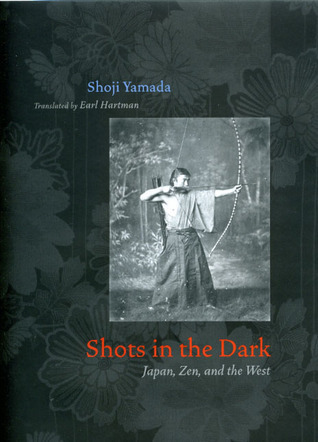
Shots in the Dark: Japan, Zen, and the West
In the years after World War II, Westerners and Japanese alike elevated Zen to the quintessence of spirituality in Japan. Pursuing the sources of Zen as a Japanese ideal, Shoji Yamada uncovers the surprising role of two cultural Eugen Herrigel’s Zen in the Art of Archery and the Ryoanji dry-landscape rock garden. Yamada shows how both became facile conduits for exporting and importing Japanese culture. First published in German in 1948 and translated into Japanese in 1956, Herrigel’s book popularized ideas of Zen both in the West and in Japan. Yamada traces the prewar history of Japanese archery, reveals how Herrigel mistakenly came to understand it as a traditional practice, and explains why the Japanese themselves embraced his interpretation as spiritual discipline. Turning to Ryoanji, Yamada argues that this epitome of Zen in fact bears little relation to Buddhism and is best understood in relation to Chinese myth. For much of its modern history, Ryoanji was a weedy, neglected plot; only after its allegorical role in a 1949 Ozu film was it popularly linked to Zen. Westerners have had a part in redefining Ryoanji, but as in the case of archery, Yamada’s interest is primarily in how the Japanese themselves have invested this cultural site with new value through a spurious association with Zen.
304 pages, Hardcover
First published May 1, 2009
Ratings & Reviews
Friends & Following
Create a free account to discover what your friends think of this book!
Community Reviews
Displaying 1 - 7 of 7 reviews

June 14, 2017
This book allowed me to clear up a misconception about Zen, and how such a misconception comes to be.
I was quite surprised to see how a local concept---here the Eastern notion of Zen---can spread all over the world and gets recast to mean something pretty different. Some say that "everything is a remix", in deed.
The book is easy to read, overall enjoyable. It definitely changed my views on several works, opening a new understanding of books entitled with a "The Zen of ...".
I was quite surprised to see how a local concept---here the Eastern notion of Zen---can spread all over the world and gets recast to mean something pretty different. Some say that "everything is a remix", in deed.
The book is easy to read, overall enjoyable. It definitely changed my views on several works, opening a new understanding of books entitled with a "The Zen of ...".

March 13, 2013
Looks at Herrigel's Art of Archery and Ryoanji rock garden, and at the post World War II attribution of "zen-ness". The criticism seems reasonable and even handed. As a person, Herrigel seemed to bend the truth, and his Nazi involvement is detailed. But this isn't an ad hominem attack, or attack at all, but a look at the myth construction. Kyudo is a sport (like judo or kendo) derived from a war art. I think it's interesting and there is much to learn from its tradition, and its principles of breathing and body alignment, but contrary to Herrigel, these guys want to hit the target.
Herrigel didn't master the bow in the three years he studied once a week. His knowledge of Zen is peripheral -- reading only. He didnt go to the temples or meditate. His kyudo teacher wasn't a priest. The "doctrine" is teacher Awa's personal philosophy. But this is the zen that Americans knew in the 60s.
Coincidentally, Zen in the Art is featured in a segment of "Know Thyself" Coursera course I have been taking, and it is lovingly quoted in several lectures. My own martial arts training in the 70s had some of the "it hits" philosophy that Shots in the Dark criticizes, and I took the stories of Herrigel's cheating at being adept as cautionary. The actual shot in the dark, when the teacher puts one arrow through the shaft of another arrow in the target, seemingly without looking, is featured in Clavell's Shogun. It is all bound up with an idealized image of Japan, those wonderful,folks who brought you Pearl Harbor ( and the Bataan death march).
Zen is cool.
But doing is long, while reading about it and telling neat stories is so much better.
Herrigel didn't master the bow in the three years he studied once a week. His knowledge of Zen is peripheral -- reading only. He didnt go to the temples or meditate. His kyudo teacher wasn't a priest. The "doctrine" is teacher Awa's personal philosophy. But this is the zen that Americans knew in the 60s.
Coincidentally, Zen in the Art is featured in a segment of "Know Thyself" Coursera course I have been taking, and it is lovingly quoted in several lectures. My own martial arts training in the 70s had some of the "it hits" philosophy that Shots in the Dark criticizes, and I took the stories of Herrigel's cheating at being adept as cautionary. The actual shot in the dark, when the teacher puts one arrow through the shaft of another arrow in the target, seemingly without looking, is featured in Clavell's Shogun. It is all bound up with an idealized image of Japan, those wonderful,folks who brought you Pearl Harbor ( and the Bataan death march).
Zen is cool.
But doing is long, while reading about it and telling neat stories is so much better.

April 14, 2025
"Shots in the Dark" was a nice discovery, quite enjoyable to read. The topic was very specialized, going deeply into the roots of kyudo and perceptions of the rock garden at Ryoan-ji. The common thread is the way they became intimately associated with Zen. Yamada analyzes from both the perspectives of foreigners, mainly focusing on Herrigel, the author of Zen in the Art of Archery, and also the perspective of Japanese, the way Herrigel's influential book shifted Japanese attitudes. To an extent, Shots in the Dark offers an extensive biographical sketch of Herrigel that is, while certainly not a takedown or character assault, in the end unflattering. Yamada is meticulous to spread the... blame? criticism? for misperceptions and exaggerations about the book around. While points come across as critical--questions about Herrigel's expertise, his motives, etc., readers get the sense that mainly Yamada is making observations, motivated, perhaps, by a love of kyudo (which he practices somewhat seriously). Yamada's observations consistently held my interest and, while it was his intent or not, frequently made me laugh. My main criticism is that the analysis of the rock garden at Ryoan-ji, while impressive from a serious and scholarly point of view, eventually became a bit tedious. Readers should note that nothing about Zen itself is explained; I am keen to read a future book by Yamada about that topic.
July 20, 2021
This is a superb book that identifies all of the problems with the "Zen in the art of..." books that Herrigel's Zen in the Art of Archery spawned. The book is about Herrigel and his biases and influences, which deeply shaped his writing. It also explores his involvement in the Nazi Party to some extent and raises important questions about his motivations in writing Zen in the Art of Archery. This book is must reading for anyone interested in Zen.
July 8, 2013
I enjoyed the parts about the history of kyudo and Herrigel and "Zen in the Art of Archery". I did not enjoy the parts about Japanese gardens. Largely this is due to my interest in archery and complete disinterest in gardens, I'll admit. The author is a fine writer, but sometimes I got completely lost in what he was trying to say or where he was going with a particular section. He ties it together in the last few pages, but some help along the way would have been nice. I learned a few things, but it was too long of a book for what I got out of it.
May 3, 2016
This is a book more martial artist should read. And not just Kyudo practitioners but for the Iaido, karate and aikido buffs who walk with their heads in the clouds as well. Yamada has done excellent research for the book and clearly dispels much of the mystique and esoteric nonsense often attributed to martial arts and many sensei love to lecture about to naïve students.

June 9, 2012
Deconstruction of views on Japanese Zen gardens and kyudo, how they've been misinterpreted. Not bad, but I was wanting to read a book that explained kyudo.
Displaying 1 - 7 of 7 reviews