Jump to ratings and reviews
Rate this book

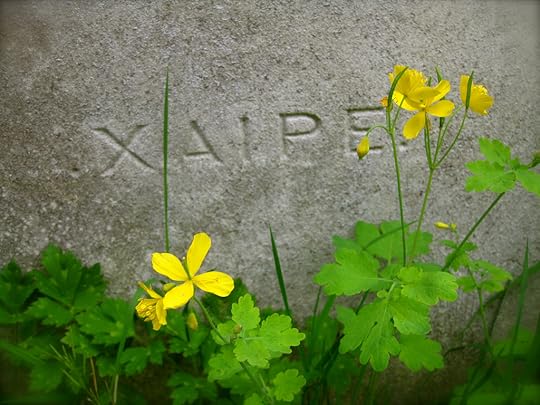
XAIPE

Rate this book
XAIPE (Greek for "rejoice"), which first appeared in 1950, contains some of E. E. Cummings's finest work. Among many poems can be found "dying is fine)but Death," "so many selves(so many friends and gods," "when serpents bargain for the right to squirm," "no time ago," "I thank You God for most this amazing," and "now all the fingers of this tree(darling)have."

88 pages, Paperback

First published January 1, 1950

9 people are currently reading
178 people want to read

About the author

E.E. Cummings

369 books3,951 followers
Edward Estlin Cummings was born in Cambridge, Massachusetts, on October 14, 1894. He began writing poems as early as 1904 and studied Latin and Greek at the Cambridge Latin High School.

He received his BA in 1915 and his MA in 1916, both from Harvard University. His studies there introduced him to the poetry of avant-garde writers, such as Gertrude Stein and Ezra Pound.

In 1917, Cummings published an early selection of poems in the anthology Eight Harvard Poets. The same year, Cummings left the United States for France as a volunteer ambulance driver in World War I. Five months after his assignment, however, he and a friend were interned in a prison camp by the French authorities on suspicion of espionage (an experience recounted in his novel, The Enormous Room) for his outspoken anti-war convictions.

After the war, he settled into a life divided between houses in rural Connecticut and Greenwich Village, with frequent visits to Paris. He also traveled throughout Europe, meeting poets and artists, including Pablo Picasso, whose work he particularly admired.

In 1920, The Dial published seven poems by Cummings, including "Buffalo Bill ’s.” Serving as Cummings’ debut to a wider American audience, these “experiments” foreshadowed the synthetic cubist strategy Cummings would explore in the next few years.

In his work, Cummings experimented radically with form, punctuation, spelling, and syntax, abandoning traditional techniques and structures to create a new, highly idiosyncratic means of poetic expression. Later in his career, he was often criticized for settling into his signature style and not pressing his work toward further evolution. Nevertheless, he attained great popularity, especially among young readers, for the simplicity of his language, his playful mode and his attention to subjects such as war and sex.

The poet and critic Randall Jarrell once noted that Cummings is “one of the most individual poets who ever lived—and, though it sometimes seems so, it is not just his vices and exaggerations, the defects of his qualities, that make a writer popular. But, primarily, Mr. Cummings’s poems are loved because they are full of sentimentally, of sex, of more or less improper jokes, of elementary lyric insistence.”

During his lifetime, Cummings received a number of honors, including an Academy of American Poets Fellowship, two Guggenheim Fellowships, the Charles Eliot Norton Professorship at Harvard, the Bollingen Prize in Poetry in 1958, and a Ford Foundation grant.

At the time of his death, September 3, 1962, he was the second most widely read poet in the United States, after Robert Frost. He is buried in Forest Hills Cemetery in Boston, Massachusetts.

source: http://www.poets.org/poetsorg/poet/e-...

Ratings & Reviews

What do you think?
Rate this book

Friends & Following

Create a free account to discover what your friends think of this book!

Community Reviews

5 stars
103 (34%)
4 stars
89 (29%)
3 stars
76 (25%)
2 stars
27 (8%)
1 star
6 (1%)
Displaying 1 - 30 of 35 reviews
Profile Image for Darwin8u.
1,841 reviews9,040 followers
February 19, 2017
chi alpha iota rho epsilon

description

"When you see the gravestones from the little necropolis of Cameirus . . . it is the so-often repeated single word -- the anonymous Xaipe-- which attracts you . . . . It is not the names of the rich or the worthy . . . but this single word, 'Be Happy,' serving both as a farewell and admonition, that goes to your heart with the whole impact of the Greek style of mind, the Greek orientation to life and death: so that you are shamed into . . . realizing how little you have fulfilled . . . a thought so simple yet so pregnant, and how even your native vocabulary lacks a word whose brevity and grace could paint upon the darkness of death the fading colors of such gaiety, love and truth as Xaipe does upon these modest gravestones."
- Lawrence Durrell

Upon Reading XAIPE
@ 29 days, 12 hours, 13 minutes.

be happy re-
Joyce? in a world
where logos &
agápē are re-
fugees stuck in
airports, (with-
out home, with-
in) a war, re-
moved in time &
unstuck by grace.

i remind and re-
wind in time to
post-War-poems
written unmanned
in lovenotlove re-
charged by Spring,
& sick of war, re-
warded egos (all
moved in) time &
unstuck by grace.

Soldier's trod
green, tired eyes
lift fractaling arms,
deep scars stretch
from night to April,
shellsshocked be-
aches grasping
tides, moonpulls re-
moves in time, &
unstuck in sand.
Profile Image for Ladi.
31 reviews3 followers
June 12, 2023
Are you checking the reviews here and wondering if you’re the only one who doesn’t understand why Cummings is so hyped? You’re not alone, I’m with you, friend.
Profile Image for Anna Ryan-Punch.
Author 9 books16 followers
March 7, 2011
e.e. cummings has been my favourite poet since high school. I carry a 'selected poems' around in my handbag (for emergencies), but it's always interesting to revisit a whole book, rather than just what someone else thought was a 'best of'. You get standout poems that don't make it into other collections, alongside lesser ones. Xaipe (pronounced "Khai-er-ree" to rhyme with 'fiery') means 'rejoice' in Greek, and the collection is often movingly joyous.

Cummings sometimes gets accused of being sentimental, deliberately impossible to read, and even casually racist. I can see how he could be read thus.

But I think his playfulness rescues him from sentimentality (I adore his poems about children):

"if a cheerfulest Elephantangelchild should sit

(holding a red candle over his head
by a finger of trunk,and singing out of a red

book)on a proud round cloud in a white high night

where his heartlike ears have flown adorable him
self tail and all(and his tail's red christmas bow)
--and if,when we meet again,little he(having flown
even higher)is sunning his penguinsoul in the glow

of a joy which wasn't and isn't and won't be words

while possibly not(at a guess)quite half way down
to the earth are leapandswooping tinily birds
whose magical gaiety makes your beautiful name--

i feel that(false and true are merely to know)
Love only has ever been,is,and will ever be,So"

His impossibility - shredded/recombined words and absurd punctuation litters his poems - suits the way I read poetry. I just read it headlong, straight through the first time, not pausing over words, punctuation or to try think or match up the parentheses. And interestingly when I go back for a second look, the image I've got the first time around usually still stands up. Try it yourself:

"the little horse is newlY

Born)he knows nothing,and feels
everything;all around whom is

perfectly a strange
ness(Of sun
light and of fragrance and of

Singing)is ev
erywhere(a welcom
ing dream:is amazing)
a worlD.and in

this world lies:smoothbeautifuL
ly folded;a(brea
thing a gro

Wing)silence,who;
is:somE

oNe."

Cummings himself responded to the racist controversy (mainly around his line "a kike is the most dangerous") in typically cryptic fashion:

'Cummings' "Good American point," as he told Allen Tate, was "that the kike isn't(helas) a Jew..." (but is an invention of Gentile society).' (quote from the inner flyleaf of Xaipe).

I loved revisiting Xaipe. It's flawed and joyous and sometimes extremely funny:

"o to be in finland
now that russia's here)

swing low
sweet ca

rr
yon

(pass the freedoms pappy or
uncle shylock not interested"

Additionally, when I re-read it, a copy of poem by Gwendolyn Brooks that I had been trying to remember for ages (When You Have Forgotten Sunday: The Love Story") fell out - I'd been using it as a bookmark! Brilliant.
Profile Image for Edita.
1,589 reviews596 followers
February 21, 2016
so never is most lonely man alone
(his briefest breathing lives some planet’s year,
his longest life’s a heartbeat of some sun;
his least unmotion roams the youngest star)
Profile Image for Anders.
474 reviews8 followers
December 31, 2016
I had never heard of this collection of Cummings' before but when I found it at the Book House, I took it home forthwith!

Apparently it's out of print, which is nice that I found it. It's also a little taller than most books its width, if you care about such things. Doubly nice is its title, Xaire, which is a transliteration of χαιρε (chaire) the Greek word for hello (or rejoice if you prefer). In the afterword, George James Firmage, relates a quote from Cummings about the book that he "spent several months persuading (espérons) 71 poems to make 1 book who called himself xaîre. Now et comment, the quote Oxford unquote Press registers alarm nudging horror; poems are nonsellable enough (paraît) without calling the poembook by some foreign word which no Good-American could either spell or pronounce." What a guy.

Onto the book itself: I've read some ee, but I recognized only two poems from this collection: "dying is fine)but Death" (which inspired that Ra Ra Riot song) and "when serpents bargain for the right to squirm", which are both really excellent examples of what I love about ee. The rest of the poems are equally excellent, although, for me, ee can be hit or miss at times. I love him when he says something and I love him when he says nothing, but sometimes he tries in between and his clarity is uncomfortably muddied or I start to think he's rebelling against grammar and structure themselves. These things clearly have a place in poetry (and in ee's oeuvre), but they either don't have a place in my heart or the degree to which his other poems shine blinds me to their truth.

In sum, there are some really great poems in here that you might have missed if you've made a point to read more than one ee book. It's a cool book in its materiality and each poem has room to breathe on its own longer-than-standard page. I'm more than happy to set it next to my other ee books.
Profile Image for Casey.
293 reviews
January 11, 2023
I only read this to have read a book starting with X, and I hated it thoroughly. Maybe it's just over my head, but honestly I think it's just bad poetry. 🤷🏻‍♀️ Also, this motherfucker uses the n word AND an antisemitic slur I had forgotten even existed. Hard pass. I'll probably downgrade to one star at some point, but for now I'm giving two because it may just be beyond my comprehension (but again, I doubt it). I can't end my reading year with this trash! 😭
Profile Image for Illiterate.
2,792 reviews56 followers
October 21, 2019
Poetry for people who’d rather be doing crosswords.
Profile Image for Sabrina.
475 reviews37 followers
Read
December 24, 2023
I hate rating poetry collections but this was a comfort reread for me….It’s Snowing Isn’t That Perfectly Wonderful
Profile Image for V.
138 reviews44 followers
August 6, 2015
This books is to poetry as Jackson Pollock is to painting. Take that as you will.

Still, between the pages of word-salad and random punctuation, there are scattered some well-crafted poems that betray cummings' underlying talent as a wordsmith. This was one of my favorites:
when faces called flowers float out of the ground
and breathing is wishing and wishing is having-
but keeping is downward and doubting and never
-it's april(yes,april;my darling)it's spring!
yes the pretty birds frolic as spry as can fly
yes the little fish gambol as glad as can be
(yes the mountains are dancing together)

when every leaf opens without any sound
and wishing is having and having is giving-
but keeping is doting and nothing and nonsense
-alive;we're alive,dear:it's(kiss me now)spring!
now the pretty birds hover so she and so he
now the little fish quiver so you and so i
now the mountains are dancing, the mountains)

when more than was lost has been found has been found
and having is giving and giving is living-
but keeping is darkness and winter and cringing
-it's spring(all our night becomes day)o,it's spring!
all the pretty birds dive to the heart of the sky
all the little fish climb through the mind of the sea
all the mountains are dancing;are dancing)

Though I don't believe his playing with space and punctuation does anything for me, there is a beautiful melody to the poem, created in part by his brilliant use of alliteration and assonance. Because cumming's skill as a poet is so clear here and in a few others, I know he must have some philosophy behind his more experimental pieces, I just can't figure it out. I suppose the real problem with the cummings and Pollocks of the world is they lead to thousands of untalented posers believing you don't need skill or purpose to make art.
Profile Image for Punk.
1,608 reviews300 followers
August 16, 2007
Poetry. I feel like it's impossible to review an entire book of poetry, but I just finished this, so I'm putting it up here anyway. Well, it's e.e. cummings. There's the unusual use of white space, the rhythmic nonsense, words meant to be felt rather than read. Half of the book is exactly what you expect from him; the other half looks like someone put e.e. through a shredder -- very disjointed, with fractured rhythm and extended parenthetical digressions. It makes me wonder what old e would have thought about the internet and all our mashed up words. It's true tl;dr lacks a kind of poetry, but so does a lot of his work. Poem 57 in this book looks like it could have easily been found on a Something Awful bulletin board, with all the specialized kind of language (or lack thereof) you find in those kinds of places.

Three stars. I found several new poems to love and poke at in this volume, but too many of the pieces were more of an exercise in reading, in matching up letters until you get a whole word, more puzzle than poem.
23 reviews
August 5, 2007
E. E. Cummings is possibly the greatest poet of the 20th centruy. His use of creative typesetting as an extension of the poem's message and feel is lost on those of us who did not witness it first. For a poet to do something so radical was unheard of, making him an instant legend. He again extends the reach of his poetry beyond the mere words through use of "odd" punctuation and meter. His poems are evocative, provocative, and complete works of genius.
Profile Image for Dale.
272 reviews2 followers
July 18, 2021
Either I'm having a fun little illiteracy moment, or everyone else is just lying about understanding what the hell this man was writing about.
Listen, I've read some Cummings poems that I genuinely enjoy, but this selection......He really let his cat walk across his keyboard for 60 poems, sprinkled a couple violently bigoted ones here and there, and added a couple fairly decent ones at the end to trick people into thinking it was, what? A good collection? At all enjoyable to read? Anyway.
Profile Image for Evelyn.
1 review
March 30, 2022
I was a bit unsure of e.e. cummings at the beginning of this book. This was my first real introduction to his style of poetry (aside from sitting through a high school presentation on love poems.) I started to like it around page 50 but he really won me over with the last few poems.
Profile Image for Karen.
32 reviews
July 1, 2023
While I appreciated some lines and a few poems, I understood even less and overall I found it beyond me. With lines like ‘$ $ $ etc(as’ I didn’t enjoy reading most of it.
Profile Image for Mark.
698 reviews18 followers
December 22, 2025
What Gertrude Stein did for experimental grammar, E. E. Cummings expanded to the level of spelling. Poetry, or at least modern poetry, primarily serves as an originality machine, initially on the part of the author, but hopefully resulting in some change in the reader as well.

Both of these authors knew all too well how easy it is to slide back into cliches (such as "all too well"); the more comfortable we become with cliches, the more difficult thinking becomes. Of course, in the cliched mind, thinking feels quite easy, too easy, to the point that you can't really call it thinking. At first blush, much of E. E. Cummings' poetry looks random, like people love to accuse modern art of being. But on closer inspection, many of the poems follow traditional poetic forms, especially sonnets. Meaning is deflected at first glance, but coagulates the more patiently you approach the text.

Though a book of poetry this experimental threatens at every moment to become either repetitive or incoherent, Cummings mercifully leaves some readerly footholds in each poem, no matter how visually explosive. If he stretches them out and dismembers the words, the grammar is fairly standard. If he interrupts the grammar, the sonic quality gives a cadence that carries it evenly along. The few times that the stars align and he has more straightforward grammar and formatting, they tend to fall a bit flat. But he shines in his visual playfulness, isolating the two "o"s in "look" on their own line so that you get the effect of two eyes peeking between the lines.

Ultimately, Cummings is brimming with life and positivity in a way refreshingly reminiscent of Walt Whitman. He has that indefatigable American spirit, the best of Twain and Vonnegut and other secular humanist satirists. One "controversial" poem in the collection uses the word "kike", only to beautifully disarm the word:

a kike is the most dangerous
machine as yet invented
by even yankee ingenu
ity(out of a jew a few
dead dollars and some twisted laws)
it comes both prigged and canted


The few times he addresses politics, it comes off with the same all-American values as old Superman comics, not jingoistic Republicanism or virtue-signalling Democratism. He interestingly calls "down with the fascist beast" after the end of WWII, knowing that vigilance is the price of liberty. But more often than not, he defers a direct meaning, letting it linger and perhaps percolate at a later date, should you be patient enough to dwell within the poems themselves. For ultimately, he writes "of a joy which wasn't and isn't and won't be words"; this is bold for a poet to admit, but I think it's only gaining more relevance today, as are his calls to embodied over cerebral knowledge: "i feel that(false and true are merely to know) / Love only has ever been,is,and will be,So"

One of my favorite parts of the collection is how regularly the momentum of poems, rather than driving you on to the next poem, instead boomerang you back to the start of the poem. Most every poem starts out in the middle of a sentence, in the middle of a phrase, with the weight of the absence of what came before being palpable, being needful and in a strange way, almost more real than the poem itself. He also regularly slices that first line with a parenthesis, using them as regularly and readily as Derrida, but to much more creative ends. A great example is found on page 6:

dying is fine)but Death

?o
baby
i

wouldn't like

Death if Death
were
good:for

when(instead of stopping to think)you

begin to feel of it,dying
's miraculous
why?be

cause dying is

perfectly natural;perfectly
putting
it mildly lively(but

Death

is strictly
scientific
& artificial &

evil & legal)

we thank thee
god
almighty for dying

(forgive us,o life! the sin of Death


With the lack of spacing around punctuation, Cummings evokes the breathless urgency of Mark the Evangelist and his many "immediately"s, as if his undistilled human energy is so powerful that it can barely be contained in language, in marks upon a page, in a book awkwardly tall and thin. For really, the reason why I plucked this one off the shelf was how it stuck out, gangly among the sea of thick, squat commentaries. For even, once you open it, the text itself is the thinnest of typewriter fonts, not the standard, thicker fare common to reputable publishers. But I think the typewriter font is fitting; it makes it feel like this was his first draft, straight from the typewriter and into the book. And that's what we're tempted to think, what with our impatient, information-hungry media consumption landscape. We glance and skim headlines to our own detriment, having less than no time for poetry. But, ironically, these fast, frantic, lively poems demand a slow, close attention, and a fair serving of repetition. They flower outward in both these respects, seeing the many decisions that went into every poem. This is the sign of a true master: the ability to create works which look both raw and refined, both first and final draft.
Profile Image for M.W.P.M..
1,679 reviews28 followers
January 23, 2022
dying is fine)but Death

?o
baby
i

wouldn't like

Death if Death
were
good:for

when(instead of stopping to think)you

begin to feel of it,dying
's miraculous
why?be

cause dying is

perfectly natural;perfectly
putting
it mildly lively(but

Death

is strictly
scientific
& artificial &

evil& legal)

we thank thee
god
almighty for dying

(forgive us,o life!the sin of Death
- pg. 6

* * *

o

the round
little man we
loved so isn't

no!w

a gay of a
brave and
a true of a

who have

r
olle
d i

nt

o
n
o

w(he)re
- pg. 8

* * *

tw

o o
ld
o

nce upo

n
a(
n

o mo

re
)time
me

n

sit(l
oo
k)dre

am
- pg. 12

* * *

chas sing does(who
,ins
tead,
smiles alw

ays a trifl
e
w
hile ironin

g!
nob odyknowswhos esh
?i
rt)n't
- pg. 13

* * *

(swooning)a pillar of youngly

loveflesh topped
with danc
ing egghead strutstrolls

eager a(twice

by
Dizzying eyeplums
pun

ctured)moo

nface swimming
ly
dreamseems

(vivi

d
an O
of

milky tranceworld writhes

in
twi
nn

ingly scarlet woundsmile)
- pg. 17

* * *

nine birds(rising

through a gold moment)climb:
ing i

-nto
wintry
twi-

light
(all together a
manying
one

-ness)nine
souls
only alive with a single mys-

tery(liftingly
caught upon falling)silent!

ly living the dying of glory
- pg. 29

* * *

snow means that

life is a black cannonadin
g into silenc
e go

lliw

og-dog)life
?
tree3ghosts

are Is A eyes

Strange
known
Face

(whylaughing!among:skydiamonds
- pg. 30

* * *

a thrown a

-way It
with
some-
thing
sil
-very

;bright,&:mys(

a thrown a-
way
X
-mas)ter-

i

-ous wisp A of glo-
ry.pr
-ettily
cl(tr)in(ee)gi-

ng
- pg. 34

* * *

(fea
therr
ain

:dreamin
g field o
ver forest &;

wh
o could
be

so
!f!
te

r?n
oo
ne)
- pg. 55

* * *

(im)c-a-t(mo)
b,i;l:e

FallleA
ps!fl
OattumblI

sh?dr
IftwhirlF
(Ul)(lY)
&&&

away wanders:exact
ly;as if
not
hing had,ever happ
ene

D
- pg. 57

* * *

blue the triangular why

of a dream(with
crazily
eyes of window)may

be un

less it
were(floati
ng through

never)a kite

like face of
the child who's
every

child(&

therefore invisible)anyhow you
've(whoeevr
we are)stepped carefully o

ver(& i)some

newer
than life(or than
death)is on

f

ilthi
es
t

sidewalk blossoming glory
- pg. 70
45 reviews
August 29, 2019
I used to think that if I really wanted to get to know a poet, I had to buy everything. Apparently the complete Sylvia Plath, which I found far too intimidating to actually read, some 20 years ago wasn't enough to disabuse me of this notion, but maybe by the time I picked up both volumes of the complete William Carlos Williams (springing from an infatuation with Steve Reich's Desert Music) a few years later it was starting to sink in.

I also used to buy a lot of "Selected Poems" anthologies, and it is only later in life that I've come to recognize this as the poetry equivalent of a greatest hits album. It may provide a good overview, but you don't get a sense of how the poet actually thinks about their work, what they value, and how things fit together into a larger scale form. Ted Hughes' foreword to the aforementioned Sylvia Plath collection talks about all the different configurations of poems into publishable books she considered, very similar to how a musician might think about putting songs onto an album; I can't help but think about how Prince went through so many different configurations of an album like Sign o' the Times: http://princevault.com/index.php?titl....

For a long time I primarily knew e. e. cummings via his 100 Selected Poems collection from Grove. I ran across KAIPE (i.e., χαίρε, from what I can gather: https://en.wiktionary.org/wiki/%CF%87...) at the Harvard Bookstore dock sale around a year ago. It's the first time I've read his work in the context of a collection of new work that he put together himself. It contains some of my favorite poems, esp. "i thank You God for most this amazing," as well as some controversial racial slurs (see discussion here: https://en.wikipedia.org/wiki/E._E._C...). Many of the poems are brilliant, a few struck me as clunky, but I feel like I got a better sense of the texture of the poet's thinking; as someone who is always interested in how artists across media do their thing, I am grateful for this.

I live about 6 blocks from cummings' former house, and I love to recite "i thank You God for most this amazing," which I recently committed to memory, as I jog past, which I do several times a week.

This book was another entry in the baby changing table poetry series. Baby now routinely requests "POEM" when hoisted up there, although I am starting to suspect that baby simply realizes that asking Papa to read simply means more time to play with diaper cream ("CREAM!"), one of baby's favorite things to do...
Profile Image for tori gm.
109 reviews
February 10, 2024
a favorite poet of mine for what i knew about him. his love for spring. his love of love. it was wonderful and light. still is, even in this body of work. i love his style, i stole it and made it my own, adoringly- but the verbiage used here i refuse to ignore. it is a raincloud on this otherwise enjoyable body of work. it didn't do what he had hoped it to, or what i could assume he wanted it to based on his minimal explanation when questioned, and it ruined this for me. the last few poems are reflective of what i adore about his earlier works, so if you happen to get your hands on this, whats worthwhile can be found on pages 67-71 TBFH.

some otherwise fun pageplay and word/syntax play and some pretty (and anti-war) passages throughout- maybe you'll encounter them in other settings- again, just really ruined by the slurs...circa 1950.
Profile Image for L Y N N.
1,653 reviews82 followers
December 28, 2024
Uhm. Poetry is not really my thing, but this...well, this is...definitely NOT my thing! I can only assume most of this was way over my head and/or required much more tedious work than I admit I wanted to put into reading these "poems."

Upon researching further I learned Cummings was an "avant-garde"/"modernist free-form poet. He broke all rules of format within his poetry. For me, this was mostly indecipherable without formidable time and effort to reread multiple times and try to figure out the "puzzle." I get that his work was ground-breaking from the 'norm' or expected poetical forms, but I can't say I found it enjoyable or even understandable...
Profile Image for Adam Feng.
112 reviews1 follower
October 20, 2025
I must admit I was attracted to the Greek title. Upon finding no traces of Ancient Greece in the poems, I was peeved. That aside, the form of Cummings' poems were, how shall I say, exiciting for the first ten, maybe twenty poems. They become pretty tiring after that. As for the content, there is even less to say.

I appreciate the ways Cummings bent puncutations and line breaks in this collection, for I didn't know you could do this, but I cannot, in all fairness, say I enjoyed the poems.

2/5
Profile Image for Sarah.
515 reviews
November 12, 2024
E. E. Cummings is hard to review. Some of these poems flow smoothly and have meaning that resonates and unique layouts that intrigue me. Other poems have unique layouts that are hard to follow and words that confuse and phrasings and rhythms that are impossible. Either Cummings was so profound an artist that some poems go over my head or else they were written purposely because he was pretentious. I can’t decide.
I will say, I like them all better when read aloud.
Profile Image for NCChris.
229 reviews25 followers
May 26, 2021
I always forget how odd some of e.e. cummings poetry is. I like some and don’t get others. I always feel like it should be read aloud at a poetry slam with a snare drum in the background.
Profile Image for steph.
142 reviews2 followers
Read
December 6, 2024
3.5 ⭐️

Avis assez mitigé honnêtement. J’ai beaucoup aimé certains poèmes, mais j’ai absolument pas compris d’autres. Je serai très curieuse d’en lire d’avantage par contre!

———

HRCYED: Alphabet, X
Profile Image for Samantha.
247 reviews
October 12, 2025
One of the smaller E.E. Cummings books I own but oh wowowow it packs a punch! Even from page 1 it dives right into that dreamlike language that gets visions dancing in your head
Profile Image for Kay.
87 reviews
June 12, 2025
I may as well be illiterate at this point but at least 23, 47, 49, 50 and 66 made sense.
Profile Image for Dennis.
43 reviews4 followers
April 18, 2010
In this collection are many poems that are openly beautiful, more than some that promise to be more rewarding on a re-read, and a few that make me a little uncomfortable, not the nonsensical (to me) abstractions that I can live with, but rather the rare ones that toss in the occasional ethnic slurs of wop, kike and nigger. Mostly because their use or intent in the twiddle-twaddle is absolutely unclear to me; I'm not sure what their placement means and what I'm to take away. Is he mocking a prejudice or employing it, I can't tell. But rather than focus on the ones that I really can't wrap my head around, that tendon hammer the knee-jerk politically correct part of me, I have to acknowledge that, on the whole, I really liked this group of poems, because more often than not there is a lot of clever grace here.
Profile Image for Brian.
Author 3 books34 followers
April 11, 2017
I just don't understand why such a beautiful poet wasted so many lines on effect and posturing. He'll follow up 15 lines of nonsense with one of the most beautiful couplets you could ever imagine, and it annoys me to no end. I don't mind experimentation, but to me his experiment didn't work, and he could have been so much better than he was.
Profile Image for Michael P..
Author 3 books74 followers
April 1, 2011
As usual, cummings has poems that are too much work to understand, and maybe cannot be understood, but more that are wonderful here than in his most recent books. His work is dazzling when his unique voice comes through.
Profile Image for Kate.
807 reviews6 followers
March 19, 2015
Favorites:

this out of within itself moo

tw oo ld o nce upo

three wealthy sisters swore they'd never part

i'm asking you dear to what else could a no but it doesn't

i thank You God for most this amazing

the great advantage of being alive
Displaying 1 - 30 of 35 reviews

Can't find what you're looking for?

Get help and learn more about the design.