Jump to ratings and reviews
Rate this book

Nikolski

Rate this book
Spring 1989. Three young people leave their far-flung birthplaces to follow their own songs of migration. Each ends up in Montreal, each on a voyage of self-discovery, dealing with the mishaps of heartbreak and the twisted branches of their shared family tree.

Filled with humor, charm, and good storytelling, this novel shows the surprising links between cartography, garbage-obsessed archeologists, pirates past and present, a mysterious book with no cover, and a broken compass whose needle obstinately points to the Aleutian village of Nikolski (a minuscule village inhabited by thirty-six people, five thousand sheep, and an indeterminate number of dogs).

290 pages, Paperback

First published August 4, 2001

82 people are currently reading
2621 people want to read

About the author

Nicolas Dickner

17 books131 followers
Nicolas Dickner est né à Rivière-du-Loup, a voyagé en Amérique latine et en Europe avant de jeter l’ancre à Québec puis à Montréal, où il vit aujourd’hui avec sa famille. Il signe en 2005 Nikolski, qui remporte le Prix des libraires du Québec, le Prix littéraire des collégiens ainsi que le prix Anne-Hébert et qui est, à ce jour, traduit dans une dizaine de langues. Tarmac, son deuxième roman paru en 2009, est également traduit dans plusieurs pays. En compagnie de Dominique Fortier, il signe Révolutions en 2014. Six degrés de liberté est son troisième roman.

Ratings & Reviews

What do you think?
Rate this book

Friends & Following

Create a free account to discover what your friends think of this book!

Community Reviews

5 stars
814 (15%)
4 stars
1,824 (35%)
3 stars
1,702 (33%)
2 stars
584 (11%)
1 star
168 (3%)
Displaying 1 - 30 of 404 reviews
Profile Image for August Bourré.
188 reviews15 followers
February 26, 2010
When I was doing my bachelor's degree, one of my summer jobs was working Confined Space Safety Watch (known colloquially as Hole Watch) for the Weyerhaeuser pulp and paper mill in Dryden. The job was pretty simple. The mill would shut down for ten days of the annual top-to-bottom maintenance period, a lot of workers, both contract and union, would have to crawl into some very cramped spaces to work, and often those spaces were dangerous. My job was to put on a tonne of heavy gear, grab a first aid/emergency rescue pack and a walkie talkie, and sit outside a confined space for twelve hours a day making sure nobody died. I worked in the bleach plant, the recovery boiler, the chemical plant, flak dryers, precipitators, black and green liquor tanks, and a few places I can't remember the names for. I did it two years in a row (earning, in each ten day period, about twice my current monthly income), and there were never any accidents or emergencies on my shifts. I got a lot of reading done. On one particularly scorching afternoon I was working in the precipitators—a relatively easy post, because there was a place to sit, it was easy to keep track of the workers, and there were normally at least three other watchers there with you—and I happened to be seated next to a woman whose name I can't recall. The precipitators were an ugly, almost frightening place. To us it was a long, narrow iron corridor with iron doors on either side, like the watertight doors of a battleship. There'd be welders and other tradesmen (always men) on the other side of the doors, balanced on thin, tightly grouped iron rails, a great, black, breathing emptiness far above and below. Even in the heat of the afternoon it was a grim, dark place, like something David Lynch would have built for the Baron Harkonnen. We didn't want to think about our surroundings, and it was too filthy a place to bring a book, so we'd talk. The woman I sat next to on that afternoon told me what she did to pass the time. She would pick a person at random, me, say, or one of the welders, and imagine an entire history for them. Would they have a family? What did they do for fun? Where did they live? If she liked the way her story turned out, she would find a way, small and innocent, to put herself in it, to make it, just briefly, her own story as well. She never wrote any of it down. It all just happened in her head, and when she was done, she'd let it drift away like smoke.

Nikolski is about serendipity, three characters whose lives barely brush up against each other, never quite connecting. Noah, the itinerant archaeologist, Joyce the dumpster diving pirate, and the unnamed bookseller with the ocean in his basement. They are united by the Book with No Face, by trash, and by a shared bond of blood that they don't even know exists. Set in Fournier, Lazer Lederhendler's translation is lovely to read as the three protagonists fumble in the dark, unknowing but, strangely, far from lost. That, I think, is the conventional reading, and it's certainly the best one.

I'm going to offer an alternative.

One of Dickner's protagonists, the only one without a name, and not coincidentlaly, the only one who is allowed to narrate his own story, works in the S.W. Gam Bookshop in Montréal, the only place visited by all three characters. Nikolski begins in 1989 with him cleaning out his dead mother's house, taking with him the Nikolski compass—a cheap plastic compass that points to the island of Nikolski, where our narrator's father lived and eventually died. It's the only thing he has left of his family. The novel also opens with garbage, bags and bags of it, full of history, of treasure, of the stuff that Noah and Joyce will build their lives with.

I wonder if there may not somewhere be a Britannica of our desires, a comprehensive repertory of the slightest dream, the least aspiration, where nothing would be lost or created, but where ceaseless transformation of all things would operate in both directions, like an elevator connecting the various storeys of our existence.

Our bookshop is, in sum, a universe entirely made up of and governed by books—and it seemed quite natural for me to dissolve myself in it completely, to devote my life to the thousands of lives duly stacked on hundreds of shelves.

This could be Nikolski, the book our narrator writes himself, the chapter in the Britannica that contains his slightest dream, the one where he has family, connections. I can imagine him sitting behind the counter, looking at the customers, seeing which books they buy (or steal), finding common ground, making up stories like the woman who sat next to me in the industrial hell of the precipitators. This woman buys books about marine life and shoplifts books about computer programming. That man comes in with a child and browses the dinosaur books. Before that, there was a woman, loud and frantic, with a book that was decades old and falling apart. How do these things connect? I see our unnamed protagonist as the narrator of the entire novel, taking his mother's collection of travel guides as a jumping off point and reaching back, creating a mythology of wanderlust and a family tree to support it, putting up the scaffolding that will let him build the courage to leave a life that holds no connective tissue for him anymore.

Of course this is just me grafting my own experiences on top of a narrative that works exceptionally well as it stands, but I think that any book that can open itself up this way, that can be read as a complex, adventurous, but still accessible novel and like a box of puzzles and secrets, like a map to pirate treasure or a midden heap, is a book that should win Canada Reads. I have two books to go, but I think I've found the contender I'm rooting for. And as an aside, if this is the sort of thing that's going on in French Canadian literature, English Canada needs to get working on more translations as good as Lederhendler's.
Profile Image for Anne.
558 reviews6 followers
April 10, 2010
"Nikolski" teases three unconnected, yet absolutely connected lives together in a complex tapestry of eccentric themes which include piracy, bibliomania, fish, archaeology and cartography. Weirdly, and with more than a whiff of magic realism, Dickner manages to pull off a story that is brilliantly implausible but perhaps is not! The translation is superb capturing all that is comic and poignant and perceptive about this truly Canadian romp (sans BC!). Five stars would have been awarded had the female protagonists been rendered as fully as the males -- we are left with a void regarding the enigmatic Joyce and the lesser but equally interesting Arizna, plus an ending that is satisfactory, but only just.
Profile Image for residentoddball.
91 reviews14 followers
July 24, 2009
I've never enjoyed being so frustrated with a book as much as I enjoyed the twists and turns of this one! I truly enjoyed reading Nikolski, but it took a lot of effort to keep the details straight.

The first few chapters jump characters and settings quite dramatically, so much so that I thought I was reading three different stories. But gradually it all comes together, and you see that it's really part of the author's style, not to mention the foundation that allows for a clever unfolding of the plot.

Not at all what I expected, Nikolski is a new twist on the theme of "six degrees of separation". Dickner subtly weaves the interconnectedness of the story's elements so exquisitely, you almost don't even notice. So often through the read, I laughed, smiled, tapped my foot in anticipation, smirked, considered sketching a diagram of my hypothesis, and at the end, found my jaw dropping in amazement.

A challenging read, but nevertheless, a really really good one.

***An additional note: I completely took for granted that this was a translated book. The translation was so well done; I never stumbled over awkward verbiage.
Profile Image for Laura.
628 reviews49 followers
October 29, 2011
Much to the chagrin of my rock-music-lovin'-husband, I love talk radio. Specifically, I love CBC Radio 1. I listen to it every day. I listen to it at home, in the car, and I used to listen to it at work. I have my favourite shows: As It Happens, The Vinyl Cafe, The Current, and Q to name a few. (If anyone at CBC is reading this: Please bring back The Point. That was my absolutely favourite!)

I also, obviously, love reading. So when CBC started Canada Reads, I loved the idea. National unity consolidated around one work of literature. I eagerly await the announcement of the finalists every year.

To be fair, I'm not a stellar Canada Reads participant. Before 2010, I had only ever read three of the eight previous winners (2002: In the Skin of a Lion by Michael Ondaatje, 2006: A Complicated Kindness by Miriam Toews, and 2007: Lullabies for Little Criminals by Heather O'Neill) and I'm pretty sure I read two of those for school. I always planned to read the books. I even planned to read the books after the announcement but before the debate so that I could champion my own favourite. But life and school got in the way and every year I never got around to doing it.

When 2010's lineup was announced, I was determined that this year would be better. I tweeted about Canada Reads 2010. I placed holds on all the books at the library.

Here's the problem with library books. You can only read them when you get them and you have to give them back. Because I was so gung ho about placing holds on all the books at once, I got all the books at once. I had to return four unread. By that point, the holds list was so long I just had to wait for my turn to come up again.

Eventually, I read two of the five shortlisted books:
Good to a Fault by Marina Endicott and Fall on Your Knees by Ann-Marie MacDonald. By that point, I had been gifted an ebook reader (and the remaining books weren't easy to find as an ebook) and a winner had already been crowned: Nikolski by Nicolas Dickner.

When I first picked up Nikolski, I needed to adjust my style of reading. The last book I read was much more of an entertaining read. With Nikolski, I was immediately swept into the literariness. I felt like I was back in university, scribbling all over my pages and thinking of the countless number of essays that could be written from the nuances hidden on the pages, except I'm not in school and I don't have to write any essays. (Oh, and I didn't scribble all over my pages. That would have ruined my ebook reader.)

The language is divine. It is actually delicious from page one. Word choice is so carefully considered in this novel, which is interesting because the book has been translated from French to English. "I crawl out of the sleeping bag and stumble over to the window. Clutching at the curtains, I watch the garbage truck pull up with a pneumatic squeal in front of our bungalow. Since when do diesel engines imitate breaking waves? Dubious poetry of the suburbs." page 8

I really liked Nikolski. The characters are personal and engaging. Like many literary books, the plot isn't the most important tool that the novel uses, but I was still eager to find out what would happen. The book follows three characters who are deeply connected as they go about their lives, often oblivious to one another.

Being a sucker for plot, I really wanted the book to give me more. I wanted the characters to become as aware as the reader was. I wanted to know what happened next. I am sure though, that if I actually got my wish, I wouldn't have found the literature nearly as good.

I do struggle with whether I would suggest this book. I initially want to say Yes! Read it! but I am quite sure that this isn't a book for everyone. I suppose I would suggest that if you want to read a book that a large amount of Canadians are reading / have read, then pick up this novel. If you have an appreciation for literature and literary devices, then pick up this novel. If you are looking for an entertaining and exceptionally engaging page turner, then this book is probably not for you.
7,019 reviews83 followers
August 23, 2018
Une belle histoire. Très bien écrite d'ailleurs, mais qui m'a laissé un peu sur mon appétit en raison de sa longueur (trop courte). Je crois que les personnages auraient pu ête approfondis afin des les découvrir et de les apprécier encore plus, car ils sont très attachants. On traverse plusieurs époques également, ce qui est bien, mais aurait pu être développé encore plus si le livre aurait été plus long. J'ai bien aimé, j'en aurais même pris plus. Malheuresement, la longeur laisse un sentiment d'inachevé et tout le livre demeure tout de même assez léger, c'est pourquoi je lui donne quatre étoiles sur cinq!
Profile Image for Bookygirls Magda .
767 reviews86 followers
January 27, 2025
4.5
Przepraszam, ale czy ja mogę przeczytać tę książkę jeszcze raz???? Od razu??? Co to była za przeprawa - nie tylko w kontekście migracji bohaterów, ale też delikatnej nici połączeń między nimi, zaskakujących i niepotwierdzonych w pełni teorii, które kłębią mi się w głowie po lekturze. Koniecznie muszę zrobić reread w papierze. Nie mogłam się oderwać, mimo że nienawidzę czytać na telefonie - w tym przypadku nie miało to znaczenia.
Profile Image for Camille.
200 reviews13 followers
January 16, 2023
Je dois me rendre à l’évidence, Nicolas Dickner est un de mes auteurs préférés! Ses histoires sont tellement originales! J’adore :)
Profile Image for Blake Fraina.
Author 1 book46 followers
September 10, 2011
Some books make you feel and others make you think.

Nicolas Dickner’s clever debut, Nikolski, definitely falls largely into the latter category. As a matter of fact, it still has me turning over its intricacies in my head months after I’ve finished it. This tightly woven tale is packed with ideas that challenge customary thinking about the nature of personal identity. Dickner asks if who we are is a result of nature or nurture, genealogy or geography, or, perhaps, a combination of all four.

Early in the story, we are introduced to the three main characters, all distantly related, although not necessarily aware of one another’s existence. They are the unnamed narrator – a second hand bookshop clerk who is in possession of a compass that always points in the direction of Nickolski, a tiny Aleutian Island, Noah - son of an itinerant Native American mother and absentee father who learned to read from roadmaps and Joyce - restless young woman descended from a family of French-Canadian pirates. The three stories unfold in alternating chapters as each begins a pilgrimage to unearth their family connections, seek their place in the world, establish their destinies and find themselves.

Like the Nickolski compass, the writer postulates that all people have a built-in homing instinct. A family of Dominican fishmongers, who rent a room to Noah and employ Joyce in their retail shop, despite being long time residents of Canada, hold a monthly "jututo" to enjoy their native foods and boisterously debate Dominican politics. And humorously, we see how Joyce (and her erstwhile mother) inadvertently fall into a twentieth century version of the family business - as computer pirates. Ties to place, ethnicity and family not only dictate our actions, but define who we are.

This was a deceptively easy and enjoyable read. There was a certain sense of mystery, plus a fair bit of suspense, that pulled me along until the end. It’s particularly impressive to see how the author weaves all the threads together. Much like the "three-headed book" that passes through the hands of both Noah and Joyce, before ending up on the bookstore’s shelves, Dickner manages to stitch three disparate stories into one cohesive, and endlessly captivating, whole. Definitely one of a kind.
Profile Image for Deanna.
1,006 reviews73 followers
August 7, 2017
I loved this quirky little book, admittedly in part because of my lately thing about Canada and Montreal. But still, it's a 3 storyline book that should drive me bonkers but I dragged out the reading of it so I wouldn't be finished yet. Reading it, you suspect, hope, wonder, doubt if these unrelated plots and their characters will ever converge. It's all very slightly magical, but only slightly. The characters and their issues and adventures are all unusual, independent, adventuring types in very different ways, all digging in the past and searching out the cartography of the world in different ways, for their own answers. I don't know how to describe it and I'm not even sure what I just read. But it works.
Profile Image for Tristan.
111 reviews
May 23, 2024
This was a book set in the 1980’s and is about maps, travel, Canadians and trash. Made for such an interesting and somehow nostalgic read. The constant references of living in a 1980’s Canadian life that I had never lived but could almost relate to kept me reading. Wouldn’t recommend to everyone though, also the ending was frustrating, the book stopped right when it was getting good!
Profile Image for Rozycqi (Magdalena).
69 reviews14 followers
February 23, 2023
Kanada, przełom lat 80. i 90. Trójka bohaterów - XXX (imienia brak), Noah i Joyce - wyfruwa w dorosłość. Jedno z nich pracuje w księgarni i właśnie pochowało matkę, drugie przyjeżdża do Montrealu z odciętej od świata wioski rybackiej, trzecie rozpoczyna w mieście wybrane na chybił trafił studia archeologiczne, po raz pierwszy osiadając w jednym miejscu na dłużej. Cała trójka to samotni, poszukujący siebie i sensu w życiu młodzi ludzie. Ich ścieżki wciąż się przecinają, a losy w pokrętny sposób powiązane są od chwili urodzenia.

Lubię powieści i filmy, w których pozornie różne wątki finalnie łączą się ze sobą, lubię szukać powiązań. Mam jednak mieszane uczucia. Nikolskiego czyta się lekko, ale trochę w tym lekkim czytaniu przytłaczała mnie ilość nazw geograficznych, nazw własnych itd. Gdyby chcieć sprawdzić je wszystkie, lektura trwałaby w nieskończoność.

Zakończenie trochę mnie rozczarowało, choć trzeba przyznać, że inne, bardziej „spektakularne”, zwyczajnie by nie pasowało.

Podsumowując, czasem się dłużyło, ogólnie czytało się całkiem nieźle, ale nie zostanie ze mną na dłużej. Właściwie to już wyparowało.
Profile Image for Ian M. Pyatt.
429 reviews
August 2, 2021
The synopsis of the book seemed intriguing, but it did not live up to my expectations. Perhaps the "2010 Canada Reads" sticker on the book may also have added to why I wanted to read it.

I did not find that there was alot of development of the main characters, the story-lines seemed to take big left turns and either did not come back to where it left off or did do only slightly. I found the fact that some of the main characters and respective story lines intersected with a one or two line mentions at airports, bookstores, garbage dumps, etc.

Profile Image for Krista.
1,469 reviews859 followers
November 20, 2015
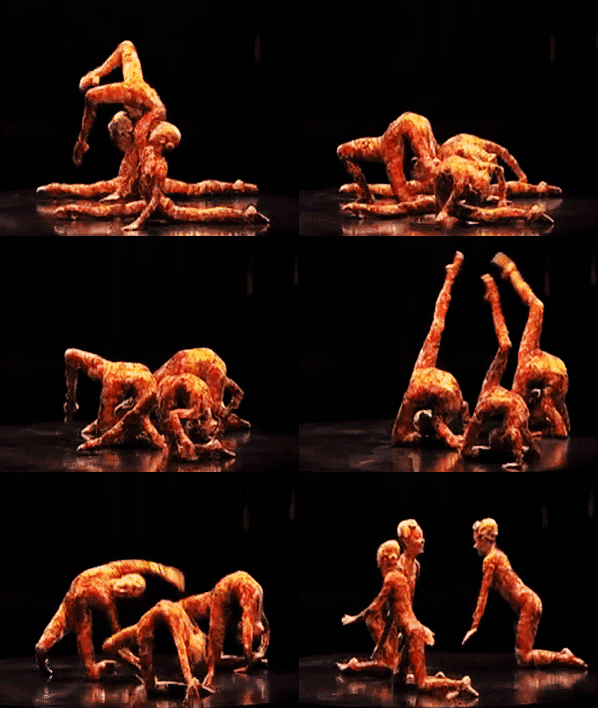
I haven't actually attended a performance of Cirque du Soleil -- those tickets are crazy expensive -- but I have watched a few of their shows when they've been on TV. Totally redefining what a circus can be, the awe-inspiring athletic performances are paired with surreal costumes and makeup, strange staging and awkward-beautiful movements and singing. When I see a scene from a Cirque du Soleil show, I am usually left thinking, "That is weird. Is it art because it's weird, or is it weird because it's art?"


I was often in mind of the Cirque du Soleil while reading Nikolski, written by Nicolas Dickner, as Quebecois as the creator of the Cirque. Is it a cultural quirk of those from the Belle Province to up the artistic value of their efforts by building rigid but invisible frameworks for their creations -- whether highly trained contortionists or precisely crafted phrases -- to leap and tumble from? What seems to work for the Cirque du Soleil fell slightly flat for me in this book.

There is a wealth of clever wordplay (and I can only trust that the translator of this book was faithful to the feel of the original).

She piles the books on the table, puts on her glasses as though she were putting on a diving suit, and plunges into her reading.

When Noah shows up, fifteen minutes later, all that can be seen of the girl are the air bubbles frothing at the surface.

And there were some obscure word choices. I loved that the cop's eyes were described as selachian (shark-like), but question the usefulness of words I don't know and don't think I'll need going forward like: metonymy ( a figure of speech used in rhetoric in which a thing or concept is not called by its own name but by the name of something intimately associated with that thing or concept) or fascicles (a bundle or a cluster). I do like to be challenged with vocabulary, but I am left wondering with some of the language in Nikolski if the translator was too literal, or if this the exact flavour the author intended.

The plot was potentially intriguing: Three young people, unknowingly related to each other, are drawn to Montreal where they cross paths and fortunes over a period of ten years. But, as it turns out, their paths and fates remain separate, and the idea of there being significance in their meetings is brushed off:

And that is exactly the trouble with inexplicable events. You inevitably end up interpreting them in terms of predestination, or magical realism, or government plots.

And so, just as I accepted the warning to not interpret greater meaning, it dawned on me that the structure of Nikolski mirrors that of the mysterious "Three-Headed Book", a unicum, that keeps poking its head above the surface:

"A unicum. A book of which there is only a single known copy in the entire world…It's made up of fragments of three books. The first third is a study on treasure hunting. The second comes from a historical treatise on the pirates of the Caribbean. The final third is taken from a biography of Alexander Selkirk, who was shipwrecked on a Pacific island…The bookbinder salvaged the wreckage of three books and sewed them together. It's a piece of craftsmanship, not a mass-printed object."

Aha, I thought. So Noah is the treasure hunter, Joyce is the pirate, and the unnamed narrator is the one shipwrecked, having never set foot off the island of Montreal. The author is signalling that there is more craftsmanship on display here than I may be aware of. I have arrived at the thrilling climax of the novel, of the circus, what death defying coup de grace will leave me dazzled and amazed? The missing map? How intriguing!

I stand there open-mouthed, contemplating the implications of this strange puzzle. Here is a discovery that clouds the issue rather than clarifying it.

Nothing is perfect.

I smile, shrug my shoulders and, after taping the map of the Caribbean into place, return the Three-Headed Book to the clearance box.


Oh, right. I'm not to suppose there's more meaning beyond the page. So is it art, or just a little weird? Nikloski is certainly well-crafted and precise, there's an air of the experimental about it, but it seemed to lack heart, and in the end, I may smile but, like the narrator, I also shrug my shoulders and contemplate the clearance box.

Profile Image for KCM73.
241 reviews11 followers
June 4, 2009
This book is about three lonely, lost souls trying to find their place in the world. Noah, Joyce and an unnamed bookstore owner are all misfits who are connected in ways they do not realize and whose lives have a lot of parallels to each other, even if they are not conscious of each other. All three of them were raised by a single parent and they all have, for one reason or another, distanced themselves from their families and are making their way in the world alone. They all are searching for meaning in their lives and, in that vein, all have a fascination with their roots and ancestry. All of them have a strong connection to maps and/or travel guides. They all have a fascination with trash or discarded objects in one way or another. The bookstore owner sells used books, even ones that others have thrown away, Noah majors in archaeology with a fascination for the archeaology of trash, and Joyce becomes a trash-diving treasure hunter as part of her quest to become an cyber-pirate.

The three story lines, although they intersect only tangentially, flow beautifully and the language is very lyrical (which is very interesting given that this book was translated from French and translations usually are a bit stilted). Of the three, my favorite character was Noah. He is so sweet and earnest and was a bit more focused and in control of his destiny than the other two. Although I adore books, bookstores and used bookstores in particular, I found it a little hard to relate to the bookstore owner because he is never identified by name and the author (perhaps deliberately) keeps the reader more distant from him. Joyce is a very interesting character but not quite as empathetic as Noah.

Overall, this was an excellent first novel by Nicholas Dickner. He has a real flair for character development and for seamlessly incorporating quirky traits and elements into the story (the archaeology of trash being only one example). I will look forward to reading future books by him.
Profile Image for Andy W Taylor.
104 reviews
March 31, 2011
Winner of the 2010 Canada Reads contest hosted by CBC I was intrigued by the setting and premise. Opening in 1989 with three young people from very different backgrounds who leave their familiar surroundings to go on their on journey of discovery that takes them to Montreal where their paths converge however tangentially.

I loved Quebec author Dickner's prose that shines through with the guidance of Lazer Lederhendler's translation. Part Kurt Vonnegut yarn and part Chuck Palihnuik fable, I was raving to everyone within shouting distance how much I was enjoying the book while I was reading it.

BUT - I found Dickner chickened out with his ending the character paths continuing to the horizon with little or no resolution. Just a new direction. Sure that's how life actually is, but after we invested in these characters as readers we want some more resolution.

Sequel maybe? Enjoyed it but have a hard time recommending it knowing others may be equally disappointed with the resolution.
Profile Image for Judy.
3,554 reviews65 followers
June 10, 2020
Quirky. Engaging. Frustrating. Perplexing. Light-hearted. Good souls.

Twenty-somethings who don't feel a need to fit a mold.

Lots of tidbits of odd info. For example,
p 3: Every beach has a particular acoustic signature, which depends on the force and length of the waves, the makeup of the ground, the form of the landscape, the prevailing winds, and the humidity in the air.

Never really pulls together, but life's often like that.
Profile Image for Viviane Martin.
9 reviews5 followers
July 4, 2014
Une histoire qui raconte beaucoup mais qui n'aboutit pas à grand chose. De nombreux rendez-vous manqués qui passent tout près de bouleverser l'existence des personnages à tout jamais. Mais l'alignement des étoiles en veut autrement. Et c'est bien tant mieux.
Profile Image for Czarny Pies.
2,832 reviews1 follower
October 17, 2014
Nikolski is the great new Quebecois novel of the 21 st century. In the United States, life is a desert that you cross on a horse with no name. In Quebec, life is a desert that you cross on a horse with no name using a compass with no polarity.
Profile Image for Marika_reads.
638 reviews478 followers
August 15, 2020
Trzy różne osoby i trzy z pozoru różne historie, które splatają się ze sobą, mimo, że bohaterowie nie są siebie nawzajem świadomi. Jest księgarz, który porządkując rzeczy po swojej zmarłej matce znajduje jedną z niewielu pamiątek po ojcu - kompas Nikolskiego, jak sam go nazwał. Jest Noah od lat przemierzający z matką kraj samochodem prowadząc życie nomady, który w końcu postanawia odciąć się i zacząć żyć samodzielnie. I Joyce wychowana przez ojca, szukająca prawdy o swojej matce.
Każdy z bohaterow w poszukiwaniu sensu rozpoczyna nowe życie i ma silną potrzebę odkrywania swojej tożsamości kulturowej i korzeni przodków. Każde z nich jest zagubione, samotne, ale zdeterminowane. Cała trójka zafascynowana jest też rzeczami wyrzucanymi przez innych - księgarz porzuconymi książkami, Joyce przeszukuje śmietniki w poszukiwaniu komputerów, a Noah jako student archeologii zajmuje się śmieciami naukowo. Jest tu też sporo wątków kulturowych i historycznych związanych z Kanadą - rdzenni mieszkańcy, piraci, relokacje czy wywłaszczanie.
Opisane historie są bardzo płynne, zręcznie przez siebie przenikają i tak naprawdę nie zmierzają w jakimś konkretnym kierunku i nie było celem autora opowiedzenia nam historii z jasno nakreślonym zakończeniem. Mi się takie urwanie opowieści podobało, choć wiem, że pewnie wielu będzie odczuwać niedosyt. Nie będzie to moja top książka z Pauzy i taka, którą zapamiętam na długo, ale polecam szczególnie w ramach literackiej gry wyszukiwania w niej symboli, metafor czy elementów łączących życie bohaterów.
Profile Image for Patrick Martel.
374 reviews47 followers
March 28, 2020
Version Livre Audio, produite par Radio-Canada et lue par son auteur, Nicolas Dickner.

Un premier roman très ambitieux, certes le fruit de beaucoup de recherches de la part de son auteur, mais écrit dans un style littéraire trop simpliste, voire collégien. Aucune chose rencontrée, aucun lieu visité, aucune personne croisée ne semble pouvoir être décrit sans faire l’objet d’une comparaison historique ou d’une anecdote cute et/ou voulue pertinente.

Toute cette futile fioriture déroute la chronique dont le fondement détient à l’évidence un potentiel largement plus intéressant que son résultat final.

Alors qu’Éric Plamondon et Éric Dupont excellent dans la transgression et la manipulation de la parenthèse littéraire, Nicolas Dickner, du moins avec NIKOLSKI, ne démontre pas avoir, outre l’ambition, les dispositions pour mener à bien un tel exercice.

Cela dit, il est fort possible que j’erre, car ce roman a été décoré de maintes récompenses, dont les non moins prestigieux Prix des libraires du Québec, le Prix littéraire des collégiens ainsi que le prix Anne-Hébert. NIKOLSKI est, à ce jour, traduit dans une dizaine de langues.

Un mot sur la version audio : J’aurais préféré que le livre soit lu par un comédien. Dickner, bien que visiblement convaincu et passionné, dégage des intonations trop familières qui deviennent lassantes à la longue et qui privent le texte de la profondeur qui est subtilement dissimulée entre les lignes.
Profile Image for Kate.
37 reviews1 follower
January 11, 2025
Я правильно зробила, що почала читати «Нікольскі» в дорозі, бо тут багато подорожей, і цей вайб просто ідеально підходить для поїздки Харків-Дніпро😁.
Починається все з розповіді чоловіка, який працює у букіністичному магазині - це вже любов з першої глави. Далі автор розповідає про деяких інших персонажів-незнайомців, які все ж таки якось повинні перетнутися. Мені особливо сподобався викладач-археолог, який проводив розкопки у сміттєвих баках. Прикольний мужик 😁
Тут персонажі завжди в русі. Хтось подорожує по світу, хтось стоїть за прилавком рибного/книжкового магазину, але кожен прагне знайти своє місце у цьому світі й адаптуватися під сучасні реалії.
Profile Image for Antoine Levasseur.
44 reviews
December 15, 2024
Il manquait pour moi un peu plus de détails sur la vie des personnages et je n’aime pas les fins ouvertes/sans réponse. L’auteur a un style d’écriture unique avec beaucoup de références historiques/culturelles, mais je n’ai pas accroché. J’ai préféré les 2 autres livres de l’auteur. J’ai tout de même apprécié la lecture.
182 reviews
August 1, 2024
J’ai bien aimé le début, mais j’ai progressivement décroché. C’était bien écrit, mais les éléments qui m’intéressaient n’étaient finalement que secondaires à l’histoire. Cette « frustration » m’a empêchée de me sentir investie dans l’histoire des personnages qui, au départ, me donnaient pourtant le goût de lire livre. Beaucoup aimé l’idée de l’archéologie des dépotoirs.
Profile Image for Jakub.
816 reviews71 followers
August 22, 2020
"Nikolski" made a very good impression on me despite being potentially inconspicuous. There is no lofty plot idea, no life dramas but there is a trio of likeable protagonists with troubles often close to when a regular reader would experience. There is also a nice bit of Canada smoothly intertwined with the plot.
Profile Image for Annabree.
16 reviews1 follower
March 5, 2011
Nikolski is one of those perfectly Canadian books that sheds light on the national mosaic. In particular, the lives of three individuals interweave in this story and sometimes they even cross paths with each other (not that they ever know it). Water, pirates, and garbage are some of the strongest themes in this story. Fish in the water each follow different currents, some staying in smaller geographic areas and others shifting from one current to another. I got the sense from this novel that the characters were like fish in the ocean's currents and sometimes they would pass by each other before moving on with their particular current.

Seemingly disconnected from family and the world around them, Noah, Joyce, and the nameless bookkeeper each follow the current of their lives without ever reaching some goal-oriented, final destination. Noah studies urban garbage as an Anthropology major, Joyce becomes a cyber-pirate and dumpster-dives for discarded technology, and the unknown narrator (the bookkeeper) collects discarded books for a second-hand book store. I was particularly interested in the theme of garbage in this novel and Dickner's proposition that we can learn a lot about our world through the garbage we leave behind.

The title "Nikolski" refers to a northern community off the Aleutian Islands. Unbeknownst to the characters, they share a common ancestor who ends up in town. The characters never really have a sense of direction in their lives (not that anyone does, and that's what makes this more true-to-life) but this far off place of Nikolski really anchors them and is a reference point from which they move. The bookkeeper keeps a Nikolski compass, which is a compass from Nikolski, and a gift from his unknown father. This unique compass doesn't point true North, but rather points to the town of Nikolski. The idea of the compass was really symbolic in this novel in that a compass can only provide a sense of direction in which one can move but it can't ever tell you where you are. And that summarizes the novel beautifully. The story was in the journey, not in the final destination.

In the end, the novel never resolves itself. I never felt the three story lines were ever drawn together or even wrapped up at all. I appreciate that Dickner didn't wrap it up in shiny paper and stick a bow on top. It would be too easy to do that. It would betray the characters and the lives they lived.

Overall, this was a great read. I think I will wonder where Joyce is in the future. And Noah and the bookkeeper, too.
Profile Image for Lindsey Reeder.
103 reviews26 followers
March 23, 2010
This weekend was filled with earl grey tea and “Nikolski” by Nicolas Dickner. If you’re from Canada and you listen to CBC, you might already know that this book was a contender on CBC’s literary competition called Canada Reads. Basically, it’s a battle of the books and each day one of the five books get kicked off and Nicolas Dickner made it to the end this year and took home the reigning title of Canada Reads, meaning that his book is the book that all Canadians should be reading and after reading it, I whole heartedly agree.

We’re introduced to three characters, one unnamed young man, Joyce and Noah. Dickner interweaves these three characters stories sparingly but successfully. We learn the back stories of each character which provides insight into why these individuals are each so complex.

Each character ends up in Montreal, Quebec (where Dickner resides) arriving in the year 1989 hoping to create a better life for themselves. Noah is there to pursue his goal of studying archeology, specifically the archeological dig of garbage. In the novel he explains, “As a rule, archaeologists don’t take much interest in nomads. The more a population travels, the fewer traces it leaves behind. They prefer to study civilizations that settle down, that build cities and produce large amounts of garbage. Garbage teaches us more than infrastructures, buildings or monuments. Garbage reveals what everything else tries to hide”.

Joyce arrives after she’s run away from the boring days of high school and is there to pusue her life long dream to become a pirate. Ironically enough, she spends a majority of her time digging through garbage to collect discarded computer parts, in order to gain illegal access to the internet (aka piracy).

It is a clever and humourous read filled with lots of different ideas that are woven into a collection of 290 pages. I suggest to read it on a day when you can give it lots of attention, as it should be read closely so you don’t miss anything.
Profile Image for Magill.
503 reviews14 followers
May 9, 2010
This was an easy and even mildly enjoyable read, and the translation certainly stood up, but the gimmick of the connection/disconnection of the characters essentially allowed the author to avoid any real character or plot development, and also resulted in the story seeming more than a little disjointed.

The book is just that, a not unpleasant read (whimsical, one newpaper review said) that goes nowhere. I would not have minded an actual story on any of the characters, which would require going deeper into the characters, if not a semblance of a plot (and I could be generous on that point as anyone who reads Anne Tyler would be). I would be curious to see if the author has anything in him beyond whimsy, but whether I would go out of my way to explore that in future novels? Maybe if it fell into my lap or was sitting on the library counter newly returned... otherwise, meh.
13 reviews
January 5, 2011
I had to think about whether I liked this book or not. It was like watching a movie that grew on you the more you thought of the memories of it rather than watching it at the time. The book was mainly about 3 characters that had connection to each other, but were mostly just ships passing in the night. They never actually connected and didn't really have much direction of their own, but each was quirky in their own right. The book just kind of starts, goes along and ends without anything being tied up. That kind of bothered me at first, but then the characters were kind of like that too, and somehow it made the story more likeable and somehow more novel than most books that nicely wrap up in the end. And it did have it's entertaining moments.
Displaying 1 - 30 of 404 reviews

Can't find what you're looking for?

Get help and learn more about the design.