Jump to ratings and reviews
Rate this book

The Daughters of Madurai

Rate this book
The Daughters of Madurai is both a heartrending family story and a page-turning mystery about the secrets we must keep to protect those we love.
Madurai, 1992.
A young mother in a poor family, Janani is told she is useless if she can’t produce a son—or worse, if she bears daughters. They let her keep her first baby girl, but the rest are taken away as soon as they are born and murdered. But Janani can’t forget the daughters she was never allowed to love.
Sydney, 2019. Nila has a secret; one she’s been keeping from her parents for too long. Before she can say anything, her grandfather in India falls ill and she agrees to join her parents on a trip to Madurai. Nila knows very little about where her family came from or who they left behind. What she’s about to learn will change her forever. While The Daughters of Madurai explores the harrowing issue of female infanticide, it’s also a universal story about the bond between mothers and daughters, the strength of women, and the power of love in overcoming all obstacles.


336 pages, Hardcover

First published February 28, 2023

634 people are currently reading
17102 people want to read

About the author

Rajasree Variyar

4 books104 followers
Rajasree Variyar grew up in Sydney, Australia and now lives in London, where she juggles writing alongside a career in digital insurance product development. She received her MA in Creative Writing from the University of East Anglia in 2020.

Her manuscript of The Daughters of Madurai was shortlisted for Hachette UK's 2019 Mo Siewcharran prize.

Her short stories have won second prize in the Shooter Literary Magazine short story competition and been long-listed for the Brick Lane Bookshop short story competition.

Ratings & Reviews

What do you think?
Rate this book

Friends & Following

Create a free account to discover what your friends think of this book!

Community Reviews

5 stars
2,416 (35%)
4 stars
2,934 (42%)
3 stars
1,229 (17%)
2 stars
220 (3%)
1 star
50 (<1%)
Displaying 1 - 30 of 853 reviews
Profile Image for Rosh ~catching up slowly~.
2,377 reviews4,887 followers
May 23, 2025
In a Nutshell: A highly relevant topic that loses its impact due to the simplistic writing style and glossing over of key events. Good description of places, but shallow exploration of people.

Story Synopsis:
1992, Madurai, India. Janani knows that unless she bears a son, her future isn’t secure in her husband’s family. She was allowed to keep her first daughter, but the ones who came after were taken away soon after birth and murdered. How long can Janani survive in the face of such a situation, being insecure about herself, her daughter, and her unborn child?
2019, Sydney, Australia. Twenty-five-year old Nila has a secret that she hasn’t told her parents yet. Just when she decides to let them know, her grandfather in India falls ill. On a trip to Madurai, a place she hasn’t visited for more than a decade, Nila discovers that she isn’t the only one with secrets.
The story comes to us in the first person perspective of Nila and third person perspective of Janani.


Where the book worked for me:
🌷 I truly appreciate the topic. I wish I could say it was no longer relevant, but the fact is that many Indians are still crazy about having a boy child. Female infanticide is a shameful occurrence, so full marks for attempting to highlight the issue. I hadn’t heard about the Cradle Baby Scheme of the TN government, so learning about that was enlightening as well.

🌷 The author clearly knows both the locations and it shows in her writing. I don’t know Sydney, but I do know Madurai, and it felt like she captured the pulse of the ambience without denigrating it. The crowds, the travel, the cityscape,… all felt genuine. (Mind you, this point applies only to the past timeline and only to the portrayal of the location, not that of the people.)

🌷 Unlike many contemporary Indian-origin authors who are no longer residents of the country, and unlike many debut writers, this author doesn’t attempt to dump everything and the kitchen sink in the plot. Her focus is on two-three primary issues (priority towards sons, gender/caste/wealth discrimination, and a minor but relevant topic connected to Nila’s secret) and she sticks to these.

🌷 Janani’s character growth is interesting, especially in the past timeline. She isn’t shown as perfect, but as someone who knows her limits and tries to push them to the fullest. I also liked the author’s choice of name for her. ‘Janani’ means ‘mother’ in Sanskrit, so it feels like an apt name for a character whose entire identity stems from her ability to be a mother to sons while all she pines for is her lost daughters. Even Shubha and Kamala were good characters. I wish there had been more of them in the book.

🌷 A part of the narrative also deals with the pressure on men to choose ‘viable’ careers such as medicine or engineering, and continue the ‘family name’. Most Indian fiction novels focus only on the women, so it was a pleasant surprise to see this being included.

🌷 I am not sure if this is a good point or bad, but all the references to South Indian cuisine made me salivate. My stomach kept growling, but my heart was happy to see all those yummy references. (I love South Indian food!)


Where the book could have worked better for me: (Oh boy! Here we go!)
🌵 When there are two timelines and one of them is in first person, we automatically expect to know more about that character’s feelings. In this book however, we know more about Janani than Nila. Nila’s arc is very underwhelming, and her emotional trajectory seems more surface level. The contemporary timeline is too simplistic and brushes aside any scene where there was a scope for deeper introspection of the characters.

🌵The representation of the Indian locations in the contemporary 2019 timeline felt like wishful thinking than realistic. I don’t know if this was to cater to the American market, but bowling isn’t a popular pastime activity in India at all. So to see characters choose bowling as their option one for relaxing made me laugh. And please, what in the world is ‘Thank Bhagavan!’ Phrases aren’t to be translated verbatim across languages. There are many cultural inaccuracies as well. I wish authors didn’t bend facts so much just to cater to the target market.

🌵 The prologue has got to be among the worst I have ever read. Doesn’t add to the story, doesn’t connect to a relevant scene, is brushed aside with a quick reference later in the narrative. Its only purpose seems to be to create shock value. The data therein would have served better as an introductory note than as a prologue.

🌵 There are too many unnecessary descriptions, especially in the initial chapters of the past timeline. This pulls down the pace.

🌵 The connection between the two tracks is visible within the first few pages, and even what's supposed to be a mystery (Nila’s secret) is quite obvious. So we already know the whats when we are reading the book; we just need to wait to discover the hows and whys. Unfortunately, the hows aren’t revealed even until the ending. There is this huge buildup to the Sanjay-Janani track, and then bammm…Everyone is in Australia! What? How? What happened in between? Such a flimsy ending!

🌵 Without going into spoilers: Lavanika is five and had no living siblings. Nila is two years older than Rohit. The timelines have a 27 years gap. This data won't make sense to you now, but if you read the book, you'll realise that this simple maths will reveal much in advance, a supposedly surprising twist. I am one who likes characters’ ages being mentioned, but in this case, they were a spoiler to what should have been an ‘Oh my!’ moment.

🌵 This will be a doozy of a point, so please bear with me. We Indians have distinct relationship words for almost every relation. Unlike English that has a simple grandmother, grandfather, sister-in-law, uncle, aunt, younger sister, and so on, most Indian languages have a specific word for each relationship. So a dad's sister and a mom's sister and an uncle's wife--all "aunts" in English--will be called by different words as per the specific relation. The issue is further complicated by the fact that India has a multitude of languages. So an elder brother will be called ‘Chetta’ in Malayalam, ‘Anna’ in Tamil, ‘Dada’ in Marathi and so on. Imagine throwing this complicated network of relations on unsuspecting Westerners! Forget Westerners, even I felt lost at times amid all the Acchachas and Veliammas and Ammayis and Kochachans in this novel. Having words from two languages—Tamil and Malayalam—added to the difficulty. I wonder how the intended readership in the US will cope with these.

🌵 I must add that there is a glossary at the end of all the Tamil and Malayalam words, but I discovered this after struggling through the whole book! In digital editions, people can’t flip through the pages, nor do they necessarily read the table of contents. So it is always helpful to have the glossary at the start, or to provide the meanings as footnotes. Even a mention of the glossary before the start would have been better.


All in all, I can just sum up by saying that this was a disappointing experience to me. While the topics were relevant, the approach was bland. It was a simple story needlessly convoluted. As it is a debut novel, I am truly sorry this was a dud for me, and I wish the author the very best for her future works.

This might work better with those who know just a little about India. So yeah, the target market can still try this out.

2 stars.

My thanks to Union Square & Co. and NetGalley for the DRC of “The Daughters of Madurai”. This review is voluntary and contains my honest opinion about the book.


———————————————

This was a buddy read with Srivalli, and our third dud in a row. Thankfully, both of us were on the same side of the rating range yet again, so we could push each other towards the finish line. Do check out her review as well. For once, her rant is almost as lengthy as mine! 😂

———————————————
Connect with me through:
My Blog | The StoryGraph | Instagram | Facebook | Twitter
Profile Image for Mai H..
1,351 reviews793 followers
March 3, 2025
Let me preface this review by saying I'm not Indian, Indian Australian, or in any way related to the diaspora. Rosh is, and left a very informative review.

I read this very slowly, as it deals with a difficult subject matter. Asian cultures prize male children above female children. We all remember China's one-child policy. Of my Vietnamese grandfather's nine children, he would routinely tell people he had four. The four are sons.

This book has two POVs. Janani lives in Madurai in 1992. Nila lives in Sydney in 2019. I guessed the connection long before it was mentioned, but as in other books with two POVs, one was clearly the winner for me. Janani's story captivated me from the first. Nila grew on me.

Janani is very often told by her mother in law that she is useless, because she keeps giving birth to daughters. They allow her to keep one, Lavanika. The others are killed. When other families in the same area give up their female babies to orphanages, they are looked down on, as this is more shameful than killing them.

I can't speak to the truths here. Like I said above, this is not my culture. I also quite enjoyed KAIKEYI, which no other South Asian I know enjoyed. So take this to heart. But this will remain a very special story to me. Books that invoke feeling often are.

📱 Thank you to NetGalley and Union Square & Co.
Profile Image for johnny ♡.
926 reviews148 followers
May 25, 2023
1992. janani gives birth to yet another girl. her mother-in-law, forever disappointed, calls for the infanticide of the child before janani can even wake up from such a strenuous birth. a girl means a dowry, a girl has minimal rights, a girl child is not a son.

2019. nila wants to understand her mother. she wants to know where she came from as she has grown up in australia and hasn’t been to madurai since her birth. she feels as if she is a disappointment to her mother, she has no clue what janani has suffered.

horribly emotional in the best way, this novel made me hug my mom extra tight tonight. the struggle of motherhood is eternal, yet this novel focuses on the love a mother bears for her child. this is a truly beautiful novel.
Profile Image for Taury.
1,201 reviews199 followers
April 11, 2025
The Daughters of Madurai by Rajasree Variyar is a very slow paced book about women in India in 1992. Women were treated a losers if they didn’t bare males. To bear a female was failure. To bear multiple was the ultimate failure, grounds to kill the baby and cause for divorce. I knew this about China. Had no idea about India. Janani is from a traditional home with her husband and his family. His mother is verbally abusive and at times physically. Female infanticide is still practiced and believe in within the terribly tragic home. Novel is based on women’s rights, Indian culture, and generational resilience. Survival seems to be the unintentional theme for this month
Profile Image for Priya.
2,151 reviews79 followers
May 17, 2023
2.5 *
I was drawn to this book because of the cover, the setting and the theme it tackles. Unfortunately, wanting a male child and female infanticide are both prevalent practices in the timeline of the book and I have heard of horror stories particularly in Madurai and Salem.

The positive aspect of the book is the bold topic, especially for a debut novel. Set in two timelines that span the decades from 1993 to 2019, the story is about young mother Janani who is not allowed to raise the babies she births after her first one because they are girls and her husband and mil want only boys. Humiliated and oppressed by societal norms that mean she cannot defy the injustice, Janani feels stifled.
Years later, in 2019,Nila, who has grown up in Australia, comes to India with her parents to see her dying grandfather one last time. She has a secret to reveal to them as well. She also hopes to know more about where her mother came from, her family and her own history but she ends up getting more than she bargained for.

I loved Janani and her portrayal was very realistic. Reading the book on mothers day was a nice coincidence as this is an ode to the strength and determination of a mother to protect her daughter. Nila's story however was dragged out a lot and there was no mystery about her secret as it was very obvious!

While the past story was better written, the writing suffered from lack of research when it came to names of the characters and the way many of them addressed each other. I don't think an older lady in 1993 would be called Vandana for example. Also, wading through the numerous terms of address for various relatives and keeping track was tedious. In addition, the addressing was not always accurate. For example, no one calls their mil 'maamiyaar'! It is either amma or athai. Janani comes from a Tamil speaking family but refers to her father as acha which is Malayalam. Her mother's sister is referred to as attai which is actually the term used for one's father's sister. Terms are used interchangeably as well and if I, as someone who is a combination of Tamilian and Malayali found it difficult, I can't imagine the target audience in the US finding it easy.

I liked the bond of friendship Janani shares with fellow sufferer Shuba and the way they help and encourage each other but I found myself wanting more about Janani's journey to a different country after her second marriage. This is only hinted at but we never get to see what happened.

The local flavour of Madurai is portrayed somewhat accurately though there are some discrepancies that jar. Overall, the book disappointed by its inability to live up to the promise of the theme.
Profile Image for queenie.
126 reviews66 followers
February 26, 2023
“The seventh, the only girl, had slipped from his grasp as he swung her at the wall by her little feet. She had transformed into the mother Goddess in the sky above his head, and cursed Kamsa, reminding him of the prophecy that Devaki’s eighth child would kill him. There was no escaping fate.”

Rating: 3.9/5.0
★★★★✩

consider reading this review on my blog!


Reading The Daughters of Madurai was like no other experience I’ve ever had before. It was deeply personal; intimate in a way that venturing too far only results in the unravelling of certain wounds concealed deep within. Rajasree Variyar creates a striking contrast between the two timelines scattered across the novel—present and the past. This isn’t a tale for the faint-hearted but a tale of the deeply woven misogyny in the minds of the people in India, an issue that was more than just an issue decades ago.

The Daughters of Madurai illustrates the lives of two women; of Janani, in 1992, and of Nila, in 2019. Janani is cursed—she brings nothing but girl children into her family at a time when girls were considered a burden. She is married off into a family that’s highly prejudiced and abusive. She finds no love but has a daughter to live for, her eldest one. Nila is keeping a secret, one that threatens to spill. But as her grandfather dies, she’s to leave for India with her family along with the looming threat of her history menacing to reveal itself.

Traversing through the streets of Madurai, the novel poses a delicate question of womanhood, infanticide and misogyny. Caught in the vicious cycle of patriarchy, countless women like Janani undergo oppression and believe it normal. Where there should be a celebration of a girl child, there’s nothing but intolerance.

The only issue I had with the book was the middle. At times, it felt that things were unnecessarily long and were straying far from the heart of the story. And some parts of the writing felt a little clippy, mixed with some slang that didn’t go well with the narrative.

But nevertheless, The Daughters of Madurai is a poignant and enduring tale of mothers and daughters and all the secrets and struggles shadowed in between. A relationship that promises complexities, especially in Asian households, this book is for the women who look for their moonbeams as a guide in the dark.

———

pre-read:
25.08.22 i'm a simple person—i see ‘madurai’ in the title and suddenly this book is all im living for
Profile Image for Prakarsha Pilla.
134 reviews7 followers
October 8, 2022
An endearing and emotional read about India's daughters. Of Janani, who kept losing her daughters to a horrific tradition of female infanticide. Of Nila, the only one Janani saved and raised in Australia.

Firstly, I must appreciate the subject the author chose for her debut book. There are countless stories of women who ran away from home with nothing except their daughter(s). And of those who fought tooth and nail to keep their little girls alive. Even today, the discrimination is evident. This one revolves around Australia and India - alternating in each chapter between Madurai of the 90s and Sydney of 2019. It isn't easy to write two contrasting scenarios. In this context, the author was impressive.

The writing is extremely straightforward and easy to read. Beginners who wish to read the dark and serious topics this book deals with should absolutely give it a try.

I read another book set in a Malayali household too, about the preference to a male child across generations. Still, in this one, I was confused with the plethora of characters and relations among them. This is embarrassing for me to say because I was born and raised in South India. But I didn't easily get through the Malayali relations and references.

I felt that the story could have elaborated certain areas, like, Janani's marriage, her move to Australia with her new family and the society's stiff opposition to her decisions. The story also has Shubha, a dear friend to Janani, another victim of dowry and male-child preference. I wish these were also talked about. Or may be, the author wanted to keep it simple. That was my only problem throughout, with this book. It is too simple even in the most shattering scenes.

My final take is, there is absolutely nothing bad or wrong about this book. But I didn't find it memorable or powerful either.

I am thankful to the publisher for giving me a review copy. My review is voluntary.
Profile Image for Deepti Srivatsan.
Author 1 book47 followers
June 26, 2023
This is one of those books which come with a lot of expectations because of the serious subject matter but disappoint because it’s very superficial. I will appreciate the author to take on such a difficult subject but I wish it didn't lack depth.
The other thing that irked me through out the novel was the incorrect translation of tamil words to English. I think the author simply used Google to translate and never double checked with a Tamil Speaking person. For example, Janani keeps referring to her mother in law as ‘maamiyar’ which is the literal translation of mother in law. No one uses that term when addressing their MIL. When Sanjay takes a pic of Janani and asks her to smile, he says ‘punnakai’. That’s smile in its noun form. The word (verb) to use would be ‘siri’ or ‘siringa’. And then there’s a reference to Janani’s sister as ‘Athai’ (She's Nila's aunt). Athai is a term used to refer to father’s sister. Mother’s older sister is ‘periamma’ which is who Rupini is to Nila. I understand the author is not Tamilian but such translation is plain lazy.
I speed read the last 100 or so pages just to be done with it.
Profile Image for Anjali.
202 reviews
May 16, 2023
A girl is a burden, a girl is a curse.

TW about this book:
Female infanticide
Physical abuse
Mental harassment

This is the crux of this book. A mother who gives birth to sons are not useless. The daughters are viewed as a wasteful burden who only increase a family's struggles because they'll require dowries one day.

Mothers-in-law berate their dils while their sons spend all the hard earned money on their vices. Husbands are spineless in front of their mothers but show their so called masculinity by hitting of abusing their wives. Two of Janani's girl babies are killed because they are girls. No one views this as a crime. Rather, they view it as a honor killing.

As a woman, this was very hard to read. Not because it was true at one point, but because it's still true. Female infanticide is still prevalent in India and other places because a girl child cannot be an "heir". The girls are not given a proper education, they have to do all the housework and if possible, go out and earn as well and even if they do all this, they are still considered lesser because they don't have a Y chromosome.

Coming back to the story, I loved the back and forth between the years. I was slightly annoyed with Nila for being so annoyed that Janani wouldn't talk to her about her past. But I get it. If I didn't know anything about my ancestry, I would feel that way too. Janani was a fantastic mother and woman and I loved the final confrontation between her and her wretched former mil. This book is very heavy. The writing style did not speak to me as much as it could and hence, the 4 stars
Profile Image for RaeLeigh.
321 reviews4 followers
March 31, 2023
Anything to do with babies and I’ll get emotional. Heart wrenching, with ups and downs, but classic happy ending! Wasn’t too sure about the beginning but the more I got into the story, it reminded me of A Thousand Splendid Sons. Not as good as that one, but I’m excited to see what Variyar comes up with next.
Profile Image for Audra.
118 reviews2 followers
April 7, 2023
Every once in a while you read a book that is just not for you. When I read the phrase “her breasts cried tears of milk into her nightdress” I knew this was going to be one of those. There’s only so much talk of pregnancy and childbirth I can personally take before I want out, and Daughters of Madurai hit that threshold in the first twenty pages.

That being said, this still could have been a good—if not traditionally enjoyable—book. Female infanticide is a horrific thing that by its very nature dregs up huge emotions. It should have worked, but a lot of it simply didn’t work for me.

There are number of little things that rankled me that added up to a frustrating reading experience, like:

Why add Sanjay’s POV when he does nothing that could not be accomplished by Janani’s? In a novel about mothers and daughters, it feels cleaner to keep it to two perspectives, that of the mother and her loving daughter. Not to mention that Sanjay’s voice widens the gulf between the two sides of the story. It feels like Janani and Nila’s stories should be roughly equal, but in practice we know everything about Janani and nothing about Nila. And yet it is Janani’s story that is presented as the mystery, not Nila’s. Nila spends the novel desperately trying to learn her mother’s story, a goal that feels less pressing when the reader already knows it. On the flip side, the linguistic hoops Rajasree Variyar goes through to keep Nila’s secret is frankly mindboggling.

Imagine having a private conversation with your girlfriend about wanting her to come out and saying, “You’ve found the person you love” or “it shouldn’t be a big deal, to stop hiding who we love from our family.” The narration is equally, pointlessly cagey: “What a relief it is that they’ve absorbed the news of her relationship with the barest of commotions.” It’s so obviously calculated so that the relationship is mostly hidden from the reader (I clocked the coming-out conversation immediately, but the blatantly obvious refusal to confirm it felt a lot like queerbaiting until literally the last chapter).

Keeping Nila’s secret but giving her no other individualized personality traits beyond curiosity about her mother’s life seriously undercut the novel. Why have Nila present at all if Janani’s is the only story you’re telling? Nila should have been, at the very least, a contrast to Janani. She’s set up to be one. She’s a largely independent woman with her own job and whose life doesn’t have to revolve around men or babies. Why not dig into her deeper to better show the life Janani was able to give her? Why not let the reader know upfront that Nila is queer so that the contrast and comparisons between her life and Janani’s first forced traditional marriage and second frowned upon love match are more emphasized?

I also dislike how, at the end, Janani just gives up her decades-long silence about her past and tells Nila everything. Too much of everything, if you ask me. You can tell someone your story without taking them to meet the abusive players from it.

It just feels like a novel of missed opportunities, where the rawness of the subject matter does the work over the actual writing. There are interesting elements, like how it is often the women reinforcing the patriarchal status who—it is Janani’s mother in law, not her husband, who kills the unwanted girls—or how giving a child up for adoption is deeply shameful—a character attempts suicide after doing so, even knowing the alternative is that her family would kill the baby—but the novel never really goes into them, rendering almost every character flat and leaving the reader to make connections themselves. Like, wouldn’t it have been interesting if Nila, a queer woman, had plans to adopt in the future, to contrast Shubha’s shame of not raising her own daughter? Or if Nila were a proponent of abortion care, to demonstrate how women, in different circumstances, are forced both to kill wanted children through female infanticide and keep unwanted fetuses in forced births, both to uphold the patriarchy?

This is a book about pregnancy, childbirth, and motherhood. Those are not subjects that interest me, but even acknowledging that the book disappointed me, as it simply had so many shortchanged or missed opportunities.
This entire review has been hidden because of spoilers.
Profile Image for Sameera Nanayakkara.
68 reviews1 follower
October 28, 2023


“Pain is inevitable. Suffering is optional.”

‘The Daughters of Madurai’ is a book I fell in love with, in the very first paragraph of the book itself. I am a fanatical reader but at the same time very critical of what has been written. So, to say that Rajasree did manage to win a five-star review way before I reached the end of the book would and should mean a lot.


Thought eh story is mainly about some women from Madurai -Kadambavanam, it appeals to all daughters of the world. While Janani is the protagonist of the story, for me Sanjay is indeed the silent hero.


The book is an emotional roller coaster ride, and it is not for the faint hearted. Therefore, reader discretion is advisable.


Janani spoke. “Having a daughter,” she said, “is a curse. It’s the same as watering your neighbor’s plants and never your own.”

The main plot of the story is woven around the gruesome tradition of selective feticide and infanticide of the girl child along with the cruelties and the misery of the victimized wives of domestic abuse.
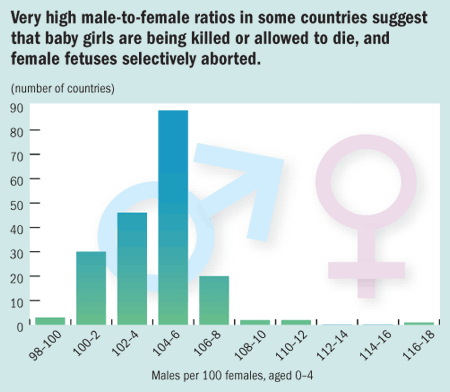

”Selective
“JANANI KNEW, THE MINUTE THE MIDWIFE PLACED her naked, squalling, soft-as-silk daughter in her arms, that she couldn’t lose this one. An image came to her mind, burying a bundle gone cold and still in the dirt by the young coconut palm. Her hands drew the hated little body closer. Tiny limbs moved in fitful pumps as Janani looked down into a face as round and purple as a mangosteen. The baby’s mouth shifted over the swollen skin of her breast, and her plaintive wail died as she found the nipple and began to feed. Her minute fingers rested against the skin over Janani’s heart.”

The main characters of the book are named appropriately and some with a flavor of irony and sarcastic humiliation. ‘Janani’ the protagonist of the novel means ‘The mother.’ Very vividly suiting her role of a young woman fighting with all her might to safeguard her children while keeping a thousand wounds hidden away in the depths of her heart. ‘Dharshan’ and ‘Vandhana’ meaning a vision of the holy and worship of the holy respectively are indeed the exact opposite of what their names mean.


The narration is written in a rather appealing lullaby rhythm with a soothing rocking movement back and forth between the bitter past and the promising present. The use of present tense and the past tense keeps the reader focused on the book just as a toddler keeps its gaze focused on its mother. It is nearly impossible to keep the book down even for a short period of time because of the suspense the author has managed to incorporate into the story. In one aspect the truth and how the lives unfold in the story is vividly evident while at the same time it all seems as if we see them through a translucent glass with question upon question popping up about the next revelation.


While being a mesmerizing and excellent debut novel, there are a few hiccups though negligible and has no direct impact on the message conveyed but taint the story. Of those the worst such example is Sanjay’s maternal aunt who happens to be a two-years older twin sister of his mother! “But what was it like for Priya, watching her twin sister dwindle before her while her brother-in-law spent his days treating other people? Vs Seeing them like this, the two of them together, was like looking at his mother reflected in a horribly warped mirror. Priya was vibrant, alive, although she was two years older .”


In the journey of finding love, freedom, and safety a woman deserves Rajashree skillfully attacks the segregation in the society based on religion and cast and playfully laughs at the face of the politician who have failed to keep up with their promises of keeping the girl child safe.


“It is such a terrible thing,” she said instead. “Religion should be a great unifier. Are we not all one before Bhagavan? Whether you call him Bhagavan or Bhagavati, Krishna or Shiva, Allah or Jesus or Buddha. Such hard lives people live, Sanju, that they turn the beauty of God into evil.”

In spite of all the advancements and the progress humanity has managed to achieve, keeping the girls safe and mothers happy is a dream yet to become a reality in most parts of this tiny earth. Many have failed to take proper action against sexual exploitation and oppression of women and to ensure their right for education, freedom, and safety. This book is a welcome step in the right direction to see that dream come true. For a better tomorrow for the women on this earth read this book. As a father of two loving daughters, I myself hope, pray, and demand this change.


”Violence
The unadulterated joy on her face, the bright laughter in her eyes—he hoped it would never fade. But how uncertain her future was. Or perhaps, it was too certain. Would she be married before she’d become a woman? Have her first child while she herself was still one?

Profile Image for Thebooktrail.
1,879 reviews340 followers
April 17, 2023
description

Discover the locations in the novel here

Wow. This book almost broke me. It’s a very powerful story and a very powerful way of writing. Set between India and Sydney, location and culture are very much part of this novel. The title looks at those girls from India who are born into a certain life and culture from which there seems little to no chance of escape.

Janani is the mum in the story who lives in India and who has several daughters. She keeps losing them though and we learn that it’s due to the awful and horrific practice of female infanticide. She does manage to save one daughter, Nila, who she manages to get to Australia. Shs grows up and has a life there but India, Madurai is always in her blood.

I was amazed to find that this was a debut. Wow. This is an author I ‘m going to watch as if this is the first subject she writes about, and in such a strong way, I want to read whatever else she writes. One very impressive thing was that she wrote two very distinct timelines and both were very strong and compelling. We see India in the 1990s and then Australia in 2019 so two different timelines and cultures was very nicely threaded together. This was the crux of the story but the author made it feel seamless.

I really admire this author as she’s written a story which will inform and educate a lot of people but also encourage dicusssion of many issues within. The stories were threaded nicely but for a fuller picture I would have loved to have found out more about Janani’s story before she had her family. There are a few characters on the sidelines that I also wanted to know more about. Hope Shubha is ok!

Despite the complex subject and themes, this is a straightforward and easy read in many respects. It’s a powerful one and I think it’s simplicity is largely reponsible for making this stand out.

Stunning cover by the way!
52 reviews
March 21, 2023
I read a lot of books but don’t often post on Goodreads. I read a variety of books for exposure to other cultures, learning and, of course, enjoyment. I am so tired of books published with the story out of chronological order just because that is the current publishing style. I understand when this technique adds something to the story but it only added to confusion in this writing.
This book was torture for me.
I started with reading the book then switched to Audible,then both at the same time and back to the book. The Audible performance was very choppy for me no matter what speed I tried.
I am not of Indian descent so I had so many words to look up and was very challenged trying to keep straight the character’s names, food names and terms of endearment. I don’t mind looking up words when I’m trying to understand another culture but between the jumping time line, challenging character names, and just sad, heartbreaking treatment of women I just had to push myself to finish this book. I wouldn’t have bothered if I wasn’t reading for book club.
I just can’t recommend this book to anyone I know. I also fault the editor for not helping this author to write this story more clearly and concisely.
Profile Image for Morgan Rohbock.
633 reviews32 followers
November 12, 2023
4.5⭐ on 🎧

One of those devastating books that reminds you the world can be a hard place and made me appreciate the small things about my life. Though I think the pacing was a bit slow at times, I think this is a great one to read with your mom or book club.
Profile Image for Susan Morris.
1,580 reviews20 followers
April 6, 2023
This story just didn’t click with me. I appreciate the topic of the plight of girl babies in India, but I felt the twist of Nila’s sexual orientation was not an added value here. And how did the family get to Australia, or even married, for that matter?!
Profile Image for Kate.
756 reviews3 followers
July 15, 2024
Rajasree Variyar has written a riveting saga surrounding the topic of female infanticide in South India. In 1993 Madurai, Janani is a young woman who has given birth to four daughters, three of whom have been killed by her husband's family simply because they are not boys. Janani now finds herself pregnant again and in a loveless marriage, abused and controlled by her alcoholic husband's mother.
In 2019, Nila, a young physiotherapist, is Australian and of Indian descent. She finds herself back in India to bury the man she believes to be her grandfather. Several family secrets come to light as Nila debates whether to tell her parents the truth about her sexuality.
There was a lot about this book that worked really well. The timelines surrounding Nila's parents Janani and Sanjay, who is the oldest son of the family Janani works for, were very compelling. The book provides an astute and nuanced commentary on class differences in India. I also felt both Sanjay and Janani were easy characters to root for. It was interesting to have a strong and likeable male character in a book that surrounds a feminist issue. In general, Variyar's characterization is well-done, as even the less likeable characters are complex beings with difficulties in their own lives and understandable motivations. The writing in this novel is pretty simple, but I feel that w0rked here as it made the story both easy to dip in and out of and engaging throughout.
This is unquestionably a strong piece of fiction, spanning about 30 years. However, there were two things about THE DAUGHTERS OF MADURAI that make it less than a 5 star read for me. First of all, each chapter in Janani's story arc begins with a description of her unborn child in utero, what body parts have developed, what the baby is able to do despite the fact that it is unborn. I understand that belonging to a culture where female infanticide is so rampant may make somebody more pro-life than pro-choice, and for good reason. However, this aspect of the writing sounded a little too close to Trumpian anti-choice activists for my taste. Perhaps if we still had the benefit of Roe v. Wade in the United States, this would not have bothered me as much. I do understand it is a major problem if babies are killed solely because of their gender, but I wondered if there was a less anti-choice way to make the same point. On the other hand, baby girls who are killed for their gender have no choice in the matter. I guess I would ultimately say that this aspect of the novel made me uncomfortable and gave me pause, but I can see there are arguments on both sides. So, in the end, I am on the fence about this aspect of the book.
What definitely did not work for me, however, was Nila's storyline. For most of the book, Nila came across as naive and self-centered, unable to understand her mother Janani basically because she chose not to. I felt Nila's growth in the story was very convenient and fast. Also, there is a plot point that surrounds Nila coming out to her parents. Coming-out stories are important, especially when they feature queer characters of colour. However, I felt that the coming-out plot line was completely unnecessary and often felt forced in this novel that already deals with an important feminist subject. It felt like it was mentioned as an afterthought a lot of the time, and gave the story a feel-good, perfect bow ending that it really didn't need. Also, Variyar thanks her husband in the Acknowledgements, so it doesn't seem she is lesbian or queer. Who knows about that? Anyway, I felt the inclusion of a coming-out narrative was rushed in this case, which diminished the overall power of the story.
Notwithstanding these criticisms, I think THE DAUGHTERS OF MADURAI is an important and very readable book that covers the complexities of a very taboo subject without falling into the trap of creating characters who are villains. I would recommend this book despite its imperfections.
Profile Image for Sneha Subramanian.
13 reviews
February 3, 2025
I picked up the book because I saw “Madurai” and a woman with jasmine flowers on the cover. Being Tamil I was excited to read a story written by an author of South Indian descent. 

The story moved way too slowly. I disliked how the author switched between 1992 and 2019; it was confusing. I dreaded the chapters set in 2019 about Nila. Those chapters were so boring, that I had to skip to get back to reading about Janani.

I was a bit disappointed that the author chose to write about overused stereotypes. In the “conversation with Rajasree Variyar,” she states “This particular form of gender-based violence is significantly more prevalent in northern India, but I did want to set the novel in the south, both because of my relationship with it and also because I feel like there isn’t much written about the south.”  I agree that there’s not much written about South India and she wanted to set the story there due to her ancestry. Why couldn’t she have picked a different topic? Unfortunately, she did not focus on the many positive characteristics of Tamil Nadu.  She even says this is most prevalent in North India she did not need to set this story in Tamil Nadu. There’s such limited representation of South India and she chose to focus on a topic that only affects a small percentage of Tamil people. Due to limited representation, others will think this is the only thing that happens in South India. 

When the author was 10 she watched the news and saw the headline about female infanticide in Bangalore and thought to herself “That could have been me”. Let’s be real it could not have been her. She is a privileged woman who grew up in Australia. I feel she is profiting off a story that is not hers to tell. I would have liked to see Variyar write about something she experienced first hand like being part of the diaspora. 

This book was a disappointing read and I would not recommend this author. 
43 reviews
August 6, 2024
3.5 stars!!

This book tackles the very, very important and heartbreaking matter of female infanticide and overall male preference in South Asian culture. Even today, many girls in India are robbed of an education, a right to live their life the way they want, and general safety.

While the mother's POV, set in Madurai in the early 90s, was well-written and engaging, I found the daughter's POV much less interesting even though the story was important. The middle of the book seemed to drag on and I was disappointed that space wasn't taken up to answer pertinent questions like details of the mother's move to Australia and even learning more about Shubha. While the book could be better, it is an important and engaging novel addressing a difficult topic that South Asian, and specifically Indian women, are all too familiar with.
Profile Image for Misty Gonzalez.
90 reviews7 followers
September 5, 2023
4.5 rounded down. I really enjoyed this book, but in the end, there was just something missing for me. Very interesting and important topic, just not everything I needed from the actual storyline.
Profile Image for Rashi Ranjan.
24 reviews
December 16, 2024
More like a 3.5. I love reading books about Indian culture, so for that reason, it was a lovely (and heartbreaking) read. But often, it felt like the author was trying too hard to explain cultural experiences, and then the message would get lost. I thought the writing was a little lengthy but I do enjoy the historical fiction with two sides that fit like a puzzle. (Important topic at its root!)
Profile Image for Phyllis | Mocha Drop.
416 reviews2 followers
January 21, 2023
“Having a daughter is a curse. It’s the same as watering your neighbor’s plants and never your own.” - Janani

This book focuses on the heart-wrenching practice of female infanticide; although illgeal in India since 1961, traditions persists and the practice continues in rural, isolated areas where such laws can not be enforced. The dowry system is a financial burden to the bride’s family and obviously more daughters equals more dowries or “gifts” to the grooms’ families. Instead of surrendering children to adoption; there are religious beliefs that advocate parental obligations to decide the fate of their children, rather than passing the decision to others.

Janani is a bright second-born daughter born to impoverished son-less parents. Following the norms of society, at a young age, she is forced into a loveless marriage to an abusive husband and vile mother-in-law. Steeped in ignorance, the blame of the child’s sex is seemingly (and incorrectly) placed on the mother/wife. Janani is forced into multiple pregnancies in an effort to produce a son. In a patriarchal system that shuns divorce (especially those initiated by the wife), female advocacy (returning home is a shameful act that would humiliate her parents), and financial independence (her husband collects her earnings as a cleaner); Janani has few options. This story offers a fairly predictable outcome - but a bit too unrealistic in a practical sense; however, I went along with it for the sake of the story.

Other aspects of Indian society regarding the caste system, arranged marriages, homophobia, and educating female children fold into the story. Characters grapple with honoring their parents, tradition, and obligations while attempting to claim their own independence and pursuit of happiness which are in direct conflict with the former.

Thanks to the publisher, Union Square and Company/Sterling Publishing, and NetGalley for an opportunity to review.
Profile Image for Barbara.
1,084 reviews153 followers
December 27, 2022
I'd love to say that this book surprised me, but it didn't.

There's nothing surprising about female infanticide in books set in India. I wish that weren't true, but it is.

Equally, keeping secrets from your family isn't unusual either.

That said, this is a well-written book that touches on many of the harsher aspects of life as a poor woman in India, and it's much lighter on the abuse than many similar stories. The author hasn't over-egged the misery and that could very easily have been the case.

In the early chapters, it's not immediately obvious (though it doesn't stretch the imagination too much to work it out), how the characters in the two timelines are connected.

The most remarkable thing about this book is how well the wealthy family accepted their son's choices and how lucky Janina was to have such supportive employers. I've read many books set in India where neither would have been the case.

Thank you to NetGalley and the publishers for my copy.
Profile Image for Katie Groves.
5 reviews2 followers
April 10, 2025
The most beautiful book I have ever read. I bought it at a shop in Fort Kochi, Kerala which made the read even more special. I learnt so much about South Indian culture and history, whilst learning about the characters and their extremely complex relationships. I think everyone should read this book.
Profile Image for Lilly Asano.
67 reviews1 follower
May 9, 2023
I'm not sure how I found this book, but I'm glad I did. Rajasree Variyar delivered such an emotional and powerful debut novel about India's infanticide and the generational trauma that has sprung from it. The thinking of the traditional villagers seems so backward and I frequently had to remind myself that the story was taking place in the 90s, not centuries ago. I loved the two perspectives that you alternate between and how from the very beginning, you understand exactly who Nila is but have to keep reading to find out how her life became the way it is. A super important piece to understand more of the world that we don't normally talk about, strongly recommend to anyone who wants to learn about other cultures or history.
Profile Image for Harshini.
20 reviews2 followers
February 24, 2024
DNF at 23%.

The beginning was promising but it was just hard to read after a while. As a Tamilian who grew up in TN I found it hard to ignore the mistakes after a while.

Too many inconsistencies and messing up of Tamil culture. Unbelievable relationship across Class and Caste for the Janani POV.

It was clearly written by a second gen NRI who googled one too many references. And failed to fact check.

Unfortunate because the premise was good. The plot itself lost its grip by revealing too much within the first 20%. And I could not continue the book beyond that.

Plus, we do eat plenty of dishes other than sambhar. I wish she had done proper research into the cuisines of TN according to caste/region/time and also the variety of other everyday foods we eat.
Profile Image for Mohini Banerjee.
66 reviews
March 14, 2024
Good effort from the author but it could be a challenging read for people who don’t know South Indian languages and phrases since they were mentioned with an increasing frequency that would have frustrated me if I wasn’t familiar with the terms. This book could have also used a good copy editor to fix some continuity errors and spelling mistakes that absolutely grated on my nerves
Profile Image for Lisa.
353 reviews43 followers
Read
April 2, 2023
DNF counting it as a read because it took me so long to get through and derailed my reading this month.
Displaying 1 - 30 of 853 reviews

Join the discussion

Can't find what you're looking for?

Get help and learn more about the design.