

What do you think?
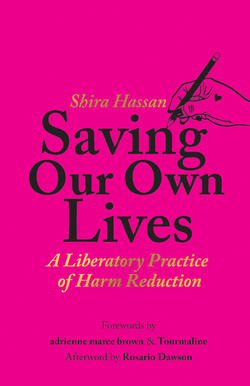
Saving Our Own Lives: A Liberatory Practice of Harm Reduction
Harm reduction is one of the most important movements of the 20th century, and yet a compilation of its critical stories and voices was, until now, seemingly nowhere to be found. Saving Our Own Lives, an anthology of essays from long-time organizer Shira Hassan, fills this gap by telling the stories of how sex workers, people of color, queer folks, and trans, gender non-conforming, and two-spirit people are building systems of change and support outside the societal frameworks of oppression and exploitation. This is a collective story of Bad Date sheets passed between sex workers in Portland, leading to the identification of a serial killer. It is the story of clean syringes, “liberated” from empathetic doctors offices and passed between punks in squats in the East Village by women of color, and the early AIDS activists who made sure that everyone knew how to use them. It is the story of transwomen of color, street-based sex workers, who created shared housing to ensure that young people had safe places to sleep. It is the story of Black Panthers creating a free breakfast program to feed a revolution and the Young Lords taking over Lincoln Park Hospital in the Bronx to demand and ultimately create community-accessible drug treatment programs.
At a political moment when Liberatory Harm Reduction and mutual aid are more important than ever, this book serves as an inspiration and a catalyst for radical transformation of our world.
At a political moment when Liberatory Harm Reduction and mutual aid are more important than ever, this book serves as an inspiration and a catalyst for radical transformation of our world.
300 pages, Kindle Edition
First published October 4, 2022
Ratings & Reviews
Friends & Following
Create a free account to discover what your friends think of this book!
Community Reviews
Displaying 1 - 30 of 48 reviews

November 22, 2025
Absolutely stunning collection of a discourse I hadn't engaged with at all, but that anyone in labour organising, mutual aid, crisis relief, and healthcare should know about. If I'd known about liberatory harm reduction in my twenties, I would have understood my behaviours of self-harm, self-isolation, drug abuse, and attempted suicides as, paradoxically, survival tactics in an evil world that didn't want me to live. Cough syrup, acid, ecstacy, overdosing, self-starving, cutting, relationship sabotage, dissociation, delusion. I didn't know any other way. Not given the tools to thrive, I only knew survival. A desperate search for a way out, when what I needed was a way through. For years, I'd viewed these coping mechanisms as maladaptive. I now see them as deeply resilient. A form of self-preservation, rather than self-destruction. A primal yearning to make it through to the next day, no matter how. I was clinging to life by a thousand frayed threads, in a tapestry of trauma that could not sustain me. But I got out.
Liberatory harm reduction is inextricable from trans, queer, antiracist, and sex worker struggles. These struggles intersected at underground needle exchanges. The fight against HIV coincided with safe drug use coincided with community-sourced HRT. During the AIDS crisis, grassroots organisers provided clean syringes and condoms to dispossessed communities left to die by the state. Denied addiction services, hormone therapies, sexual violence shelters, housing and food, harm reductionists developed mutual aid networks. These networks didn't gatekeep services through moralistic rhetorics based in Christian conservatism, middle-class propriety, or mind-numbing bureaucratic processes. Harm reduction, like person-centred therapy, privileged client needs. If they wanted to shoot up, they were given safe ways to do so, and safe spaces to trip in. If they wanted to get clean, they were given the info, resources, and support to get there. If they were interested in harm reduction, they could go to education sessions where everyone was fed beforehand (you can't dedicate yourself on an empty stomach). Where state services withheld support from uncitizen-like subjects who couldn't keep clean, needed sex work to survive, or were homeless and jobless; liberatory harm reduction provided support as a baseline, meeting people where they were at, rather than where they should be.
Harm reduction arose from the most dispossessed in America. It came from Marsha P. Johnson and Sylvia Rivera, trans activists who hustled in the sex trade to provide housing for kids fleeing transphobic households. It came from the Young Lords who occupied a white supremacist hospital in South Bronx to reorganise it into an addiction clinic. It came from the Black Panthers who educated their kin to their rights against police, prisons, and courts. Harm reduction centred those living in poor segregated neighbourhoods, going to underfunded community schools, living in food deserts filled with fast food, lacking affordable vegetables and fruits, and turning to street economies to survive: sex work for money, drugs for relief and pleasure, both for community. Such communities came under attack by police, who raped, assaulted, and arrested their members; and recovery programs that shamed, pitied, and controlled them, reducing systemic oppression to individual failure. The solution was to self-organise against the twin snakes of inequality and supremacy. The petty moralism of a bourgeoisie who victim-blame those most in need of understanding, empathy, and care.
I cannot stress how much respect and love I have for liberatory harm reduction. However, there're parts of it that make me feel uneasy. It's deeply nonjudgemental, trusting that people know what's best for themselves—a harm reductionist should merely show safer paths towards what people desire. But some coping mechanisms are designed to kill us. One of my friends was a labour organiser. He died this year from a heart attack at 30. He'd begun taking anti-psychotics that made him gain weight, but he didn't change his lifestyle or diet. He ate fast food and junk food. He got a blood clot in his leg. He experienced nausea after eating food. He was prone to vomiting. By the last year of his life, he was ordering Uber Eats every night. While I understand the stress and exhaustion that leads to such a lifestyle, I don't understand how I can be nonjudgement when our coping mechanisms kill us, when they're pushed onto us by advertising giants, by corporate labs that design food to be addictive, by capitalists who make money off our pain.
Similarly, I have a hard time thinking about harm reduction in relation to drugs, because drugs have historically been used to destroy colonial resistance. Alcohol was introduced into the Americas to destroy indigenous communities. Heroin was pushed into black neighbourhoods by the CIA to destroy liberation movements. There's so much power in destigmatising drug use, in telling people that their drug use is a survival mechanism, but survival mechanisms are a pragmatics of lowerclass living, not a liberatory state or goal. My drug abuse was a form of resilience, but it was also harmful to myself and those around me. I shouldn't have felt shame, but there's a component of harm worth interrogating here. How does harm intersect with accountability? To myself and those around me? If I truly am too deep in my trauma, who will help me, rather than enable me? Who will tell me that I'm going to destroy my life, and my relationship to those I love?
I hate suicide prevention. It's authoritarian, abusive, condescending, and ableist. It presumes sanity and positivity as normal states of being in an oppressive, unjust, and violent world. It functions to return non-normative subjects to a level of productivity conducive to profit-making. It's not about wellbeing, but control. At the same time, if someone had listened to me completely in my worst despair and given me an exit bag to kill myself with, I would have never discovered that my pain was driven by complex trauma, rather than some sadboi notion of the human condition. That there were ways out, even if I could and would not see them, due to my cynicism and self-hatred.
Again, this is a stunning collection. It touches on sex work, queer punks, detox centres, indigenous healthcare, and destigmatises drug use, self-harm, and eating disorders. It's made me question my assumptions about how to "help" others, internalised from christianity, buddhism, daoism, and counselling; but there's a lot I have to process about the relations between autonomy and accountability, and liberation and intervention. It feels irreconcilable to me to be nonjudgemental and critical at the same time. There are forces out to destroy us, and they enter us and make us destroy ourselves. At what point does self-preservation turn to flourishing? Perhaps, by providing basic necessities like housing, food, healthcare, and safe spaces to chat, learn, and love, we shed our old skins and discover new bodies. The power of communal care to heal traumas that isolate us to despair and dreams of death. A new body in the shell of the old. But I'm not sure it's enough, because our desires are never fully our own. We're at the mercy of ideologies that hijack our physiologies, psyches, and cultural practices. Without self-interrogation, we can easily remain mired in harm, no matter how much we try to reduce it.
xx
Liberatory harm reduction is inextricable from trans, queer, antiracist, and sex worker struggles. These struggles intersected at underground needle exchanges. The fight against HIV coincided with safe drug use coincided with community-sourced HRT. During the AIDS crisis, grassroots organisers provided clean syringes and condoms to dispossessed communities left to die by the state. Denied addiction services, hormone therapies, sexual violence shelters, housing and food, harm reductionists developed mutual aid networks. These networks didn't gatekeep services through moralistic rhetorics based in Christian conservatism, middle-class propriety, or mind-numbing bureaucratic processes. Harm reduction, like person-centred therapy, privileged client needs. If they wanted to shoot up, they were given safe ways to do so, and safe spaces to trip in. If they wanted to get clean, they were given the info, resources, and support to get there. If they were interested in harm reduction, they could go to education sessions where everyone was fed beforehand (you can't dedicate yourself on an empty stomach). Where state services withheld support from uncitizen-like subjects who couldn't keep clean, needed sex work to survive, or were homeless and jobless; liberatory harm reduction provided support as a baseline, meeting people where they were at, rather than where they should be.
Harm reduction arose from the most dispossessed in America. It came from Marsha P. Johnson and Sylvia Rivera, trans activists who hustled in the sex trade to provide housing for kids fleeing transphobic households. It came from the Young Lords who occupied a white supremacist hospital in South Bronx to reorganise it into an addiction clinic. It came from the Black Panthers who educated their kin to their rights against police, prisons, and courts. Harm reduction centred those living in poor segregated neighbourhoods, going to underfunded community schools, living in food deserts filled with fast food, lacking affordable vegetables and fruits, and turning to street economies to survive: sex work for money, drugs for relief and pleasure, both for community. Such communities came under attack by police, who raped, assaulted, and arrested their members; and recovery programs that shamed, pitied, and controlled them, reducing systemic oppression to individual failure. The solution was to self-organise against the twin snakes of inequality and supremacy. The petty moralism of a bourgeoisie who victim-blame those most in need of understanding, empathy, and care.
I cannot stress how much respect and love I have for liberatory harm reduction. However, there're parts of it that make me feel uneasy. It's deeply nonjudgemental, trusting that people know what's best for themselves—a harm reductionist should merely show safer paths towards what people desire. But some coping mechanisms are designed to kill us. One of my friends was a labour organiser. He died this year from a heart attack at 30. He'd begun taking anti-psychotics that made him gain weight, but he didn't change his lifestyle or diet. He ate fast food and junk food. He got a blood clot in his leg. He experienced nausea after eating food. He was prone to vomiting. By the last year of his life, he was ordering Uber Eats every night. While I understand the stress and exhaustion that leads to such a lifestyle, I don't understand how I can be nonjudgement when our coping mechanisms kill us, when they're pushed onto us by advertising giants, by corporate labs that design food to be addictive, by capitalists who make money off our pain.
Similarly, I have a hard time thinking about harm reduction in relation to drugs, because drugs have historically been used to destroy colonial resistance. Alcohol was introduced into the Americas to destroy indigenous communities. Heroin was pushed into black neighbourhoods by the CIA to destroy liberation movements. There's so much power in destigmatising drug use, in telling people that their drug use is a survival mechanism, but survival mechanisms are a pragmatics of lowerclass living, not a liberatory state or goal. My drug abuse was a form of resilience, but it was also harmful to myself and those around me. I shouldn't have felt shame, but there's a component of harm worth interrogating here. How does harm intersect with accountability? To myself and those around me? If I truly am too deep in my trauma, who will help me, rather than enable me? Who will tell me that I'm going to destroy my life, and my relationship to those I love?
I hate suicide prevention. It's authoritarian, abusive, condescending, and ableist. It presumes sanity and positivity as normal states of being in an oppressive, unjust, and violent world. It functions to return non-normative subjects to a level of productivity conducive to profit-making. It's not about wellbeing, but control. At the same time, if someone had listened to me completely in my worst despair and given me an exit bag to kill myself with, I would have never discovered that my pain was driven by complex trauma, rather than some sadboi notion of the human condition. That there were ways out, even if I could and would not see them, due to my cynicism and self-hatred.
Again, this is a stunning collection. It touches on sex work, queer punks, detox centres, indigenous healthcare, and destigmatises drug use, self-harm, and eating disorders. It's made me question my assumptions about how to "help" others, internalised from christianity, buddhism, daoism, and counselling; but there's a lot I have to process about the relations between autonomy and accountability, and liberation and intervention. It feels irreconcilable to me to be nonjudgemental and critical at the same time. There are forces out to destroy us, and they enter us and make us destroy ourselves. At what point does self-preservation turn to flourishing? Perhaps, by providing basic necessities like housing, food, healthcare, and safe spaces to chat, learn, and love, we shed our old skins and discover new bodies. The power of communal care to heal traumas that isolate us to despair and dreams of death. A new body in the shell of the old. But I'm not sure it's enough, because our desires are never fully our own. We're at the mercy of ideologies that hijack our physiologies, psyches, and cultural practices. Without self-interrogation, we can easily remain mired in harm, no matter how much we try to reduce it.
xx
November 13, 2022
When I started reading this book, I fundamentally disagreed with almost everything Shira Hassan stands for and the idea of Liberatory Harm Reduction itself. I also absolutely loved this book. I read it as part of a book club at my school's Women's Center. The ideas presented on drug use, sex work, homelessness, self-harm and other sensitive issues are certainly outside of the sphere of controversy, even for most liberal and left-leaning people. And yet, I have learned so much from this book. I have questioned things I didn't know I needed to question. Although the book often lacks context of certain social issues and includes an overabundance of lists, the fundamental messages remain clear: community organizing and self-compassion are absolutely essential to creating a better world.

March 1, 2023
This book rewired my brain and made me rethink everything I thought I knew about how change happens and how we work together to build stronger communities and save lives. I felt my commitments to abolition and liberation leveling up as I read.
January 5, 2024
This book is an incredible achievement, and a detailed compilation of some of the most powerful voices in radical harm reduction working today. Saving Our Own Lives truly has something for everyone, from the skeptic to the beginner to the seasoned harm redux worker, and I found my own thoughts being challenged and reframed as I read. Rather than providing easy answers, contributors celebrate the challenge of collective liberation and engage seriously and thoughtfully with work both in the shadow of and beyond medico-psychiatric and legal frameworks of carceral “care.” I am excited to reference these conversations in my everyday relationships, my dissertation, and particularly my ongoing discussions with friends and colleagues about Mad, abolitionist, and anti-psych approaches to disorderly eating — which I was pleased to see included in this book!

January 18, 2023
While some of the chapters and interviews left me wanting to learn more, this was a fantastic companion read to Steven Thrasher’s The Viral Underclass (which I read late last year).
December 17, 2022
Excellent - highly recommend. If you’re looking for books and words to help expand your thinking around what it truly means to do harm reduction work, then this is the book for you.
“The emergency is not at the time of the making of the wound - that’s the wrong emergency. The right emergency is looking at whatever is going on in that person’s life that makes self-injury the best strategy for dealing with pain, trauma, violence and so on. People don’t want to get complicated or messy. But it is.” -
On PG. 319, Saving Our Own Lives by Shira Hassan.
“The emergency is not at the time of the making of the wound - that’s the wrong emergency. The right emergency is looking at whatever is going on in that person’s life that makes self-injury the best strategy for dealing with pain, trauma, violence and so on. People don’t want to get complicated or messy. But it is.” -
On PG. 319, Saving Our Own Lives by Shira Hassan.

June 2, 2024
Read for my Reading Toward Liberation book club. This is a tough read! A lot of honest and upsetting details about the street economy, childhood abuse, and what people do to survive. The self-harm and eating disorder portions were hardest for me to get through. I’m glad I read this and it definitely is making me think about liberatory harm reduction in a different way.

January 31, 2024
interesting!! wish it had a bit more practical info and exercises on how to bring harm reduction principles into daily life. i did find some of the essays were a bit repetitive but overall lots of gems

April 14, 2026
I inched through this book slowly at first, and then devoured the second half in one sitting. Being a white woman in social work school means I can really easily slip into being an agent of the system that criminalizes and murders BIPOC people, trans and GNC people, sex workers and drug users. And I will forever carry this book with me through my career and my personal life to make sure I always remember to center people. This is a must read if you want to do good social work. This book will inform my practice forever and I owe it all to the oppressed communities who prioritized surviving over submitting. So so grateful to have read this ❤️

July 20, 2025
I have conflicting thoughts about this book, though I value the content and learned a lot. I understand and appreciate the importance of learning about the roots of harm reduction, especially the role of marginalized and disenfranchised people in "creating" it through survival. Still, the book feels too hellbent on maintaining some kind of harm reduction purity/perfection.
While the content was often incredible and valuable, the undertone of the book felt gatekeepy and self righteous. The whole premise is that harm reduction is “saving our own lives" - reducing harm outside of systems, and that each person gets to define what harm reduction means to them, in their own lives and on their own terms. So why, then, do the author and contributors seem to arbitrarily decide what is and isn’t harm reduction? Sometimes there’s no explanation, and other times the statements feel contradictory. It's like "harm reduction is fluid and flexible and up to individuals/communities to define... unless we disagree with their definition/tactics/approach." It felt like they simultaneously suggests that everything is harm reduction, while also insinuating that nothing is harm reduction. The constant contradiction was frustrating. For instance, the author/contributors say public health harm reduction isn’t true liberatory harm reduction because it doesn’t address root or systemic causes of harm. Okay, fair. But then they also describe texting your mom to say where you're going and how long you’ll be there as harm reduction. I can see both points, but they also can’t both be true, right? Am I crazy?
And trust me, I understand the criticisms of public health harm reduction, especially when social services collaborate with the criminal legal system. But people are hurting and dying, and many are actively asking for help. Isn’t it better for systems to incorporate harm reduction and risk reduction practices, even if imperfect, than not at all? That’s the question I’m left with. I get the argument against public health harm reduction as it currently exists, but the authors seem more focused on preserving the “purity” of harm reduction as they define it, rather than making it more accessible or far-reaching. Can we find a way to reduce harm within flawed public health harm reduction, perhaps? Idk, maybe that misses the whole point, lol.
It was also super repetitive in places, while skimming over other subjects or failing to fully explain concepts. As someone in a master’s program who’s already studied many of the ideas and terms in this book, I could (mostly) follow along. But I don’t see how this would be accessible or useful to someone who isn’t already plugged into harm reduction, disability justice, transformative justice, etc. And maybe that’s not the point of the book, but if it was, it kind of failed by coming off as a bit too pretentious/elitist.
Still, I recommend reading this and I’m taking a lot of lessons with me, especially as I enter a hospital-based practicum. I loved and appreciated so much of the content. My criticisms aren’t about disagreeing with the core messages, I actually agree with most of it. I just think that if harm reduction is “grace in action,” then we can have more grace for those trying, even if imperfectly, to make harm reduction reach more people. At the end of the day, this is just one book, and I know one book can’t do it all. Shira and the other contributors offered a ton of additional readings and resources that I plan to work through. And I guess my homework is to reflect on how much of my frustration is valid, and how much is my own defensiveness and bias.
While the content was often incredible and valuable, the undertone of the book felt gatekeepy and self righteous. The whole premise is that harm reduction is “saving our own lives" - reducing harm outside of systems, and that each person gets to define what harm reduction means to them, in their own lives and on their own terms. So why, then, do the author and contributors seem to arbitrarily decide what is and isn’t harm reduction? Sometimes there’s no explanation, and other times the statements feel contradictory. It's like "harm reduction is fluid and flexible and up to individuals/communities to define... unless we disagree with their definition/tactics/approach." It felt like they simultaneously suggests that everything is harm reduction, while also insinuating that nothing is harm reduction. The constant contradiction was frustrating. For instance, the author/contributors say public health harm reduction isn’t true liberatory harm reduction because it doesn’t address root or systemic causes of harm. Okay, fair. But then they also describe texting your mom to say where you're going and how long you’ll be there as harm reduction. I can see both points, but they also can’t both be true, right? Am I crazy?
And trust me, I understand the criticisms of public health harm reduction, especially when social services collaborate with the criminal legal system. But people are hurting and dying, and many are actively asking for help. Isn’t it better for systems to incorporate harm reduction and risk reduction practices, even if imperfect, than not at all? That’s the question I’m left with. I get the argument against public health harm reduction as it currently exists, but the authors seem more focused on preserving the “purity” of harm reduction as they define it, rather than making it more accessible or far-reaching. Can we find a way to reduce harm within flawed public health harm reduction, perhaps? Idk, maybe that misses the whole point, lol.
It was also super repetitive in places, while skimming over other subjects or failing to fully explain concepts. As someone in a master’s program who’s already studied many of the ideas and terms in this book, I could (mostly) follow along. But I don’t see how this would be accessible or useful to someone who isn’t already plugged into harm reduction, disability justice, transformative justice, etc. And maybe that’s not the point of the book, but if it was, it kind of failed by coming off as a bit too pretentious/elitist.
Still, I recommend reading this and I’m taking a lot of lessons with me, especially as I enter a hospital-based practicum. I loved and appreciated so much of the content. My criticisms aren’t about disagreeing with the core messages, I actually agree with most of it. I just think that if harm reduction is “grace in action,” then we can have more grace for those trying, even if imperfectly, to make harm reduction reach more people. At the end of the day, this is just one book, and I know one book can’t do it all. Shira and the other contributors offered a ton of additional readings and resources that I plan to work through. And I guess my homework is to reflect on how much of my frustration is valid, and how much is my own defensiveness and bias.

June 3, 2024
if you ever heard the question “well what does that look like?” when talking about abolition, transformative justice, harm reduction, and decolonization, Shira Hassan (and many friends) show you the answer. This is an anthology of personal stories, histories, and interviews framing the every day practices that shape liberatory harm reduction. I learned so much in this book about how to live and move forward in the world, and every concept is explained with so much detail that it’s so accessible! Imo required reading

June 9, 2024
So much good content here. I observe a lot of internalized stuff I need to unlearn!

January 19, 2023
incredibly powerful and insightful book!!
December 6, 2025
for work book club- really good & informative! Favorite essay was on the intersection of the punk movement & harm reduction
March 18, 2023
I was worried this wouldn’t be as good as I remembered in rereading but it’s so good! 10/10 would recommend as a radicalizing force for wannabe social workers in their early 20s and also for re-reading during your masters degree.

April 26, 2025
Shira Hassan’s Saving Our Own Lives is not just a book—it’s a reclamation. A reclamation of care work from institutions that have made safety synonymous with surveillance. A reclamation of harm reduction from sanitized nonprofits and state-sanctioned scripts. A reclamation of survival itself, especially for queer, trans, disabled, and BIPOC communities who have always had to create their own safety in a world designed to discard them.
At its heart, this book is a radiant manifesto for liberatory harm reduction—a politic and practice born not in sterile clinics but in syringe exchanges, hormone sharing, sex worker drop-ins, and whispered community care networks. Hassan reminds us again and again: harm reduction did not originate in academic journals or white-led recovery centers. It emerged from the wisdom of trans women of color, sex workers, drug users, and disabled folks who dared to believe they were worth saving on their own terms.
Through essays, interviews, and deeply rooted political analysis, Saving Our Own Lives invites us to look beyond behavior modification and into the soil of systemic harm: criminalization, white supremacy, carceral psychiatry, and structural abandonment. Shira does not flinch from complexity—she names how the state profits off our pain, how public health has co-opted care, how even our own protective instincts can edge into coercion. And yet, every page pulses with love. Not the kind that demands change before safety, but the kind that says: you deserve care exactly as you are.
What struck me most was the expansiveness of harm reduction here. This isn’t just about drugs—though Shira powerfully debunks the punitive failures of carceral “treatment.” It’s about how we treat hormone use, abortion access, mental illness, sex work, food justice, housing instability. It’s about what happens when we believe each other capable of change, but don’t make that belief a prerequisite for love. Harm reduction becomes a framework for self and community liberation—one that rejects high-risk rhetoric and instead asks: what unmet need is driving this pain? And how can we meet that need, together?
Standout contributions like Kelly McGowan’s essay on carceral psychiatry and the Native Youth Sexual Health Network’s reflections on food sovereignty and Indigenous wisdom broaden the scope even further. There’s no top-down expertise here, only peer knowledge, shared tools, and collective survival.
Saving Our Own Lives refuses disposability. It whispers: we are not our worst day. It insists that every one of us is worthy of care, rest, and interdependence. This is harm reduction as transformation, not transaction. As community, not compliance. As liberation, not leniency.
Shira Hassan has given us a blueprint for loving each other better, not in spite of our struggles, but precisely through them. This book is a lifeline. I’m so grateful it exists.
📖 Read this if you love: abolitionist praxis, radical community care, and the works of Mariame Kaba, Leah Lakshmi Piepzna-Samarasinha, and adrienne maree brown.
🔑 Key Themes: Liberatory Harm Reduction, Bodily Autonomy and Agency, Anti-Criminalization, Queer and Trans Survival, Community-Based Healing and Mutual Aid.
At its heart, this book is a radiant manifesto for liberatory harm reduction—a politic and practice born not in sterile clinics but in syringe exchanges, hormone sharing, sex worker drop-ins, and whispered community care networks. Hassan reminds us again and again: harm reduction did not originate in academic journals or white-led recovery centers. It emerged from the wisdom of trans women of color, sex workers, drug users, and disabled folks who dared to believe they were worth saving on their own terms.
Through essays, interviews, and deeply rooted political analysis, Saving Our Own Lives invites us to look beyond behavior modification and into the soil of systemic harm: criminalization, white supremacy, carceral psychiatry, and structural abandonment. Shira does not flinch from complexity—she names how the state profits off our pain, how public health has co-opted care, how even our own protective instincts can edge into coercion. And yet, every page pulses with love. Not the kind that demands change before safety, but the kind that says: you deserve care exactly as you are.
What struck me most was the expansiveness of harm reduction here. This isn’t just about drugs—though Shira powerfully debunks the punitive failures of carceral “treatment.” It’s about how we treat hormone use, abortion access, mental illness, sex work, food justice, housing instability. It’s about what happens when we believe each other capable of change, but don’t make that belief a prerequisite for love. Harm reduction becomes a framework for self and community liberation—one that rejects high-risk rhetoric and instead asks: what unmet need is driving this pain? And how can we meet that need, together?
Standout contributions like Kelly McGowan’s essay on carceral psychiatry and the Native Youth Sexual Health Network’s reflections on food sovereignty and Indigenous wisdom broaden the scope even further. There’s no top-down expertise here, only peer knowledge, shared tools, and collective survival.
Saving Our Own Lives refuses disposability. It whispers: we are not our worst day. It insists that every one of us is worthy of care, rest, and interdependence. This is harm reduction as transformation, not transaction. As community, not compliance. As liberation, not leniency.
Shira Hassan has given us a blueprint for loving each other better, not in spite of our struggles, but precisely through them. This book is a lifeline. I’m so grateful it exists.
📖 Read this if you love: abolitionist praxis, radical community care, and the works of Mariame Kaba, Leah Lakshmi Piepzna-Samarasinha, and adrienne maree brown.
🔑 Key Themes: Liberatory Harm Reduction, Bodily Autonomy and Agency, Anti-Criminalization, Queer and Trans Survival, Community-Based Healing and Mutual Aid.

May 28, 2025
this book was really fantastic and powerful and i don’t say that lightly! genuinely so amazing and made me think so hard about systems that punish people for survival, especially public health and social services. like even the new wave of public health that emphasizes social determinants of health is just as complicit in a carceral system that reinforces systemic injustices. the self-determination of early and current BIPOC liberatory harm reductionists is genuinely so beautiful. this book was such a gift to me and i’m actually starting to get more involved with local volunteering and community outreach because of it! what a wonderful book i can’t emphasize that enough 🥲
some of my favorite quotes:
“if you have come here to help me you are wasting your time, but if you have come because your liberation is bound up with mine, then let us work together.”
“every time i have gotten up from an experience of violence, even taken a breath after an attack, it is my body and spirit gathering their resilience and propelling me toward the next breath again.”
“often, we’ve learned to distance ourselves from other people with disabilities like ours or not like ours — to be the one special one in a system of scarcity that says there’s room for only one cripple who doesn’t have any needs, really.”
“harm reduction accepts all this, believing that the essence of any healthy life is the capacity to be empowered.”
omg one last thing typing out the quotes made me remember the disability justice concepts woven throughout this book, they were so thoughtful and really spoke to my heart. what a lovely book
some of my favorite quotes:
“if you have come here to help me you are wasting your time, but if you have come because your liberation is bound up with mine, then let us work together.”
“every time i have gotten up from an experience of violence, even taken a breath after an attack, it is my body and spirit gathering their resilience and propelling me toward the next breath again.”
“often, we’ve learned to distance ourselves from other people with disabilities like ours or not like ours — to be the one special one in a system of scarcity that says there’s room for only one cripple who doesn’t have any needs, really.”
“harm reduction accepts all this, believing that the essence of any healthy life is the capacity to be empowered.”
omg one last thing typing out the quotes made me remember the disability justice concepts woven throughout this book, they were so thoughtful and really spoke to my heart. what a lovely book
August 20, 2025
Throughout the book are little gems of thought-provoking challenges to the status quo of established systems. As a person who is a survivor of abuse and trauma, and who has also spent almost a decade working in mental health and community services, I completely agree that the existing models of mental health treatment, D&A, domestic abuse services, etc. are wrought with dysfunction.
That being said, I don't agree with the author's underdog-elitism tone of seeing prosocial institutions as fundamentally against her. For example:
(capitalization is mine for emphasis)
"I began to see that ALL shelters...were not reducing problems but making them worse"
and
"The Medical Industrial Complex [benefits] from the exploitation of nearly EVERYBODY"
and
"....racism, ableism, and colonialism upon which the field of public health has been built."
While making many, many such absolute statements, the author within the same book gave anecdotes of individuals who benefited from services provided by such institutions. She even offers up herself as someone who continually went to doctors for "critical medication and care for my chronic illnesses and disabilities."
So which is it? Are we defunding/dismantling institutions because they're a social evil, or are vulnerable people experiencing a degree of harm reduction from them? Is validating such grey areas not the whole purpose of this book?
That being said, I don't agree with the author's underdog-elitism tone of seeing prosocial institutions as fundamentally against her. For example:
(capitalization is mine for emphasis)
"I began to see that ALL shelters...were not reducing problems but making them worse"
and
"The Medical Industrial Complex [benefits] from the exploitation of nearly EVERYBODY"
and
"....racism, ableism, and colonialism upon which the field of public health has been built."
While making many, many such absolute statements, the author within the same book gave anecdotes of individuals who benefited from services provided by such institutions. She even offers up herself as someone who continually went to doctors for "critical medication and care for my chronic illnesses and disabilities."
So which is it? Are we defunding/dismantling institutions because they're a social evil, or are vulnerable people experiencing a degree of harm reduction from them? Is validating such grey areas not the whole purpose of this book?
July 29, 2024
Defs should be mandatory reading for everyone! I think there was a lot of stellar philosophy in this book. Heard from many amazing people. It really provides an inside look at how community and compassion will save us.
It’s incredibly inspiring, I’ve been wanting to be more active in my community and this was like a slap on the wrist like I should be doing more for sure.
I wish everyone looked at other people the way this author and their colleagues do. Treating everyone with grace, meeting everyone where they are at without judgement. I think we need to meet ourselves with that as well.
The only downside to this book was I felt like it was a little long and repetitive. I think it could have been cut down a bit just because I felt like a lot of the same things were getting said by different people. But I thought it was valuable hearing from all those people.
Read this book!!
It’s incredibly inspiring, I’ve been wanting to be more active in my community and this was like a slap on the wrist like I should be doing more for sure.
I wish everyone looked at other people the way this author and their colleagues do. Treating everyone with grace, meeting everyone where they are at without judgement. I think we need to meet ourselves with that as well.
The only downside to this book was I felt like it was a little long and repetitive. I think it could have been cut down a bit just because I felt like a lot of the same things were getting said by different people. But I thought it was valuable hearing from all those people.
Read this book!!
June 19, 2025
i do not like shira hassan’s writing style at all, so many tangents that it became hard to keep up with but NONETHELESS. i appreciated the shift in thinking from standard medical-industrial harm reduction to this liberatory framework, centering the voices that actually matter when doing this work (sex workers, people who use drugs, queer/trans, bipoc, houseless communities, etc.) throughout the span of the book, i do feel hassan was soooooo repetitive and was tryna meet some word count - i also hate books with flowery language like “YOU ARE SO BEAUTIFUL” 😘😘😘 just say what you need to say. but again, i think this is a nice tool that provides deeper, often forgotten history and features essays from prominent figures in this space

July 20, 2026
This book will stick with me and I know I will incorporate elements into my work and life moving forward. It has helped me really ask how I can be involved in empowering people to live the lives they want while noticing instances when the MIC hurts more than it helps by penalizing people and using a patronizing stance. Reading this book make me confront challenging questions and recognize internal unconscious biases to bring them to the forefront of my mind and challenge them.
While this book is very meaningful and impactful, I do wish it had more concrete examples of ways to implement harm reduction techniques in a variety of settings. It was also quite repetitive at points.
While this book is very meaningful and impactful, I do wish it had more concrete examples of ways to implement harm reduction techniques in a variety of settings. It was also quite repetitive at points.

October 6, 2026
really radical introduction to foundations of harm reduction. having background in this work, this was relatively digestible for me, but i wouldn’t advise it to people just getting to learn about harm reduction work because some of these examples of harm reduction praxis can be jolting.
as someone now public health adjacent, the conversation surrounding dept of public health co-optation of harm reduction was so important and relevant!! this was really an awesome collection of stories, information and knowledge sharing, and examples of radical care in action.
repetitive enough to have made me dread the last 50 pages.
as someone now public health adjacent, the conversation surrounding dept of public health co-optation of harm reduction was so important and relevant!! this was really an awesome collection of stories, information and knowledge sharing, and examples of radical care in action.
repetitive enough to have made me dread the last 50 pages.
September 11, 2023
This is a wonderful collection of essays and conversations on the practice of Liberatory Harm Reduction and its roots in Transformative Justice. I recently started working in the public health field of harm reduction, and an activist friend recommended this book to me. It is deeply (and justly so) critical of public health, the medical industrial complex, and the carceral system (which is so often linked to both). I am really glad I read this work so I can keep my focus on the liberatory roots of harm reduction rather than the distilled harmful reduction we see publicly acknowledged.

February 16, 2024
I learned a whole lot from this book, and I'm going to center the entire philosophy of "meeting people where they're at" from now on. truly a beautiful book on unconditional support to those in need and how to help people without shaming or judging them. I love the message of autonomy and just, how to come up with creative, non-traditional solutions to every situation. my only complaint with this book is the essay/interview format. it doesnt flow sometimes, and could get a little repetitive. but the lessons from this book are something i think everyone should learn about.
July 8, 2023
Must read for every person who does public health and thinks harm reduction is just needle exchanges and has a mainstream understanding from academic research. This goes beyond any of that to center voices of survivors and many interactional layers that most academics without lived experience would understand but could have a glimpse of with this book.

August 19, 2023
This is a really important book that needed to be written. It tells the story of how harm reduction was created by queer and trans people of color, sex workers, drug users, and unhoused youth to keep each other alive. That said, I think that it could have been shorter. I liked the interviews, but some of the chapters were very repetitive.

January 31, 2024
I picked up this book specifically for its chapters on harm reduction and disorderly eating for a term paper in my fat studies class this past summer, but I’m just now finishing the rest of the book six months later. I’m so glad that I revisited this to read it in full; so much wisdom in these pages, and I am a better person for it.

July 6, 2026
A good collection of diverse views and information. Some excellent essays, some that didn't click with me as much which is typical for compendiums.
content warnings:
Graphic: Addiction, Drug use
Moderate: Ableism, Death, Fatphobia, Homophobia, Mental illness, Racism, Sexual violence, Violence, Police brutality, Medical content, Colonisation
content warnings:
Graphic: Addiction, Drug use
Moderate: Ableism, Death, Fatphobia, Homophobia, Mental illness, Racism, Sexual violence, Violence, Police brutality, Medical content, Colonisation

September 14, 2023
I learned a huge amount from this thoughtful book. I am very new to the concept of Liberatory Harm Reduction; this was an excellent foundation for learning about it and brought my awareness to many incredible individuals, communities, and organizations who have been doing this work for centuries.
July 19, 2024
To be able to recommend this to ANYONE would be a great honour. Never have I read more compassionate and important words. My holy grail. Holy shit will be thinking about this and will come back to this brilliant writing often. Harm reduction saves lives
Displaying 1 - 30 of 48 reviews