

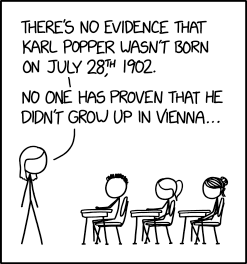
What do you think?

The Logic of Scientific Discovery
When first published in 1959, this book revolutionized contemporary thinking about science and knowledge. It remains the one of the most widely read books about science to come out of the twentieth century.
(Note: the book was first published in 1934, in German, with the title Logik der Forschung. It was "reformulated" into English in 1959. See Wikipedia for details.)
(Note: the book was first published in 1934, in German, with the title Logik der Forschung. It was "reformulated" into English in 1959. See Wikipedia for details.)
544 pages, Paperback
First published January 1, 1934
About the author
Karl Popper
311 books1,794 followersSir Karl Raimund Popper, FRS, rose from a modest background as an assistant cabinet maker and school teacher to become one of the most influential theorists and leading philosophers. Popper commanded international audiences and conversation with him was an intellectual adventure—even if a little rough—animated by a myriad of philosophical problems. He contributed to a field of thought encompassing (among others) political theory, quantum mechanics, logic, scientific method and evolutionary theory.
Popper challenged some of the ruling orthodoxies of philosophy: logical positivism, Marxism, determinism and linguistic philosophy. He argued that there are no subject matters but only problems and our desire to solve them. He said that scientific theories cannot be verified but only tentatively refuted, and that the best philosophy is about profound problems, not word meanings. Isaiah Berlin rightly said that Popper produced one of the most devastating refutations of Marxism. Through his ideas Popper promoted a critical ethos, a world in which the give and take of debate is highly esteemed in the precept that we are all infinitely ignorant, that we differ only in the little bits of knowledge that we do have, and that with some co-operative effort we may get nearer to the truth.
Nearly every first-year philosophy student knows that Popper regarded his solutions to the problems of induction and the demarcation of science from pseudo-science as his greatest contributions. He is less known for the problems of verisimilitude, of probability (a life-long love of his), and of the relationship between the mind and body.
Popper was a Fellow of the Royal Society, Fellow of the British Academy, and Membre de I'Institute de France. He was an Honorary member of the Harvard Chapter of Phi Beta Kappa, and an Honorary Fellow of the London School of Economics, King's College London, and of Darwin College Cambridge. He was awarded prizes and honours throughout the world, including the Austrian Grand Decoration of Honour in Gold, the Lippincott Award of the American Political Science Association, and the Sonning Prize for merit in work which had furthered European civilization.
Karl Popper was knighted by Queen Elizabeth II in 1965 and invested by her with the Insignia of a Companion of Honour in 1982.
(edited from http://www.tkpw.net/intro_popper/intr...)
Popper challenged some of the ruling orthodoxies of philosophy: logical positivism, Marxism, determinism and linguistic philosophy. He argued that there are no subject matters but only problems and our desire to solve them. He said that scientific theories cannot be verified but only tentatively refuted, and that the best philosophy is about profound problems, not word meanings. Isaiah Berlin rightly said that Popper produced one of the most devastating refutations of Marxism. Through his ideas Popper promoted a critical ethos, a world in which the give and take of debate is highly esteemed in the precept that we are all infinitely ignorant, that we differ only in the little bits of knowledge that we do have, and that with some co-operative effort we may get nearer to the truth.
Nearly every first-year philosophy student knows that Popper regarded his solutions to the problems of induction and the demarcation of science from pseudo-science as his greatest contributions. He is less known for the problems of verisimilitude, of probability (a life-long love of his), and of the relationship between the mind and body.
Popper was a Fellow of the Royal Society, Fellow of the British Academy, and Membre de I'Institute de France. He was an Honorary member of the Harvard Chapter of Phi Beta Kappa, and an Honorary Fellow of the London School of Economics, King's College London, and of Darwin College Cambridge. He was awarded prizes and honours throughout the world, including the Austrian Grand Decoration of Honour in Gold, the Lippincott Award of the American Political Science Association, and the Sonning Prize for merit in work which had furthered European civilization.
Karl Popper was knighted by Queen Elizabeth II in 1965 and invested by her with the Insignia of a Companion of Honour in 1982.
(edited from http://www.tkpw.net/intro_popper/intr...)
Ratings & Reviews
Friends & Following
Create a free account to discover what your friends think of this book!
Community Reviews
Displaying 1 - 30 of 230 reviews

June 26, 2018
We do not know: we can only guess.
Karl Popper first wrote Logik der Forchung (The Logic of Research) in 1934. This original version—published in haste to secure an academic position and escape the threat of Nazism (Popper was of Jewish descent)—was heavily condensed at the publisher’s request; and because of this, and because it remained untranslated from the German, the book did not receive the attention it deserved. This had to wait until 1959, when Popper finally released a revised and expanded English translation. Yet this condensation and subsequent expansion have left their mark on the book. Popper makes his most famous point within the first few dozen pages; and much of the rest of the book is given over to dead controversies, criticisms and rejoinders, technical appendices, and extended footnotes. It does not make for the most graceful reading experience.
This hardly matters, however, since it is here that Popper put forward what has arguably become the most famous concept in the philosophy of science: falsification.
This term is widely used; but its original justification is not, I believe, widely understood. Popper’s doctrine must be seen as a response to inductivism. In 1620 Francis Bacon released his brilliant Novum Organum. Its title alludes to Aristotle’s Organon, a collection of logical treatises, mainly focusing on how to make accurate deductions. This Aristotelian method—characterized by syllogisms: deriving conclusions from given premises—dominated the study of nature for millennia, with precious little to show for it. Francis Bacon hoped to change all that with his new doctrine of induction. Instead of beginning with premises (‘All men are mortal’), and reasoning to conclusions (‘Socrates is mortal’), the investigator must begin with experiences (‘Socrates died,’ ‘Plato died,’ etc.) and then generalize a conclusion (‘All men are mortal’). This was how science was to proceed: from the specific to the general.
This seemed all fine and dandy until, in 1738, David Hume published his Treatise of Human Nature, in which he explained his infamous ‘problem of induction.’ Here is the idea. If you see one, two, three… a dozen… a thousand… a million white swans, and not a single black one, it is still illogical to conclude “All swans are white.” Even if you investigated every swan in the world but one, and they all proved white, you still could not conclude with certainty that the last one would be white. Aside from modus tollens (concluding from a negative specific to a negative general), there is no logically justifiable way to proceed from the specific to the general. To this argument, many are tempted to respond: “But we know from experience that induction works. We generalize all the time.” Yet this is to use induction to prove that induction works, which is paradoxical. Hume’s problem of induction has proven to be a stumbling block for philosophers ever since.
In the early parts of the 20th century, the doctrine of logical positivism arose in the philosophical world, particularly in the ‘Vienna Circle’. This had many proponents and many forms, but the basic idea, as explained by A.J. Ayer, is the following. The meaning of a sentence is equivalent to its verification; and verification is performed through experience. Thus the sentence “The cat is on the mat” can be verified by looking at the mat; it is a meaningful utterance. But the sentence “The world is composed of mind” cannot be verified by any experience; it is meaningless. Using this doctrine the positivists hoped to eliminate all metaphysics. Unfortunately, however, the doctrine also eliminates human knowledge, since, as Hume showed, generalizations can never be verified. No experience corresponds, for example, to the statement: “Gravitation is proportional to the product of mass and the inverse square of distance,” since this is an unlimitedly general statement, and experiences are always particular.
Karl Popper’s falsificationism is meant to solve this problem. First, it is important to note that Popper is not, like the positivists, proposing a criterion of ‘meaning’. That is to say that, for Popper, unfalsifiable statements can still be meaningful; they just do not tell us anything about the world. Indeed, he continually notes how metaphysical ideas (such as Kepler’s idea that circles are more ‘perfect’ than other shapes) have inspired and guided scientists. This is itself an important distinction because it prevents him from falling into the same paradox as the positivists. For if only the statements with empirical content have meaning, then the statement “only the statements with empirical content have meaning” is itself meaningless. Popper, for his part, regarded himself as the enemy of linguistic philosophy and considered the problem of epistemology quite distinct from language analysis.
To return to falsification, Popper’s fundamental insight is that verification and falsification are not symmetrical. While no general statement can be proved using a specific instance, a general statement can indeed be disproved with a specific instance. A thousand white swans does not prove all swans are white; but one black swan disproves it. (This is the aforementioned modus tollens.) All this may seem trivial; but as Popper realized, this changes the nature of scientific knowledge as we know it. For science, then, is far from what Bacon imagined it to be—a carefully sifted catalogue of experiences, a collection of well-founded generalizations—and is rather a collection of theories which spring up, as it were, from the imagination of the scientist in the hopes of uniting several observed phenomena under one hypothesis. Or to put it more bluntly: a good scientific theory is a guess that does not prove wrong.
With his central doctrine established, Popper goes on to the technicalities. He discusses what composes the ‘range’ or ‘scope’ of a theory, and how some theories can be said to encompass others. He provides an admirable justification for Occam’s Razor—the preference for simpler over more complex explanations—since theories with fewer parameters are more easily falsified and thus, in his view, more informative. The biggest section is given over to probability. I admit that I had some difficulty following his argument at times, but the gist of his point is that probability must be interpreted ‘objectively,’ as frequency distributions, rather than ‘subjectively,’ as degrees of certainty, in order to be falsifiable. Also, the statistical results of experiments must be reproducible in order to avoid the possibility of statistical flukes.
All this leads up to a strangely combative section on quantum mechanics. Popper apparently was in the same camp as Einstein, and was put off by Heisenberg’s uncertainty principle. Like Einstein, Popper was a realist and did not like the idea that a particle’s properties could be actually undetermined; he wanted to see the uncertainty of quantum mechanics as a byproduct of measurement or of ‘hidden variables’—not as representing something real about the universe. And like Einstein (though less famously) Popper proposed an experiment to decide the issue. The original experiment, as described in this book, was soon shown to be flawed; but a revised experiment was finally conducted in 1999, after Popper’s death. Though the experiment agreed with Popper’s prediction (showing that measuring an entangled photon does not affect its pair), it had no bearing on Heisenberg’s uncertainty principle, which restricts arbitrarily precise measurements on a single particle, not a pair of particles.
Incidentally, it is difficult to see why Popper is so uncomfortable with the uncertainty principle. Given his own dogma of falsifiability, the belief that nature is inherently deterministic (and that probabilistic theories are simply the result of a lack of our own knowledge) should be discarded as metaphysical. This is just one example of how Popper’s personality was out of harmony with his own doctrines. An advocate of the open society, he was famously authoritarian in his private life, which led to his own alienation. This is neither here nor there, but it is an interesting comment on the human animal.
Popper’s doctrine, like all great ideas, has proven both influential and controversial. For my part I think falsification a huge advance over Bacon’s induction or the positivists’ verification. And despite the complications, I think that falsifiability is a crucial test to distinguish, not only science from pseudo-science, but all dependable knowledge from myth. For both pseudo-science and myth generally distinguish themselves by admirably fitting the data set, but resisting falsification. Freud’s theories, for example, can accommodate themselves to any set of facts we throw at them; likewise for intelligent design, belief in supernatural beings, or conspiracy theories. All of these seem to explain everything—and in a way they do, since they fit the observable data—but really explain nothing, since they can accommodate any new observation.
There are some difficulties with falsification, of course. The first is observation. For what we observe, or even what we count as an ‘observation’, is colored by our background beliefs. Whether to regard a dot in the sky as a plane, a UFO, or an angel is shaped by the beliefs we already hold; thus it is possible to disregard observations that run counter to our theories, rather than falsifying the theories. What is more, theories never exist in isolation, but in an entire context of beliefs; so if one prediction is definitively falsified, it can still be unclear what we must change in our interconnected edifice of theories. Further, it is rare for experimental predictions to agree exactly with results; usually they are approximately correct. But where do we draw the line between falsification and approximate correctness? And last, if we formulate a theory which withstands test after test, predicting their results with extreme accuracy time and again, must we still regard the theory as a provisional guess?
To give Popper credit, he responds to all of these points in this work, though perhaps not with enough discussion. But all these criticisms belie the fact that so much of the philosophy of science written after Popper has taken his work as a starting point, either attempting to amplify, modify, or (dare I say it?) falsify his claims. For my part, though I was often bored by the dry style and baffled by the technical explanations, I found myself admiring Popper’s careful methodology: responding to criticisms, making fine distinctions, building up his system piece by piece. Here is a philosopher deeply committed to the ideal of rational argument and deeply engaged with understanding the world. I am excited to read more.

June 6, 2007
If it was 400 pages shorter, I'd give it 5 stars.
Popper makes his point quickly and emphatically on the merits of deductive reasoning versus inductive and its use in scientific research. Unfortunately, he continues to give examples to reiterate his point. Reading the first 50 pages is good enough. But, it's a good book for any and all graduate students in the scientific field to have on a bookshelf (particularly at the bench).
Popper makes his point quickly and emphatically on the merits of deductive reasoning versus inductive and its use in scientific research. Unfortunately, he continues to give examples to reiterate his point. Reading the first 50 pages is good enough. But, it's a good book for any and all graduate students in the scientific field to have on a bookshelf (particularly at the bench).

February 20, 2016
Logik der Forschung :دوستانِ گرانقدر، این کتاب در ابتدا با این عنوان در وین به چاپ رسید
از آنجایی که میتوان گفت این کتاب تخصصی است و خواندنِ آن برایِ شما بزرگواران ممکن است خسته کننده و کسالت آور باشد، لذا مهمترین مسائلِ مدنظرِ « سِر کارل پوپر» در این کتاب را در زیر برایتان مینویسم
علم به واسطۀ انقلاب ها ( منظورِ پوپر، انقلاب در نظریه و علم است) رشد میکند، رشدِ معرفتِ علمی، مبتنی است بر سقوطِ مکررِ نظریه هایِ علمی و جایگزینیِ آنها به وسیلۀ نظریه هایِ بهتر و رضایت بخش تر، مگر اینکه نظریه هایِ منسوخ خطا باشند
کارل به نوعی «آموختن از خطاها» را با «آموختن به روشِ آزمون و خطا» یکی میداند
کارل دانشمند را کسی میداند که « مسئله» را حل میکند و در این رابطه نوشته: علم تنها با مسئله آغاز میشود. بُروزِ مسائل خصوصاً وقتی پیش می آید که امیدِ خود را در رسیدن به انتظارات از دست بدهیم، یا چنین مسائلی وقتی رخ میدهد که نظریه ها، ما را با دشواری ها و تناقض هایی مواجه سازند
کارل، پایبند بودن به سنّت را در پیشرفت و تحولِ علمی بسیار مهم قلمداد کرده است و مینویسد: به لحاظِ کمی و کیفی، از هر نظر که بگوییم، مهمترین منبعِ معرفت، ( صرفِ نظر از معرفتِ ذاتی)، همان «سنّت» است... آنچه آزادی خوانده میشود، در حقیقت تحولی است از یک سنّت به سنّتِ دیگر
کارل در موردِ زندگی و کشفِ جهانِ ناشناخته نوشته: فرض کنید آگاهانه وظیفۀ خود دانسته ایم که در صورتِ امکان و تا جایی که امکان دارد، به کمکِ قوانین و نظریه هایِ تبیین کننده، در جهانِ ناشناختۀ خود زندگی کنیم و خود را تا جایی که میتوانیم با آن سازگار کنیم و آنها را تبیین کنیم... اگر چنین چیزی را وظیفۀ خود دانسته ایم، در این صورت هیچ روشِ معقول تری از روشِ « حدس و ابطال» برایِ ارائۀ متهورانۀ نظریه ها، سخت کوشی برایِ اثباتِ نادرستی آنها و پذیرشِ آزمایشیِ آنها، در صورتِ شکستِ تلاش هایِ انتقادی وجود ندارد... بدونِ فهمِ قوّتِ این نظریه هایِ علمی، موفقیت و پیشرفتِ علم را نخواهیم فهمید
کارل بر این موضوع پافشاری دارد که: هرگونه تحول و پیشرفت در علم، باید روشی را که به وسیلۀ آن کشفِ علمی و پیشرفت صورت گرفته را مهم قلمداد کرد
کارل قویاً معتقد است که رشد و پیشرفت در علم، با شکستِ انقلابیِ یک نظریه صورت گرفته است، یعنی جایگزینیِ یک نظریۀ علمی با یک نظریۀ علمیِ بهتر
------------------------------------------------------------------------------
دوستانِ خردگرا، وقتی به شما تعلیم میدهند، تا شما، تحتِ هیچ شرایطی، به دنبالِ کشفِ این جهان و کشفِ علت ها نروید، به حتم میخواهند چیزی به تو تحمیل کنند، که آن چیز، «ایمانِ دینی» نام دارد. و ایمان، تنها مقوله ای است که به هیچ استدلالی پایبند نیست... از تحقیق و پژوهش نترسید عزیزانِ من... خرد فقط با کشف مجهولات، پروار میشود
عزیزانم، آنچه مهمتر از کشفِ علمی است، کشفِ توانایی هایِ خودتان است، وقتی نمی توانید توانایی هایِ خودتان را کشف و باور کنید، یقیناً مجبور خواهید شد تا دروغهایِ دیگران را قبول کرده و آن دروغ ها را عبادت کنید
وقتی به خود اجازه ندادید که مانندِ دیگران بیندیشید، اطمینان داشته باشید، آن زمان است که در کشف و مکاشفه، موفق خواهید بود
دوستانِ خوب و بزرگوار، اسرار چیزی جز غربال و اصلاحِ شعور و تقویتِ خِرَد، برای فهمِ ندانسته ها، نیست... مجهولاتِ شعور خودتان را کشف کنید، تا این جهان را عمیقتر فهم کرده و در دانش و علم پیشرفت کنید
«پیروز باشید و ایرانی»
از آنجایی که میتوان گفت این کتاب تخصصی است و خواندنِ آن برایِ شما بزرگواران ممکن است خسته کننده و کسالت آور باشد، لذا مهمترین مسائلِ مدنظرِ « سِر کارل پوپر» در این کتاب را در زیر برایتان مینویسم
علم به واسطۀ انقلاب ها ( منظورِ پوپر، انقلاب در نظریه و علم است) رشد میکند، رشدِ معرفتِ علمی، مبتنی است بر سقوطِ مکررِ نظریه هایِ علمی و جایگزینیِ آنها به وسیلۀ نظریه هایِ بهتر و رضایت بخش تر، مگر اینکه نظریه هایِ منسوخ خطا باشند
کارل به نوعی «آموختن از خطاها» را با «آموختن به روشِ آزمون و خطا» یکی میداند
کارل دانشمند را کسی میداند که « مسئله» را حل میکند و در این رابطه نوشته: علم تنها با مسئله آغاز میشود. بُروزِ مسائل خصوصاً وقتی پیش می آید که امیدِ خود را در رسیدن به انتظارات از دست بدهیم، یا چنین مسائلی وقتی رخ میدهد که نظریه ها، ما را با دشواری ها و تناقض هایی مواجه سازند
کارل، پایبند بودن به سنّت را در پیشرفت و تحولِ علمی بسیار مهم قلمداد کرده است و مینویسد: به لحاظِ کمی و کیفی، از هر نظر که بگوییم، مهمترین منبعِ معرفت، ( صرفِ نظر از معرفتِ ذاتی)، همان «سنّت» است... آنچه آزادی خوانده میشود، در حقیقت تحولی است از یک سنّت به سنّتِ دیگر
کارل در موردِ زندگی و کشفِ جهانِ ناشناخته نوشته: فرض کنید آگاهانه وظیفۀ خود دانسته ایم که در صورتِ امکان و تا جایی که امکان دارد، به کمکِ قوانین و نظریه هایِ تبیین کننده، در جهانِ ناشناختۀ خود زندگی کنیم و خود را تا جایی که میتوانیم با آن سازگار کنیم و آنها را تبیین کنیم... اگر چنین چیزی را وظیفۀ خود دانسته ایم، در این صورت هیچ روشِ معقول تری از روشِ « حدس و ابطال» برایِ ارائۀ متهورانۀ نظریه ها، سخت کوشی برایِ اثباتِ نادرستی آنها و پذیرشِ آزمایشیِ آنها، در صورتِ شکستِ تلاش هایِ انتقادی وجود ندارد... بدونِ فهمِ قوّتِ این نظریه هایِ علمی، موفقیت و پیشرفتِ علم را نخواهیم فهمید
کارل بر این موضوع پافشاری دارد که: هرگونه تحول و پیشرفت در علم، باید روشی را که به وسیلۀ آن کشفِ علمی و پیشرفت صورت گرفته را مهم قلمداد کرد
کارل قویاً معتقد است که رشد و پیشرفت در علم، با شکستِ انقلابیِ یک نظریه صورت گرفته است، یعنی جایگزینیِ یک نظریۀ علمی با یک نظریۀ علمیِ بهتر
------------------------------------------------------------------------------
دوستانِ خردگرا، وقتی به شما تعلیم میدهند، تا شما، تحتِ هیچ شرایطی، به دنبالِ کشفِ این جهان و کشفِ علت ها نروید، به حتم میخواهند چیزی به تو تحمیل کنند، که آن چیز، «ایمانِ دینی» نام دارد. و ایمان، تنها مقوله ای است که به هیچ استدلالی پایبند نیست... از تحقیق و پژوهش نترسید عزیزانِ من... خرد فقط با کشف مجهولات، پروار میشود
عزیزانم، آنچه مهمتر از کشفِ علمی است، کشفِ توانایی هایِ خودتان است، وقتی نمی توانید توانایی هایِ خودتان را کشف و باور کنید، یقیناً مجبور خواهید شد تا دروغهایِ دیگران را قبول کرده و آن دروغ ها را عبادت کنید
وقتی به خود اجازه ندادید که مانندِ دیگران بیندیشید، اطمینان داشته باشید، آن زمان است که در کشف و مکاشفه، موفق خواهید بود
دوستانِ خوب و بزرگوار، اسرار چیزی جز غربال و اصلاحِ شعور و تقویتِ خِرَد، برای فهمِ ندانسته ها، نیست... مجهولاتِ شعور خودتان را کشف کنید، تا این جهان را عمیقتر فهم کرده و در دانش و علم پیشرفت کنید
«پیروز باشید و ایرانی»

November 20, 2020
Mágikus erővel bír ez a könyv: bármilyen fitten is kezdtem bele, három mondat után azon kaptam magam, hogy ásítok. A hátsó borítóra ugyan ráírta valaki, hogy "a művelt nagyközönségnek is izgalmas és élvezhető olvasmány", de vagy nagyon el akarta adni a kötetet, vagy végzetesen máshogy definiáljuk a "nagyközönség" kifejezést. Szerény véleményem szerint ugyanis Popper egyszerűen tesz a laikusokra - laikus alatt értve mindenkit, akinek nem a Bernoulli-tétel volt a jele az óvodában. Ő csak és kizárólag balhitben tévelygő kollégáihoz beszél, azokhoz, akiket meg akar győzni arról, rosszul értik a tudománytörténet egyik legégetőbb problémáját, a "valószínűtlenségi logika" meg az "induktív módszerek" híveihez intézi szavait, azokhoz, akiknek eddig a létezéséről sem tudtam, de Popper megjelenéséig vélhetően uralták a tudományfilozófiát. Ennek következtében teljesen természetes, hogy olyan a szövegben haladni, mintha sós mocsáron lábalnék át (szembeszélben!), hisz a szerzőnek folyvást és kétséget kizáróan bizonyítania kell, amit állít, következésképpen olyan szavakat, mint az "egyszerű", a "valószínű" vagy a "véletlen" megpróbál matematikai képletekre lefordítani, és úgy általában, minden marginálisnak tűnő logikai problémát tíz oldalon keresztül fejteget, pedig én simán elhinném becsszóra is. Ja, és arról nem is beszéltem még, hogy lépten-nyomon olyan lábjegyzetekbe ütközünk, amelyek felhívják a figyelmünket, hogy Popper azóta kibővítette vagy elvetette a fenn taglalt gondolatmenetet, de ha erről többet akarunk tudni, akkor fordíttassuk le a Postscript c. munkáját, mert az sajna nincs meg magyarul. Na, hát így.

Mivel az eddigiekkel nyilván elvettem mindenki kedvét a könyv elolvasásától, kötelességemnek érzem, hogy legalább összefoglaljam, miről szól. Annál is inkább, mert közben meg ménkű fontos könyv, olyan szöveg, ami alapvetően forradalmasította a tudományos gondolkodást.
Popper tézise ugyanis az, hogy a tudományos állítások mércéje nem a verifikálhatóság (kb. bebizonyíthatóság), hanem a falszifikálhatóság (cáfolhatóság). Leegyszerűsített példával illusztrálva: ha én azt állítom, hogy minden egész szám háromszorosa páros szám lesz, akkor végtelen számú esetet tudok mondani, ami engem támaszt alá, de ez nem jelent semmit, mert ettől még az állítás nem lesz igaz. Viszont elég egy olyan esetet mondani, amikor a végösszeg páratlan, és háhá, máris falszifikáltuk az állítást. No most ennek számos következménye van, leginkább az, hogy Popper értelmezésében csak azok az állítások tekinthetőek tudományosnak, amelyek - legalább elméletben - cáfolhatóak. Az "Isten szeret téged" megállapítás például lehet, hogy igaz, lehet, hogy nem, sem megerősíteni, sem megcáfolni nem tudjuk, tehát nem tekinthető tudományos hipotézisnek*. A másik, tán még ennél is fontosabb hozadék, hogy Popper szemében a tudomány nem kész, megállapodott valami, saját metaforája szerint inkább olyan házra emlékeztet, amit felhúztunk ugyan, mert lakni csak kell valahol, de legyünk felkészülve rá, hogy ha úgy alakul, bármikor lebonthatjuk vagy áthelyezhetjük máshová. Nincs tehát végérvényes tudás, csak egyfajta ideiglenes állapot, állításaink addig érvényesek, amíg valaki nem jön a cáfolattal. De ez nem a tudomány relativizálása, dehogy, sőt: a tudomány fejlődésének záloga. Túl sok okos töltötte azzal egész szakmai pályafutását, hogy saját, egyszer kicsiszolt elméletét védte foggal-körömmel ahelyett, hogy maga próbálta volna megcáfolni azt - holott Popper szerint ez lenne a tisztességes eljárás, ettől haladunk előre. Vagy ahogy a szerző mondja: "a tudós ugyanis nem azért tudós, mert tudás, cáfolhatatlan igazság van a birtokában, hanem azért, mert állhatatosan és vakmerően kritikusan keresi az igazságot."
Újszerű és termékeny elmélet ez, amit az is jelez, hogy a társadalomtudományba is átszivárgott. Hogy mást ne mondjak, a nyílt társadalom egyik alapvető hivatkozási pontja lett belőle: “Az adott társadalmi szituációk résztvevőiként mindannyiunknak rendelkeznünk kell bizonyos nézetekkel, amelyek alapján cselekszünk. De milyen alapon cselekedjünk, amennyiben elfogadjuk, hogy nézeteink nagy valószínűséggel tévesek, de legalábbis a valóság hiányos vetületei. A válasz ugyanaz, mint amit Popper adott a tudományos módszerre: nézeteinket átmeneti igazságokként kell kezelni, és közben biztosítani kell az állandó felülvizsgálatot. Ez a nyílt társadalom alaptétele.” (Meg se mondom, ki mondta. A miniszterelnök úr szokta gyakran emlegetni, ha ideges.) Nyugodtan állíthatjuk hát, hogy Popper elvei egyfajta forradalmat eredményeztek a gondolkodásban. Kár, hogy olyan kínszenvedés volt olvasni. Mindegy, túl vagyok rajta. Majdnem olyan büszke vagyok erre, mintha kockákat növesztettem volna a hasamra.
* Ez a kritérium kifejezetten fontos, ha meg akarjuk különböztetni az áltudományokat a tudományoktól. Hisz az áltudománynak pont az a lényege, hogy nem ad lehetőséget a cáfolatra. Gondoljunk a laposföldesekre. Bármilyen ellenük szóló bizonyítékot laza csuklómozdulattal hamisítványnak, egy ellenséges környezet manipulációjának bélyegeznek. Ezzel abszurd szituációt teremtenek: világképükben a mellettük szóló "érvek" verifikálják állításaikat, de az ellenérvek is, mert minden ellenérv csak annak bizonyítéka, hogy létezik egy hatalmas ellenség, aki minden erejével el akarja leplezni az ő igazságukat.
Mivel az eddigiekkel nyilván elvettem mindenki kedvét a könyv elolvasásától, kötelességemnek érzem, hogy legalább összefoglaljam, miről szól. Annál is inkább, mert közben meg ménkű fontos könyv, olyan szöveg, ami alapvetően forradalmasította a tudományos gondolkodást.
Popper tézise ugyanis az, hogy a tudományos állítások mércéje nem a verifikálhatóság (kb. bebizonyíthatóság), hanem a falszifikálhatóság (cáfolhatóság). Leegyszerűsített példával illusztrálva: ha én azt állítom, hogy minden egész szám háromszorosa páros szám lesz, akkor végtelen számú esetet tudok mondani, ami engem támaszt alá, de ez nem jelent semmit, mert ettől még az állítás nem lesz igaz. Viszont elég egy olyan esetet mondani, amikor a végösszeg páratlan, és háhá, máris falszifikáltuk az állítást. No most ennek számos következménye van, leginkább az, hogy Popper értelmezésében csak azok az állítások tekinthetőek tudományosnak, amelyek - legalább elméletben - cáfolhatóak. Az "Isten szeret téged" megállapítás például lehet, hogy igaz, lehet, hogy nem, sem megerősíteni, sem megcáfolni nem tudjuk, tehát nem tekinthető tudományos hipotézisnek*. A másik, tán még ennél is fontosabb hozadék, hogy Popper szemében a tudomány nem kész, megállapodott valami, saját metaforája szerint inkább olyan házra emlékeztet, amit felhúztunk ugyan, mert lakni csak kell valahol, de legyünk felkészülve rá, hogy ha úgy alakul, bármikor lebonthatjuk vagy áthelyezhetjük máshová. Nincs tehát végérvényes tudás, csak egyfajta ideiglenes állapot, állításaink addig érvényesek, amíg valaki nem jön a cáfolattal. De ez nem a tudomány relativizálása, dehogy, sőt: a tudomány fejlődésének záloga. Túl sok okos töltötte azzal egész szakmai pályafutását, hogy saját, egyszer kicsiszolt elméletét védte foggal-körömmel ahelyett, hogy maga próbálta volna megcáfolni azt - holott Popper szerint ez lenne a tisztességes eljárás, ettől haladunk előre. Vagy ahogy a szerző mondja: "a tudós ugyanis nem azért tudós, mert tudás, cáfolhatatlan igazság van a birtokában, hanem azért, mert állhatatosan és vakmerően kritikusan keresi az igazságot."
Újszerű és termékeny elmélet ez, amit az is jelez, hogy a társadalomtudományba is átszivárgott. Hogy mást ne mondjak, a nyílt társadalom egyik alapvető hivatkozási pontja lett belőle: “Az adott társadalmi szituációk résztvevőiként mindannyiunknak rendelkeznünk kell bizonyos nézetekkel, amelyek alapján cselekszünk. De milyen alapon cselekedjünk, amennyiben elfogadjuk, hogy nézeteink nagy valószínűséggel tévesek, de legalábbis a valóság hiányos vetületei. A válasz ugyanaz, mint amit Popper adott a tudományos módszerre: nézeteinket átmeneti igazságokként kell kezelni, és közben biztosítani kell az állandó felülvizsgálatot. Ez a nyílt társadalom alaptétele.” (Meg se mondom, ki mondta. A miniszterelnök úr szokta gyakran emlegetni, ha ideges.) Nyugodtan állíthatjuk hát, hogy Popper elvei egyfajta forradalmat eredményeztek a gondolkodásban. Kár, hogy olyan kínszenvedés volt olvasni. Mindegy, túl vagyok rajta. Majdnem olyan büszke vagyok erre, mintha kockákat növesztettem volna a hasamra.
* Ez a kritérium kifejezetten fontos, ha meg akarjuk különböztetni az áltudományokat a tudományoktól. Hisz az áltudománynak pont az a lényege, hogy nem ad lehetőséget a cáfolatra. Gondoljunk a laposföldesekre. Bármilyen ellenük szóló bizonyítékot laza csuklómozdulattal hamisítványnak, egy ellenséges környezet manipulációjának bélyegeznek. Ezzel abszurd szituációt teremtenek: világképükben a mellettük szóló "érvek" verifikálják állításaikat, de az ellenérvek is, mert minden ellenérv csak annak bizonyítéka, hogy létezik egy hatalmas ellenség, aki minden erejével el akarja leplezni az ő igazságukat.
Read
July 20, 2007"I define the empirical content of a statement p as the class of its potential falsifiers. The logical content is defined, with the help of the concept of derivability, as the class of all non-tautological statements which are derivable from the statement in question. So the logical content of p is at least equal to that of a statement q, if q is derivable from p."
If you liked that, you'll looooove this book!
If you liked that, you'll looooove this book!

January 24, 2016
Strictly to be confined within the realms of the scientific disciplines. But as far as other realms of human activity are concerned, the methodology espoused here is to be taken in caution.
September 22, 2008
I volunteered to read this book in my PhD Doctoral Seminar because I thought my German language abilities would help me further understand Karl Popper.
It didn't.
Here's my review:
Grappling with underlying ideas of how science is “discovered” and the underlying problems that exist with new knowledge? Sir Karl Popper’s book, The Logic of Scientific Discovery, directly addresses these issues and additionally tackles a theme important to philosophy – epistemology or the growth of knowledge. A critical examination of the logic behind science is required for the “growth of scientific knowledge.”
Popper’s book, published in the early 1930s, elicited a storm of controversy. In fact, the author has since written three novels as well as numerous papers to further explain his views. The premise he makes is that laws of nature, theories and hypotheses should not be and never should be established as “truth”. Instead, they can be corroborated and supported by the observations and systematic tests of science.
Of the three organized parts to the book, the first part deals with an introduction to the Logic of Science. The second section, by far the largest, begins to expound upon different components needed to frame his overall thesis. Together, these are arranged into short monologues (85 of them) that dissect the components of theoretical scientific research. The last section of his book contains seven appendices as well as twelve additional appendices added since his first edition. These contain examples and explicit rationale to elaborate upon and delve into those items that he felt would be the most contentious or have since been found contentious by his peers.
In short, he spends most of his time reviewing some of the more fundamental problems that philosophers have encountered (and often have chosen to ignore) in the advancement of science. He takes aim at the generally accepted “theory of scientific method”, arguing that most methodological rules, conventions, and approaches taken contain fundamental flaws. Beginning with the theories in use, he observes that the logical problems, often dismissed by assumption or by convention, should not and do not need to be handled in this way. The notion of falsification and the problem of empirical basis are thoroughly discussed. A great deal of space is devoted to the nuances of testability and simplicity followed by two dozen or so pieces on probability. His “Observations on Quantum Theory” are fascinating as he walks the reader through many of theory’s questionable assumptions. Finally, he finishes with several thoughts on “corroboration, or how a theory stands up to tests.”
This book is NOT light reading – a good dictionary to assist with the mastery of his subject area is highly recommended. In addition, a college-level education in the empirical sciences and philosophy wouldn’t hurt. Figures such as Kant, Bernoulli, Newton, Einstein and others are used throughout the book to support or reject his theses. He is well versed in his contemporaries’ work and speaks with an ease regarding their research and theories in a way that lends credence to his own views. Contemporaries such as Einstein, with whom he corresponded, were equally familiar and knowledgeable with accepted philosophical tenets as well as in their particular fields of science. Unfortunately, the book’s flow and organization leaves much to be desired. For example, Popper chose to footnote and comment on nearly every monologue he wrote in subsequent editions. (The original had been printed near the beginning of his career.) For many, this is a great boon, because he uses this space to defend his work over time as well as expound even further upon his thoughts. He also acknowledges his mistakes or where he has been convinced otherwise and even encourages readers to skip portions of the book he no longer supports. Publishing a revised and enlarged edition to correct his work might have made things easier for the reader. However, this artifact may simply be a way to show how his thinking has evolved over the years.
Owing to the radically provocative nature of his ideas, the many separate books, papers, and symposia this book has spawned, this book has fulfilled its purpose. It has become one of the classics in modern logical thinking by critically examining the underpinnings of modern scientific thought and theory. This book deserves a place in the library of every serious student of philosophy. While writing about logical examination of scientific theories, Popper muses, “Our method of research is not to defend them, in order to prove how right we were. On the contrary, we try to overthrow them.” In essence, his legacy remains: there will always be another set of laws, another set of hypotheses and their accompanying axioms that will absorb existing theories and well established axioms until the next set comes along. And we still have so much to discover.
It didn't.
Here's my review:
Grappling with underlying ideas of how science is “discovered” and the underlying problems that exist with new knowledge? Sir Karl Popper’s book, The Logic of Scientific Discovery, directly addresses these issues and additionally tackles a theme important to philosophy – epistemology or the growth of knowledge. A critical examination of the logic behind science is required for the “growth of scientific knowledge.”
Popper’s book, published in the early 1930s, elicited a storm of controversy. In fact, the author has since written three novels as well as numerous papers to further explain his views. The premise he makes is that laws of nature, theories and hypotheses should not be and never should be established as “truth”. Instead, they can be corroborated and supported by the observations and systematic tests of science.
Of the three organized parts to the book, the first part deals with an introduction to the Logic of Science. The second section, by far the largest, begins to expound upon different components needed to frame his overall thesis. Together, these are arranged into short monologues (85 of them) that dissect the components of theoretical scientific research. The last section of his book contains seven appendices as well as twelve additional appendices added since his first edition. These contain examples and explicit rationale to elaborate upon and delve into those items that he felt would be the most contentious or have since been found contentious by his peers.
In short, he spends most of his time reviewing some of the more fundamental problems that philosophers have encountered (and often have chosen to ignore) in the advancement of science. He takes aim at the generally accepted “theory of scientific method”, arguing that most methodological rules, conventions, and approaches taken contain fundamental flaws. Beginning with the theories in use, he observes that the logical problems, often dismissed by assumption or by convention, should not and do not need to be handled in this way. The notion of falsification and the problem of empirical basis are thoroughly discussed. A great deal of space is devoted to the nuances of testability and simplicity followed by two dozen or so pieces on probability. His “Observations on Quantum Theory” are fascinating as he walks the reader through many of theory’s questionable assumptions. Finally, he finishes with several thoughts on “corroboration, or how a theory stands up to tests.”
This book is NOT light reading – a good dictionary to assist with the mastery of his subject area is highly recommended. In addition, a college-level education in the empirical sciences and philosophy wouldn’t hurt. Figures such as Kant, Bernoulli, Newton, Einstein and others are used throughout the book to support or reject his theses. He is well versed in his contemporaries’ work and speaks with an ease regarding their research and theories in a way that lends credence to his own views. Contemporaries such as Einstein, with whom he corresponded, were equally familiar and knowledgeable with accepted philosophical tenets as well as in their particular fields of science. Unfortunately, the book’s flow and organization leaves much to be desired. For example, Popper chose to footnote and comment on nearly every monologue he wrote in subsequent editions. (The original had been printed near the beginning of his career.) For many, this is a great boon, because he uses this space to defend his work over time as well as expound even further upon his thoughts. He also acknowledges his mistakes or where he has been convinced otherwise and even encourages readers to skip portions of the book he no longer supports. Publishing a revised and enlarged edition to correct his work might have made things easier for the reader. However, this artifact may simply be a way to show how his thinking has evolved over the years.
Owing to the radically provocative nature of his ideas, the many separate books, papers, and symposia this book has spawned, this book has fulfilled its purpose. It has become one of the classics in modern logical thinking by critically examining the underpinnings of modern scientific thought and theory. This book deserves a place in the library of every serious student of philosophy. While writing about logical examination of scientific theories, Popper muses, “Our method of research is not to defend them, in order to prove how right we were. On the contrary, we try to overthrow them.” In essence, his legacy remains: there will always be another set of laws, another set of hypotheses and their accompanying axioms that will absorb existing theories and well established axioms until the next set comes along. And we still have so much to discover.

October 10, 2017
If only I was clever enough to understand anything...

November 12, 2010
I studied this while in grad school. My thesis, which never got much beyond the notes stage, used Popper and other epistemologies to examine the difference between "natural" sciences and "social" sciences. The basic hypothesis was that the latter rested on "essentially contested" propositions. For example, Galileo's observations of the solar system and the conclusions he drew therefrom depended on the underlying theory of optics being correct. Since both the theory and instruments were new and crude, that was originally probably a pretty formidable attack. However, there is nothing about whether or not the theory of optics is correct that is a direct affront to anyone's ideological holdings. Meanwhile, over in the social sciences, my suspicion is that there will always be unresolvable debates about the essence of things: which is more important, charity or justice? Seniority or quantifiable capability?
Popper provided the foundation for much of my thinking, and more. But my thesis advisor thought I was straying pretty far from International Relations and I was finding there was too much more recent epistemology to be read to sustain my interest.
I still think I'm right :-) but it doesn't really matter, does it?
Popper provided the foundation for much of my thinking, and more. But my thesis advisor thought I was straying pretty far from International Relations and I was finding there was too much more recent epistemology to be read to sustain my interest.
I still think I'm right :-) but it doesn't really matter, does it?
Read
October 13, 2019
"itiraf etmemiz gerekirse: Aslında hiçbir şeyi bilmiyoruz; ama bulmacayı çözüyoruz."
(s.314)
Evrenin derinliklerine baktığımızda, ve sonsuz küçüklüğe gözlerimizi diktiğimizde. Elimizdeki zayıf, güçsüz, dayanıksız aletlerimize rağmen -çünkü cüretimizle- bir şeyi öğreniyoruz yalnızca; ne kadar az şey bildiğimizi. Ne kadar küçük ve zayıf, ve narin olduğumuzu. Entelektüel alçakgönüllülük insanın tam da "çok şey öğrendiğini" sandığı anda ortaya çıkan bir duygu.
Çünkü çok ama çok az şey biliyoruz. Ancak cüretkarız, ancak hevesliyiz, öğrenmek istiyoruz. Gerçeğe asla kesin olarak ulaşamayacağız. Ancak yaklaşacağız.
Teorilerimizi sınaya sınaya, teorilerimizi eleye eleye; çürükleri döke döke. En yanlışlanabilir, en sağlanabilir ve en dar olanlar kalıncaya dek.
Bu arada, kitabın hacmini görüp korkmayın. Yarısından fazlası ek.
M.B.
Mersin
13.10.2019
Evrenin derinliklerine baktığımızda, ve sonsuz küçüklüğe gözlerimizi diktiğimizde. Elimizdeki zayıf, güçsüz, dayanıksız aletlerimize rağmen -çünkü cüretimizle- bir şeyi öğreniyoruz yalnızca; ne kadar az şey bildiğimizi. Ne kadar küçük ve zayıf, ve narin olduğumuzu. Entelektüel alçakgönüllülük insanın tam da "çok şey öğrendiğini" sandığı anda ortaya çıkan bir duygu.
Çünkü çok ama çok az şey biliyoruz. Ancak cüretkarız, ancak hevesliyiz, öğrenmek istiyoruz. Gerçeğe asla kesin olarak ulaşamayacağız. Ancak yaklaşacağız.
Teorilerimizi sınaya sınaya, teorilerimizi eleye eleye; çürükleri döke döke. En yanlışlanabilir, en sağlanabilir ve en dar olanlar kalıncaya dek.
Bu arada, kitabın hacmini görüp korkmayın. Yarısından fazlası ek.
M.B.
Mersin
13.10.2019

June 26, 2015
His reputation preceding him, with a pretty good idea of what the main arguments of the book are, it is a daunting task to read Popper in the original. But it soon becomes clear that there is enough value, ingenuity and originality in "The Logic" to merit reading the original book in lieu of, or in addition to, later clarifications, commentaries and critiques (including some by Popper himself).
First, a warning. The logical complexity and mathematical sophistication of his arguments, combined with the author's engagement with the partially outmoded terminology of the positivists and probability theorists, means that some sections of the book will almost certainly appear, to all but the most savant of savants, varying degrees of impenetrable, inscrutable and unreadable. The dense appendices, full of logical and mathematical proofs, can happily be skipped. It is also clear that some parts of the main text of the book have become severely outdated, especially the sections on quantum mechanics (cf. the Heisenberg-Bohr interpretation and its implications). The low point of the book, from a readability perspective, namely the 70 dense pages devoted to probability theory, especially that of J.M. Keynes, and refuting its implications for science, seem to be of little interest to contemporary debates, and only marginally relevant to Popper's main arguments.
So I would not fuss about reading every chapter, footnote or appendix. The main gist of the book can be expressed in non-technical terms. And Popper himself does a wonderful job explaining his position in the few opening chapters. So it might even be enough to read through chapters I-VI.
At his best, Popper is a very lucid philosopher of science, whose revolutionary doctrine, that scientific doctrines can never be "verified" or deemed "true," but only temporarily more or less corroborated, is carefully argued for, using a combination of natural language and technical terminology (which is sometimes helpful, although never absolutely necessary, or so it seems to me). The fact that he spends considerable time attacking his contemporaries - the inductionists, the positivists, the Vienna Circle, the pragmatists, the conventionalists, etc. - means that he occasionally gets bogged down in technical minutiae, but the main thread is luckily never lost.
Disentangling the the fact that he revolutionized the history of the philosophy of science from the particular arguments advanced in the book is a difficult task. As Popper himself always emphasized, there are no isolated observations that are "theory-free", but we are always carrying with us some "metaphysical" assumptions (strictly speaking untestable, unscientific and unempirical). Thus, before reading the book, the reader will almost certainly have been introduced to Popperian methodology via some circuitous route, e.g. a commentary, a philosophy course, or a later critique. These form a king of "background halo" through which the reading experience will be refracted.
Some of the "baggage" that I personally brought to the reading experience - in additional to a deep respect for Popper's critique of inductive science - was the importance and value of some of the criticism that has been targeted against him. This is no time to go through the theories of Kuhn or Feyerabend, for example, but I'm sure the reader will find the time to go read those authors. The fact that Popper has influenced subsequent scholarship is vital to understanding him. It WILL colour the reading experience, but not in the sense of "tainting" the pure original picture, but "motivating" the reading experience with a combination of prejudiced respect and curiosity.
However, I wish to offer one major criticism that I have with Popper's wonderfully stringent theory: I worry that Popper offers too much of an "idealized" version of science. He proceeds logically to devise an ideal system that bears little resemblance to actual science. More concretely, Popper's "system" (if we can call it that) contains a realist component and an idealist component, and these two aspects do not mix easily. In fact, they are often in dire conflict with each other.
The realist component, which I admire, is embedded in his notion of how hypotheses and theories come about. The idealist component, which I see as the problem, is embedded in his notion of how hypotheses and theories are supposed to be put into the test (ideally of the potentially falsifying "crucial experiment"). Overall, Popper's view of science describes an ideal scientific practice, whereby theories - motivated by WHATEVER source, be it rational belief or irrational flight of fancy - are devised, and crafted, in such a way that they meet the maximum criteria of universality, simplicity and testability (i.e. falsifiability). This is certainly a difficult task, but Popper insists on it. In this view, doing anything else - i.e. devising "ad hoc" explanations to explain weakness, or devising metaphysical tautologies to explain strengths - is frowned upon, and the practice of science is hopefully purified of such bad methodologies. But we have a problem, since there is no guarantee that the scientists, who are psychologically very much invested and often in love with their own theories, will, absent strong institutional incentives, be motivated to design their theories in such a manner. This assumes too rosy a picture of humanity. In his "Open Society and its Enemies", Popper has accused social scientists of being naively optimistic. But in "the Logic", Popper seems to fall for the same fallacious view of human motivation and capabilities. Even if Popper acknowledges his logical focus, he SEEMS to be implying that devising such a system of science, where fallibility and falsifiability are crowned king and queen, is theoretically possible.
But human beings have a psychology that is fighting hard against such devises. Scientists, like other humans, will carry their irrational and self-serving practices, which motivate their quest for knowledge, and their desire to build metaphysical systems, all the way to the experimental stage; and only a strong community of peer pressure and external criticism can build sufficient safeguards against building theories that are impervious to refutation, or, which comes to the same thing, of being reluctant to accept studies that threaten one's cherished theories. Whether such strong institutional studies can be built is an empirical question; even if Popper provides a good way for an ideal scientific community to be structured, it is dubious whether it ever will be. A more reasonable assumption is to assume that science will, hopefully, come to approximate a system of perfect competition, where systems (theories, hypotheses) can be freely tested. Even if most scientists will be reluctant to set their theories to the test, peer pressure can, ideally, force it on them. This seems to me to be the only way to rescue Popper's methodology from the pitfalls of human self-deception.
And indeed, Popper knew this: he references "natural selection" and "freedom" as prerequisites of science, since they foster competition that can lead to the rejection of bad habits and theories. Indeed, Popper's insistence on falsifiability ONLY makes sense if embedded into this context. But such a context does not preclude pragmatic, instrumental or positivistic theories, either, which seems to make Popper's insistence on a particular methodological commitment metaphysical (which he readily admits); and, more dangerously, superfluous, if RESULTS are what matter. (And results can be obtained using probabilistic logic, positivistic induction, or any other methodology.)
Even if Popper's original formulation of scientific practice can be criticized, and has been with justification, this is partly missing the point. The value of Popper's insight is that even though it contains many outdated and outmoded paragraphs, it opened up a whole new methodology. Very few thinkers have been able to set up a new paradigm that challenges the very foundations of our commonly held beliefs and practices, but Popper certainly did, and he did so with rigorous logic.
Great thinkers are often ones who use reason AGAINST reason, use logic AGAINST logic, i.e. to show the limits of reason and logic, and this is exactly the greatest contribution of Popper's critical method. He does not leave us with debilitating skepticism, but with exhilarating awareness of the imperfections of our knowledge, the constantly challenging nature of reality, the critical nature of science, and the "irrational rationality" of our own drives, beliefs, faith and curiosity.
First, a warning. The logical complexity and mathematical sophistication of his arguments, combined with the author's engagement with the partially outmoded terminology of the positivists and probability theorists, means that some sections of the book will almost certainly appear, to all but the most savant of savants, varying degrees of impenetrable, inscrutable and unreadable. The dense appendices, full of logical and mathematical proofs, can happily be skipped. It is also clear that some parts of the main text of the book have become severely outdated, especially the sections on quantum mechanics (cf. the Heisenberg-Bohr interpretation and its implications). The low point of the book, from a readability perspective, namely the 70 dense pages devoted to probability theory, especially that of J.M. Keynes, and refuting its implications for science, seem to be of little interest to contemporary debates, and only marginally relevant to Popper's main arguments.
So I would not fuss about reading every chapter, footnote or appendix. The main gist of the book can be expressed in non-technical terms. And Popper himself does a wonderful job explaining his position in the few opening chapters. So it might even be enough to read through chapters I-VI.
At his best, Popper is a very lucid philosopher of science, whose revolutionary doctrine, that scientific doctrines can never be "verified" or deemed "true," but only temporarily more or less corroborated, is carefully argued for, using a combination of natural language and technical terminology (which is sometimes helpful, although never absolutely necessary, or so it seems to me). The fact that he spends considerable time attacking his contemporaries - the inductionists, the positivists, the Vienna Circle, the pragmatists, the conventionalists, etc. - means that he occasionally gets bogged down in technical minutiae, but the main thread is luckily never lost.
Disentangling the the fact that he revolutionized the history of the philosophy of science from the particular arguments advanced in the book is a difficult task. As Popper himself always emphasized, there are no isolated observations that are "theory-free", but we are always carrying with us some "metaphysical" assumptions (strictly speaking untestable, unscientific and unempirical). Thus, before reading the book, the reader will almost certainly have been introduced to Popperian methodology via some circuitous route, e.g. a commentary, a philosophy course, or a later critique. These form a king of "background halo" through which the reading experience will be refracted.
Some of the "baggage" that I personally brought to the reading experience - in additional to a deep respect for Popper's critique of inductive science - was the importance and value of some of the criticism that has been targeted against him. This is no time to go through the theories of Kuhn or Feyerabend, for example, but I'm sure the reader will find the time to go read those authors. The fact that Popper has influenced subsequent scholarship is vital to understanding him. It WILL colour the reading experience, but not in the sense of "tainting" the pure original picture, but "motivating" the reading experience with a combination of prejudiced respect and curiosity.
However, I wish to offer one major criticism that I have with Popper's wonderfully stringent theory: I worry that Popper offers too much of an "idealized" version of science. He proceeds logically to devise an ideal system that bears little resemblance to actual science. More concretely, Popper's "system" (if we can call it that) contains a realist component and an idealist component, and these two aspects do not mix easily. In fact, they are often in dire conflict with each other.
The realist component, which I admire, is embedded in his notion of how hypotheses and theories come about. The idealist component, which I see as the problem, is embedded in his notion of how hypotheses and theories are supposed to be put into the test (ideally of the potentially falsifying "crucial experiment"). Overall, Popper's view of science describes an ideal scientific practice, whereby theories - motivated by WHATEVER source, be it rational belief or irrational flight of fancy - are devised, and crafted, in such a way that they meet the maximum criteria of universality, simplicity and testability (i.e. falsifiability). This is certainly a difficult task, but Popper insists on it. In this view, doing anything else - i.e. devising "ad hoc" explanations to explain weakness, or devising metaphysical tautologies to explain strengths - is frowned upon, and the practice of science is hopefully purified of such bad methodologies. But we have a problem, since there is no guarantee that the scientists, who are psychologically very much invested and often in love with their own theories, will, absent strong institutional incentives, be motivated to design their theories in such a manner. This assumes too rosy a picture of humanity. In his "Open Society and its Enemies", Popper has accused social scientists of being naively optimistic. But in "the Logic", Popper seems to fall for the same fallacious view of human motivation and capabilities. Even if Popper acknowledges his logical focus, he SEEMS to be implying that devising such a system of science, where fallibility and falsifiability are crowned king and queen, is theoretically possible.
But human beings have a psychology that is fighting hard against such devises. Scientists, like other humans, will carry their irrational and self-serving practices, which motivate their quest for knowledge, and their desire to build metaphysical systems, all the way to the experimental stage; and only a strong community of peer pressure and external criticism can build sufficient safeguards against building theories that are impervious to refutation, or, which comes to the same thing, of being reluctant to accept studies that threaten one's cherished theories. Whether such strong institutional studies can be built is an empirical question; even if Popper provides a good way for an ideal scientific community to be structured, it is dubious whether it ever will be. A more reasonable assumption is to assume that science will, hopefully, come to approximate a system of perfect competition, where systems (theories, hypotheses) can be freely tested. Even if most scientists will be reluctant to set their theories to the test, peer pressure can, ideally, force it on them. This seems to me to be the only way to rescue Popper's methodology from the pitfalls of human self-deception.
And indeed, Popper knew this: he references "natural selection" and "freedom" as prerequisites of science, since they foster competition that can lead to the rejection of bad habits and theories. Indeed, Popper's insistence on falsifiability ONLY makes sense if embedded into this context. But such a context does not preclude pragmatic, instrumental or positivistic theories, either, which seems to make Popper's insistence on a particular methodological commitment metaphysical (which he readily admits); and, more dangerously, superfluous, if RESULTS are what matter. (And results can be obtained using probabilistic logic, positivistic induction, or any other methodology.)
Even if Popper's original formulation of scientific practice can be criticized, and has been with justification, this is partly missing the point. The value of Popper's insight is that even though it contains many outdated and outmoded paragraphs, it opened up a whole new methodology. Very few thinkers have been able to set up a new paradigm that challenges the very foundations of our commonly held beliefs and practices, but Popper certainly did, and he did so with rigorous logic.
Great thinkers are often ones who use reason AGAINST reason, use logic AGAINST logic, i.e. to show the limits of reason and logic, and this is exactly the greatest contribution of Popper's critical method. He does not leave us with debilitating skepticism, but with exhilarating awareness of the imperfections of our knowledge, the constantly challenging nature of reality, the critical nature of science, and the "irrational rationality" of our own drives, beliefs, faith and curiosity.

Read
April 4, 201190% of the value of Popper today, especially for the non-scientist is in the first part of the book. Popper reconciles Kant's observations about how the world is ultimately filtered through the lenses of space and time with a fundamentally empiricist, materialist sense of reality. While I disagree with some of his assertions-- especially his complete disavowal of inductive reasoning, and his general disregard for non-scientific knowledge-- I respect his method and, as a fellow empiricist, believe that his scientific (but definitely NOT his political) philosophy has made the world a better place, and paved the way for the pioneering efforts of Kuhn, Lakatos, and others. Read the Logic of Scientific Discovery if you're at all interested in the nature of inquiry. Philosophy of science emerges as a mature discipline, and science itself gets its best definition.
My lack of technical knowledge prevented me from fully understanding large sections. My limited knowledge of quantum theory and probability, along with my complete lack of knowledge about the works of Bernoulli and others, made the latter half of the Logic of Scientific Discovery utterly impenetrable. However, it's still very much worth reading the first part.
My lack of technical knowledge prevented me from fully understanding large sections. My limited knowledge of quantum theory and probability, along with my complete lack of knowledge about the works of Bernoulli and others, made the latter half of the Logic of Scientific Discovery utterly impenetrable. However, it's still very much worth reading the first part.

September 1, 2015
The point is that whenever we try to propose a solution to a problem, we ought to try as hard as we can to overthrow our solution, rather than defend it.
I'm one of the hundreds, if not thousands, of readers of Taleb's The Black Swan: The Impact of the Highly Improbable, who went off in search of Karl Popper's books somewhere in the middle of reading. It WAS difficult to find Popper's works, as Taleb indicated in recounting his own struggle to find Popper's philosophy of science publications. They're long out of print and simply don't exist in the wilds of public libraries or charity shops, but may be found with a little digging through the stacks of some of the better used book shops around--there are still a few of these hanging on somehow in New York (I found two at Strand, a couple more in tiny shops further southeast towards the capitalist shithole of SoHo).
Anyway, Taleb's was a well-timed reminder that society forgets, within a day or two on average it seems, that terrible, previously unthinkable, awful horrible shit happens, all over the Earth, to thousands of people every day. True, we are blind by human nature to probabilities. But we're also nearly all of us very poorly educated. We're not stupid because we are unintelligent or incurious, we're stupid through censorship, including the censorship of commerciality--we're now fed whatever pays best. Paid to the 'owner' of the 'capital' that produces the narrative, not to those forced to consume shit. Despite the knowledge nominally available to us today--the learnings of billions and billions of people from all over the world--this has been mostly buried and confused and altered through the lenses we presently have before us. Recognizing that experiential reality is highly variable in all its facets is not a difficult skill to learn--it really is easily within the grasp of every single human being on the Earth to understand that the past is no indicator, almost whatsoever, of any kind, even way beyond the parameters that we think could possibly be probable... At the end of the day, we don't actually know a whole lot when it comes to the nature of reality and our materialistic existence, which is most likely but who really knows, the only kind of existence any of us will ever have--I mean, it's just this, probably [shrug].
The thing I've learned about that over the last 53 loops is that no one who claims to know what it all is and 'why' --as if there could possibly be a 'why' that any of us could understand in our most imperfect of states, as entropy is the only law that we can almost say is actually made of a substance approximating iron--is either deceived or deluded or both and often deceived by themselves--like, they never actually look inside. Ooof. I struggle to believe that people really do that to themselves--live entirely in cosplay, all the time--but it would explain a lot.
Anywho, it is incredibly, dangerously, naïve to base our understanding of reality in a finite number of empirical observations. And, well, the ability to forget is sometimes a good thing, right? But we can remember that no one knows. Those who say they do are ideologues and/or charlatans and can be safely ignored universally. Yes--go, observe, listen, sniff, test. There is light here and there. Where you find certainty, look elsewhere.
I'm one of the hundreds, if not thousands, of readers of Taleb's The Black Swan: The Impact of the Highly Improbable, who went off in search of Karl Popper's books somewhere in the middle of reading. It WAS difficult to find Popper's works, as Taleb indicated in recounting his own struggle to find Popper's philosophy of science publications. They're long out of print and simply don't exist in the wilds of public libraries or charity shops, but may be found with a little digging through the stacks of some of the better used book shops around--there are still a few of these hanging on somehow in New York (I found two at Strand, a couple more in tiny shops further southeast towards the capitalist shithole of SoHo).
Anyway, Taleb's was a well-timed reminder that society forgets, within a day or two on average it seems, that terrible, previously unthinkable, awful horrible shit happens, all over the Earth, to thousands of people every day. True, we are blind by human nature to probabilities. But we're also nearly all of us very poorly educated. We're not stupid because we are unintelligent or incurious, we're stupid through censorship, including the censorship of commerciality--we're now fed whatever pays best. Paid to the 'owner' of the 'capital' that produces the narrative, not to those forced to consume shit. Despite the knowledge nominally available to us today--the learnings of billions and billions of people from all over the world--this has been mostly buried and confused and altered through the lenses we presently have before us. Recognizing that experiential reality is highly variable in all its facets is not a difficult skill to learn--it really is easily within the grasp of every single human being on the Earth to understand that the past is no indicator, almost whatsoever, of any kind, even way beyond the parameters that we think could possibly be probable... At the end of the day, we don't actually know a whole lot when it comes to the nature of reality and our materialistic existence, which is most likely but who really knows, the only kind of existence any of us will ever have--I mean, it's just this, probably [shrug].
The thing I've learned about that over the last 53 loops is that no one who claims to know what it all is and 'why' --as if there could possibly be a 'why' that any of us could understand in our most imperfect of states, as entropy is the only law that we can almost say is actually made of a substance approximating iron--is either deceived or deluded or both and often deceived by themselves--like, they never actually look inside. Ooof. I struggle to believe that people really do that to themselves--live entirely in cosplay, all the time--but it would explain a lot.
Anywho, it is incredibly, dangerously, naïve to base our understanding of reality in a finite number of empirical observations. And, well, the ability to forget is sometimes a good thing, right? But we can remember that no one knows. Those who say they do are ideologues and/or charlatans and can be safely ignored universally. Yes--go, observe, listen, sniff, test. There is light here and there. Where you find certainty, look elsewhere.
Now it is far from obvious, from a logical point of view, that we are justified in inferring universal statements from singular ones, no matter how numerous; for any conclusion drawn in this way may always turn out to be false: no matter how many instances of white swans we may have observed, this does not justify the conclusion that all swans are white.

June 12, 2014
الفصول الاولى في الكتاب، جميلة وتسلط الضوء بشكل عمومي على فكرة الفيلسوف،،كارل بوبر ، لكن من القسم الثاني، يصبح الكتاب صعباً، و الأمثلة تخصصية في علوم الرياضيات والفيزيا،،
..
لغة الكتاب غير سلسة على الإطلاق، ولا أعرف هل المشكلة في الترجمة أم نفس الكتاب الأصلي
..
لغة الكتاب غير سلسة على الإطلاق، ولا أعرف هل المشكلة في الترجمة أم نفس الكتاب الأصلي
September 13, 2026
8,5/10
Wanneer je dit boek leest, zeker met een academische achtergrond, dan denk je toch snel: "ja dit weten we toch al wel" en blader je soms snel door. Tot je je beseft dat het Popper zelf was die dit eigenhandig heeft bewerkstelligd (met een hele rits aan andere empiristen). Ondanks dat elke student er mee doodgegooid wordt in je gemiddelde verplichte wetenschapsfilosofie module, is het bijzonder om het uit de bron zelf te lezen.
Wanneer je dit boek leest, zeker met een academische achtergrond, dan denk je toch snel: "ja dit weten we toch al wel" en blader je soms snel door. Tot je je beseft dat het Popper zelf was die dit eigenhandig heeft bewerkstelligd (met een hele rits aan andere empiristen). Ondanks dat elke student er mee doodgegooid wordt in je gemiddelde verplichte wetenschapsfilosofie module, is het bijzonder om het uit de bron zelf te lezen.

Want to Read
March 30, 2020About the usage of Chloroquine in time of coronavirus. Magic versus science.
https://www.philomag.com/lactu/distin...
https://www.philomag.com/lactu/distin...

November 2, 2014
Popper enjoys a reputation as the greatest philosopher of the 20th Century. This book, in which he elucidated the doctrine of falsification still espoused by prominent scientific commentators like Richard Dawkins and endorsed by most scientists, went a long way to establishing that reputation. I would go so far as to say that you cannot understand a keystone in the philosophy of science without reading this work.
This is not an easy book to read - it is a little mathematical here and there, and there is a lengthy section on probability that is frankly a lot of effort. There are also copious footnotes and some very mathematical appendixes. However, this is philosophical history as it was made and is worth the extra work. Popper actually corresponded with the likes of Einstein about the correspondence of his ideas to real science, and modified some of his positions after publication. That evolution is reflected in footnotes that acknowledge weaknesses without correcting them. This, it seems to me, is a paragon of intellectual honesty.
There are insights of startling clarity, and a few which seem counter-intuitive on first blush. Popper explains very neatly how the falsifiability and therefore the scientific utility of a theory stem from the range of statements that it rules out. The theory that planets move in ellipses requires at least three points to falsify; a theory that they moved in circles might be falsified with only two. Epicycles might have needed hundreds. Ad hoc hypotheses make theories more complex while increasing the range of statements that they accommodate - Ockham's Razor drops out of falsifiability before our eyes. Probability statements cannot be falsified by single experiments, but probability in theories is still falsifiable - so long as one cannot reliably predict a deviation from probabilistic behaviour!
Ultimately, the value of such a piece of work must be seen historically, and Popper's doctrine is now orthodoxy. This is a classic of Western thought.
This is not an easy book to read - it is a little mathematical here and there, and there is a lengthy section on probability that is frankly a lot of effort. There are also copious footnotes and some very mathematical appendixes. However, this is philosophical history as it was made and is worth the extra work. Popper actually corresponded with the likes of Einstein about the correspondence of his ideas to real science, and modified some of his positions after publication. That evolution is reflected in footnotes that acknowledge weaknesses without correcting them. This, it seems to me, is a paragon of intellectual honesty.
There are insights of startling clarity, and a few which seem counter-intuitive on first blush. Popper explains very neatly how the falsifiability and therefore the scientific utility of a theory stem from the range of statements that it rules out. The theory that planets move in ellipses requires at least three points to falsify; a theory that they moved in circles might be falsified with only two. Epicycles might have needed hundreds. Ad hoc hypotheses make theories more complex while increasing the range of statements that they accommodate - Ockham's Razor drops out of falsifiability before our eyes. Probability statements cannot be falsified by single experiments, but probability in theories is still falsifiable - so long as one cannot reliably predict a deviation from probabilistic behaviour!
Ultimately, the value of such a piece of work must be seen historically, and Popper's doctrine is now orthodoxy. This is a classic of Western thought.

July 7, 2016
چون با آرای بقیه فلاسفه علم چندان آشنا نیستم قسمتهایی از کتاب گنگ بود واسم. شاید بهتر میبود نظرات بقیه روشنتر بیان می شد. البته گویا کتاب ذیلی بر منطق اکتشاف علمی رو پوپر به همین منظور نوشته. بخش احتمالات کتاب رو هم به توصیه پوپر در پانوشت ناخوانده رها کردم. این کتاب رو بایستی بعدا دوباره بخونم البته این بار همراه با ذیلی بر منطق اکتشاف علمی.

December 7, 2025
ENGLISH
In “The Logic of Scientific Discovery”, Karl Popper consolidates his famous reasoning on what characterizes science and what doesn’t.
The first chapter is a masterpiece of clarity and objectivity. In it, the Austrian physicist and philosopher delivers everything: (i) his criticism of inductivism and declaration of his method as deductive; (ii) his demarcation method of science; and (iii) the appointment of falsefiability as the criterion for such demarcation.
The book, however, dives deep into hard abstraction thereafter, including complex discussions of themes of Physics. Hardly any non experienced reader in the subjects discussed will be able to follow Popper's line of reasoning. This is due to the lack of practical examples that could be interspersed with the highly coded language he uses. Relief only returns in the end, when Popper shortly resumes the discussion of the issues of the first chapter. For the advanced reader, the book still has almost an entire book in its appendix, with Popper exploring further some of the topics covered in the book, including the reproduction of a letter from Albert Einstein to him.
Popper starts out by criticizing what he calls inductivism as an appropriate method for science. Remembering David Hume, who based his thought on empiricism (my review of and Enquiry into Human Understanding here: https://www.goodreads.com/review/show...), causal inference is a result of previous experiences humans capture with their senses: You know that a moving billiard ball will push another after hitting it because you've seen it before. Yet that doesn’t allow you to conclude that the same result will always occur. For Popper, the idea that one departures from facts of experience to reach general conclusions or laws is no science. Seeing only several white swans allows no one to conclude that only white swans exist. For Popper, the way a scientist formulates a hypothesis, how a music composer comes up with an idea for a song, or an insight is born in the mind of an artist, is of no interest for science since this is of the interest of Psychology — except when the process for him/her to get the innovative idea is relevant for the particular scientific method in itself.
If for Popper the way a scientist comes up with a hypothesis is of no interest for science, the appropriate scientific method is a deduction. New ideas lead to conclusions through logical deduction. Such conclusions are compared with other statements and theories to see which logical relations exist in the case and if the new theory will advance science. Then there will be the proving of the theory through empirical applications of its conclusions. The process is deductive since the theory’s statements are submitted to testing allowing new statements to be produced.
For Popper, the aspect that characterizes science is essentially negative: verifiability is not what makes a statement scientific — the statement should be falsifiable (very much counterintuitive, indeed). That doesn’t mean the statement should be false, but it must be formulated with an open door to refutation through testing. Statements such as “it is going to rain or not tomorrow” are thus not scientific, but “it is going to rain tomorrow” is, since only in such case testing is possible to respond properly to such statement and allows for the advancement of science. Humans will always pursue a chimerical absolute truth, which does not exist, but by doing so they promote the advancement of knowledge.
Popper struggles with probability in that context. If a weather forecaster states that tomorrow there is a 40% chance of rain but that doesn’t happen on the next day, did the forecaster err? Popper dedicates a whole lot of his book to addressing that type of issue. For him, statistical probability of events are scientific, but he does not consider the probability of truth of a universal proposition to be scientific.
In the former case (statistical probability of events), the statement “there is a 50% chance of this atom of radius decay in 1,600 years” is scientific: one can test it, observe thousands of atoms and, if results diverge from prediction, the hypothesis is refuted in practice. In a “40%-chance-of-rain-tomorrow” forecast, the meteorologist states that in similar conditions it rained 40 times in 100. No rain tomorrow does not refute the statement, but if under the same conditions the number of times it rains drops severally in a long period the theory behind the calculation may be considered refuted.
Yet in the latter case (the probability of truth of a universal proposition), the idea that the more we accumulate confirmatory evidence, the more likely a universal law is, is non scientific — it is essentially inductivism. A statement “there is a 99% chance that the Relativity Theory is true” is not scientific because one cannot test it. One can observe 1 billion confirmatory events, yet since the number of possible events is infinite, the mathematical probability (favorable events/total events) is zero. In sum, probability of events is scientific, while probability of theories is just an inductive illusion.
A whole lot can be said about other topics and issues covered in the book. For example, his obsession with testing and consequent implications for the consideration of Mathematics as a science or not. Another criticism is that Evolutionary Theory would not be scientific according to Popper’s reasoning - though there is at least partial rebutting in this topic, being the observation of genetic modifications in viruses prolonging epidemics an empirical evidence of evolution, for example.
The issue is very complex and Popper is just one author - though one of the most foundational ones - addressing scientific methodology. His contribution is undeniable since the basis of his theory survives to this day. My journey throughout the theme has just begun (second semester of 2025), so it seems unavoidable for me to come back to this book several times in the future — and maybe update/adjust this review.
PORTUGUÊS
Em "A Lógica da Pesquisa Científica", Karl Popper consolida seu famoso raciocínio sobre o que caracteriza a ciência e o que não a caracteriza.
O primeiro capítulo é uma obra-prima de clareza e objetividade. Nele, o físico e filósofo austríaco entrega tudo: (i) sua crítica ao indutivismo e a declaração de seu método como dedutivo; (ii) seu método de demarcação da ciência; e (iii) a identificação da falseabilidade como critério para tal demarcação.
O livro a partir daí, contudo, mergulha em abstrações complexas, incluindo discussões aprofundadas sobre temas de Física. Dificilmente um leitor sem experiência nos assuntos abordados conseguirá acompanhar a linha de raciocínio de Popper. Isso devido à falta de exemplos práticos que poderiam ser intercalados com a linguagem extremamente codificada que ele utiliza. O alívio só retorna no final, quando Popper retoma brevemente a discussão dos temas do primeiro capítulo. Para os leitores mais avançados, o livro ainda contém quase um livro inteiro em seu apêndice, com Popper explorando mais a fundo alguns dos tópicos abordados na obra, incluindo a reprodução de uma carta de Albert Einstein para ele.
Popper começa criticando o que ele chama de indutivismo como um método apropriado para a ciência. Lembrando David Hume, que baseou seu pensamento no empirismo (minha resenha de "Uma Investigação sobre o Entendimento Humano" aqui: https://www.goodreads.com/review/show...), a inferência causal é um resultado de experiências anteriores que os humanos captam com seus sentidos: você sabe que uma bola de bilhar em movimento vai empurrar a outra após acerta-la por ter visto isso outras vezes. Mas isso não permite concluir que o mesmo resultado acontecerá todas as vezes. Para Popper, a ideia de que se parte de fatos da experiência para chegar a conclusões ou leis gerais não é ciência. Ver apenas alguns cisnes brancos não permite que alguém conclua que só existem cisnes brancos. Para Popper, a maneira como um cientista formula uma hipótese, como um compositor musical concebe uma ideia para uma canção ou como uma intuição nasce na mente de um artista não interessa à ciência, pois isso interessa à Psicologia — exceto quando o processo para que ele/ela chegue à ideia inovadora é relevante para o próprio método científico em questão.
Se para Popper a maneira como um cientista formula uma hipótese não interessa à ciência, o método científico apropriado é a dedução. Novas ideias levam a conclusões por meio da dedução lógica. Tais conclusões são comparadas com outras afirmações e teorias para verificar quais relações lógicas existem no caso e se a nova teoria contribuirá para o avanço da ciência. Em seguida, a teoria é comprovada por meio de aplicações empíricas de suas conclusões. O processo é dedutivo, pois as afirmações da teoria são submetidas a testes, permitindo a formulação de novas afirmações.
Para Popper, o aspecto que caracteriza a ciência é essencialmente negativo: a verificabilidade não é o que torna uma afirmação científica — a afirmação deve ser falseável (algo bastante contra-intuitivo, de fato). Isso não significa que a afirmação deva ser falsa, mas sim que deve ser formulada com uma porta aberta à refutação por meio de testes. Afirmações como "vai chover ou não amanhã" não são científicas, mas "vai chover amanhã" é, pois somente nesse caso é possível realizar um teste para responder adequadamente a tal afirmação e permitir o avanço da ciência. Os seres humanos sempre buscarão uma verdade absoluta quimérica, que não existe, mas, ao fazê-lo, promovem o avanço do conhecimento.
Popper se debate com a probabilidade nesse contexto. Se um meteorologista afirma que amanhã há 40% de chance de chuva, mas isso não acontece no dia seguinte, o meteorologista estava errado? Popper dedica grande parte de seu livro a endereçar esse tipo de questão. Para ele, a probabilidade estatística de eventos é científica, mas ele não considera a probabilidade da veracidade de uma proposição universal como científica.
No primeiro caso (probabilidade estatística de eventos), a afirmação “há 50% de chance de este átomo de raio decair em 1.600 anos” é científica: pode-se testá-la, observar milhares de átomos e, se os resultados divergirem da previsão, a hipótese é refutada na prática. Em uma previsão de “40% de chance de chover amanhã”, o meteorologista afirma que, em condições semelhantes, choveu 40 vezes em 100. A ausência de chuva amanhã não refuta a afirmação, mas se, sob as mesmas condições, o número de vezes que chove reduz drasticamente em um longo período, a teoria por trás do cálculo pode ser considerada refutada.
Contudo, no segundo caso (a probabilidade de verdade de uma proposição universal), a ideia de que quanto mais acumulamos evidências confirmatórias, mais provável é uma lei universal, não é científica — é essencialmente indutivismo. Uma afirmação de que “há 99% de chance de a Teoria da Relatividade ser verdadeira” não é científica porque não se pode testá-la. Pode-se observar 1 bilhão de eventos confirmatórios, mas, como o número de eventos possíveis é infinito, a probabilidade matemática (eventos favoráveis/total de eventos) é zero. Em suma, a probabilidade de eventos é científica, enquanto a probabilidade de teorias é apenas uma ilusão indutiva.
Muito se pode dizer sobre outros tópicos e questões abordados no livro. Por exemplo, sua obsessão por testes e as implicações disso para a consideração da Matemática como ciência ou não. Outra crítica é que a Teoria da Evolução não seria científica de acordo com o raciocínio de Popper – embora haja pelo menos uma refutação parcial nesse tópico, sendo a observação de modificações genéticas em vírus, a prolongar epidemias, uma evidência empírica da evolução, por exemplo.
A questão é muito complexa e Popper é apenas um autor – embora um dos mais fundamentais – a abordar a metodologia científica. Sua contribuição é inegável, visto que a base de sua teoria permanece até hoje. Minha jornada pelo tema acaba de começar (segundo semestre de 2025), então parece inevitável que eu retorne a este livro diversas vezes no futuro — e talvez atualize/ajuste esta resenha.
In “The Logic of Scientific Discovery”, Karl Popper consolidates his famous reasoning on what characterizes science and what doesn’t.
The first chapter is a masterpiece of clarity and objectivity. In it, the Austrian physicist and philosopher delivers everything: (i) his criticism of inductivism and declaration of his method as deductive; (ii) his demarcation method of science; and (iii) the appointment of falsefiability as the criterion for such demarcation.
The book, however, dives deep into hard abstraction thereafter, including complex discussions of themes of Physics. Hardly any non experienced reader in the subjects discussed will be able to follow Popper's line of reasoning. This is due to the lack of practical examples that could be interspersed with the highly coded language he uses. Relief only returns in the end, when Popper shortly resumes the discussion of the issues of the first chapter. For the advanced reader, the book still has almost an entire book in its appendix, with Popper exploring further some of the topics covered in the book, including the reproduction of a letter from Albert Einstein to him.
Popper starts out by criticizing what he calls inductivism as an appropriate method for science. Remembering David Hume, who based his thought on empiricism (my review of and Enquiry into Human Understanding here: https://www.goodreads.com/review/show...), causal inference is a result of previous experiences humans capture with their senses: You know that a moving billiard ball will push another after hitting it because you've seen it before. Yet that doesn’t allow you to conclude that the same result will always occur. For Popper, the idea that one departures from facts of experience to reach general conclusions or laws is no science. Seeing only several white swans allows no one to conclude that only white swans exist. For Popper, the way a scientist formulates a hypothesis, how a music composer comes up with an idea for a song, or an insight is born in the mind of an artist, is of no interest for science since this is of the interest of Psychology — except when the process for him/her to get the innovative idea is relevant for the particular scientific method in itself.
If for Popper the way a scientist comes up with a hypothesis is of no interest for science, the appropriate scientific method is a deduction. New ideas lead to conclusions through logical deduction. Such conclusions are compared with other statements and theories to see which logical relations exist in the case and if the new theory will advance science. Then there will be the proving of the theory through empirical applications of its conclusions. The process is deductive since the theory’s statements are submitted to testing allowing new statements to be produced.
For Popper, the aspect that characterizes science is essentially negative: verifiability is not what makes a statement scientific — the statement should be falsifiable (very much counterintuitive, indeed). That doesn’t mean the statement should be false, but it must be formulated with an open door to refutation through testing. Statements such as “it is going to rain or not tomorrow” are thus not scientific, but “it is going to rain tomorrow” is, since only in such case testing is possible to respond properly to such statement and allows for the advancement of science. Humans will always pursue a chimerical absolute truth, which does not exist, but by doing so they promote the advancement of knowledge.
Popper struggles with probability in that context. If a weather forecaster states that tomorrow there is a 40% chance of rain but that doesn’t happen on the next day, did the forecaster err? Popper dedicates a whole lot of his book to addressing that type of issue. For him, statistical probability of events are scientific, but he does not consider the probability of truth of a universal proposition to be scientific.
In the former case (statistical probability of events), the statement “there is a 50% chance of this atom of radius decay in 1,600 years” is scientific: one can test it, observe thousands of atoms and, if results diverge from prediction, the hypothesis is refuted in practice. In a “40%-chance-of-rain-tomorrow” forecast, the meteorologist states that in similar conditions it rained 40 times in 100. No rain tomorrow does not refute the statement, but if under the same conditions the number of times it rains drops severally in a long period the theory behind the calculation may be considered refuted.
Yet in the latter case (the probability of truth of a universal proposition), the idea that the more we accumulate confirmatory evidence, the more likely a universal law is, is non scientific — it is essentially inductivism. A statement “there is a 99% chance that the Relativity Theory is true” is not scientific because one cannot test it. One can observe 1 billion confirmatory events, yet since the number of possible events is infinite, the mathematical probability (favorable events/total events) is zero. In sum, probability of events is scientific, while probability of theories is just an inductive illusion.
A whole lot can be said about other topics and issues covered in the book. For example, his obsession with testing and consequent implications for the consideration of Mathematics as a science or not. Another criticism is that Evolutionary Theory would not be scientific according to Popper’s reasoning - though there is at least partial rebutting in this topic, being the observation of genetic modifications in viruses prolonging epidemics an empirical evidence of evolution, for example.
The issue is very complex and Popper is just one author - though one of the most foundational ones - addressing scientific methodology. His contribution is undeniable since the basis of his theory survives to this day. My journey throughout the theme has just begun (second semester of 2025), so it seems unavoidable for me to come back to this book several times in the future — and maybe update/adjust this review.
PORTUGUÊS
Em "A Lógica da Pesquisa Científica", Karl Popper consolida seu famoso raciocínio sobre o que caracteriza a ciência e o que não a caracteriza.
O primeiro capítulo é uma obra-prima de clareza e objetividade. Nele, o físico e filósofo austríaco entrega tudo: (i) sua crítica ao indutivismo e a declaração de seu método como dedutivo; (ii) seu método de demarcação da ciência; e (iii) a identificação da falseabilidade como critério para tal demarcação.
O livro a partir daí, contudo, mergulha em abstrações complexas, incluindo discussões aprofundadas sobre temas de Física. Dificilmente um leitor sem experiência nos assuntos abordados conseguirá acompanhar a linha de raciocínio de Popper. Isso devido à falta de exemplos práticos que poderiam ser intercalados com a linguagem extremamente codificada que ele utiliza. O alívio só retorna no final, quando Popper retoma brevemente a discussão dos temas do primeiro capítulo. Para os leitores mais avançados, o livro ainda contém quase um livro inteiro em seu apêndice, com Popper explorando mais a fundo alguns dos tópicos abordados na obra, incluindo a reprodução de uma carta de Albert Einstein para ele.
Popper começa criticando o que ele chama de indutivismo como um método apropriado para a ciência. Lembrando David Hume, que baseou seu pensamento no empirismo (minha resenha de "Uma Investigação sobre o Entendimento Humano" aqui: https://www.goodreads.com/review/show...), a inferência causal é um resultado de experiências anteriores que os humanos captam com seus sentidos: você sabe que uma bola de bilhar em movimento vai empurrar a outra após acerta-la por ter visto isso outras vezes. Mas isso não permite concluir que o mesmo resultado acontecerá todas as vezes. Para Popper, a ideia de que se parte de fatos da experiência para chegar a conclusões ou leis gerais não é ciência. Ver apenas alguns cisnes brancos não permite que alguém conclua que só existem cisnes brancos. Para Popper, a maneira como um cientista formula uma hipótese, como um compositor musical concebe uma ideia para uma canção ou como uma intuição nasce na mente de um artista não interessa à ciência, pois isso interessa à Psicologia — exceto quando o processo para que ele/ela chegue à ideia inovadora é relevante para o próprio método científico em questão.
Se para Popper a maneira como um cientista formula uma hipótese não interessa à ciência, o método científico apropriado é a dedução. Novas ideias levam a conclusões por meio da dedução lógica. Tais conclusões são comparadas com outras afirmações e teorias para verificar quais relações lógicas existem no caso e se a nova teoria contribuirá para o avanço da ciência. Em seguida, a teoria é comprovada por meio de aplicações empíricas de suas conclusões. O processo é dedutivo, pois as afirmações da teoria são submetidas a testes, permitindo a formulação de novas afirmações.
Para Popper, o aspecto que caracteriza a ciência é essencialmente negativo: a verificabilidade não é o que torna uma afirmação científica — a afirmação deve ser falseável (algo bastante contra-intuitivo, de fato). Isso não significa que a afirmação deva ser falsa, mas sim que deve ser formulada com uma porta aberta à refutação por meio de testes. Afirmações como "vai chover ou não amanhã" não são científicas, mas "vai chover amanhã" é, pois somente nesse caso é possível realizar um teste para responder adequadamente a tal afirmação e permitir o avanço da ciência. Os seres humanos sempre buscarão uma verdade absoluta quimérica, que não existe, mas, ao fazê-lo, promovem o avanço do conhecimento.
Popper se debate com a probabilidade nesse contexto. Se um meteorologista afirma que amanhã há 40% de chance de chuva, mas isso não acontece no dia seguinte, o meteorologista estava errado? Popper dedica grande parte de seu livro a endereçar esse tipo de questão. Para ele, a probabilidade estatística de eventos é científica, mas ele não considera a probabilidade da veracidade de uma proposição universal como científica.
No primeiro caso (probabilidade estatística de eventos), a afirmação “há 50% de chance de este átomo de raio decair em 1.600 anos” é científica: pode-se testá-la, observar milhares de átomos e, se os resultados divergirem da previsão, a hipótese é refutada na prática. Em uma previsão de “40% de chance de chover amanhã”, o meteorologista afirma que, em condições semelhantes, choveu 40 vezes em 100. A ausência de chuva amanhã não refuta a afirmação, mas se, sob as mesmas condições, o número de vezes que chove reduz drasticamente em um longo período, a teoria por trás do cálculo pode ser considerada refutada.
Contudo, no segundo caso (a probabilidade de verdade de uma proposição universal), a ideia de que quanto mais acumulamos evidências confirmatórias, mais provável é uma lei universal, não é científica — é essencialmente indutivismo. Uma afirmação de que “há 99% de chance de a Teoria da Relatividade ser verdadeira” não é científica porque não se pode testá-la. Pode-se observar 1 bilhão de eventos confirmatórios, mas, como o número de eventos possíveis é infinito, a probabilidade matemática (eventos favoráveis/total de eventos) é zero. Em suma, a probabilidade de eventos é científica, enquanto a probabilidade de teorias é apenas uma ilusão indutiva.
Muito se pode dizer sobre outros tópicos e questões abordados no livro. Por exemplo, sua obsessão por testes e as implicações disso para a consideração da Matemática como ciência ou não. Outra crítica é que a Teoria da Evolução não seria científica de acordo com o raciocínio de Popper – embora haja pelo menos uma refutação parcial nesse tópico, sendo a observação de modificações genéticas em vírus, a prolongar epidemias, uma evidência empírica da evolução, por exemplo.
A questão é muito complexa e Popper é apenas um autor – embora um dos mais fundamentais – a abordar a metodologia científica. Sua contribuição é inegável, visto que a base de sua teoria permanece até hoje. Minha jornada pelo tema acaba de começar (segundo semestre de 2025), então parece inevitável que eu retorne a este livro diversas vezes no futuro — e talvez atualize/ajuste esta resenha.

October 1, 2021
This is a tough but very illuminating read. Popper provides a framework to understand the “growth of knowledge” and what one may classify as science. While anyone that has had any contact with modern science fields and the scientific method is certainly familiar with the method of falsification proposed by the author, reading the original was an illuminating experience.
Popper argument derives from the problem of induction, that is, the inherent incapability we have of proving anything. If science relies on observation and stability of phenomena to derive causality (also called “laws”), we cannot logically ascertain that what we observed is indeed a glimpse of the natural laws of anything since our observations are, by necessity, limited: we cannot measure all the occurrences of an event in the present, let alone guarantee such behavior will remain in the future. This “asymmetry”, which requires but one violation of our “law” for it to stop being a “law” indeed demands a more simple, humble form to try and ascertain causality.
Popper tries to solve this by admitting that “true” knowledge is impossible: science instead should impose a clear, simple set of hypotheses which must be constantly tested, trying to falsify them in the hope of advancing human knowledge. “Truth”, therefore, is a moving target: we cannot ever hope to achieve it, but in our pursuit to approach it we can drive knowledge further. In a world which was and remains very much under the pretense of the all-powerful empiricism, such argument carries a powerful message.
After “setting up” this discussion, Popper tries to expound this problem from multiple angles. While this can be considered a “repetition” of the same argument, I think his approach brings numerous additional questions to mind. I was particularly impacted by his discussion about the problem of demarcation (when something can be considered “science”), his discussion on the limits of statistical analysis as a “proof” of anything and his exposition on how even his own theory, in a sense, cannot be falsifiable since it requires initial assumptions (axioms). These factors indeed make a skeptic to consider how much, when leading to the ultimate consequences, science is that much different from religion.
My “criticism” here is more an admission of ignorance than anything: make no mistake, this is a difficult book to read. Popper engages with numerous philosophers and scientists and, despite writing clearly and even doing some basic exposition of their ideas, if you are not versed in epistemology, statistics, and physics this will certainly reduce how much you can get out of this. Nonetheless, considering the strong arguments, the pristine writing style and how much such topic influences present society, if you ever had the faintest curiosity about this topic or was recommended this book, you should read it (it’s ok to skip the formulas, believe me).
Popper argument derives from the problem of induction, that is, the inherent incapability we have of proving anything. If science relies on observation and stability of phenomena to derive causality (also called “laws”), we cannot logically ascertain that what we observed is indeed a glimpse of the natural laws of anything since our observations are, by necessity, limited: we cannot measure all the occurrences of an event in the present, let alone guarantee such behavior will remain in the future. This “asymmetry”, which requires but one violation of our “law” for it to stop being a “law” indeed demands a more simple, humble form to try and ascertain causality.
Popper tries to solve this by admitting that “true” knowledge is impossible: science instead should impose a clear, simple set of hypotheses which must be constantly tested, trying to falsify them in the hope of advancing human knowledge. “Truth”, therefore, is a moving target: we cannot ever hope to achieve it, but in our pursuit to approach it we can drive knowledge further. In a world which was and remains very much under the pretense of the all-powerful empiricism, such argument carries a powerful message.
After “setting up” this discussion, Popper tries to expound this problem from multiple angles. While this can be considered a “repetition” of the same argument, I think his approach brings numerous additional questions to mind. I was particularly impacted by his discussion about the problem of demarcation (when something can be considered “science”), his discussion on the limits of statistical analysis as a “proof” of anything and his exposition on how even his own theory, in a sense, cannot be falsifiable since it requires initial assumptions (axioms). These factors indeed make a skeptic to consider how much, when leading to the ultimate consequences, science is that much different from religion.
My “criticism” here is more an admission of ignorance than anything: make no mistake, this is a difficult book to read. Popper engages with numerous philosophers and scientists and, despite writing clearly and even doing some basic exposition of their ideas, if you are not versed in epistemology, statistics, and physics this will certainly reduce how much you can get out of this. Nonetheless, considering the strong arguments, the pristine writing style and how much such topic influences present society, if you ever had the faintest curiosity about this topic or was recommended this book, you should read it (it’s ok to skip the formulas, believe me).

May 18, 2017
The Logic of Scientific Discovery is an attempt to formulate the rules of science, based on critical rationalism. In other words: no metaphysics and no subjectivity. Even though Popper tries to make the material accessible to people not schooled in logic and mathematics, it is a tough, condensed and abstract work to wrestle through.
The main message can be summarized as: we should abandon the attempt to base science on inductive logic (Hume's problem of induction: you can never draw universal (infinite) conclusions from a finite set of data - there's no way to prove the next observation will not contradict your conclusion). Instead, we should formulate theories (universal statements) and derive - via logic - testable hypotheses (singular statements). The aim of the scientist is then to try to falsify these hypotheses, thereby testing the theory. Each hypothesis has its own degree of falsifiability: the more precise the description of reality (i.e. the more possibilities of falsifying the hypothesis), the higher its degree of falsifiability. Hypotheses with the highest degrees of falsifiability are preferable over hypotheses with lesser degrees of falsifiability.
It follows from this that theories can never be verified (say goodbye to logical positivism), only falsified. The more a theory has withstood tests to falsify its hypotheses, the more confidence we have in the theory - this is called corroboration. Scientists should formulate theories, derive testable hypotheses with high degrees of falsifiability, and do their utmost to try to overthrow their own (or each others) theories. Only this leads to the growth of scientific knowledge.
On a sidenote: Popper's demarcation criterion (i.e. testability and falsifiability) is still a useful tool to distinguish knowledge from speculation - or in other terms: to distinguish science from pseudoscience. Does Sigmund Freud's psychoanalysis contain knowledge? No, because Freud claims that everything we do is caused by our unconsciousness, which is by definition not testable; therefore Freud's theories are not scientific, therefore the theories contain no knowledge.
Another classic example is Karl Marx's theory of the social revolution. According to Marx, capitalism will collapse, leading to a social revolution, which will result in a socialist state. This theory was testable in principle (for example, Marx predicted the downfall of the English bourgeousie). In practice, this collapse was never witnessed. The solution? Auxiliary hypotheses: it will happen in the future! But according to Popper's falsification criterion, the theory was refuted, since the various specific predictions didn't happen. Building an edifice of auxiliary hypotheses (which were - in retrospect - not observed to occur anyways) is just a stubborn attempt to save a failing research programme.
The main message can be summarized as: we should abandon the attempt to base science on inductive logic (Hume's problem of induction: you can never draw universal (infinite) conclusions from a finite set of data - there's no way to prove the next observation will not contradict your conclusion). Instead, we should formulate theories (universal statements) and derive - via logic - testable hypotheses (singular statements). The aim of the scientist is then to try to falsify these hypotheses, thereby testing the theory. Each hypothesis has its own degree of falsifiability: the more precise the description of reality (i.e. the more possibilities of falsifying the hypothesis), the higher its degree of falsifiability. Hypotheses with the highest degrees of falsifiability are preferable over hypotheses with lesser degrees of falsifiability.
It follows from this that theories can never be verified (say goodbye to logical positivism), only falsified. The more a theory has withstood tests to falsify its hypotheses, the more confidence we have in the theory - this is called corroboration. Scientists should formulate theories, derive testable hypotheses with high degrees of falsifiability, and do their utmost to try to overthrow their own (or each others) theories. Only this leads to the growth of scientific knowledge.
On a sidenote: Popper's demarcation criterion (i.e. testability and falsifiability) is still a useful tool to distinguish knowledge from speculation - or in other terms: to distinguish science from pseudoscience. Does Sigmund Freud's psychoanalysis contain knowledge? No, because Freud claims that everything we do is caused by our unconsciousness, which is by definition not testable; therefore Freud's theories are not scientific, therefore the theories contain no knowledge.
Another classic example is Karl Marx's theory of the social revolution. According to Marx, capitalism will collapse, leading to a social revolution, which will result in a socialist state. This theory was testable in principle (for example, Marx predicted the downfall of the English bourgeousie). In practice, this collapse was never witnessed. The solution? Auxiliary hypotheses: it will happen in the future! But according to Popper's falsification criterion, the theory was refuted, since the various specific predictions didn't happen. Building an edifice of auxiliary hypotheses (which were - in retrospect - not observed to occur anyways) is just a stubborn attempt to save a failing research programme.

Want to Read
January 18, 2013The Popular Popper series appears to be missing on the Goodreads database. I'll leave this link for the companion to the present work till such time as this is rectified-
http://www.amazon.com/Scientific-Disc...
I find this lecture by Popper a great introduction to his work in general-
http://tannerlectures.utah.edu/_docum...
http://www.amazon.com/Scientific-Disc...
I find this lecture by Popper a great introduction to his work in general-
http://tannerlectures.utah.edu/_docum...
February 13, 2023
Explanations and falsification
I would not advise most people to read Karl Popper's The Logic of Scientific Discovery, but only because David Deutsch's The Fabric of Reality contains a better presentation of Popper's ideas. The following quote is a good place to start to understand the significance of The Logic of Scientific Discovery
Popper contributes two useful new ideas. The first of these is explanation. Good theories are not just descriptions or generalizations -- they are explanations. The difference is not easy to pin down -- Popper puts some effort into it. Deutsch gives an example I really like, though. Suppose we are asked for an explanation of why a particular copper atom is located where it is: 45 meters above the ground in Trafalgar Square, London. One could imagine an attempted explanation that started with the creation of the copper atom in a supernova and described in minute detail all the forces that pushed and pulled it around until it ended up in that location. This is not really an explanation -- it is just a uselessly detailed description. Suppose, instead, someone tells you that a large group of apes who called themselves "Great Britain" fought a war with another group of apes called "France", and that one of the apes, a male called "Nelson" commanded the British apes that won a battle with the French apes. In memory of this battle the British erected a bronze statue in London and elevated it on a tall column.
As an explanation of how copper atoms move around, the second is obviously more useful. Good explanations -- good theories -- have what I call "fanout" (a term borrowed from electronics). A good explanation explains not just the things it was created to explain, but other things. Newton's Theory of Gravitation was a splendid example. With just a few simple principles: an inverse-square forces between any two masses, Newton explained an apple falling to Earth, the moon falling toward (and thus orbiting) Earth, all of Kepler's planetary laws, and the tides.
A REALLY good theory fans out not just to things we already know, but to the future. This is where Popper's second key idea, falsification comes in. Falsification is the idea with which Popper replaced induction. A good theory makes predictions about the results of experiments (or more generally, future observations). For instance, Newton's theory predicted that two masses should be attracted to each other. Newton's theory could be falsified if there was no such attraction. That was very hard to test, because gravity is such a weak force, but Henry Cavendish eventually managed it -- and in fact, Newton's Theory was right about this. A theory is successful if it "resists falsification".
How do Popper's ideas hold as a description of how scientists really think? Very well! Scientists in my experience don't think explicitly about explanation (a shame, since it is a helpful idea), but their behavior reveals a preference for theories that are good explanations. And they do think quite explicitly about falsification. Scientists try to prove their theories wrong! Yes, they do. First, nothing is more exciting to a scientist than a result that clearly shows that some previously popular theory is wrong. Second, even those scientists seeking to prove their own theory gravitate immediately towards the most implausible predictions they can experimentally test, because they know that those will most effectively convince skeptics.
Blog review.
I would not advise most people to read Karl Popper's The Logic of Scientific Discovery, but only because David Deutsch's The Fabric of Reality contains a better presentation of Popper's ideas. The following quote is a good place to start to understand the significance of The Logic of Scientific Discovery
The value today of philosophy to physics seems to me to be something like the value of early nation-states to their peoples. It is only a small exaggeration to say that, until the introduction of the post office, the chief service of nation-states was to protect their peoples from other nation-states. The insights of philosophers have occasionally benefited physicists, but generally in a negative fashion—by protecting them from the preconceptions of other philosophers.One such preconception was the idea that science is based on inductive logic -- whatever that means -- it is far from clear. I was told this in elementary and high school. This idea, which apparently we owe (at least in part) to Immanuel Kant, is quite, quite wrong. It makes no sense, as Popper clearly explains in his first chapter. Furthermore, as a description of how actual scientists actually think, it utterly fails.
--Steven Weinberg
Popper contributes two useful new ideas. The first of these is explanation. Good theories are not just descriptions or generalizations -- they are explanations. The difference is not easy to pin down -- Popper puts some effort into it. Deutsch gives an example I really like, though. Suppose we are asked for an explanation of why a particular copper atom is located where it is: 45 meters above the ground in Trafalgar Square, London. One could imagine an attempted explanation that started with the creation of the copper atom in a supernova and described in minute detail all the forces that pushed and pulled it around until it ended up in that location. This is not really an explanation -- it is just a uselessly detailed description. Suppose, instead, someone tells you that a large group of apes who called themselves "Great Britain" fought a war with another group of apes called "France", and that one of the apes, a male called "Nelson" commanded the British apes that won a battle with the French apes. In memory of this battle the British erected a bronze statue in London and elevated it on a tall column.
As an explanation of how copper atoms move around, the second is obviously more useful. Good explanations -- good theories -- have what I call "fanout" (a term borrowed from electronics). A good explanation explains not just the things it was created to explain, but other things. Newton's Theory of Gravitation was a splendid example. With just a few simple principles: an inverse-square forces between any two masses, Newton explained an apple falling to Earth, the moon falling toward (and thus orbiting) Earth, all of Kepler's planetary laws, and the tides.
A REALLY good theory fans out not just to things we already know, but to the future. This is where Popper's second key idea, falsification comes in. Falsification is the idea with which Popper replaced induction. A good theory makes predictions about the results of experiments (or more generally, future observations). For instance, Newton's theory predicted that two masses should be attracted to each other. Newton's theory could be falsified if there was no such attraction. That was very hard to test, because gravity is such a weak force, but Henry Cavendish eventually managed it -- and in fact, Newton's Theory was right about this. A theory is successful if it "resists falsification".
How do Popper's ideas hold as a description of how scientists really think? Very well! Scientists in my experience don't think explicitly about explanation (a shame, since it is a helpful idea), but their behavior reveals a preference for theories that are good explanations. And they do think quite explicitly about falsification. Scientists try to prove their theories wrong! Yes, they do. First, nothing is more exciting to a scientist than a result that clearly shows that some previously popular theory is wrong. Second, even those scientists seeking to prove their own theory gravitate immediately towards the most implausible predictions they can experimentally test, because they know that those will most effectively convince skeptics.
Blog review.

January 16, 2026
C'est compliqué, des fois des trucs très clairs qui reprennent l'idée de refutabilité de la science pour qu'elle porte ce nom dignement, des fois je suis perdu genre les degrés de falsifiabilité ça m'a abattu. L'examen des problèmes fondamentaux c'est excellent c'est un peu l'intro rêvé sur la science du khagneux 2026. Adieu idole de l'epistême, je sais que la science ne peut que conjecturer avec rigueur je m'en remet à la littérature mtn.
July 21, 2023
4 stars for clear writing (much needed in philosophy!) Letting go of theory-free observation and justifications of induction is much needed but sadly Popper's project here ultimately fails
October 4, 2011
This is a difficult book. Popper assumes a lot of knowledge in the reader regarding probability theory, quantum mechanics, and logic. It's not a work for the layman. As such, the entire chapter on probability (the lengthiest chapter, if I recall) was beyond my grasp. As was the chapter on quantum theory. Many of the appendices were highly technical in nature and were, too, incomprehensible to me. Regardless, Popper's demarcation criterion of falsifiability separating empirical science from metaphysics is monumentally important and deserves a special place in the philosophy of science. I'm not sure if I'm convinced, however, of his complete rejection of induction, but his arguments are compelling (if, at times, difficult to follow.) All in all, this is definitely worth reading for anyone interested in the subject matter. It might be advisable to skim over the heavy-duty math portions, though.

July 22, 2018
This book requires slow reading and requires a solid grasp of scientific experimentation, methodologies and the logic of science. If you don't, but have the interest and willingness to learn, it is a good book about the nature of scientific knowledge and its implications. It proposes that no matter how many experiments you do, you can ever prove a theory. However, an experiment, that can be reproduced, can actually disprove one. I took a Philosophy of Science Couse in college that explained the key concepts in this book, without having to read this book, meaning that it runs longer and appears more complicated than was necessary. That said, it is a critical book for scientific philosophers in the quest for scientific validity and related fields like metaphysics.

July 30, 2012
I've been wanting to read this since Dr. Steinhoff's Philosophy of Science class at USU turned me on to Popper and Feyerabend and the boys in the year 2000. The beginning and the end were amazing (5 stars), but I wasn't smart enough for the meat in the middle. I really like the idea of falsification. We would be better off if we all tried to disprove our ideas logically thus testing their strength instead of just holding our ground knowing we are right and God is on our side.

August 9, 2012
بعد از این خوندن این کتاب کمتر میتونستم با کسی صحبت کنم چون بیشتر میفهمیدم که چقدر چرت و پرت میگن

August 22, 2013
The Logic of Scientific Discovery is Karl Popper's great work in which he lays out his thesis of deductivism -- a logical approach to science based on the falsification, rather than confirmation, of hypotheses. The act of confirming a hypothesis cannot be made deductively valid, because it commits the logical fallacy of affirming the consequent (if hypothesis H predicts observation O, it is incorrect to conclude that observing O implies the correctness of H). The act of falsification, on the other hand, can be made deductive via modus tollens: if H predicts O, then observing ~O (not O), we conclude ~H (not H, that H is wrong). This, quite simply, is the heart of Popper's philosophy.
It is easy to understand this asymmetry between confirmation (or verifiability) and falsifiability. Scientific theories and laws generally take the form of universal statements. The problem of induction asserts that such universal statements can never be derived from singular statements, for example, upon observing several white swans, we are of course not logically justified in extending this property to all swans (nor can we search the whole universe to check). On the other hand, such universal statements can be contradicted by singular statements, for example, the claim that all swans are white can be refuted by the observation of only a single black swan -- "consequently it is possible by means of purely deductive inferences (with the help of the modus tollens of classical logic) to argue from the truth of singular statements to the falsity of universal statements." (p. 19) Popper's confidence in this realization encouraged him to promote falsification as the line of demarcation between science and pseudoscience: "it must be possible for an empirical scientific system to be refuted by experience." (p. 18)
Objections to Popper's program tend to center around the perceived negativity associated with the act of falsification; call it a psychological aversion to refutation. More practically, the concern is that science is not about what doesn't work -- how can we hope to improve our knowledge of the world if we cannot confirm, or verify, scientific hypotheses? Shouldn't science be constructive, rather than destructive? How else are we supposed to establish scientific laws? Popper counters that our view as scientists should not be that our theories are correct, only that they aren't wrong. He believes in a relentless, vigorous assault on all hypotheses and scientific proposals with the hopes of striking down those that miss the mark; he envisions a sort of selection process in which the "unfit' hypotheses are weeded out and the best ones selected by "exposing them all to the fiercest struggle for survival" (p. 20). So Popper does have some semblance of confirmation in mind -- he evidently associates it with the notion of fitness. Importantly, though, Popper views the cycle of conjecture and refutation as generative, as one that puts scientific hypotheses through a sort of optimization process in order to develop theories that, though ultimately incorrect, are the very best possible prototype of the truth: "Theories are nets cast to catch what we call 'the world': to rationalize, to explain, to master it. We endeavor to make the mesh ever finer and finer."
The fitness of a theory is established through the process that Popper terms corroboration: "A positive decision can only temporarily support a theory...but so long as the theory withstands severe tests and is not superseded by another theory, then we say it has been corroborated by past experience." (p. 10) To corroborate a theory, it must withstand more extensive and rigorous testing than its competitors. In short, it must be more "testable", or equivalently, more "falsifiable". The reason testability is important is because it is logically related to the empirical content of the theory: "the more a theory forbids, the more it says about the world of experience." What this means is that theories with more universal or precise statements are more testable because there are more opportunities for a misstep, more places for them to go wrong. For those of us who have ever been torn between two competing explanatory models for a set of data, we might have relied on various heuristics of model complexity, like the number of free parameters or predictiveness of the model. These are precisely the ideas Popper has in mind when he advocates for empirical content. It is striking that the modern statistical basis of hypothesis testing and model selection was so accurately anticipated by Popper.
Recall Salmon's suspsicion over Popper's process of corroboration, in particular, his assertion that Popper was smuggling in some induction in order to make ampliative statements about the world. Indeed, Popper's description of conjecture and refutation as a matter of life and death in the face of experiment, and the steady climb towards the fittest explanation of a given set of data must be ampliative. After all, the process of corroboration essentially optimizes the information content of passable theories. But is this induction? Popper would say, "no", but I believe this is a point that deserves considerable thought.
Popper's ideas, if nothing else, have made it OK to accept that science is not about being certain, that, as scientists, all we can really be certain about is the inadequacy and ultimate imperfection of our theories. Karl Popper argued passionately and I think decisively that this is not the weakness but the hallmark, the unique power, of the scientific enterprise in comparison to other modes of inquiry. Indeed, "...it is not his possession of knowledge, of irrefutable truth, that makes the man of science, but his persistent and recklessly critical quest for truth."
It is easy to understand this asymmetry between confirmation (or verifiability) and falsifiability. Scientific theories and laws generally take the form of universal statements. The problem of induction asserts that such universal statements can never be derived from singular statements, for example, upon observing several white swans, we are of course not logically justified in extending this property to all swans (nor can we search the whole universe to check). On the other hand, such universal statements can be contradicted by singular statements, for example, the claim that all swans are white can be refuted by the observation of only a single black swan -- "consequently it is possible by means of purely deductive inferences (with the help of the modus tollens of classical logic) to argue from the truth of singular statements to the falsity of universal statements." (p. 19) Popper's confidence in this realization encouraged him to promote falsification as the line of demarcation between science and pseudoscience: "it must be possible for an empirical scientific system to be refuted by experience." (p. 18)
Objections to Popper's program tend to center around the perceived negativity associated with the act of falsification; call it a psychological aversion to refutation. More practically, the concern is that science is not about what doesn't work -- how can we hope to improve our knowledge of the world if we cannot confirm, or verify, scientific hypotheses? Shouldn't science be constructive, rather than destructive? How else are we supposed to establish scientific laws? Popper counters that our view as scientists should not be that our theories are correct, only that they aren't wrong. He believes in a relentless, vigorous assault on all hypotheses and scientific proposals with the hopes of striking down those that miss the mark; he envisions a sort of selection process in which the "unfit' hypotheses are weeded out and the best ones selected by "exposing them all to the fiercest struggle for survival" (p. 20). So Popper does have some semblance of confirmation in mind -- he evidently associates it with the notion of fitness. Importantly, though, Popper views the cycle of conjecture and refutation as generative, as one that puts scientific hypotheses through a sort of optimization process in order to develop theories that, though ultimately incorrect, are the very best possible prototype of the truth: "Theories are nets cast to catch what we call 'the world': to rationalize, to explain, to master it. We endeavor to make the mesh ever finer and finer."
The fitness of a theory is established through the process that Popper terms corroboration: "A positive decision can only temporarily support a theory...but so long as the theory withstands severe tests and is not superseded by another theory, then we say it has been corroborated by past experience." (p. 10) To corroborate a theory, it must withstand more extensive and rigorous testing than its competitors. In short, it must be more "testable", or equivalently, more "falsifiable". The reason testability is important is because it is logically related to the empirical content of the theory: "the more a theory forbids, the more it says about the world of experience." What this means is that theories with more universal or precise statements are more testable because there are more opportunities for a misstep, more places for them to go wrong. For those of us who have ever been torn between two competing explanatory models for a set of data, we might have relied on various heuristics of model complexity, like the number of free parameters or predictiveness of the model. These are precisely the ideas Popper has in mind when he advocates for empirical content. It is striking that the modern statistical basis of hypothesis testing and model selection was so accurately anticipated by Popper.
Recall Salmon's suspsicion over Popper's process of corroboration, in particular, his assertion that Popper was smuggling in some induction in order to make ampliative statements about the world. Indeed, Popper's description of conjecture and refutation as a matter of life and death in the face of experiment, and the steady climb towards the fittest explanation of a given set of data must be ampliative. After all, the process of corroboration essentially optimizes the information content of passable theories. But is this induction? Popper would say, "no", but I believe this is a point that deserves considerable thought.
Popper's ideas, if nothing else, have made it OK to accept that science is not about being certain, that, as scientists, all we can really be certain about is the inadequacy and ultimate imperfection of our theories. Karl Popper argued passionately and I think decisively that this is not the weakness but the hallmark, the unique power, of the scientific enterprise in comparison to other modes of inquiry. Indeed, "...it is not his possession of knowledge, of irrefutable truth, that makes the man of science, but his persistent and recklessly critical quest for truth."
Displaying 1 - 30 of 230 reviews