

What do you think?

The Heavy Bright
In this allegorical, fantastical graphic novel, a queer young woman aims to dispel the greed and cruel masculine energy that has consumed the world. Once, the world lived in harmony. People trusted and aided each other, dreamed freely, and communed with their ancestors. And then one day the eggs appeared. One thousand black eggs, heavy as pure lead, which by some mystical property, provoked greed and violence in all who came in contact with them. A family of brutish men managed to hoard the eggs and build a misogynistic dynasty that held all of the land in an iron grip. Years later, Arna, an orphaned young woman immune to the beguiling power of the eggs, is charged with a monumental hunt down these formidable men, pilfer their eggs, and release the bright from the heavy. Along the way, she falls for the enchanting Sela, who shows her how beautiful the world can be. In The Heavy Bright , masterful cartoonist and animator Cathy Malkasian propels the reader into a lushly watercolor, Ghibli-esque fantasy world tinged with equal parts whimsy and menace. Her characters are vulnerable and relatable, made real through deep, psychological underpinnings. Perhaps Malkasian’s most ambitious and impactful work to date, The Heavy Bright is an allegorical graphic novel that grapples with the themes of greed, corruption, ignorance and bigotry, toxic masculinity, female empowerment, gender and queerness, love, death, and the urgent necessity for all to come together to heal our ailing world. Full-color illustrations throughout
340 pages, Hardcover
First published March 28, 2023
About the author
Cathy Malkasian
18 books31 followersCathy Malkasian's alternative comics career began at age four, with the covert distribution of sketches to an unreceptive neighbor (“Keep your brat’s pamphlets off my porch!”). Hot on the heels of this and various kindergarten triumphs, she became overbearingly enthused, teaching herself to sketch and paint, pursuing music lessons, play auditions and somehow ending up with a degree in musicology. Her blend of goofiness, sarcasm, and rumination has carried her through the years.
In the early 1990s Malkasian began her career in animation, starting in design and storyboarding, then directing series episodes and pilots, and eventually co-directing the Wild Thornberrys Movie in 2002. Soon after she turned her efforts to novel and graphic novel storytelling, and returned to animation to direct many episodes of Curious George TV.
In the early 1990s Malkasian began her career in animation, starting in design and storyboarding, then directing series episodes and pilots, and eventually co-directing the Wild Thornberrys Movie in 2002. Soon after she turned her efforts to novel and graphic novel storytelling, and returned to animation to direct many episodes of Curious George TV.
Ratings & Reviews
Friends & Following
Create a free account to discover what your friends think of this book!
Community Reviews
Displaying 1 - 21 of 21 reviews
May 18, 2023
This one grew on me, and I’m glad stuck with it. At first I had the feeling that HEAVY BRIGHT was going to be one of those nonsensical, weird-for-weirdness sake comics. However, the story began coming together, and through the otherworldly fantasy setting, readers will recognize commentary of a variety of real-world topics, particularly toxic masculinity and the culture of violence.
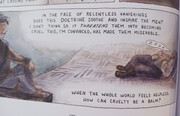
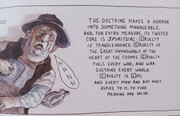
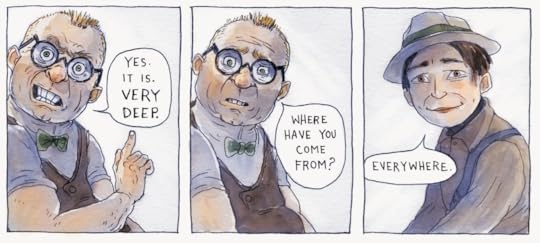
An aspect of this commentary that I honed in on, and that probably won’t be recognized by many readers, is how much toxic masculinity is wrapped up in not only hurting other people, but in violence toward animals as well, particularly in the name of sport, recreation, or tradition. A familiar mindset can be seen on display in panels such as this:
Some eco-feminist writers have also made this connection. The creator of this graphic novel does as well, at least partially, when the story depicts a character socializing a young boy into violent, warlike ways by torturing a caged mouse.
Thankfully, BRIGHT doesn’t dwell in the gloom—it points to a different way of conducting life and running society, and it does so with joy and humor.
An aspect of this commentary that I honed in on, and that probably won’t be recognized by many readers, is how much toxic masculinity is wrapped up in not only hurting other people, but in violence toward animals as well, particularly in the name of sport, recreation, or tradition. A familiar mindset can be seen on display in panels such as this:
Some eco-feminist writers have also made this connection. The creator of this graphic novel does as well, at least partially, when the story depicts a character socializing a young boy into violent, warlike ways by torturing a caged mouse.
Thankfully, BRIGHT doesn’t dwell in the gloom—it points to a different way of conducting life and running society, and it does so with joy and humor.

September 14, 2023
I really enjoyed this. Funny, sometimes frightening and always strange. It reminded me of the potential of graphic novels, why I started reading them and why I still love reading them.
January 11, 2024
As a trans nb reader, I do think there's a bit more nuance to the gender politics of this book then some of the reviews in here are saying. To be clear, this is still a book very much based in second wave feminism allegory (men=evil/violent/dogmatic, women=good/empathetic/philosophic, intersex and nb people are nonexistent, etc.), which might make it an automatic nope for some people. However, I think the ending and some of the characters make the case that strict binaries (specifically patriarchal binaries) are ultimately unproductive and peace comes in reconciliation and connecting to the past. There are glimmers of a more nuanced story in here but it's unfortunately overshadowed by the heavy-handed storytelling in most cases.
The Heavy Bright ultimately feels like a fairly basic morality fable too weighed down by the author's personal philosophies and layers of metaphor to actually make the points it's trying to make. If you enjoy the art style it's probably worth a read, but there are other books out there that explore these themes with more awareness and better storytelling.
The Heavy Bright ultimately feels like a fairly basic morality fable too weighed down by the author's personal philosophies and layers of metaphor to actually make the points it's trying to make. If you enjoy the art style it's probably worth a read, but there are other books out there that explore these themes with more awareness and better storytelling.
May 1, 2023
This is some very bizarre, 2nd wave feminism, men vs. women stuff. Trans people don't exist, no intersectionality, lots of biological determinism, girl-dressed-as-a-boy on a quest trope. Somehow the woman who murdered entire cities full of people is the fairy godmother? No thanks.
May 21, 2023
Excellent art work; the plot and some of the details were just a little too strange for my taste.

May 1, 2023
This was just okay. I liked the pencil work and some of the world building was fun, but I didn’t love the writing so much. I don’t enjoy when a book is just preaching on political and social issues without making much of an effort to be allegorical. It felt like the story was just written around the social statements the writer was wanting to make and it was just too obvious.
October 6, 2024
Absolutely worth a read!!
I see criticism of Cathy Malkasian’s binary representation of gender. Her world is one where people born with vaginas don’t have the chance to be anything other than women. Where people born with penises are taught they must be men, and to be a man is to hate and use women. Is that not a criticism queers have of the world today?
I agree it would be cool to see someone intersex, like that would have been clever and could carry a bigger message about the silliness of defined sex and gender. But I don’t see Malkasian as uninterested in the silliness of assigning meaning to sex and gender. I think there aren’t explicitly complex gender identities in The Heavy Bright because part of the point is that there isn’t space for them to exist peacefully. They exist for survival, in the case of Arna, who doesn’t seem to mind being perceived as a man at all. I read Arna as relaxed and comfortable in ‘drag’ as a man — even if this obviously was a choice of survival, and doesn’t mean Arna is necessarily transmasculine or non-binary, or would be in non-violent circumstances. It seems just as rushed to me to read the book and imagine it isn’t at all possible Arna is transmasc or non binary.
I also see comments that this leans heavily second wave feminism. Men are the victims of their own violence, and are kind when “freed” from it. Pointedly, this violence comes from some external source that men and women alike helped perpetuate, originally. That doesn’t strike me as a simple “man = bad, woman = good” message. In fact, Arna’s dad, the bartender, and the Mayor (to an extent) all represent men who are (or who want to be) gentle and good in spite of their education. I don’t think it portrays men as inherently evil, but rather victims and perpetrators of literal patriarchy, as is the case irl.
I see so much beauty woven through this story, even in the midst of ugliness. I can’t tell if it’s meant for teens or adults, and in that I agree it’s maybe a bit simple in its storytelling, but that’s not a fault for me. The book leaves room for a lot — my point in mentioning gender above is that I think Malkasian leaves room for gender ambiguity, and critiques binaries via their violent enforcement in her comic. If I had read some of these reviews before finding the book I may have never checked it out from the library, and that would have been a loss for me. I hope that doesn’t happen to anyone else who’s willing to try it out, because there is so much heart here.
I see criticism of Cathy Malkasian’s binary representation of gender. Her world is one where people born with vaginas don’t have the chance to be anything other than women. Where people born with penises are taught they must be men, and to be a man is to hate and use women. Is that not a criticism queers have of the world today?
I agree it would be cool to see someone intersex, like that would have been clever and could carry a bigger message about the silliness of defined sex and gender. But I don’t see Malkasian as uninterested in the silliness of assigning meaning to sex and gender. I think there aren’t explicitly complex gender identities in The Heavy Bright because part of the point is that there isn’t space for them to exist peacefully. They exist for survival, in the case of Arna, who doesn’t seem to mind being perceived as a man at all. I read Arna as relaxed and comfortable in ‘drag’ as a man — even if this obviously was a choice of survival, and doesn’t mean Arna is necessarily transmasculine or non-binary, or would be in non-violent circumstances. It seems just as rushed to me to read the book and imagine it isn’t at all possible Arna is transmasc or non binary.
I also see comments that this leans heavily second wave feminism. Men are the victims of their own violence, and are kind when “freed” from it. Pointedly, this violence comes from some external source that men and women alike helped perpetuate, originally. That doesn’t strike me as a simple “man = bad, woman = good” message. In fact, Arna’s dad, the bartender, and the Mayor (to an extent) all represent men who are (or who want to be) gentle and good in spite of their education. I don’t think it portrays men as inherently evil, but rather victims and perpetrators of literal patriarchy, as is the case irl.
I see so much beauty woven through this story, even in the midst of ugliness. I can’t tell if it’s meant for teens or adults, and in that I agree it’s maybe a bit simple in its storytelling, but that’s not a fault for me. The book leaves room for a lot — my point in mentioning gender above is that I think Malkasian leaves room for gender ambiguity, and critiques binaries via their violent enforcement in her comic. If I had read some of these reviews before finding the book I may have never checked it out from the library, and that would have been a loss for me. I hope that doesn’t happen to anyone else who’s willing to try it out, because there is so much heart here.

May 18, 2023
May 2023, and this is my first big hardcover graphic novel of the year, feminist fantasy and I have mixed feelings about it, as I did of the previous two (also big) Cathy Malkasian books I read, Eartha and Temperance. It's a kind of more bizarre and yet happy-ending post-apocalyptic, 334-page companion to The Handmaid's Tale, an allegory of our time, where men have largely destroyed the planet through their wars and guns and misogyny. So it's very on-the-nose, and creepy, as all these fat dead naked guys without genitalia (not mutilated, just disappeared) (and thus no testosterone, less toxic) walk around mystified.
The central characters are queer, Sela and Aran (who passes as a boy in this dangerous environment for females) and a kind of flying fairy godmother, Bird Woman. The cause of the upset to the planet, all the toxic masculinity and violence and hating on women seems to be 99 black round things--I was going to say balls, but that's not what she intends-- that have to be destroyed so the ship can be righted, so the goodness of the world can be restored. Go queers, to save the planet with their empathy (though there is some violence that the Bird Woman seems to cause).
The drawing is as always with the alt-comix artist Malkasian bizarre, and I'm not a huge fan of fantasy, so am not much of a fan of the fantasy world-building here, but I did read it all the way through, thinking it was somewhere between 3 and 4 stars, but I like the ending positivity, as she hopes for harmony. If you like fat trolls, you will like Malkasian's work. I see at a glance that early reviews here have some people absolutely hating it, but I kind of feel like the quirky Malkasian is interesting. Even at this length it does not take long to read.
The central characters are queer, Sela and Aran (who passes as a boy in this dangerous environment for females) and a kind of flying fairy godmother, Bird Woman. The cause of the upset to the planet, all the toxic masculinity and violence and hating on women seems to be 99 black round things--I was going to say balls, but that's not what she intends-- that have to be destroyed so the ship can be righted, so the goodness of the world can be restored. Go queers, to save the planet with their empathy (though there is some violence that the Bird Woman seems to cause).
The drawing is as always with the alt-comix artist Malkasian bizarre, and I'm not a huge fan of fantasy, so am not much of a fan of the fantasy world-building here, but I did read it all the way through, thinking it was somewhere between 3 and 4 stars, but I like the ending positivity, as she hopes for harmony. If you like fat trolls, you will like Malkasian's work. I see at a glance that early reviews here have some people absolutely hating it, but I kind of feel like the quirky Malkasian is interesting. Even at this length it does not take long to read.

August 2, 2023
Cathy Malkasian's cartooning is highly engaging and creative, but the story didn't do much for me. I love me a good book with a message, but sometimes it can feel a bit preachy and heavy-handed and less allegorical as the synopsis claims. The Heavy Bright juggles themes of power, greed, misogyny and queerness, which can be a lot to accomplish in a single graphic novel. Unfortunately, the story drags quite early on and it's only because of Malkasian's great artwork that I felt even remotely compelled to continue. The book features some almost animation-like flow to the story which is fairly refreshing to someone like me who reads way more comics than I do watch animated films. Despite not liking this all that much, I'd be interested in reading something else by Malkasian in the future.

January 26, 2024
It's Cathy Malkasian, so I'm expecting it to be surreal.
In the afterlife, a lady bird spirit watches over the neutered spirits of military commanders. In the living world, women have so little value that fathers will trade daughters for a pair of boots. The bird spirit relates to a girl named Arna about how this world of toxic masculinity came to be caused by physical objects which influence people's emotions. Arna dresses as a boy and sets off on a quest do destroy the objects. But even as she does and the world becomes less warlike, toxic masculinity doesn't disappear.
Allegorical, full of symbolism your college lot professor could analyze. Personally, I found this to be a simplistic take on a complex subject.
In the afterlife, a lady bird spirit watches over the neutered spirits of military commanders. In the living world, women have so little value that fathers will trade daughters for a pair of boots. The bird spirit relates to a girl named Arna about how this world of toxic masculinity came to be caused by physical objects which influence people's emotions. Arna dresses as a boy and sets off on a quest do destroy the objects. But even as she does and the world becomes less warlike, toxic masculinity doesn't disappear.
Allegorical, full of symbolism your college lot professor could analyze. Personally, I found this to be a simplistic take on a complex subject.
June 24, 2023
Just, ew. This book is full of all sorts of toxicity. It portrays men as inherently evil and foul. Trans, asexual, and gender nonconforming people do not get to exist in the world created inside this book. And it puts women on this weird pedestal as nonviolent, complacent beings. The main character's whole arc is following, without question or making any decisions of her own, the orders of one of the original perpetrators of the genocide who also tells the main character to repress feelings of grief, anger, and loneliness because such feelings are the source of the evil in this book. Feminist book, my ass.

May 14, 2023
A few thoughts on The Heavy Bright
This is a weird book. I couldn’t really grasp what was going on or why. I get the pacifism and feminism and unity of all souls but there was something missing. The world building was such that I would call it dreamlike if I were being charitable but otherwise it was a miss for me.
This is a weird book. I couldn’t really grasp what was going on or why. I get the pacifism and feminism and unity of all souls but there was something missing. The world building was such that I would call it dreamlike if I were being charitable but otherwise it was a miss for me.

May 18, 2023
The art in this book is gorgeous. That was really what kept me engaged as I read through the work. However, I found the plot confusing overall. I also didn’t find it particularly feminist, despite the book’s description. The primary character is female (disguised as male) who ultimately triumphs, but the majority of the book shows women being ‘traded’ either literally or figuratively, reduced into whether they are breedable or not, and with most disappeared into the mysterious Bright. Yes, the men who ascribe to these views and the views themselves are mocked, but regardless of the mockery, the world doesn’t seem to get actively better despite the protagonist’s efforts. At the end, when the protagonist triumphs, there’s no transition between the before and the after. It’s just suddenly good. I understand the victory is supposed to be with love and remembering family, but it just felt clunkily delivered, dropped all at the end instead of building to better things throughout.

July 14, 2025
I’m actually so impressed at the world building of this graphic novel. It’s a longie, but I just kept thinking it should be studied in school. It captures some pretty heavy topics, done so well! Corruption, toxic masculinity, war?! Then still have room for exploring gender, queerness, menopause, death, ancestors. Lots of themes to unpack

April 13, 2023
This was a lot of a book to read in one go, and I guess I’m still digesting it. It was trying to say something about gender, I think, but I'm not sure it even knew what that was.
August 24, 2023
Stayed for the art only

December 19, 2023
3.5 stars rounded up to 4.
This was interesting and heavy and grew on me the more I read.
This was interesting and heavy and grew on me the more I read.
Read
March 10, 2024This one was really odd. I don’t know how to feel about the messaging. Don’t feel like the gender war was something that works for me when it couldn’t be explored more thoroughly.

April 7, 2024
For ett forferdelig men nydelig univers av en bok. Mye sannhet bak det dystopiske, men kanskje litt væl fæl mot mannsrollen.

August 12, 2024
Simply impeccable. I love everything about this book, from the watercolors to the borderline caricatured designs.

June 20, 2025
In an age long gone, humans lived in relative peace guided by the wisdom of their ancestors. One day, a group of children happen upon a mysterious cave filled with strange bright orbs which turn heavy and dark in their presence before inciting a violent rage amongst them. In the following decades those who survive, almost entirely male, find their connection to ancestors severed and decide to use these dark artifacts to wage war and amass their own power. A young girl growing up amongst this turmoil finds herself around an artifact after her father perishes in a fire caused by its influence. She fails to be corrupted by it and in turn makes the object bright again, soon finding her spirit transported to the afterlife where she meets an older woman whom participated in the artifacts' initial discovery. The two devise a plan to rid the world of the objects' corruption and the girl returns to the world of the living to begin her journey.
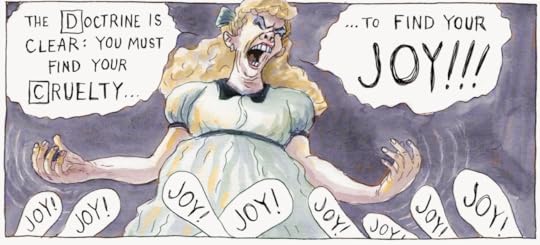
Now this is a book that deserves the controversy! What appears on the surface to be a fantasy story spurred by the death of innocence is instead more of a satire and evisceration of often misogynist right-leaning ideologies / theologies. This approach is often compelling, especially in the development of the wickedly gloves-off 'Doctrine', but almost entirely lacks nuance and feels as if it crafts a similar but opposite bigotry as the one it attempts to dismantle. In this world nearly all men are portrayed as feckless, insecure, and cruel losers who can only achieve a sense of accomplishment through the subjugation of others. In turn women are presented with near universal grace and innocence, with only those whom allow themselves to be corrupted by men being presented differently. While I admire the courage of the work in pulling absolutely no punches, the broad gendered characterization fails the otherwise compelling breakdown of ideological failings that do exist among many (if far short of all) men. Moreover, I found most of the fantasy and adventure trappings rather thin with a world that feels small in which the main character faces very little resistance. The art is also not really my bag with drab watercolors and sketchy line work that largely failed to immerse me. The end result feels a bit messy and inconsistent even though I found elements of the narrative and prose brilliant. Definitely worth a read, but something that feels far less effective than it could have been.
Now this is a book that deserves the controversy! What appears on the surface to be a fantasy story spurred by the death of innocence is instead more of a satire and evisceration of often misogynist right-leaning ideologies / theologies. This approach is often compelling, especially in the development of the wickedly gloves-off 'Doctrine', but almost entirely lacks nuance and feels as if it crafts a similar but opposite bigotry as the one it attempts to dismantle. In this world nearly all men are portrayed as feckless, insecure, and cruel losers who can only achieve a sense of accomplishment through the subjugation of others. In turn women are presented with near universal grace and innocence, with only those whom allow themselves to be corrupted by men being presented differently. While I admire the courage of the work in pulling absolutely no punches, the broad gendered characterization fails the otherwise compelling breakdown of ideological failings that do exist among many (if far short of all) men. Moreover, I found most of the fantasy and adventure trappings rather thin with a world that feels small in which the main character faces very little resistance. The art is also not really my bag with drab watercolors and sketchy line work that largely failed to immerse me. The end result feels a bit messy and inconsistent even though I found elements of the narrative and prose brilliant. Definitely worth a read, but something that feels far less effective than it could have been.
Displaying 1 - 21 of 21 reviews